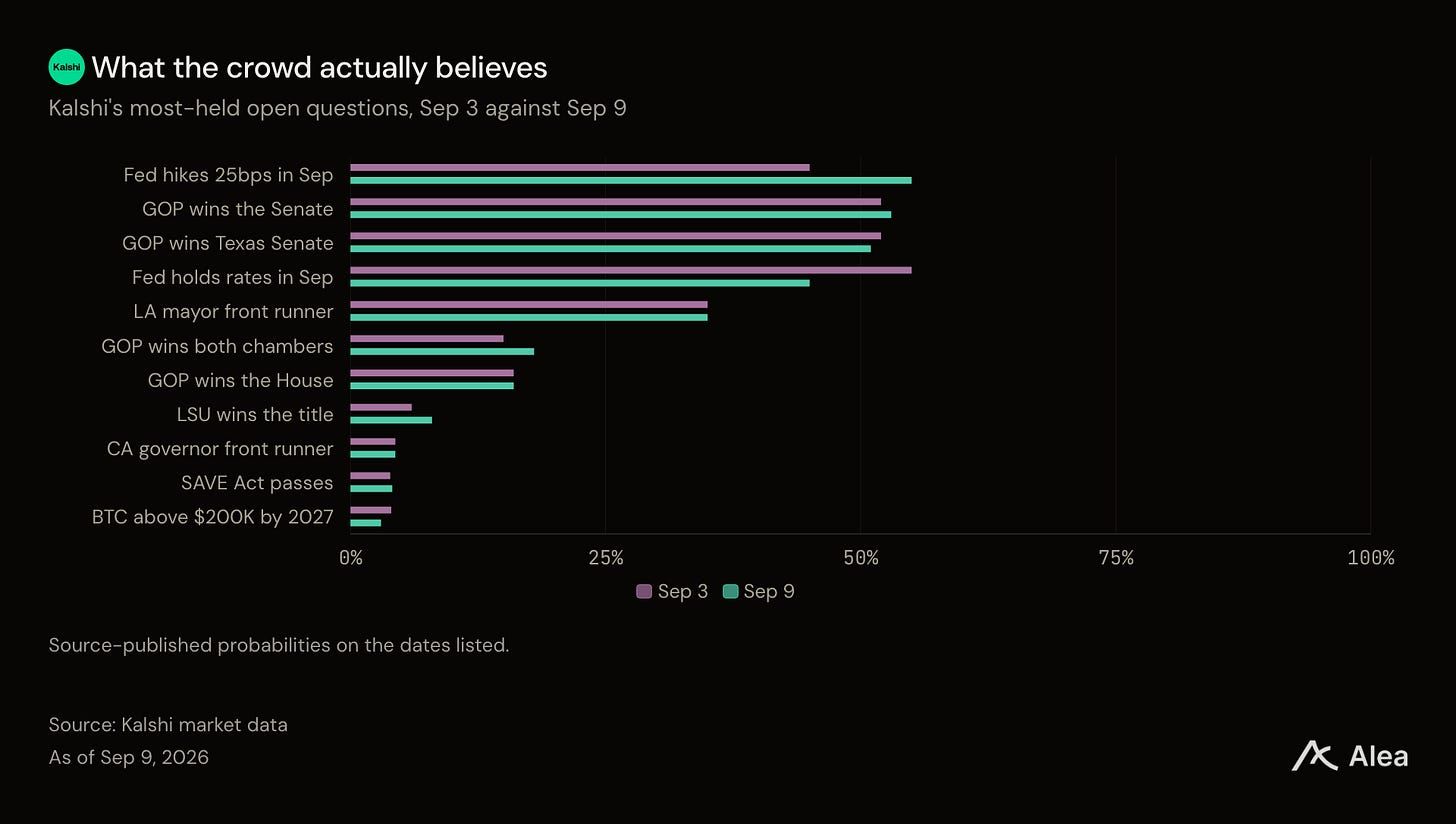
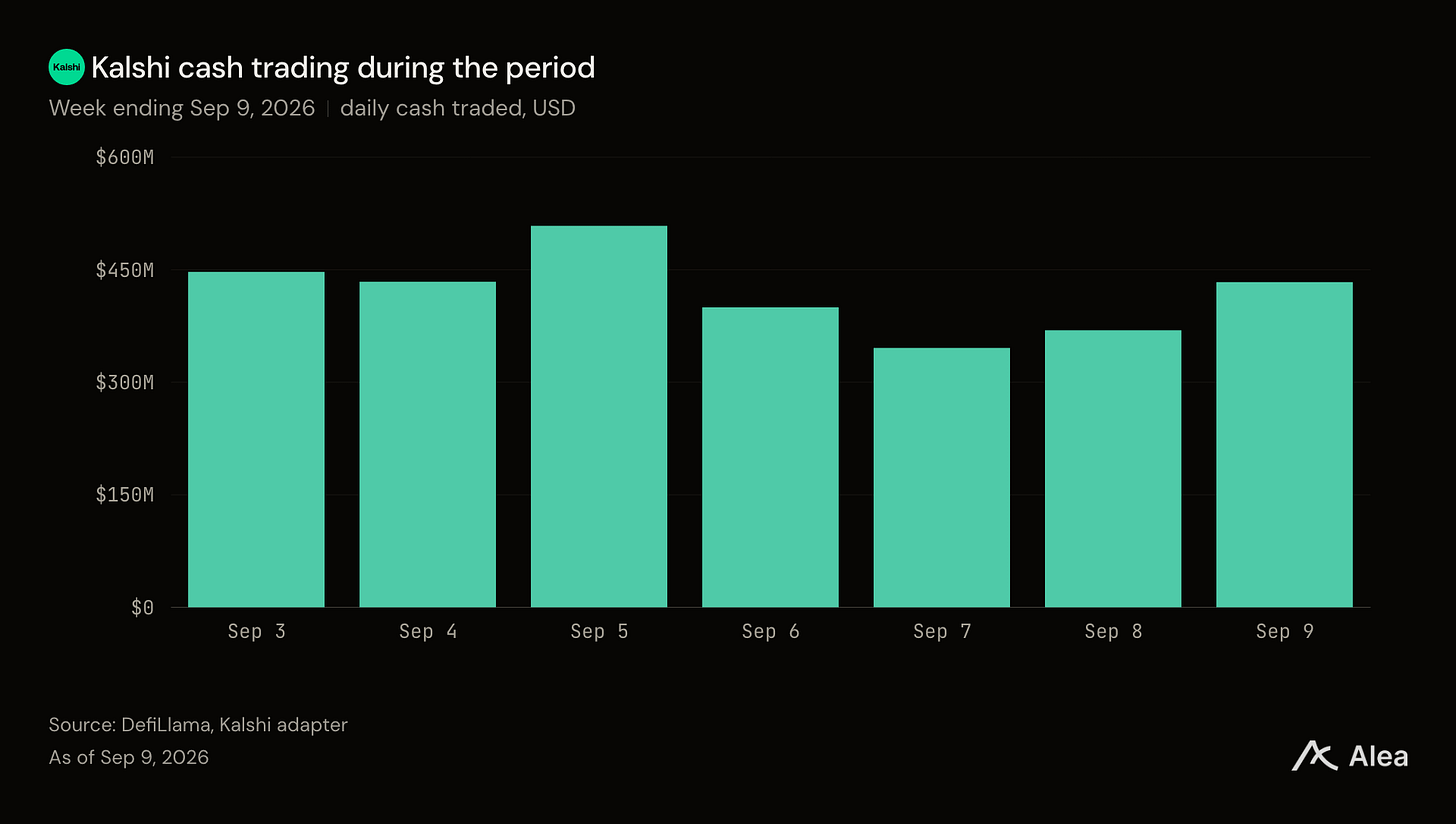
Kalshi just had its second-biggest week ever, $2.94B traded, eleven times the same week a year ago. Almost none of it changed anyone's mind. Republicans to win the House closed at 16%, where it has sat inside a five-point band since July. The Senate closed at 53%. Texas at 51%. One contract on the list moved ten points in five days, and it is the only one that resolves in September.
Takeaways
$2.94B traded, the second-biggest week in Kalshi's 271-week history. Only the week of Jul 2 beat it, at $3.07B.
The Sep 16 Fed contract crossed over. A 25bp hike went from 45% to 55%, and reached 81% by Sep 11 after two energy-driven inflation prints.
The House contract has covered five points since July. The Fed contract has covered fifty-five.
Elections traded 32.8% less than the week before, in a week the exchange grew 12.3%. They added positions anyway.
Traders added 147M open positions. 88% came from one combination series, not from the weekend parlay book.
The crowd moved where the news was
The election book did nothing. The House contract closed at 16% and has not left a 14-to-17 band all August. The US Senate closed at 53% and Texas at 51%. Both sit within a couple of points of where they opened the week, and of where they sat a month ago. These contracts resolve in Nov 2026. Nothing dated touched them, so nothing moved.
One contract had a date next week. The Federal Reserve decides Sep 16, and Kalshi's contract on that decision opened the week at 45% and closed it at 55%. Holding rates fell the same distance, 55% to 45%. The two crossed on the way.
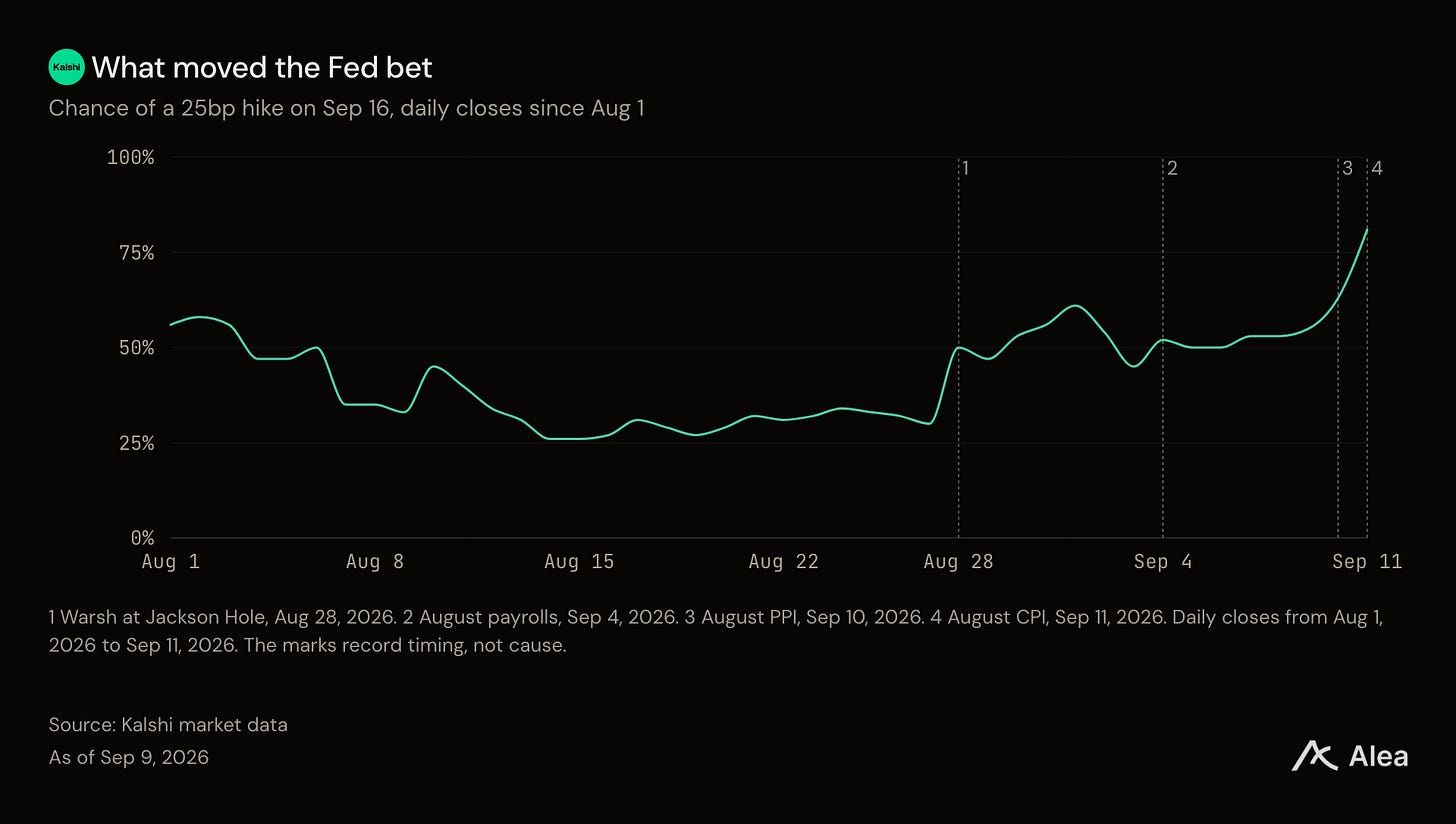
It did not stop at the week's close. Producer prices landed Sep 10 and the hike closed that day at 63%. Consumer prices landed Sep 11 and it was bid at 81% against an 82% offer.
Both prints were energy. The BLS put diesel up 24.1% in August and called it over a third of the rise in goods producer prices. It put gasoline up 3.9% and called that over a third of the monthly consumer increase. Behind both sits crude: WTI ran from $70.56 on Jun 30 to $97.26 on Sep 9. The competing explanation is older and simpler. Chair Warsh told Jackson Hole on Aug 28 that the summer's better inflation readings "do not tell me that underlying trends have meaningfully improved". The contract went from 30% to 50% in a day, before any of this data existed.
Elections got quieter as the exchange got busier
The exchange traded 12.3% more contracts than the week before. That growth was not shared.
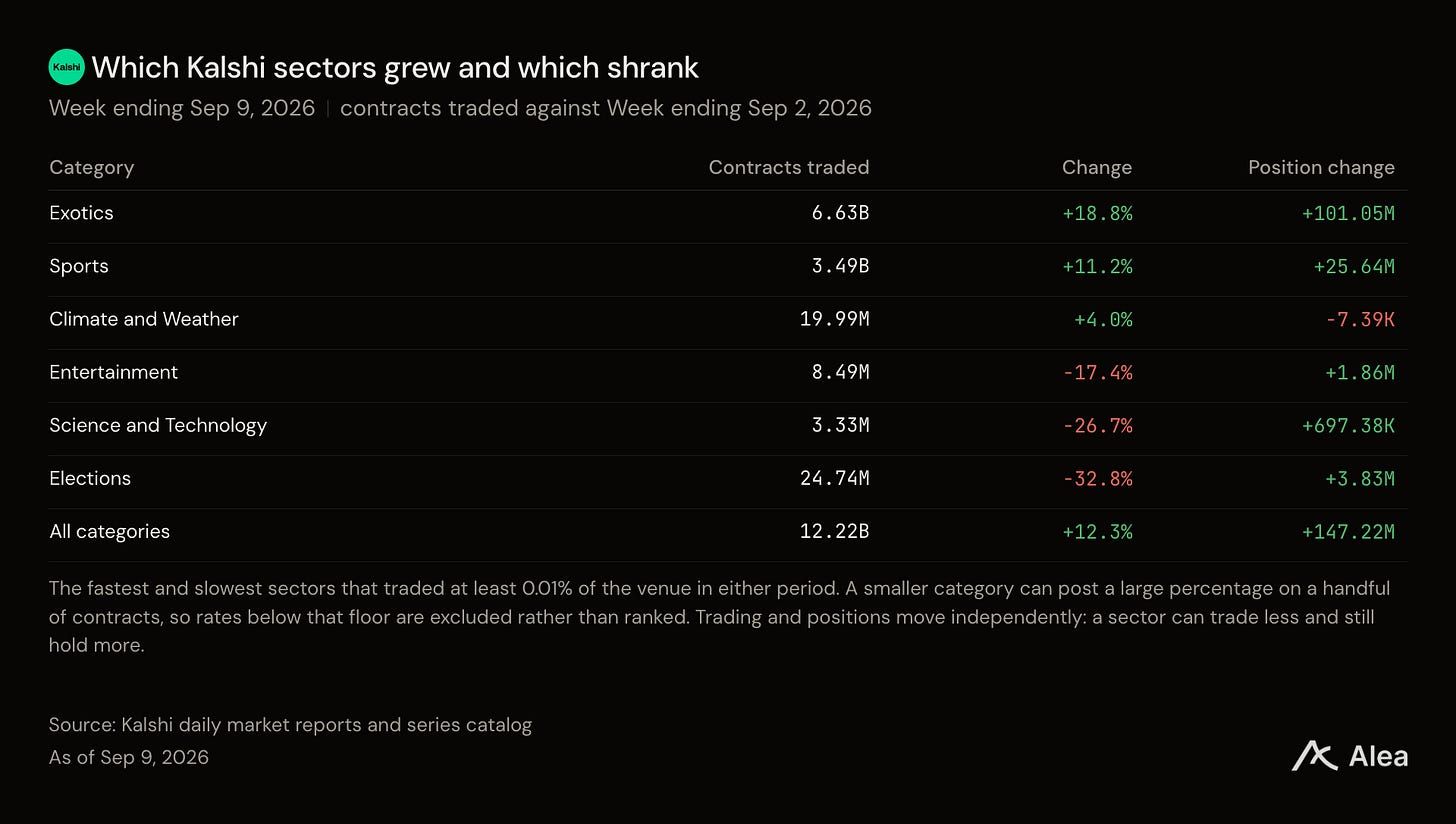
Parlays grew 18.8% and sports 11.2%, and together they are 83% of the venue. Elections traded 32.8% less. Science and technology fell 26.7%, entertainment 17.4%.
Elections traded a third less and still added +3.83M positions. Economics traded 8.8% less and added +8.73M. The categories that carry the forecasts got quieter and heavier at once, which is what accumulation looks like.
Two exchanges wearing one name
There is a fast Kalshi and a slow Kalshi, and every number you read adds them together. The fast one is parlays and 15-minute crypto. A parlay here is one ticket bundling separate outcomes, paying only if every leg lands. Same idea a sportsbook sells, listed as an event contract.
A combination contract is not the product of its legs. Republicans to win the House trades at 16% and Republicans to win the Senate at 53%. Multiply those and you get 8.5%. The contract on both trades at 18%, more than twice that, because the market prices the two races as one bet on the same national swing.
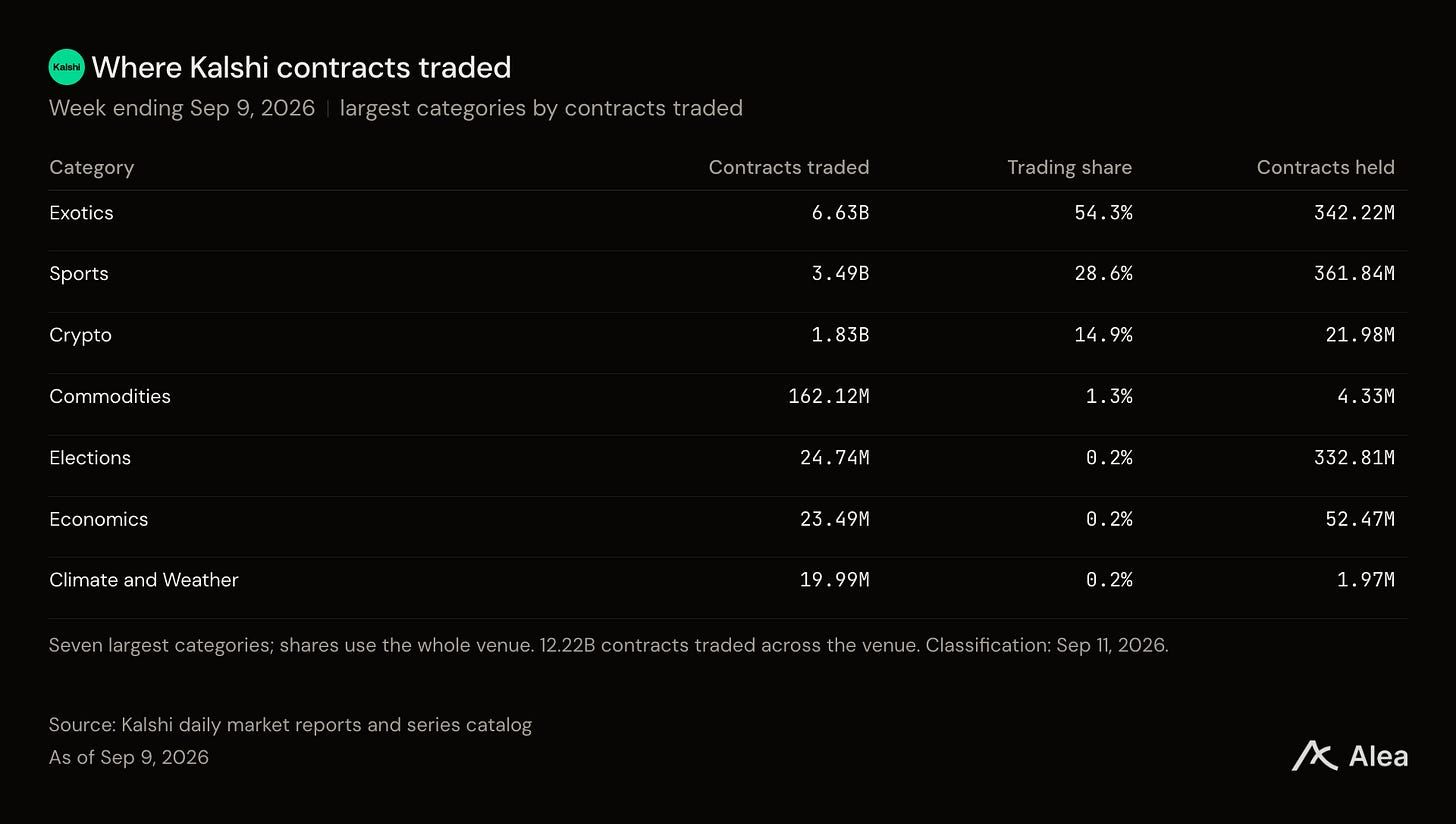
Kalshi files parlays under Exotics, and they were 54.3% of everything traded last week. Fifteen-minute Bitcoin markets added another 11%. These contracts are born and die inside a day. The slow one is elections and economics, 0.4% of trading and 31% of every position still open when the week closed.
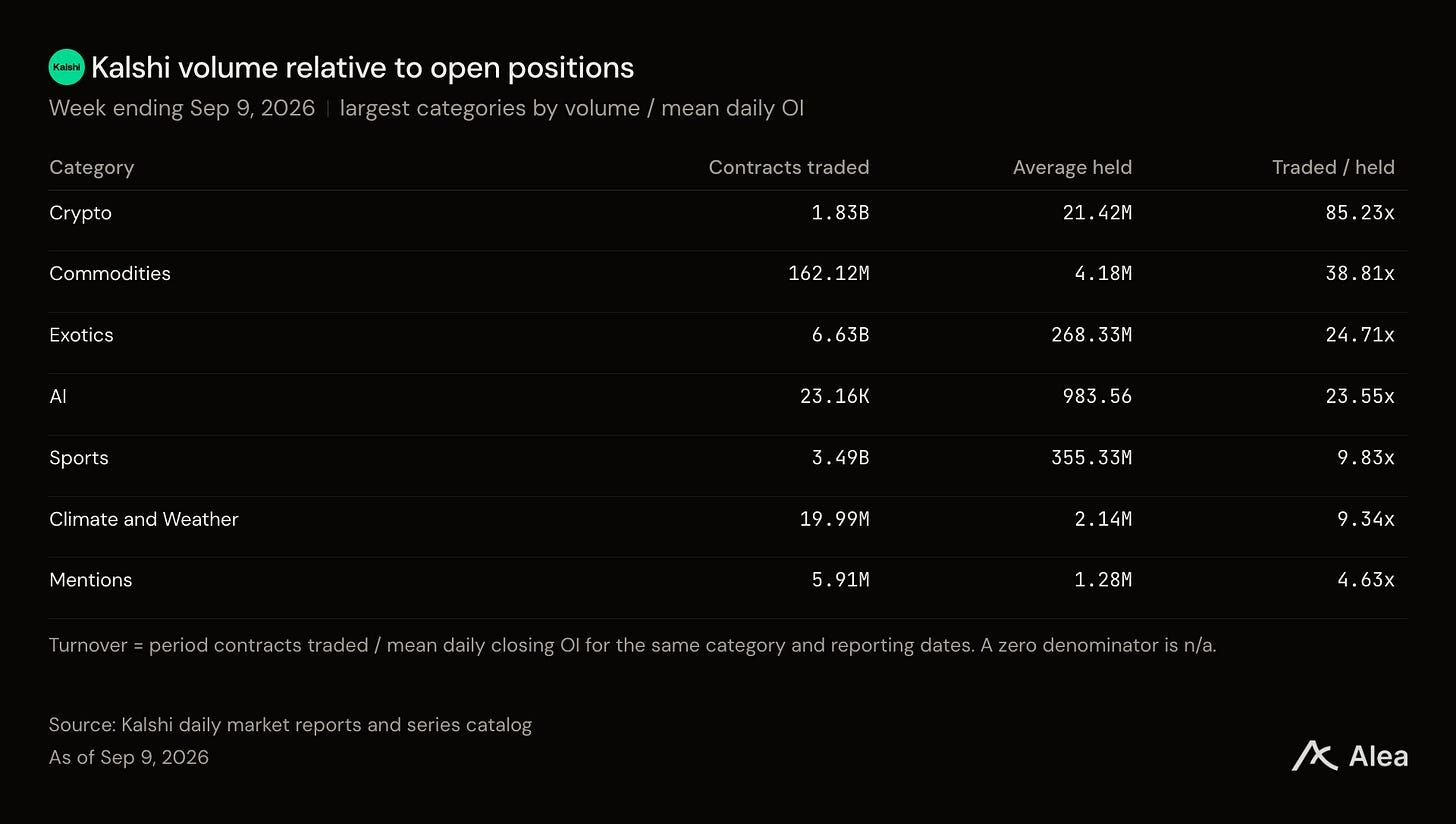
Divide what traded by what was held, and crypto runs at 85x a week. Parlays run at 25x. Elections run at 0.1x. At that speed the whole election book changes hands about once every ten weeks. People buy a view on the midterms and leave it there.
The record build was not the weekend parlay book
Traders added 147M open positions last week, the fourth-biggest weekly build in Kalshi's history. The obvious explanation is the weekend parlay crowd, and it is wrong.
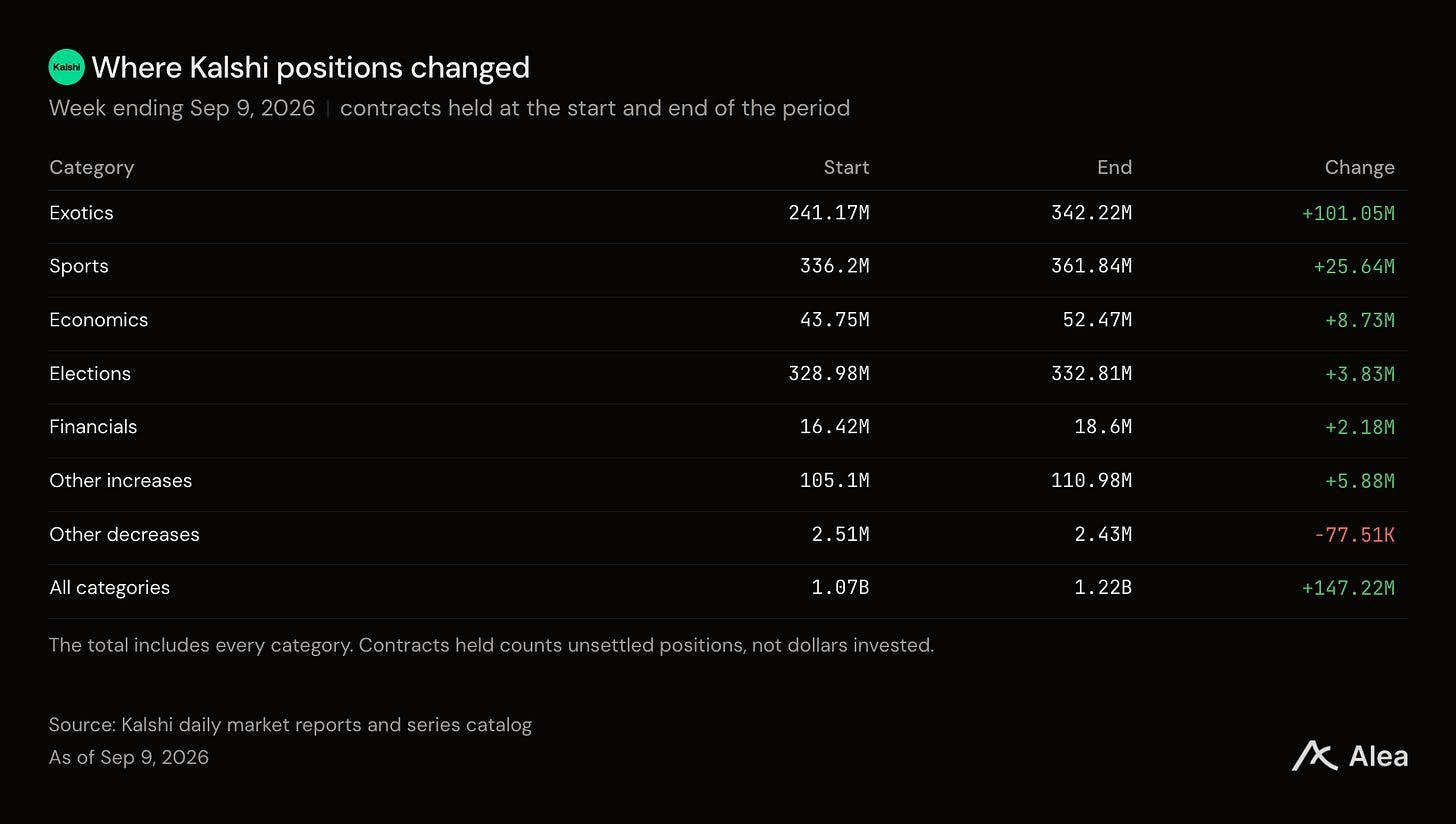
Exotics, the category the parlays sit in, added +101M. Drill one level down and that number splits in two.
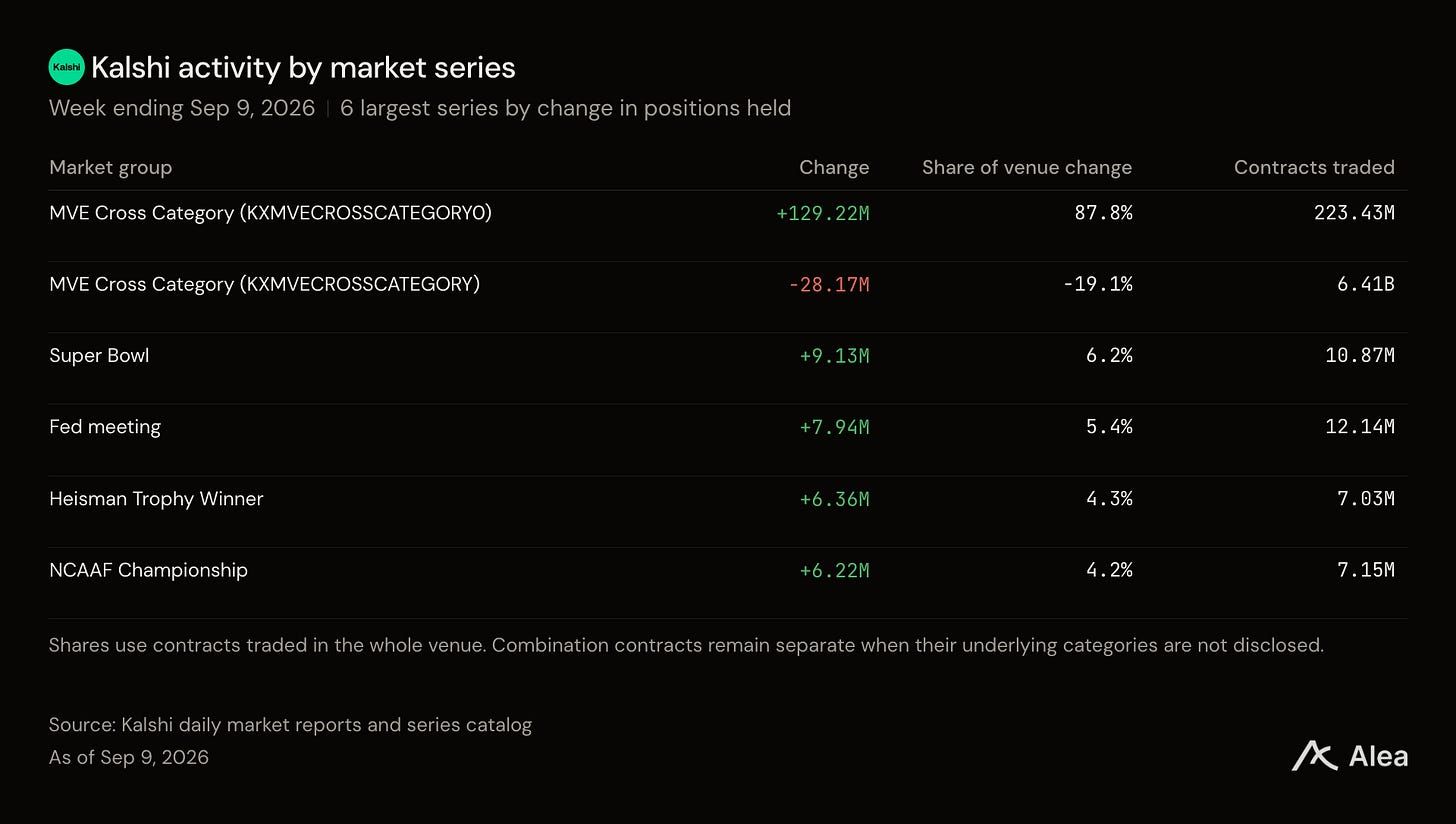
One combination series traded 6.41B contracts, more than half the exchange, and finished with 28M fewer positions than it started. A second combination series traded 223M, one contract for every 29 the first one traded, and added 129M positions. That second series alone is 88% of the exchange's entire position build.
So the record open book is not a crowd of weekend bettors. It is one slow product that people buy and hold. Most of the rest is the sporting calendar arriving: Super Bowl +9.13M, the Heisman Trophy +6.36M, the college football championship +6.22M.
Dollars and contracts stopped agreeing
Kalshi reports both numbers. Last week they moved at different speeds, and the gap tells you what kind of trading filled the week.
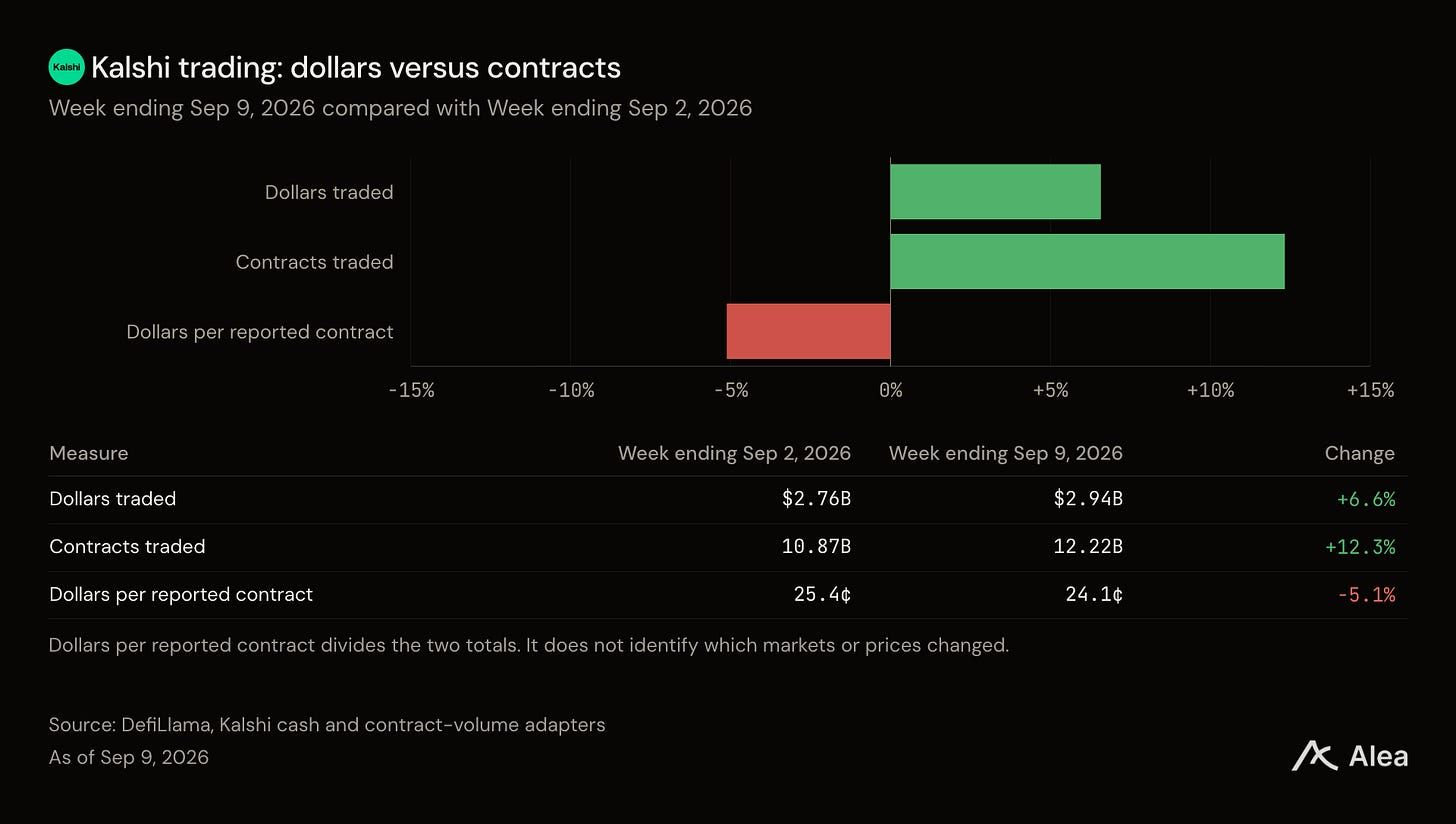
Dollars rose +6.6% while contracts rose +12.3%, so the average contract got cheaper, 25.4c down to 24.1c. Long-shot legs trade for pennies. They add contract count far faster than dollars, which is why contract counts flatter Kalshi and dollars do not.
Saturday Sep 5 was the biggest day at $509M, on the opening college-football slate. The quietest was Monday Sep 7 at $346M. Kalshi's slowest day last week still beat its best day a year ago.
Kalshi's event-contract fee is quadratic in price. It is charged on the expected earnings on the contract, so it peaks near fifty cents and shrinks toward either end.
The perpetual book moved 1.8 times the event book
Kalshi also runs perpetual futures: leveraged contracts that track an asset's price with no expiry date. It listed the first ones in America on May 29 and passed $1B in the opening week.
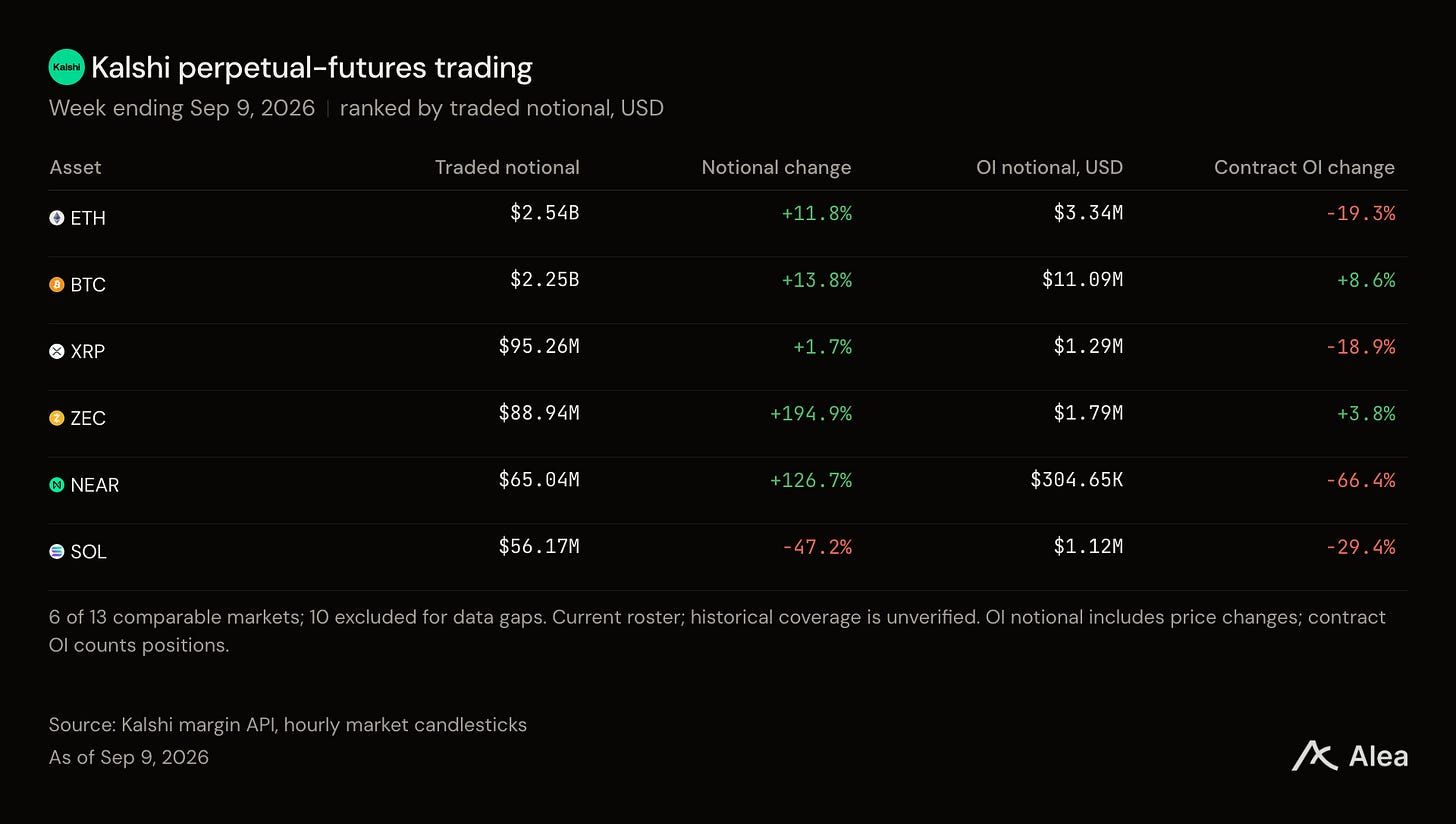
Thirteen perpetual markets with complete histories in both weeks traded $5.24B of notional, up +13.2%, against $2.94B of cash through the whole event-contract exchange. Bitcoin and Ether are 91% of it.
What Kalshi shipped this week
Gold and silver perpetual futures went live on Sep 10, CFTC-approved and trading around the clock. Kalshi's argument is that the futures structure "was designed for physical deliveries of wheat and corn". Most participants never want delivery, so they pay rollover costs for an expiry they do not need. Neither contract had traded when the week closed.
The exchange also listed a full Champions League suite, 20 new series among the 292 that traded this week and not the week before. Five perpetual contracts had no comparable week before this one. They traded $59.8M between them.
What to watch
Four dated things, and one promise.
Sep 16, the Fed. The contract says 81% hike. This is the first calibration test worth scoring: an 81% that misses teaches more than an 81% that lands.
Sep 16, the metals fee schedule. It takes effect no earlier than that day's close. Gold and silver have been listed since Sep 10 and have not traded. Watch whether they do.
Next week, the soccer book. Every one of the twelve biggest open positions resolving next week is a soccer parlay, and ten of the twelve are priced under 3%. Watch whether that book keeps growing once the opening football weekends are behind it.
Oct 14, the next CPI. The chain that moved the Fed contract runs through energy. If crude holds near $97, the next print carries the same push.
We are recording this week's price for every market that resolves between Sep 11 and Sep 18. Next week we will tell you how the crowd did.
Important Links

A $2.94B week on Kalshi moved exactly one forecast, and oil moved that. Alea's weekly market work follows that chain across the major liquid markets. The wider library covers the protocols, tokens, and venues behind it.
Research reports. Deep Dives and Blueprints explain protocols and their economics. Theses and Memos examine investment cases and catalysts. Benchmarks compare performance, while Perspectives assess specific developments.
Weekly Pulse. Read a weekly assessment of macro and the major liquid markets.
Protocol Data Rooms. Research each protocol in one place, with Analytics for historical comparisons and Intel for news and governance developments where available.
Podcast Digest and Summit Digest. Read summaries of industry conversations and events. Find Alea shows and their episodes through Podcast Digest.
Governance Tracker. Follow proposals and voting activity across protocols.
For protocol teams preparing institutional conversations, discuss research for your protocol with Alea.