In October, Raydium held 57% of the liquidity on Solana's four largest fee-charging AMMs. It paid 17% of their LP fees. Meteora reversed the ratio: 11% of the liquidity, 37% of the fees.
Does Meteora simply charge traders more? On pool fees, yes: its pools charged the most of the four per dollar traded, though PumpSwap's traders paid more once coin-creator fees are counted. On Meteora's three busiest pairs shared with Raydium and Orca, it charged less than the more expensive rival on two and about the same on the third. That leaves its pool mix as the explanation.
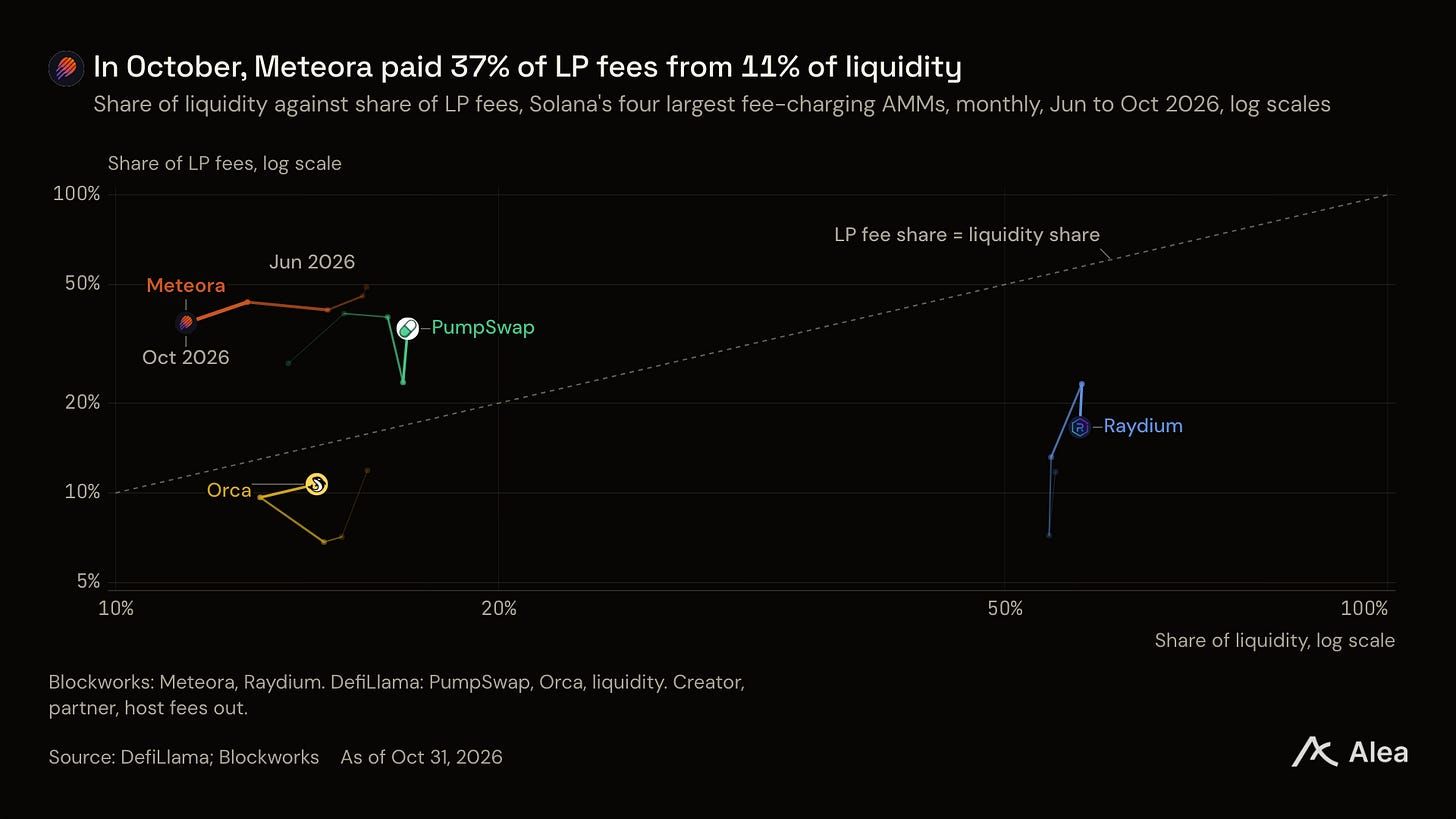
From June to October 2026, Meteora's share of liquidity slid from 15.7% to 11.4%.
Key Takeaways
Against PumpSwap, Meteora's lead comes from its take on each trade, not from turnover. Its liquidity traded less often than PumpSwap's in October, yet each $1,000 of it earned LPs $88 in gross fees, against $57 on PumpSwap.
Meteora's SOL-USDC fee lies between Orca's and Raydium's. Over the 30 days to Nov 9, traders paid $0.55 per $1,000 on Meteora. On Orca they paid $0.40, and on Raydium $0.61.
MET stakers now collect a tenth of DLMM revenue in USDC. For a staker who clears the $10 LP-fee bar, the USDC is worth 7.8% a year of the stake's Nov 9 value, at Q3's pace.
The pool mix sets the fee
An LP's gross fee income per $1,000 of liquidity is two numbers multiplied: what LPs take from each $1,000 traded, and how many times the liquidity trades in a month.
Against Raydium, Meteora's LP take per $1,000 traded runs almost four times as high. Against PumpSwap and Orca, turnover is lower: Meteora's liquidity traded 19.6x in October, less than either but about three times Raydium's turnover.
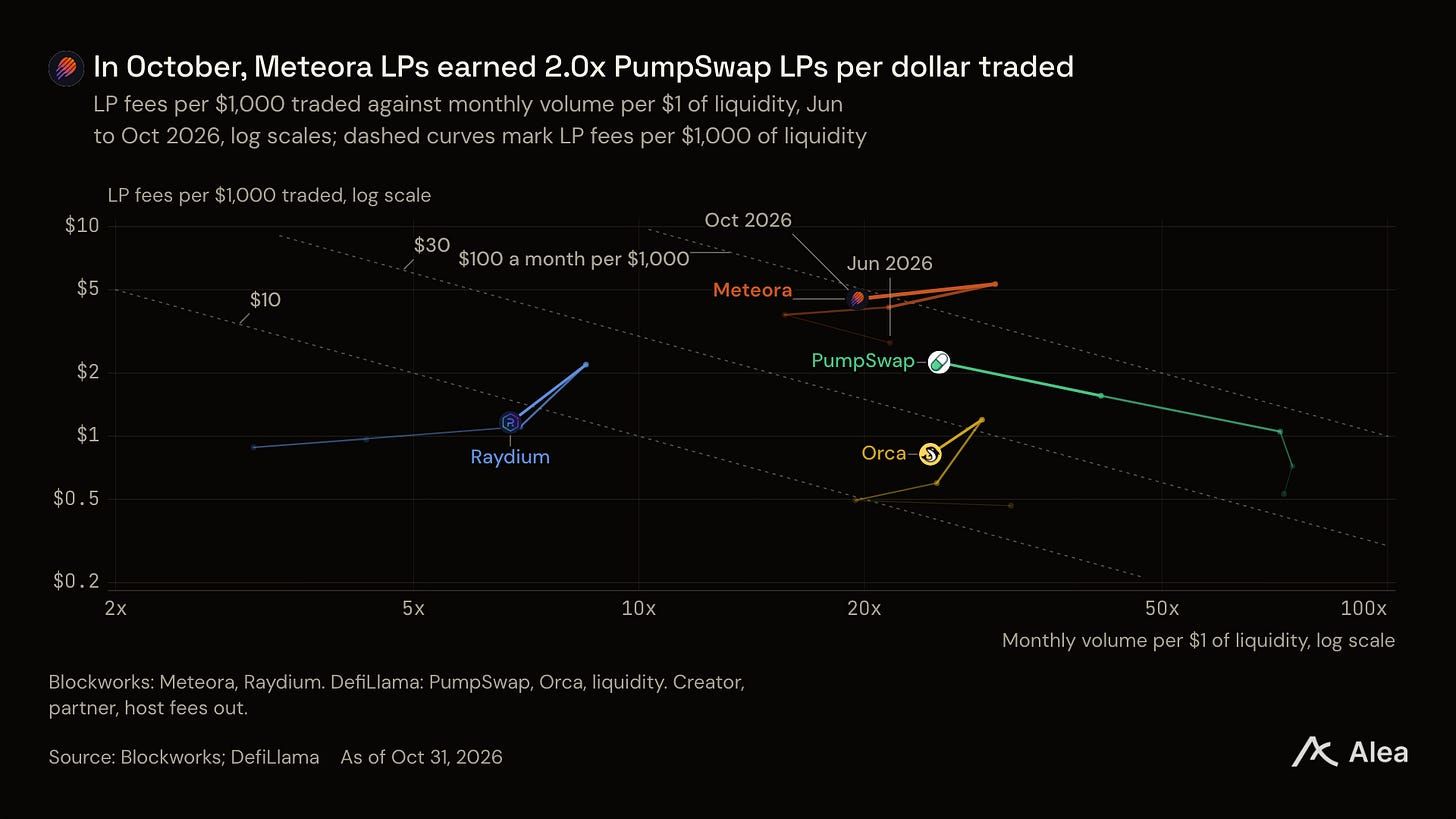
Against those two, the edge is the take.
Meteora charged the most on four of the six pairs that it, Raydium and Orca all list, and three of those four are its smaller pools: JUP-SOL, BONK-SOL and FARTCOIN-SOL. Its three busiest shared pairs are SOL-USDC, TRUMP-USDC and PUMP-SOL. On the first two, its fee fell between the other venues'. On PUMP-SOL it was $1.61 per $1,000 traded, a cent above Orca's $1.60. Its PUMP-SOL LPs earned $39 per $1,000 held. Orca's earned $116 and Raydium's $153, because their liquidity traded three to seven times as often.
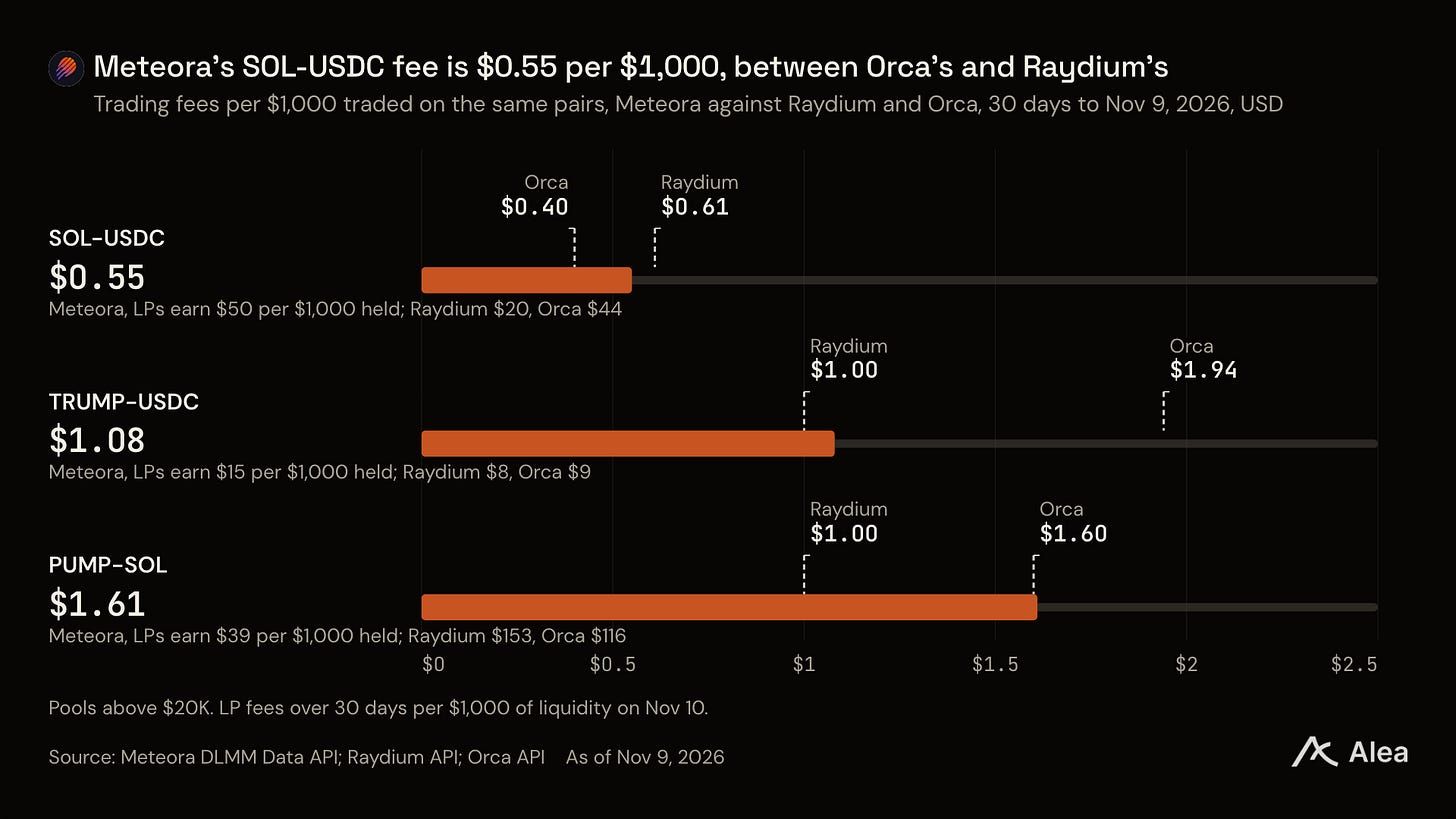
On SOL-USDC, Meteora's pools held less than half of Raydium's liquidity on Nov 10, yet over the 30 days their volume beat Raydium's and reached a third of Orca's. For each $1,000 held, their LPs earned $50, more than twice Raydium's. Orca's LPs earned about a tenth less.
The high average comes from memecoin pools on DLMM, the pool type where each LP picks a price range. September was Q3's peak month, when those pools generated $40.1M of LP fees. Their base fee starts high, and the dynamic fee rises with volatility.
Traders in new-token pools pay a high fee, and three parties share it. DAMM is Meteora's full-range dynamic AMM. In October its pools charged $65 per $1,000 traded, launch-partner fees included. From August to October, DAMM pools charged $18.1M. Launch partners took $10.5M of it, LPs $4.13M and Meteora $3.5M. On DLMM, LPs keep most of each fee and carry the price risk: when a pool's token falls faster than its fees build up, the LP loses money.
Orca is moving toward the same design: on Oct 22, it added fee profiles that rise with volatility.
From September to October, the trader fee held as volume fell 40%
Meteora's fee per $1,000 traded has climbed since June.
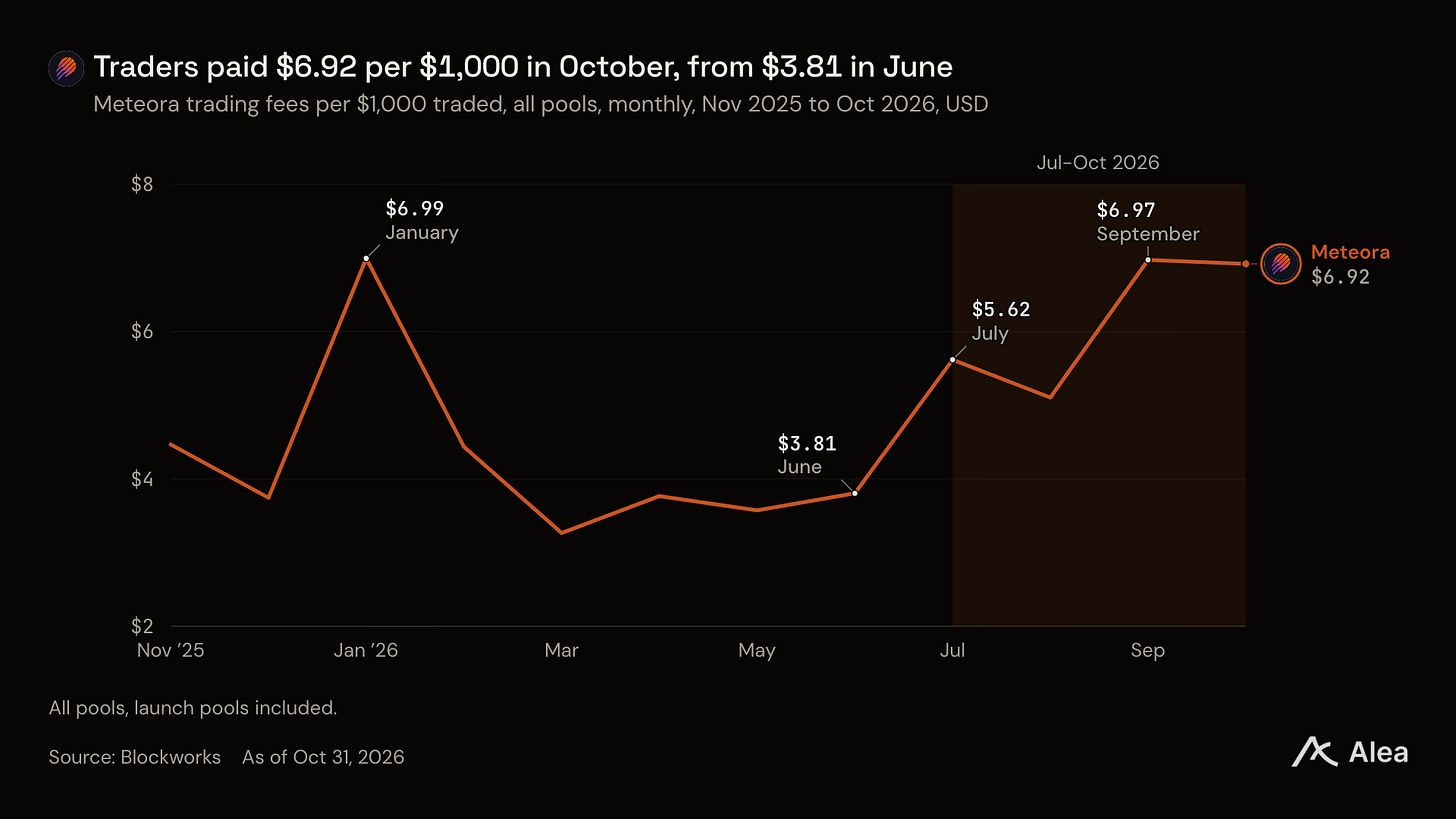
From September to October, Meteora's volume and fees both fell about 40%, leaving the fee per $1,000 traded within 1% of September's level. New-token pools held the fee up, with DAMM's fee per $1,000 traded doubling. On DLMM, which carried almost all of October's volume, the fee per $1,000 traded slipped to $5.40 from $6.13.
Meteora also widened what its pools trade: in September, it opened its launch curves to any Solana asset, tokenized stocks included, and its tokenized-asset pools traded $485M that month, up from $224M in August.
DLMM's memecoin pools carry the LP lead; new-token pools raise the fee, and launchpads collect the rise.
From August to October, LPs kept at least $74 of every $100 traders paid
From August to October, Meteora's pools charged $115.7M in fees, of which LPs kept at least $85.9M. Integrator hosts, launch partners, Meteora itself and, since Jul 21, MET stakers and their referrers share the rest.
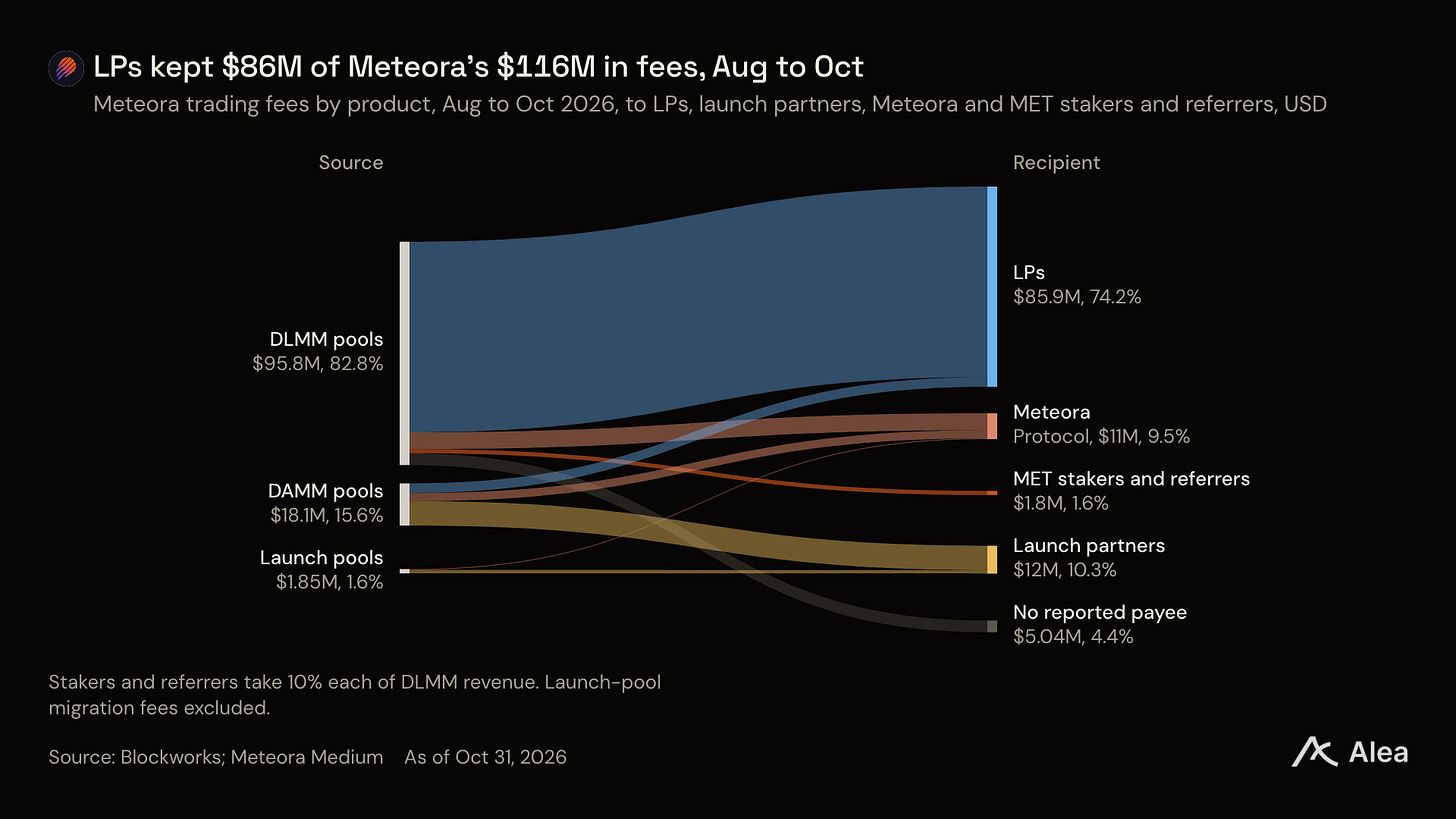
Stakers' USDC comes out of the same trading fees that pay LPs. As of its September report, Meteora hadn't sold any of the MET that unlocks to its reserve each month.
In Q3, Meteora reported $12.0M of revenue, almost all of it from LP pools, whose $11.3M more than doubled their Q2 revenue. Total revenue was still 59% below Q3 2025, when launches alone brought in $15.1M.
Launchpads, not LPs, collected October's rise on new tokens
Meteora's pools have a cast: traders pay the fee, LPs supply the liquidity, and launchpads, trading apps and MET holders each take a cut. October moved money between them.
Launchpads and token creators want the fee stream of the tokens they launch, and Meteora's fee rules give them a share. In October, they took $5.3M of DAMM fees, up from $3.6M in September, while DAMM volume halved. The doubled fee per $1,000 traded went to launchpads and creators, while DAMM's LPs got $0.65M, down from $2.2M.
Aggregators such as Jupiter and Titan route trades into DLMM pools, and an app that adds a host account takes a fifth of the protocol's share. On a pair that trades on three venues, the aggregator sends each order to the best price after fees, which means a venue that charges more needs deeper liquidity to win the order. A new token with one pool has no cheaper route.
Since Jul 21, Meteora has paid a tenth of its DLMM revenue to MET stakers and another tenth to referrers and the LPs they bring in, keeping the rest. By Oct 17, referred LPs had generated more than $39M of fees, and the program's USDC rewards since Jul 21 had passed $1.9M, counting the third period at Meteora's estimate. Each staked MET gives a referrer 0.1 USDC of earning capacity per cycle, which means a referrer with no stake earns nothing. Meteora's stated aim is to turn its stakers into LPs; it also added a $150K bonus for its top referrers.
The rivals want the same launches. Tokens that fill pump.fun's launch curve move to PumpSwap, where coin creators took $7.96 of every $1,000 traded in October, twice the pool fee, while Raydium runs its own launchpad, LaunchLab. Proprietary AMMs such as HumidiFi compete for majors like SOL-USDC instead. The launchpads move next: each one earns from every trade on its tokens and can take its next launch to any curve.
The yield on staked MET follows the pace of trading
From Oct 21, a staker must earn $10 in LP fees in each 30-day period to claim. For a staker who clears that bar, 10,000 staked MET draw $252 a year at Q3's average DLMM revenue. That assumes the 128M MET staked by Oct 17.
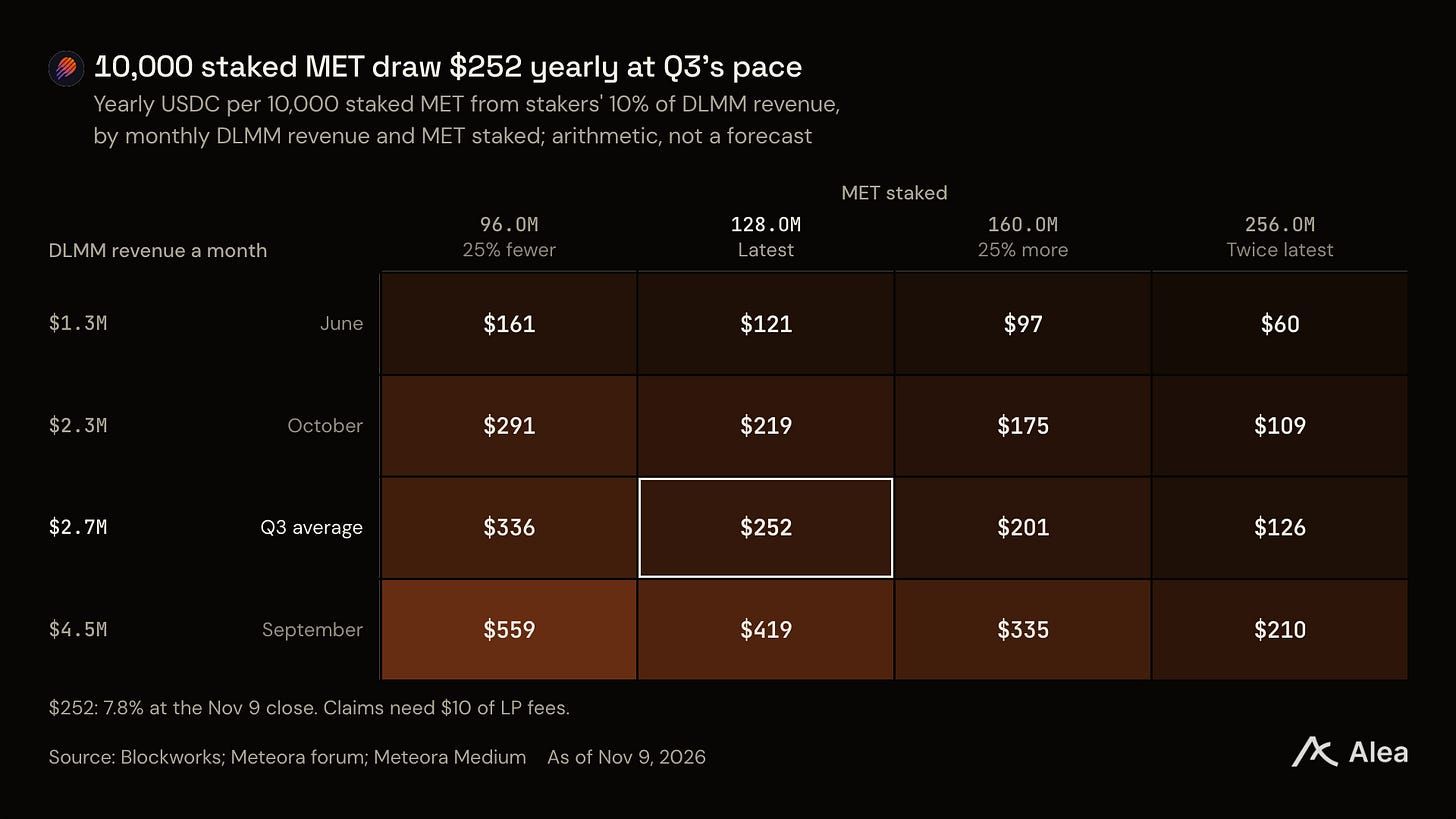
Those 10,000 MET were worth $3,208 at the Nov 9 close. The USDC pays 7.8% a year on that value. At October's DLMM revenue, the same stake draws $219, or 6.8%.
Total revenue has since slowed. Over the 30 days to Nov 10, it ran 43.5% below October's annualized pace. If DLMM revenue falls that far from October, the draw drops to $123, or 3.8%. Each figure falls by a fifth if staked MET grows by a quarter. Meteora's staking update also listed a one-step option that turns USDC rewards into staked MET, and each staker who uses it raises the staked total, lowering every other staker's draw.
At the Nov 9 close of $0.321, MET's fully diluted value is $321M. That is 6.7x Q3 revenue at an annual rate and 12.0x the 30-day run rate.
DLMM Pro opened in beta on Nov 15
Meteora showed DLMM Pro at Solana Summit Singapore on Oct 6 and opened a waitlist. On Nov 6, it announced Wave as a fourth LP strategy beside Spot, Curve and Bid-Ask, set to launch with DLMM Pro. On Nov 15, Meteora added Wave to the DLMM Pro developer kit and opened DLMM Pro in beta later that day. It granted beta access in batches and still had its waitlist open on Nov 19. By then, Meteora had not confirmed that beta LPs can pick Wave in the app.
Meteora's LP take can fall 36% before PumpSwap catches up
The strongest counter-case is that Meteora's lead comes from a burst of launches, not from its design. The lead has been thin before. In July, Meteora's LPs earned $59 per $1,000 held, while PumpSwap's earned $54.
At October turnover, Meteora's LPs fall to PumpSwap's October level only if their take drops 36%, to $2.89 per $1,000 traded. June's take was $2.79. In October, DAMM pools, where new tokens trade, did half of September's volume, and Meteora's overall LP take fell 15% from September's level.
PumpSwap's lever is its fee split, which pump.fun sets: at October's turnover, PumpSwap's LPs would match Meteora's $88 if they kept 93% of the pool fee. In October, pump.fun's own cut of the pool fee came to $14.1M, and the change would cost it most of that. Orca's new fee profiles match Meteora only if its LPs' take rises 4.4 times at the same turnover.
Proprietary AMMs threaten Meteora's volume more than its LP income: on Meteora, SOL-USDC, the major pair they compete for, pays about a tenth of the DLMM average per dollar traded.
The fee level and the LP share explain the lead
These are fees before what LPs lose when a new token falls. Against PumpSwap, two things stack: Meteora's pools charged 1.4x PumpSwap's pool fee per dollar in October. Its LPs also kept 85% of October's pool fees, which leave out launch-partner fees, against 59% on PumpSwap. Against Raydium, Meteora wins on take and on turnover: almost four times the take and about three times the turnover. Against Orca, whose LPs keep as much and whose liquidity turns over faster, the fee level decides, and Meteora's memecoin pools set it high.
Important Links
Disclosures
This report on Meteora was not paid for or commissioned.
Members of the Alea Research team, including those directly involved in the analysis above, may have positions in the tokens discussed.
This content is provided for educational purposes only and does not constitute financial or investment advice. You should do your own research and only invest what you can afford to lose. Alea Research is a research platform and not an investment or financial advisor.

Alea Research covers Solana's trading venues and the tokens that share their fees, with research, protocol data and weekly market reads in one place.
Research reports. Deep Dives and Blueprints explain protocols and their economics. Theses and Memos examine investment cases and catalysts. Benchmarks compare performance, while Perspectives assess specific developments.
Weekly Pulse. Read a weekly assessment of macro and the major liquid markets.
Protocol Data Rooms. Research each protocol in one place, with Analytics for historical comparisons and Intel for news and governance developments where available.
Podcast Digest and Summit Digest. Read summaries of industry conversations and events. Find Alea shows and their episodes through Podcast Digest.
Governance Tracker. Follow proposals and voting activity across protocols.
For protocol teams preparing institutional conversations, discuss research for your protocol with Alea.