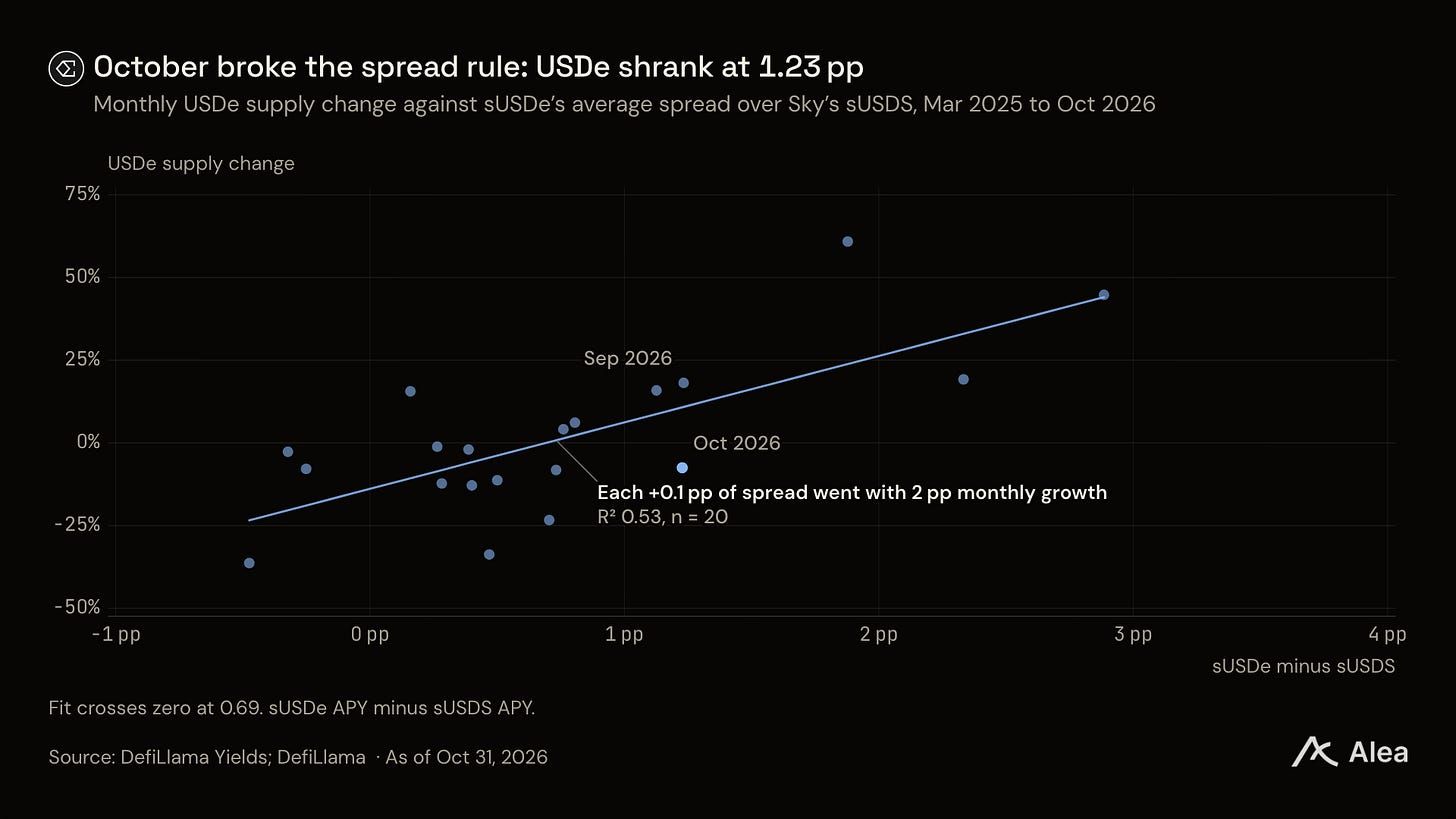
USDe now grows when borrowers loop and shrinks when they unwind. A loop posts USDe as collateral, borrows dollars against it, and mints more USDe with them. October showed it. The yield spread between Ethena's savings token sUSDe and Sky's rival savings token sUSDS held at September's 1.23 points, and until then every month with a spread above 1 point had brought growth. Yet USDe shrank 7.4%.
The fall began on Oct 6, the day USDe peaked. Aave's USDT borrow rate is the cost of a USDT loop on Aave. That day the rate jumped above sUSDe's yield.
A loop also brought USDe back. In the week to Nov 8 Ethena minted $362M for one multisig Safe that loops on Aave. By Nov 8 USDe had regained its whole fall from the Oct 6 peak. That Safe ran at a health factor of 1.02 on Nov 12, just above Aave's liquidation line of 1.0. If its loop unwinds, three quarters of the rebound goes with it, and ENA's first buyback moves further away.
Key takeaways
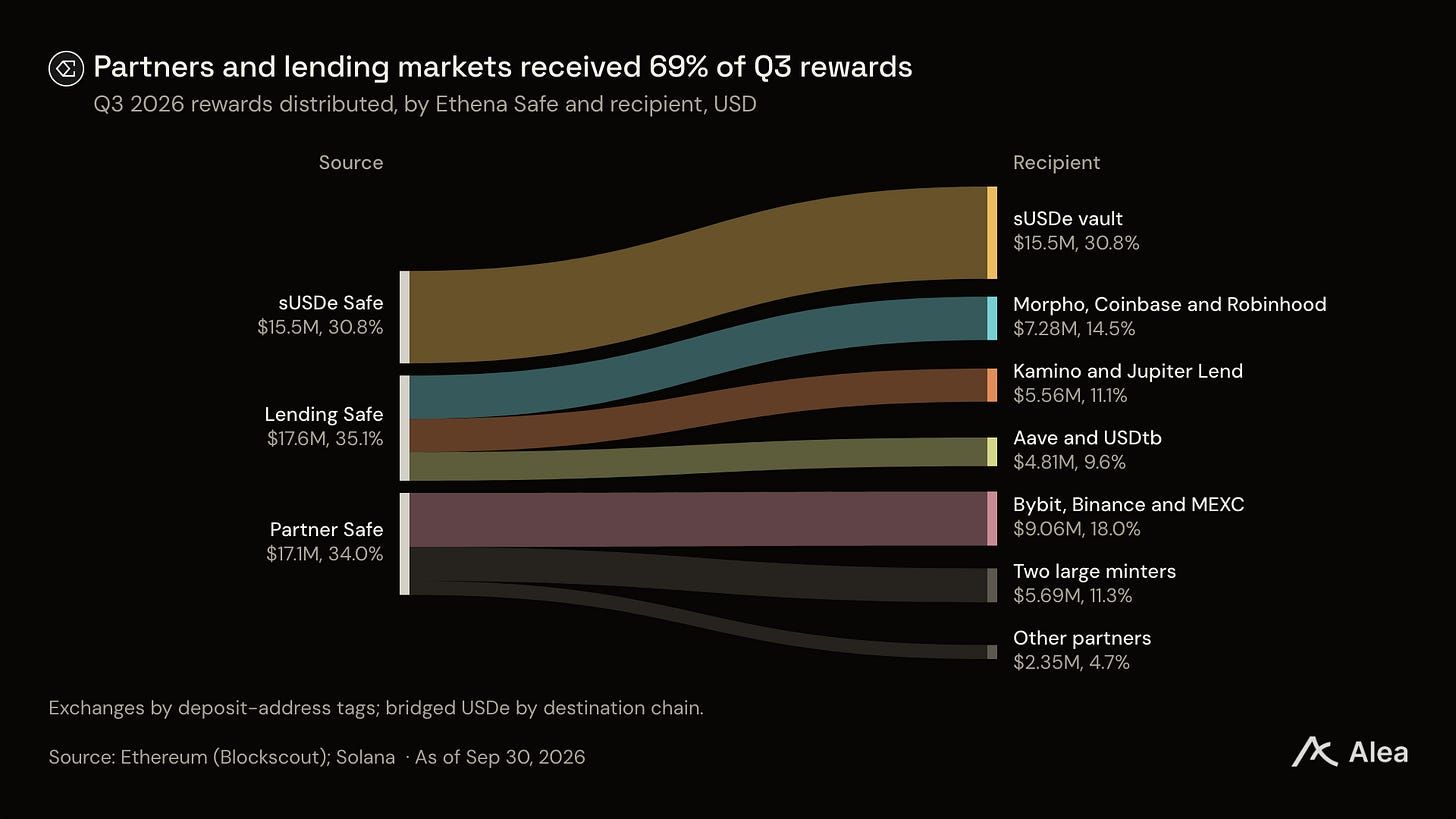
Partners and lending markets now take most of Ethena's rewards. Ethena's partner and lending Safes paid out 69% of Q3's rewards, up from 38% a year earlier; the sUSDe vault took the rest.
Ethena's weekly budget for the Aave loop reward fell by more than half in October. At a similar target rate, the smaller budget pays for less than half as much looped USDe.
The rebound rests on one loop with a health factor of 1.02. A fall of about 2.3% in its collateral's value against its debt would trigger liquidation.
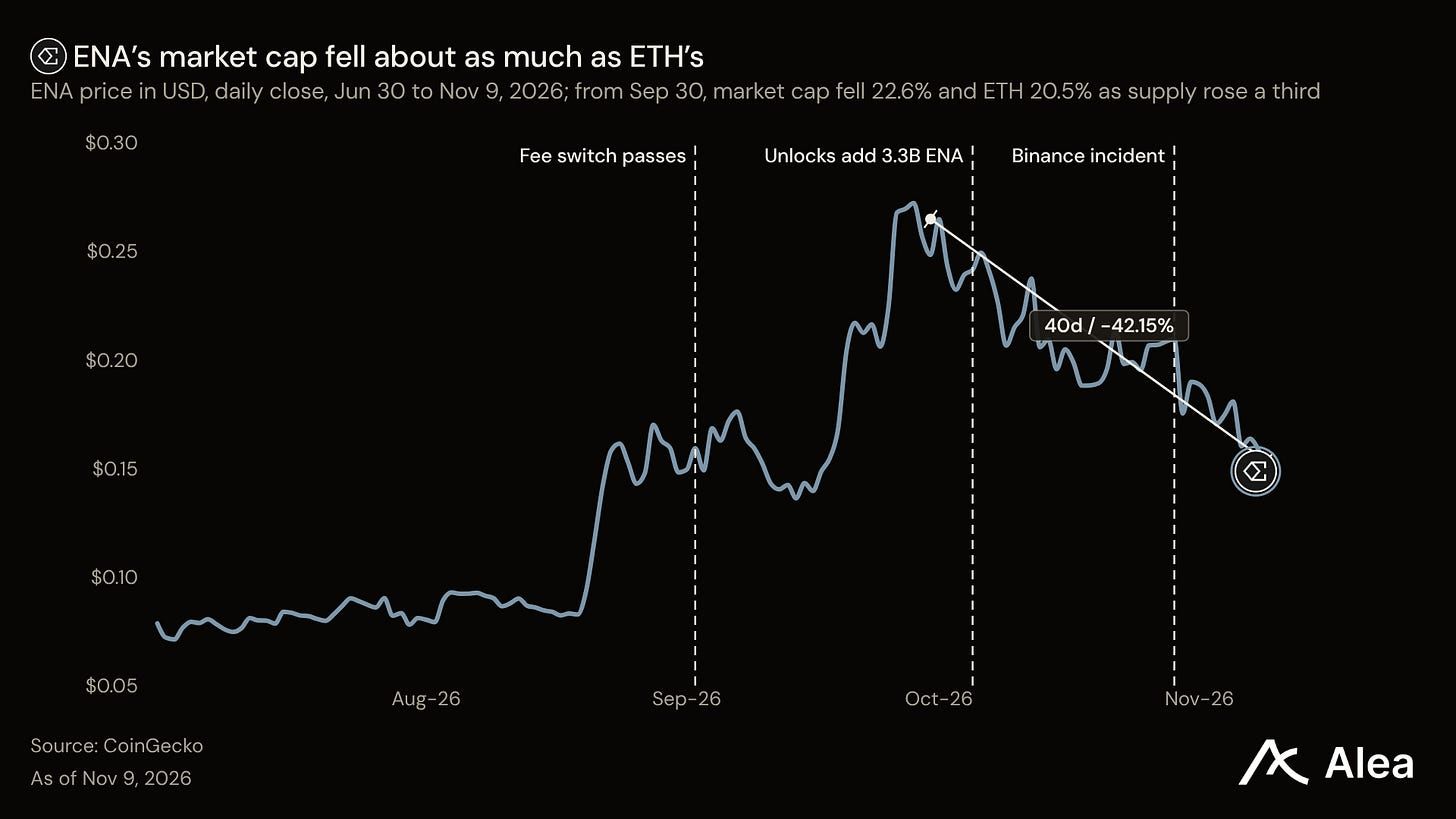
ENA's price fell twice as far as ETH's after Sep 30. Its market cap fell about as much as ETH's, because circulating ENA rose by a third.
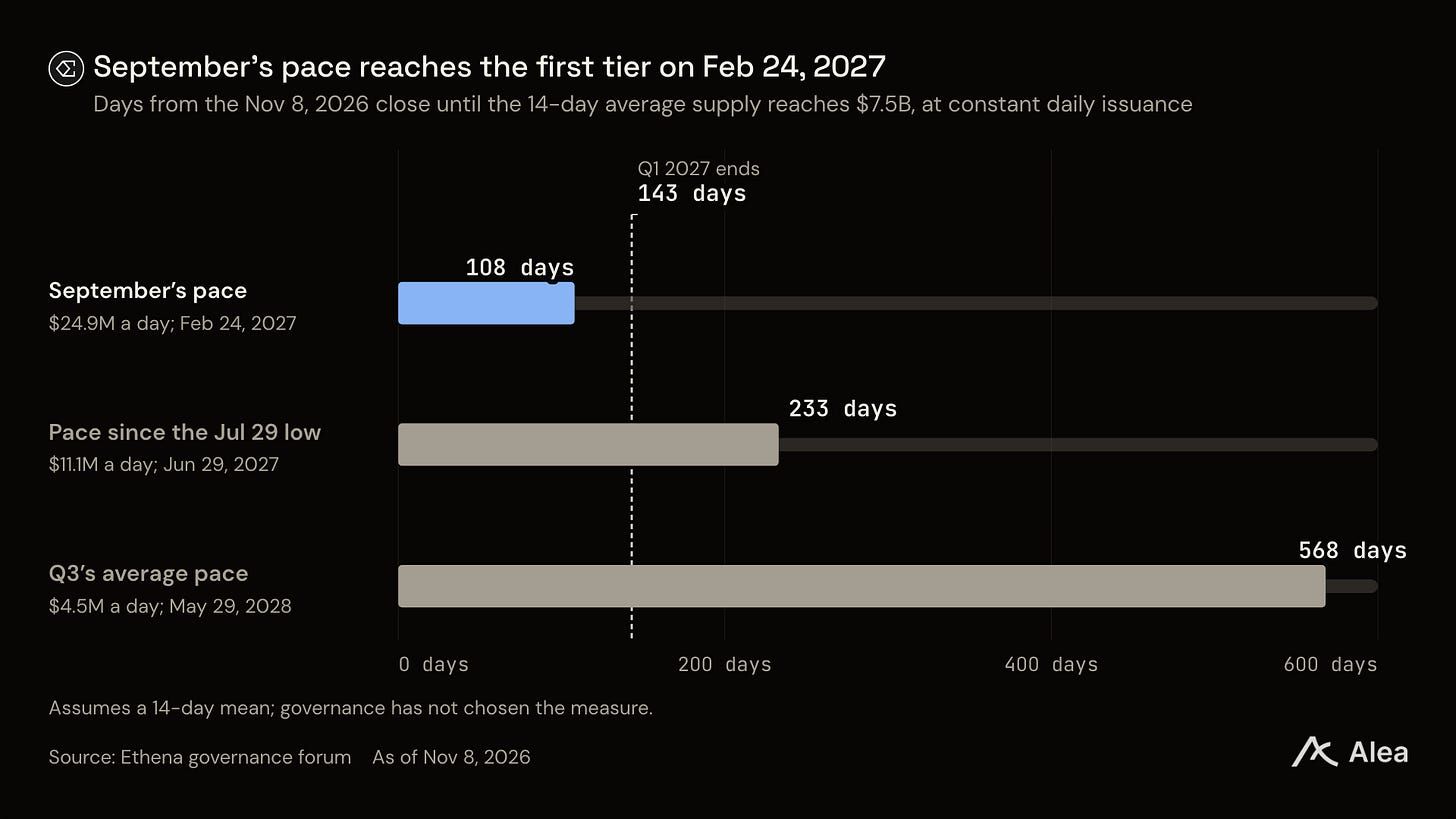
At September's pace, USDe's 14-day average reaches the first buyback tier in February 2027. At Q3's pace it waits until mid-2028, and by Nov 12 governance had not chosen how to measure supply.
Ethena pays out what its backing earns
USDe is a dollar backed by assets that earn. Approved addresses swap USDC or USDT for USDe at about par, and Ethena puts those dollars into four revenue streams: funding and basis, lending, real-world assets, and stablecoin rewards. Lending is now the largest. On Nov 10 Ethena had lent $2.35B of the backing to DeFi markets and trading firms. Ethena started with the crypto basis trade. That trade held $905M: Ethena holds BTC or ETH, shorts the same amount in perpetual futures, and collects the funding that leveraged longs pay.
In Q3 Ethena paid out $50.2M as USDe rewards, up from $47.0M in Q2. The rewards go to three places: its sUSDe vault, partners such as Bybit, Binance, and two large minters, and USDe in lending markets. USDe held anywhere else earns nothing. The vault took $15.5M. Partners and lending markets took the rest.
sUSDe is Ethena's savings token. It's a vault: you stake USDe, and its share price rises with each payout, about 5% a year in early November. Aave's loop reward is a separate payment from sUSDe's yield.
Ethena's Liquid Leverage program pays the Aave loop reward to USDe suppliers on Aave V3's Ethereum Core market. Aave issues aEthUSDe to USDe suppliers as the receipt for their deposits. The program pays in aEthUSDe, rewarding only suppliers who borrow stablecoins against their USDe and keep a health factor of 2 or lower. A lower health factor means more debt. Each weekly round sets a target rate; the round to Nov 13 targeted up to 5.25% a year. Ethena's lending reward Safe funds each round, through two intermediate Safes, from the same backing income that pays sUSDe.
The loop reward pays only USDe that carries a loan, and a loop multiplies it. On Nov 6 Aave charged 4.86% to borrow USDC. Supplied USDe earned 0.24% from Aave on top of the loop reward. At Aave's 90% loan-to-value limit, each dollar of the holder's money carries ten dollars of USDe. At the full 5.25% reward rate, that position earned about 11% a year on the holder's dollar. A one-point change in the reward rate changes that return by ten points.
The older Aave loop that borrowed USDe against sUSDe turned into a loss in September after Aave's risk stewards priced USDe loans above sUSDe's yield.
Loops outgrew USDe
Ethena cut USDC mint and redeem fees to zero on Jul 9 and did the same for USDT mints on Aug 24. Ethena said the change made loops free to enter and exit on two Morpho markets, the ones behind Coinbase's USDC lending and Robinhood Earn's USDG lending. It also paid rewards to USDe collateral there. In Q3 borrowers added $540M of USDe collateral on those two markets, more than USDe's whole $412M net growth. By Sep 30 borrowers owed 89 cents against each dollar of USDe collateral on the two markets. Over the same quarter the sUSDe vault shrank from $1.68B to $1.26B.
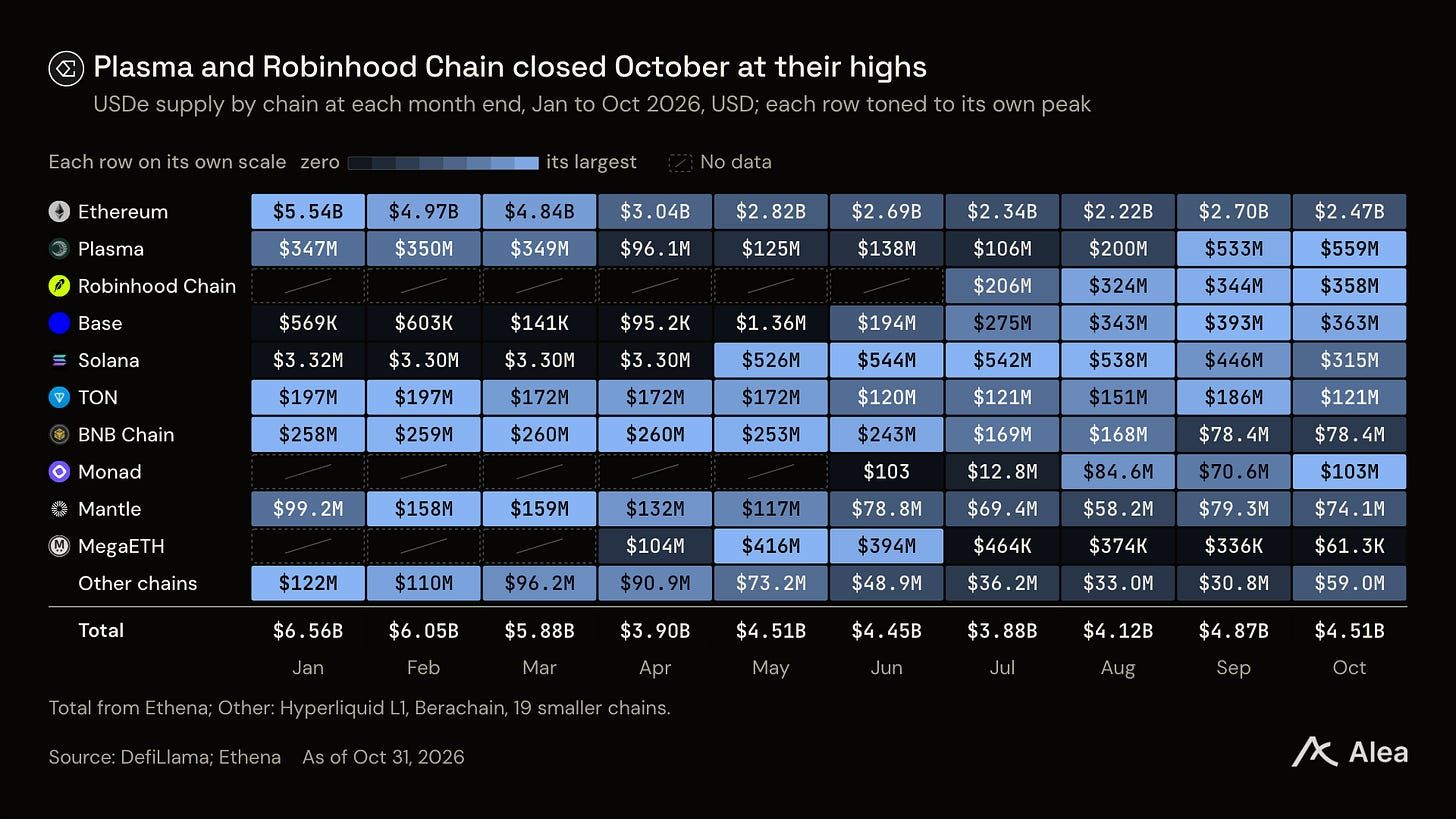
By Sep 30, USDe made up a third of the stablecoins on Plasma and Robinhood Chain, compared with 1.9% on Ethereum. Both chains closed October at their highs for the year.
October broke the spread rule
The spread rule measures what savers earn. It leaves out what loopers pay. On the line fitted to 20 months, September's 1.23-point spread pointed to growth of about 11%. USDe grew 18.2%. October had the same spread and lost 7.4%.
Every looper pays the borrow rate on the dollars borrowed, whether the collateral is sUSDe or USDe with rewards. USDe peaked at $4.98B on Oct 6. That day Aave's USDT borrow rate rose above sUSDe's yield. It stayed above for three days and reached 8.9% on Oct 7. About $137M of USDe left Aave by Oct 8, mostly from positions that repaid USDT debt. Total supply fell $157M over the same two days.
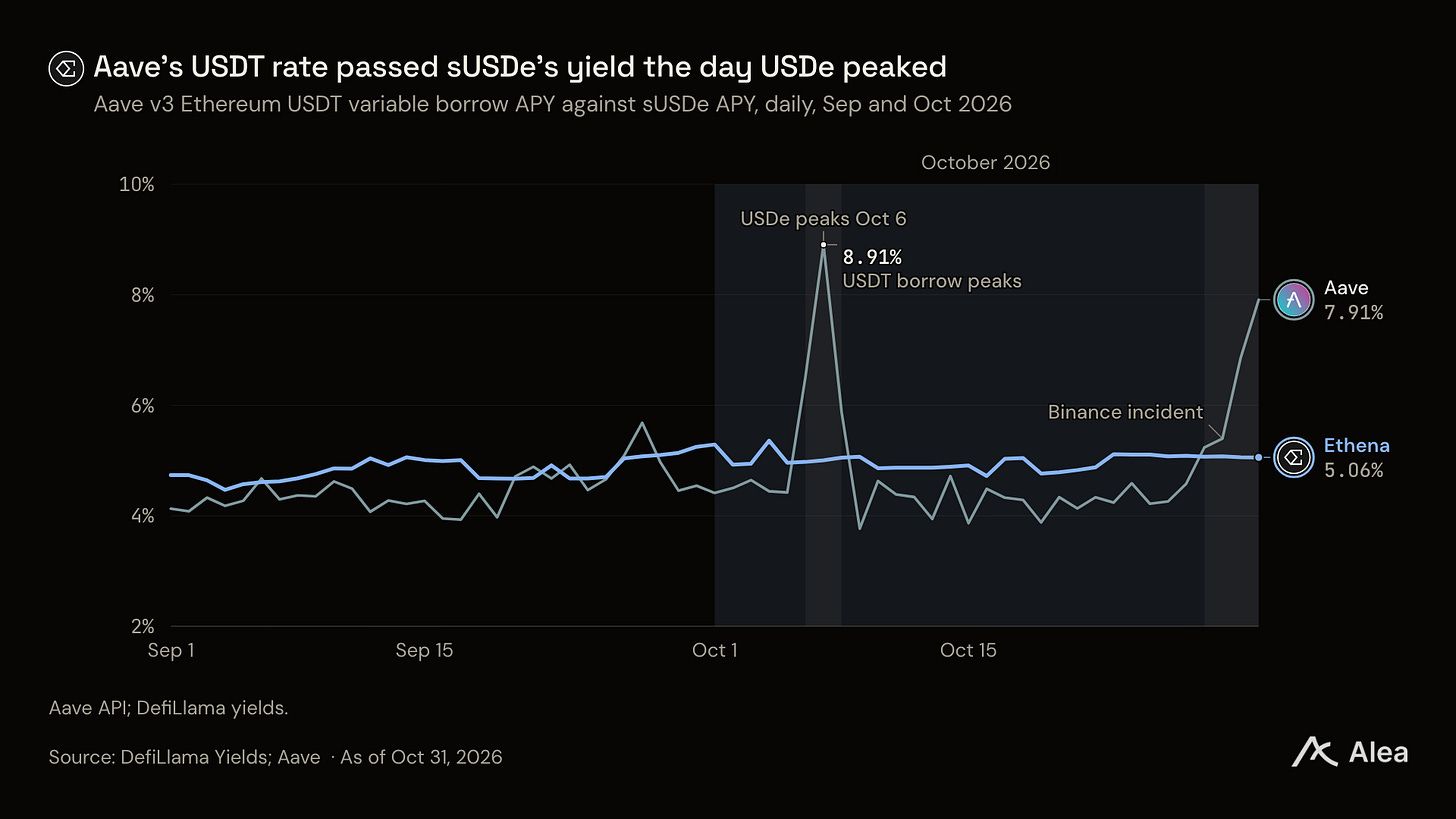
Aave's USDT rate fell back below sUSDe's yield from Oct 9, but USDe kept shrinking. Ethereum had taken most of its October loss in the first spike. Solana had gained about $49M in early October, then lost about $180M from Oct 9 to month-end, twice Ethereum's loss over the same weeks. Over the month USDe shrank three times as fast as other dollar stablecoins.
On Oct 29 a Binance security incident paused USDe and ENA withdrawals there, and Ethena put its exposure at about $8.8M, a seventh of its reserve fund. Binance said it would cover all losses and reopened withdrawals on Nov 3.
Ethena's own Aave loop reward shrank through the month as well: its weekly budget fell from about 512,000 aEthUSDe in late September to about 218,000 in the week to Oct 23.
One Aave loop brought USDe back
Only addresses that Ethena approves can mint USDe. Each signs an order that names the collateral, the amount, and who receives the USDe. Ethena's minting wallet then submits it to the mint contract, which caps new USDe at $200M a block. Ethena added Safe 0xa711 to that list on Jan 7, 2026. The Safe acts when 5 of its 11 signers approve.
On Nov 6 Safe 0xa711 ran 21 borrow-and-mint cycles in four hours. Each cycle borrowed USDC on Aave against the Safe's collateral and sent it to Ethena for new USDe. Each borrow took about 90% of the last deposit. Each mint came out about a tenth smaller than the one before. Ethena minted $327M this way. With two smaller rounds of mints that week, the Safe took $362M of new USDe by Nov 8. That was 76% of all the USDe added from the Oct 31 close to Nov 8.
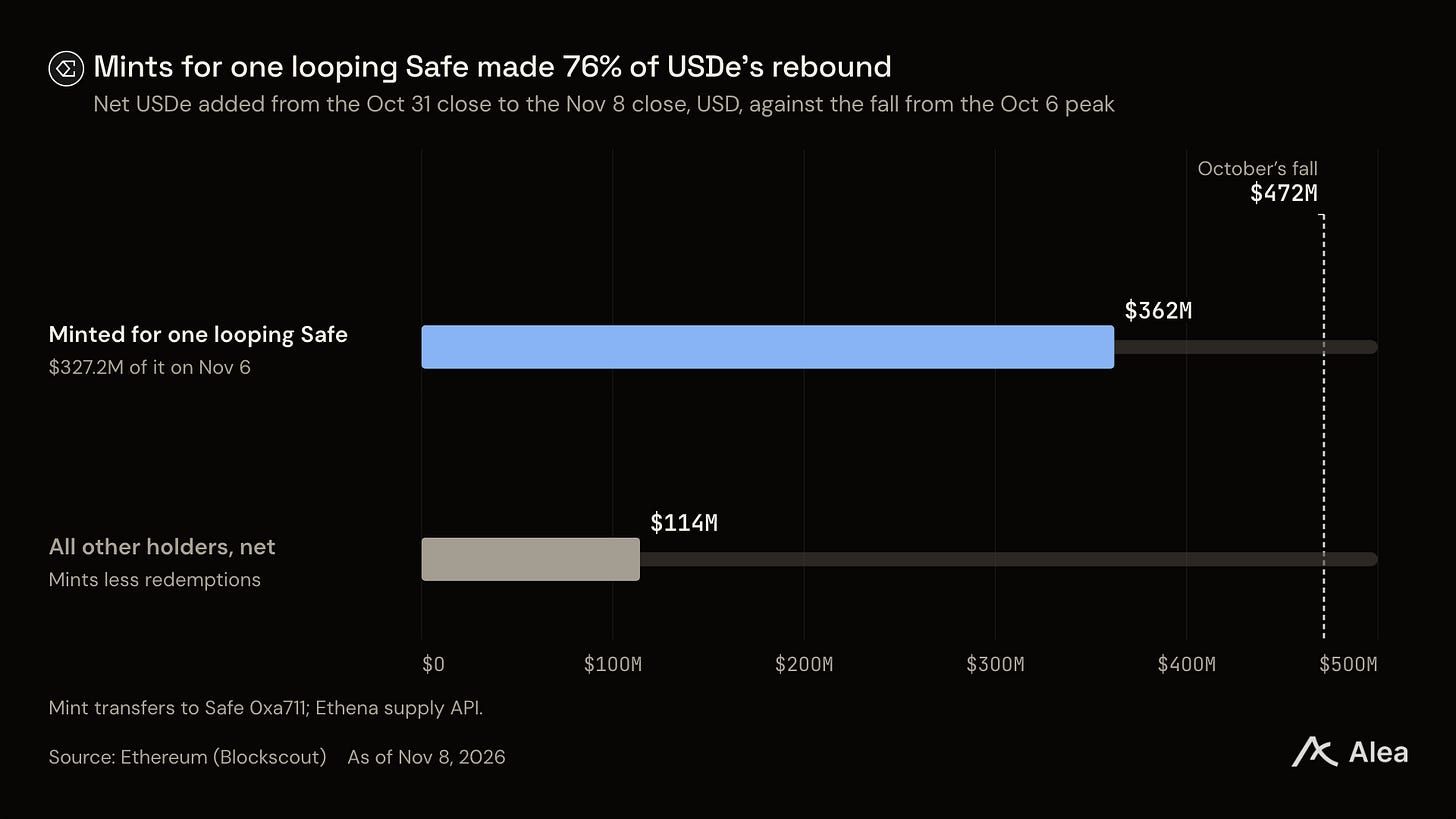
Safe 0xa711 had been earning the loop reward: it claimed about 132,000 aEthUSDe from the program on Nov 2. Midway through the Nov 6 cycles, the Safe that runs the program removed 0xa711 from that week's payouts. Forty minutes later Safe 0xa711 began staking its new USDe into sUSDe and posting that instead. Its Nov 8 cycles posted USDe again. On Nov 12 the loop was still open. Its USDC debt reached $382M, more than it minted, because it already ran a smaller loop before November, and it rests on about $43M of the Safe's own capital.
After Nov 9 other holders redeemed. USDe fell from $4.99B that day to $4.91B by Nov 11.
The saver side of the spread held. sUSDe's 30-day yield stood at 5.10% on Nov 11, still 1.3 points above sUSDS.
At September's pace, ENA's first buyback comes in February 2027
Ethena's governance token ENA received none of Q3's rewards. Holders passed the fee switch unopposed on Sep 2. Once USDe's circulating supply reaches $7.5B, the Foundation receives 5% of gross protocol revenue for ENA buybacks. The share rises in steps to 25% from $25B. No buyback had run by Nov 12. Governance hasn't set how to measure supply against the $7.5B mark; two Risk Committee members back a 14-day trailing average.
At the Nov 8 close, supply was about $2.5B below the first tier, and the 14-day average trails supply by about a week. At September's pace of $24.9M a day, it gets there on Feb 24, 2027, inside Q1. At the pace since the Jul 29 low it takes until mid-2027, and at Q3's pace until mid-2028. Looped USDe counts toward the average like any other USDe, and it leaves the average when loops unwind, as in October.
On Oct 5 the Ethena Foundation pulled forward every remaining investor unlock. That is why ENA's market cap fell less than its price from Sep 30 to Nov 9. The price fell 42.1%; the market cap fell 22.6%, close to ETH's and SKY's. What the first buyback tier pays depends on USDe supply, rewards per dollar of USDe, and the tier rate. At Q3's rewards per dollar, the first tier would send the Foundation at least $17.6M a year for buybacks. That is a floor, because gross revenue is at least as large as the rewards it funds. On Nov 9 ENA's market cap stood at about 118 times that floor.
Not every incentive runs through a loan. Binance pays up to 10% a year on USDe held there through Nov 30. But loans move USDe both ways, and October showed how fast they reverse. If Safe 0xa711's loop unwinds, September's pace reaches the first buyback tier about two weeks later, in March 2027.
Important Links
Ethena Q3 2026 Benchmark · Ethena Q3 2026 IR deck · Fee switch proposal · Fee switch vote · USDe supply · Ethena transparency
The Ethena Q3 2026 Benchmark has the full numbers in 34 exhibits on supply by chain, rewards by recipient, the fee switch, and ENA's multiples. Its IR deck makes the same argument in slides, in light and dark.
This report on Ethena was not paid for or commissioned.
Members of the Alea Research team, including those directly involved in the analysis above, may have positions in the tokens discussed.
This content is provided for educational purposes only and does not constitute financial or investment advice. You should do your own research and only invest what you can afford to lose. Alea Research is a research platform and not an investment or financial advisor.

Ethena's Data Room holds its backing, rewards and governance in one place, with Analytics for its history and Intel for its news and votes.
Research reports. Deep Dives and Blueprints explain protocols and their economics. Theses and Memos examine investment cases and catalysts. Benchmarks compare performance, while Perspectives assess specific developments.
Weekly Pulse. Read a weekly assessment of macro and the major liquid markets.
Protocol Data Rooms. Research each protocol in one place, with Analytics for historical comparisons and Intel for news and governance developments where available. Open Ethena Analytics. Open Ethena Intel.
Podcast Digest and Summit Digest. Read summaries of industry conversations and events. Find Alea shows and their episodes through Podcast Digest.
Governance Tracker. Follow proposals and voting activity across protocols.
For protocol teams preparing institutional conversations, discuss research for your protocol with Alea.