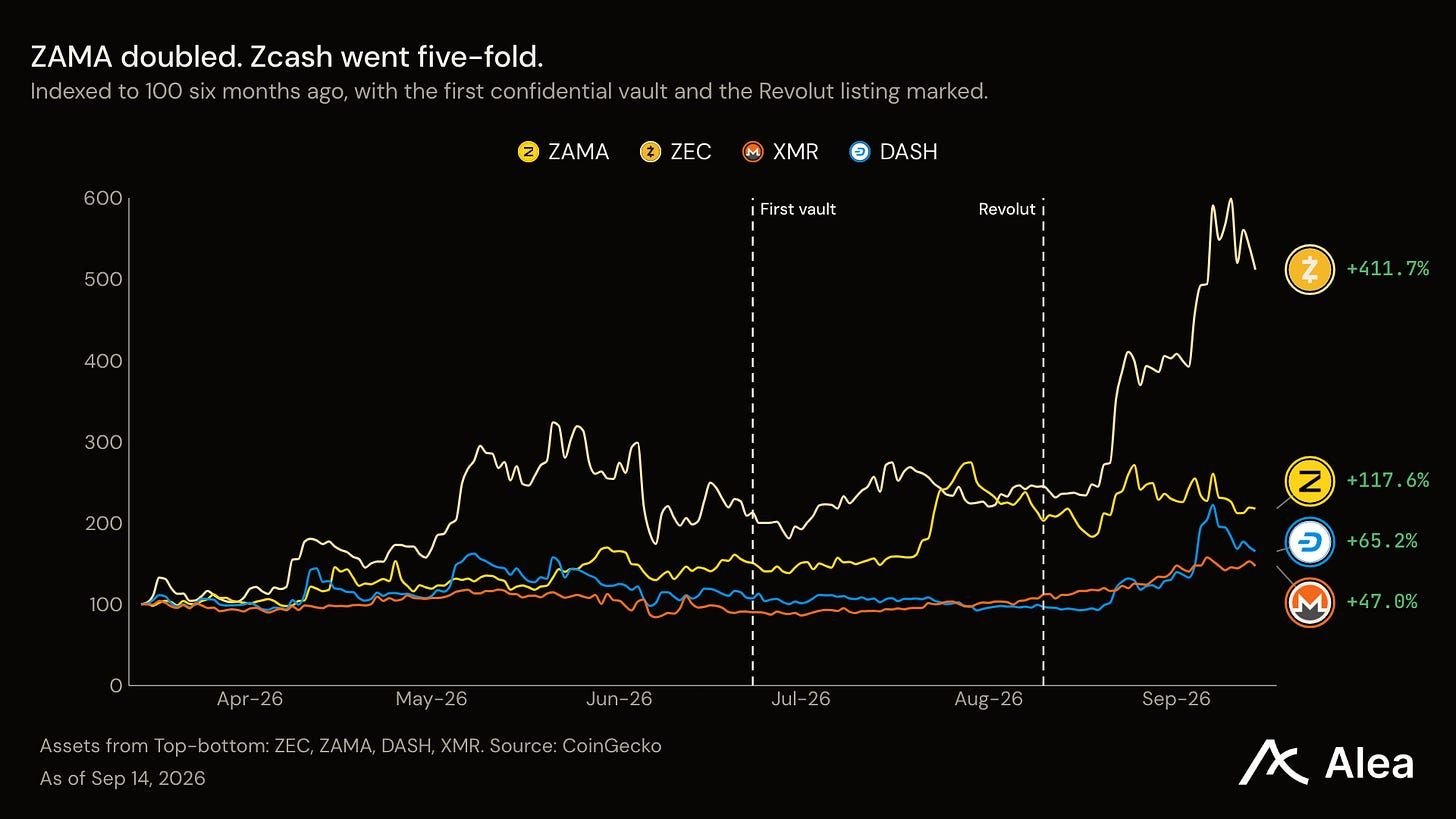
Put USDC into a Steakhouse vault on Morpho through Zama and it is still USDC. Same issuer, same vault, same curator, same rate. What changes is that the balance is encrypted on chain, and decryption is granted only to parties you name. On Sep 15 Zama did that for sixteen vaults at once and opened a trading venue beside them. A swap there costs 19.53 basis points on Zama's own token and 1.22 between stablecoins, and every cent of it buys ZAMA on the open market and burns it. The token is up 117.6% since Mar 14, all of it before the new fee existed.
Takeaways
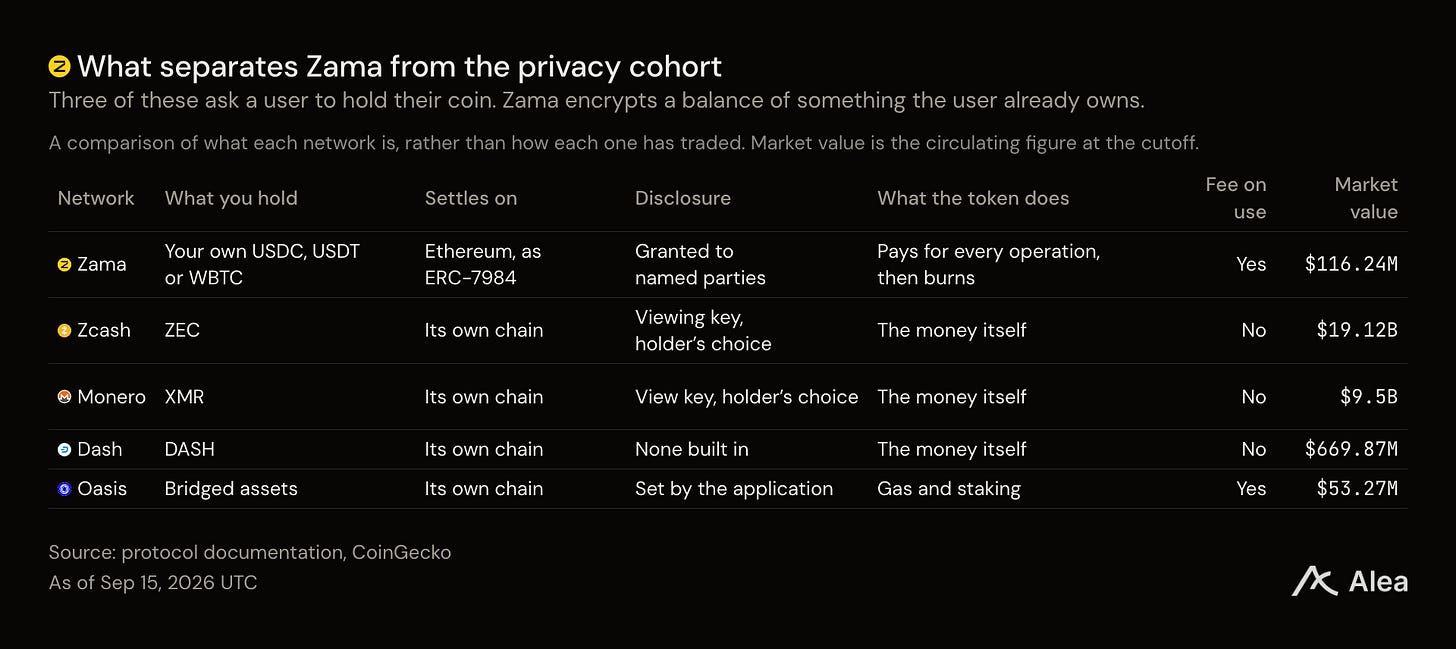
Zama keeps your asset and encrypts your balance. Zcash, Monero, and Dash ask you to hold their coin. A confidential deposit through Zama stays USDC, USDT, or WBTC, redeemable one for one, also in the Morpho vault an allocator already uses.
The fee now grows with the size of the money. Every charge before the swap was a fixed price per operation. The swap takes a share of the trade, and 100% of it buys back and burns ZAMA.
It aims at a market that already exists. Crypto's over-the-counter desks trade $50B to $60B a day away from public order books, and that volume is up 109% year over year. Those desks avoid public chains because size and direction leak.
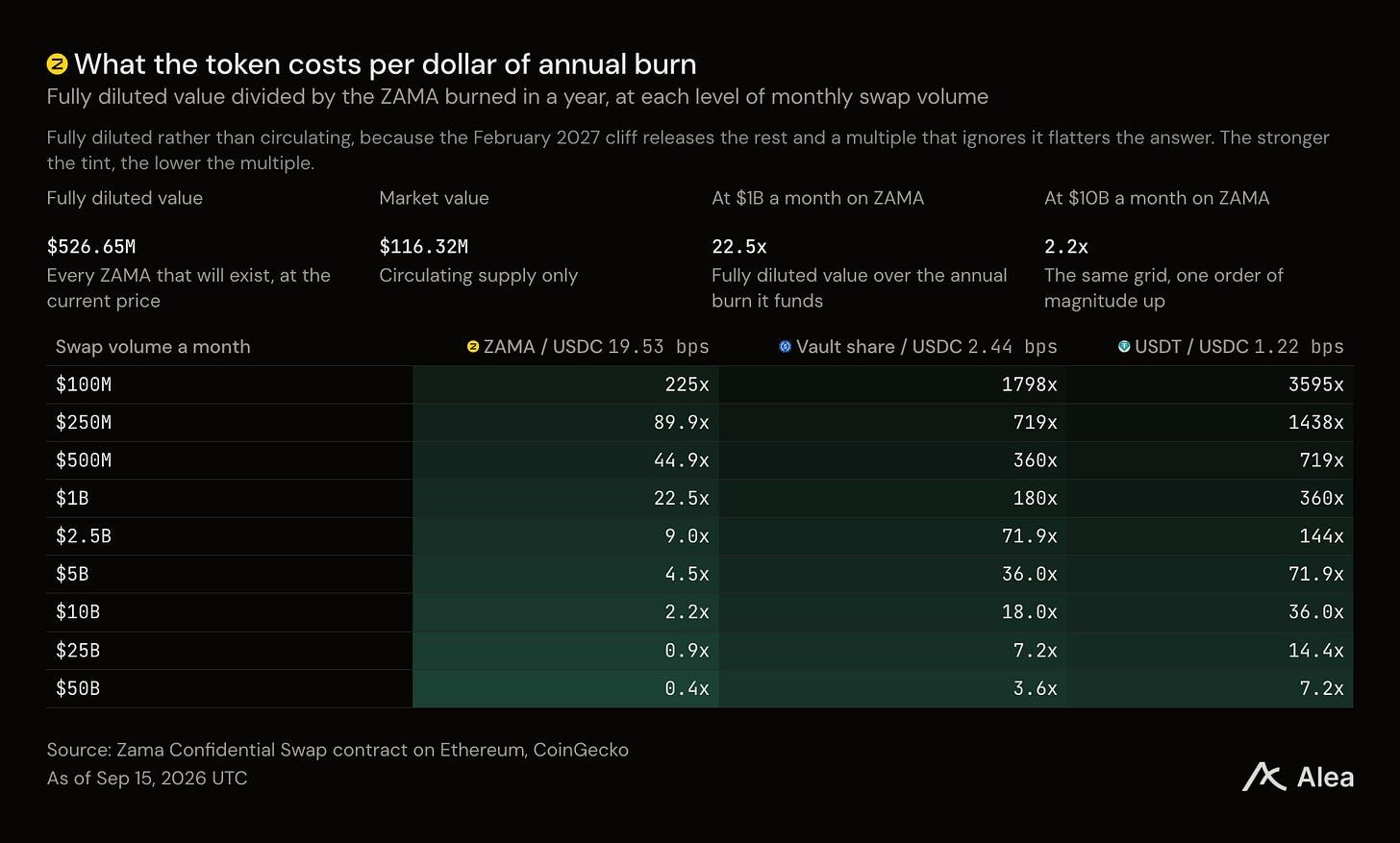
The burn gives the token a multiple to argue over. At $1B a month on its own pair, the fee retires $23.4M of ZAMA a year, which prices a $527M fully diluted value at 22.5x.
The deposits arrived after the incentive faded. Steakhouse's confidential USDC vault held $5.7M on the day its boosted rate peaked at 49.2%. The rate settled at 7.2%, and deposits then grew to $43.0M, with the public version of the same strategy one transaction away.
What Zama sells
Zama is a confidentiality layer for assets that already exist, running on five chains: Ethereum, Polygon, BSC, HyperEVM, and Solana. This week's vaults and swap sit on Ethereum, because that is where Morpho and its curators are. Wrap USDC and you get cUSDC: an ERC-7984 token that holds the same dollar, redeems the same way, and keeps its balance and transfer amounts encrypted on chain. Decryption is granted to named parties, which is how an auditor, a fund administrator, or a compliance desk still sees the position. Zama added continuous monitoring through Hypernative in August to run that check without unwrapping anything.
Zcash and Monero make privacy the asset, which means holding their coin and accepting whatever depth it has. Zama makes privacy a service billed on an asset you already own. The issuer, the venue, and the vault all stay the same.
Dealers bid without seeing the size
The Confidential Swap is not an exchange with pools. There is no liquidity to price against and no public quote to read. It is an auction: a trader posts an order with the amount encrypted, whitelisted dealers bid on it blind without seeing the size or which way it goes, the contract picks the best bid while the numbers are still encrypted, and the winner settles.
An observer sees that a trade settled on that pair. The amount, the price, and the side stay encrypted.
Using it takes three steps. You wrap USDC into cUSDC once, which mints a confidential token holding the same dollar. Inside that wrapper you can trade as often as you like, and only the swap charges a fee. When you want out, you unwrap back to plain USDC.
Three pairs are live, all of them quoted against confidential USDC: ZAMA, USDT, and a Steakhouse vault share, which lets a depositor sell a yield position without unwrapping it first.
The fee is where the Sep 15 release changes Zama's economics. Before the swap, Zama charged a fixed price per cryptographic operation, in cents. The swap charges a share of the trade instead, set per pair, and hands all of it to the buyback.
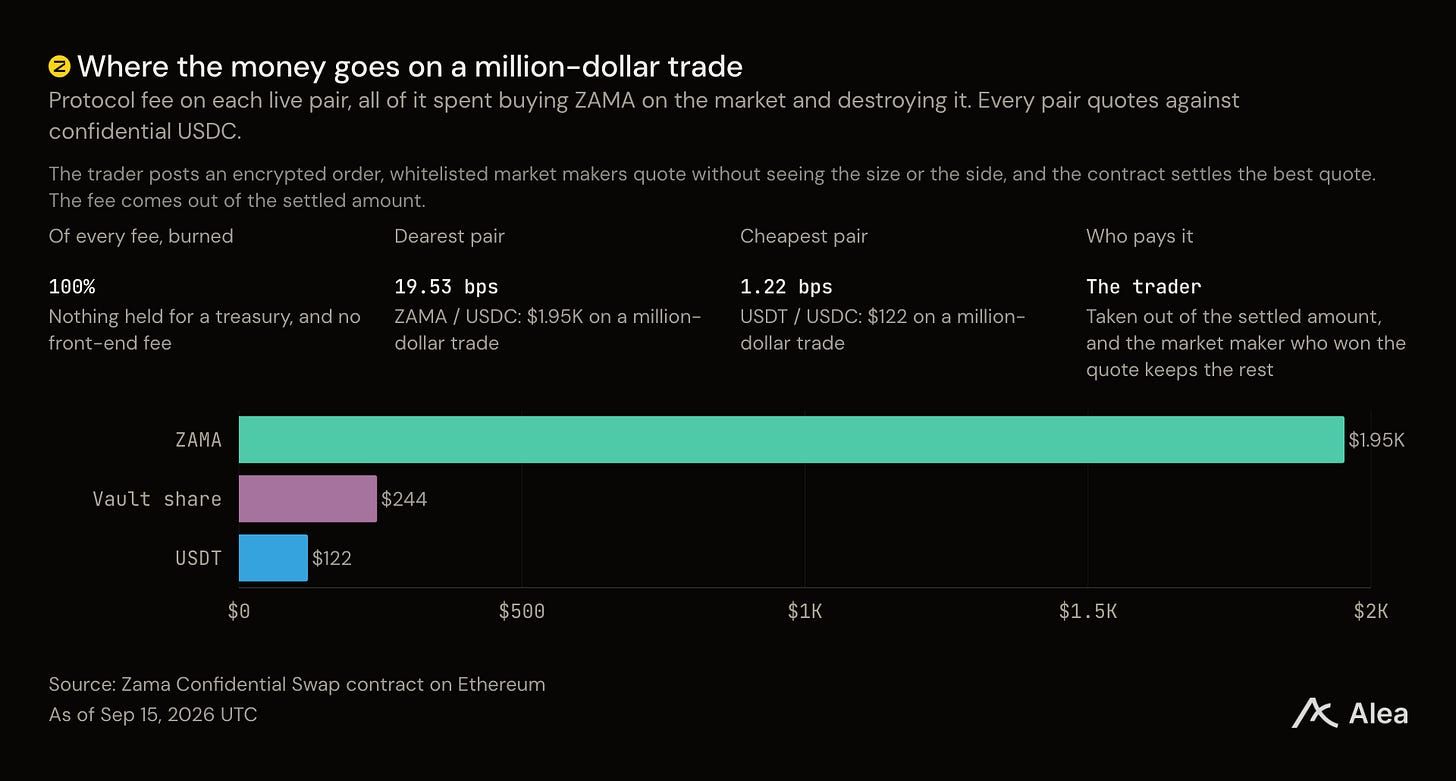
Stablecoin to stablecoin costs 1.22 bps, inside the 1 to 4 bps that Curve's stable pools and Uniswap's 0.01% tier charge. Moving dollars privately costs about what moving them publicly costs. Leaving a yield position costs 2.44 bps, which prices the exit without unwrapping. The volatile ZAMA pair carries 19.53 bps, where a market maker needs paying for the risk. All three rates are set in the contract as a power of two, which is why they step by a factor of eight rather than landing on round numbers.
What Zama charges for, and who gets it
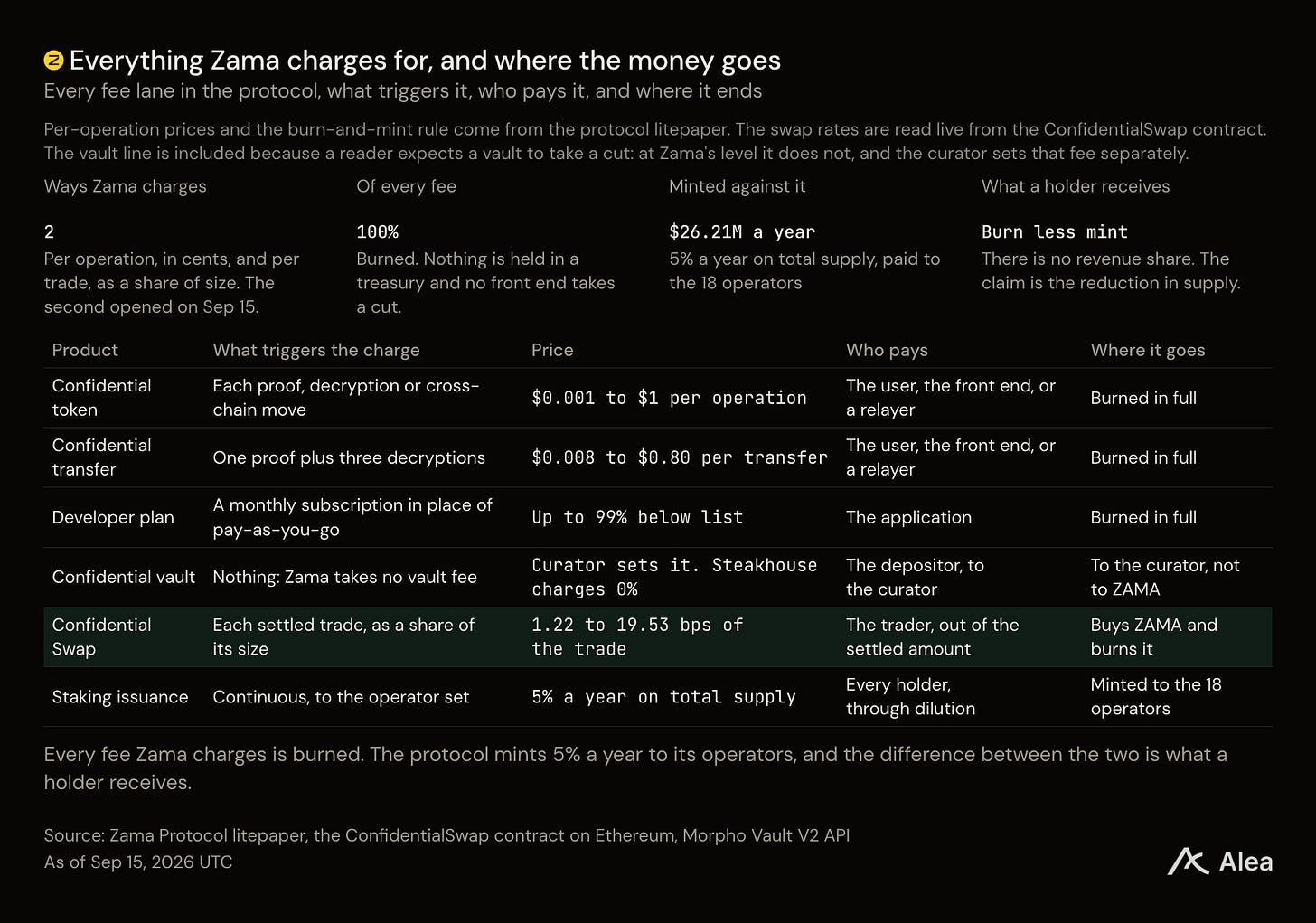
Zama sells three things, charges for two of them, and sends every cent to the same place.
The confidentiality layer is the base product and bills per cryptographic operation. A proof, a decryption, or a move between chains runs from a tenth of a cent to a dollar, A confidential transfer uses one proof and three decryptions, which puts it between $0.008 and $0.80. Prices are set in dollars and paid in ZAMA, and the user, the front end, or a relayer can be the one who pays.
The sixteen vaults cost a depositor nothing at Zama's level. Morpho's curator sets the vault fee, and Steakhouse's confidential USDC vault currently charges 0% on both management and performance. Zama earns from the operations a confidential deposit generates, never from the yield it pays.
The Confidential Swap is the second lane and the new one. It charges a share of the trade rather than a price per click, which is the first time Zama's revenue moves with the size of the money rather than the count of it.
The market the swap draws from
Zama has to trade $1.12B a month on its own token pair to buy back a month of issuance. Against the $1.5T that over-the-counter desks move monthly at the low end of the range Zama cites, that is 0.075%.
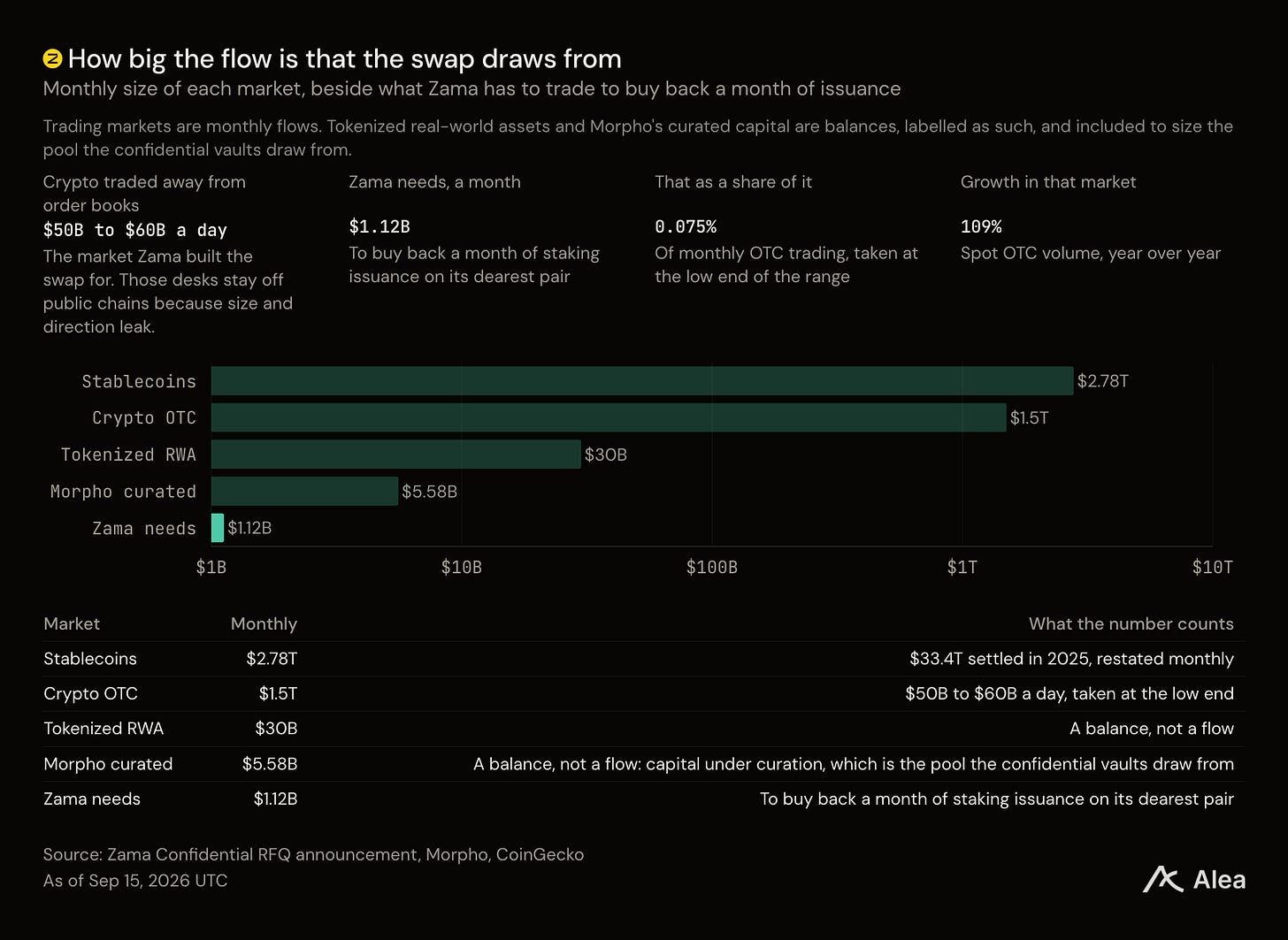
The cheaper pairs need more, because the rate is sixteen times lower: $18.0B a month between stablecoins, or 1.2% of the same flow. Both ends of that range are shares of a market that already trades, and that market grew 109% in a year.
What volume pays the token
The swap opened in private beta and posting an order still needs a place on a whitelist.
Every dollar of swap fee buys ZAMA and burns it. The burn is volume times rate. It passes annual issuance at $1.12B a month on the ZAMA pair, and at $10B a month on the stablecoin pairs.
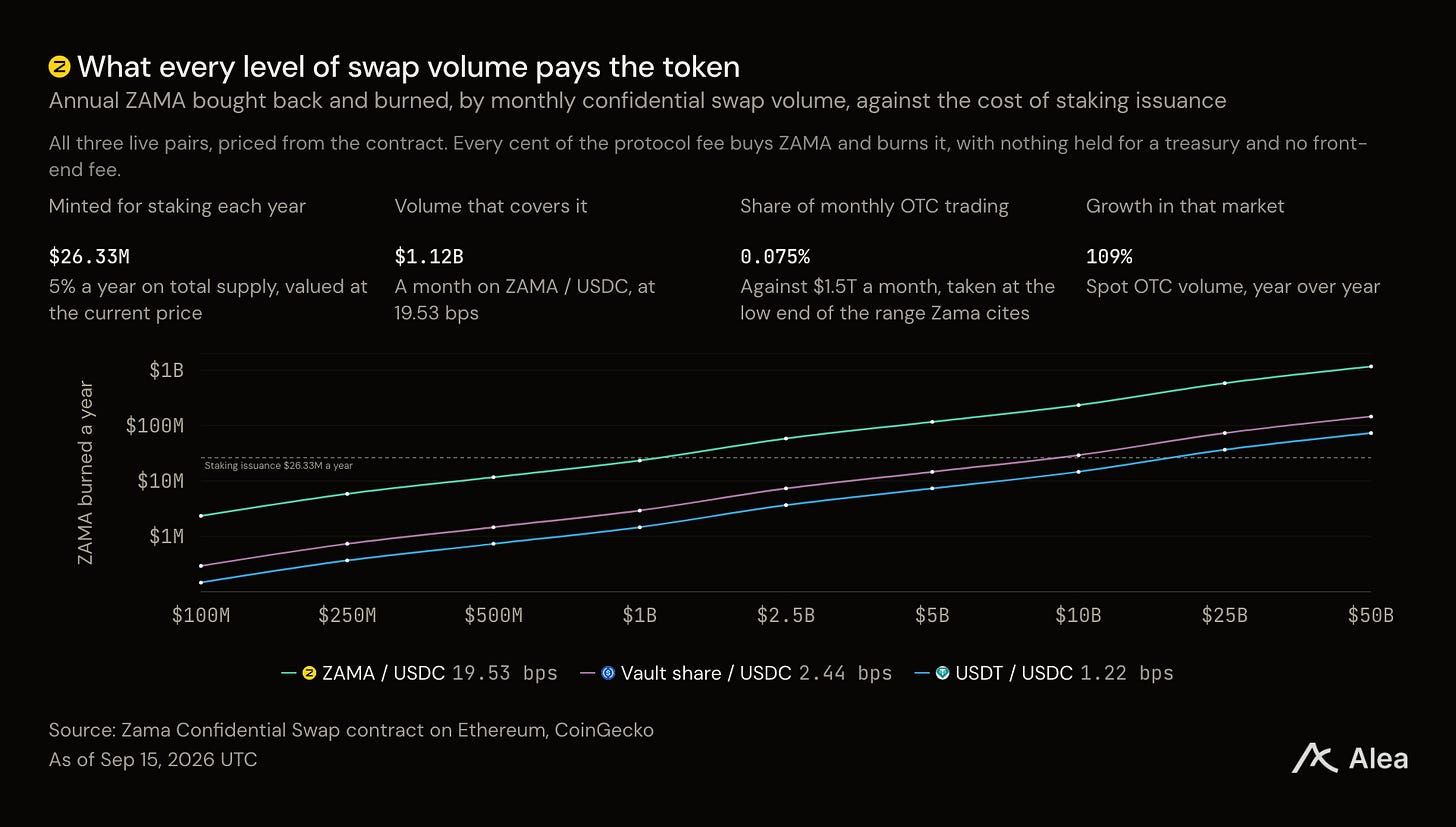
ZAMA carries a fully diluted value of $527M on 11.304B tokens. Run $1B a month across its own pair and the fee retires $23.4M a year, putting that valuation at 22.5 times the burn. Run $10B, and 2.2 times.
$1B a month is roughly 16 times the $61M currently shielded through the wrappers.
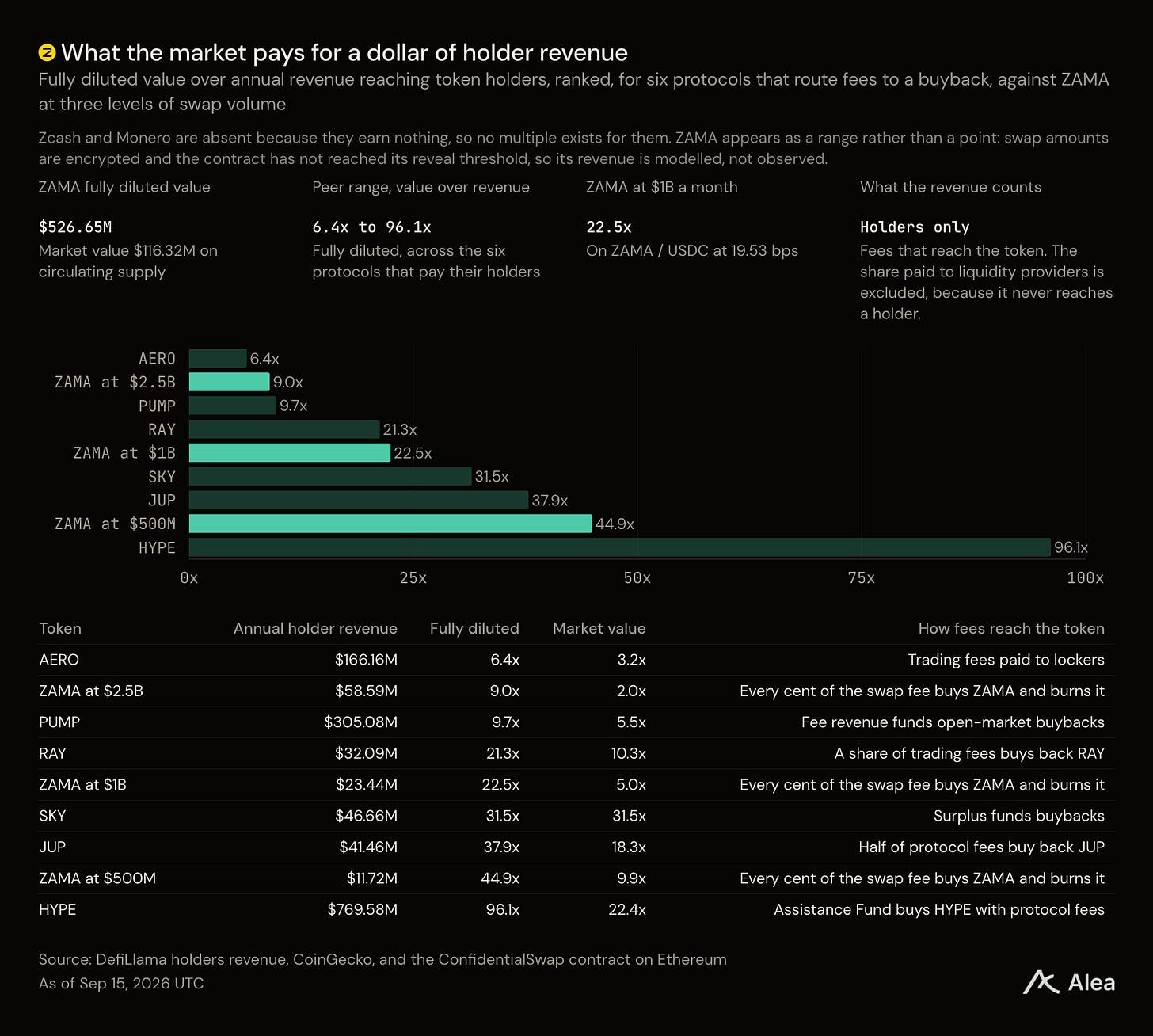
Against protocols that already pay their holders, taking six of them that route fees into a buyback or a burn, the market prices them between 6.4 and 96.1 times the revenue that reaches the token. $1B a month would put ZAMA at 22.5 times, between Raydium and Sky.
What the vaults already proved
Steakhouse Confidential Prime USDC opened on Jun 19 with a twelve-week reward campaign paid in three decreasing phases, on top of the strategy's own yield of about 4%. The boost put the trailing rate at 49.2% on Jun 26, and on that day the vault held $5.7M.
The rate then fell to 10.2% within nine days and settled at 7.2%. Deposits went the other way: $25.5M by Jul 15, and a peak of $43.0M on Aug 7, six weeks after the high rate was gone.
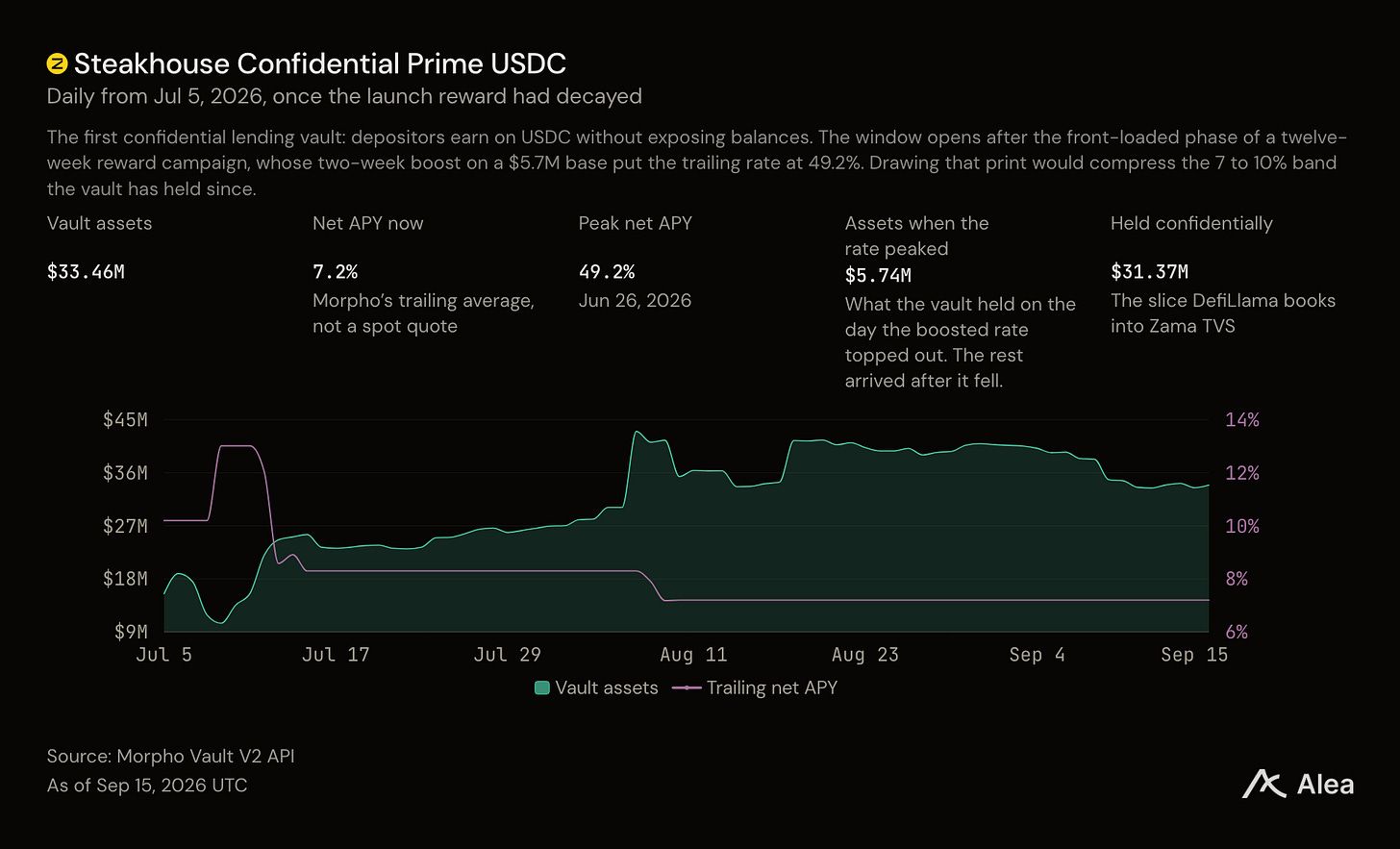
Money that arrived at 7.2%, with the identical public vault one transaction away, was buying confidentiality rather than yield. It is also why five institutional desks agreed to run the sixteen that opened this week. Steakhouse Financial, Armitage by Wintermute, Flowdesk, RockawayX, and Bitwise curate $2.47B on Morpho between them, 44% of all curated capital there.
Price, and February 2
ZAMA trades near $0.047, a market value of $116M and a fully diluted value of $527M. That sits 47% below the $1B Series B valuation and 7% below the $0.05 auction clear, which puts the last two rounds of capital underwater. The token is 30% below its $0.0663 high from Jul 27.
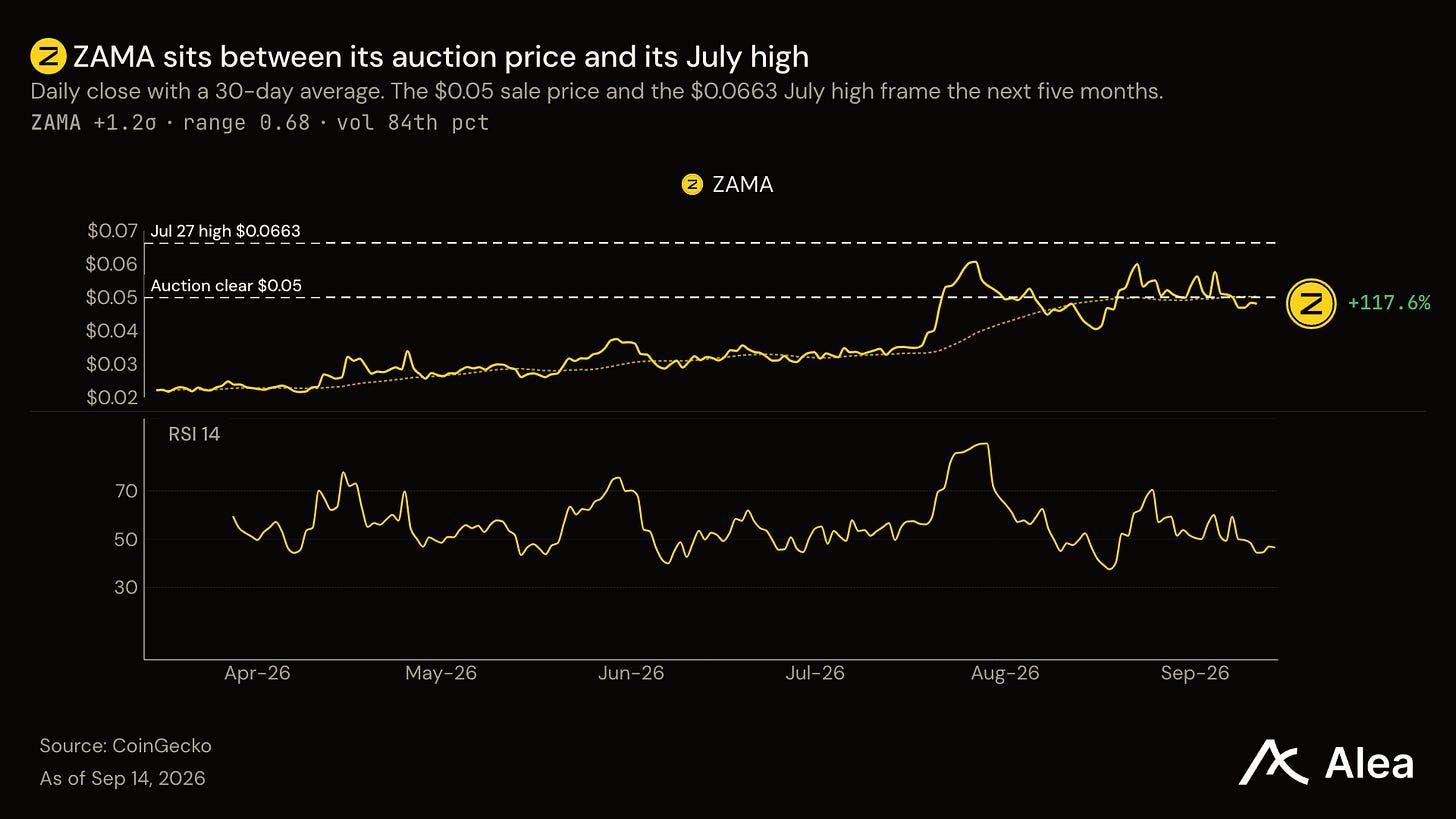
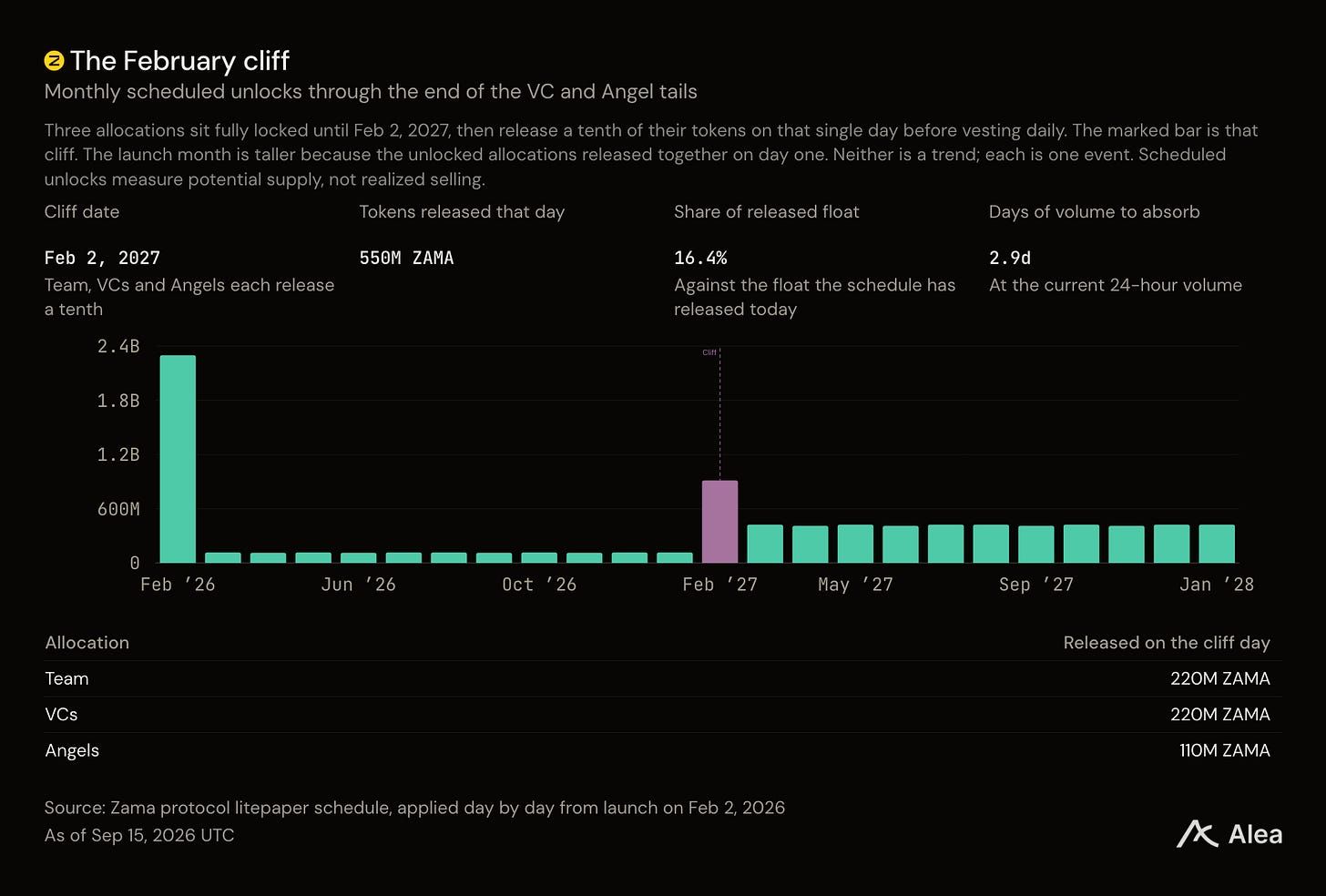
$0.05 is the level with money behind it. The January sale cleared there, it is where that book stops being underwater, and it has capped every rally since Aug 10. On Feb 2, 2027, 550M ZAMA held by the team, venture investors, and angels unlocks in one day, with a further 116.8M of treasury and growth vesting around it. That single day is 16.4% of the float the schedule will have released by then, worth $26M at the current price (it measures potential supply rather than selling).
The short version
Since June, Zama has shown a confidential deposit rides a public vault unchanged, and that the deposits keep coming once the reward stops: the first vault grew from $5.7M to $43.0M while its rate fell to a seventh. This week it added the piece that charges for it: a fee that scales with the trade, aimed at $50B a day of flow that already avoids public chains, with 100% of it burning the token. Sixteen vaults and five curators running 44% of Morpho's curated capital supply the inventory. The first measured number arrives in thirty-nine swaps.
Important Links
Confidential DeFi at Scale: the launch announcement, with the vault, curator, and asset breakdown
Confidential RFQ announcement: how the swap works, who it is built for, and the size of the over-the-counter market
Zama Protocol litepaper: the fee schedule, burn-and-mint model, and operator set
ConfidentialSwap contract: read `getActivePairIds` and `getPair` for the live pairs and the fee on each
Steakhouse Confidential Prime USDC: the first confidential vault on Morpho
Morpho curators: curator assets and rankings
ZAMA market data: price, supply and valuation
Zcash market data: the privacy-cohort comparison
Protocol fee and holder revenue: the revenue basis behind the peer multiples
Zama shielded value: total value shielded through the wrappers

Alea Research publishes independent, source-closed research for allocators, portfolio managers, traders, and protocol teams.
Research reports. Deep Dives and Blueprints explain protocols and their economics. Theses and Memos examine investment cases and catalysts. Benchmarks compare performance, while Perspectives assess specific developments.
Weekly Pulse. Read a weekly assessment of macro and the major liquid markets.
Protocol Data Rooms. Research each protocol in one place, with Analytics for historical comparisons and Intel for news and governance developments where available.
Podcast Digest and Summit Digest. Read summaries of industry conversations and events. Find Alea shows and their episodes through Podcast Digest.
Governance Tracker. Follow proposals and voting activity across protocols.
For protocol teams preparing institutional conversations, discuss research for your protocol with Alea.