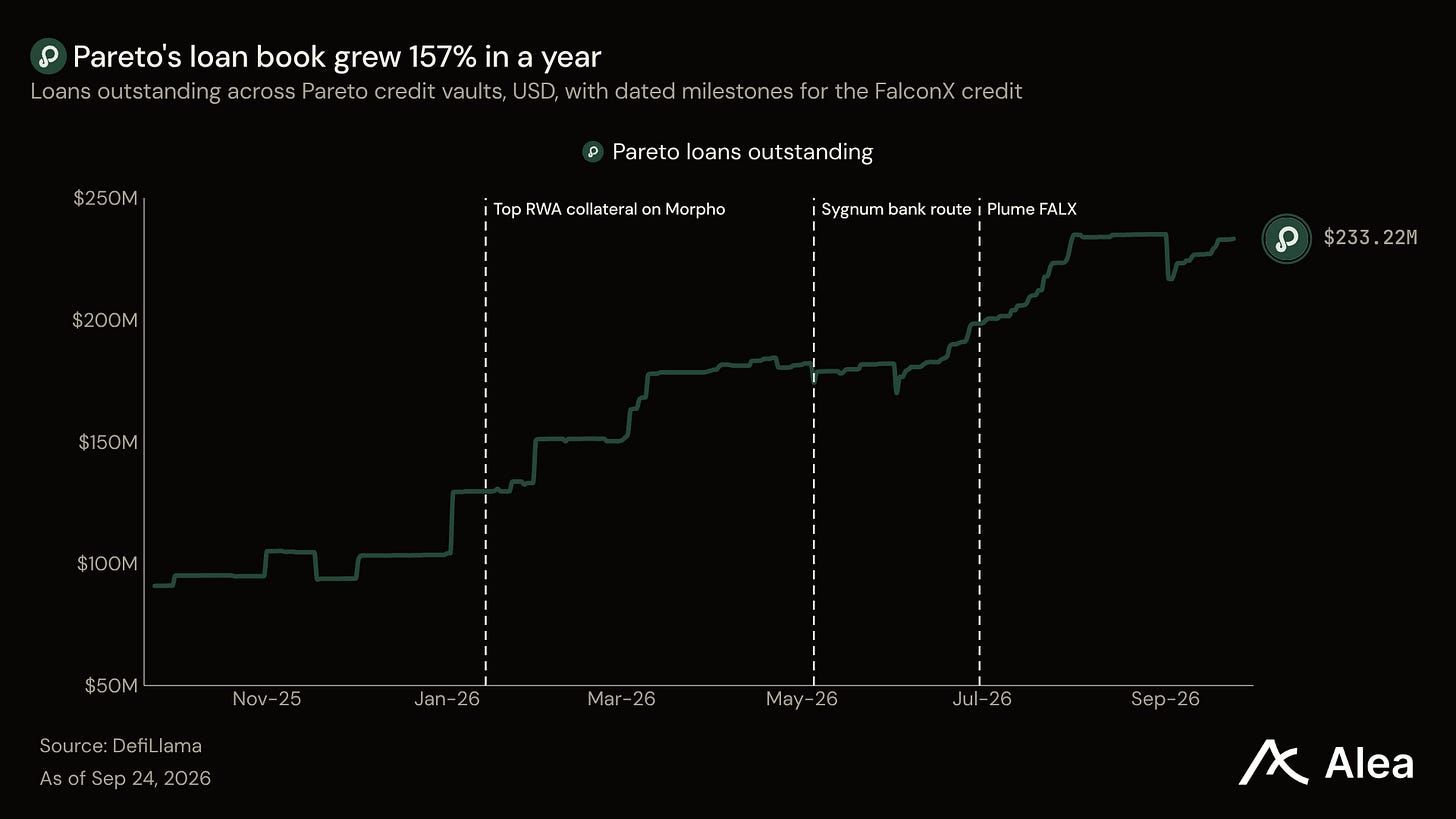
Tokenization solved the record-keeping problem in private credit, and that exposed the older one: finding enough buyers. Pareto and M11 built for that second problem. Pareto's loans outstanding reached $233.2M on Sep 24, up 157% in 12 months, as one FalconX facility reached DeFi lenders, a looped vault on Morpho, a Swiss bank's clients, and new chains. We spoke with Pareto's chief executive Matteo Pandolfi and M11's Thibault Labidi on our podcast. Labidi argued that the limit sits on the buyer side: onchain capital is not yet large or trusted enough to attract traditional loan originators.
Takeaways
Pareto sells one credit decision many times. M11 underwrites FalconX as a borrower once, and the same exposure now reaches DeFi lenders, looped positions on Morpho, Sygnum Bank's clients, and lending markets on three more chains.
A FalconX lender keeps 7.62% a year after Pareto's fee, against 4.04% on three-month T-bills. The lender can leave at the end of any monthly cycle, and within 72 hours when the next cycle's rate is at least one point lower.
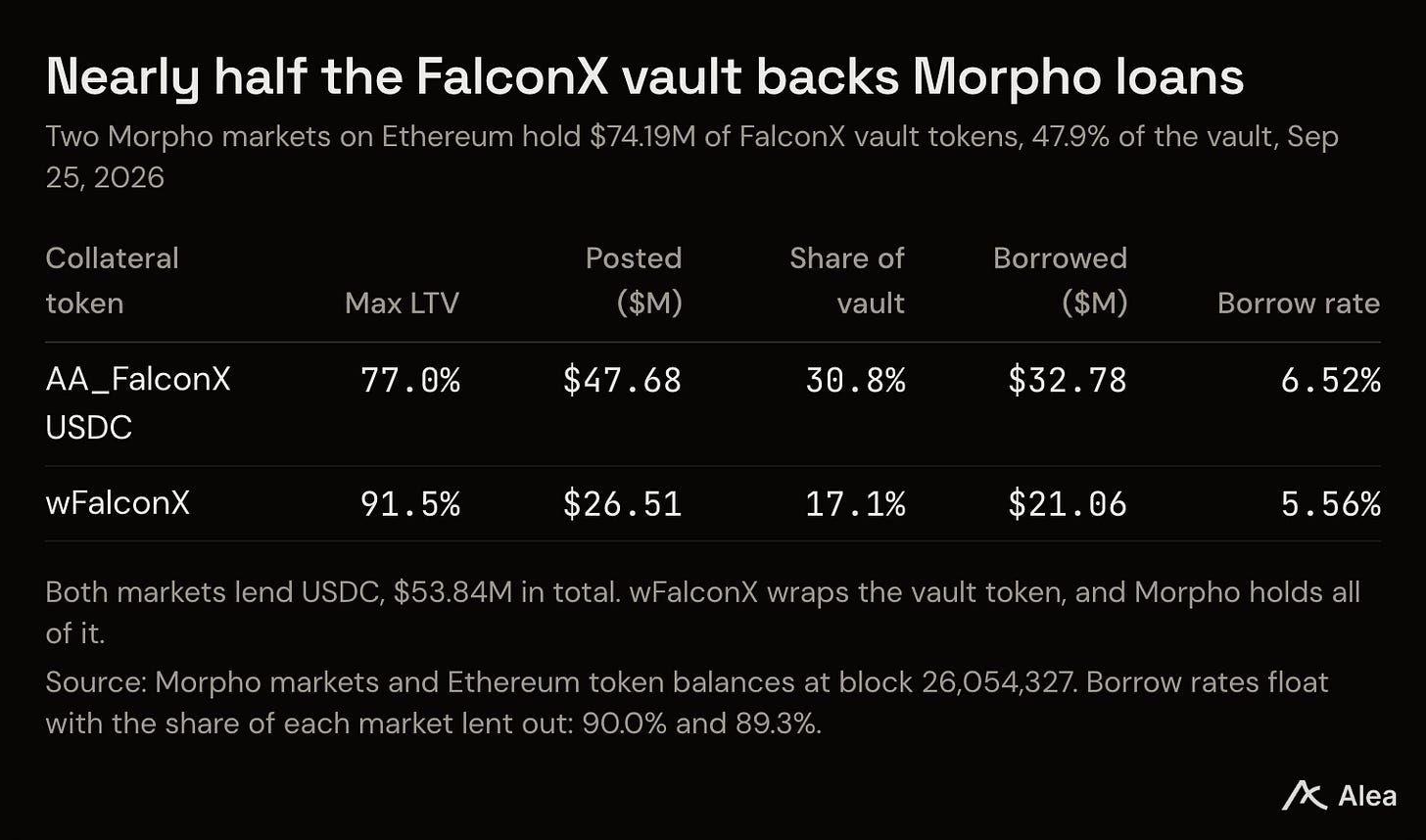
Morpho markets hold 47.9% of the vault as collateral, and lenders have borrowed $53.8M of USDC against it. The loop pays while the vault's rate stays above the cost of that borrowing.
Since Sep 1, Pareto has charged the FalconX vault 0.20% of assets a year in place of 10% of interest, and its treasury multisig collects the fees. At current sizes, fees across its five vaults run near $850K a year.
Holder value capture is an option Pareto has not used: PAR, the successor to the IDLE token, has no published fee share or public market. The next dated event is Oct 1, when the FalconX cycle ends, $31.1M of queued withdrawals pay out, and the next rate is set.
One FalconX credit, many ways to buy it
FalconX is a prime broker: it lends dollars to trading firms and hedge funds against their crypto collateral. FalconX launched a Pareto Credit Vault in March 2025, curated by M11 Credit, the credit arm of the investment firm Maven 11. Lenders deposit USDC, Pareto's contracts pass it to FalconX at the start of each monthly cycle, and FalconX pays a fixed rate that resets every cycle. Vault records showed $155.0M on Sep 25, seven times the next largest of Pareto's five active vaults. Pareto has since opened more ways to buy the same credit:
Aug 18, 2025. Pareto announced Morpho markets that take vault tokens as collateral, and Gauntlet launched a vault that borrows against them to buy more.
May 5, 2026. FalconX announced Sygnum Bank as lender of record for eligible clients, with M11 as administrative and collateral agent.
May 12, 2026. Pareto launched the vault token on Monad, where a Morpho market accepts it as collateral.
Jun 30, 2026. Plume and FalconX launched FALX on Plume, Ethereum, and Solana, a facility they said has room to reach about $1B.
Sep 9, 2026. RedStone launched a feed of the vault's value on Monad, Plume, and MegaETH, which lets lending markets there price the token.
Over the same year, loan data showed Pareto's book outgrowing those of two onchain lenders with longer records.
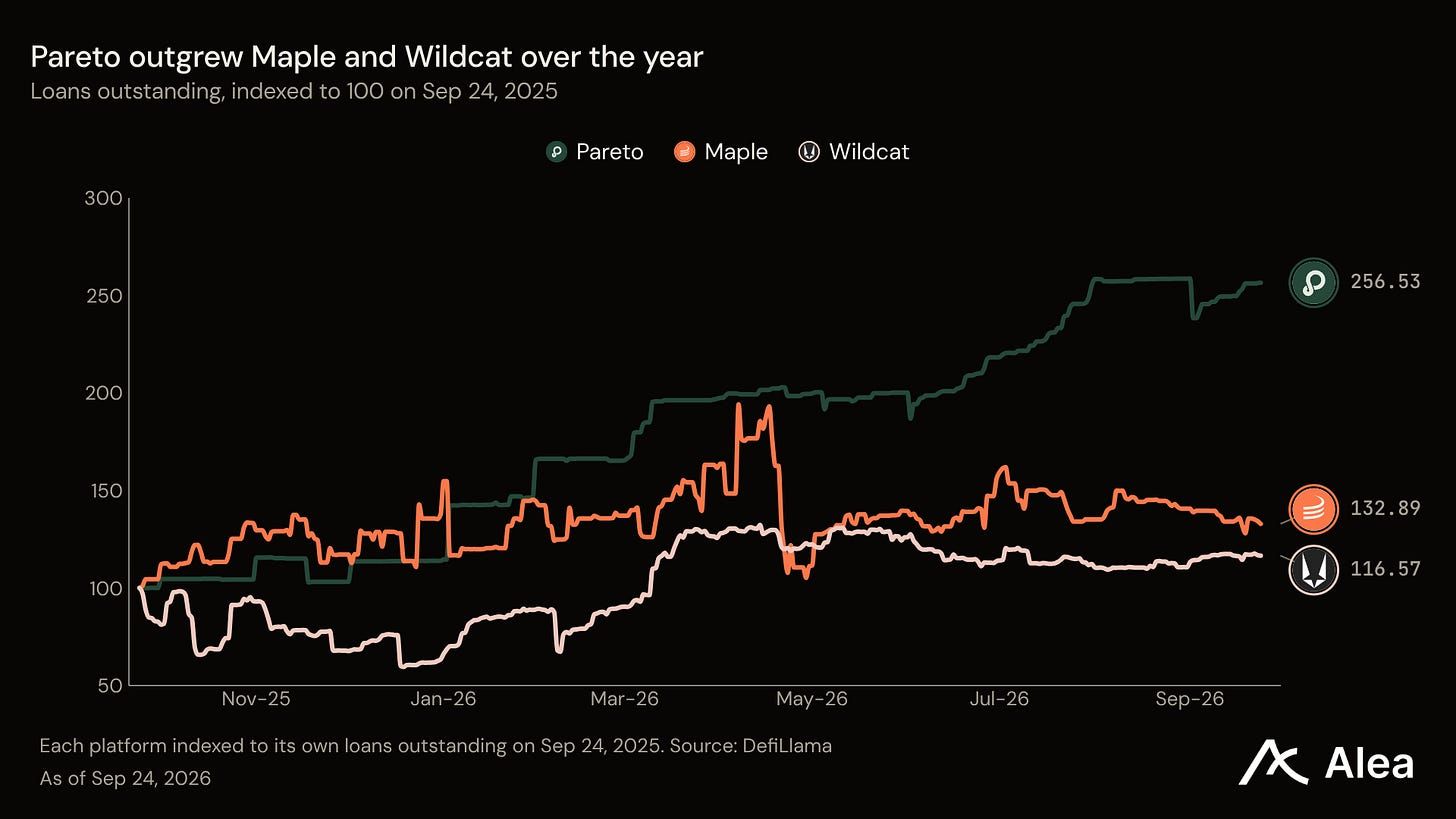
Labidi argued on the show that Pareto answers the buyer problem horizontally. The same contracts run five vaults for five kinds of borrower, from FalconX's prime brokerage to market making and high-frequency trading, and M11 curates the largest.
The biggest route turns the loan into collateral. A lender posts the vault token on Morpho and borrows USDC against it, and that loan can buy more of the same credit. In January Pareto reported that was the largest real-world-asset collateral on Morpho.
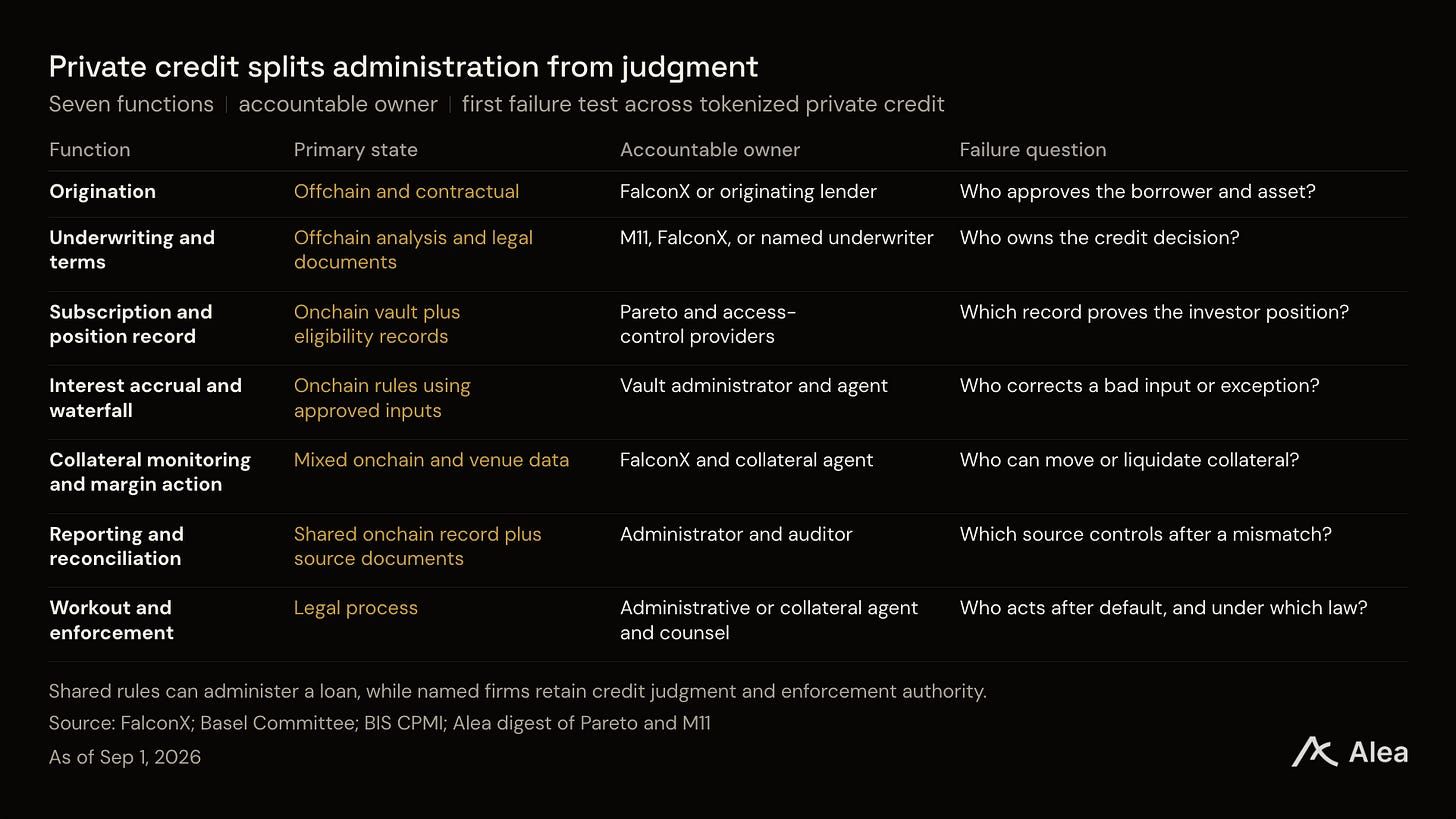
Code runs the cycle, M11 makes the credit call
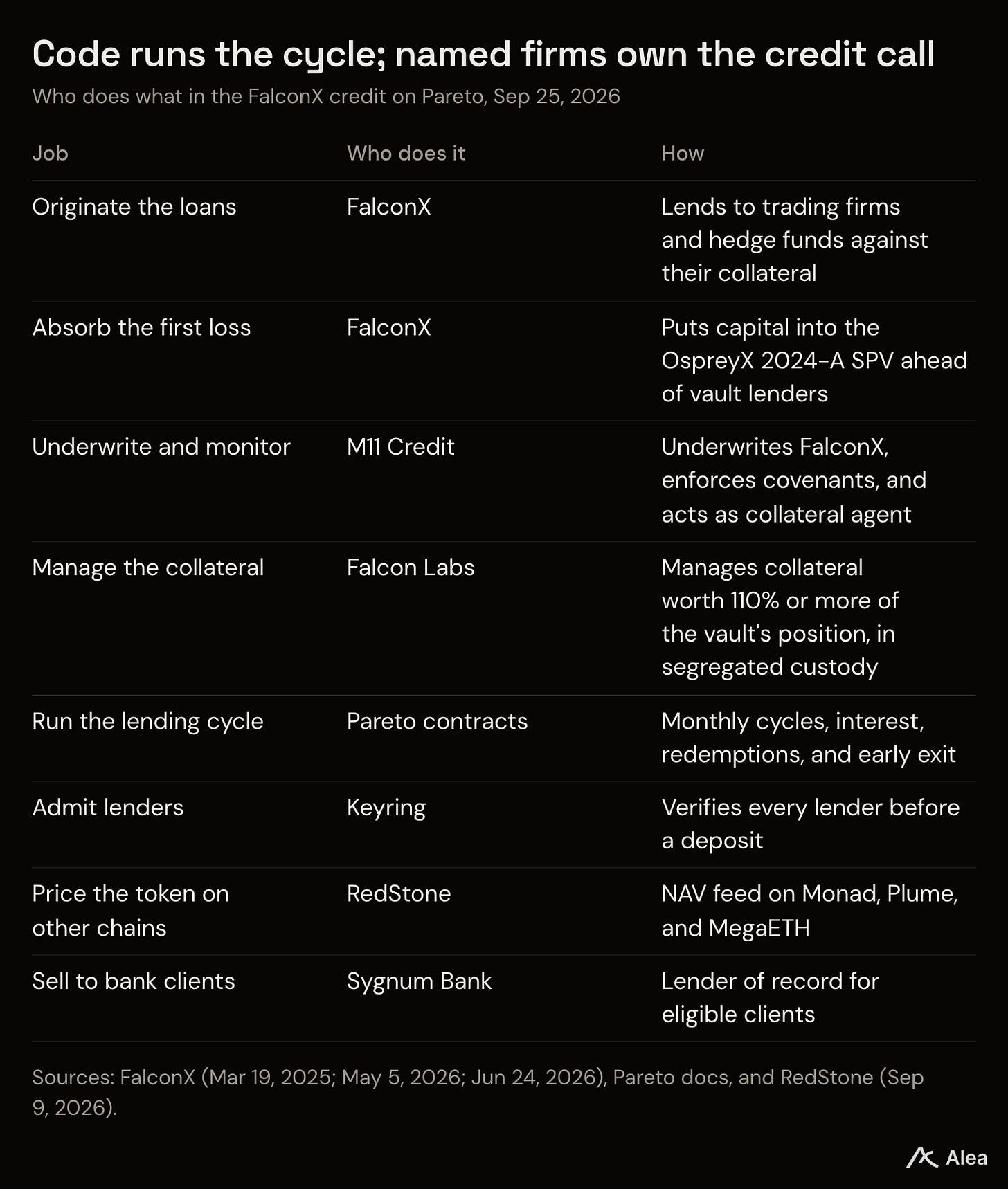
Pareto published the rules its contracts follow. They take deposits only from verified lenders and send the funds straight to the borrower's wallet when a cycle opens. Interest accrues through the cycle, and withdrawals wait in a queue for its end. A lender can leave within 72 hours when the next cycle's rate is at least one point lower than the last.
People own the rest. FalconX disclosed that M11 underwrites its borrowing, enforces the loan terms, and acts as collateral agent. FalconX puts first-loss capital into OspreyX 2024-A, a bankruptcy-remote company that keeps vault lenders' money apart from FalconX's own balance sheet. Collateral worth at least 110% of the vault's position secures the loan in segregated custody, reported by Redstone.
On the show, Labidi remarked M11 carries the legal liability and a veto, and every lender signs an NDA and passes institutional underwriting before seeing the deal terms.
Pandolfi said the structural risk is a default handled badly, where lenders meet a weak legal structure or a waterfall they cannot read. Pareto wants curators such as M11 to run a workout onchain, in view of every lender. The Basel Committee published the same bar for banks: a tokenized asset must carry the same legal rights, including claims in insolvency, as the asset beneath it.
The monthly cycle is also the exit, and lenders use it. The vault's strategy contract showed $31.1M of withdrawals queued for the cycle that ends on Oct 1, equal to a fifth of the vault. A request leaves the vault's value when it is made. That is why the vault reads $155.0M, while Pareto's loans outstanding count the queue until FalconX repays it at the end of the cycle.
Pareto prices the FalconX vault for its lenders
The vault contract showed a rate of 7.82% a year for the current cycle. Until Sep 1, Pareto took 10% of that interest. Its treasury multisig then approved a fee of 0.20% of assets a year in its place, and a lender now keeps 7.62%, against 7.03% before the change. The change hands most of Pareto's take on its largest vault back to lenders, widening the spread that the Morpho loop earns.
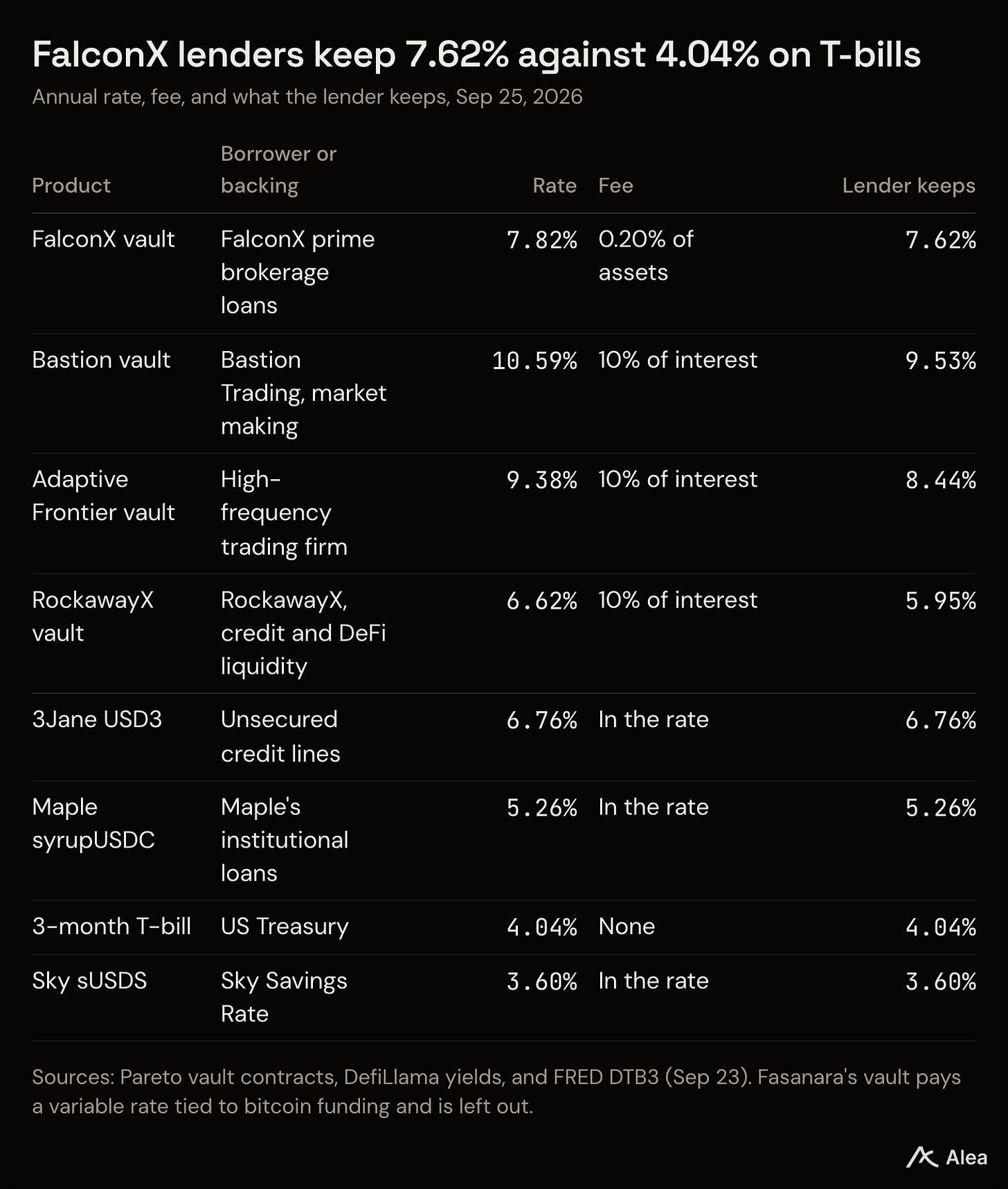
The Morpho loop earns the spread between that 7.62% and the cost of borrowing against the token. Both Morpho markets price that loan below the vault's rate. Each market has lent out about 90% of its deposits, the target Morpho published for its rate model. At 100%, the borrow rate jumps to four times the rate at target, and a looped position loses money whenever that rate passes the vault's.
FalconX pays the interest, and lenders receive it after Pareto's fee. The fees go to a treasury multisig that Pareto disclosed in its documentation. The FalconX vault pays 0.20% of assets a year, and the other four pay 10% or 20% of their interest. M11's pay as curator is not published. Pareto announced PAR as the successor to the IDLE token, and PAR has no public market or published fee share for its holders. Pareto stated that USP, its credit-backed synthetic dollar, sends 5% of the interest it earns to a Stability Fund that absorbs losses before sUSP stakers do.
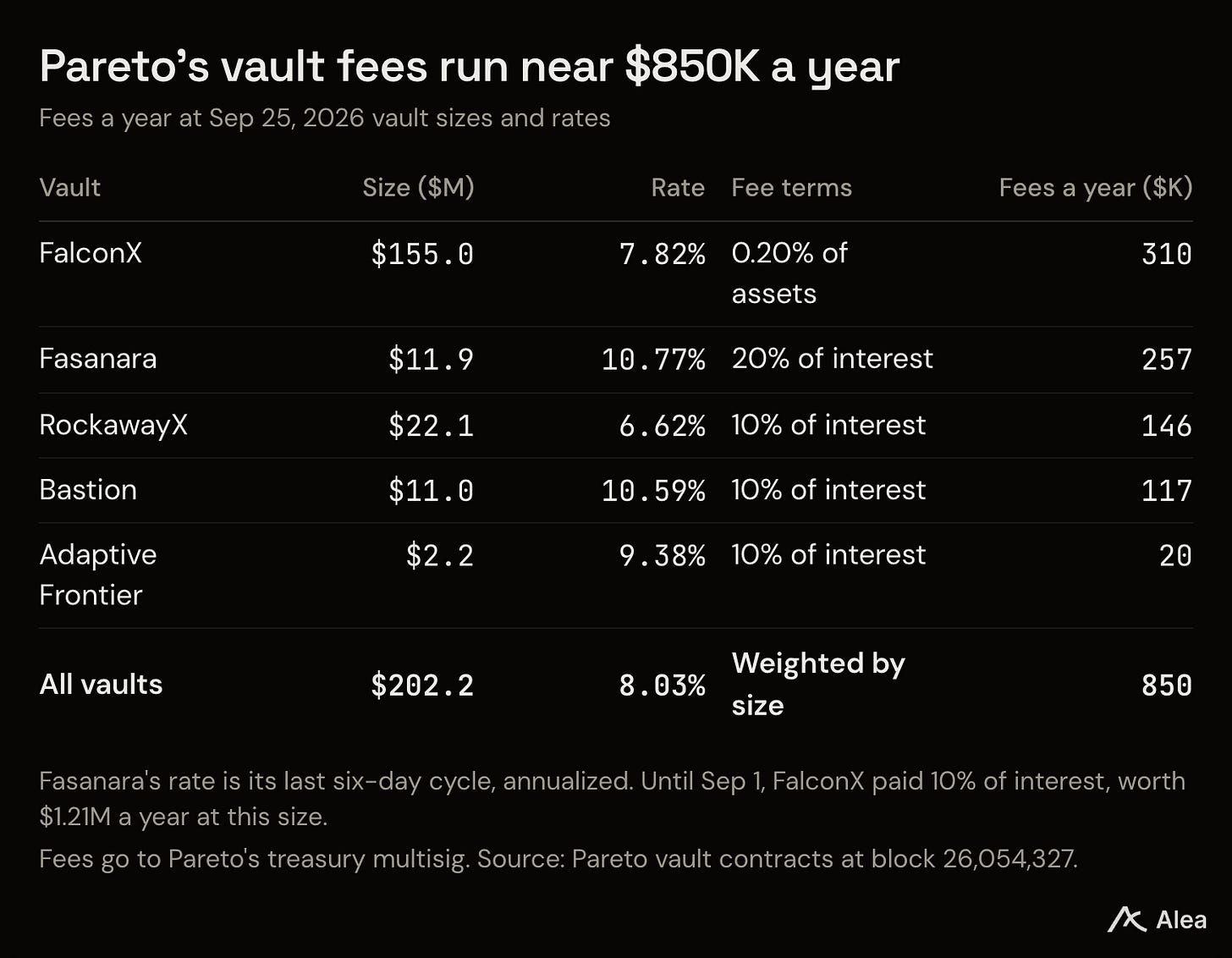
Figure puts loans onchain at birth, and Pareto moves them to buyers
Figure takes the other route: it records the home-equity loans it originates on its own blockchain, Provenance, from the start. Labidi said Pareto does not need that step, because the hybrid model already works with structuring and monitoring kept offchain. Across the market, credit recorded onchain far exceeds credit that investors can move. Market data showed $36.6B held as records that cannot leave the issuer's platform, against $7.9B in tokens that investors can hold and move. Ava Labs' Olivia Vande Woude argued on an earlier episode that the value sits in distribution rather than issuance. In our summer recap, we said that demand sets the pace for tokenized assets.
Altogether, Pareto's advantage is reach. Every route runs on the same vault token, and one underwriting decision by M11 serves every buyer on it. Since Sep 1, each of those buyers keeps more of the borrower's rate. That is the buyer side Labidi called the limit, and Pareto grew its loan book to $233.2M by building it.
Important Links

Alea Research turns conversations like this one into research on protocols and the economics underneath them.
Research reports. Deep Dives and Blueprints explain protocols and their economics. Theses and Memos examine investment cases and catalysts. Benchmarks compare performance, while Perspectives assess specific developments.
Weekly Pulse. Read a weekly assessment of macro and the major liquid markets.
Protocol Data Rooms. Research each protocol in one place, with Analytics for historical comparisons and Intel for news and governance developments where available.
Podcast Digest and Summit Digest. Read summaries of industry conversations and events. Find Alea shows and their episodes through Podcast Digest.
Governance Tracker. Follow proposals and voting activity across protocols.
Our show follows the economics of onchain businesses, from the category down to the contract that books the revenue. This episode covered who carries credit risk and who runs the work around it. If your firm builds that layer, such as custody, collateral administration, compliance, or pricing, sponsoring the show puts your company beside these conversations. Tell us your company and the audience you want to reach, and mention the show in your message.