Coinbase, Robinhood, and Circle. All had big releases with large implications for crypto. Each release with a common denominator: issuance. They all made a bet this year—from tokenized equities to stablecoins—that only pays off if people can reach the assets they issue. Indeed, distribution is king. Jumper routed $934.6M in the 30 days to Sep 10, up 40.3% on the month before, and its fastest-growing destination is a chain that is 74 days old.
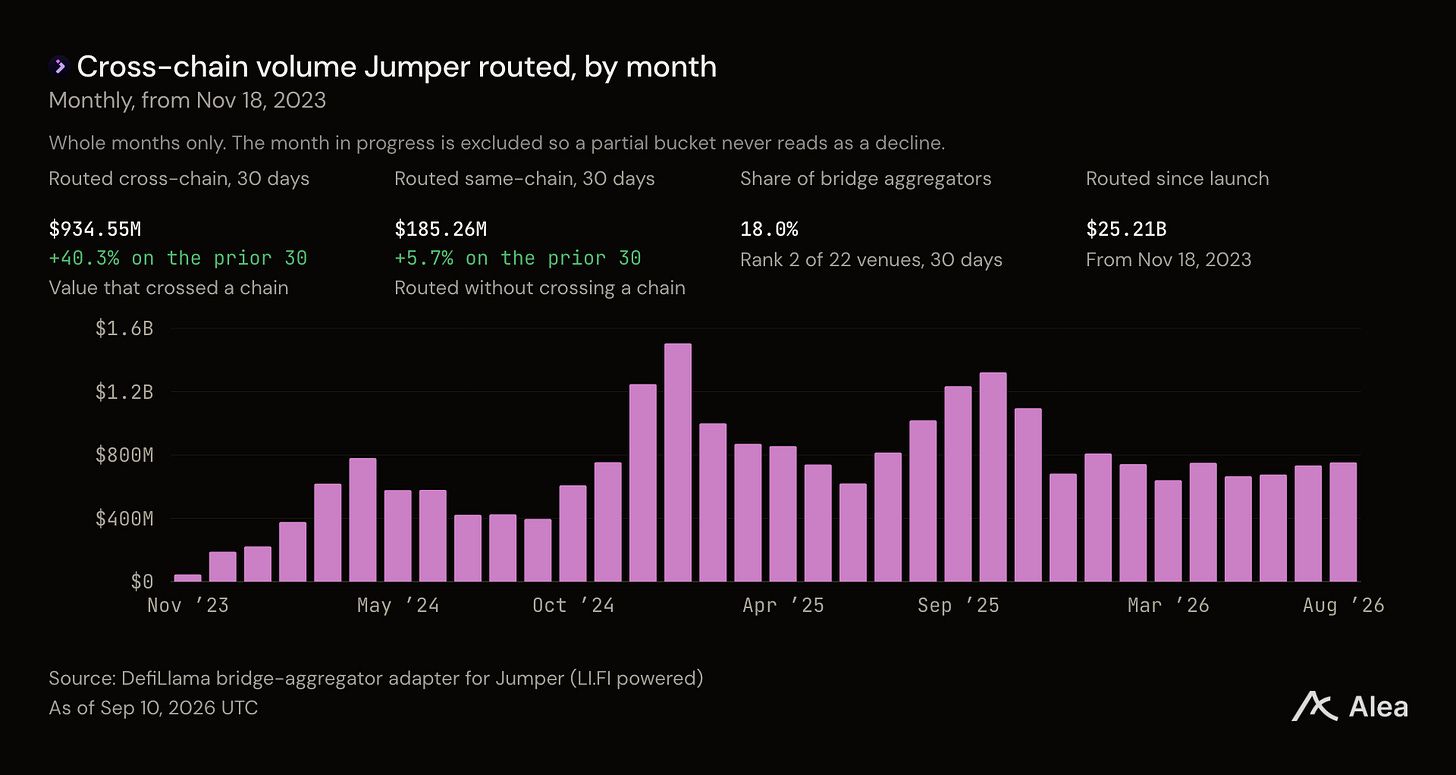
Takeaways
LI.FI distributes tokenized stocks from xStocks, Ondo, Backpack, Robinhood, and Coinbase. One integration reaches every one of them, and carries them to 1,000+ apps and wallets.
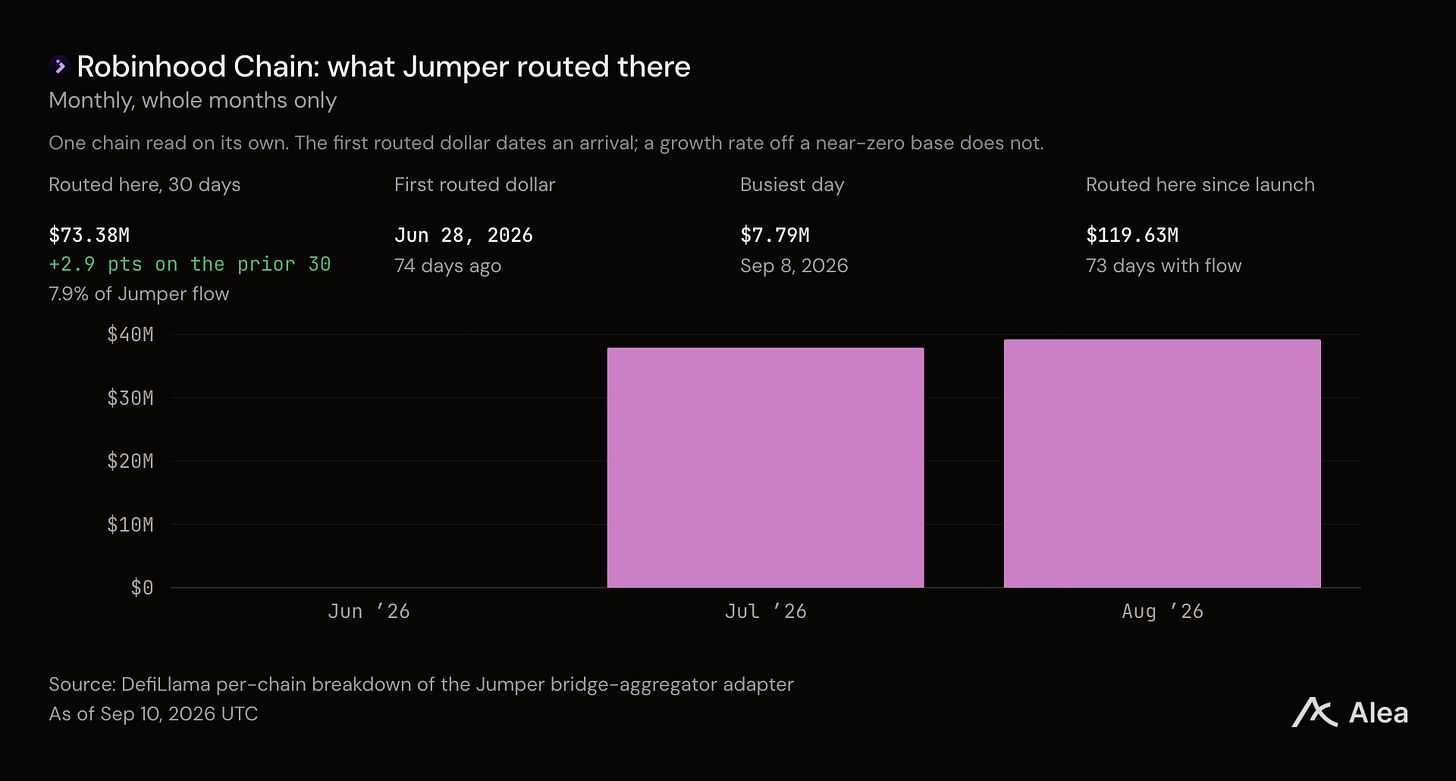
Robinhood Chain went from its first routed dollar on Jun 28 to 7.9% of Jumper’s 30-day volume, up 2.9 points on the prior month and the largest gain in the destination mix.
Intents lets someone start with USDG on one chain and finish holding a stock token on another, in one step, with no manual bridging or swapping.
Advance lifted the median transfer up 39.1% to $89.42 in its first month.
Circle’s Arc mainnet opens on Sep 16 with LI.FI routing to it on day one, the same move Jumper made on Robinhood Chain in June.
Five issuers, one integration
Tokenized equities got their issuers in 2026. Coinbase listed stocks natively on Base in August, and LI.FI was one of the first routing systems to carry them. Robinhood built an entire chain around them. Ondo, xStocks, and Backpack are live. Centrifuge signed on Aug 31. Circle’s Arc opens on Sep 16.
Each of them meets the same problem on launch day. A tokenized share is worth nothing to someone who cannot reach it from the wallet, chain, and asset they already hold. Issuance is the easy half.
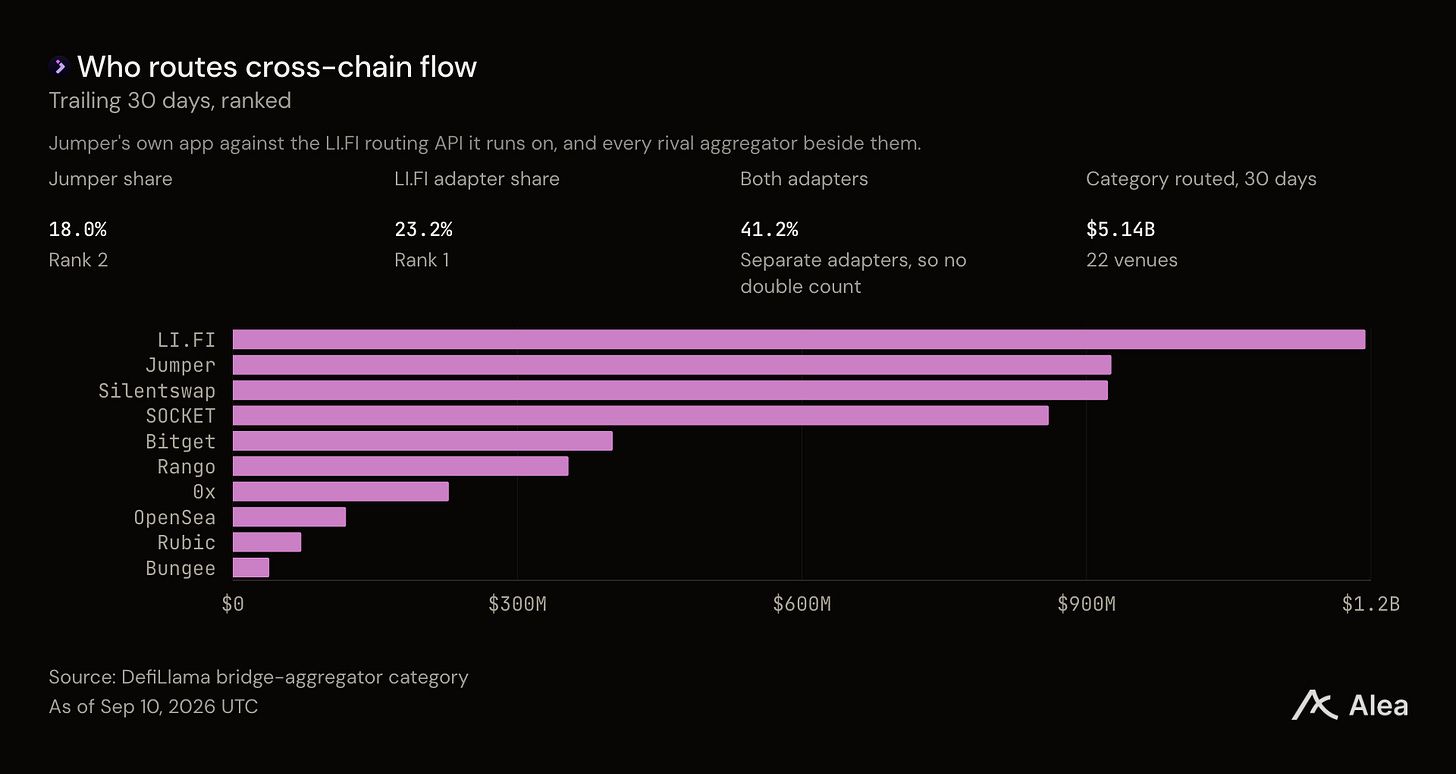
That is the job LI.FI sells. Jumper is the consumer front end that runs on it. The router holds 18.0% of a $5.14B bridge-aggregator category, second of twenty-two venues, behind the LI.FI routing API it runs on at 23.2%. DefiLlama books the two as separate protocols, because Jumper’s transfers sit outside the LI.FI row rather than inside it, so the shares add. The LI.FI stack routes 41.2% of the category.
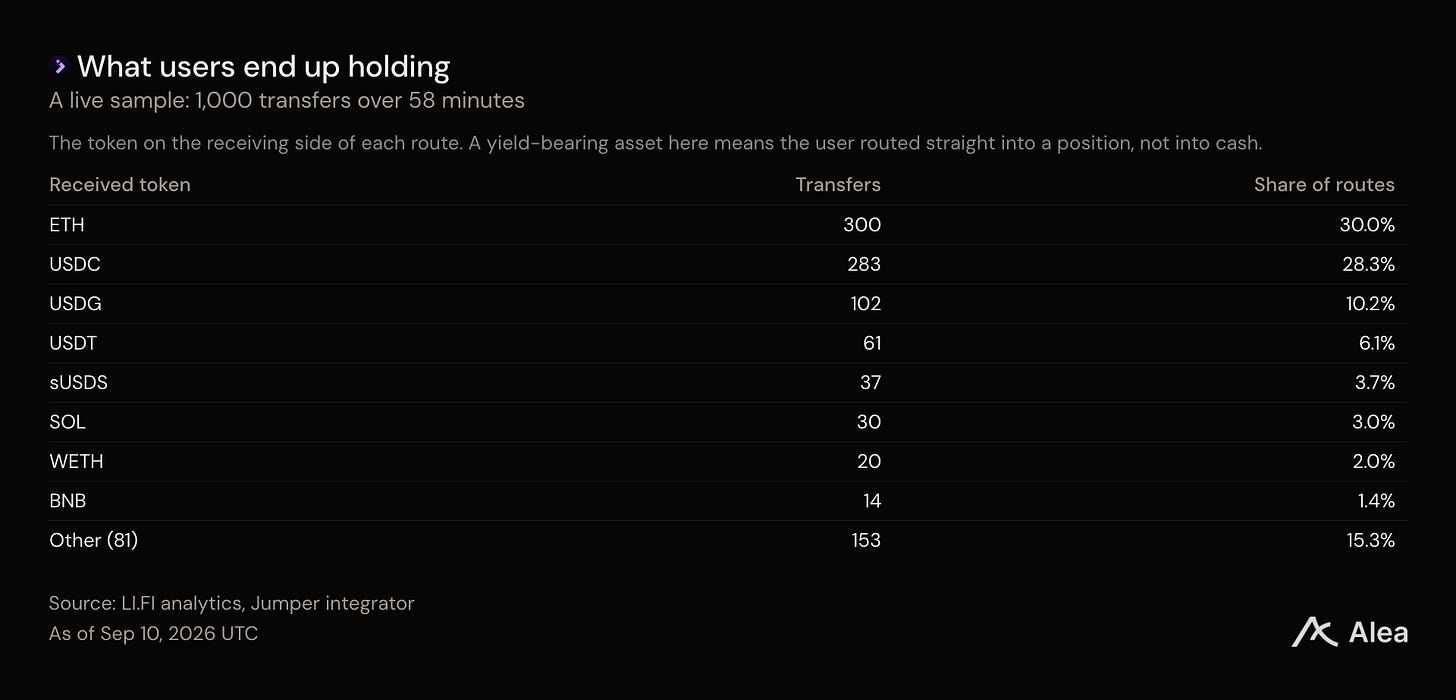
The median transfer is $91, and stablecoins take about half of all receive routes.
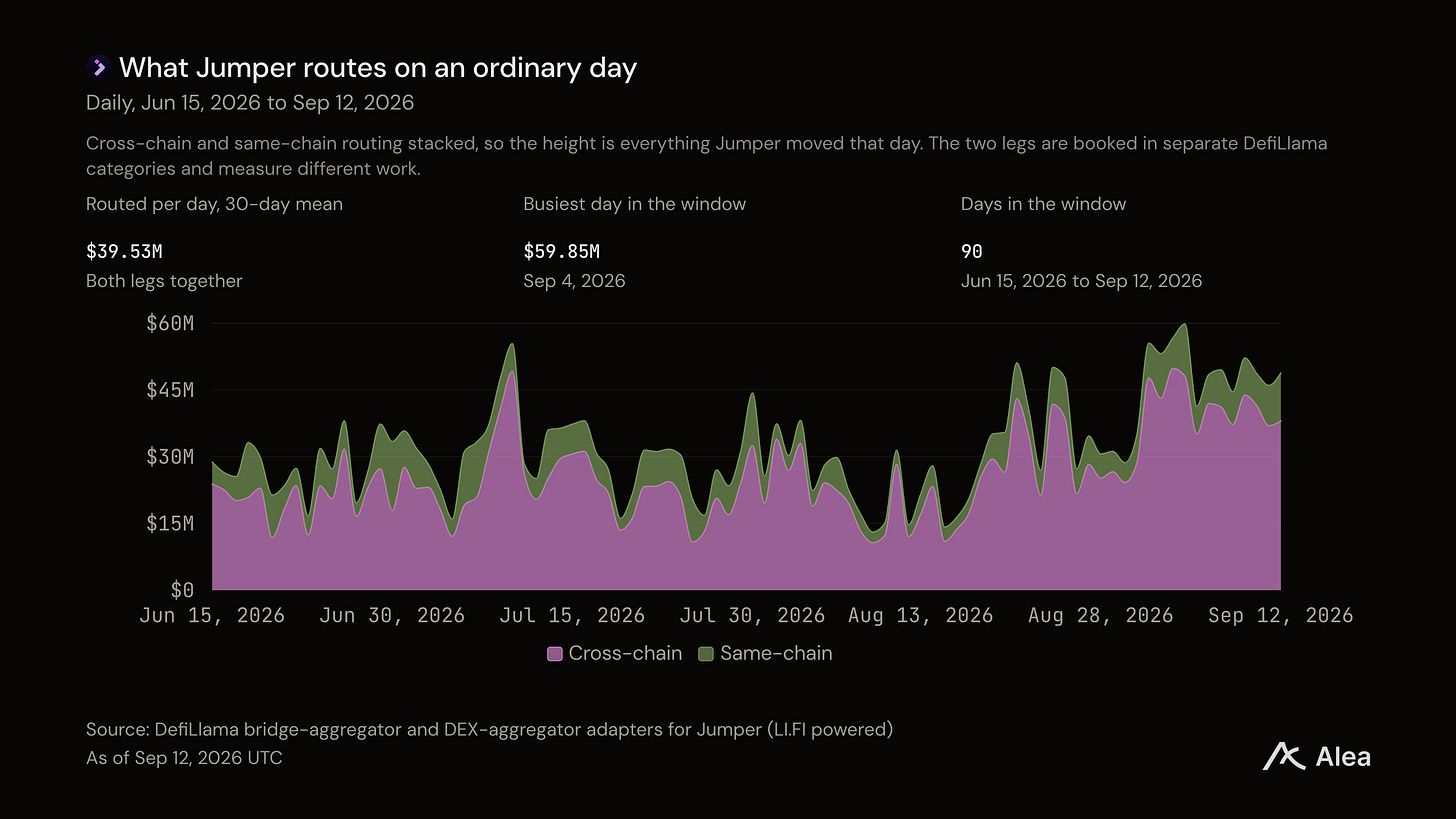
Day to day that comes to $39.5M routed on an average day across both legs, with the busiest day of the quarter reaching $59.9M on Sep 4. The pace has been climbing since the middle of August.
Robinhood Chain went from nothing to 7.9% in 74 days
Robinhood Chain routed its first Jumper dollar on Jun 28, 2026. Seventy-four days later it carries 7.9% of Jumper’s 30-day volume, the fifth-largest destination behind Ethereum, Arbitrum, Base, and Solana. That is $73.4M in 30 days and $119.6M since launch.
It is also the largest share gain in the destination cohort, up 2.9 points on the prior month. Ethereum added 1.3 points, Ink 1.2 from a much smaller base, and Solana 1.1. No chain lost more than a point. The flow is widening toward whatever opened most recently rather than concentrating behind one winner.
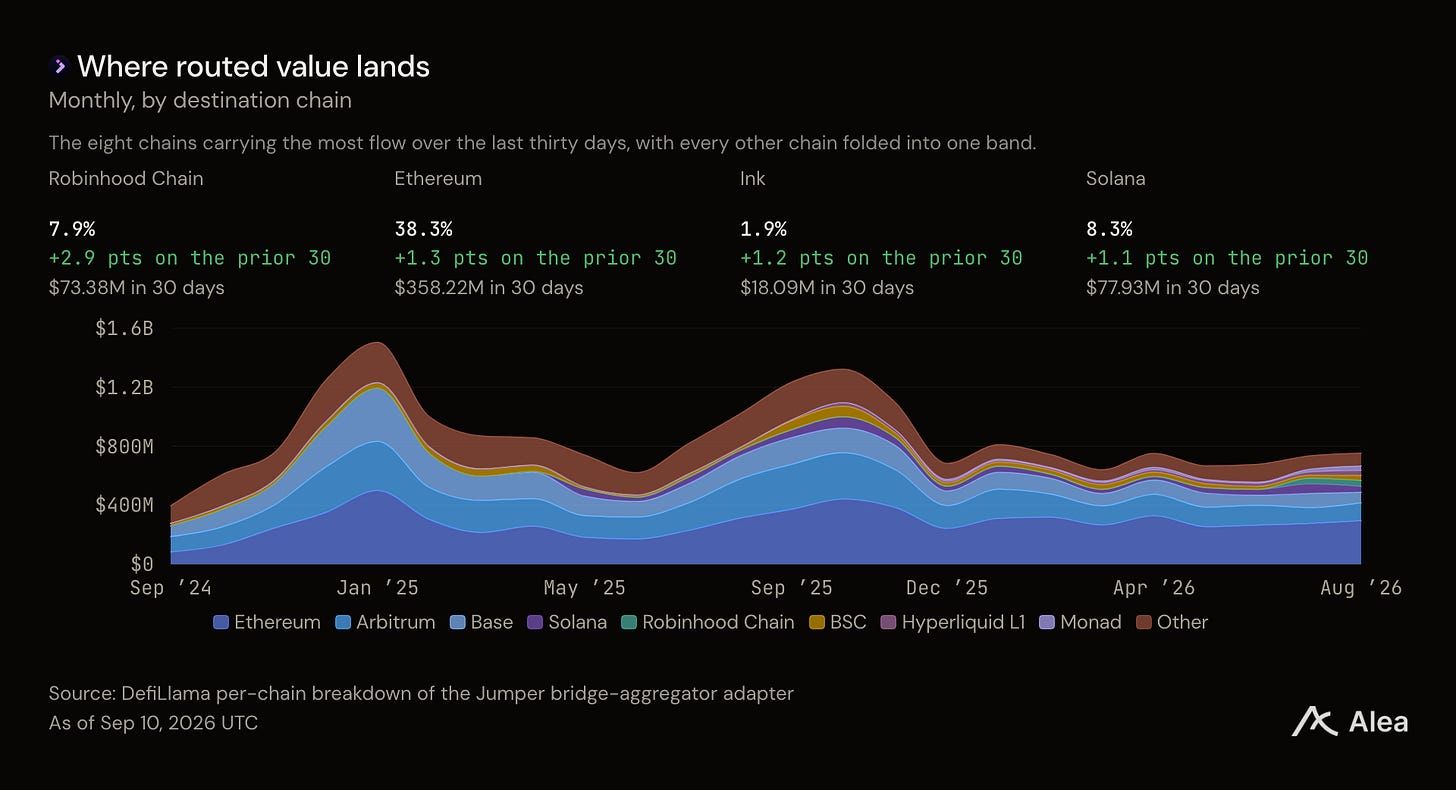
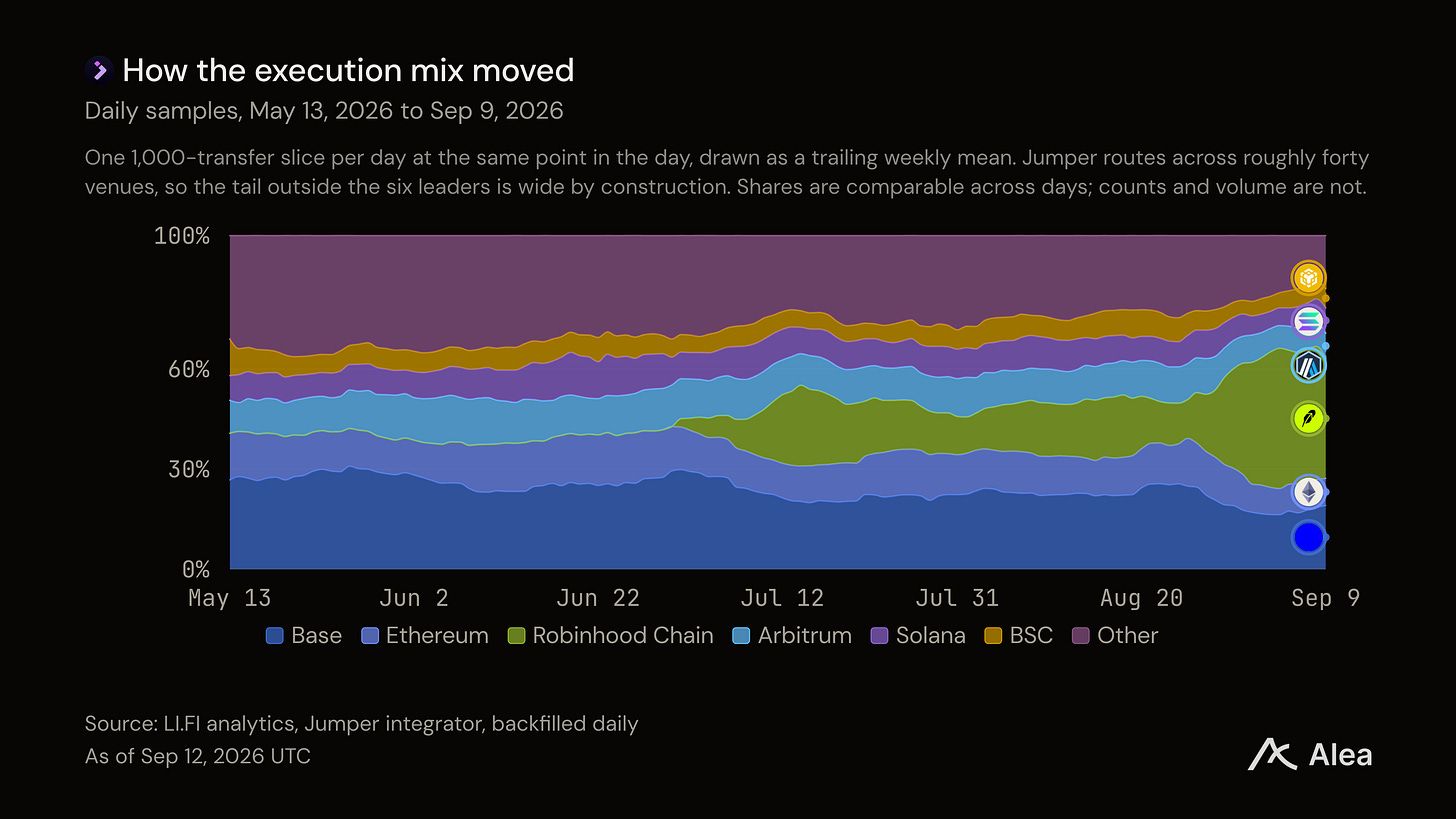
Dollars are one lens, and route count is another. By share of the routes Jumper samples each day, Robinhood Chain runs near 26% against 7.9% of the dollars. The chain is pulling in a great many small transfers rather than a few large ones, which is what a retail venue looks like when it is working.
Forty tokenized assets, and the routes to reach them
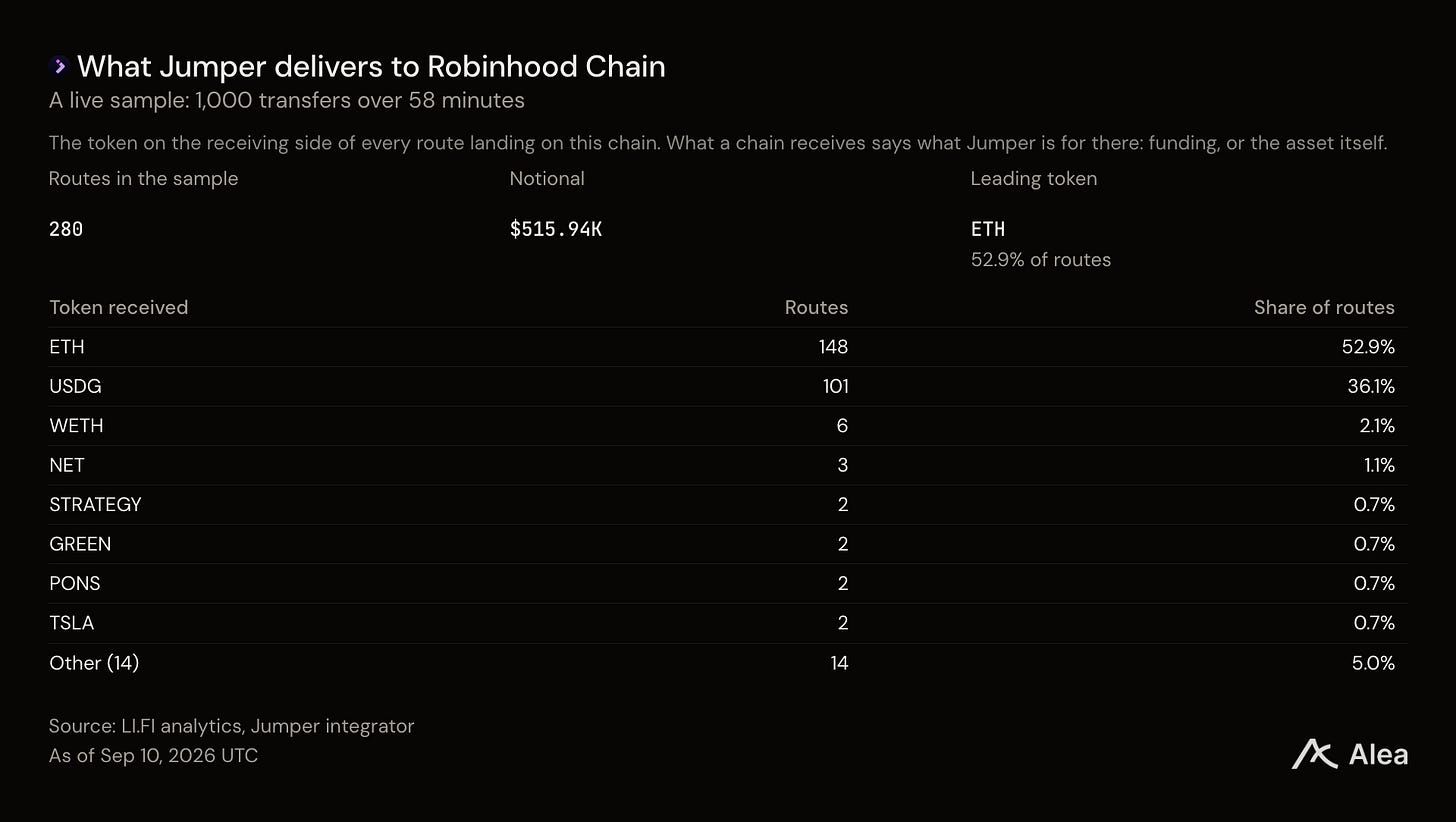
Robinhood Chain is built around tokenized stocks, and Jumper is one of its funding routes. Of 280 transfers landing there, 52.9% arrive as ether and 36.1% as USDG.
Every asset Robinhood lists needs dollars before it can trade, and Jumper is one of the routes that brings them.
Intents routes a stock-token purchase directly. A user starts with USDG on one chain and ends holding SPCX on Robinhood Chain, with solvers competing to fill the order.
Apps get that route without building solver infrastructure, and LI.FI ships it to 1,000+ integrations including Robinhood Wallet, MetaMask, and Phantom. Jumper also runs a separate property at rwa.jumper.xyz carrying about forty tokenized assets, from NVDA and SPY to gold and short-dated Treasuries.
Across 120,000 routes through Jumper itself over four months, tokenized equities account for 34. Jumper’s own app is one route of several, and it is the one least likely to carry the trade. Building distribution before the demand arrives is the point. The default route into an asset class is only cheap to own while the asset class is small.
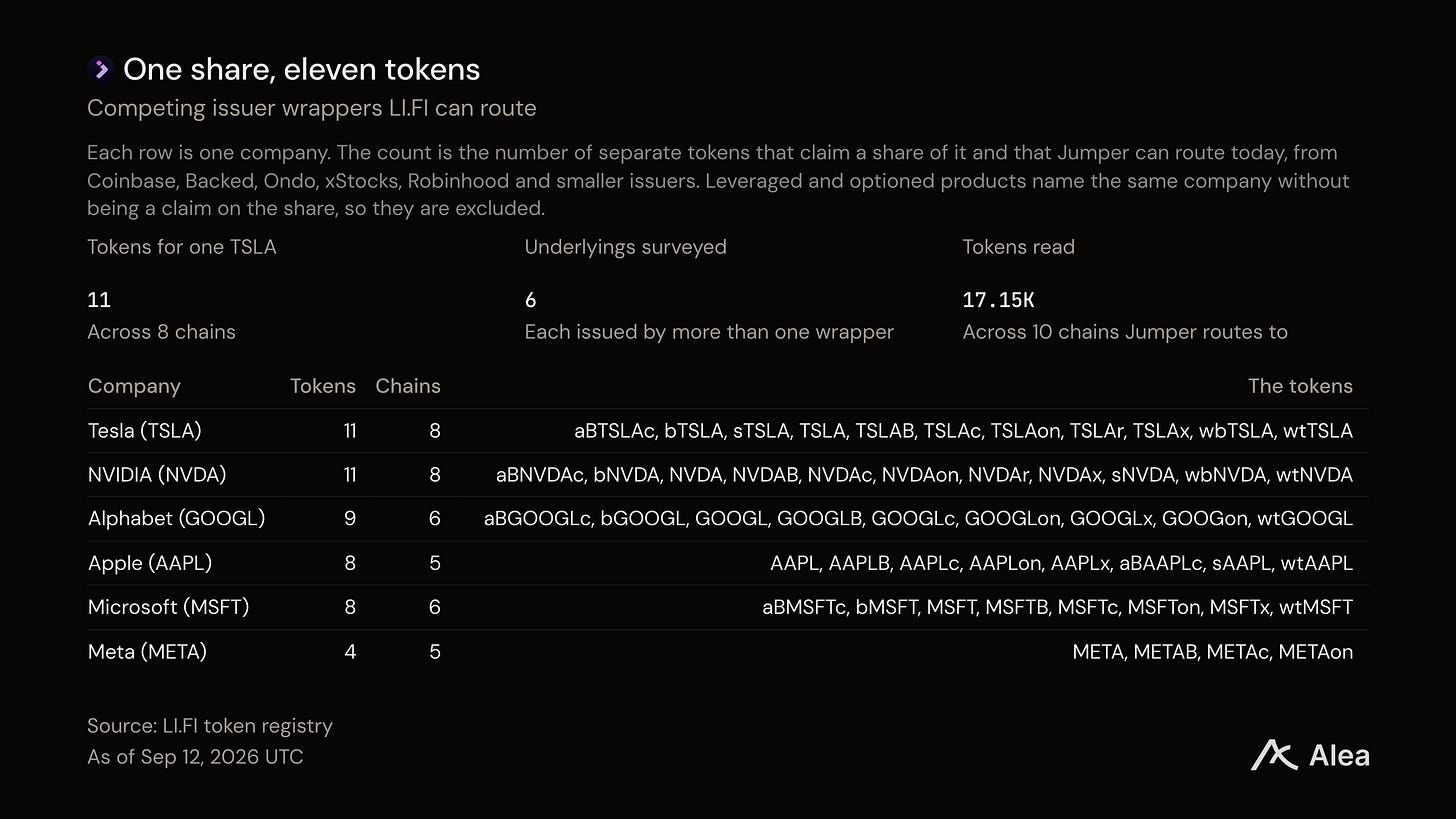
The fragmentation is worse than the demand number suggests, and it is the reason this layer gets paid. One Tesla share is eleven separate tokens on LI.FI’s own registry, spread across eight chains, minted by Coinbase, Backed, Ondo, xStocks, Robinhood and smaller issuers. NVIDIA is another eleven. A holder of one cannot spend it where another is quoted, so someone has to make them interchangeable.
What it costs to move money
Jumper shipped Advance in the first week of August: simulated swaps, smart slippage, large order splitting, and limit orders through CoW Swap and 1inch. August also added perpetuals and Solana quote simulation.
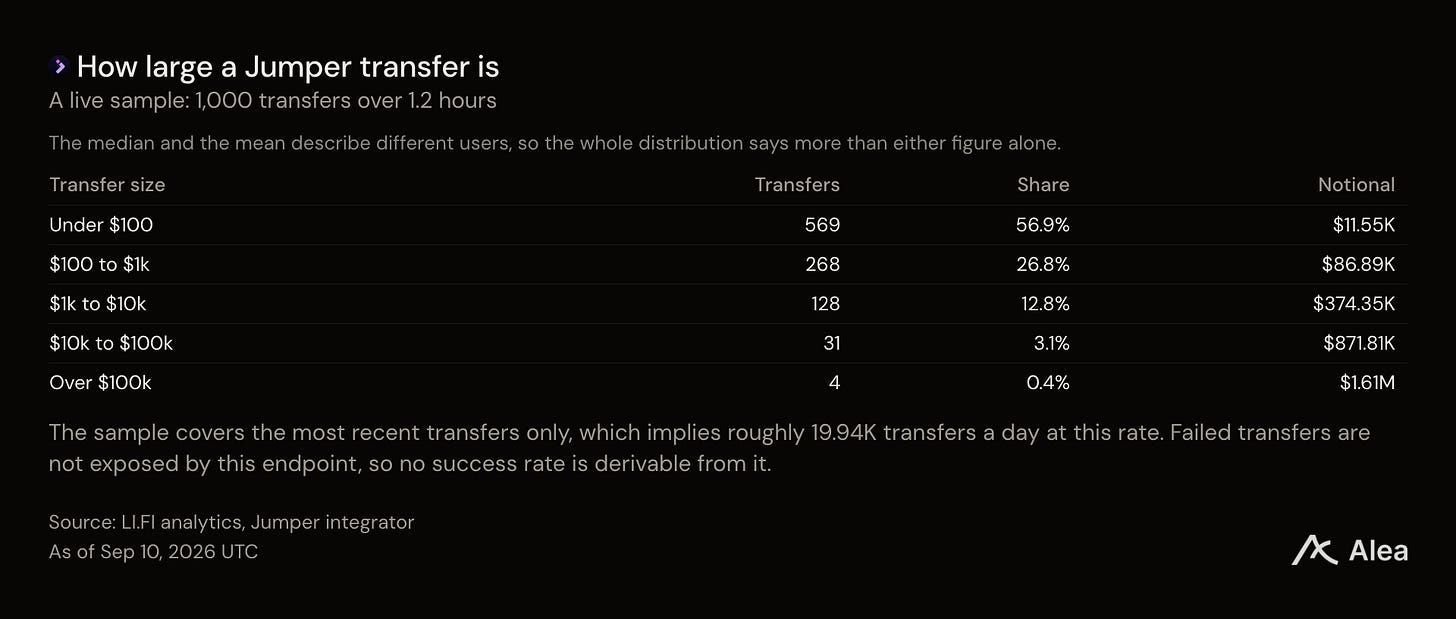
The median transfer rose from $64.30 to $89.42 across the launch. The upper tail moved the other way. The 90th percentile fell 10.8% to $2,116.34, and transfers over $10,000 fell from 4.2% of the mix to 3.7%.
Both hold because Jumper grew underneath them. The window needed to collect a thousand transfers fell from 2.65 hours to 1.97. Large transfers rose in count, from roughly 380 a day to 445. They grew more slowly than everything else, and that’s why their share of the mix fell while their count rose.
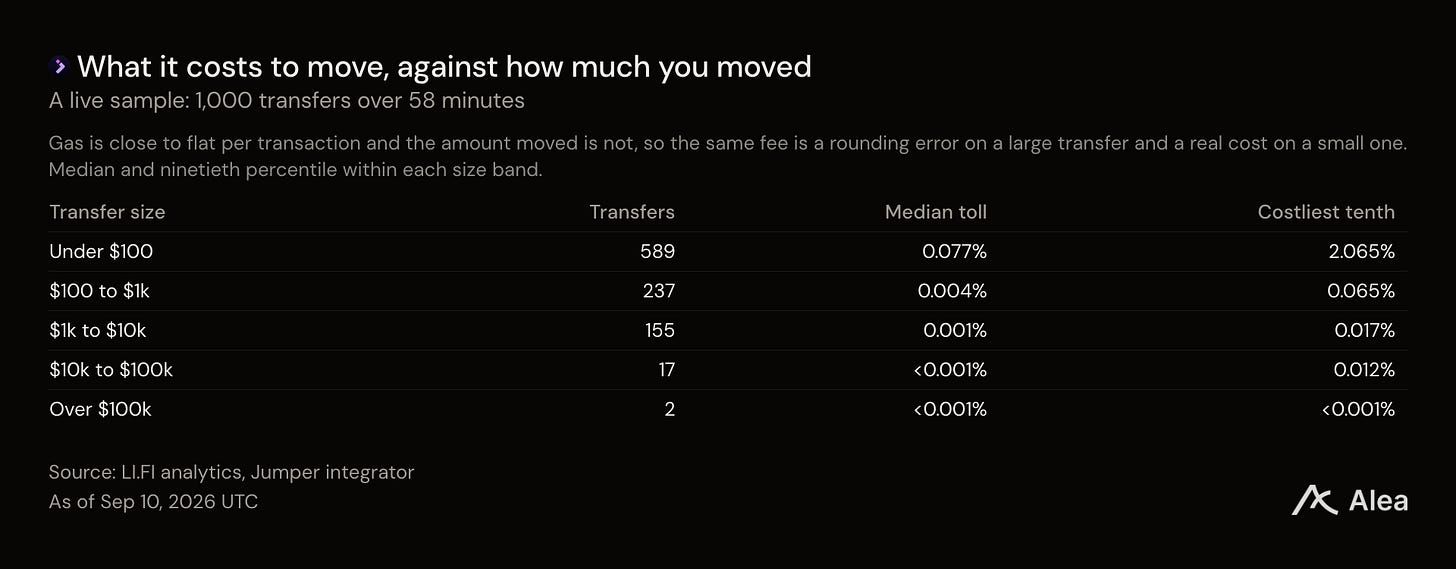
Gas is close to flat per transaction while the amount moved is not; the median transfer under $100 pays 0.077% of the amount in gas, while above $10,000 the same fee is under 0.001%. Transfers under $100 are most of Jumper’s flow by count, 589 of every 1,000. Advance was built for the other end of the book.
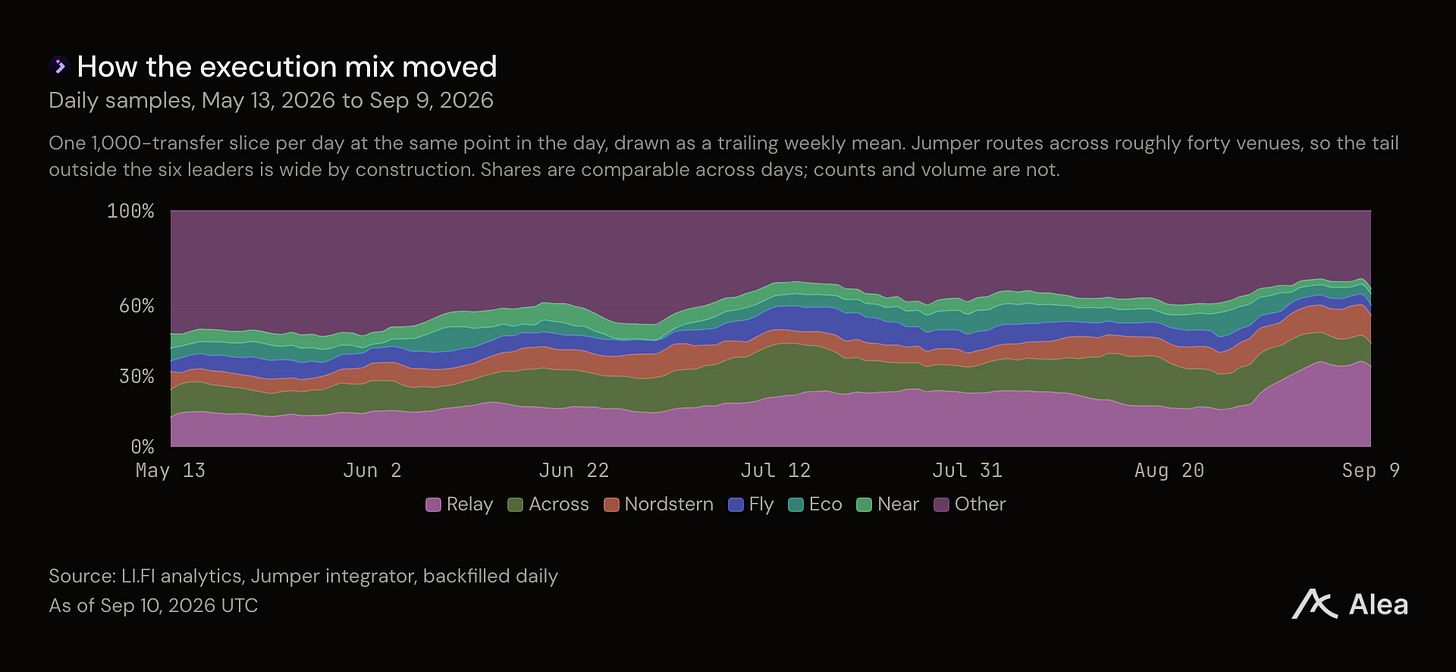
Route selection concentrated over the same period. Relay rose from 13.9% of Jumper’s routing in mid-May to 34.0% on Sep 9 on a trailing weekly mean, and the six leading venues now take about two-thirds of route selection against half in May.
LI.FI’s own Intents venue now runs at 6.2%. LI.FI owns that venue outright.
Arc opens on Sep 16
Circle’s Arc mainnet opens on Sep 16 with LI.FI live from day one. One integration brings same-chain swaps on Arc, bridging in from every other supported ecosystem, and one-click deposits. It is the same move Jumper made on Robinhood Chain in June and on Coinbase’s Base listing in August.
The infrastructure underneath kept shipping through the quarter. Intents redeployed to identical addresses on every EVM chain and went live on Solana with sponsored transactions. Smart Deposit Addresses landed on Aug 19, turning an onchain action into a plain token transfer with no approval to sign.
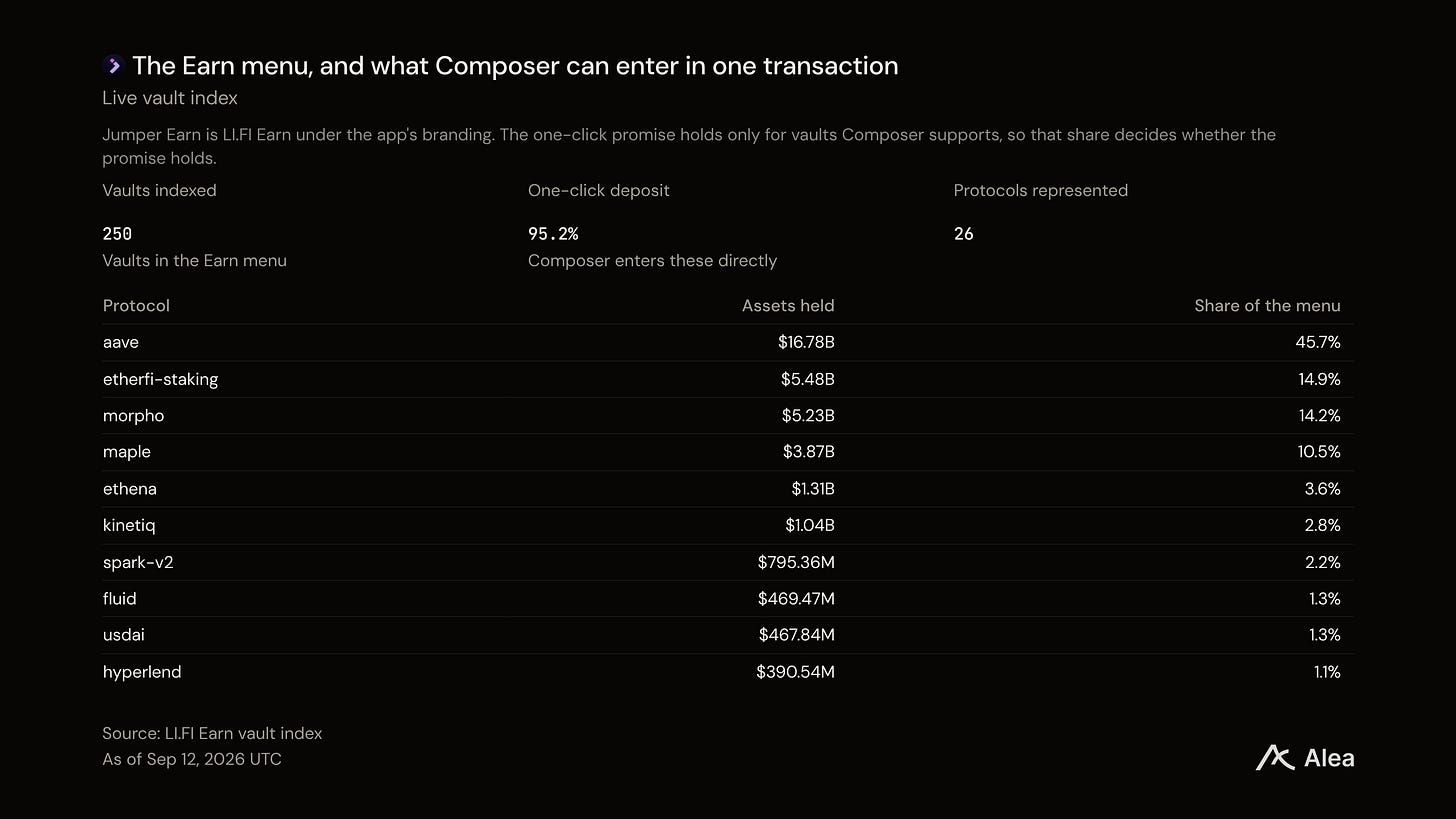
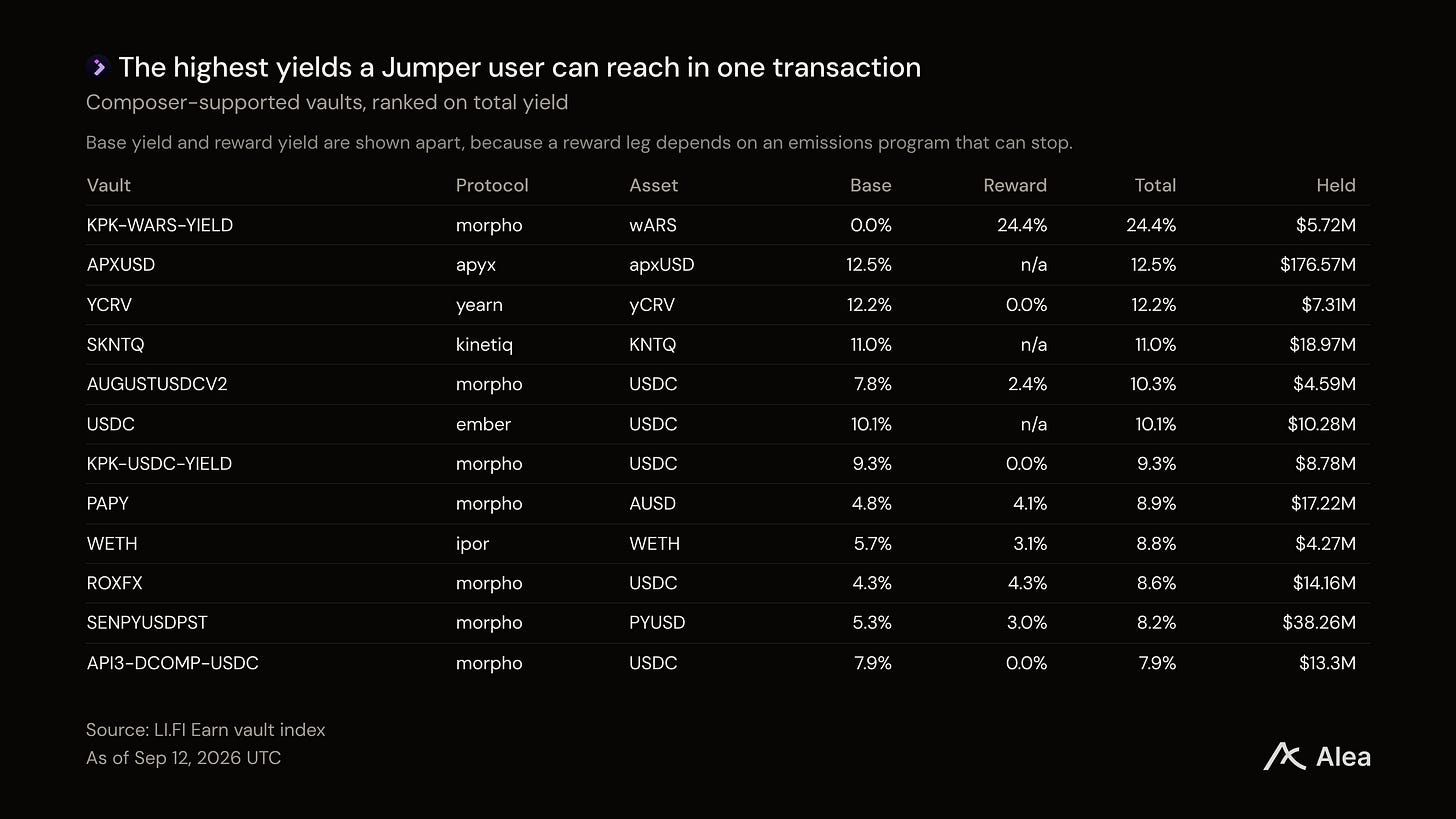
Earn is the allocator layer. It now indexes 250 vaults across 26 protocols. Aave holds $16.8B of that, 45.7% of it. Composer enters 95.2% of those vaults in a single transaction. It added Compound, infiniFi, and Apyx vaults in June, Plume’s Nest in July, and seven-day and thirty-day yield views with insurance-risk tags in August. It now ships inside MetaMask’s Agent Wallet.
What a user reaches through it today runs from 7.9% on a USDC vault to 24.4% at the top of the list.
Robinhood Chain took 74 days to go from nothing to 7.9% of Jumper’s volume. Arc opens on Sep 16 with the same routing already in place. The position compounds while new venues keep arriving, and 2026 has not run short of them.
Important Links

Jumper Exchange has a Data Room on Alea, with the business model, funding, coverage and due diligence behind this edition’s numbers.
Research reports. Deep Dives and Blueprints explain protocols and their economics. Theses and Memos examine investment cases and catalysts. Benchmarks compare performance, while Perspectives assess specific developments.
Weekly Pulse. Read a weekly assessment of macro and the major liquid markets.
Protocol Data Rooms. Research each protocol in one place, with Analytics for historical comparisons and Intel for news and governance developments where available.
Podcast Digest and Summit Digest. Read summaries of industry conversations and events. Find Alea shows and their episodes through Podcast Digest.
Governance Tracker. Follow proposals and voting activity across protocols.
For protocol teams preparing institutional conversations, discuss research for your protocol with Alea.