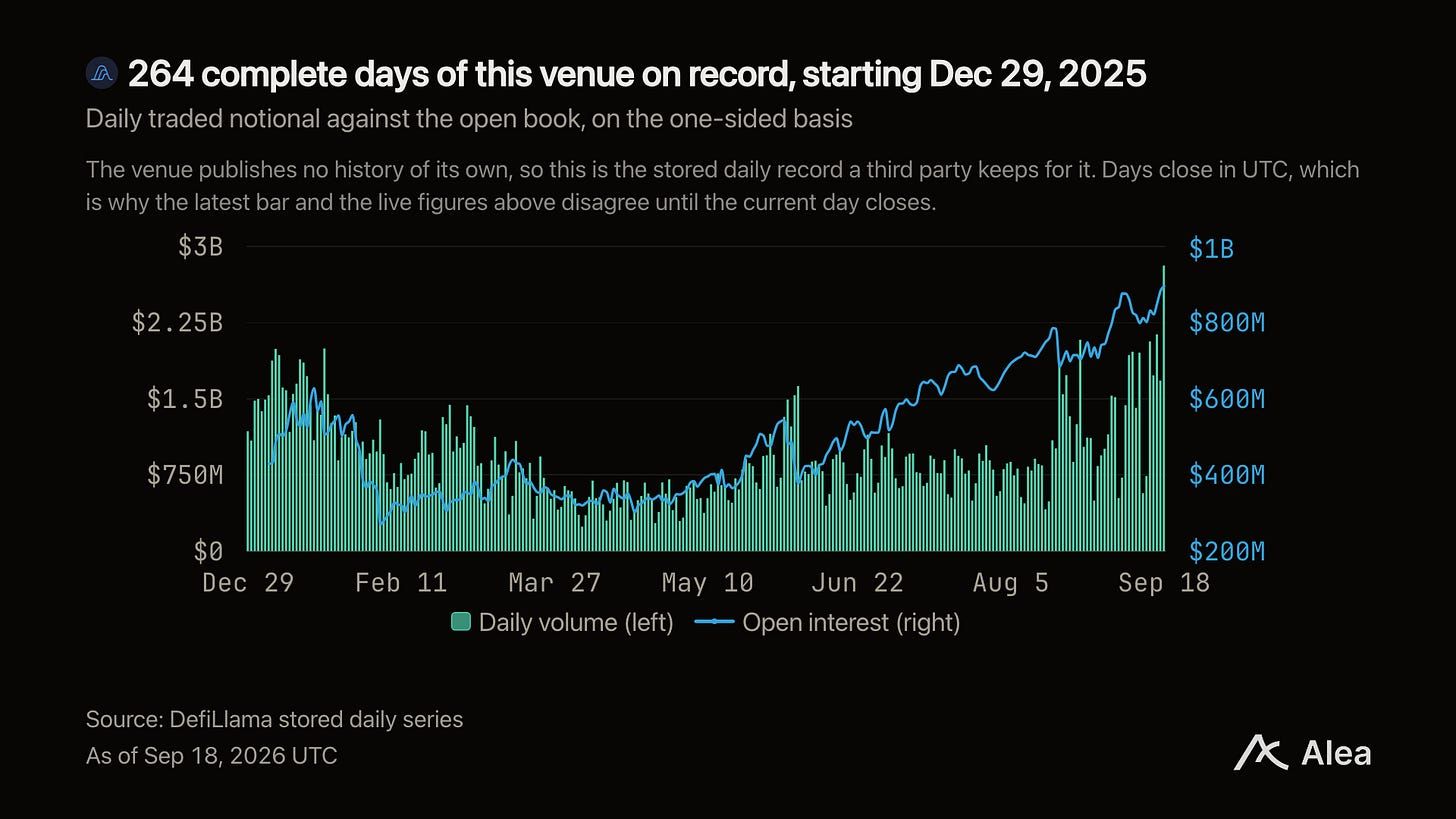
X has spent September pricing a range of $1B to $10B for $VAR. Underneath that spread sits one question: is the volume worth anything once the venue stops paying for it? Onchain perpetual venues recorded $5.69T in the first 261 settled days of 2026. Volume per day fell 30.9% from the first quarter to the third. Variational kept 97% of its own. Its share rose from an April low of 2.71% to 7.17% in September. Open interest closed the window at $895.4M, the highest of its year.
Takeaways
Variational recorded $240.2B of volume between Jan 1 and Sep 18, 4.22% of every dollar traded across onchain perpetual venues, and ranks 7th of the 150 venues with volume this year.
Volume per day across the whole sector fell 30.9%, from $26.6B in the first quarter to $18.4B in the third. Four of the seven largest venues kept half their first-quarter volume or less. Variational kept 97%.
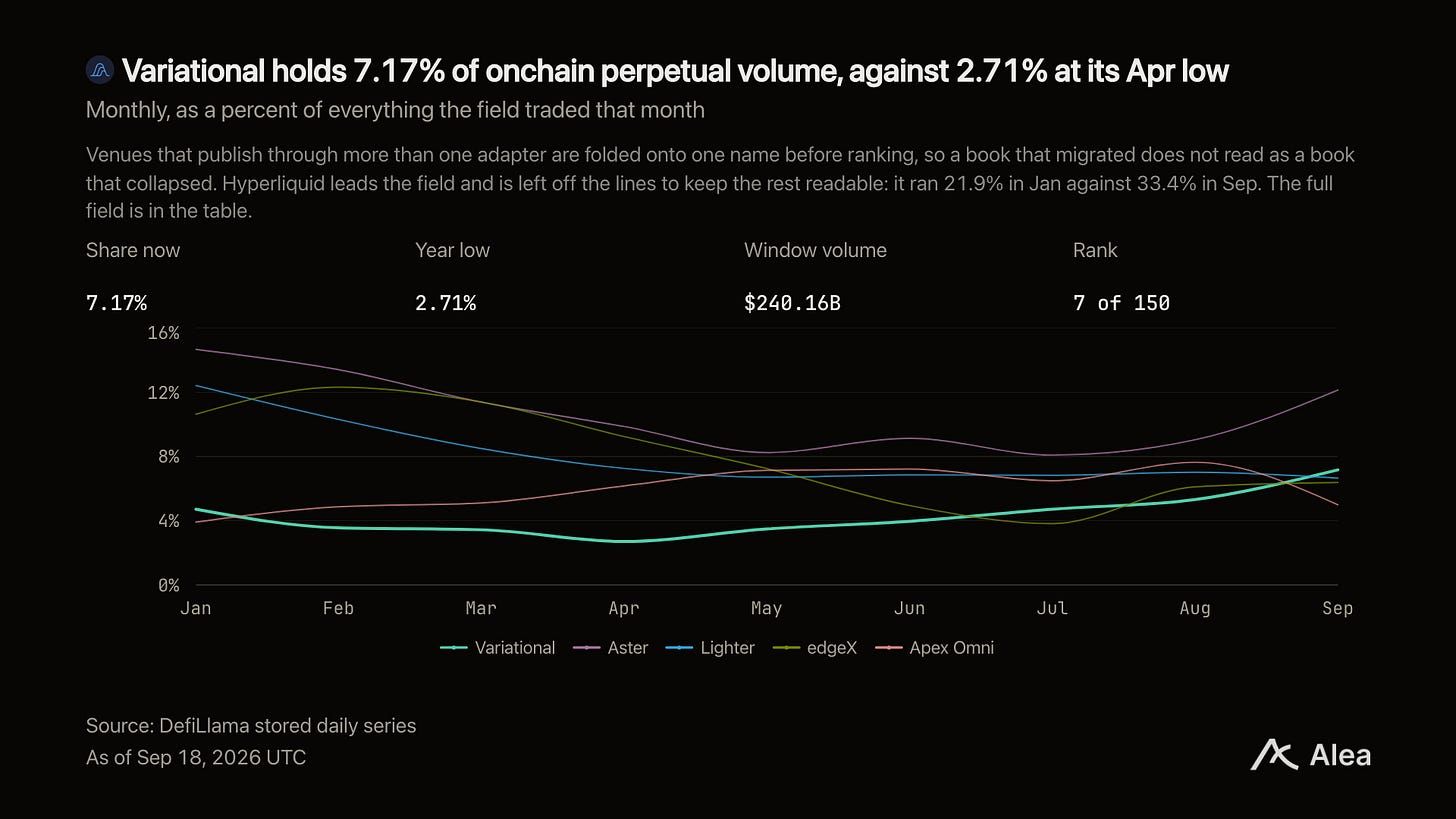
Its share of the sector rose from 2.71% in April to 7.17% across the first 18 days of September, its highest reading of the year.
Open interest rose to $895.4M on Sep 18, a year high and 2.7 times the April low.
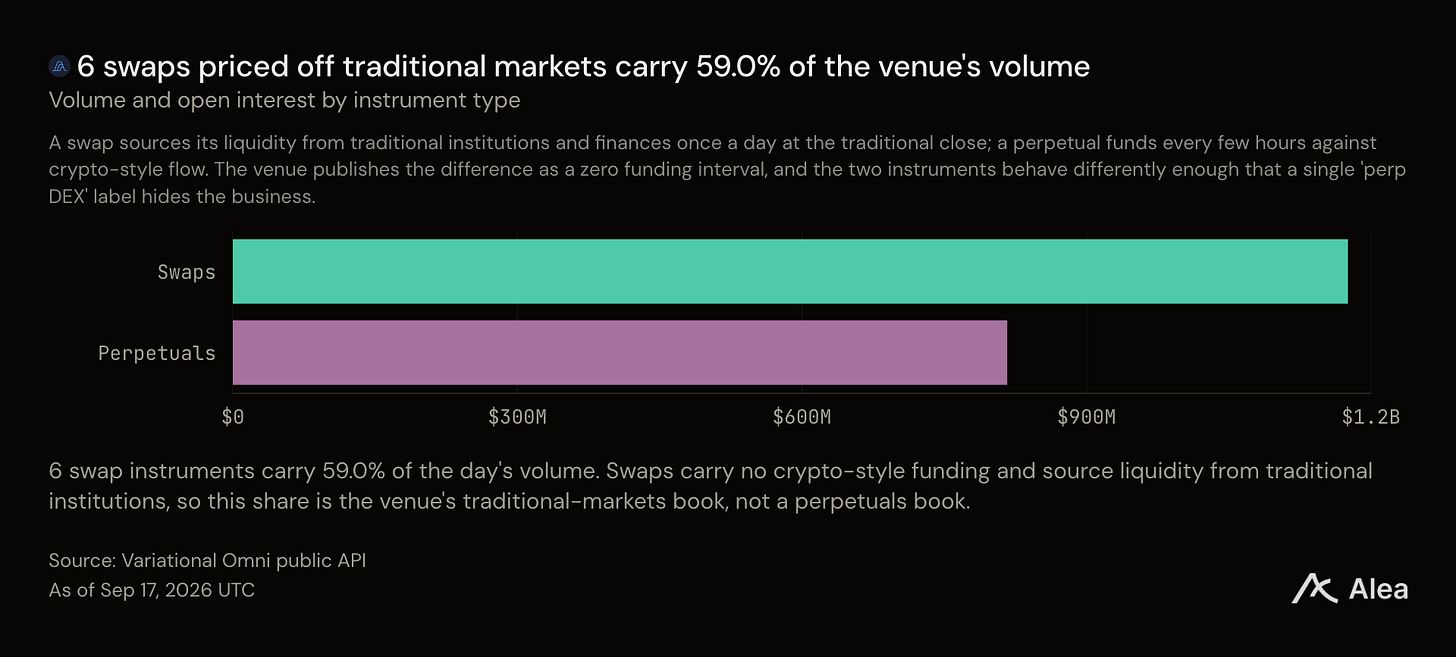
The venue launched swaps on Sep 1, contracts that track stock indexes, metals, and crude rather than crypto. They already carry a larger share of the book than Bitcoin.
The venue
Variational settles derivatives peer to peer in USDC on Arbitrum. Its retail product, Omni, is one cross-margined account for crypto, stock indexes, metals and crude, with more than 500 live markets on it. There are no trading fees at all. Omni does not charge any maker or taker fees.
That leaves one way to earn, and it is the whole design.
A house dealer called the Omni Liquidity Provider quotes every market and takes the other side of every trade. It generates revenue by retaining the market-making yield that is usually extracted by external market makers.
A normal exchange rents its depth from outside firms and charges traders a fee for the privilege. This one owns the firm. In May the company announced $50M led by Dragonfly, with Bain Capital Crypto and Coinbase Ventures alongside.
The year
Variational traded $240.2B in the 261 settled days from Jan 1 to Sep 18. The whole onchain perpetual field recorded $5.69T across the same days. That is one dollar in every twenty-four, on a field of 150 venues.
The sector declined but three venues did not
Every large onchain perpetual venue recorded less this year. Volume per day across the field fell 30.9%, from $26.6B in the first quarter to $18.4B in the third. Both are per-day averages.
But the losses did not land evenly.
Of the seven largest venues, four kept half their first-quarter volume or less: Aster at 49%, Grvt at 49%, Lighter at 45%, edgeX at 32%. Three held. Hyperliquid kept 99%, Apex Omni 99%, and Variational recorded 97%.
Variational's market share rose from 3.99% in the first quarter to 5.57% in the third.
What is actually traded here
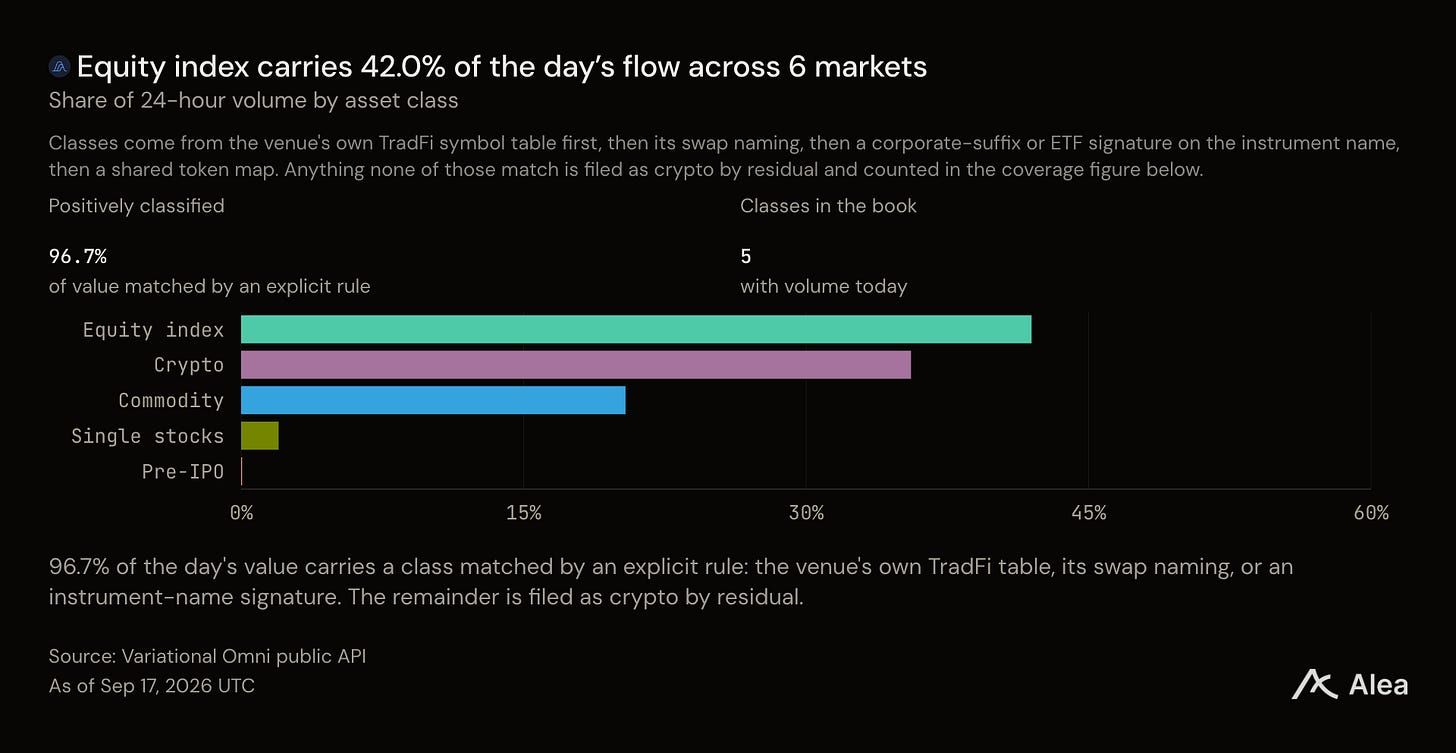
64.4% of the venue’s volume was not a cryptocurrency. Stock indexes alone were 42.0%, ahead of every cryptocurrency combined at 35.6%. Metals and crude carry most of the rest.
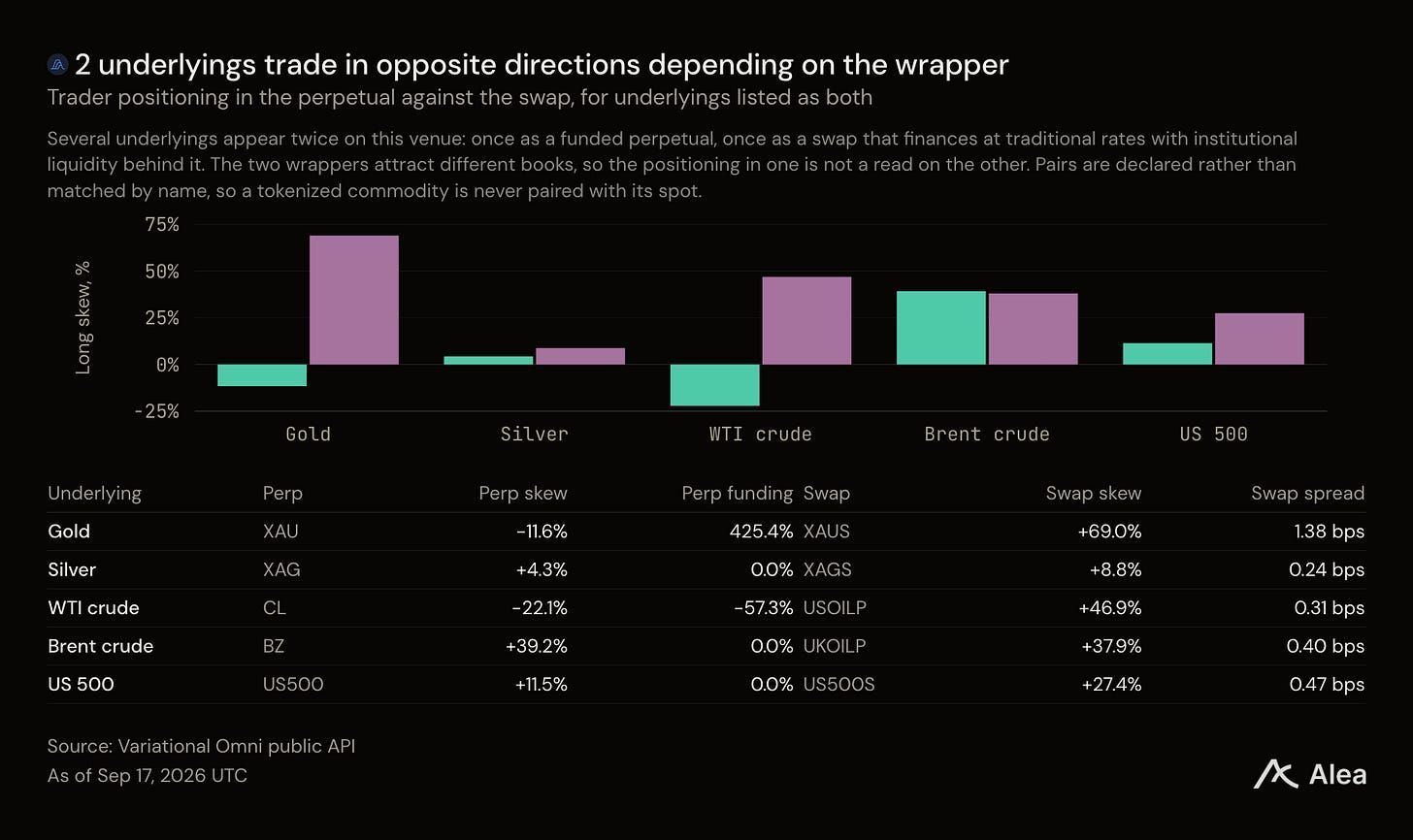
Swaps "source liquidity from traditional financial institutions to offer deeper liquidity and flatter funding rates than perps".
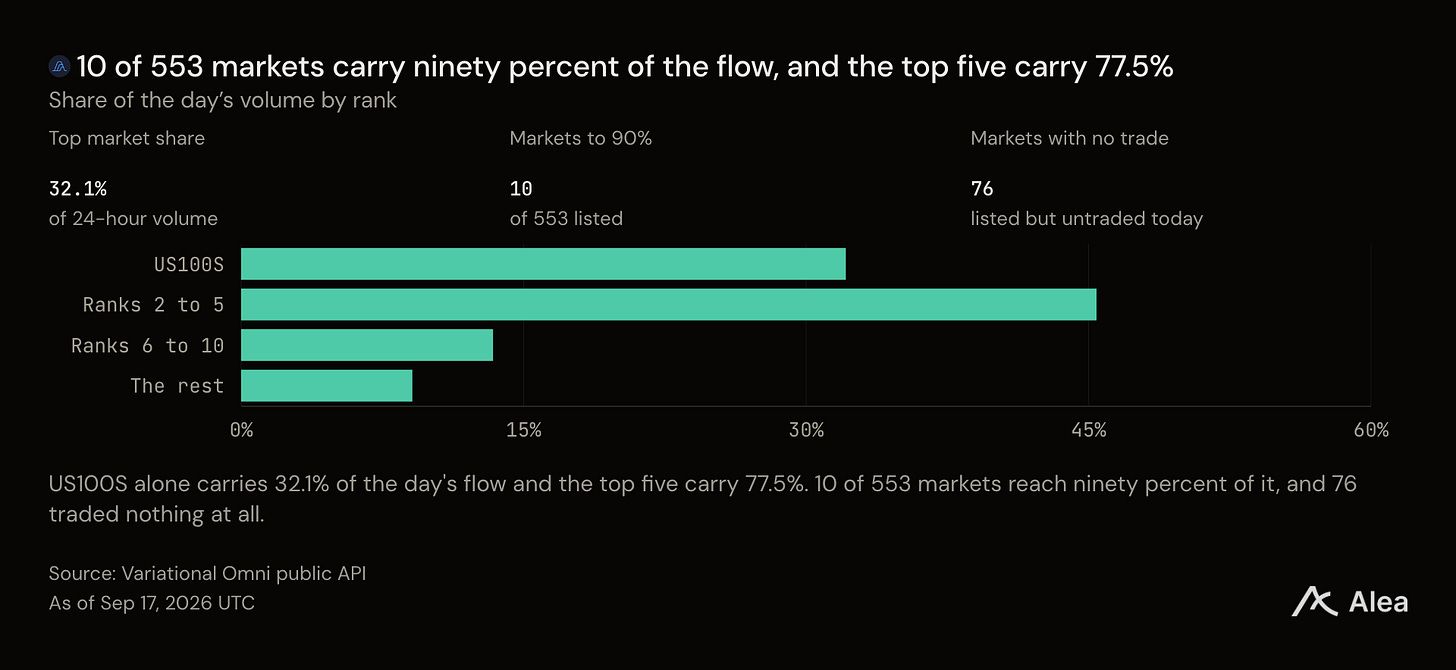
On an order-book venue that concentration would be a warning. Depth there is built by many resting bids, and a thin book breaks under size. Here it is the model working as designed.
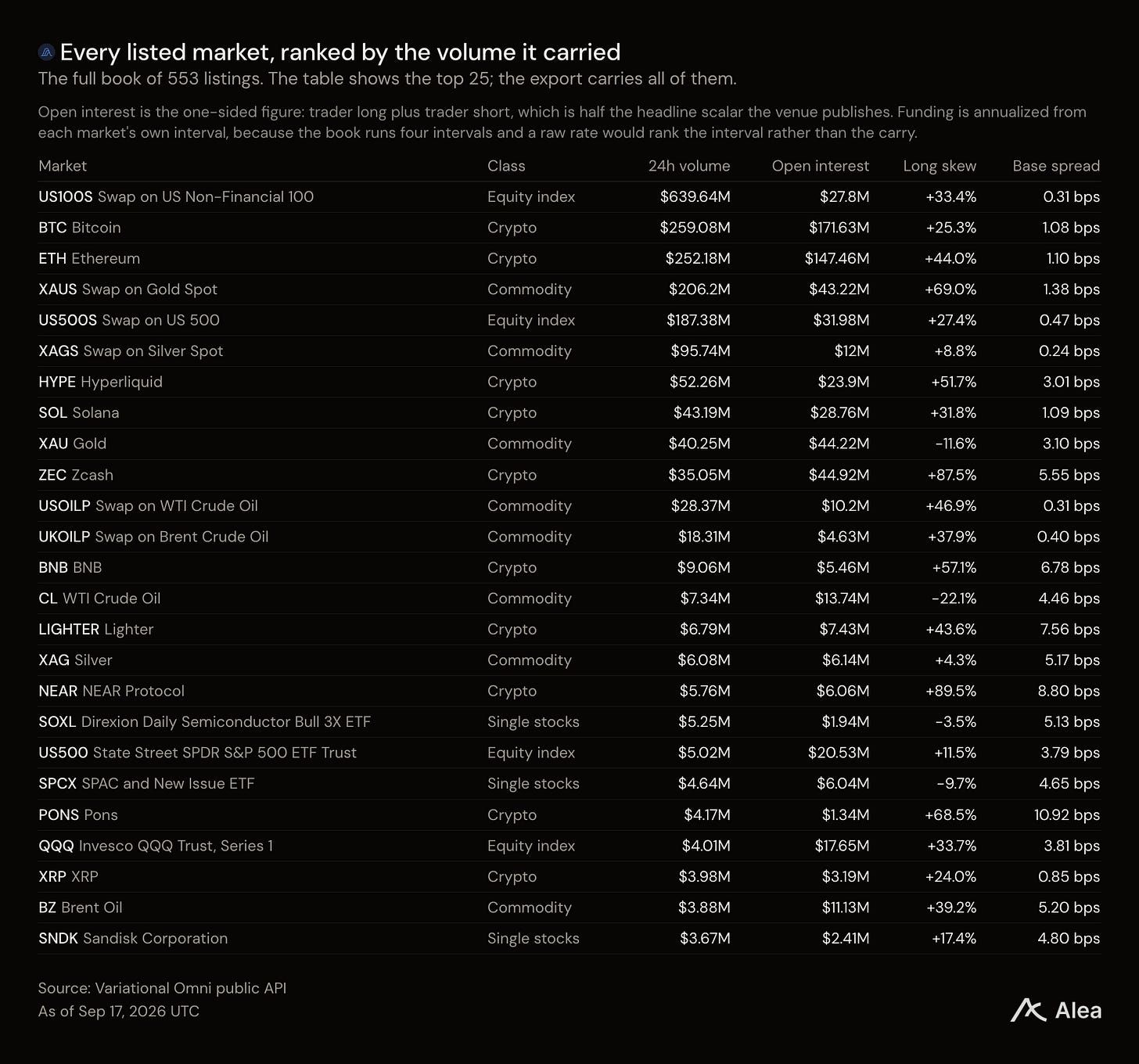
Whether the quote survives size
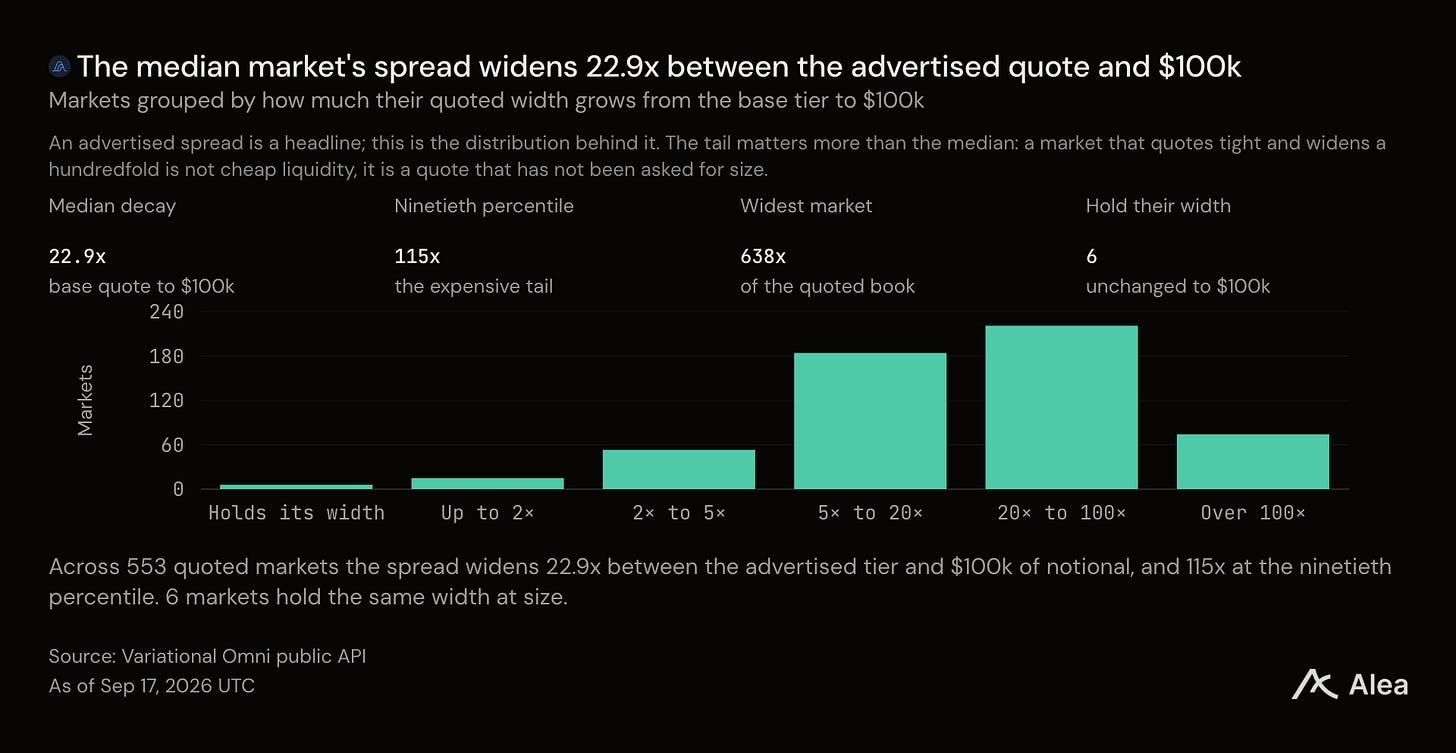
A tight headline price means nothing if it widens the moment real size arrives. Thirteen of the venue's markets that quote a million dollars carried 93.5% of its volume at a median width of 8.59 bps.
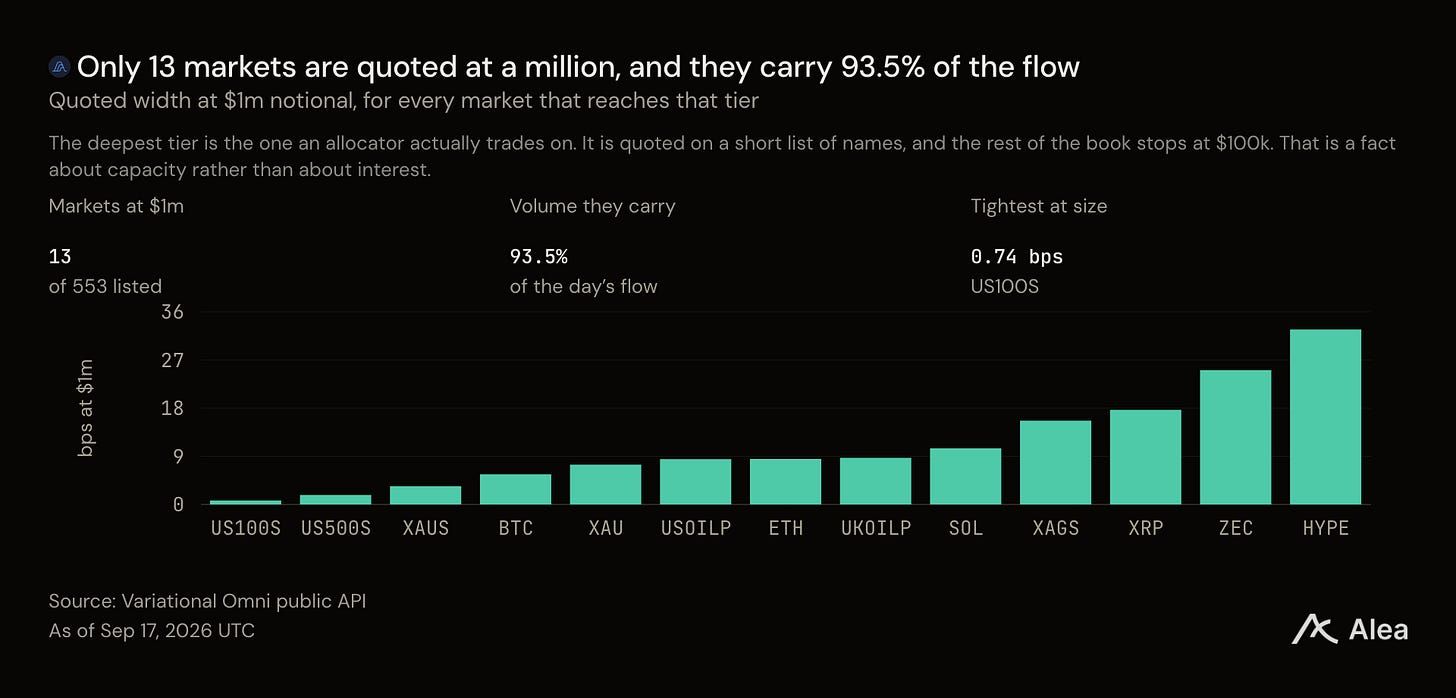
The ranking inverts what a crypto trader expects. The Nasdaq 100 swap advertises 0.31 bps and holds 0.74 bps at a million dollars. Bitcoin advertises 1.08 bps. The median market quoted at that size widens to 8.59 bps.
The instrument a crypto venue is supposed to be worst at is the one it prices best. A dealer with a traditional hedge behind it is not guessing at the price of the Nasdaq.
What the house carries
The house dealer takes the other side of every trade, so the venue's book is its own inventory. On the Sep 17 reading, traders held $871.0M of open positions on the one-sided basis. Behind that sat $212.4M of collateral on the venue, plus the provider's own USDC recorded on Arbitrum.
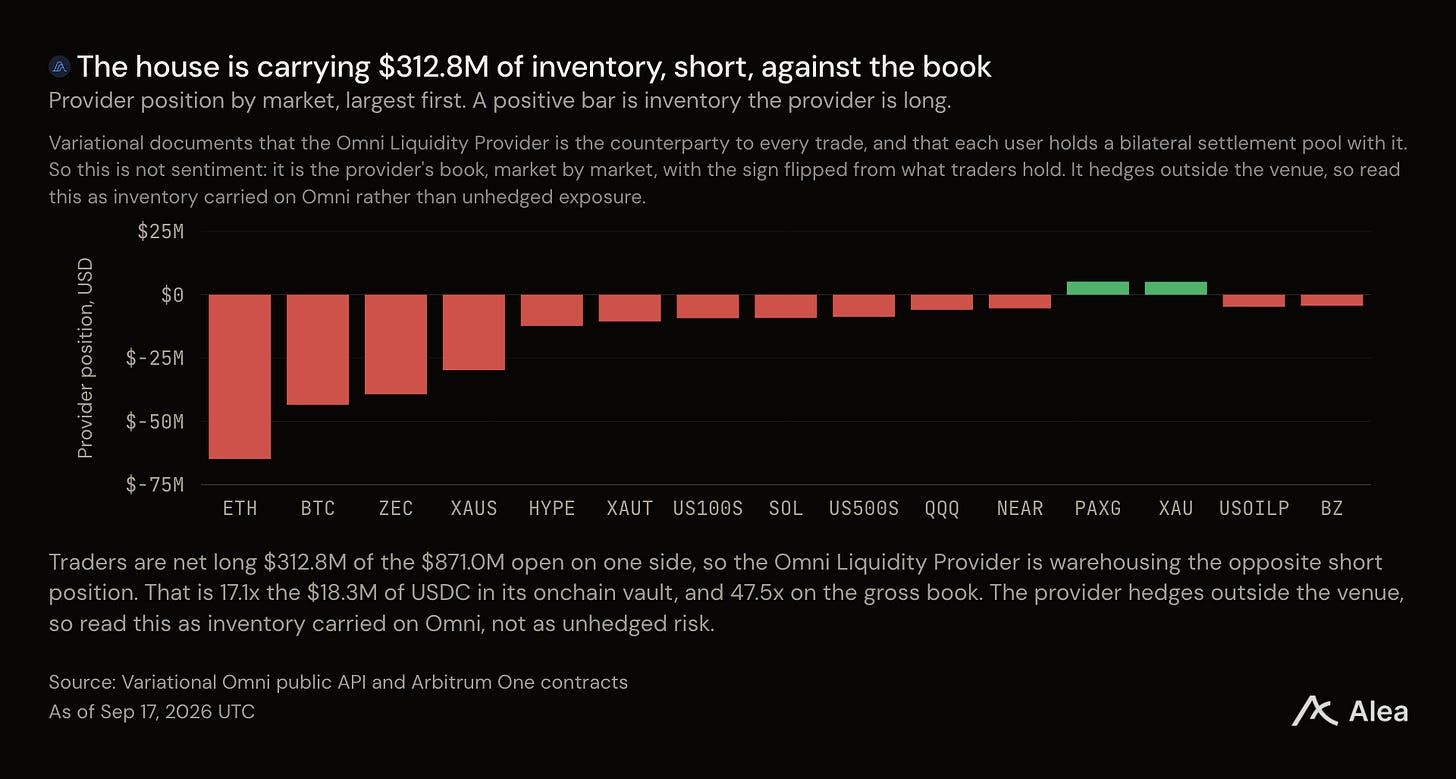
That inventory is the cost of the design rather than a flaw in it. Variational has stated that it hedges the exposure elsewhere, which is what aggregating dealer liquidity means in practice: the risk leaves the venue and lands in the market the contract tracks.
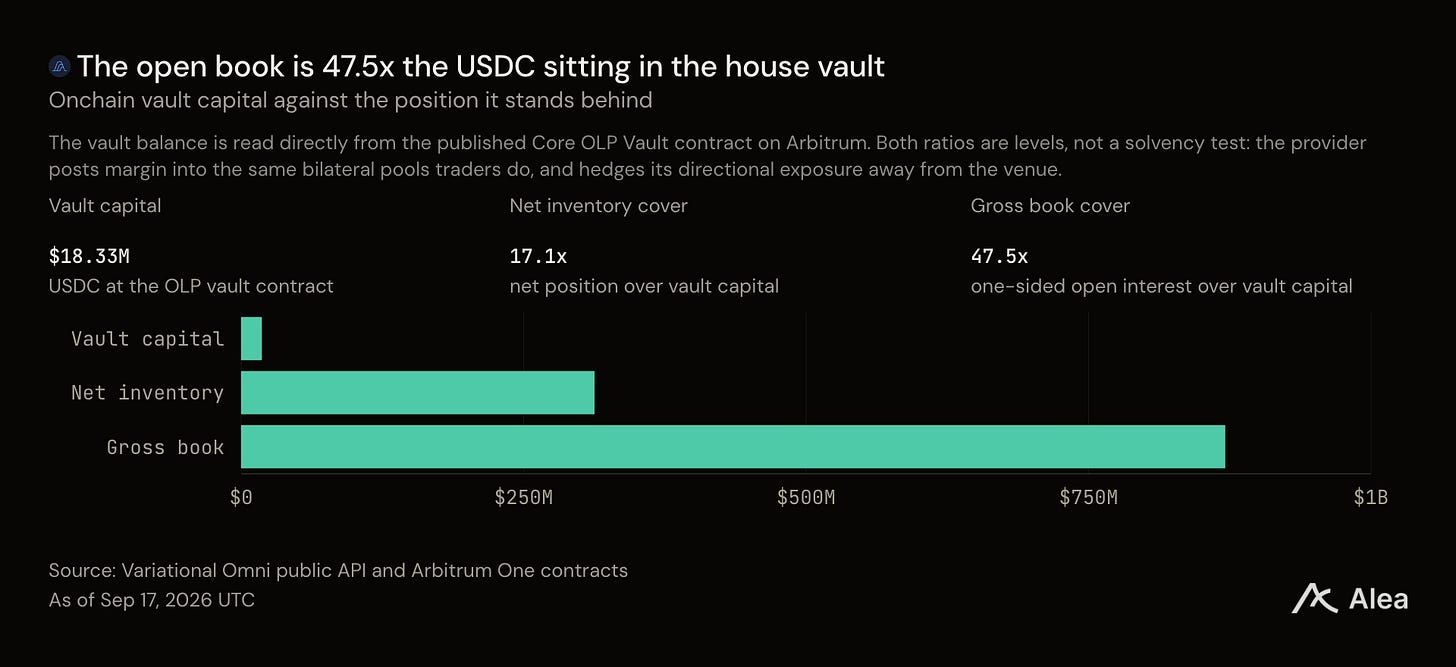
Any ratio measured against that vault holds for one block and no longer. Ten reads of the vault contract recorded between 16:13 and 18:43 UTC ran from $7.37M to $18.42M, and about $10.2M of it arrived inside a single twenty-minute window.
The same open book covers that balance 118 times at the low and 47 times at the high. Neither number is a solvency reading. The provider works the balance through the day and hedges outside the venue. What the ratio measures is how much inventory sits on Omni at one instant.
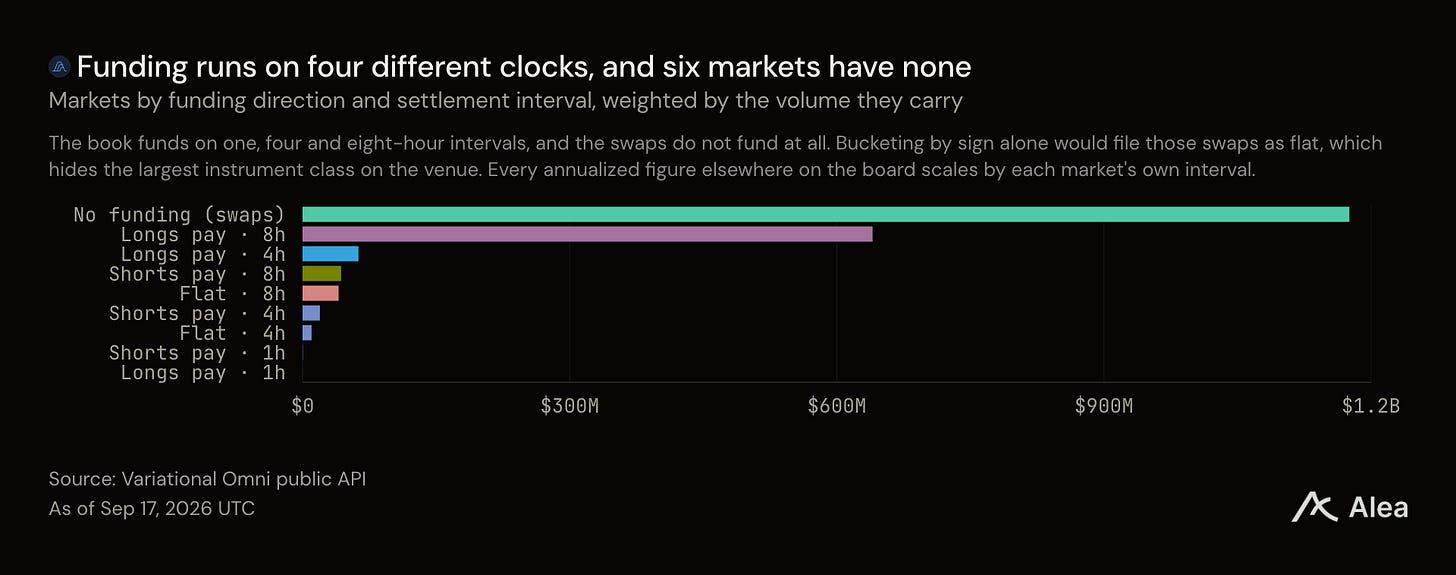
Six of the venue's contracts carry no crypto-style funding rate, and calling them free to hold would be wrong. These swaps accrue a financing charge once a day, at the traditional market close of 17:00 ET, Monday to Friday. Dollar indices are benchmarked to SOFR, and Friday's charge is tripled to cover the weekend. A trader holding Nasdaq exposure here pays about what a prime broker would charge. What they avoid is the eight-hourly swing of crowd positioning that sets a crypto funding rate.
What a venue with no fees earns
With no fee to count, the spread is the only revenue this venue has. What it earns from that spread is an estimate as a range.
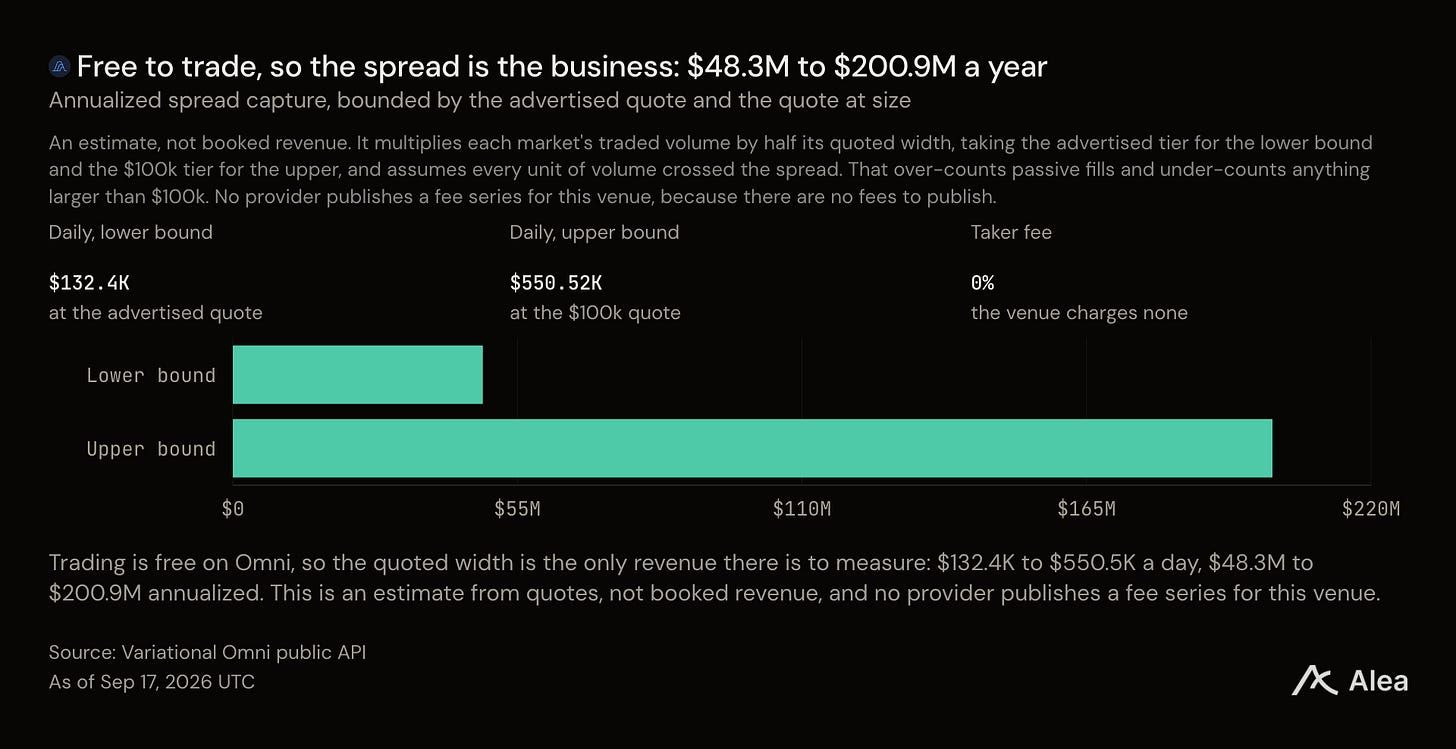
The venue keeps the market-making yield an outside firm would otherwise take, and the protocol takes a cut of that spread instead of a cut of fees. The only charge a trader meets is a flat $0.10 on each deposit and each withdrawal. It covers gas and deters spam.
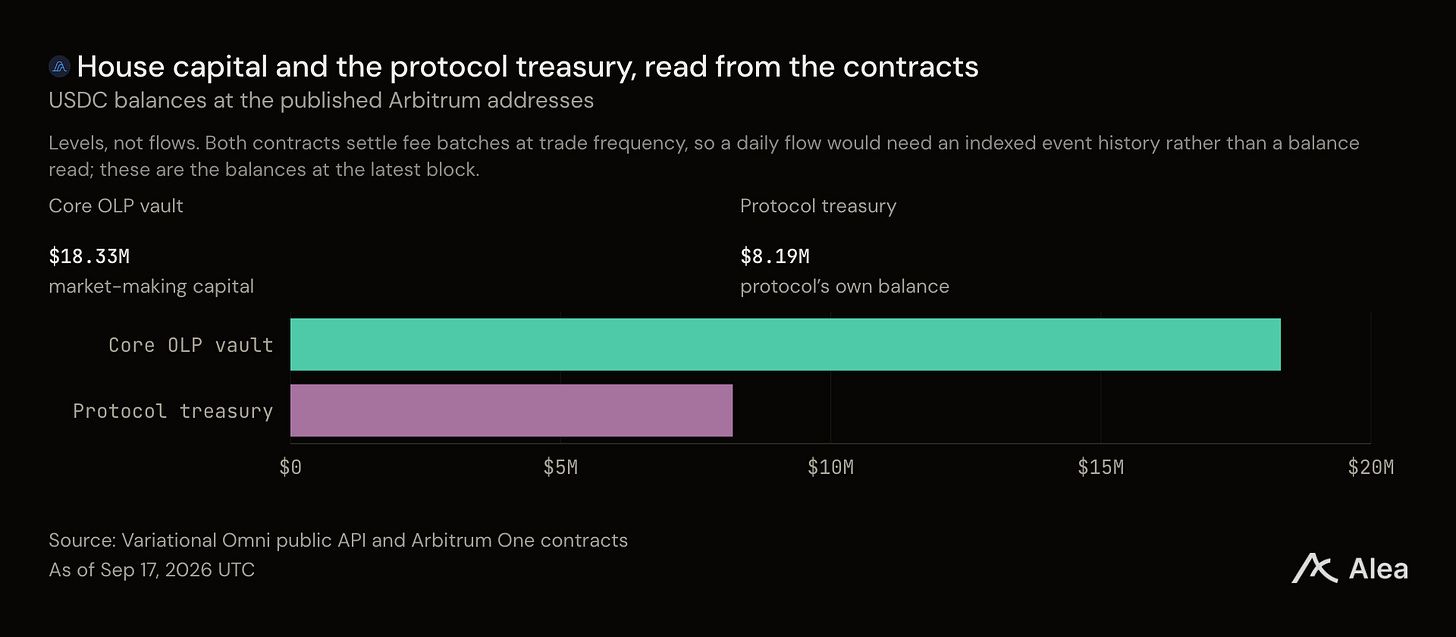
Variational has stated that it plans to distribute approximately 50% of $VAR to the community, a share most protocols do not offer. It has also stated that it "may allocate a portion of fee revenue to purchases of $VAR, with acquired tokens burned". That second commitment is a lever rather than a floor. The amount and frequency sit with the Variational Foundation, and the documentation says they "may be modified or discontinued at any time".
Closing
Variational ran a points program through 2026, and the third-quarter share gain sits inside its final weeks. The venue launched swaps on Sep 1 and awarded double points on them. It then ran a swaps trading competition from Sep 10 to Sep 24, with a 20,000 USDC pool. Three incentives landed in the month the share reached 7.17%.
Weekly point distributions "will conclude no later than the end of Q3 2026", and the last two land on Sep 18 and Sep 25. What follows is the cleanest read this venue will offer all year, because the fourth quarter measures the book with the subsidy switched off.
Two pieces of evidence already sit outside the incentive. A width of 0.74 bps at a million dollars is a property of the dealer quote. No reward program narrows that spread. And the open book closed the window at $895.4M, a year high. Points by volume reward turnover, while open interest is capital a trader chooses to leave at risk overnight. The venue has built the part a reward program cannot rent.
Dated ahead
Sep 25. The last weekly point distribution the venue has published.
On or before Sep 30. Weekly point distributions conclude, and the fourth quarter starts measuring the book without them.
Important Links
What a swap is on Omni, and why it finances at traditional rates.
The fee model, which charges nothing to trade.
The Omni Liquidity Provider, the counterparty to every trade.
The points program and its published end.
The Core OLP vault, which holds the house capital on chain.

Research reports. Deep Dives and Blueprints explain protocols and their economics. Theses and Memos examine investment cases and catalysts. Benchmarks compare performance, while Perspectives assess specific developments.
Weekly Pulse. Read a weekly assessment of macro and the major liquid markets.
Protocol Data Rooms. Research each protocol in one place, with Variational Analytics for historical comparisons and Variational Intel for news and governance developments. See Variational Data Room.
Podcast Digest and Summit Digest. Read summaries of industry conversations and events. Find Alea shows and their episodes through Podcast Digest.
Governance Tracker. Follow proposals and voting activity across protocols.
For protocol teams preparing institutional conversations, discuss research for your protocol with Alea.