Rip Cars asked for $250,000 in July. $32.0M arrived. MetaDAO took the $250,000 and sent the rest back. Nothing unusual happened. Demand grew from $5.8M at the first sale in April 2025 to $32.0M for Rip Cars. Twenty-three sales have recorded $624.7M offered against $45.4M accepted. Buyers keep coming because of what happens after the sale. Most launchpads wire the money to the founder and move on. MetaDAO leaves it in a treasury the buyers govern, with the company’s intellectual property and the right to mint new tokens. Nothing moves unless a market agrees.
Takeaways
The September 1 relaunch announced a company rebuilding venture capital for the internet, plus a For Funds desk for institutions.
Twenty-three sales drew $624.7M. MetaDAO took $45.4M and returned the rest. 22 of 23 still closed.
META holders control the treasury, the intellectual property, and the right to mint. Minting a new token means staking 200,000 META and letting traders price the proposal for three days first.
Fees arrive when the coins a raise creates get traded, so revenue tracks raises a quarter late: $1.8M in the fourth quarter of 2025, $556K in the first of 2026, $376.5K in the second. The third closes on September 30.
Companies stay private, and the gains stay with them
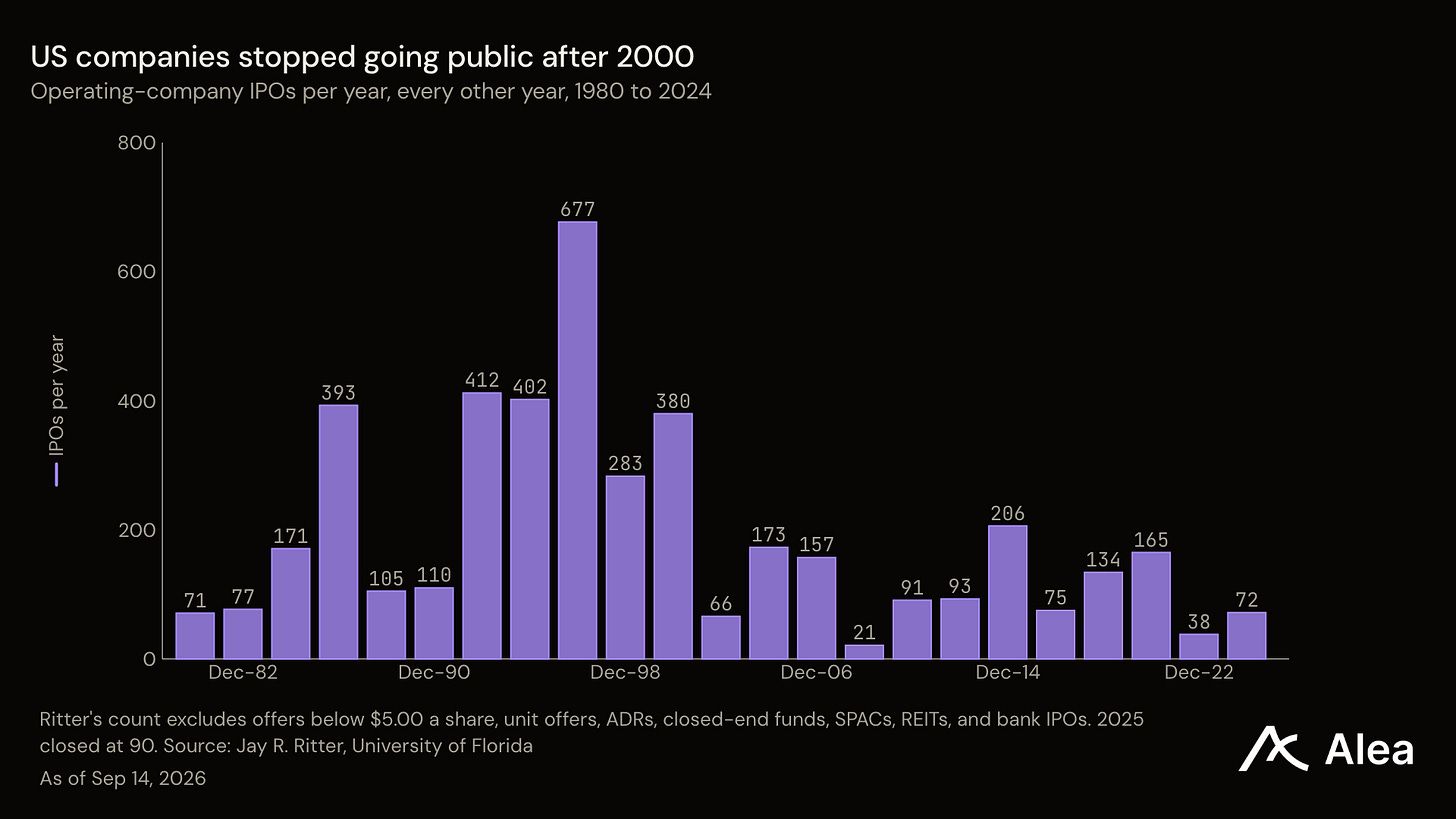
The median American company that listed between 1999 and 2000 was five years old. After 2001 the median rose to eleven. In 2024 it reached fourteen.
Domestic operating companies on US exchanges fell from 7,451 in 1997 to 3,657 at the end of 2025. Among those that do list, the median now sells a 14.5% stake, down from 33.3% in 1993.
Take SpaceX. It listed in June 2026 after twenty-four years private. The offer priced at $135 and closed its first day at $161. That +19% pop handed roughly $14.4B to the institutions that got an allocation. Retail got the leftovers, with its share reported in the low-20% range of the offering.
Meanwhile 24.3 million US households, 18.5% of the total, qualify to buy the private rounds where that value forms. To qualify you need $200,000 of income or $1M outside your home. Congress set those numbers in 1982 and never raised them; ordinary wage growth has carried more households over the line every year. The SEC has recorded that shift year by year, and the share rose from 1.8% in 1983 to 18.5% today. All driven by inflation.
Crypto offers better mechanisms to fix capital formation. A share in a private company is an entry in a lawyer's spreadsheet: to sell it you need a buyer, a board consent, and a transfer agent. A token is a bearer asset on a public ledger. It prices continuously, it settles in seconds, and the rules that govern it are code every holder can read. That is what lets a company with fifteen employees give a stranger a real, sellable claim on Tuesday afternoon. Crypto has been able to do this since 2017. What it kept getting wrong was everything that happened after the money changed hands.
Every earlier fix ended at the sale
The last fifteen years produced a long list of answers. Each widened the pool of buyers, and each stopped the moment the money changed hands.
Regulation Crowdfunding has recorded $1.5B since 2016, an average of $359,000 a deal. Its investors cannot price what they hold, and a recorded 47% of issuers stop filing annual reports. Regulation A+ has recorded $10.5B against $31.7B sought.
SPACs did let retail in before the merger. The record showed 861 of them raising $219.9B across 2020 and 2021. The 2021 mergers then returned -64.2% after one year and -73.0% after three.
Crypto repeated the pattern faster. ICOs took roughly $20B in 2017 and 2018, with failure rates estimated at 46% to 59% for the 2017 class.
The 2024 answer was a low float. Only 6% to 20% of the supply traded at launch, while the price implied a value for all of it. Those launches needed about $80B of new buying, estimated as the amount required to hold prices flat against the unlocks ahead.
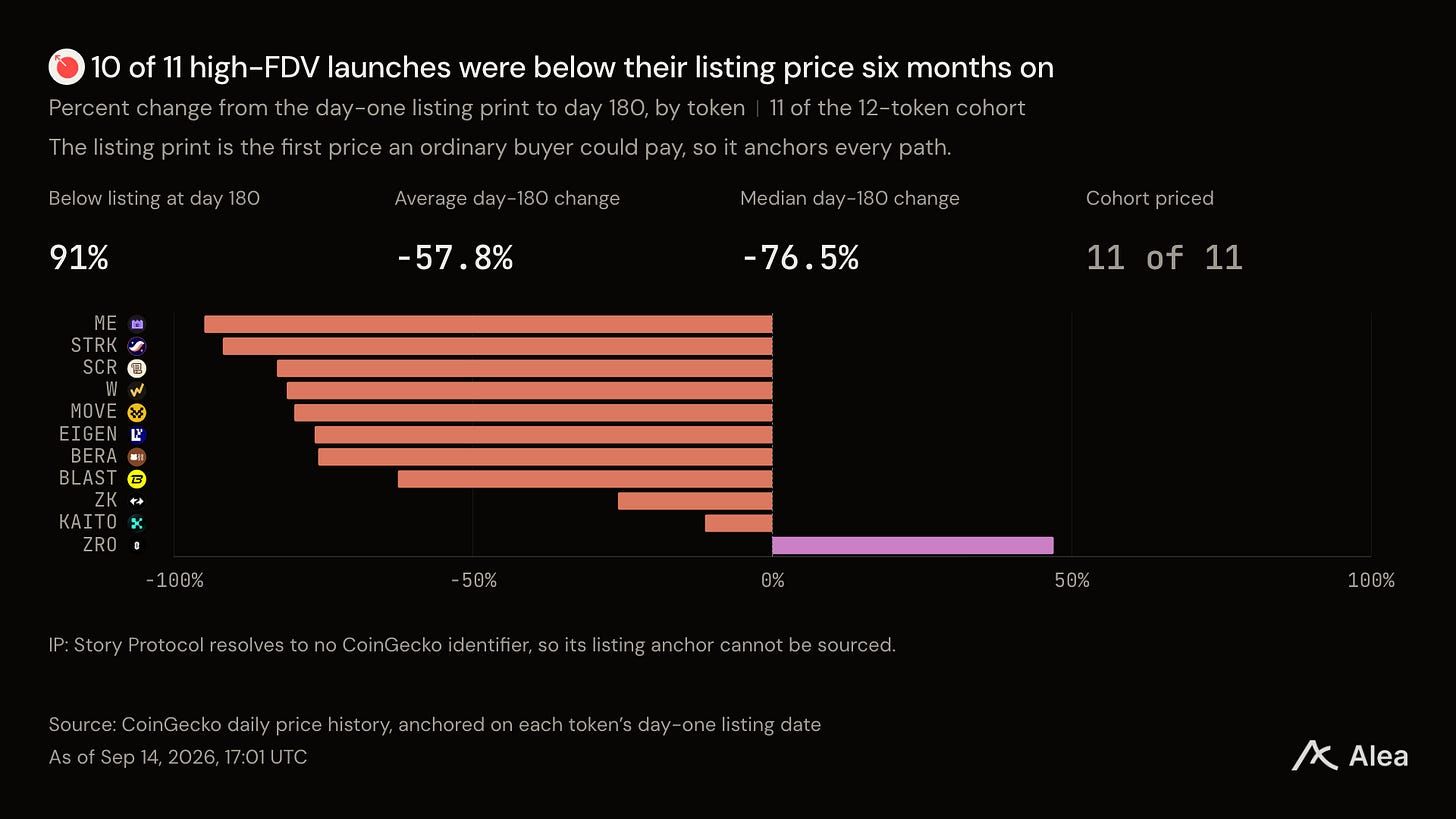
Then 2025 rebuilt the gate it had set out to remove. Plasma closed a $500M cap in about five minutes. Falcon Finance took $112.8M against a $4M target. Of 118 launches recorded through 2025, 84.7% sat below their launch price, with a median of -71.1%.
Echo did more than anyone to reopen public sales. It then closed a sale to Coinbase at $375M, having raised a little over $200M for the projects on it. The platform was worth more than everything it ever funded.
Every one of these sold the same thing: a place in the queue. Reg CF sold a stake with no price to read and no way out. ICOs and the 2025 sales sold a token whose issuer decided alone what happened to the proceeds, the moment the money landed. The buyer’s say ended at the wire.
What MetaDAO changed is the part that happens after the raise.
The sales MetaDAO picks, and the ones anyone can start
MetaDAO runs two kinds of sale on the same contracts and the same fees. It picks and markets one kind. Anyone can start the other. The results are not close.
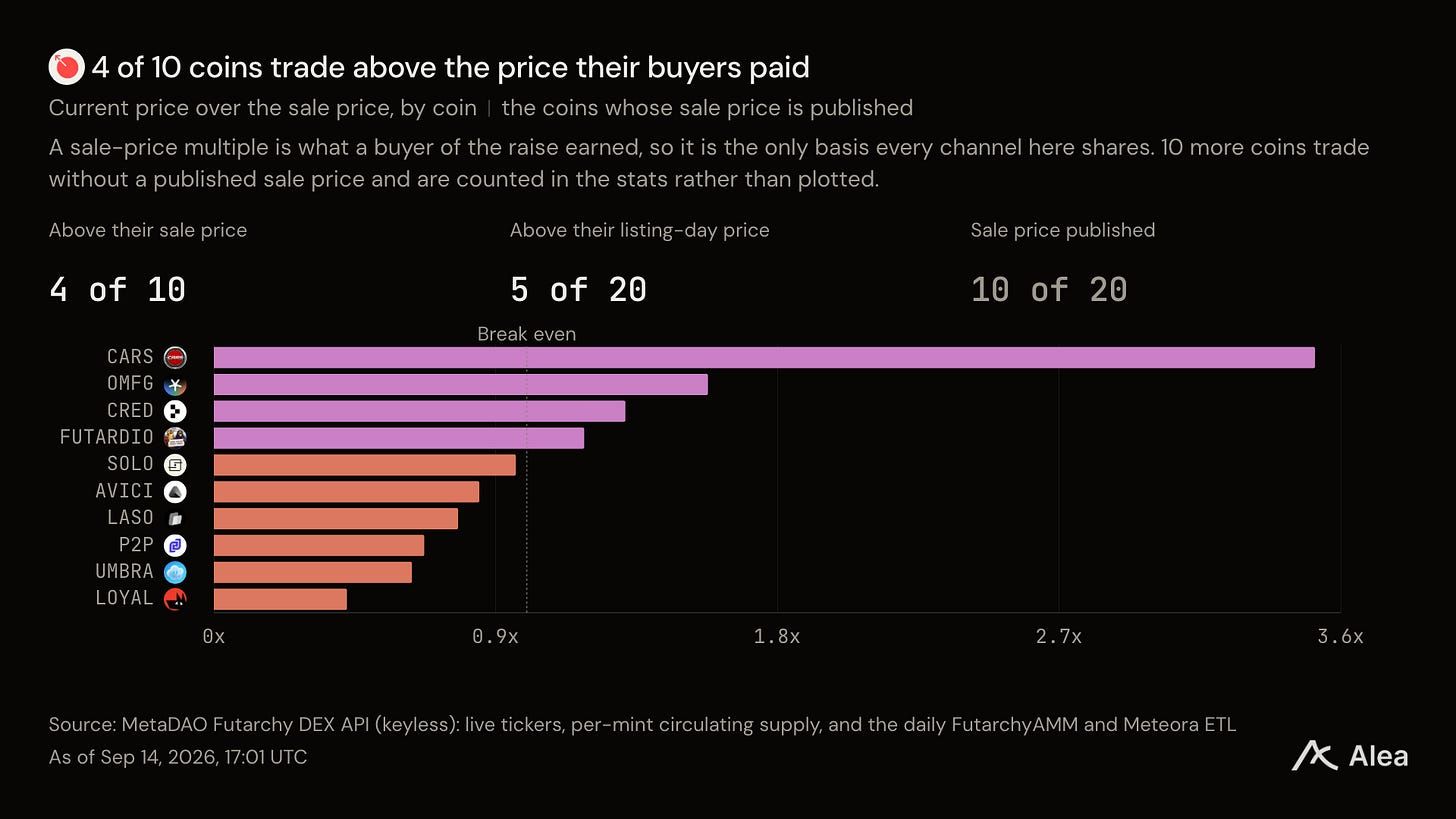
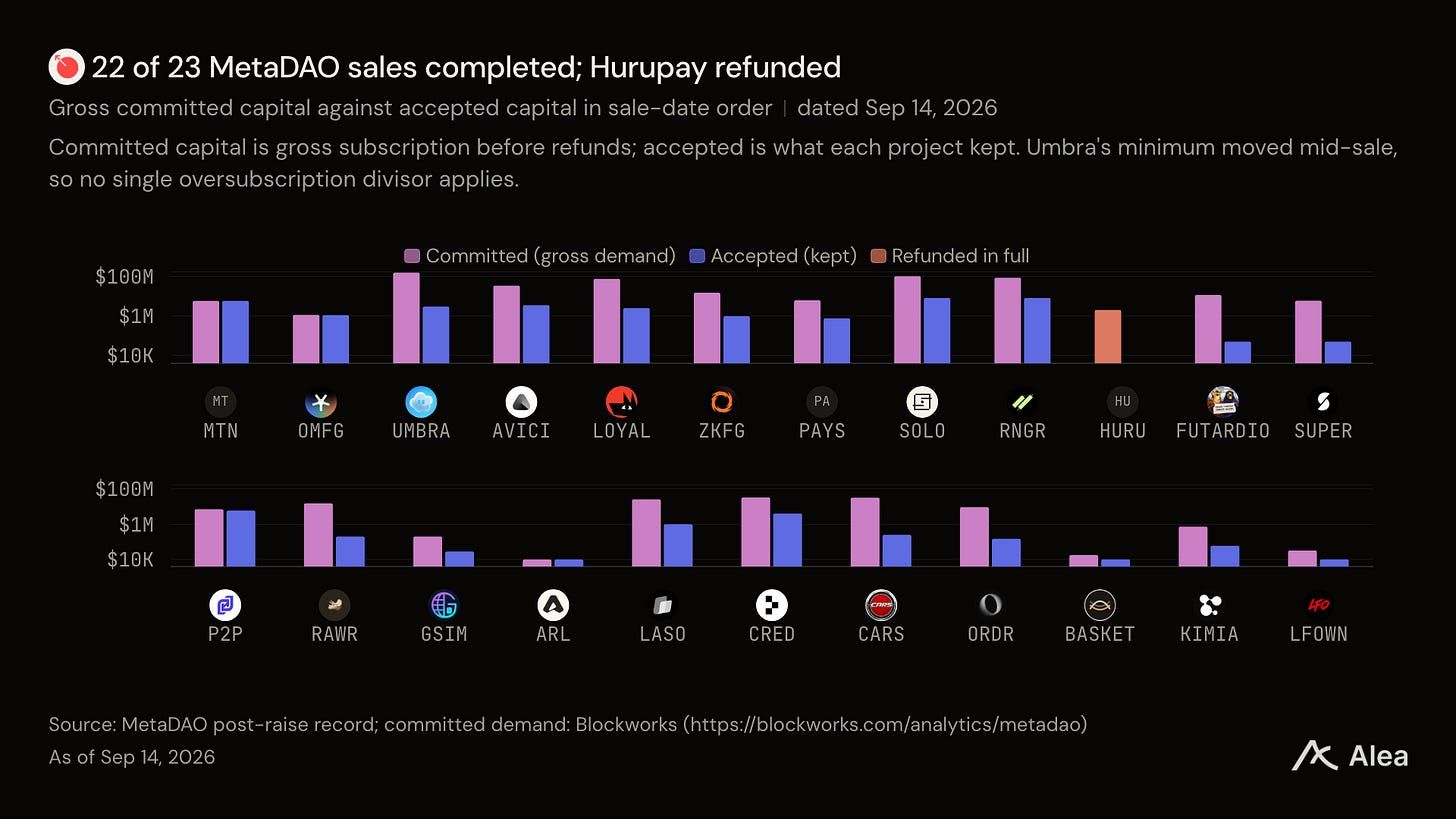
Sales carry a discretionary cap, published in its own rules, which lets believers commit while stopping a project from raising too much. Rip Cars asked for $250,000 in July and $32.0M arrived. MetaDAO kept the $250,000 and returned the rest, so the company launched at a price its product can still grow into. Across all of it: $624.7M offered, $45.4M accepted, 22 of 23 sales completed.
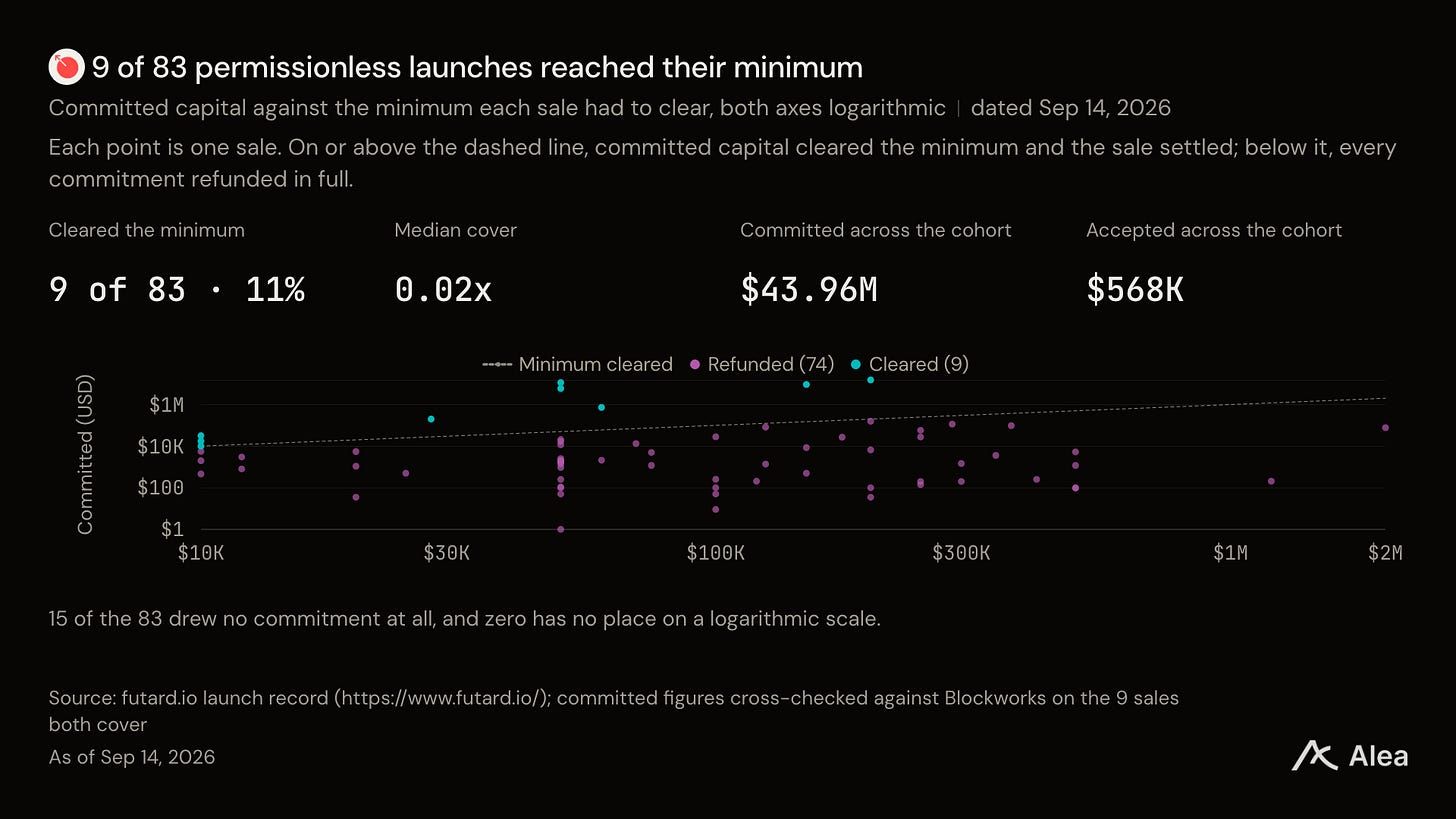
The open kind is futard.io, where anyone can start a sale and MetaDAO has published all of them. Ninety have run and nine cleared their minimum, turning $44.0M of offers into $568K. Same crowd, same contracts, same fees. The difference is that somebody picks the companies.
Picking well is the job, so MetaDAO has been putting more of its judgment into the rules. Ownership Score, introduced in July, set half the Rip Cars allocation by how early a funder committed and how long they stayed.
Alea published a full account of that formula in July.
The books still fill from the top. Credible, an onchain lender that raised through MetaDAO in June, took 77% of its committed capital from wallets of $100,000 or more, reported alongside another $2.3M pledged before the sale opened. Open access has not made the buyers small.
A live price, a binding vote, and an exit
MetaDAO sells one thing to a token buyer: you do not have to trust the founder. Its investor documentation stated exactly that.
Solana's 2021 class is the reason that matters. Parrot raised $85M and the team was reported keeping $72M of it. Aurory raised $108M, and its token has since declined 99.5% from its high. Both were legal. Nothing in the deal stopped either team from deciding on its own what the money was for. On MetaDAO it cannot be decided alone: moving treasury money is a proposal, in public, that anyone can trade against.
Ownership coins hand the buyer three things a private shareholder never gets.
The first is a live price. MetaDAO has published every company’s runway in months beside its valuation, and has disclosed its own treasury to the dollar each quarter. A private company discloses nothing. A public one discloses quarterly, forty days late.
The second is a binding say on each dollar. In July, someone proposed moving $1.6M of Umbra's treasury to an outside wallet. Traders bet against it, the price said the company was worth less with the money gone, and MetaDAO recorded the proposal rejected. In August holders refused to liquidate Kimia and kept the team funded. In September they renegotiated a founder's unlock schedule in public. None of these needed the founder's permission.
The third is an exit that needs no buyer for the company. Ranger wound down and returned $5.05M to holders at about $0.78 a token. Paystream was liquidated by vote on September 2. ZKFG was taken private at the second attempt, after the first failed at fifty participants and the second passed at sixty-seven.
The same rules, published in the token documentation, govern META itself. Treasury, intellectual property, and mint authority all sit under decision markets, where traders rather than voters settle each proposal. A new token needs a public proposal, 200,000 META staked, and a three-day market before it exists. There are no scheduled unlocks and no vesting outside governance, and MetaDAO publishes a MiCA white paper under digital token identifier BQ53DH590.
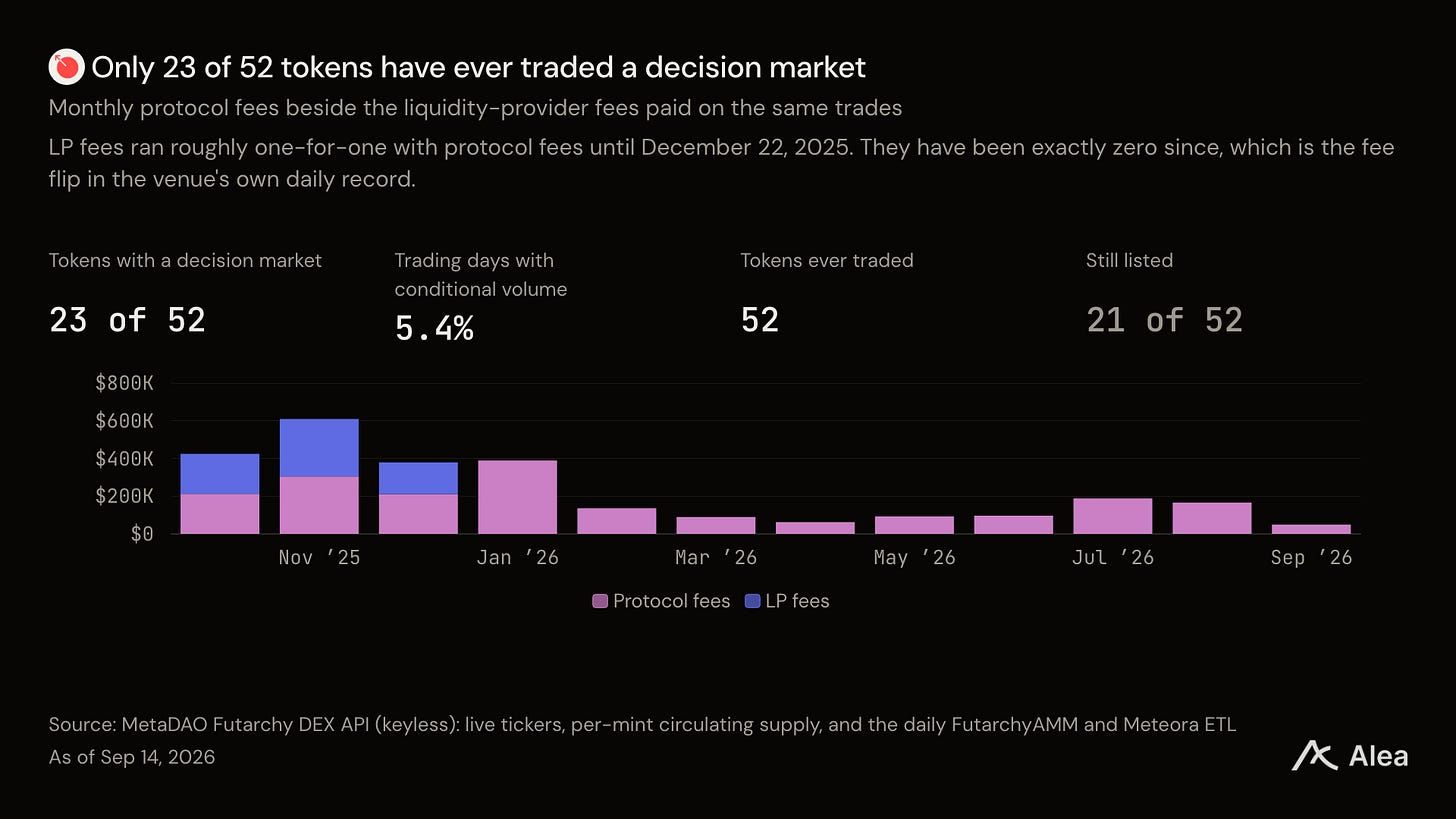
Here is how MetaDAO makes money. It charges 0.50% on every trade in its Futarchy AMM, and since December 22, 2025, the whole fee goes to the protocol. The fees pile up in a treasury holding $9.95M, of which $1.4M is META itself, against a $109.6M market cap. So META trades at 11.0x the assets it governs, or 12.7x counting only the assets that are not the token. Today those fees stay in the treasury and holders decide what to do with them, which is the same power they hold over everything else MetaDAO owns. The venue has already built fee switches, revenue splits, and burns for the companies it launched, so it knows how to route money to holders whenever its own holders vote to.
Small crowds are settling these decisions. MetaDAO has recorded a median of about twelve traders a decision. One proposal in September passed with two. Only 23 of MetaDAO's 51 tokens have ever had a decision market trade at all, and those markets are open on 5.4% of days. Where real money is at stake the crowd does show up: a capital increase drew 102 traders, a distribution 92, a take-private 67. Routine spending draws almost nobody, which is how a thin market usually looks before it is worth anyone's time.
What a rival would have to rebuild
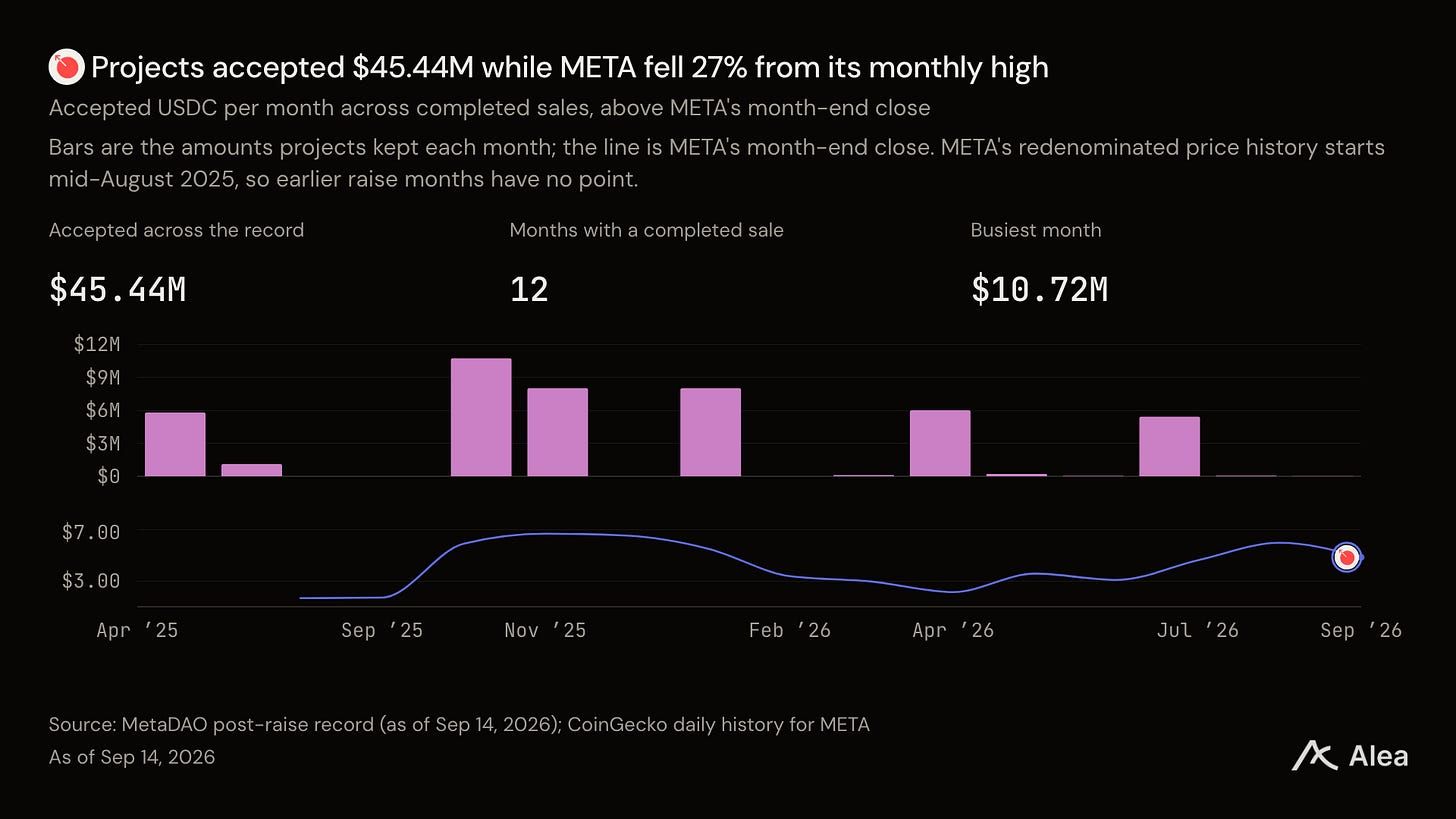
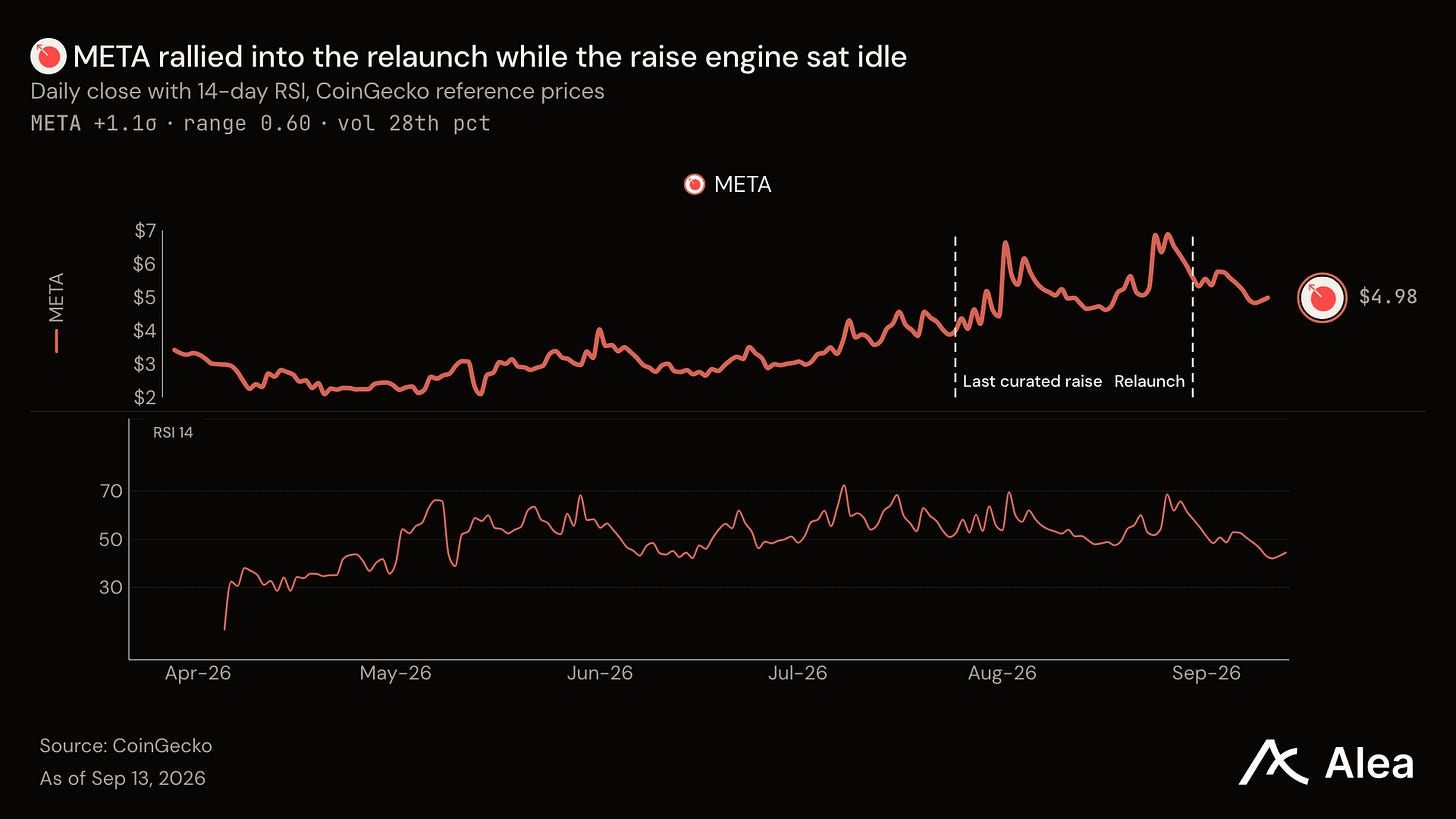
MetaDAO earns its fees on trading. A raise is what creates the coin that then gets traded, so fee revenue runs a quarter or so behind the sales calendar. It recorded $1.8M in the fourth quarter of 2025, after the autumn cohort listed, then $556K in the first quarter of 2026 and a low of $67K in March. July recovered to $199K as Credible and Rip Cars started trading. The first thirteen days of September produced $47K, and the last chosen raise closed on July 25. The pattern describes the shape of the business.
So the work this year has gone into finding more companies worth raising for, and that is the part a rival cannot copy quickly.
Colosseum and Orrick published the STAMP agreement in December, a standard set of terms in which the token is the only thing an investor owns. Hackathon winners go into an accelerator and then into a raise; MetaDAO watches a team build for months before it underwrites them.
METADAO-039 paid $2M to seed Ownership Capital, a fund that buys into the companies and votes its stake. META-040 moved another $2M of treasury USDC into a yield-bearing stablecoin built by a company MetaDAO itself launched. The September relaunch added the For Funds desk, which sells institutions a guaranteed allocation.
Put together, that is a pipeline, a legal template, a house fund, and an institutional bid. A competitor needs all four in place before its first sale.
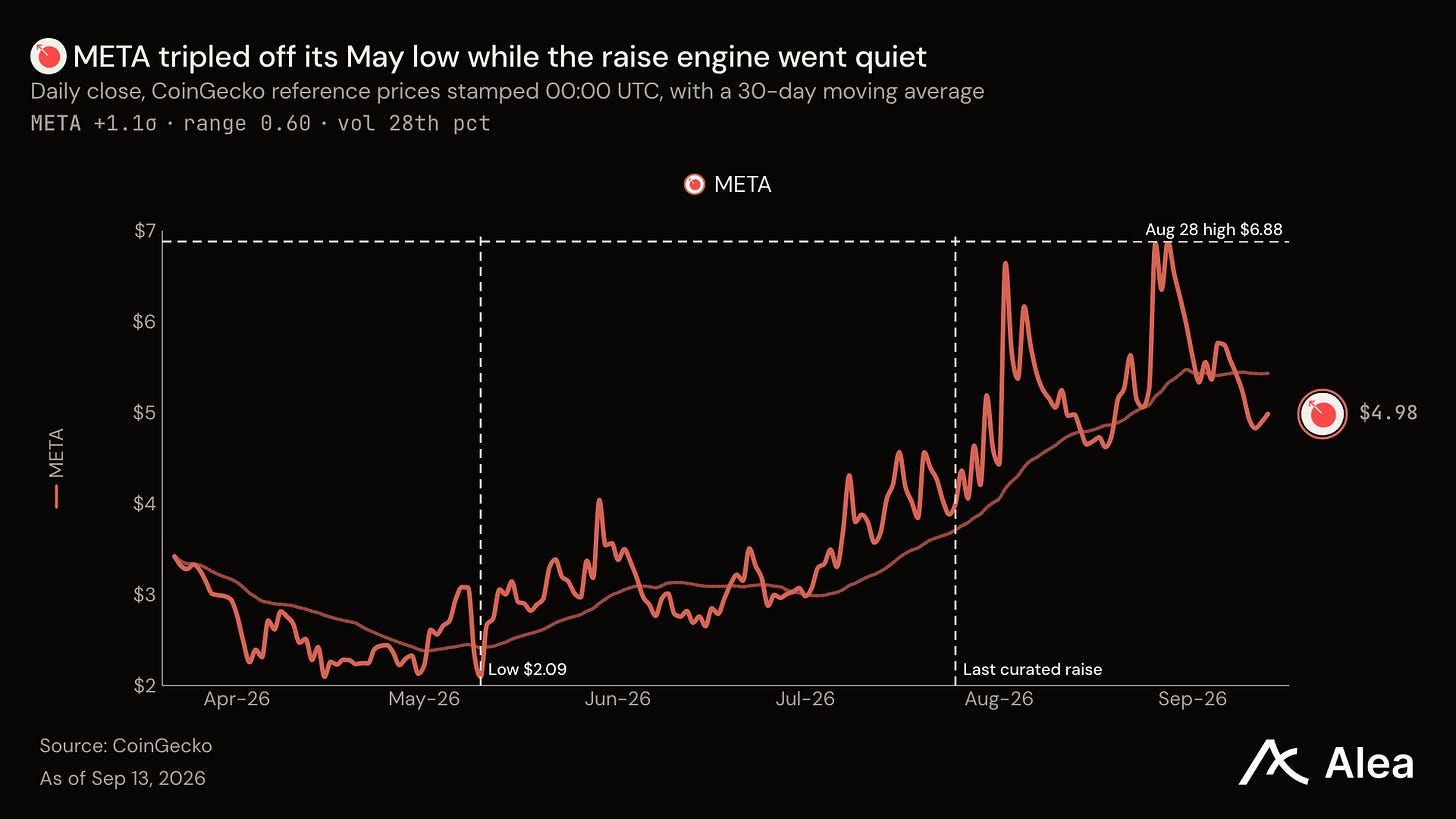
Buyers have been paying for that pipeline before it has produced a raise. META bottomed at $2.09 in May, when revenue was at its trough, and peaked at $6.88 on August 28, three days before the relaunch and five weeks after the last sale closed. It ended September 13 at $4.98, +225% over a year and -54% from its October 2025 high.
Paying holders is something MetaDAO already does for a living. It ran Jito's fee switch and Flash's revenue split. Umbra's holders approved a $250K buyback on September 8, and Sanctum's proposal to burn 259 million tokens was reported this month. Every one of those ran through the same decision markets META itself uses.
The machinery for a META buyback exists, the treasury that would fund one is unspent, and any holder can put it to a market.
Buyers show up, the machinery works, and the disclosure beats anything private or public markets offer. What is unsettled is supply: whether MetaDAO can find and check enough good companies to use the money already waiting. UMIA is chasing the same founders on Base with $6.2M raised from 2,700 wallets. But MetaDAO starts with fifteen companies funded, thirteen dollars offered for every one it took, and a treasury its holders control.
Important Links

Alea Research publishes independent, source-closed research for allocators, portfolio managers, traders, and protocol teams.
Research reports. Deep Dives and Blueprints explain protocols and their economics. Theses and Memos examine investment cases and catalysts. Benchmarks compare performance, while Perspectives assess specific developments.
Weekly Pulse. Read a weekly assessment of macro and the major liquid markets.
Protocol Data Rooms. Research each protocol in one place, with Analytics for historical comparisons and Intel for news and governance developments where available.
Podcast Digest and Summit Digest. Read summaries of industry conversations and events. Find Alea shows and their episodes through Podcast Digest.
Governance Tracker. Follow proposals and voting activity across protocols.
For protocol teams preparing institutional conversations, discuss research for your protocol with Alea.