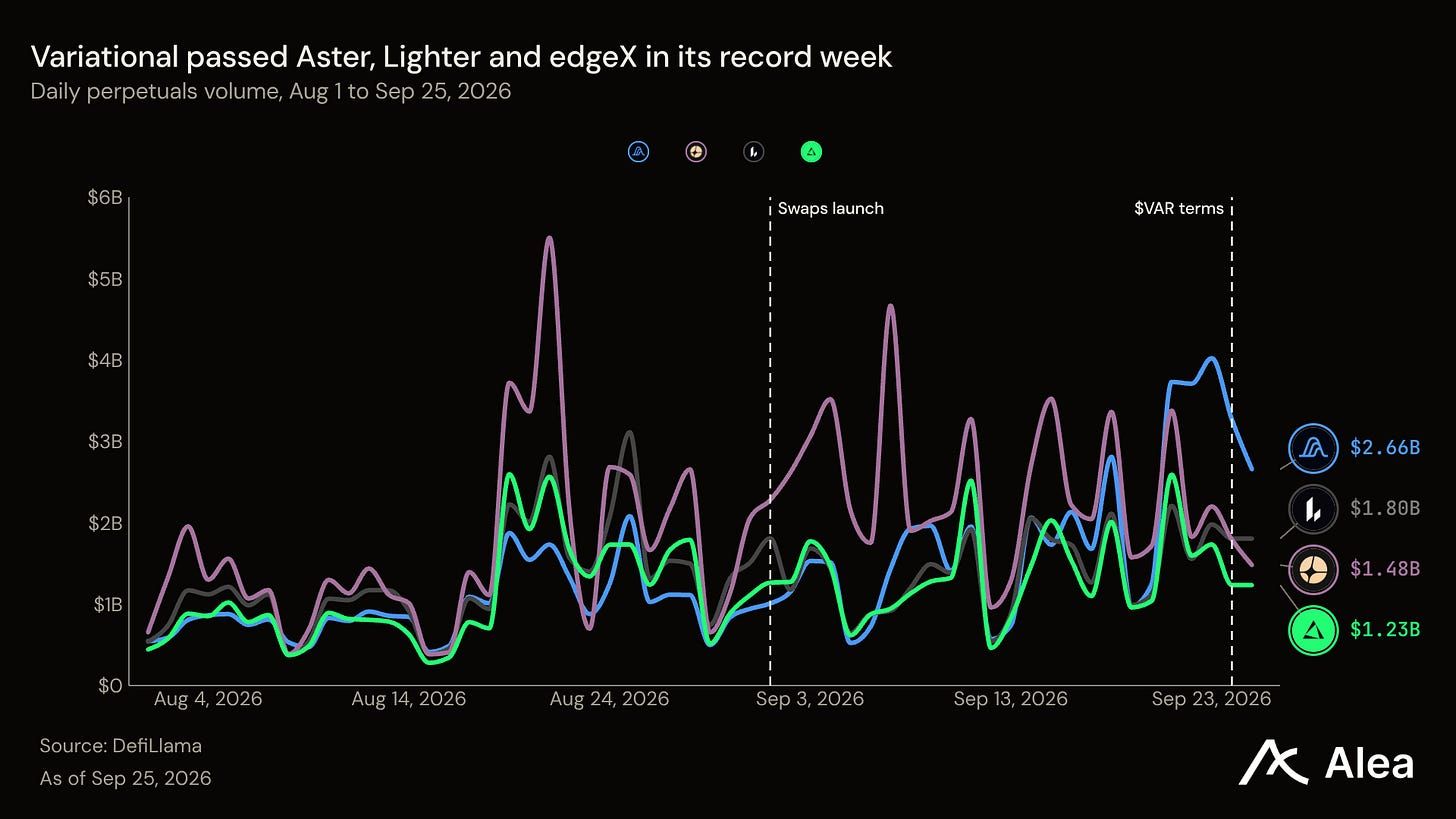
Variational traded $17.39B in the five days to Sep 25, up 66.9% on the same days a week earlier and more than in any full week on record. Then it published the prize. Points holders get 32% of $VAR, all of it unlocked on launch day, a larger day-one share than Hyperliquid's 31%. The same terms keep weekly points running until the launch in the fourth quarter.
Takeaways
The record came before the prize. Volume from Sep 21 to Sep 25 beat every full week on record, and open positions passed $1B for the first time. Weekly points were still scheduled to end with September; the Sep 24 terms moved that end to launch.
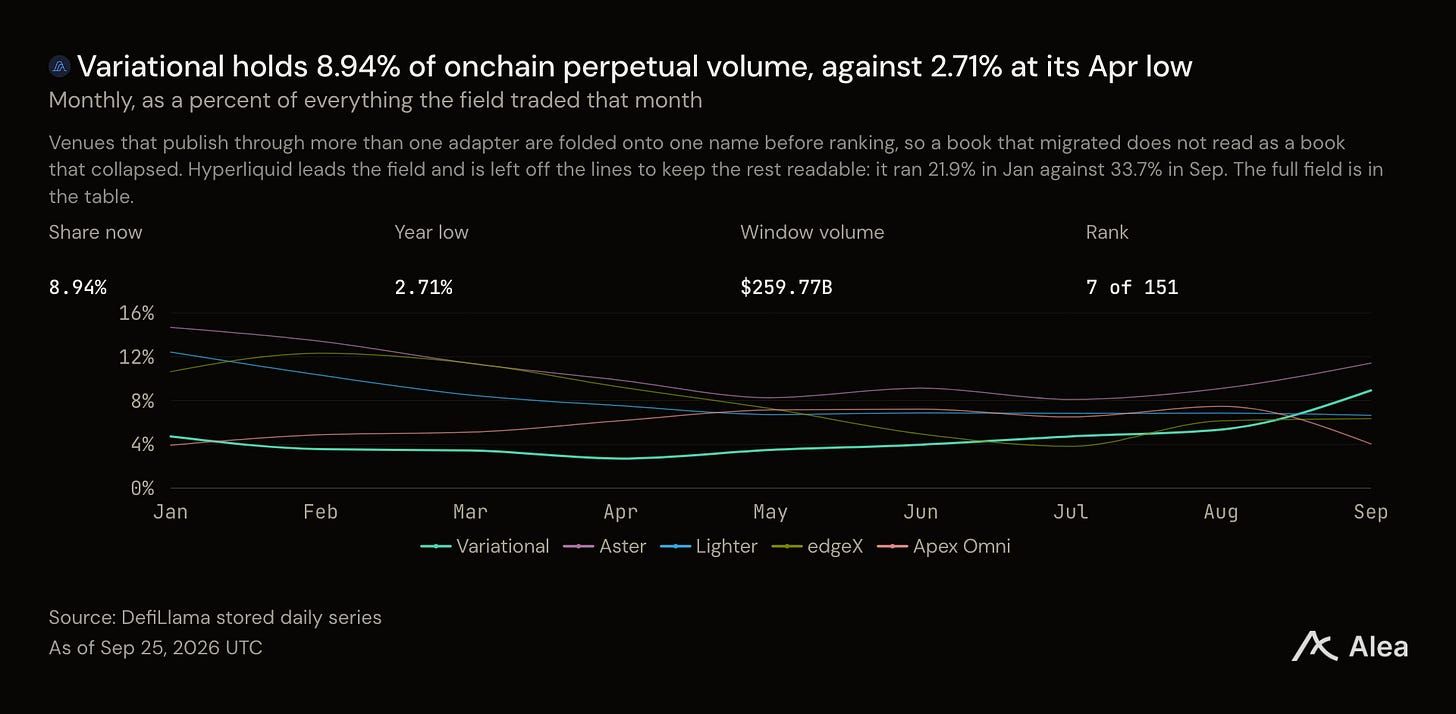
Only Hyperliquid traded more. Variational carried 14.95% of onchain perpetual volume from Sep 21 to Sep 25, second of 98 venues. In August it ranked sixth, with 5.36%.
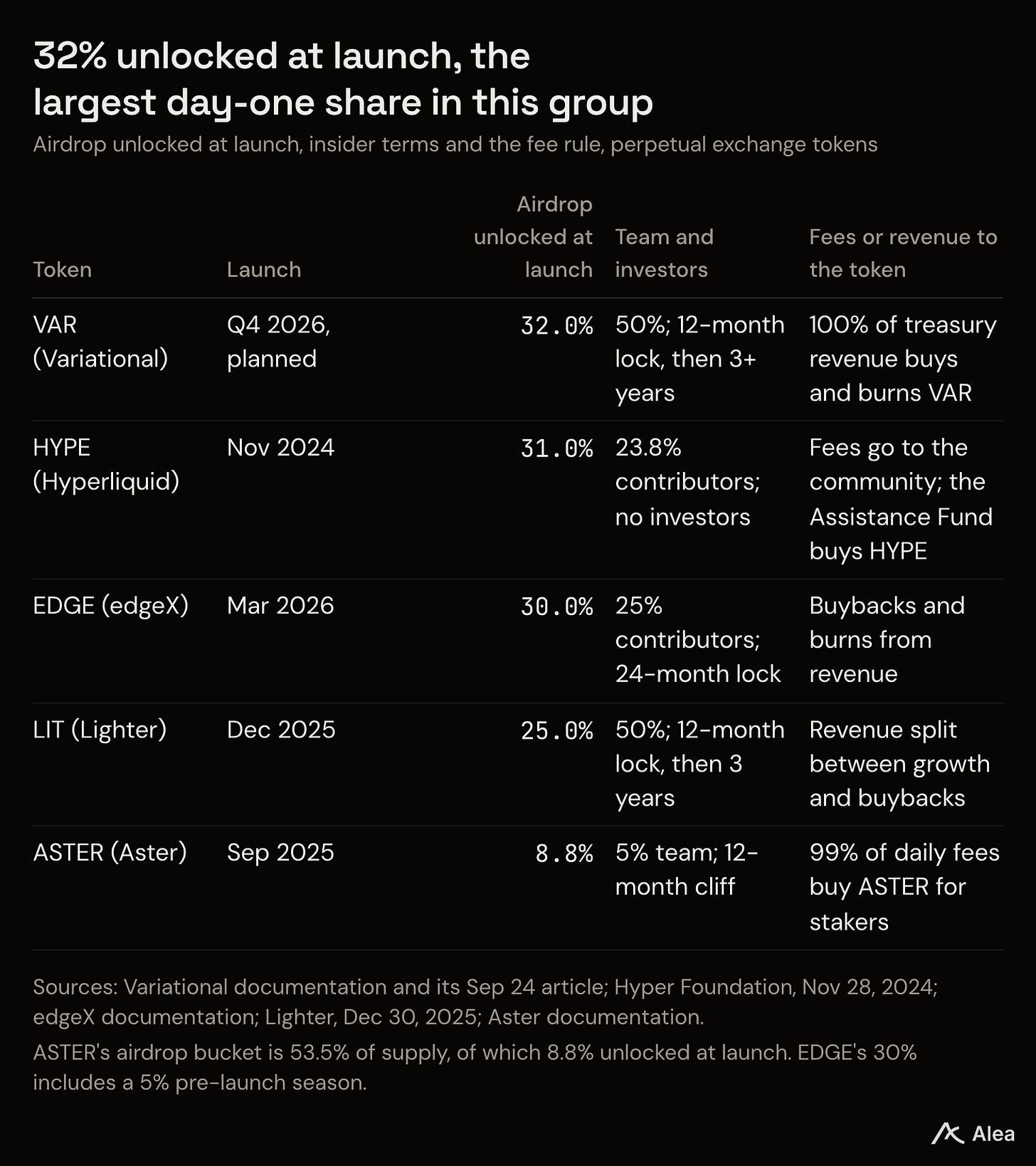
32% to traders on day one. That is more than Hyperliquid's 31% and Lighter's 25%. Team and investors hold 50%, locked for 12 months after launch.
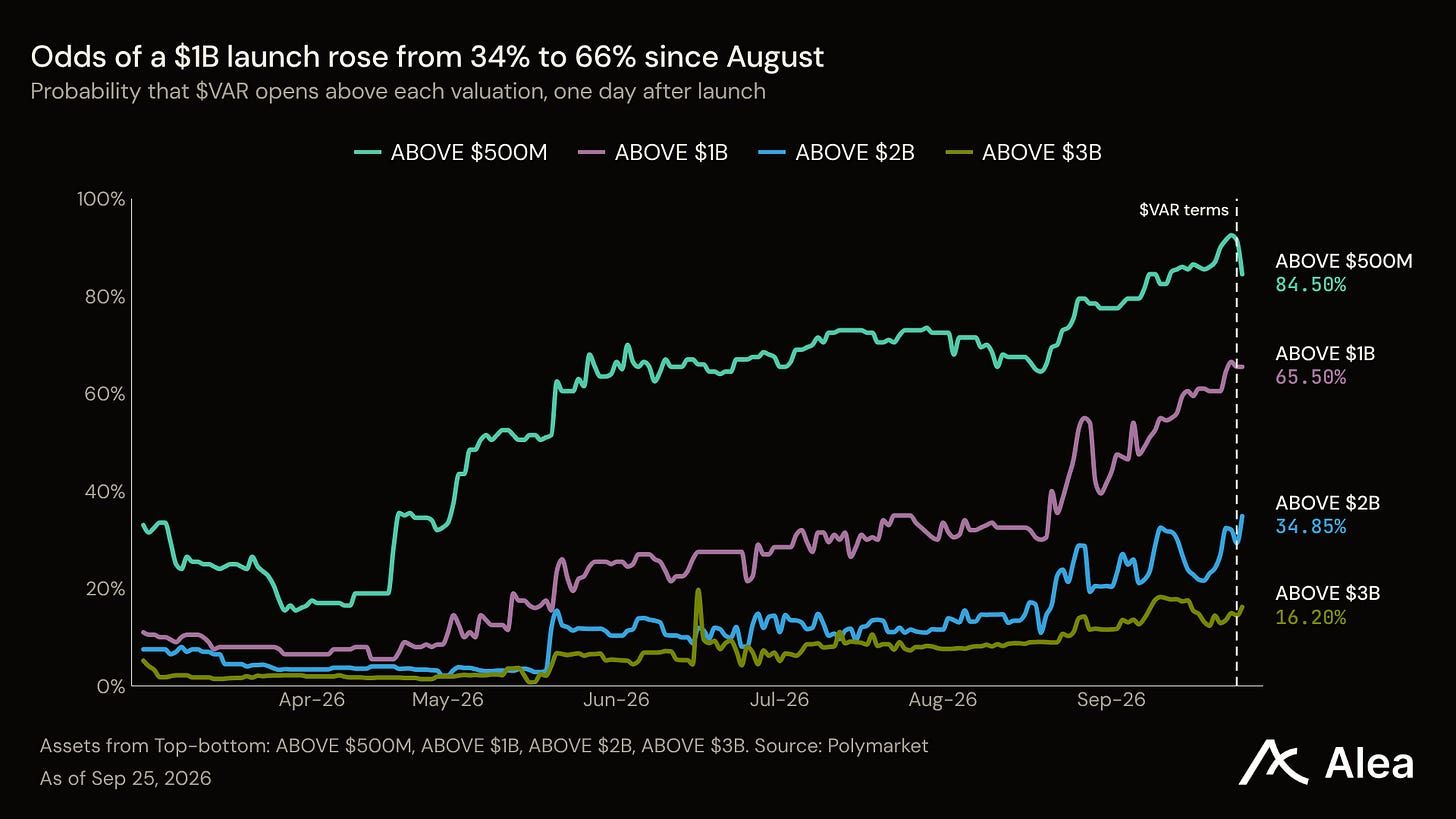
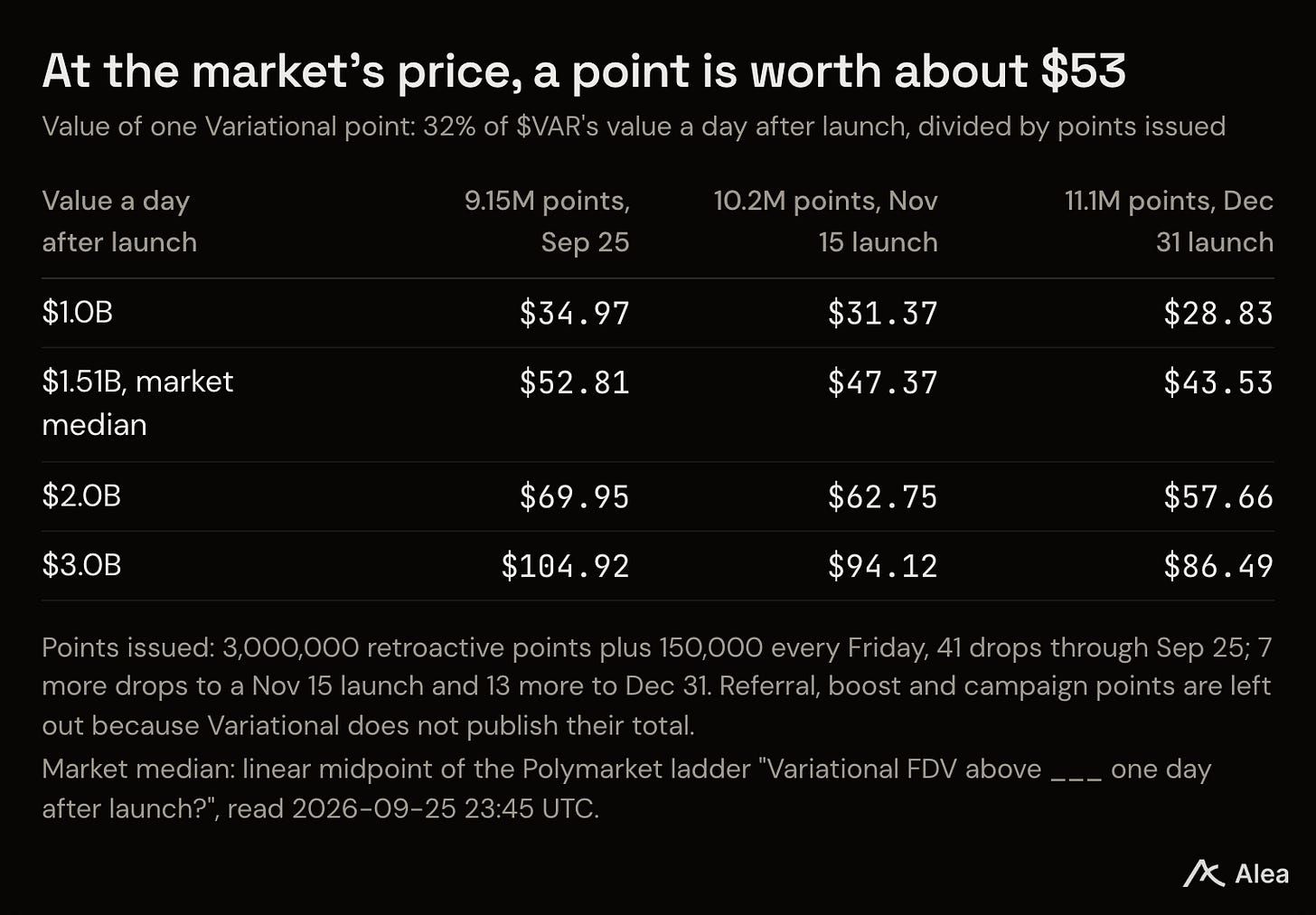
A price on every point. The market values $VAR near $1.51B a day after launch. At that price one point is worth $52.81, and each Friday drop until launch cuts that by 1.6%.
Every treasury dollar buys $VAR. The treasury takes 20% of the spread traders pay. Variational reported $914,194 reaching it in the two weeks to Sep 18.
No fee, and tight at size. Traders pay no trading fee, and the Nasdaq 100 swap quoted a million dollars at 0.68 bps on Sep 25, a seventh of Bitcoin's width.
The Venue: The Finish Line Moved to Launch
Variational published its token terms at 01:13 UTC on Sep 24. $VAR launches in the fourth quarter. Points holders get 32% of supply, all of it unlocked at launch. An 18% reserve sits with the Variational Foundation, and 50% goes to the team and investors, locked for 12 months after launch and released over at least three years.
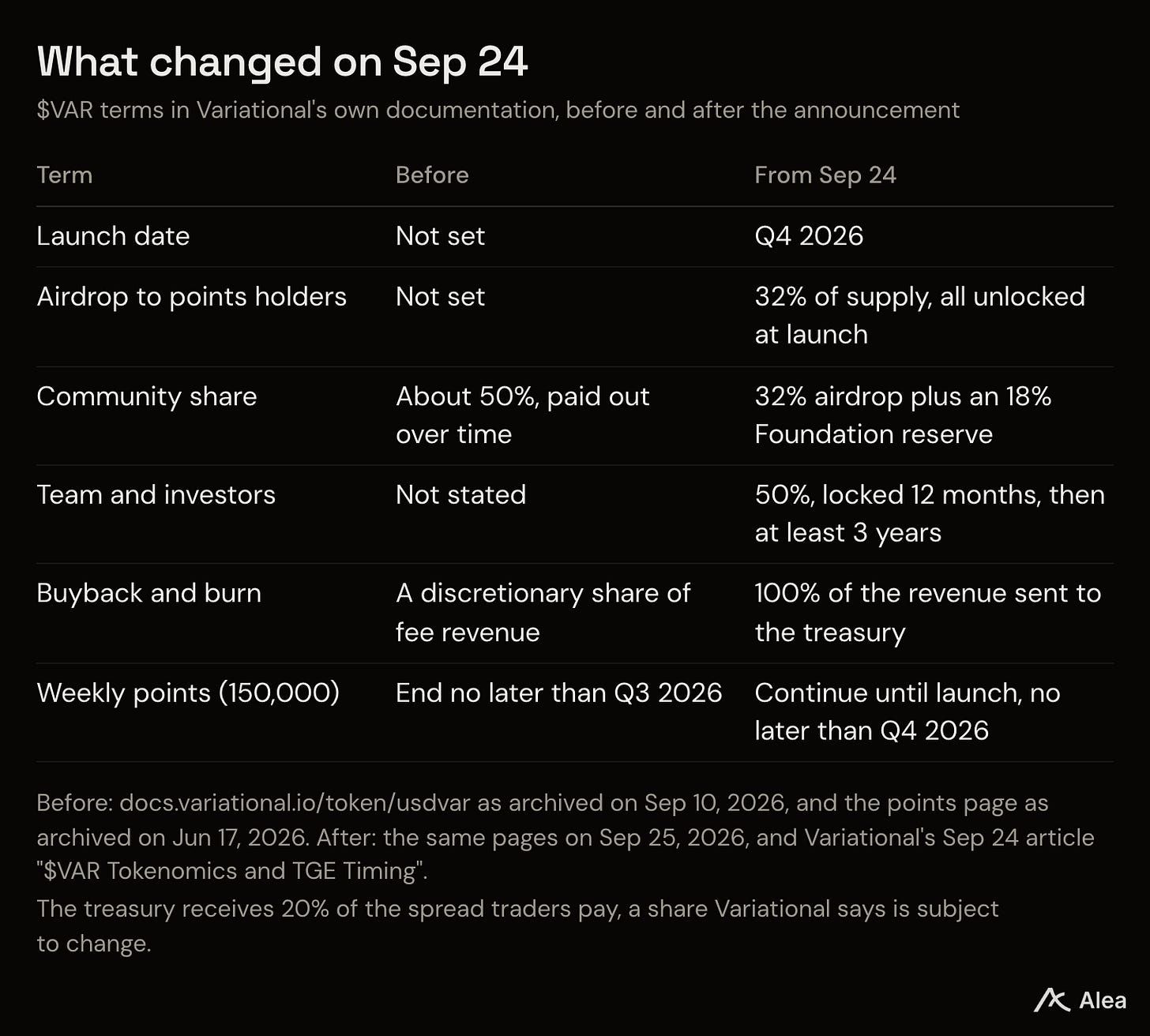
Two lines changed the most. The buyback moved from a discretionary share of fee revenue to 100% of the revenue that reaches the treasury. The Sep 10 page stated that the Foundation set the old share and was free to change or stop it at any time. Weekly points, scheduled to end with the third quarter, now run until launch. Variational tied the delay to "major strategic partnerships that redefine Variational's trajectory" and listed what comes first: a public mainnet, more swaps, a trading API, and the details of the buyback. The same evening a seventh swap, on the Taiwan index, went live.
The Field: Second Only to Hyperliquid
From Sep 21 to Sep 25, Variational carried 14.95% of all onchain perpetual volume, second of 98 venues. Hyperliquid carried 34.46%. Aster, Lighter, and edgeX carried 9.18%, 6.49%, and 6.15%, and all three ranked above Variational in August, when it placed sixth with 5.36%. For September to date it ranks third, with 8.94%.
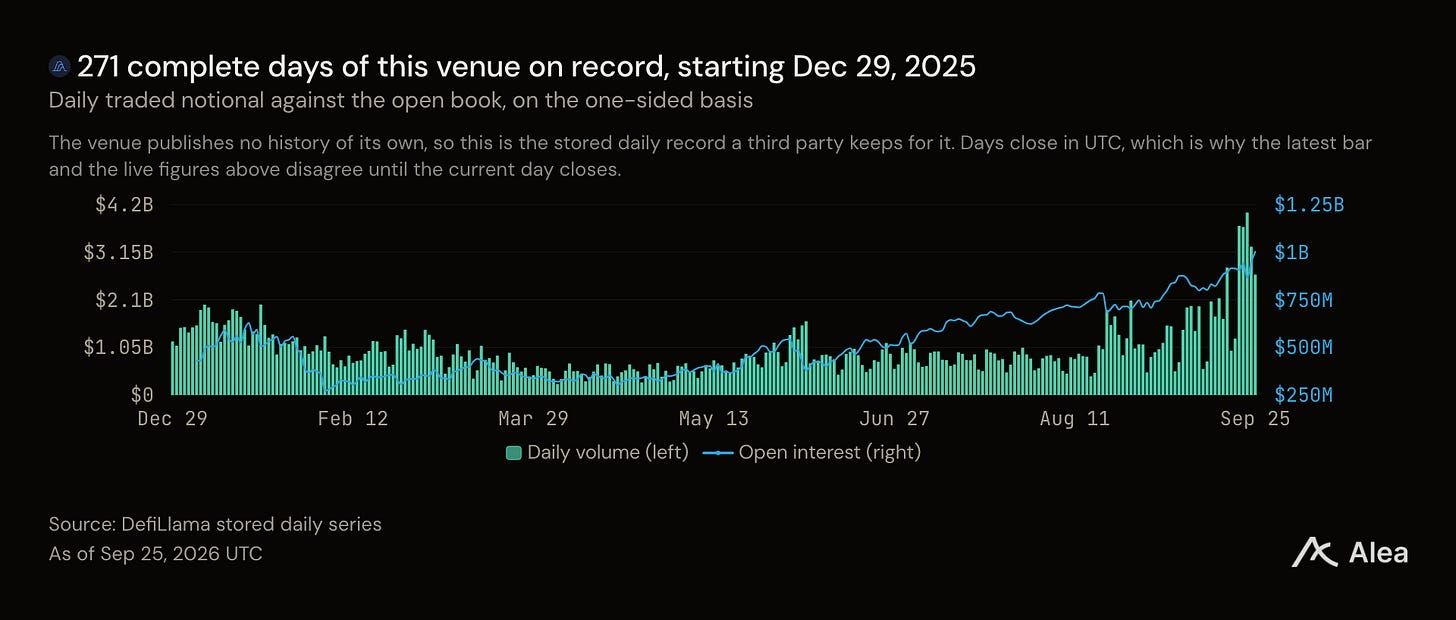
The records came one after another. Daily volume set five records from Aug 25, the first new high since Jan 20, and topped out at $4.02B on Sep 23. The week's $17.39B beat the $12.63B of the best full week before it. September passed January's $44.94B as the largest month on record, with five days to spare. Open interest, the value of open positions counted once, closed Sep 25 at $1.00B, its first settled day above $1B.
The Book: The Nasdaq Swap Out-Traded Bitcoin
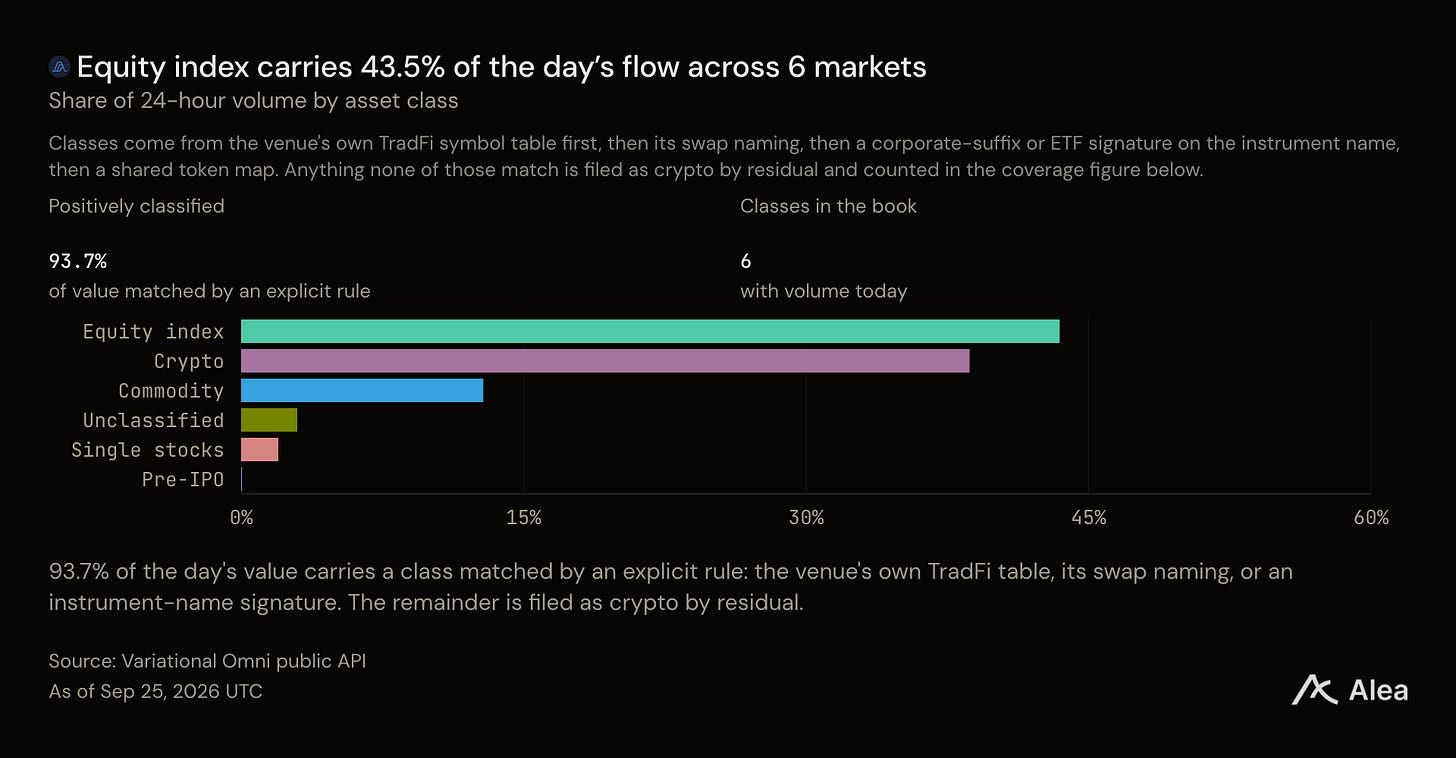
Seven swaps carried 56.6% of the venue's volume in the 24 hours to 21:58 UTC on Sep 25. A swap tracks a stock index, a metal, or crude oil, charges its financing once a day at the traditional close, and draws its liquidity from traditional institutions.
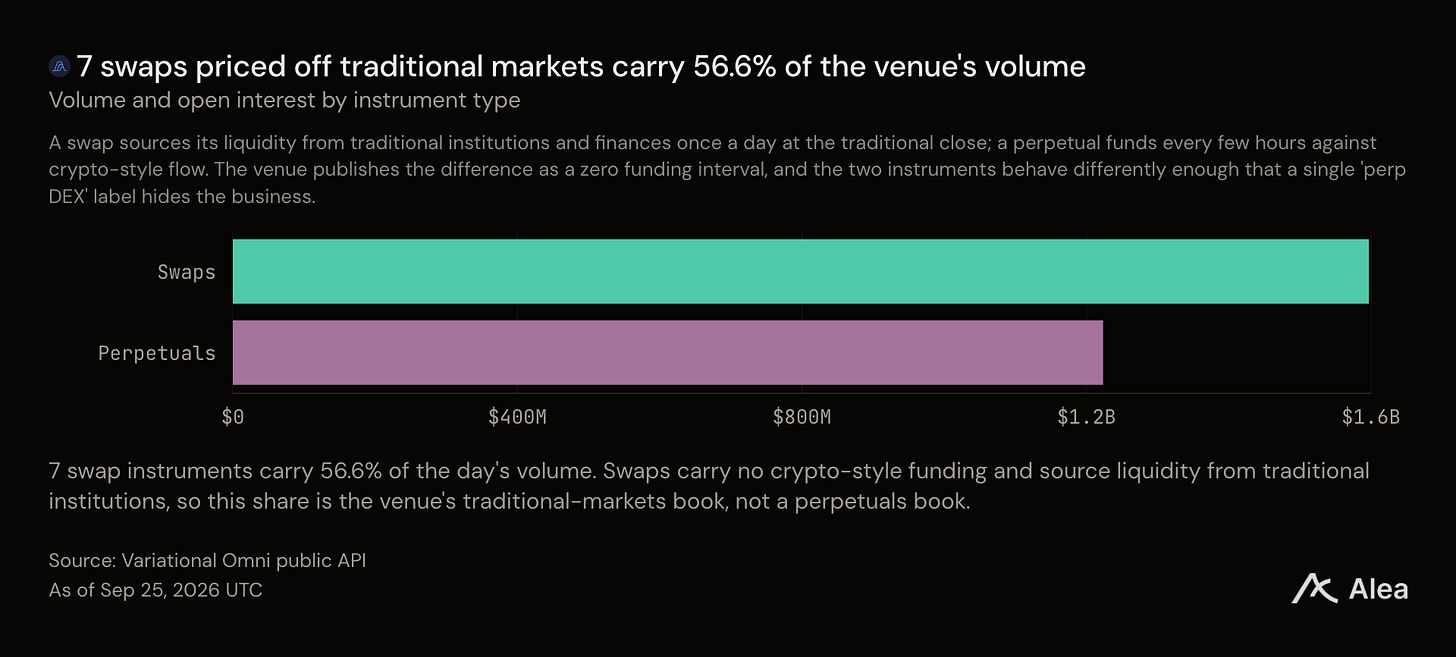
Stock indexes alone carried 43.5% of the day's flow, more than every cryptocurrency combined, and the Nasdaq 100 swap was the largest single market on the venue. Variational's chief executive put the traditional-markets share near 70% of daily volume on Sep 18.
Execution: A Million Dollars at 0.68 bps
Only 20 of 553 markets quote a million dollars, and they carried 94.1% of the day's volume. The width at that size decides what a large order costs.
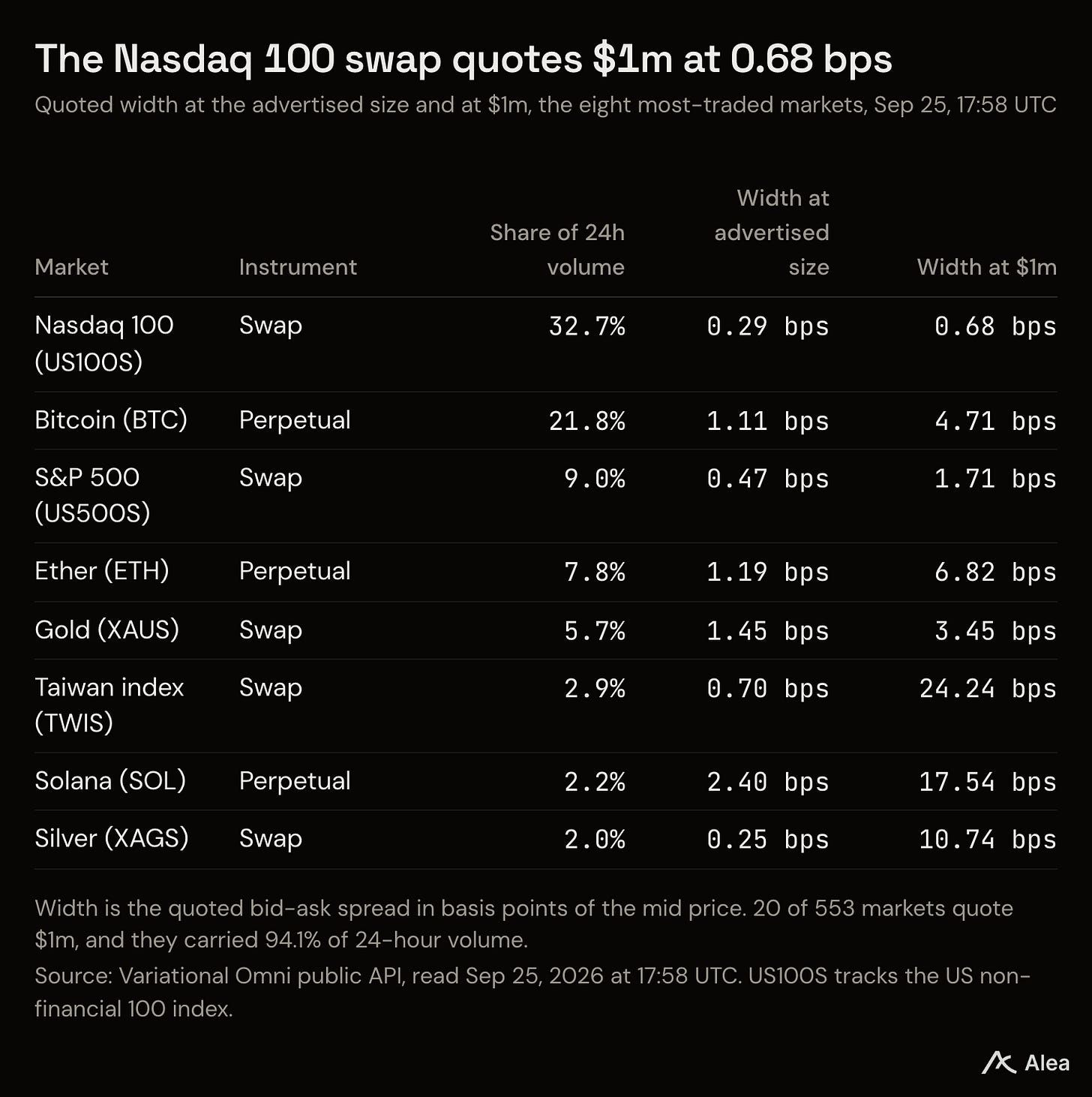
The Nasdaq 100 swap held 0.68 bps at a million dollars, against 4.71 bps for Bitcoin and 6.82 bps for Ether. Swap traders now enter "$5M+ positions with under 1 bip of all-in execution costs," and Omni charges no trading fee on top.
The Token: A Price on Every Point
Thirty-two percent is a large share to hand out on day one. Hyperliquid released 31% at its genesis, edgeX released 30%, and Aster released 8.8% of supply at launch from a larger bucket. The insider share is larger than Hyperliquid's. Team and investors hold 50%, the same share Lighter announced for its own, against 23.8% for Hyperliquid's contributors, who had no investors beside them.
The market priced the terms within hours, and the middle held. On Polymarket, the odds that $VAR opens above $1B a day after launch stood at 65.5% before the terms and closed Sep 25 at 65.5%, against 33.5% on Aug 1. The tails moved instead. The odds above $2B rose to 34.85% from 29.3%, and the odds above $500M fell to 84.5% from 91.5%, the ladder showed at the close.
At the market's median of $1.51B, one point is worth $52.81, which is 32% of that value divided by the 9.15 million points issued through Sep 25. Every Friday adds 150,000 points to the same 32%, which cuts the value of each point by 1.6%. A launch on Dec 31 means thirteen more weekly drops on the published schedule, 11.1 million points, and $43.53 a point at the same median.
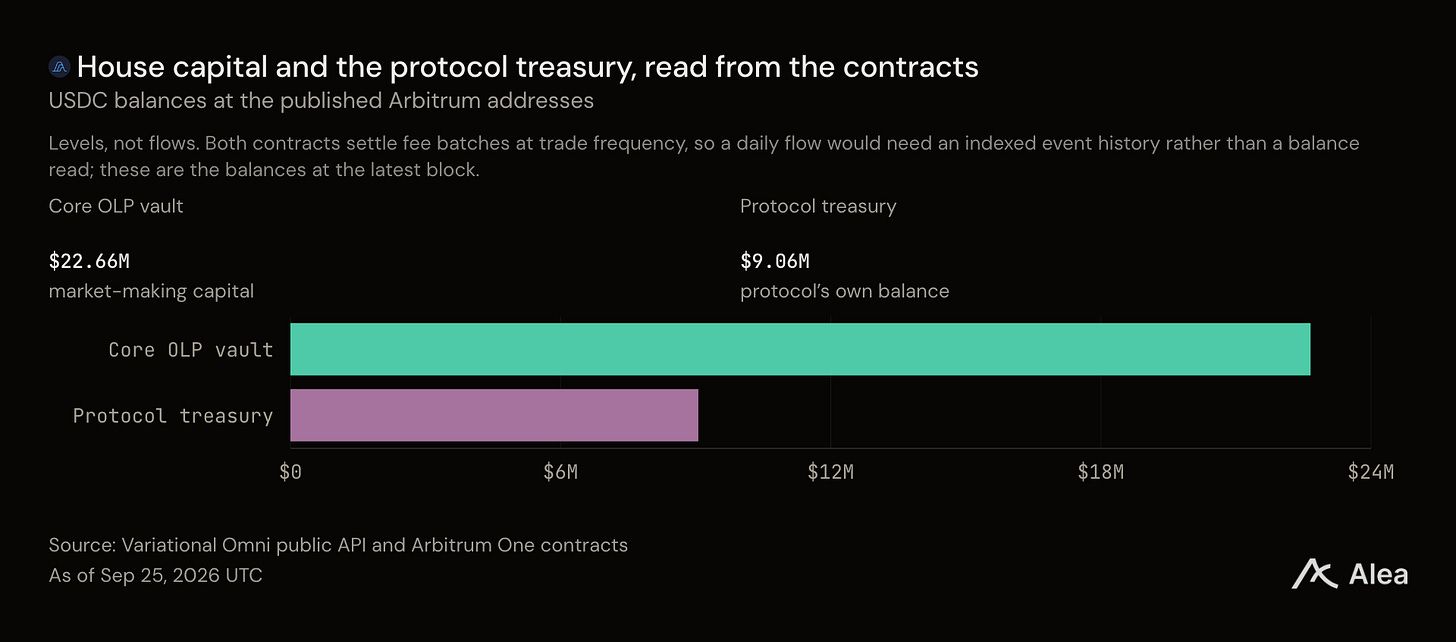
Omni charges no trading fee, and its house dealer, the Omni Liquidity Provider, earns the spread. The treasury gets 20% of that spread, a share Variational calls "subject to change." Variational reported $914,194 reaching the treasury in the two weeks to Sep 18, and the treasury contract held $9.06M on Sep 25.
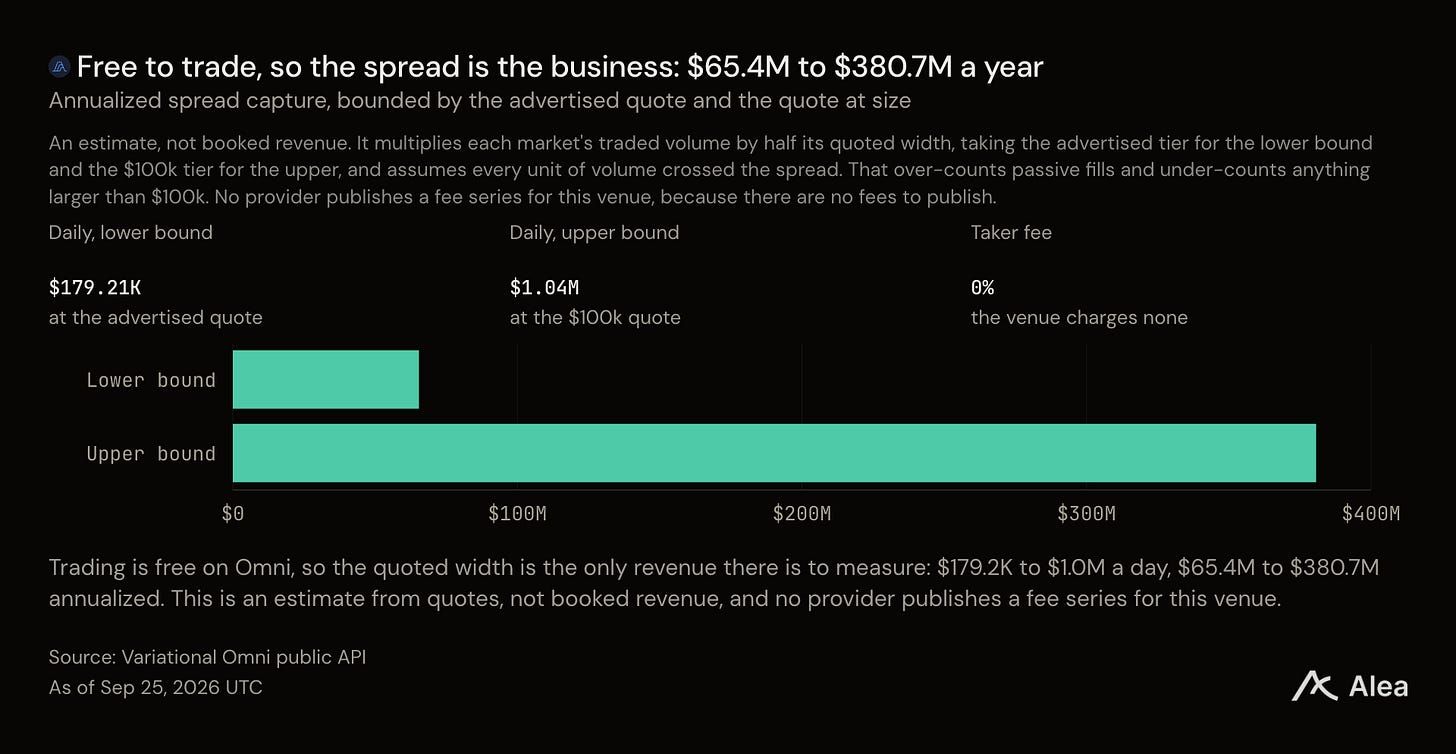
The reported income sits inside the range the venue's own quotes imply. Variational reported $4.57M of gross spreads in those two weeks, about $119M a year at the same pace, between the $65.4M and $380.7M that the quotes on Sep 25 implied. Twenty percent of that range is $13.1M to $76.1M a year, and all of it is now pledged to buying $VAR back and burning it.
The Countercase: Points Pay Until Launch
Onchain perpetual volume as a whole fell 8.1% on the same weekdays a week earlier, while Variational's rose 66.9%, in the weeks the points program was scheduled to end. Swaps earned double points from Sep 3, a swaps trading competition ran from Sep 10 to Sep 24, and week 41's drop went to 30,358 accounts, after twelve weeks between 24,501 and 25,967. Turnover, what each dollar of open positions traded in a day, rose to 3.76 times from 2.43.
Dated Ahead
Oct 2, 00:00 UTC. Week 42's drop of 150,000 points, then one every Friday until launch.
Before launch. Variational promised the split between team and investors, a public mainnet, a trading API, and the buyback details.
Fourth quarter. $VAR launches, and weekly points end no later than Dec 31.
Twelve months after launch. The team and investor lock ends, and their 50% releases over at least three years.
Verdict: What the Points Did Not Build
Variational set its records while its own terms still ended points in September. Then it gave traders a reason to stay: 32% of the token unlocked on day one, near $53 a point at the market's price, and every treasury dollar pointed at buying $VAR back. Points now run to launch, and part of the record belongs to them. The part that does not is a Nasdaq 100 quote of 0.68 bps for a million dollars, open positions above $1B, and a venue that grew by two thirds in a field that shrank.
Important Links

Read our Weekly Pulse, Alea's full-week strategic synthesis across macro and the major liquid markets.
Alea combines independent research with live protocol data for financial institutions and protocol teams. We clarify market structure and test investment cases. The same work communicates economic value with precision.
Explore Protocol Data Rooms for institution-ready protocol evidence.