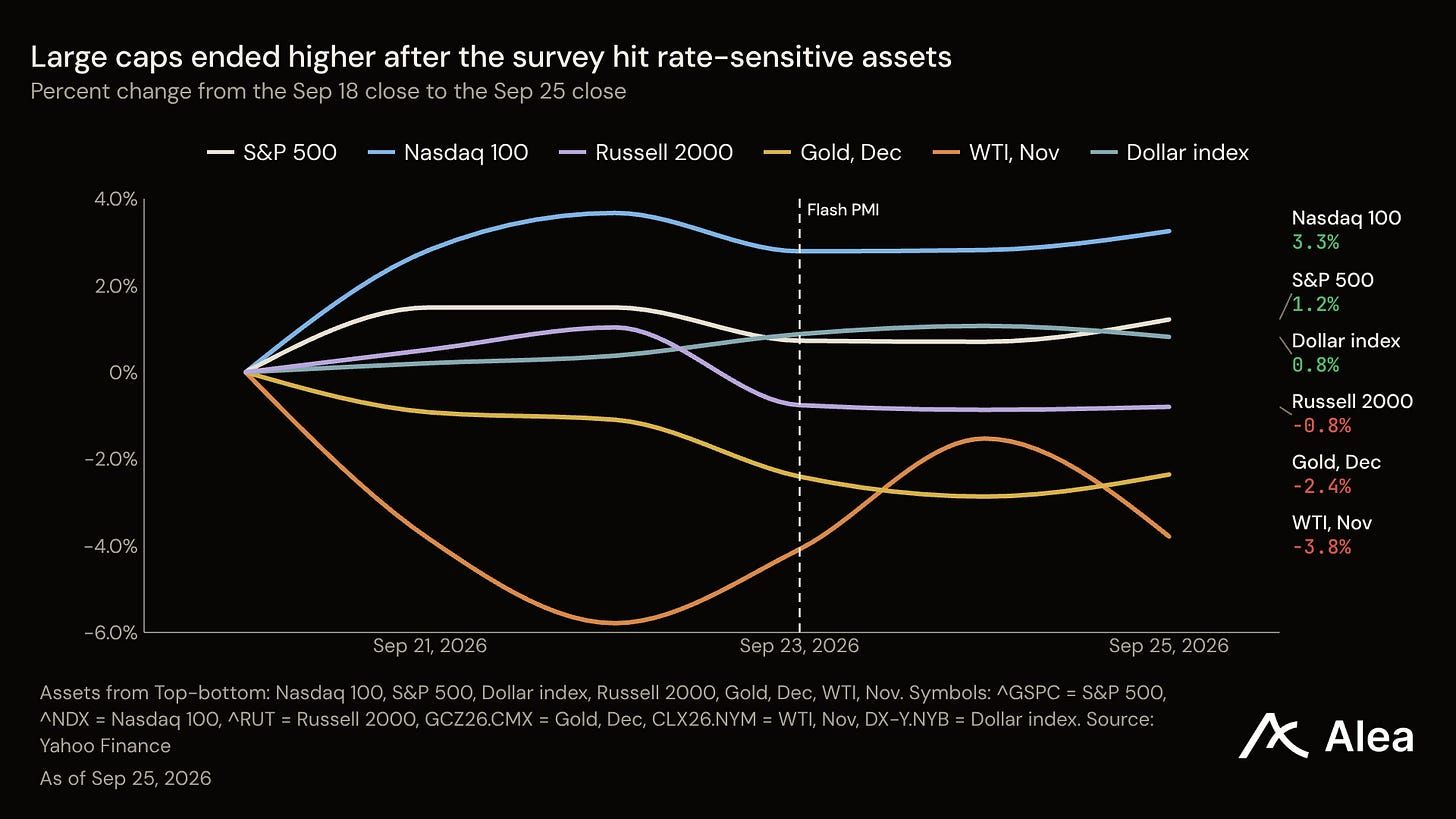
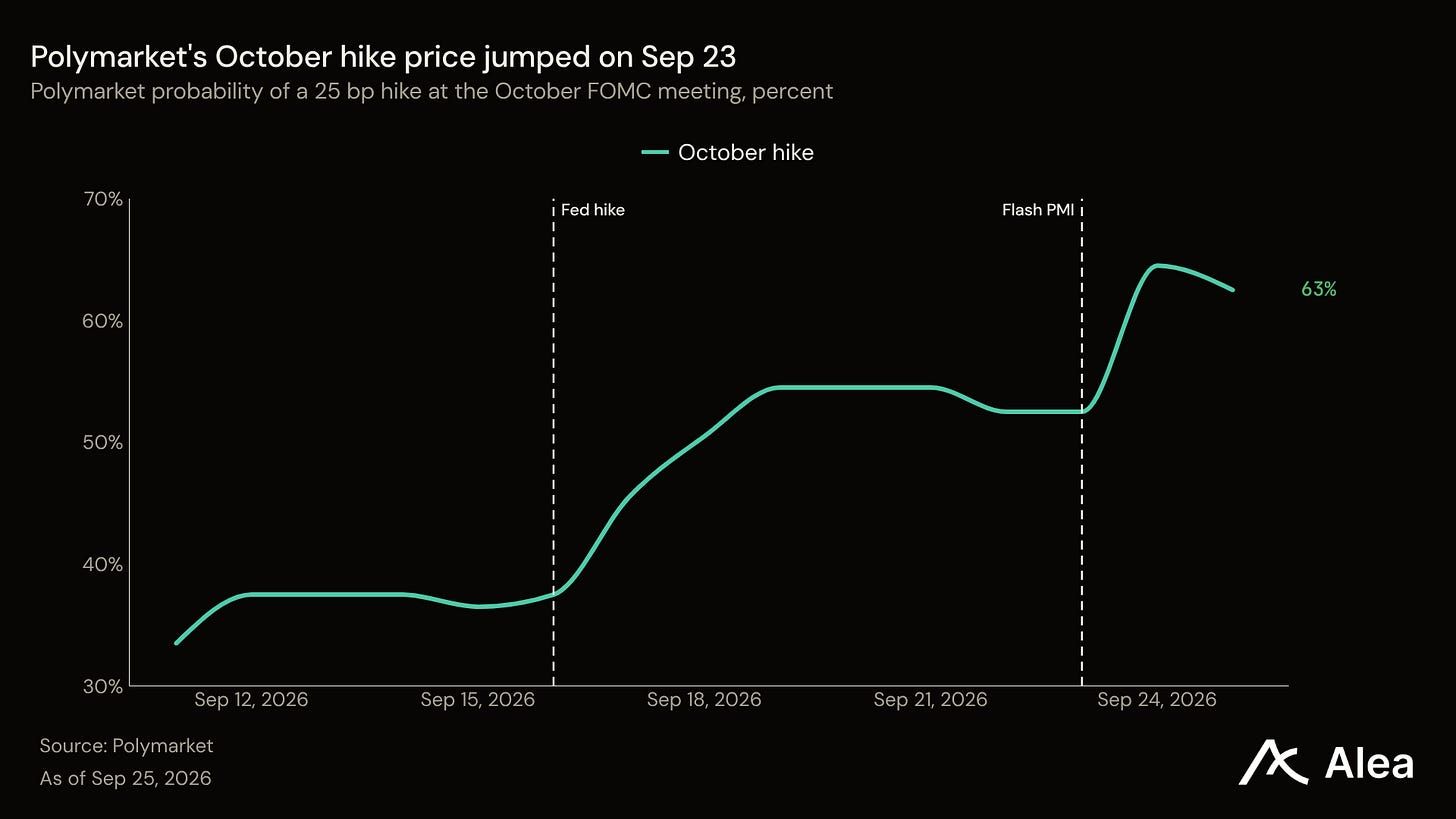
A week ago the market treated a second Fed hike as a coin flip. Wednesday changed that in an hour. Between the flash PMI survey and a speech by Governor Barr twenty minutes later, the price of an October hike on Polymarket climbed from 53.5% to 69.5%. On Thursday the 10-year Treasury closed at 5.18%, its highest close since July 2007. The S&P 500 still finished the week higher. Meta and a few other giants carried it. The average stock fell.
Takeaways
The market leaned into the Fed's second hike. By Friday's close, Polymarket priced an October hike at 62.5%, from 54.5% a week earlier. Sixteen of 18 Fed officials had already written at least one more hike into their September projections.
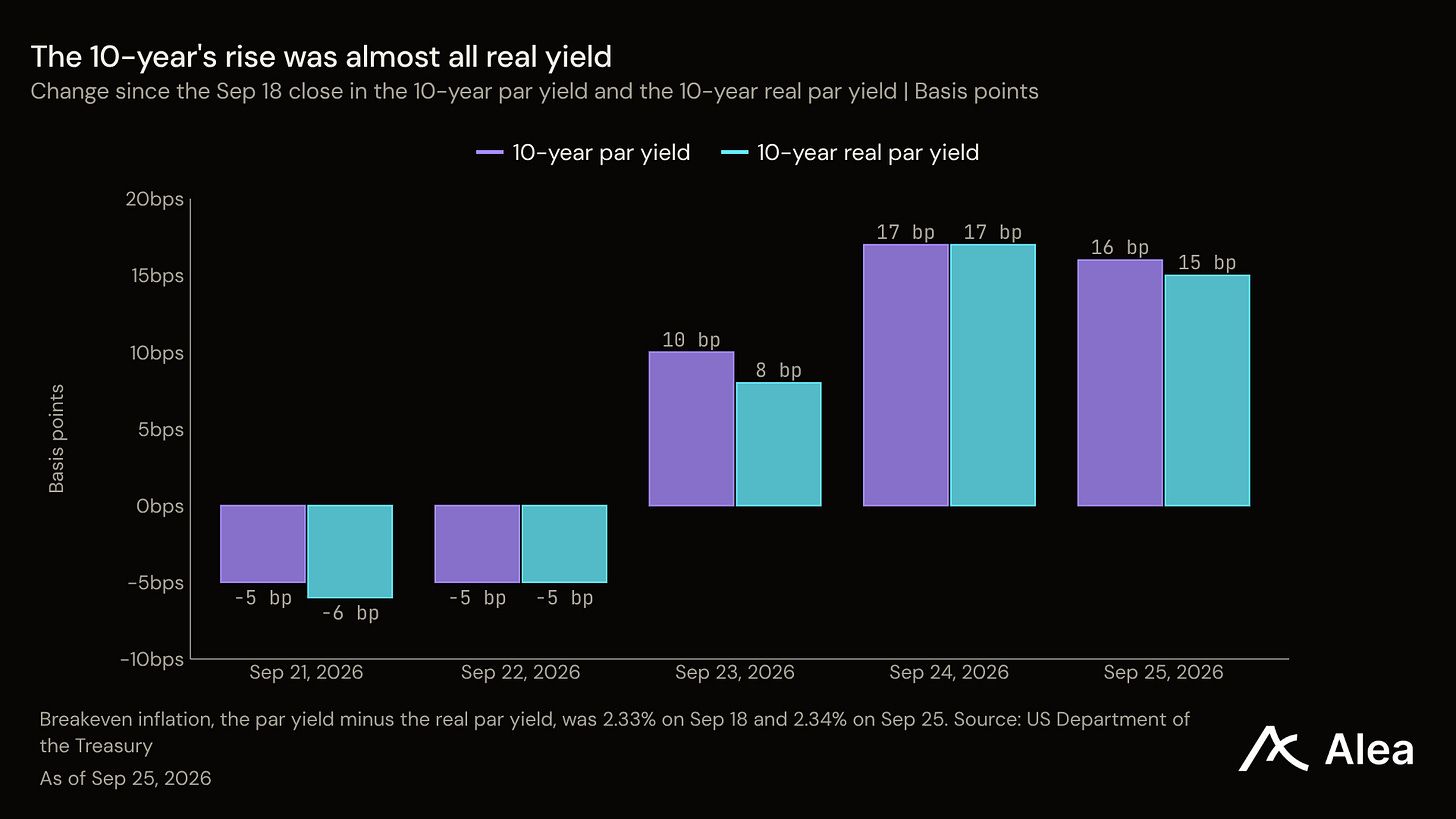
Money got dearer. Inflation did not. The 10-year rose 16 bp from its Sep 18 close, and 15 of those basis points were real yield.
The index hid who paid. The S&P 500 finished +1.21% on a few of its largest members, led by Meta, while the equal-weight S&P 500 fund finished -0.56%.
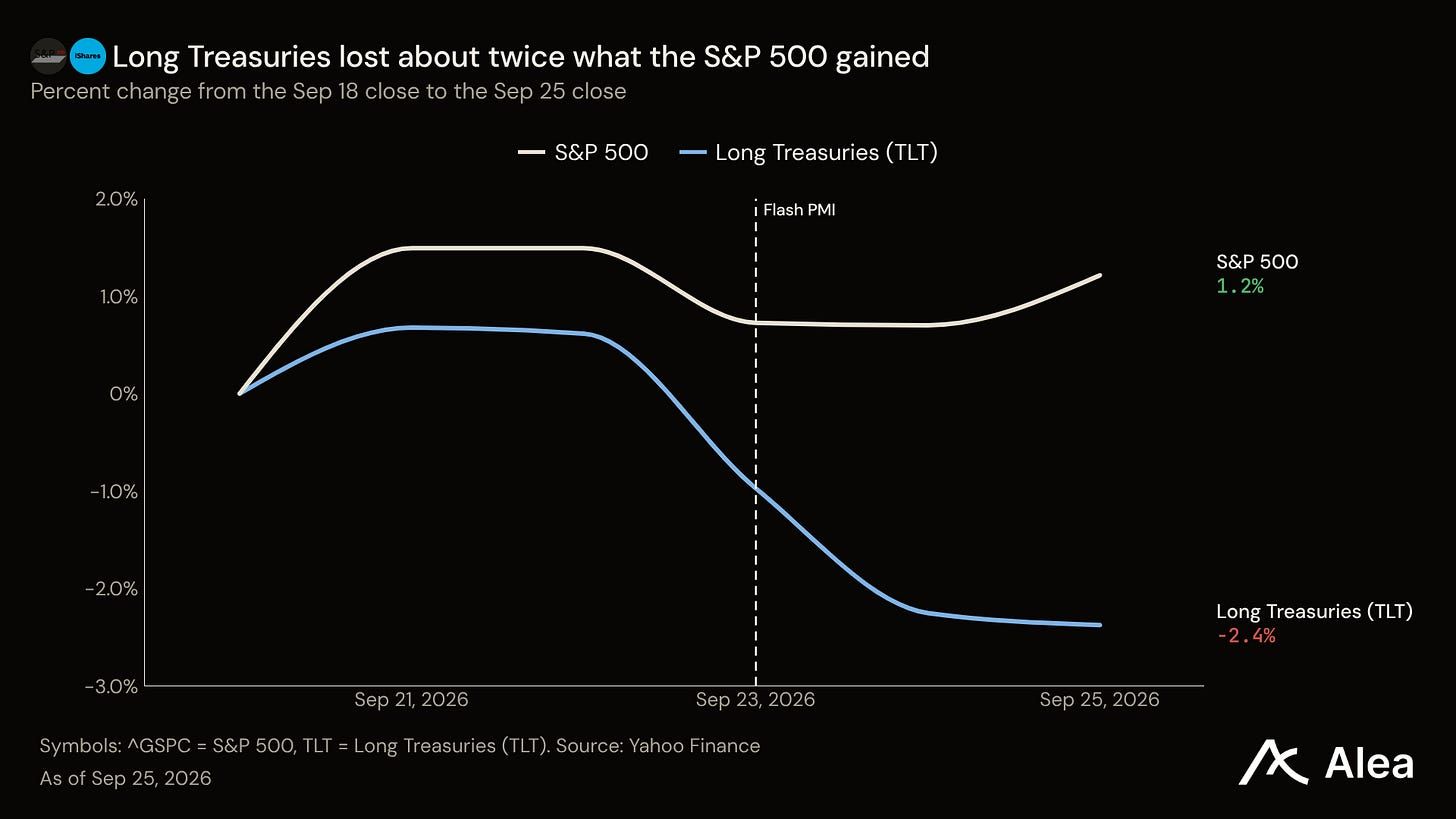
Bonds and gold paid the bill. Long Treasuries ended -2.38% and December gold -2.36%, in a week with no stock drawdown for bonds to cushion.
Crypto's buyers arrived before the survey. Spot BTC ETFs took in $999M on Monday, their largest day since Oct 6, 2025. BTC kept a +3.51% week through Wednesday's rate shock and Thursday's Bitget breach.
Cross Asset Market: Bonds Paid for a Calm Week in Stocks
In a balanced portfolio, the bond sleeve meant to cushion a fall lost money in a week that had no fall to cushion. The dollar index rose 0.81% as yields climbed.
Options priced a calm week for stocks and BTC, and both stayed inside it. At the Sep 18 close, the VIX implied a one-standard-deviation range of about 2.1% either way for the S&P 500 over five sessions, and the index used a little more than half of it. Deribit's volatility index priced about 4.9% for BTC over seven days, and BTC used about 70% of it. Bonds were the loud market. The 10-year rose 15 bp on Wednesday alone.
Last Week's View: The Inflation Call Held
Last week we wrote that the rise in rates had stopped being about inflation, and that the 10-year had failed to stay above 5%. The inflation call is confirmed by Treasury's real yield curve, which puts the 10-year real yield at 2.83%, up from 2.68% a week earlier. Breakeven inflation moved from 2.33% to 2.34%. Once again the market repriced the cost of money and left the price level alone. However, the 10-year closed above 5% on Wednesday, Thursday, and Friday, and Thursday's 5.18% was its highest close since Jul 6, 2007.
Macro: The Market Caught Up With the Dots
In September the Fed projected one more hike this year. The market took a week to believe it. Sixteen of the 18 officials who submitted projections on Sep 16 put the policy rate higher by December, yet on Sep 18 Polymarket priced an October hike at 54.5%.
Two events moved it, twenty minutes apart. S&P Global's flash composite PMI for September printed 58.4, up from 56.0 and the fastest growth since July 2021. Input costs rose at their quickest pace since October 2022. The October hike price climbed from 53.5% to 60.5% in the eleven minutes after the release. Then Governor Barr said his base case includes more adjustments "to ensure inflation comes down to target in a timely fashion," and the price reached 69.5% within the hour. On Thursday, Philadelphia Fed President Paulson backed the September hike and pointed to modest further tightening.
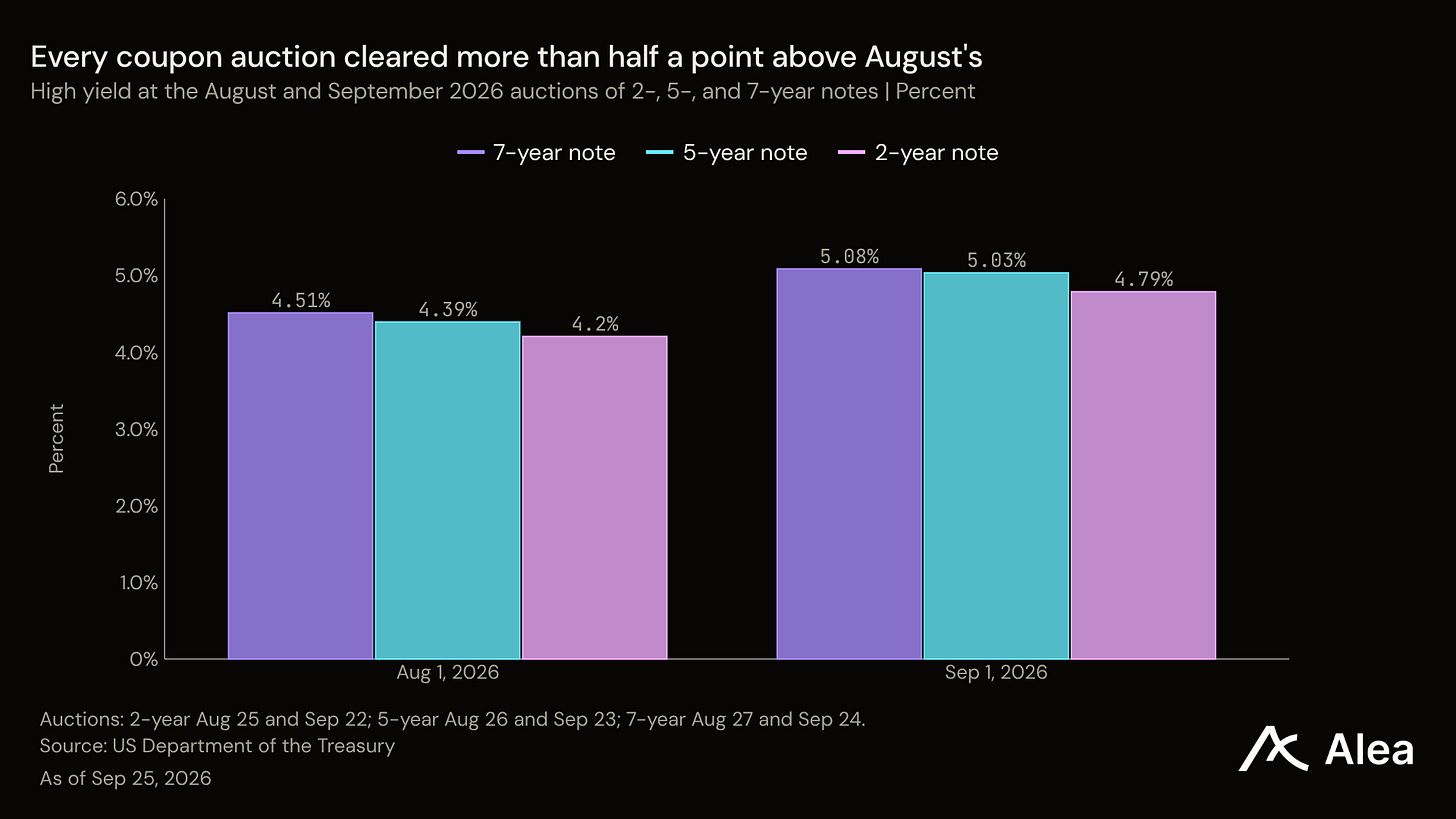
Meanwhile, lenders to the government charged more. The Treasury sold $70B of 5-year notes on Wednesday at 5.033%, the highest yield at a 5-year auction since Jun 28, 2006. Thursday's $44B of 7-year notes cleared at 5.085%, the highest since that series restarted in 2009.
Crypto: ETF Buyers Moved Before the Survey
We called crypto's rally a squeeze rather than conviction last week. That call is weakened, because this week the buying came through spot ETFs. The buyers showed up on Monday, two days before the rate shock. Spot BTC ETFs took in $999M that day, the largest single-day inflow since Oct 6, 2025, and ETH ETFs took in $270M. BTC rose 6.6% on Monday, measured at the US close.
BTC gave some of it back after the survey. It fell 2.0% on Wednesday, the same day yields jumped and long Treasuries fell. Then, at 18:31 UTC on Thursday, Bitget detected unauthorized transfers from its hot wallets, which it put at about $351.6M. BTC ended Thursday's US session within 0.2% of Wednesday's close and finished the week 3.51% above its Sep 18 close. ETH gained 2.22% on the week.
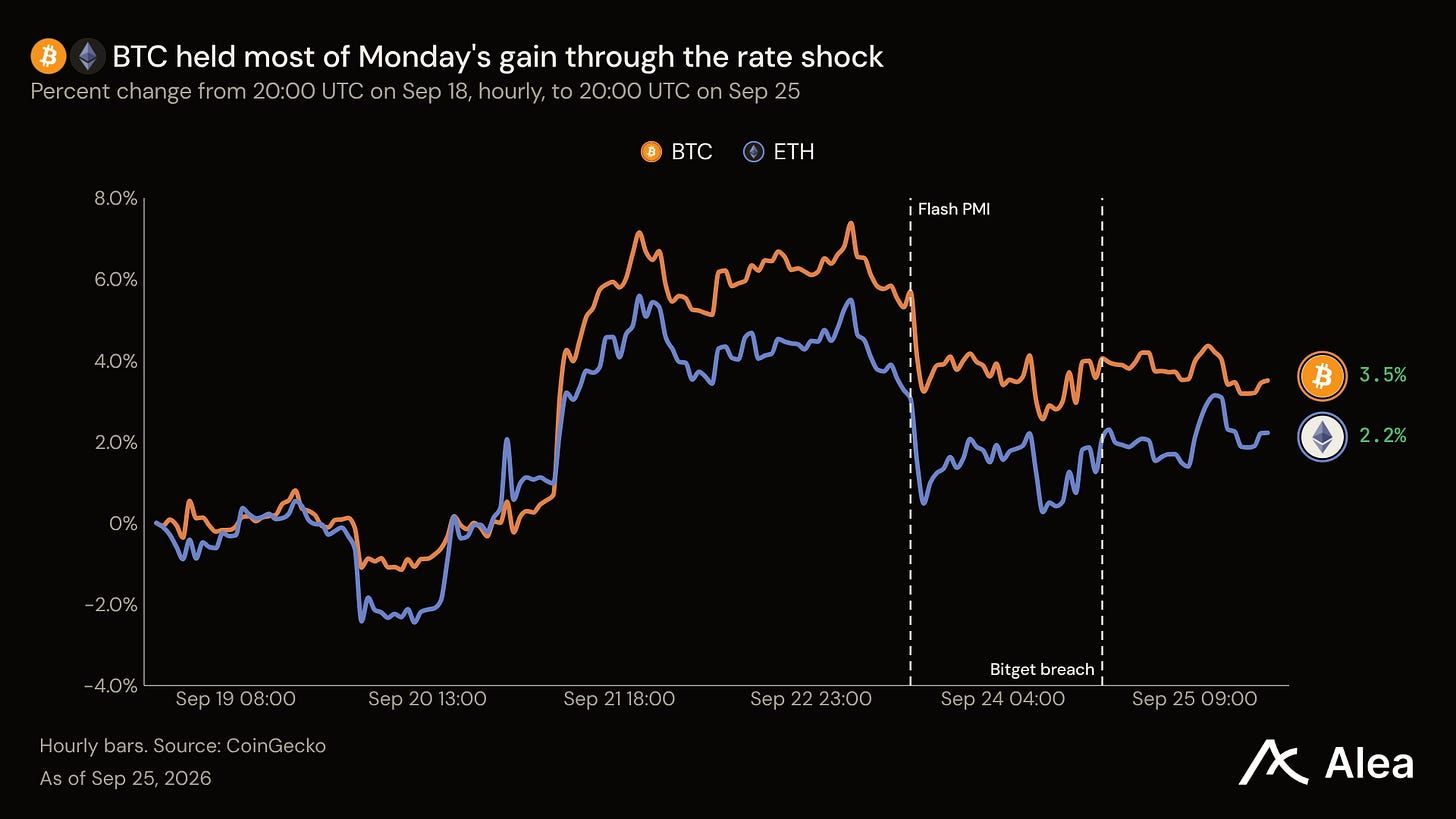
Longs paid no premium to keep their positions open. On Hyperliquid, BTC funding sat at the venue's default rate, 10.95% a year, in 139 of the week's 168 hours. Spot BTC ETFs kept buying through Thursday, $2.25B across the four days.
Equities: The Index Rose, the Average Stock Fell
A few giants kept the S&P 500 higher, and the Nasdaq 100 gained 3.25%. Meta led them, up 12.90% on the week. Most of that came on Monday, after Sensor Tower counted more than 2.5M downloads of Muse, the personal AI agent Meta launched on Sep 8.
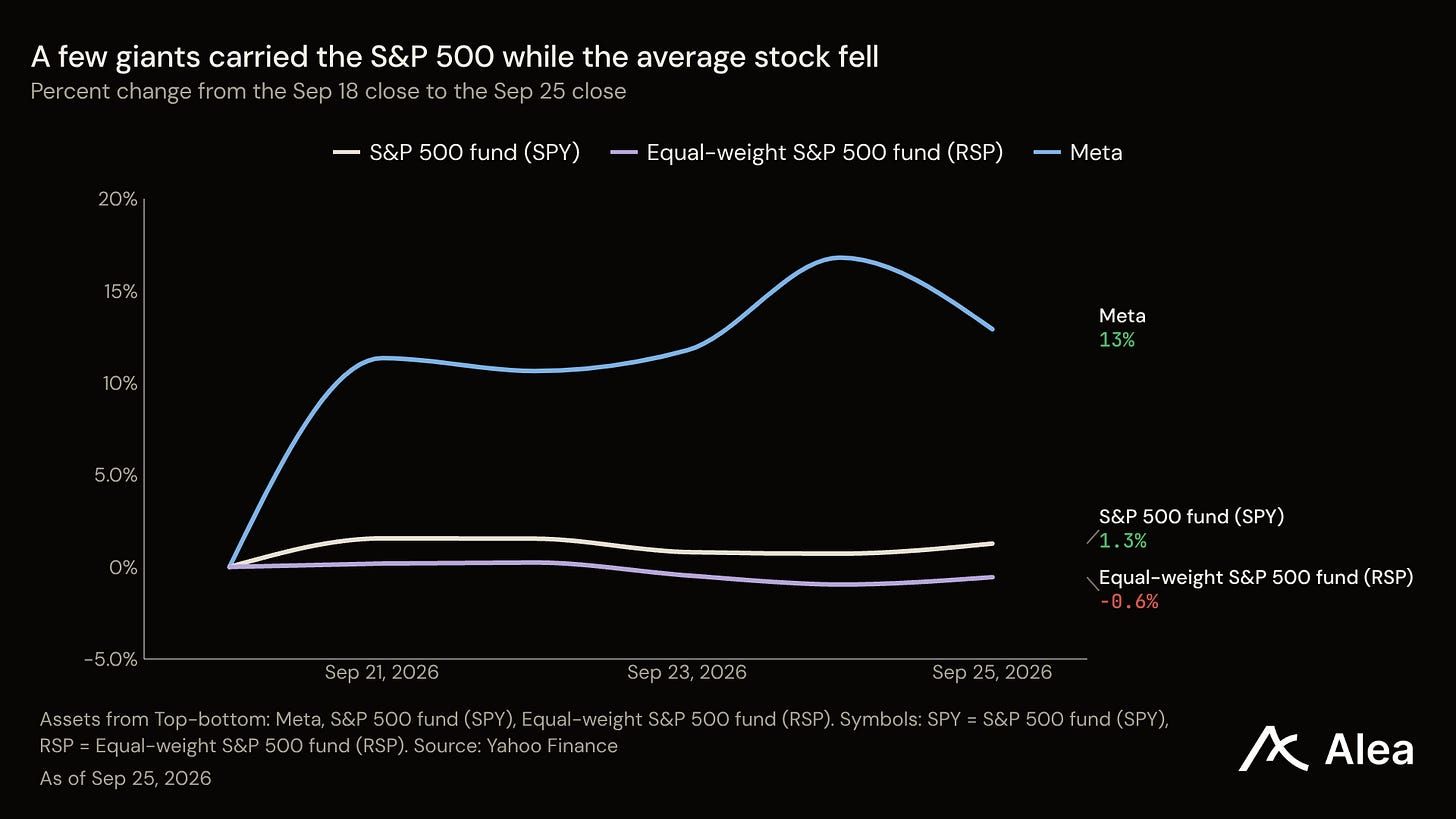
The average company went the other way. The equal-weight S&P 500 fund fell 0.56%, and the Russell 2000 lost 0.80%, both with their worst day on Wednesday. Alphabet, another giant, dropped 3.8% that day.
Commodities: One Strait, Two Crude Prices
Crude traders priced the Strait of Hormuz two ways at once. November Brent rose 0.48% while November WTI fell 3.79%. On Wednesday, Brent's spot premium over WTI reached about $24 a barrel. The tanker freight fund BWET fell 18.2% on Tuesday, after reports of an Iranian offer to reopen the strait. A senior Iranian official said on Wednesday that Tehran can reopen it within a week if the US blockade lifts. In the US, commercial crude stocks rose 3.0M barrels in the week to Sep 18.
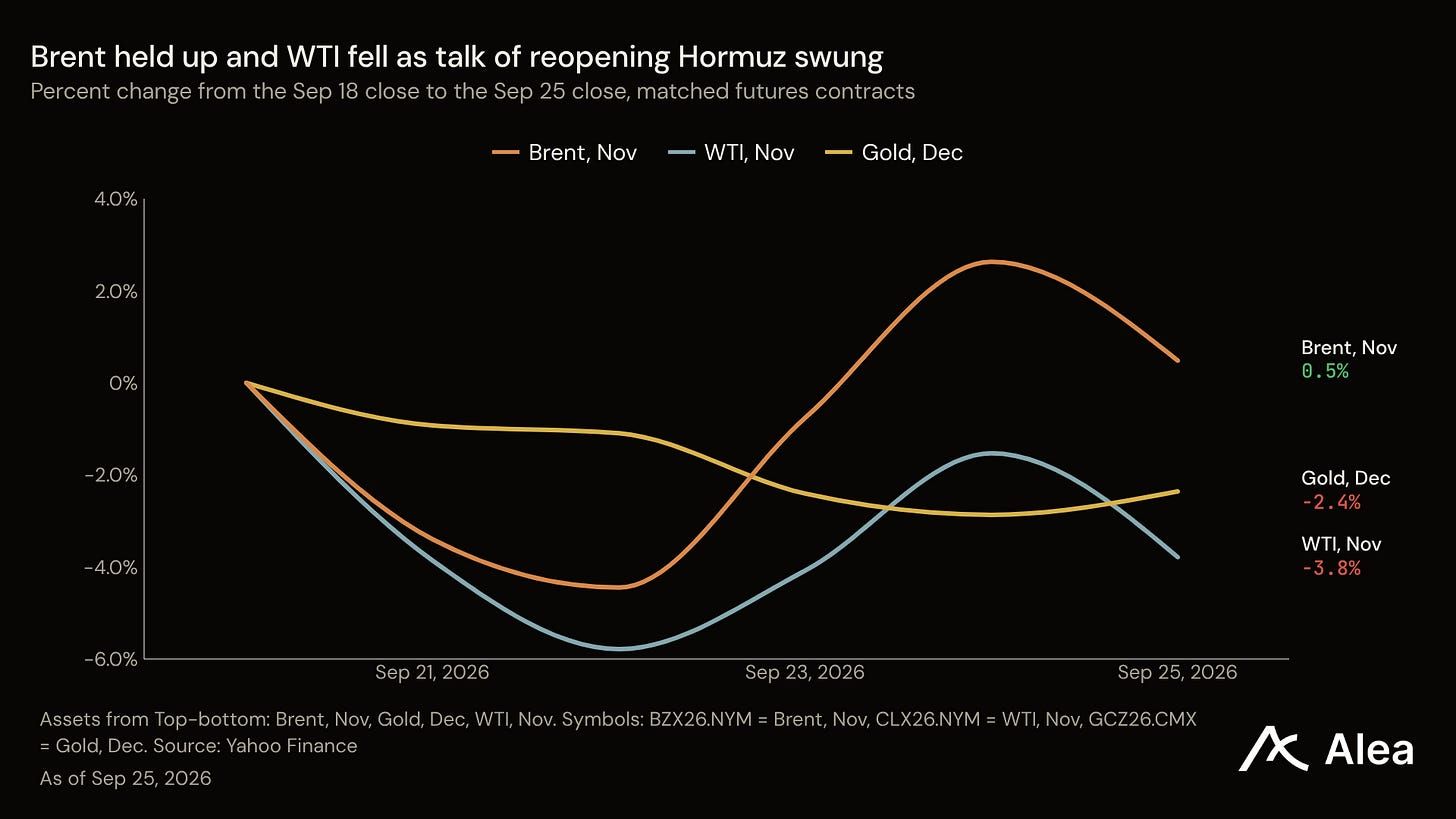
Gold paid the rate bill directly. December gold fell 2.36% as the 10-year real yield climbed to 2.83%. The metal that pays nothing lost ground to the bond that now pays more.
The Verdict: Money Got Dearer, the Index Did Not Notice
The odds now favor a second hike. Polymarket's October hike contract closed the week at 62.5%, and that price has to survive two data prints before the decision. August PCE inflation lands on Sep 30, September payrolls on Oct 2, and the Fed decides on Oct 28.
The market came most of the way to the Fed and raised the price of money to say so. Fifteen of the 10-year's 16 basis points were real yield. That bill landed on long Treasuries, on gold, and on the average stock. The index stayed higher only because a few of its largest members rose, with Meta first on news of its own.
Important Links

Weekly Pulse follows the Fed path, Treasury yields, crypto, equities, and commodities through the full week. Pulse reports come with an Alea Plus or Pro plan.
Research reports. Deep Dives and Blueprints explain protocols and their economics. Theses and Memos examine investment cases and catalysts. Benchmarks compare performance, while Perspectives assess specific developments.
Weekly Pulse. Read a weekly assessment of macro and the major liquid markets.
Protocol Data Rooms. Research each protocol in one place, with Analytics for historical comparisons and Intel for news and governance developments where available.
Podcast Digest and Summit Digest. Read summaries of industry conversations and events. Find Alea shows and their episodes through Podcast Digest.
Governance Tracker. Follow proposals and voting activity across protocols.
For protocol teams preparing institutional conversations, discuss research for your protocol with Alea.