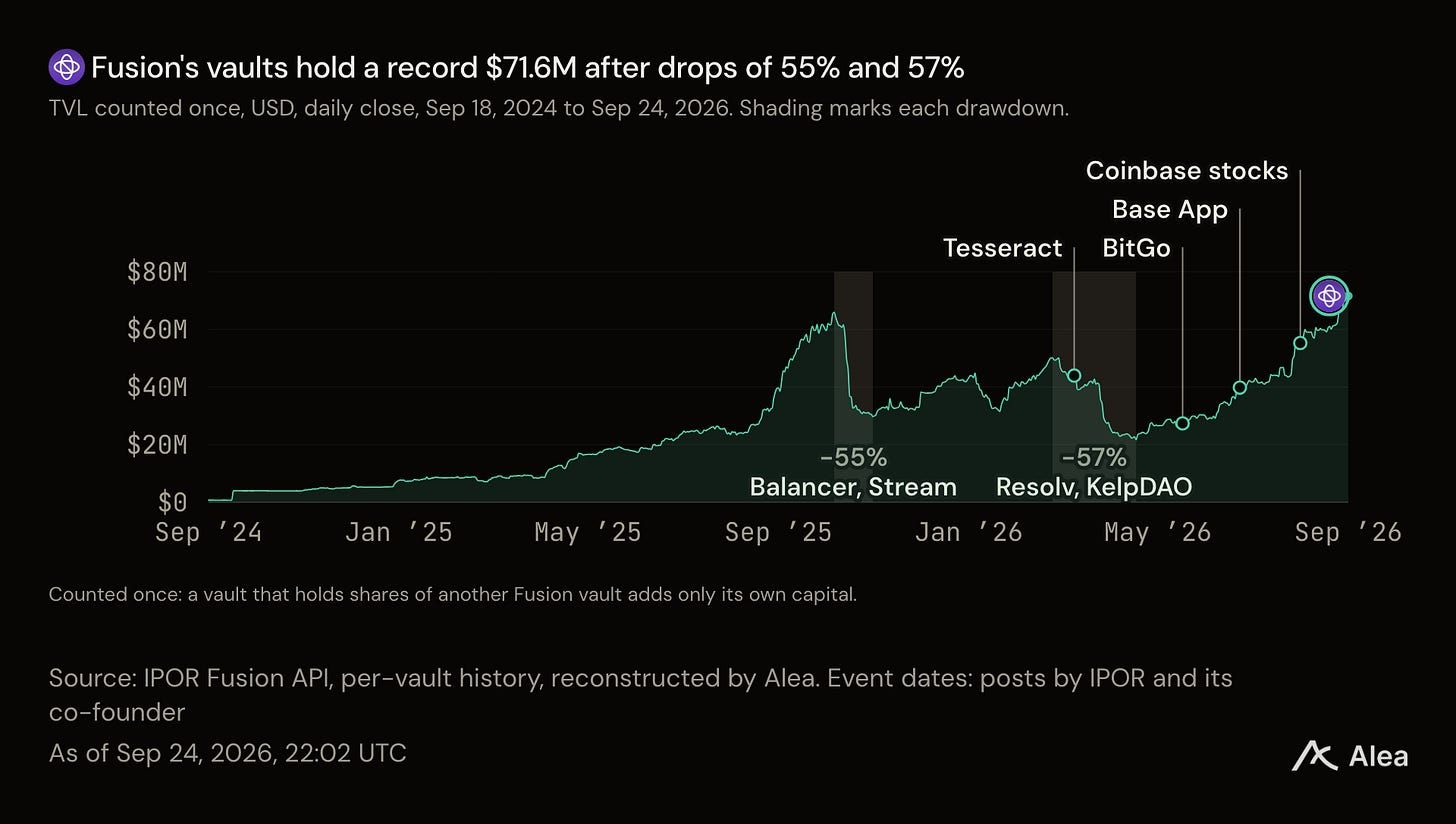
Most fintechs, exchanges, and asset managers can afford to build a DeFi desk. Few can afford to spend the time, knowledge, and experience required. Not just TradFi. DeFi treasuries also need on-demand, custom, and automated strategies that run around the clock with circuit-breakers built-in. These days, the opportunity cost of not owning a risk-adjustable yield factory for your assets is just too high. The good news is that whether you are a TradFi or DeFi entity, you can rent this transparent desk while keeping your existing customer relations and customizing your strategies. Tesseract, a MiCA-licensed manager, worked with that stack for a year and then built its client vaults on it. Deposits in Fusion vaults reached a record $71.6M on Sep 24, and at constant asset prices they grew 91% in a year.
Takeaways
A fintech can offer an Earn product on Fusion without writing vault contracts or integrations. Fusion's modules reach more than 40 protocols, and IPOR's factory deploys a new vault from one strategy file.
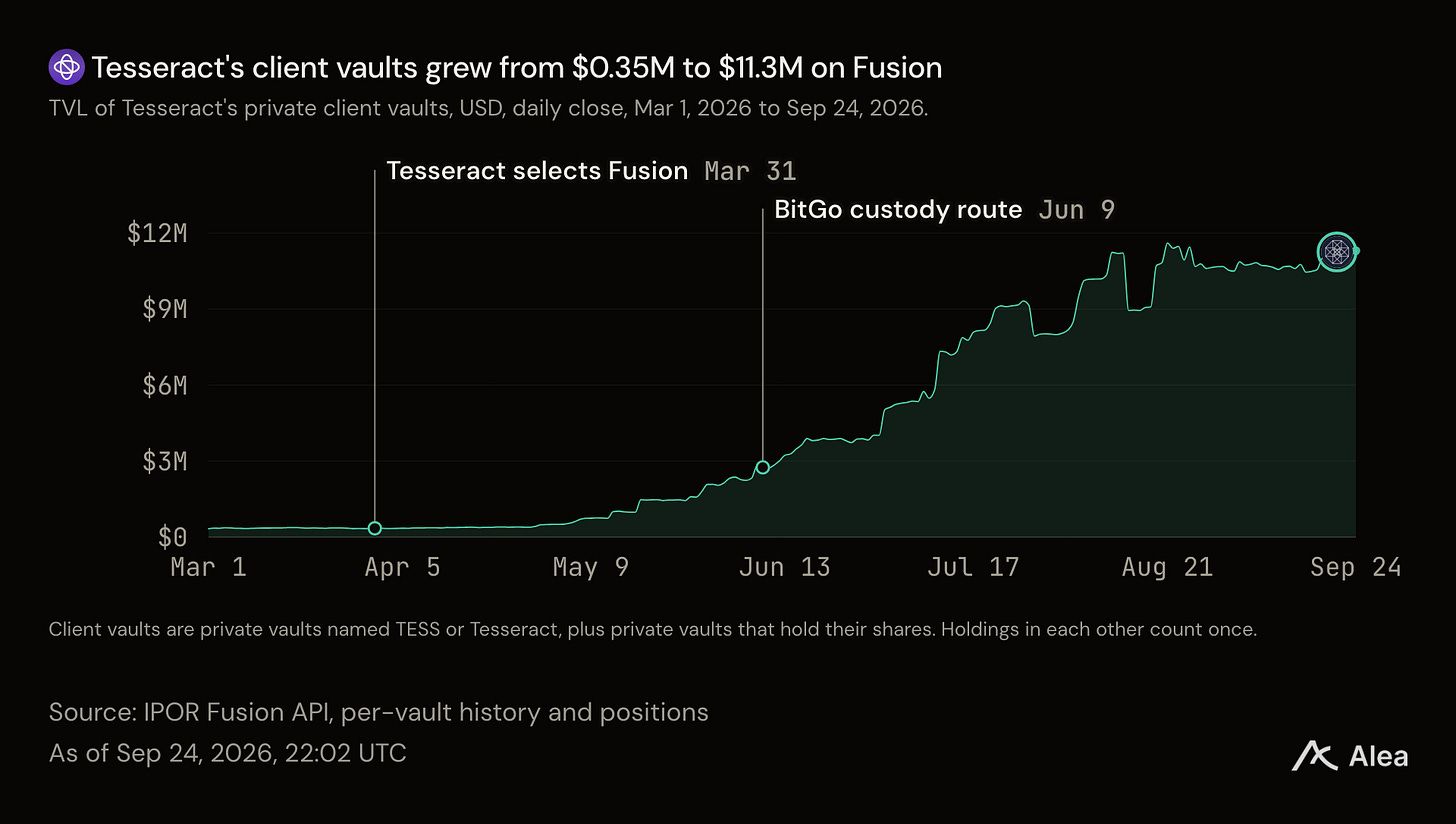
Regulated money already runs on Fusion. Deposits in the client vaults of Tesseract, a MiCA-licensed manager, grew from $0.35M to $11.3M after it chose Fusion in March. BitGo custody clients can allocate to vaults as well.
A dedicated vault belongs to one client, and the operator who rebalances it cannot withdraw from it. A trade outside its limits fails before any money moves.
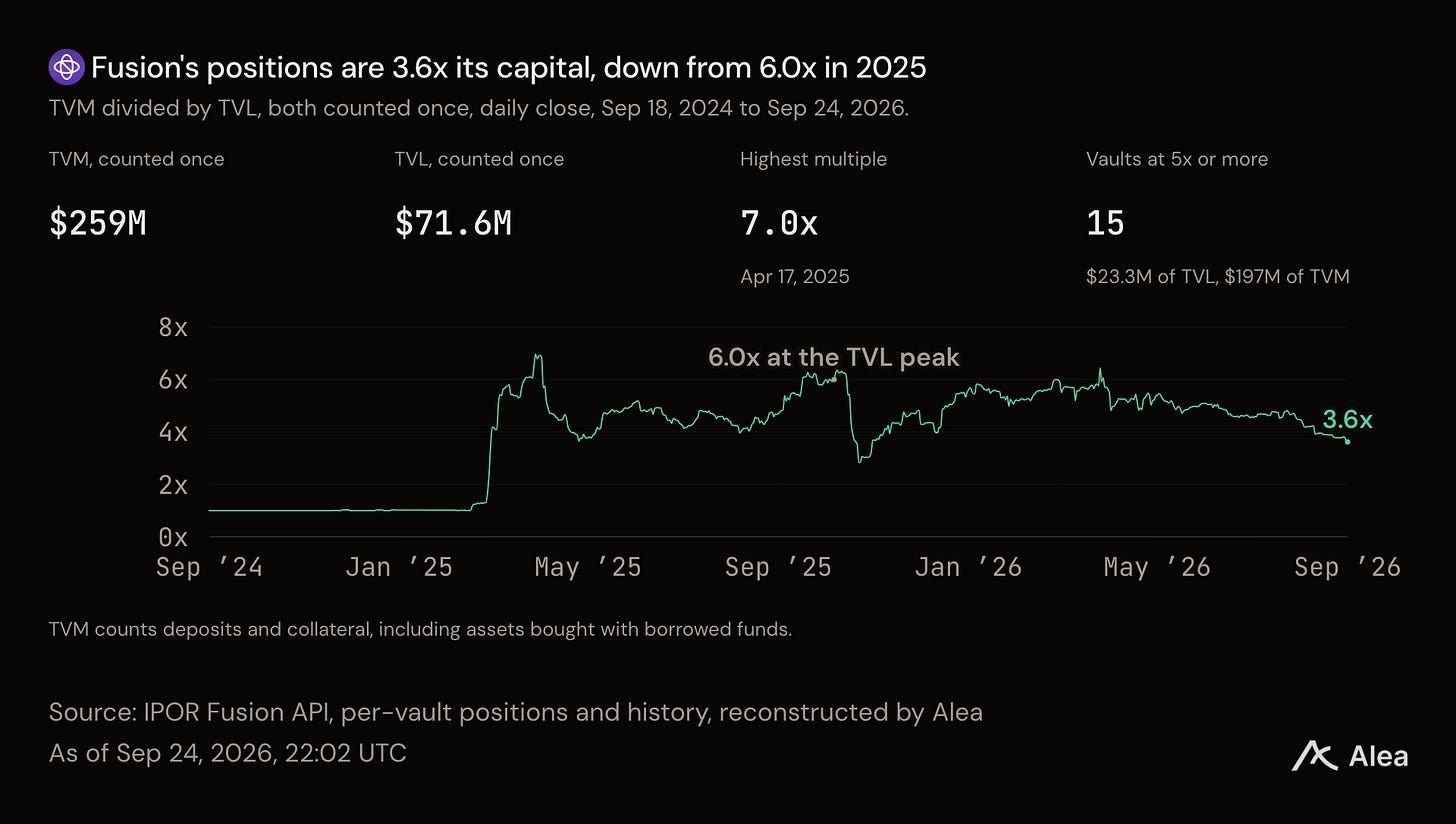
Deposits set a new record with less borrowing. Fusion vaults held ~$71.6M approaching Q3 end, while positions run at 3.6 times deposits, down from 6.0 times at the October 2025 deposit peak.
Tokenized stocks entered Fusion vaults. IPOR launched carry vaults on Coinbase's tokenized Apple, Nvidia, Alphabet, and Meta shares on Aug 24, the day those shares reached Base.
Build a vault desk, or plug into one
Before an institution puts client money into a yield product, it needs audited vault code. That same code consists of onchain adapters and offchain triggers that work in tandem adapting to changing market conditions. This is what connects the vault’s assets to venues like DEXs or lending markets. The vault must then dynamically compute its share price from live positions and keep trading rights apart from withdrawal rights. Meanwhile, many firms still need access checks for regulated clients and a plan for the day a market breaks.
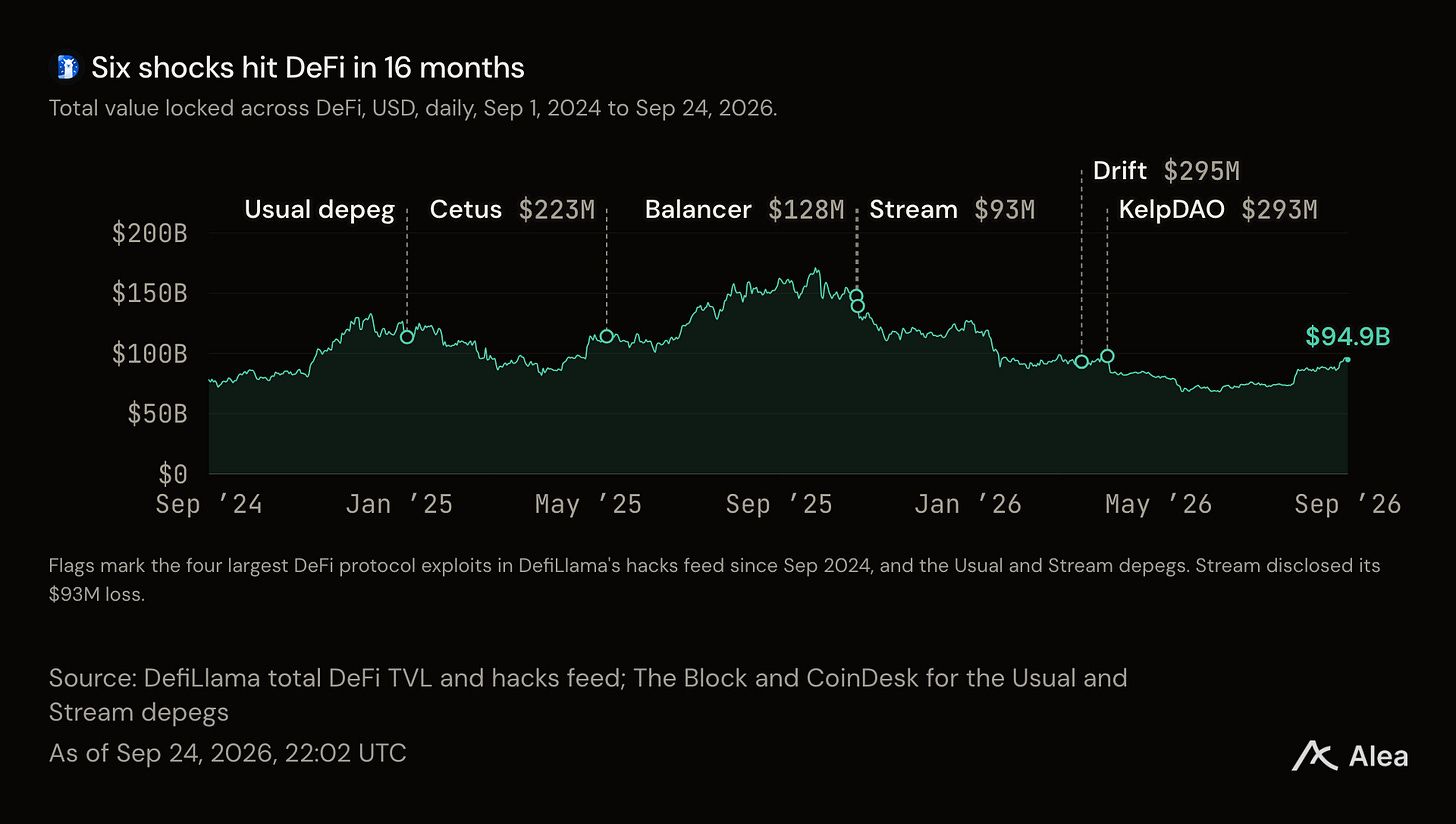
There is a lot of complexity involved in building infrastructure capable of supporting risk-adjusted returns. Just think of the sheer amount of hidden dependencies underpinning a strategy. Case in point: Usual, Stream, Kelp, and more.
If there is a protocol with deep expertise and experience in onchain yield and money markets, that’s IPOR. First with interest rate swaps. Now with vaults. Since 2022, its team has dealt with all sorts of yield dynamics, from arbitrage and relative value on the positive side to yield manipulation on the dark one. Its blog could easily be considered the must-read primer for every TradFi participant entering DeFi.
Fusion builds every vault from fuses. A fuse is a small contract that performs one action on one protocol, such as a deposit on Aave or a loan on Morpho. Fuses are what DeFi calls money legos. A manager can combine them into a single-market lending vault for a cautious client or a leveraged staking loop for an aggressive one. IPOR's fuses already reach more than 40 protocols through 170+ methods.
While everything can stay permissionless, IPOR built Fusion with regulated asset managers in mind. Its factory deploys a new vault in one click. The institution picks the fuses and sets the limits, while IPOR supplies the integrations and the accounting. The permissionless method works the same way. Additionally, IPOR just published a launchpad that lets an AI agent set up a vault from one strategy file.
The first regulated manager, Tesseract, authorized under the EU's MiCA rules, said it worked with Fusion's contracts for more than a year before it made them the main destination for its institutional clients in March 2026. That’s how institutional adoption happens, gradually and behind the scenes.
While most firms could explore what building onchain yield products is about, or build their own solutions, or pay for a provider to serve their own strategies, the question is whether they can afford the time.
Each vault does one job, provable onchain
A Fusion vault does one job. Its configuration lists the markets the vault can enter and caps what it can place in each. Any other transaction fails. Tesseract for example announced that each of its Dedicated Client Vaults serves one client. Each of those vaults keeps the client's assets apart from the manager's and from every other client's. Similarly, in the example IPOR published for institutions, each vault mirrors a separately managed account, which is the structure asset managers already use for single clients.
Fusion splits the strategy and money roles. In the guide IPOR published for vault builders, the administrator, called the Atomist, sets which fuses and markets a vault can use and how much it can place in each. The Alpha, the operator who trades, acts only through the fuses that the vault has connected and cannot move client funds out. Take the example that IPOR Labs CEO Darren Camas published, where a vault caps any one lending market at 30%. A bot's order to put 35% into Morpho then fails.
IPOR's institutional vaults can also admit only wallets that passed KYC or KYB checks. Any change to fees, assets, or fuses waits behind a timelock, so depositors can withdraw before it takes effect.
The mastery lies in the simplicity. A vault's one job can also be a portfolio of other vaults. A Fusion vault can hold shares of any vault built to the ERC-4626 token standard, including other Fusion vaults. A manager can therefore build a fund of funds, one product that spreads client money across several strategies, each inside its own limits.
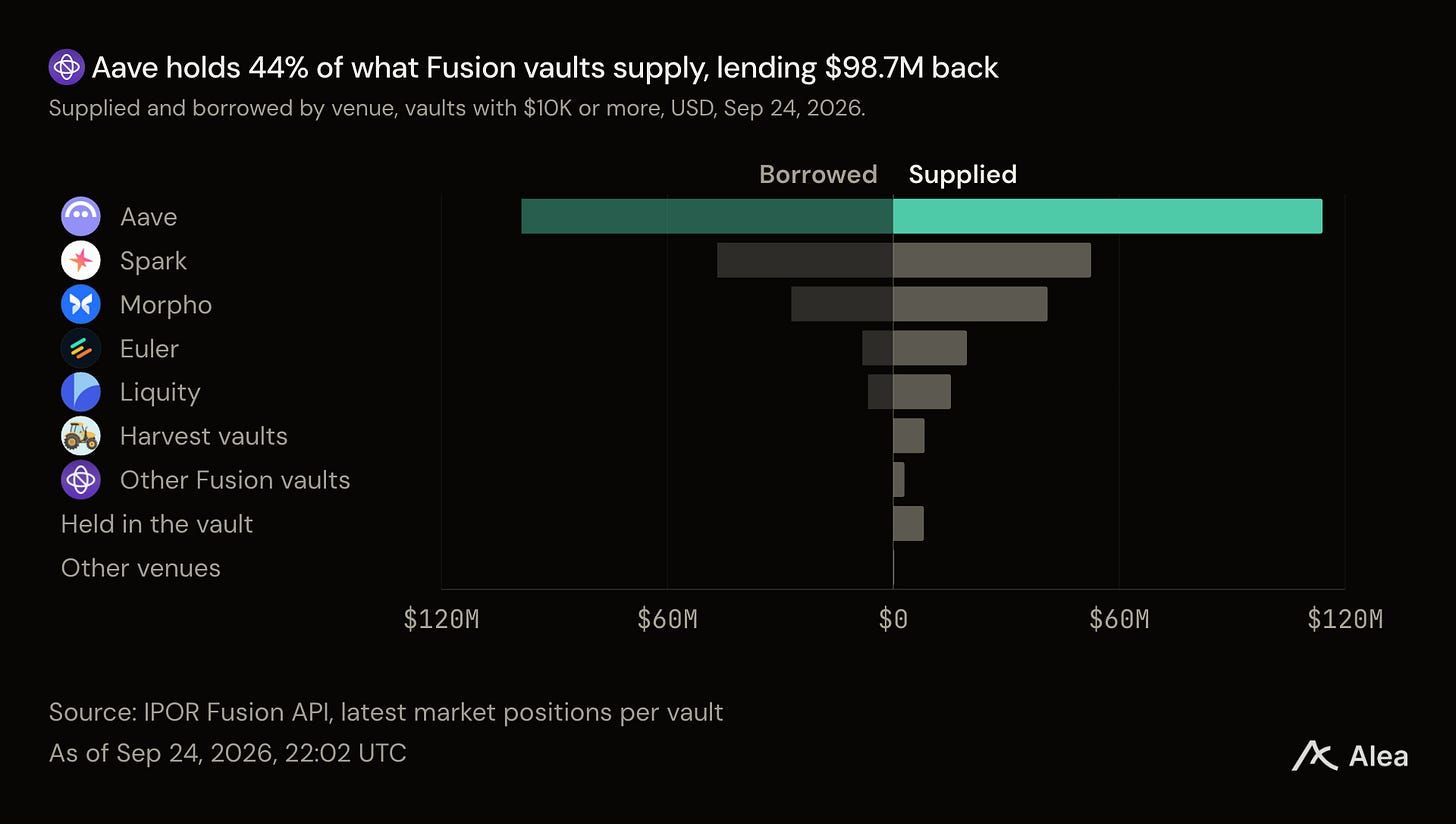
Fusion applies the crypto rule "don't trust, verify." Every vault prices its shares from the positions it reads onchain. Anyone can easily recompute those balances and confirm that the vault used them. Darren argued that Stream Finance failed in November 2025 on the opposite design, because a manager priced xUSD from books kept offchain. IPOR instead reports two numbers for every vault: the deposits and the gross position those deposits carry after borrowing.
Four shocks, and deposits came back to a record
Four outside shocks hit the vaults between November 2025 and April 2026, and the risk controls held. Fusion ran no Balancer code, and when Stream's xUSD lost its peg a day later, Darren explained that the DAO's vaults held only collateral that its risk group had approved. In March, IPOR reported that none of them had exposure to Resolv. On the day of the KelpDAO exploit, IPOR stated that the DAO's stETH vault pulled all of its WETH from Aave's core market, and the vault kept running without a pause, giving back about a month of yield. Vaults also cut borrowing fast, and positions fell from 6.0 times deposits at the October 2025 peak to 2.8 times by mid-November. Fusion's own exploit came in January, when an attacker took $336K from its oldest vault, which predated a stricter check that later vaults enforce. A white-hat returned the funds minus the 10% bounty and the assets were put back to work within hours.
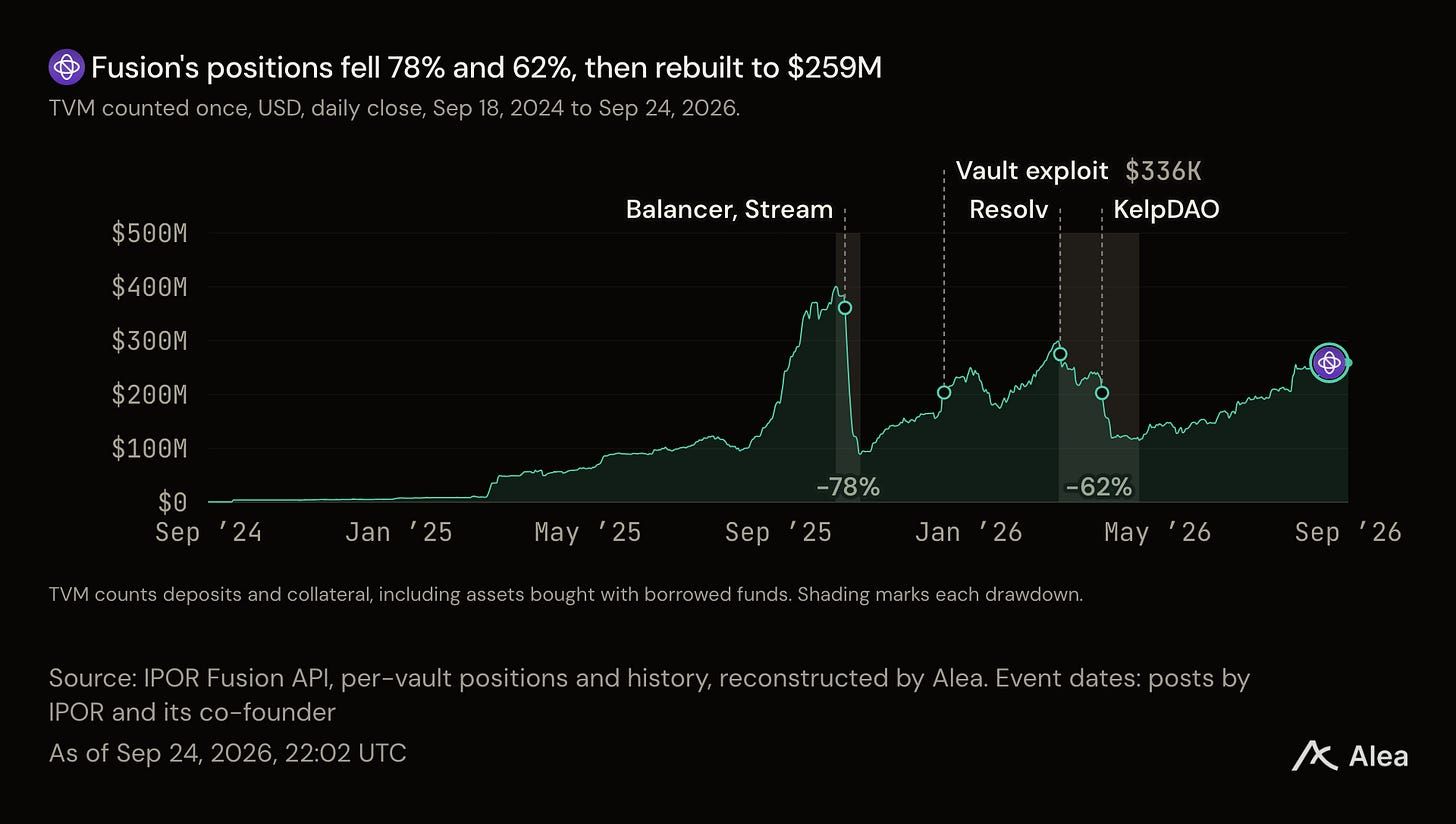
Deposits fell by more than half in each of the two drawdowns. Three Reservoir vaults accounted for $25.1M of the $36.2M that left in the first one. On Sep 18 deposits closed above their October 2025 peak for the first time. On Sep 23 ETH closed 36% below its price a year earlier, and the recovery came from new deposits.
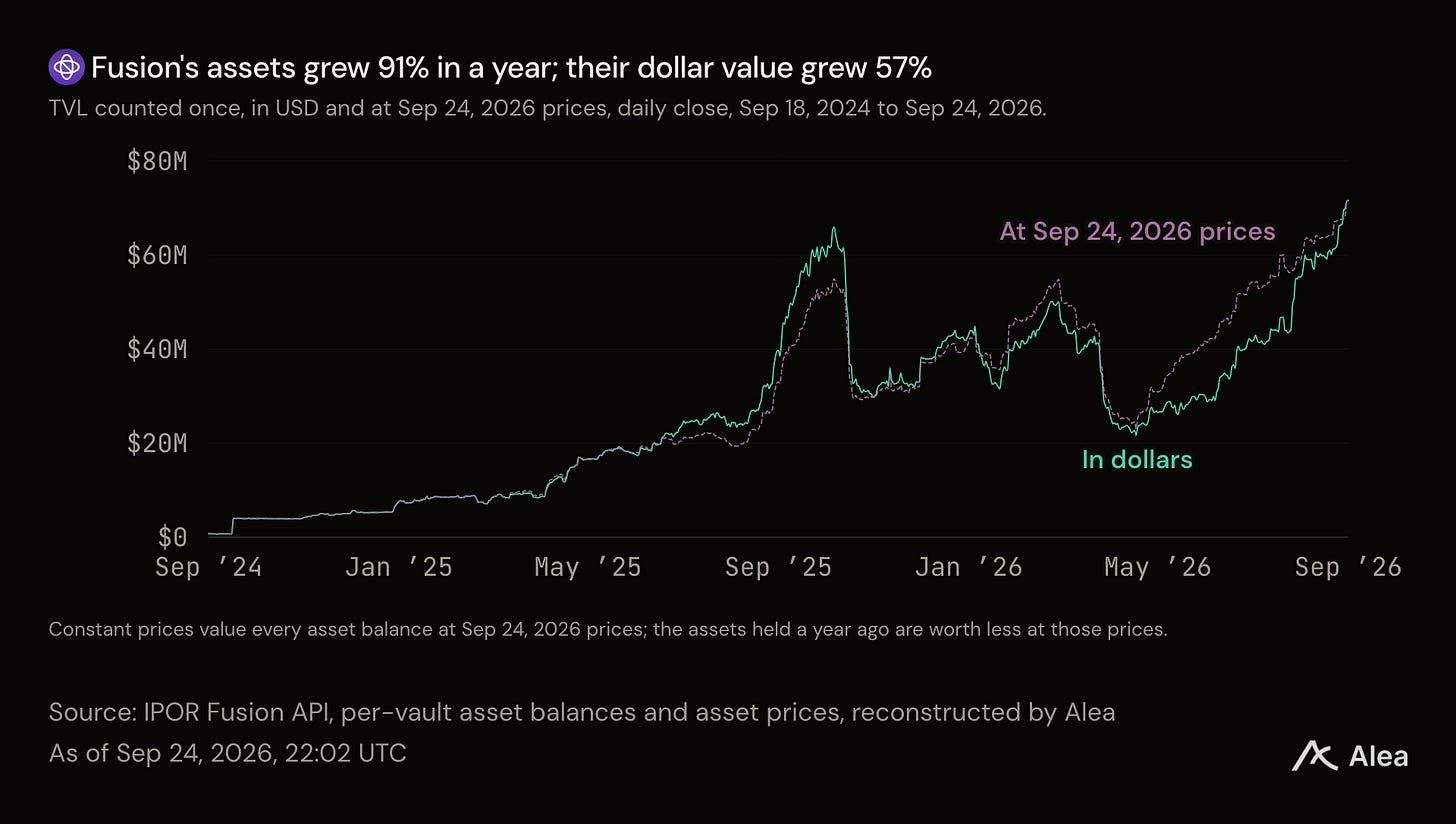
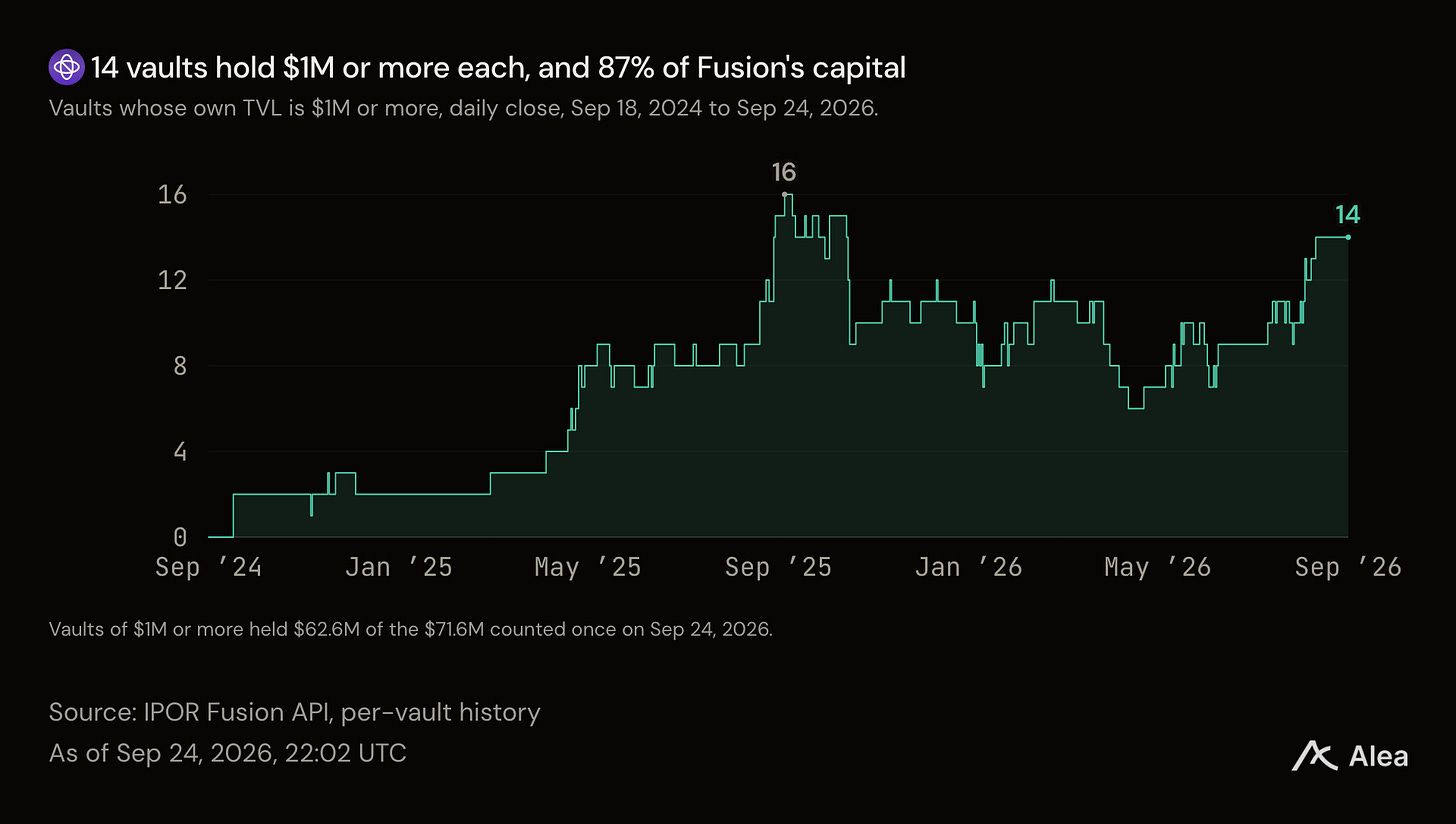
Six operators run $68.6M of Fusion's $71.6M
Independent operators run the strategies, while IPOR Fusion is neutral infrastructure that does not compete with them. Just like Morpho and its curators. Clearstar and Sentinel run the most money, and Tesseract ranks third through its private client vaults.
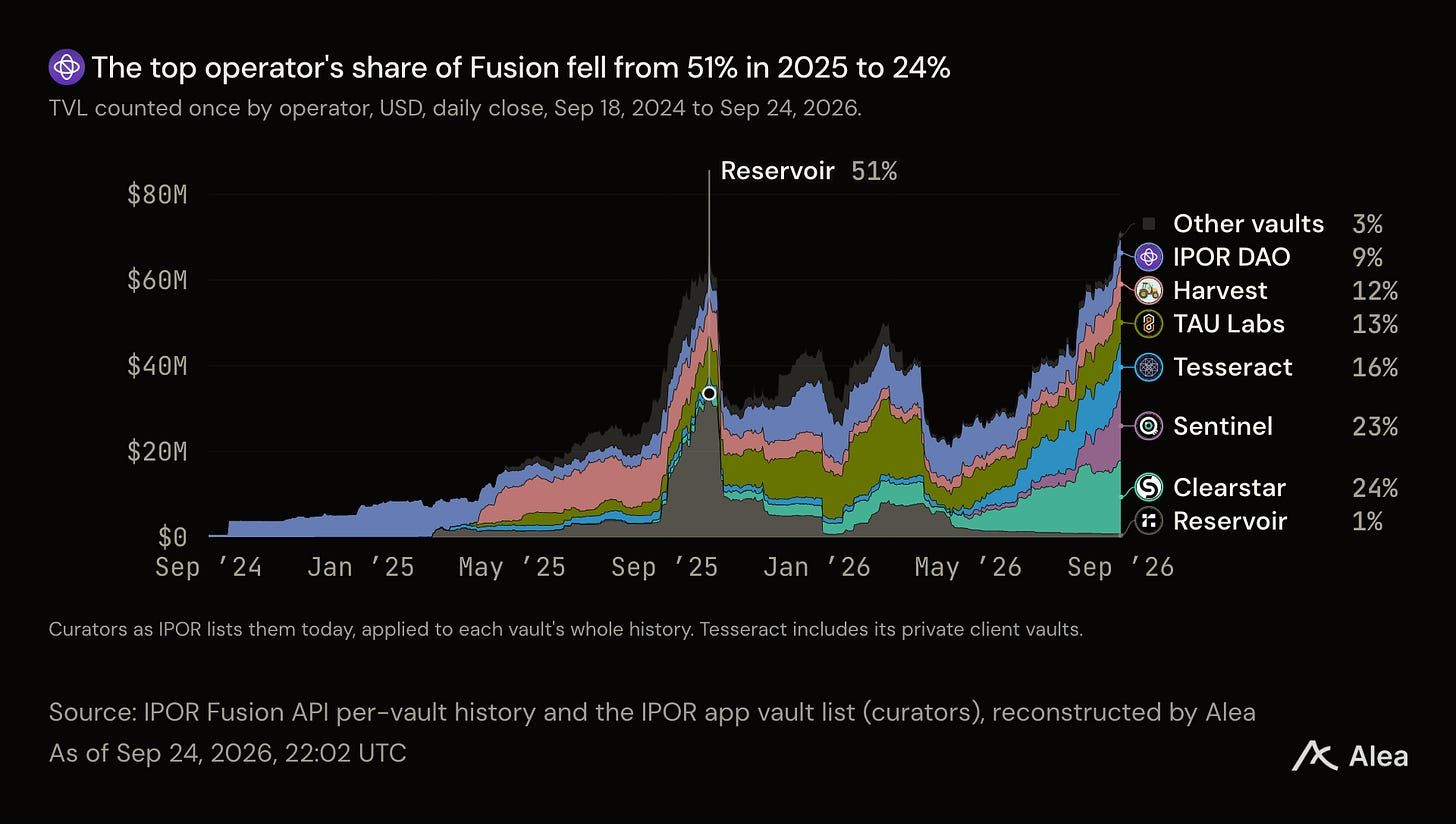
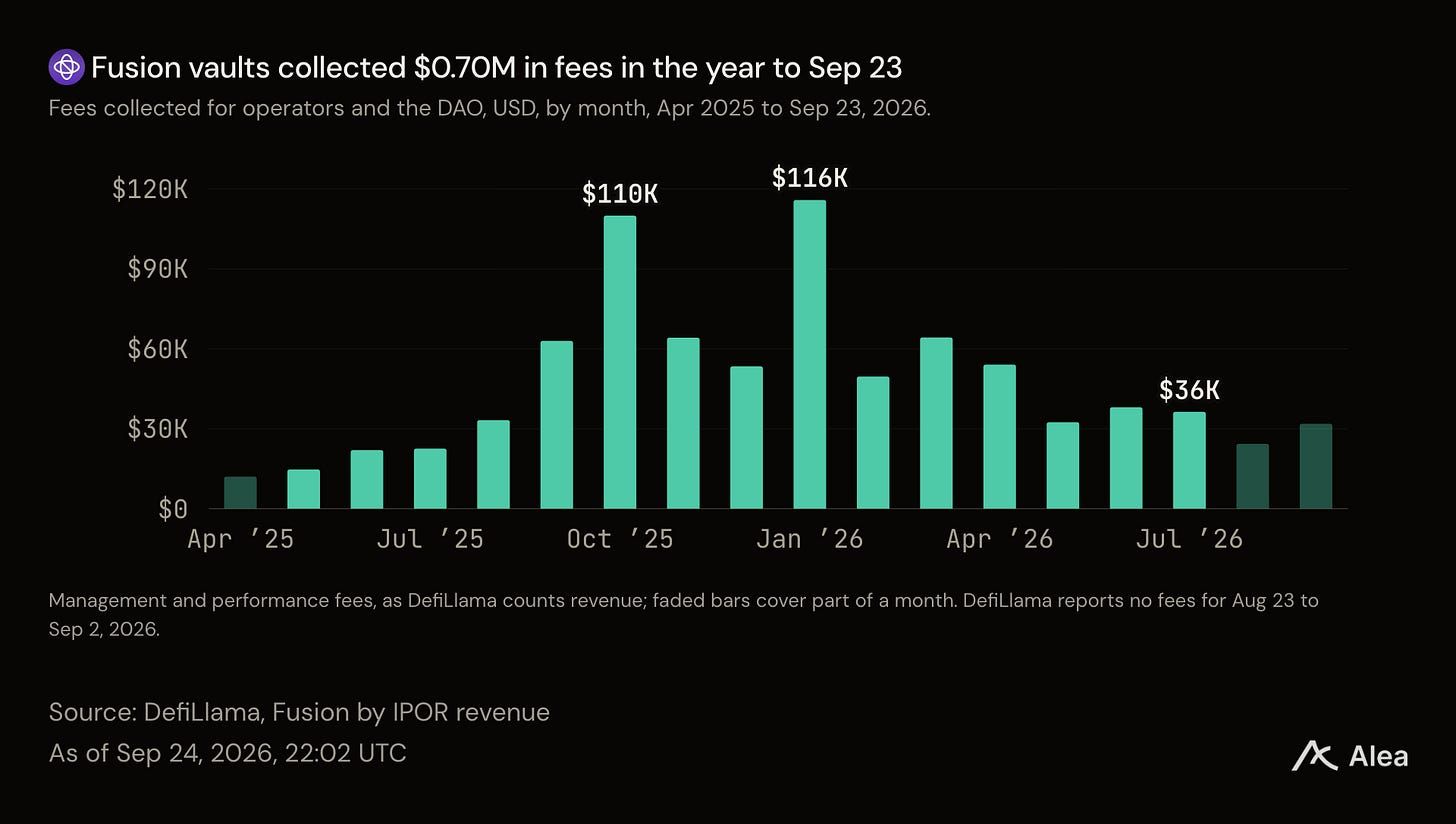
Each operator sets the fees on its vaults and earns them. DAO voters approved a DAO share of 0.3% a year of assets and 2% of performance on vaults that third parties run, paid in vault shares. Fusion vaults recorded $0.70M of management and performance fees in the twelve months to Sep 23, for operators and the DAO combined.
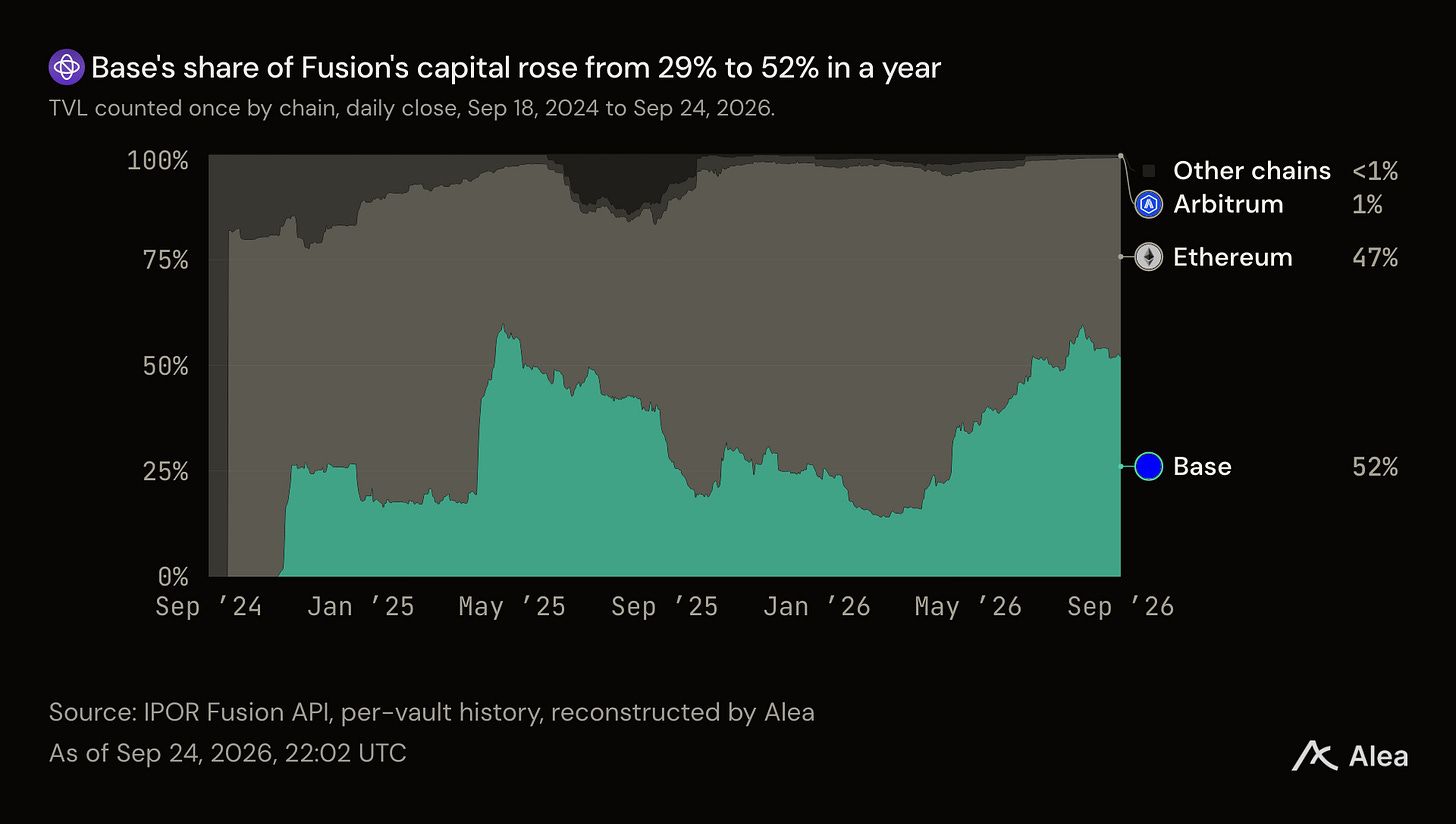
Base carries $24.1M of the $25.9M that deposits added in the year to Sep 23. Its largest strategies loop cbETH, Coinbase's staked ether token. They post cbETH as collateral on a lending market and borrow ETH against it, then use the ETH to buy more cbETH. This looping has been quite profitable when rewards paid for about half of that yield. The largest cbETH vault earned about 15% in June, with 7.8 points from the loop and 7.9 points from rewards on Aave. By July, Fusion vaults held about 45% of the cbETH on Base.
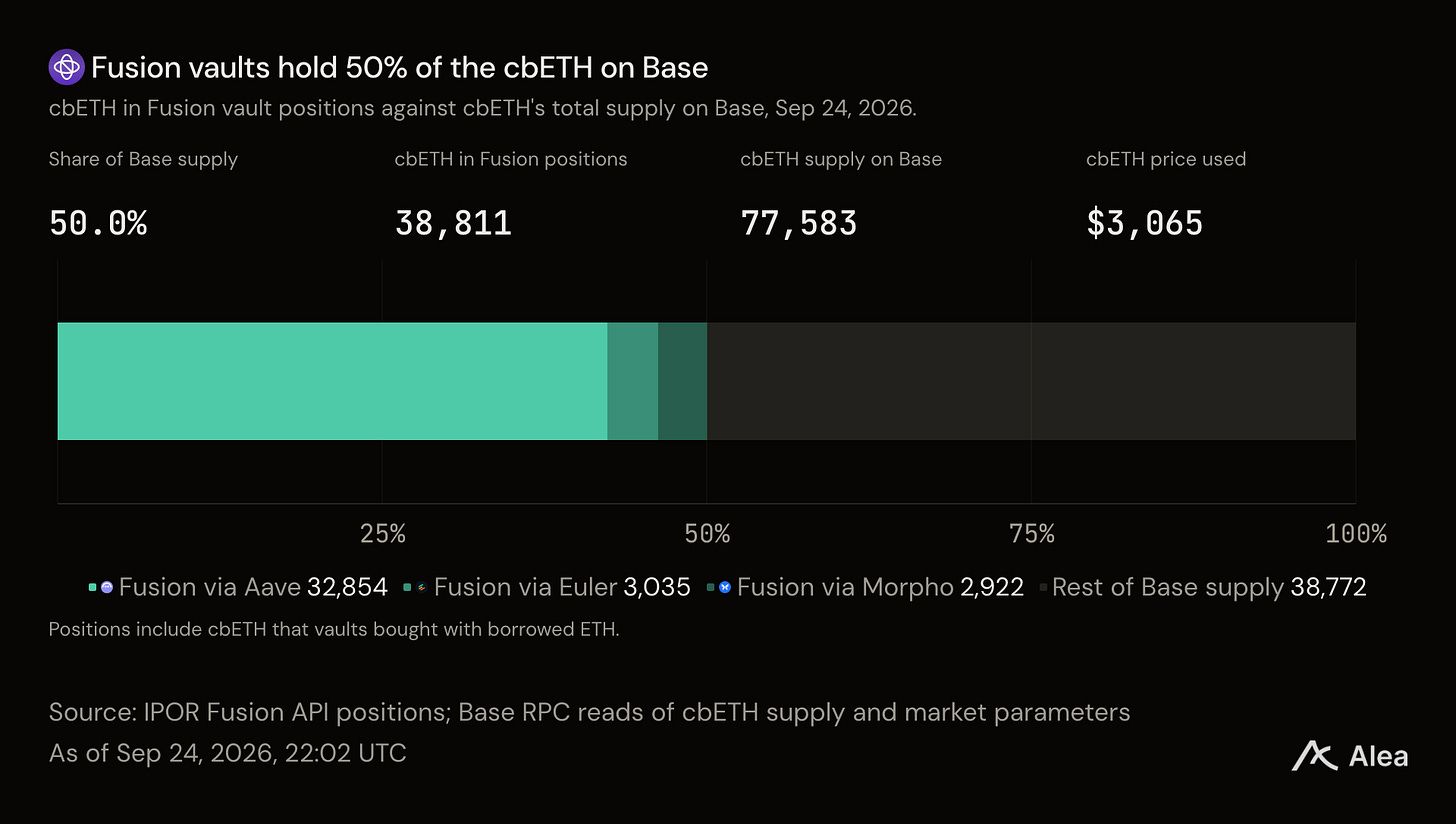
Exchanges and fintechs now run chains of their own. Kraken launched Ink in December 2024, and Robinhood announced Robinhood Chain's mainnet on Jul 1. Circle launched Arc's mainnet on Sep 16 with Aave and Morpho lending and curated vaults in place. Deposits on the three chains closed at $1.7B on Sep 25. Each chain needs a yield product for that money, or its users move their stablecoins to chains that pay them. Base already shows what a vault layer adds. Fusion's growth put new deposits into Base's lending markets and made Fusion's vaults the largest holders of cbETH on the chain.
Tokenized stocks become collateral
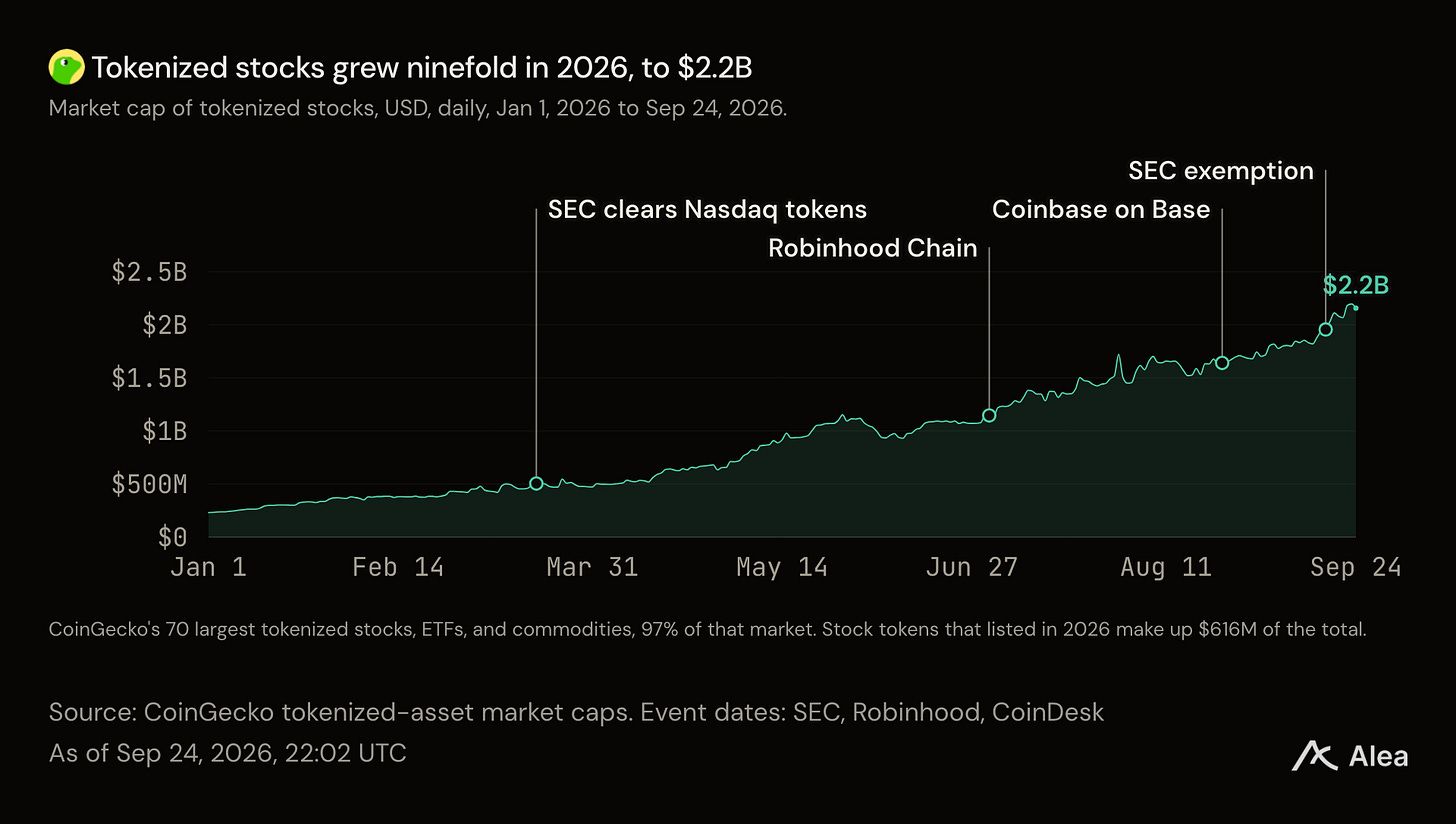
Coinbase launched tokenized Apple, Nvidia, Alphabet, and Meta shares on Base on Aug 24, for investors outside the US. The custodian Alpaca holds each underlying share. And if you are wondering about integration speed, IPOR launched carry vaults on all four that day, run by TAU Labs, with pre-deposits at a 10% target rate. IPOR now has a dedicated Stocks section in its app.
Credit will be the key for growing them, because an onchain lending market charges every borrower the same rate while a brokerage charges small accounts more. In Darren’s words, "a wallet or a fintech can embed one and offer a stock Earn product without building the machinery behind it."
Tokenized stocks are a new kind of collateral, and the rules for them arrived this year. The SEC approved tokenized trading on Nasdaq in March, and it announced a five-year exemption for tokenized-securities venues on Sep 17. Aave launched a Base market on Sep 25 that accepts seven Coinbase stocks as collateral for USDC loans. Once a stock can secure a loan, a vault can run a carry trade on it. The vault deposits the stock, borrows stablecoins against it, and puts them to work at a higher rate than the loan costs.
Gold. IPOR announced a Clearstar carry vault on Tether's XAUt gold token in December 2025, and YO launched yoGOLD on the same token with Fusion strategies.
Tokenized credit. IPOR launched a Hyperithm vault that loops Midas's mHYPER on Morpho.
Assets without a live onchain price. IPOR published a feature that values tokenized private credit and similar holdings at prices that a curator or a named third party supplies.
A fintech can ship Earn without a DeFi team
The largest exchanges already rent this layer. Alea's July Onchain Asset Management report showed that Coinbase routes in-app USDC deposits into Morpho vaults and that Kraken routes deposits into Veda vaults. Each exchange keeps the customer account and the regulatory duties while outsourcing onchain credit and yield infrastructure.
IPOR offers the same for wallets, exchanges, and fintechs, with a dedicated vault for each client. Tesseract already uses IPOR Institutional Vaults for regulated managers and BitGo and Anchorage for custody clients. And Darren recently announced that he will take the institutional case to Vault Summit Singapore on Oct 9.
Institutional money arrives through custody reviews, pilots, and compliance sign-offs, one client at a time. Fusion is at the start of that cycle, and its rails have already held through four market shocks. A fintech that plugs in now will have Earn live when its clients ask for it. One that starts building will be hiring a DeFi team.
Important Links

Alea Research covers protocols and the economics underneath them.
Research reports. Deep Dives and Blueprints explain protocols and their economics. Theses and Memos examine investment cases and catalysts. Benchmarks compare performance, while Perspectives assess specific developments.
Weekly Pulse. Read a weekly assessment of macro and the major liquid markets.
Protocol Data Rooms. Research each protocol in one place, with Analytics for historical comparisons and Intel for news and governance developments where available. Open Fusion by IPOR Analytics. Open Fusion by IPOR Intel.
Podcast Digest and Summit Digest. Read summaries of industry conversations and events. Find Alea shows and their episodes through Podcast Digest.
Governance Tracker. Follow proposals and voting activity across protocols.
For protocol teams preparing institutional conversations, discuss research for your protocol with Alea.