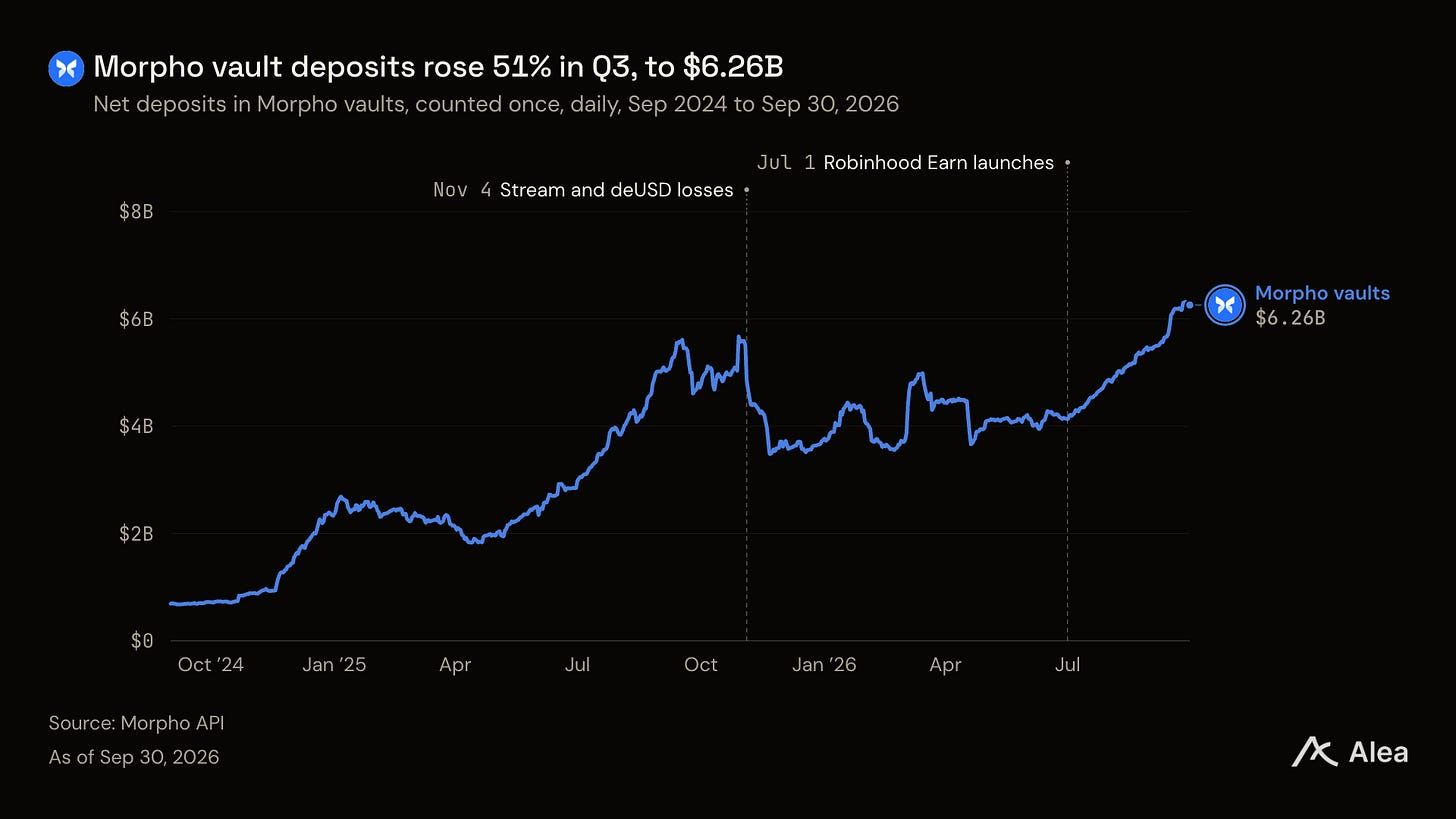
Morpho vault deposits grew 51% in Q3. In that period, Robinhood brought lending vaults into its app and Circle’s Arc mainnet went live. In parallel, the competitive race between curators continues heating up as more players enter the game. S&P’s new Vault Risk Assessment framework, VRA, was also announced to examine vault depositors’ actual access to cash. Vaults differ sharply on withdrawal access and depositor concentration, even when they lend against similar assets.
Takeaways
S&P launched the VRA (Vault Risk Assessment for digital asset markets) on Oct 4, with initial assessments still pending. Sky Frontier Foundation announced a Moody’s B3 counterparty risk rating on Oct 7. Sky’s capital, through Spark and Grove, is the largest depositor in three of the 12 largest Morpho vaults.
Morpho’s vaults held $6.26B of net deposits on Sep 30, up 51% in the third quarter. Robinhood Earn launched on Jul 1 and Uniswap Earn launched on Jul 30. Coinbase exposes a Steakhouse USDC vault on Base already, and Arc opened on Sep 16 with Morpho live from day one.
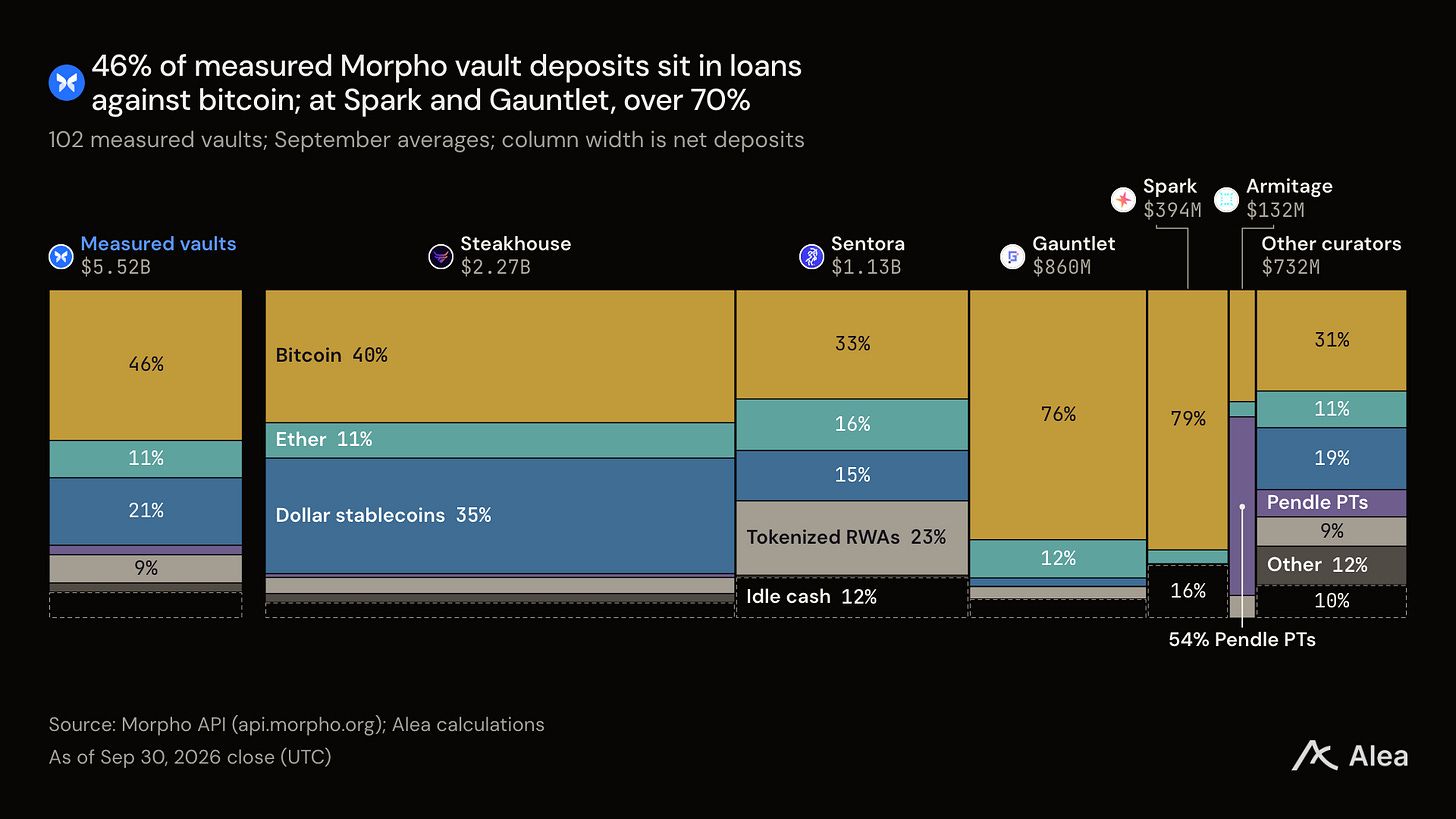
Bitcoin and ether secure the loans behind 57% of deposits in 102 measured vaults. S&P scores both assets among its best collateral. Its method places both at 1 to 3 on its six-point asset scale (a lower score means more secure); dollar stablecoins back another 21%.
The estimated share of deposits in vaults with under 10% in cash rose from 21.8% to 38.5% in Q3. In 217 measured vaults, risk changes wait at least two days for 99% of deposits, and a guardian or sentinel covers 97%.
Robinhood Chain and Arc added $670M of vault deposits
Morpho Blue pairs one collateral asset with one loan asset per market, while curated vaults spread deposits across markets. The protocol keeps each market isolated; a vault bears losses in the markets it funds. App distributors, like CEX Earn programs, often pick a curator to manage their vaults, leaving the curator responsible for choosing markets, caps, and withdrawal routes.
Morpho Midnight also launched in July with fixed-term, multicollateral credit.
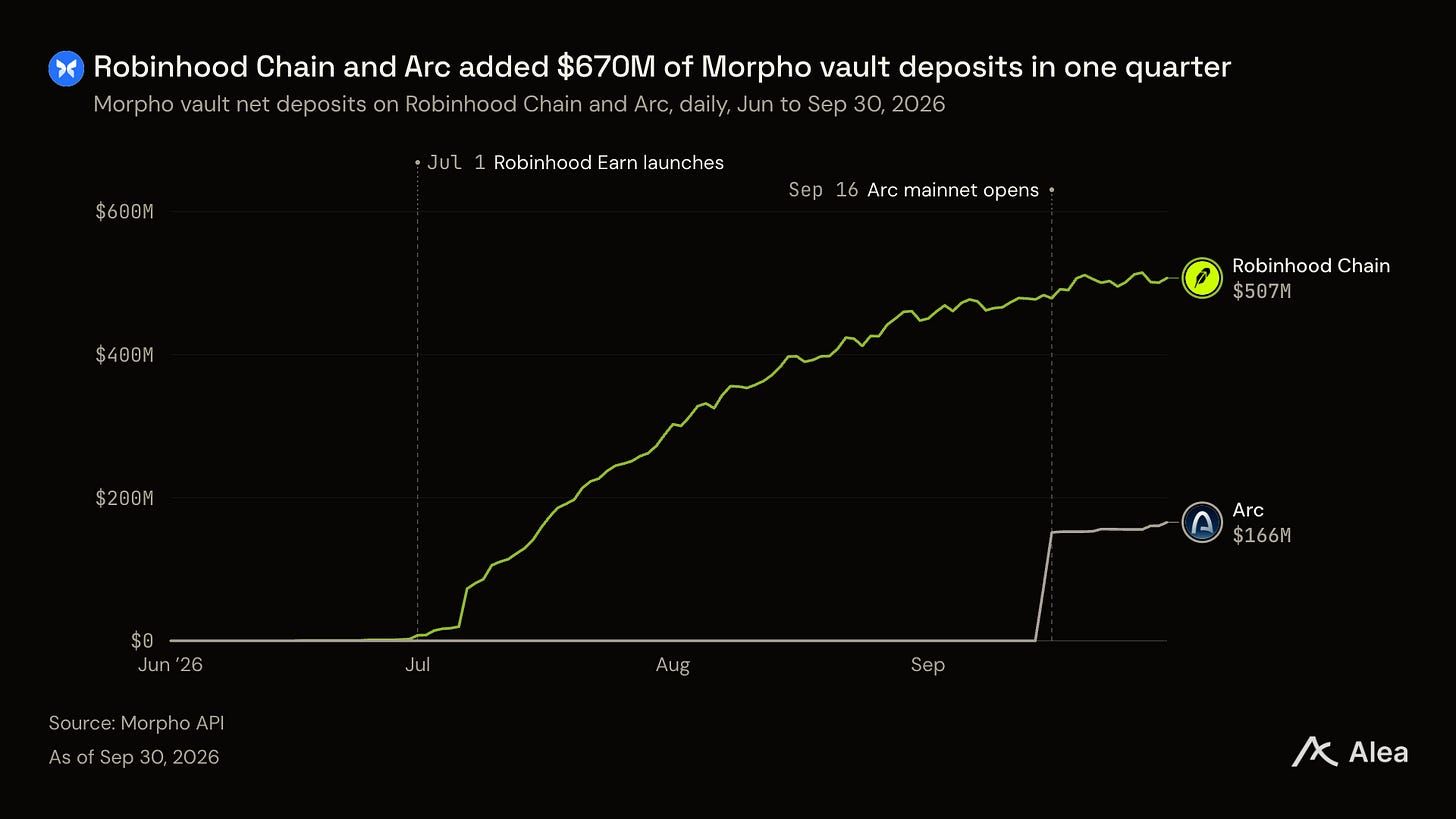
Uniswap launched Earn on Jul 30 with three Gauntlet-curated Morpho vaults on Ethereum. Zama opened confidential access to 16 Morpho vaults on Sep 15. Robinhood Chain and Arc added $670M of vault deposits in Q3, accounting for 32% of Morpho’s $2.12B net increase. The former rose from $2M on Jun 30 to $507M on Sep 30, almost all in Steakhouse USDG; the latter reached $166M.
S&P Global Markets enters the game
With ~$11B in TVL and ~$5.5B in active loans at the end of Q3, TVL rose almost 20x in the span of two years, while active loans grew from ~$3.47B in June 2026 to an Oct 10 figure of ~$5.73B, +65% in about four months. None of this went unnoticed by TradFi giants. S&P Global Markets now plans initial Vault Ratings Assessments to be released during the year, adding curator, liquidity, and operational risk checks.
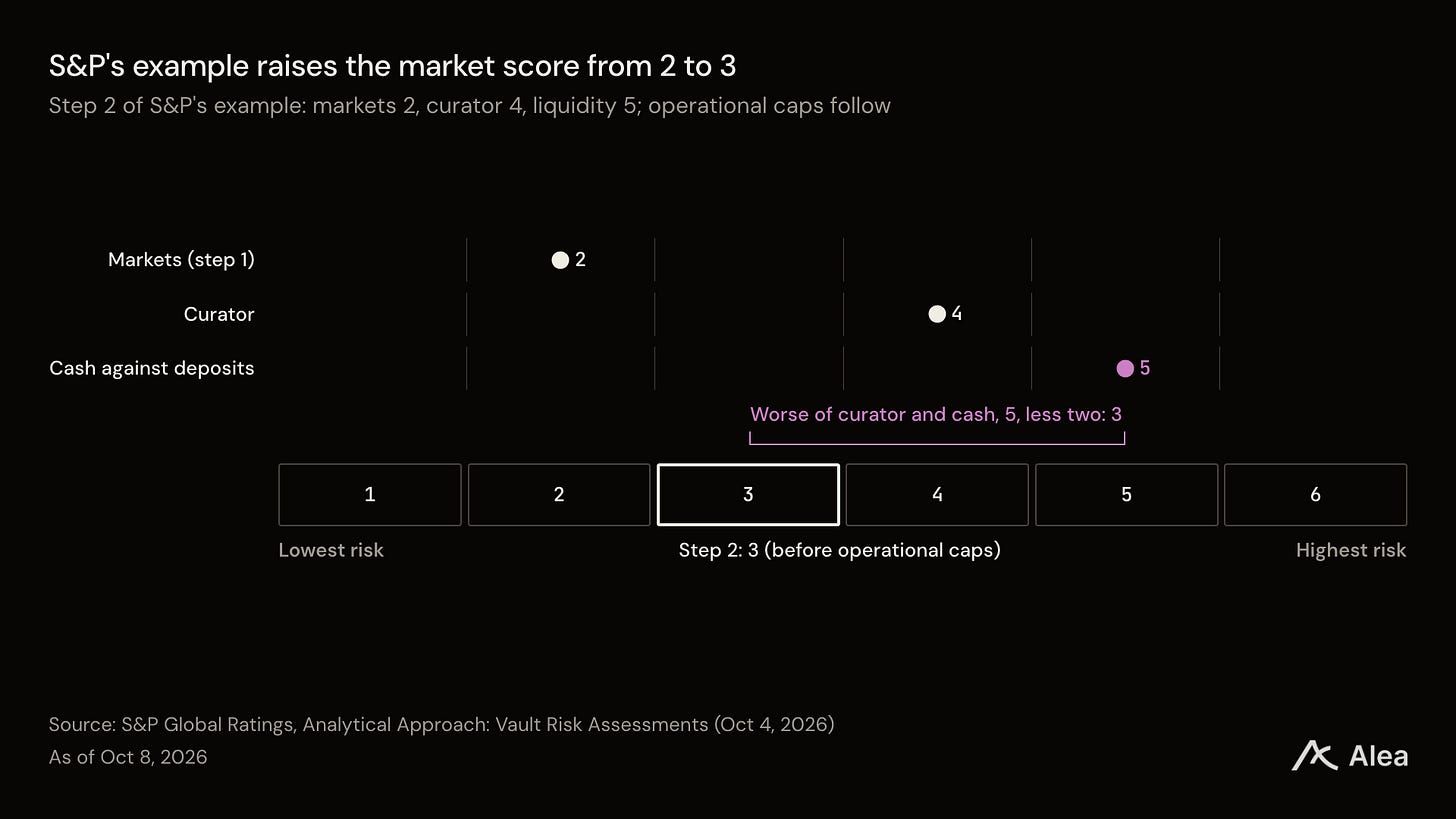
On S&P’s scale, 1 is the lowest risk and 6 the highest. First, S&P scores the markets that the vault’s permitted strategy can fund. It then assesses curator quality and liquidity, with cash and the largest depositors informing the liquidity score. The result can be at most two points better than the worse of the curator and liquidity scores. Separate caps follow for blockchain, protocol, and governance and security risk. A final mapping assigns scores 1 to 6 to AAA(v) through B(v); CCC(v) through D(v) cover impaired vaults. Importantly, the VRA isn’t a credit rating or a yield forecast.
Bitcoin and ether back most vault lending
Bitcoin and ether backed 57% of deposits in 102 measured vaults in September. S&P’s asset scale, where 1 is lowest risk and 6 is highest), places wrapped ether at 1, the most liquid staked ether and wrapped bitcoin at 2, and less liquid versions at 3. Dollar stablecoins score 3 to 5, depending on their risk of losing the peg, while tokenized real-world assets start at the weaker end of the scale. The 102 measured vaults held 94% of net deposits, and dollar stablecoins backed 21% of their deposits.
Bitwise launched its PAPY vault on Sep 2 to lend AUSD against tokenized real-world assets. It expanded to Arc on Sep 16. Sentora launched a PYUSD vault on Aug 26 that lends against Huma’s PST, backed by payment receivables. This shows how fast and wide the universe of collateral-credit combinations is rising, with DeFi-native firms and TradFi players competing on the same field.
Spark and Grove are the largest depositors in three of the biggest vaults
Across 206 vaults that held at least $1M each in gross deposits at the Sep 30 close, vaults where the largest wallet held over 20% of deposits accounted for 74% of net deposits. That concentration meets S&P’s threshold for a market-risk score no better than 3.
In 8 of the 12 largest vaults, the largest depositor owned more than the vault held in cash. Those eight held 66% of the twelve’s net deposits at the Sep 30 close.
In three of the eight, that depositor is Spark’s or Grove’s allocator, both of which deploy Sky’s capital. Spark’s ALM Proxy owns nearly all of Spark USDC Vault and all of Sentora x Spark RLUSD. Grove’s allocator owns 40% of Steakhouse Prime USDC. In Steakhouse USDG and Steakhouse USDC on Coinbase, the two retail vaults among the twelve, the largest depositor owns 2% to 3%.
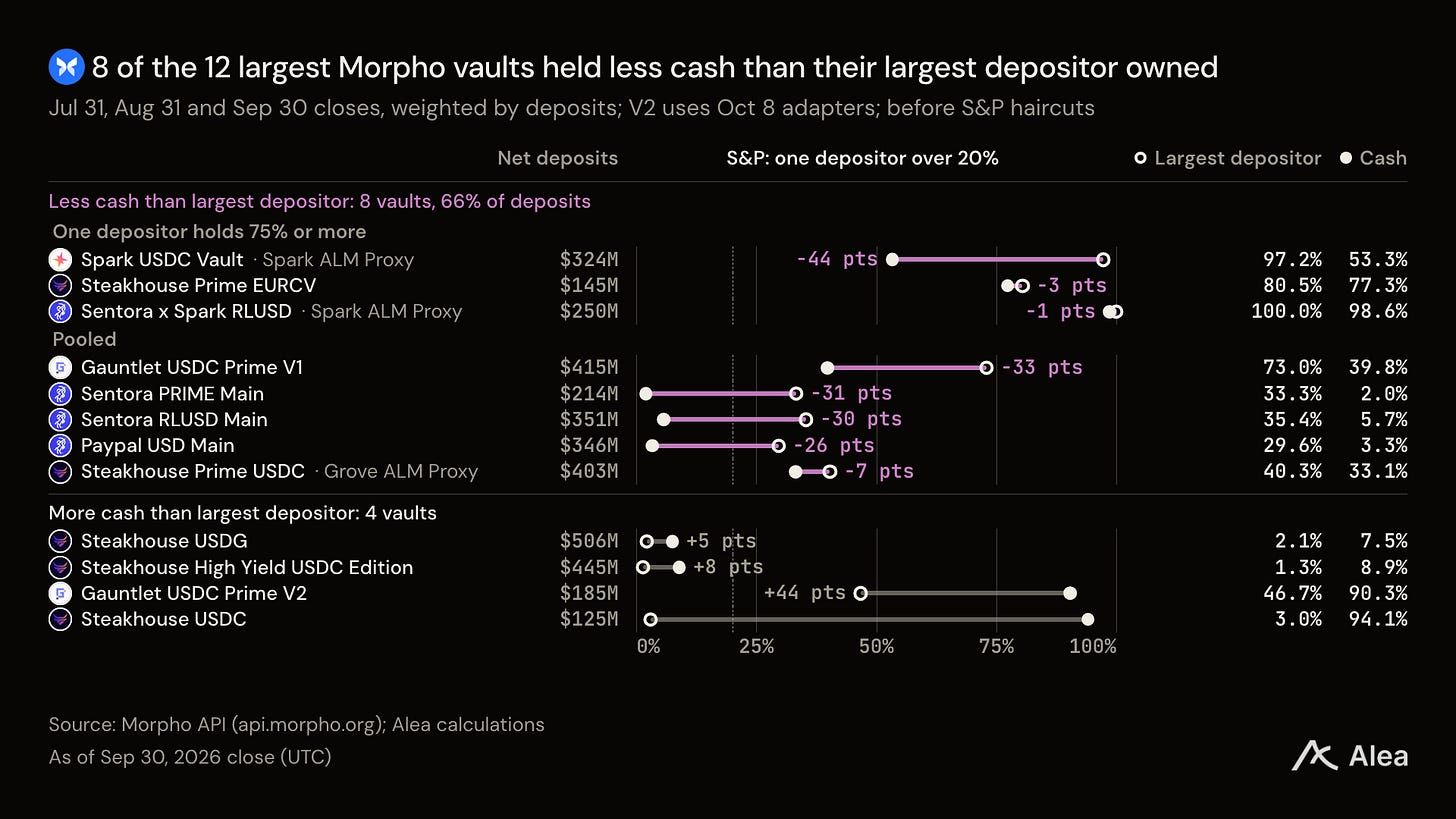
S&P still treats a wallet count as “an imperfect measure”: one address can hold the deposits of thousands of users, and several addresses can belong to one firm.
Curators lock risk changes for days
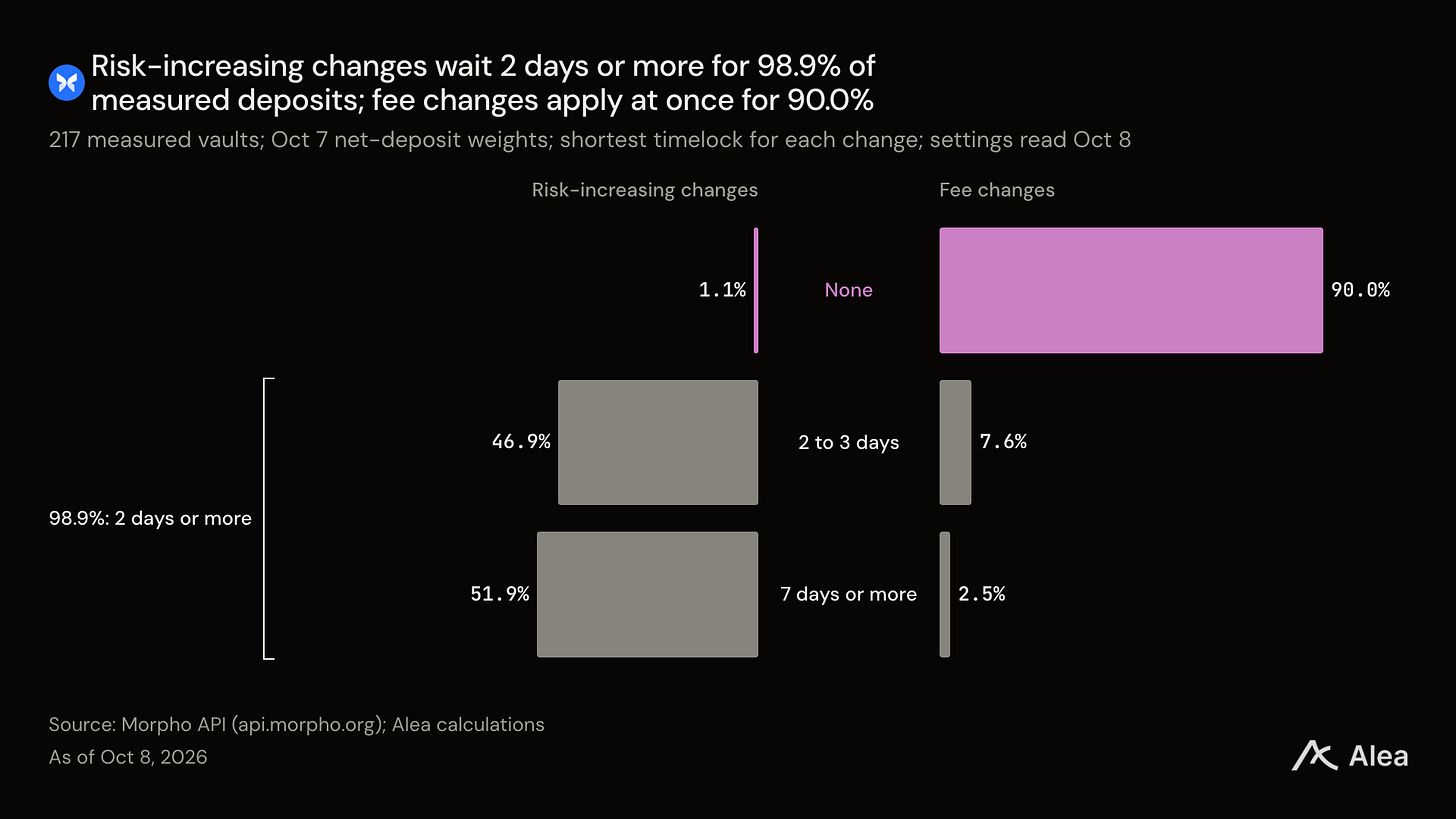
In 217 vaults, risk changes wait at least two days for 99% of net deposits. For 52%, the wait lasts seven days or more. A guardian or sentinel, which can cancel a pending change, covers 97% of these deposits. S&P’s VRA lists these timelocks among the stronger features of vault governance. These vaults hold ~99% of all net deposits.
S&P’s list also names timelocks on fees, although a V1 fee change applies immediately. This affects interest earned after the change, with a maximum fee of 50%. V2 lets a curator timelock its fees, and 13% of measured V2 deposits are in vaults that do.
Still, on Aug 23, attackers used malicious governance proposals to take control of Term’s USDC and ETH vaults. About $6.8M left Parity Core ETH on Morpho during the attack, and the associated WETH/wstETH utilization spike cleared in about eight minutes. The attack targeted Term’s vault governance; its direct fixed-rate lending contracts remained intact.
By Oct 1, Term had recovered $987,095 against $1.64M of recorded USDC depositor losses. No stolen ETH had been recovered; rescued fixed-rate loans continued to produce principal and interest and Term targeted Oct 2 for its first distribution.
The two largest curators held 61.9% of net deposits on average in Q3
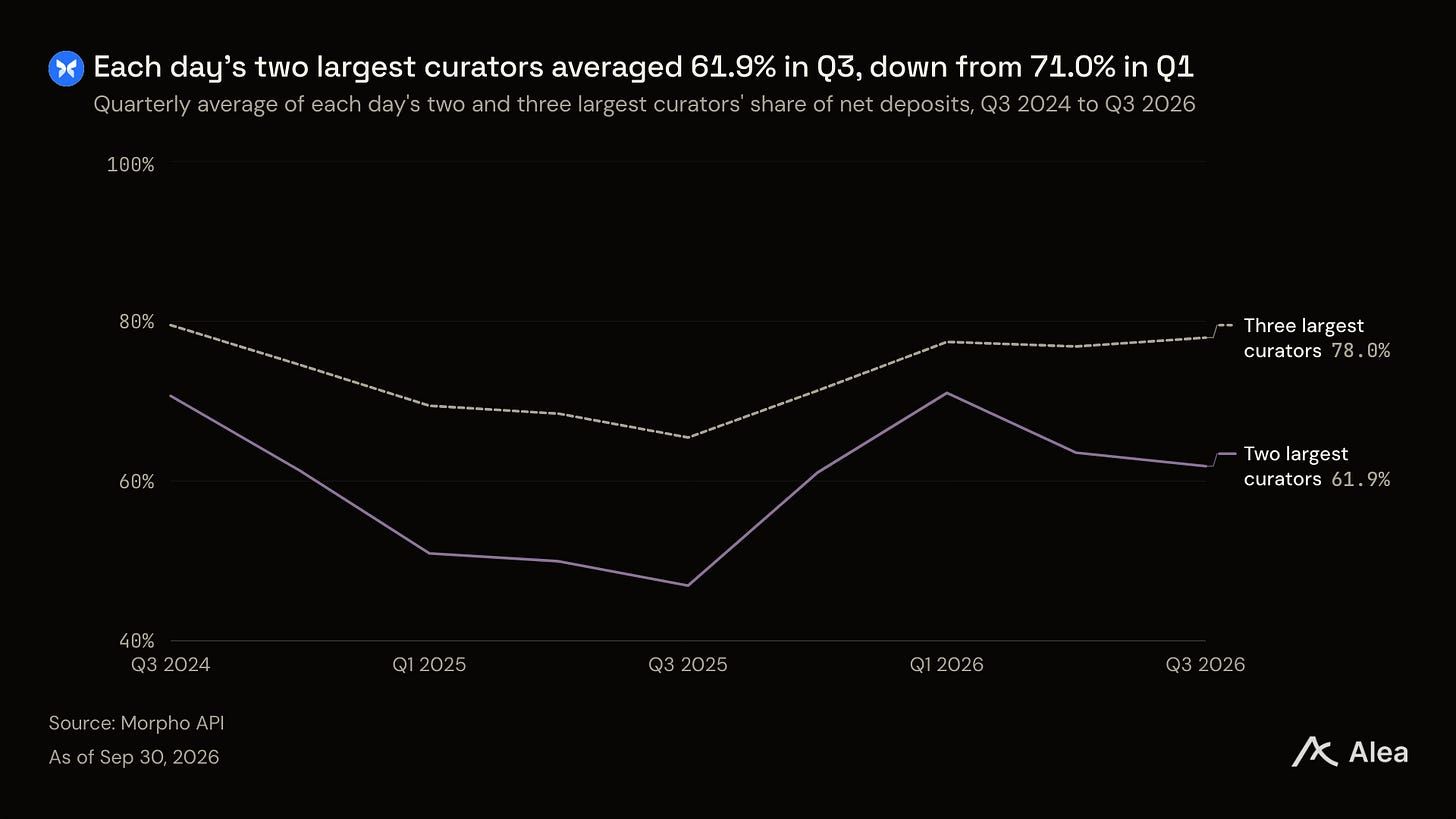
Each day’s two largest curators averaged 61.9% of net vault deposits in the third quarter, down from 71.0% in the first and up from 46.9% a year earlier. Deposits gathered at Steakhouse and Gauntlet after the November losses. In 2026 Sentora grew from 5.4% of deposits in the first quarter to 17.5% in the third and took second place from Gauntlet, whose share fell from 29.8% to 17.4%. Steakhouse averaged 43.1% in the third quarter.
Peirce raised securities questions about vault discretion in July
On Jul 22, SEC Commissioner Hester M. Peirce placed vaults on a spectrum from fixed allocation in immutable code to curator discretion. Sentora, the second-largest curator, actually met the SEC’s Crypto Task Force on Aug 10 to ask when a curator’s discretion counts as the managerial effort that makes a vault a security.
Morpho’s founder Paul Frambot also proposed a distinction between noncustodial and discretionary vaults, naming timelocks, sentinels, and in-kind exits as safeguards, with each vault’s settings determining its protections and exit rights.
Credora by RedStone has rated Morpho and Spark vaults since Nov 6, 2025. On Jul 28, it changed how market risk enters Morpho V1 and V2 vault ratings. The method combines default probability, loss severity, and allocation into the probability of breaching the vault’s loss threshold. Most ratings stayed unchanged; some fell, mainly by one grade. Outside of that, S&P’s approach will assess permitted strategy and exit terms through an analyst opinion as well.
Withdrawal access belongs beside depositor concentration
Distribution grew Morpho’s vault deposits. Still, it’s worth reminding about how much withdrawal access can differ from product to product. Curators choose allocations and liquidity routes, while borrower demand affects the cash available for normal withdrawals. S&P’s first assessments will combine these choices with curator quality and operational risk.
Alea has no commercial relationship with S&P Global or the curators named.
Important Links
APY comparison: the 15 dollar vaults
Cash groups use Q3 means, with vaults ranked by Sep 30 net deposits. Each row gives net deposits and Q3 mean net APY, rounded to $0.1M and 0.01%.
Under 10% in cash
Steakhouse High Yield USDC Edition (Base, V2): $444.7M / 2.78%
Sentora RLUSD Main (Ethereum, V2): $351.4M / 6.12%
Paypal USD Main (Ethereum, V2): $346.2M / 5.62%
Sentora PRIME Main (Ethereum, V2): $214.2M / 6.24%
sky.money USDT Savings (Ethereum, V2): $60.9M / 3.64%
Steakhouse High Yield USDC (Ethereum, V2): $46.9M / 5.34%
Hyperithm USDC Apex (Monad, V2): $46.6M / 8.27%
Above 50% in cash
Spark USDC Vault (Base, V1): $323.6M / 3.90%
Gauntlet USDC Prime (Base, V2): $184.7M / 4.36%
Steakhouse USDC (Base, V1): $124.5M / 3.24%
Grove x Steakhouse USDC High Yield (Base, V1): $103.3M / 4.35%
Steakhouse USDC (Ethereum, V1): $63.7M / 3.87%
Clearstar cbAssets Vault (Base, V2): $37.4M / 6.22%
sky.money USDS Flagship (Ethereum, V2): $37.3M / 4.78%
Steakhouse Confidential Prime USDC (Ethereum, V2): $34.3M / 8.06%
APY closing dates run Jul 1 to Sep 30.

Alea Research tracks Morpho’s markets, vaults, and curators in one Data Room, from deposits and utilization to each curator’s share of vault deposits.
Research reports. Deep Dives and Blueprints explain protocols and their economics. Theses and Memos examine investment cases and catalysts. Benchmarks compare performance, while Perspectives assess specific developments.
Weekly Pulse. Read a weekly assessment of macro and the major liquid markets.
Protocol Data Rooms. Research each protocol in one place, with Analytics for historical comparisons and Intel for news and governance developments where available. Open Morpho Analytics. Open Morpho Intel.
Podcast Digest and Summit Digest. Read summaries of industry conversations and events. Find Alea shows and their episodes through Podcast Digest.
Governance Tracker. Follow proposals and voting activity across protocols.
For protocol teams preparing institutional conversations, discuss research for your protocol with Alea.