Stacks keeps finding buyers for bigger bitcoin bonds, Bullish and 21Shares among them. What limits the next one is how much bitcoin miners pay in. The bonds doubled twice in two months to 1,005 BTC. The Endowment sizes each bond so miners’ bitcoin still covers what all the bonds are owed at least twice, its 2.0x coverage target.
Miners pay the yield on every one of those bonds, bidding bitcoin for the right to mine new STX. That bitcoin goes to bondholders before anyone else. It’s paid out as sBTC, the token on Stacks backed by bitcoin. A bond runs about six months at a 3% yearly target, paid weekly. Each bond also locks up some STX next to its bitcoin.
Miners' bitcoin covered what the Genesis Bond was owed 17.9 times in its first cycle; in the third bond's first week, it covered what all three were owed 4.1 times, still about twice the Stacks Endowment's 2.0x target. With a fourth bond starting around Dec 5, is there room for another doubling, about 2,000 BTC?
Key takeaways
4.1x coverage in the third bond's first week, still twice the Endowment's 2.0x target.
Miners' bitcoin grew 80% from the Genesis cycle to before Bond 3. A higher STX price explains about a quarter of that rise; miners bidding harder explains the rest.
Native locks supplied 1,000 of the third bond's 1,005 BTC.
A doubled Bond 4 of 2,000 BTC would bring coverage to 1.8x at 417 sats. Miners paying 13% more than STX’s price suggests takes it to the 2.0x target; over the four weeks to Nov 14, they paid 15.4% more.
The fourth bond opened for enrollment on Nov 24 at 1,050 BTC. At 417 sats, that size leaves coverage at 2.4x, above target.
Capacity: the Endowment sets it each period, starting from SIP-045's proposed initial 3,000 BTC.
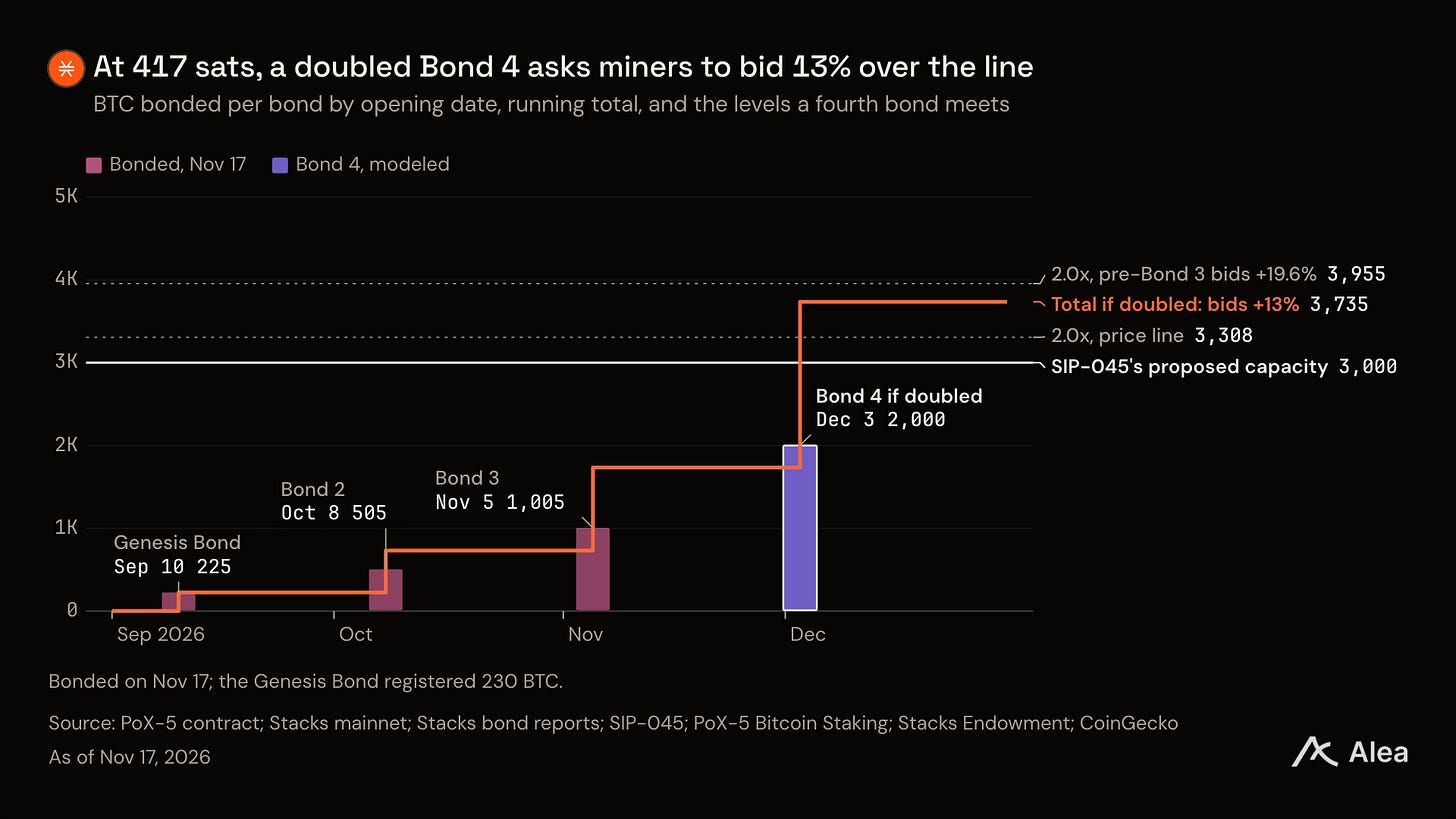
To separate STX’s price from how hard miners bid, we fitted a line to every weekly payout since August. It shows how much bitcoin miners usually pay at a given STX price. We call it the price line. STX’s price is in sats, the hundred-millionths of a bitcoin, and it closed at 417 sats on Nov 15.
Bonds took a quarter of miners' bitcoin
When miners' bitcoin runs short, bondholders are paid first. SIP-045 has the PoX-5 staking contract pay bond yield first, then send 15% of what remains to a reserve, leaving the rest to STX-only stakers. Rewards run in two-week cycles of two weekly runs.
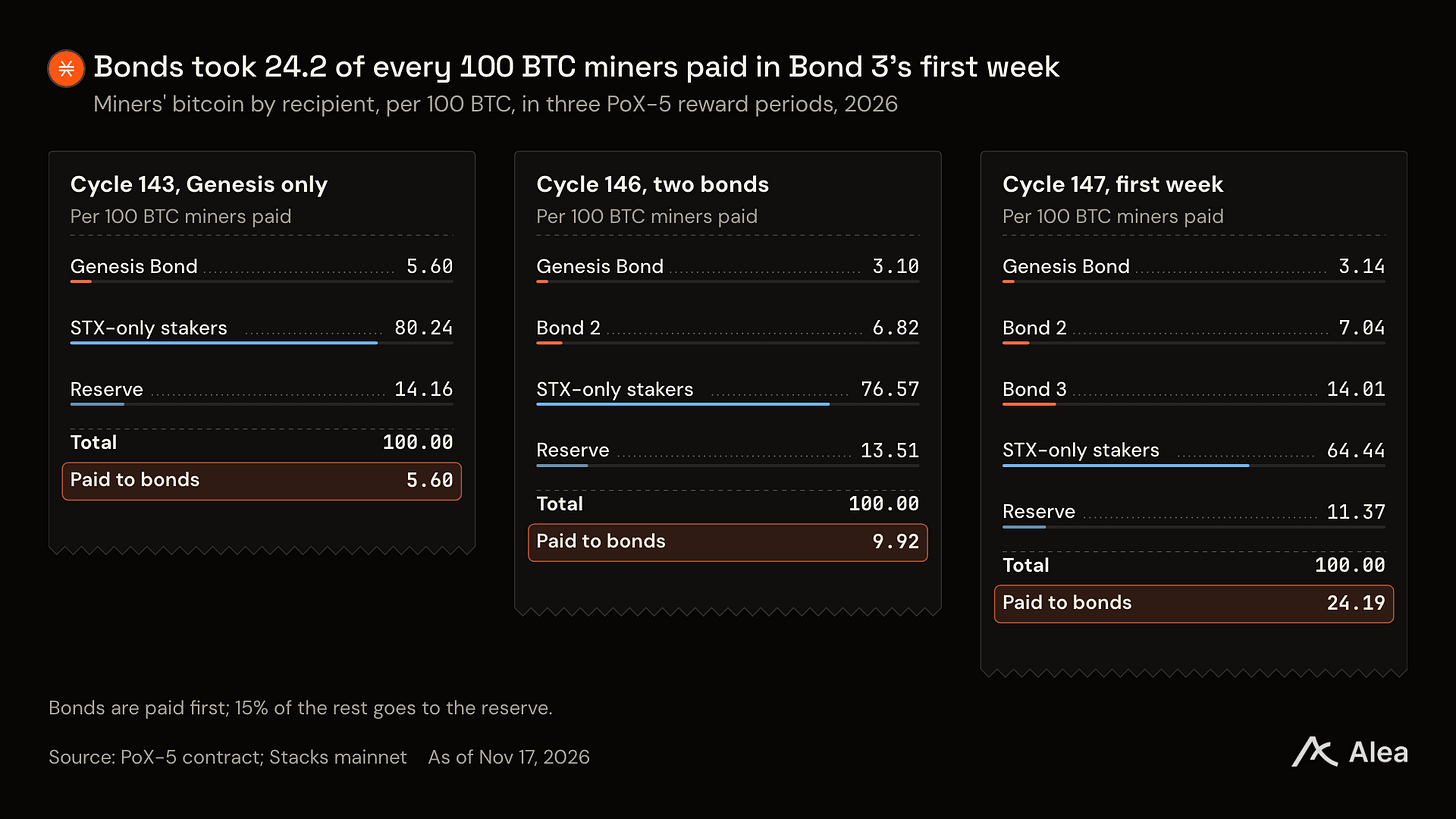
In the third bond's first week, bonds took 24.2% of miners' bitcoin, more than four times their Genesis-cycle share. STX-only stakers still did better than in the Genesis cycle: about 4.0 BTC a cycle then, 6.8 BTC in the cycle before the third bond, and a pace of about 5.5 BTC a cycle in its first week.
At the 2.0x target, bonds would take half. Below 1.5x the Endowment cuts new bond sizes; below 1.0x it halts new bonds.
Below 1.0x, miners' bitcoin no longer pays every bond's yield in full; the contract pays first the bonds that paired the most STX per bitcoin. The reserve held 6.10 BTC on Nov 17, about three cycles of bond payments, though during PoX-5 only a new improvement proposal can spend it.
Miners paid above the price line in the cycle before Bond 3
Miners' bitcoin grew 80% between the Genesis cycle and the cycle before the third bond. On the price line, STX’s rise accounts for about a quarter of that growth.
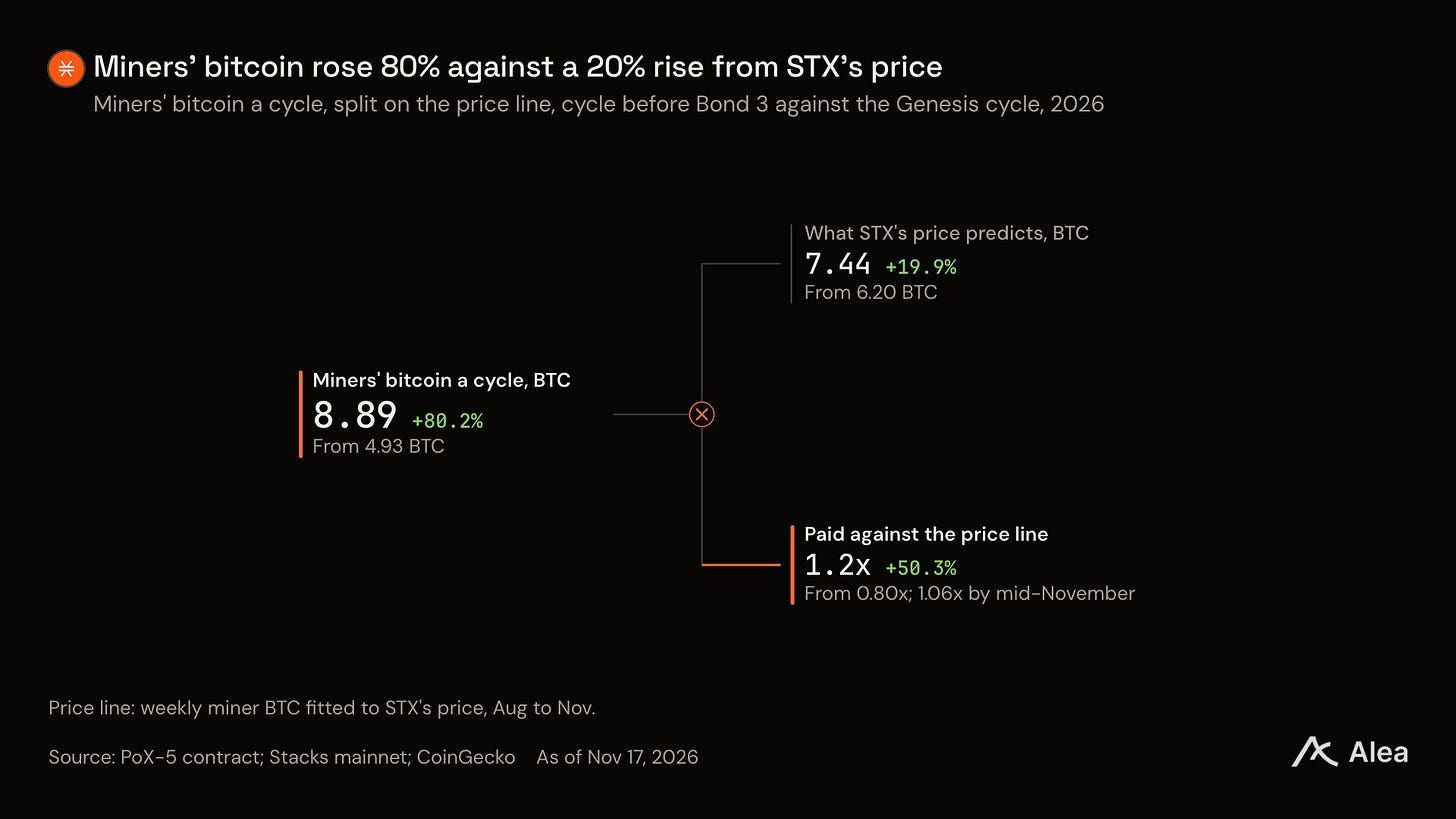
The rest came from miners paying more for the same STX: 20.5% below the price line in the Genesis cycle, then 19.6% above it in the cycle before the third bond.
That excess fell from 34% in the week to Oct 29 to 6% in the week to Nov 14, though that week was still the fourth straight run above the line.
Native locks brought Bond 3
The third bond reversed the mix. The Endowment allocates each bond's capacity among its partners before the bond opens. StackingDAO's stBTC supplied nearly all of the second bond; native locks supplied 1,000 of the third bond's 1,005 BTC.
A native lock keeps bitcoin in a timelock on the Bitcoin chain, held by its owner or a custodian, while a pool holds its members' bitcoin in the staking contract as sBTC.
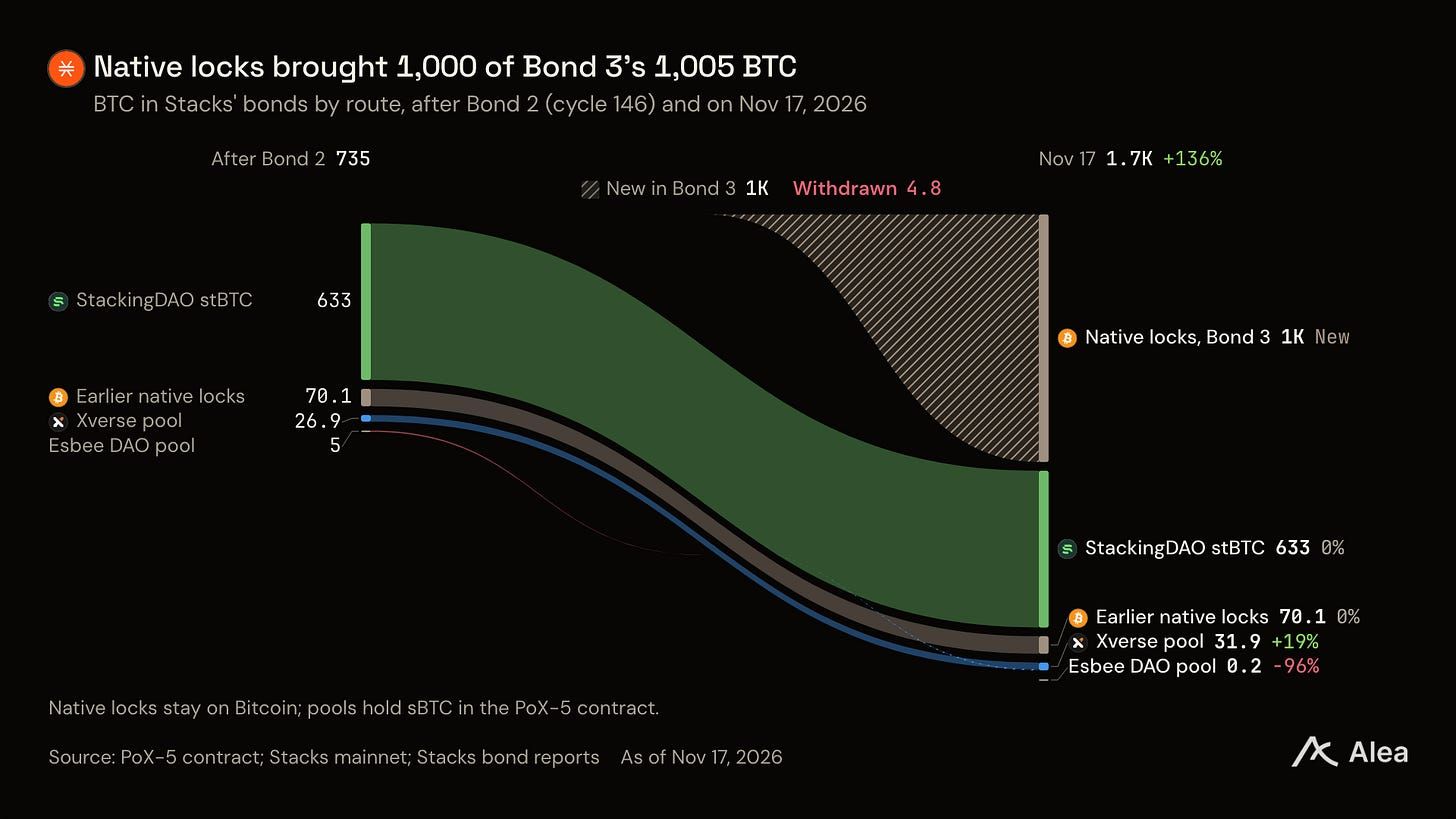
One lock supplied 70% of that bond and held 40% of all bonded bitcoin on Nov 17. The Xverse pool added the last 5 BTC, while pool members withdrew about 5 BTC from the Genesis Bond.
The Endowment expects future bonds to "lean more heavily toward institutions."
The new bitcoin earns the yield only
Stacks set itself three jobs for Q4: grow bonded bitcoin each month, put it to work in apps, and ship Epoch 4.1. The third bond covered November's share of the first.
The second job runs through stBTC, which StackingDAO's bonded bitcoin backs and holders can post as loan collateral. On Nov 17, the Stacks lending market Zest held 411 BTC of stBTC, nearly two thirds of all stBTC, after an October peak near 619 BTC.
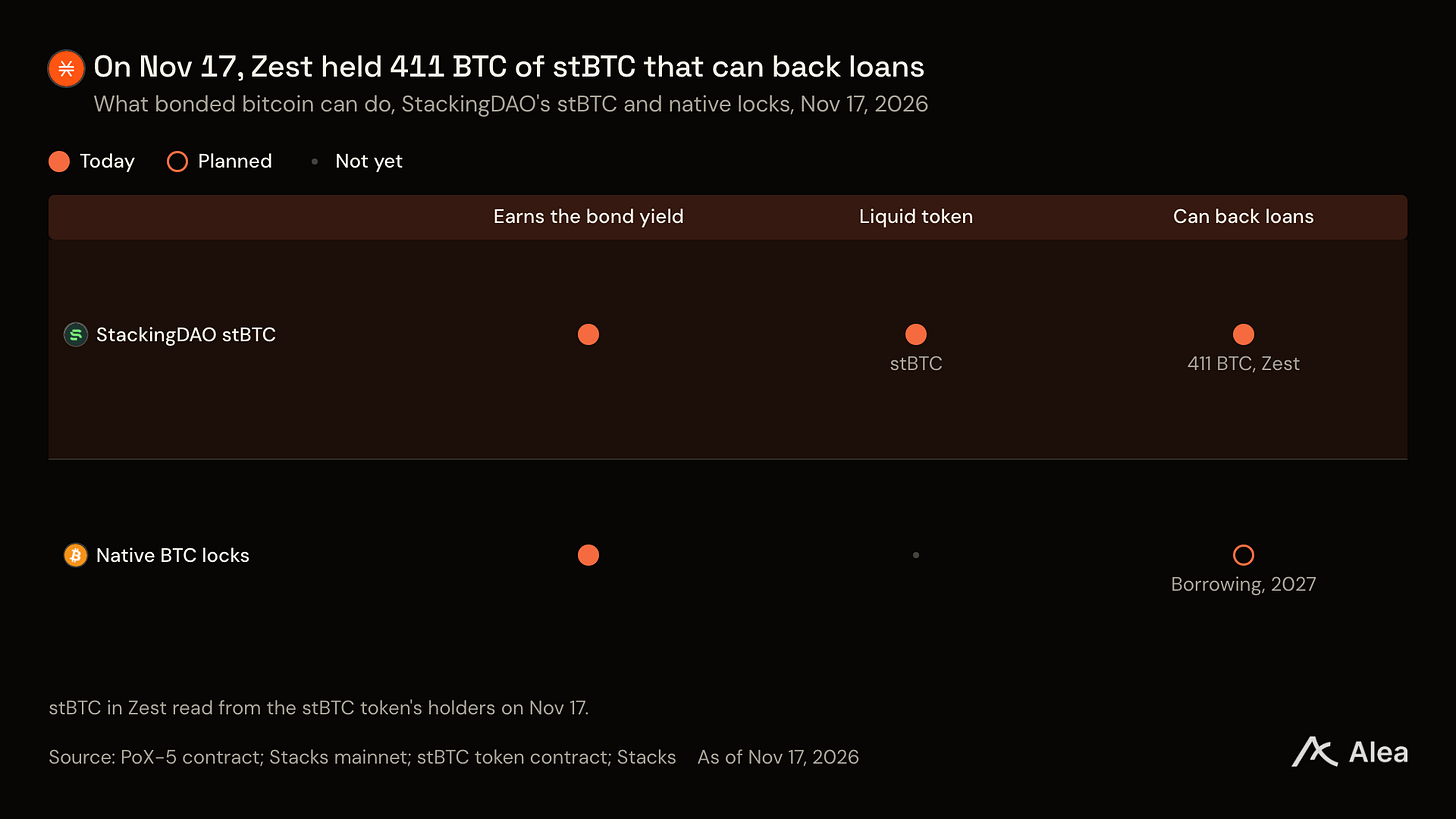
In the third bond, StackingDAO's bonded bitcoin held at 633 BTC while its share of all bonded bitcoin fell from 86% to 36%.
Native locks earn only the bond yield for now, though Stacks plans stablecoin loans against them for 2027, letting holders borrow while the bitcoin keeps earning.
How large Bond 4 can be
How big can Bond 4 be? To size it, the Endowment reads trailing averages and a forward view of STX's price in sats.
Start from the Nov 15 close of 417 sats, which the four weekly runs to Nov 14 also averaged. There, the price line puts the three bonds at 3.8x, below the 4.1x of the third bond's first week, when STX traded higher and bids ran above the line.
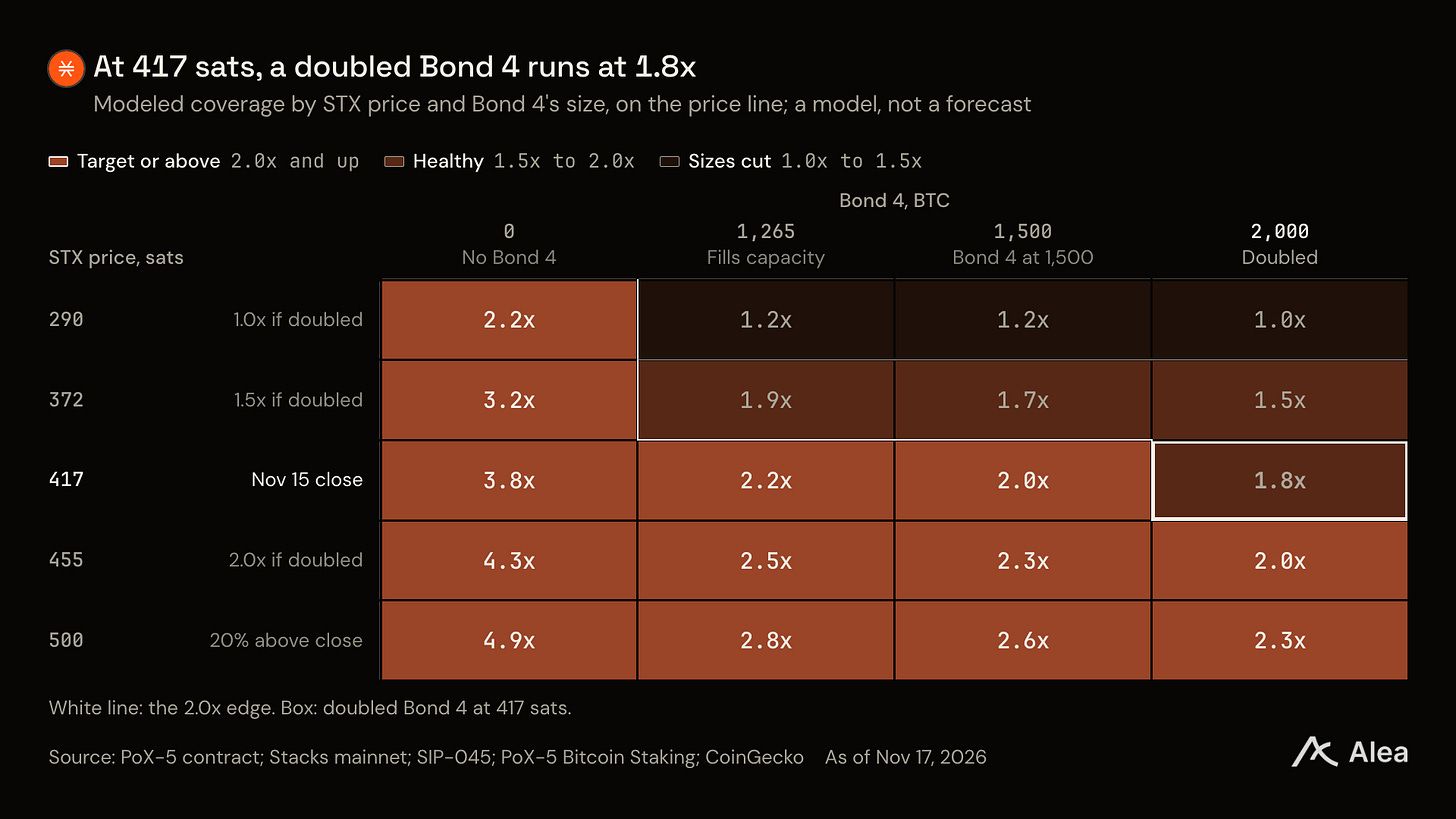
With a doubled fourth bond of 2,000 BTC, coverage drops to 1.8x on the price line. That's healthy under the rules' bands but short of the target, which comes back at about 455 sats or with bids 13% above the line. At 1.8x, STX-only stakers would get about 2.9 BTC a cycle, below their Genesis-cycle 4.0.
For a bondholder, the floor concerns the yield; a coverage shortfall cuts payments and leaves the principal in place. With that bond, miners' bitcoin stops paying every bond's yield in full below about 290 sats on the line, a floor that rises to about 332 sats at bids like the Genesis cycle's, below the line.
Capacity is a setting the Endowment controls. SIP-045's proposed initial capacity of 3,000 BTC, for all bonds together, leaves 1,265 BTC. During PoX-5 the Endowment sets capacity each period; a doubling takes total bonds above 3,000 BTC.
Verdict
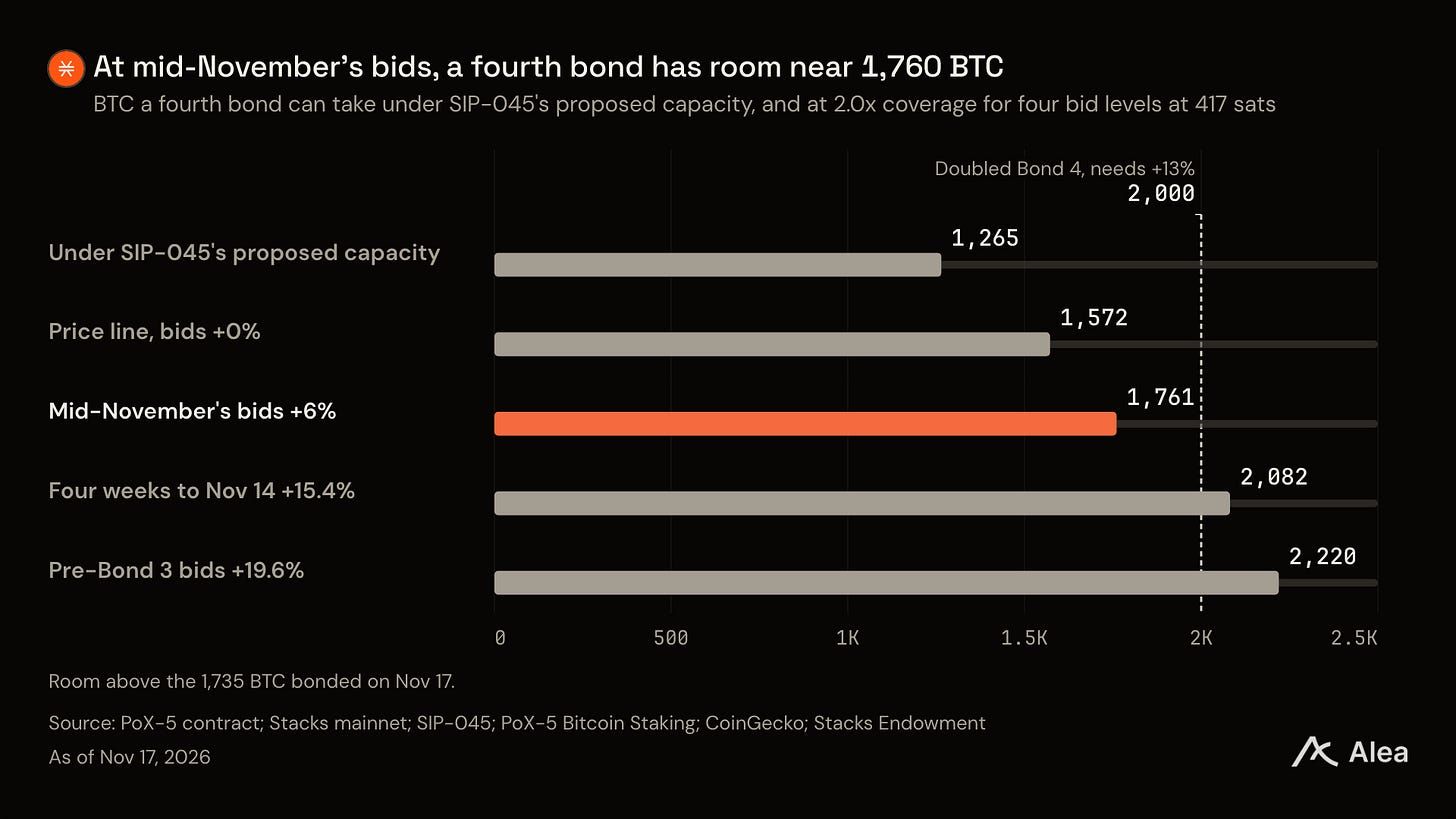
There's room for a fourth bond near 1,760 BTC at mid-November's bids; a full doubling asks miners for 13% more than STX's price predicts. Those bids ran 6% above the price line. The four weekly runs to Nov 14 paid 15.4% above it, room for about 2,080 BTC, though two late-October weeks carried that average.
Any Bond 4 above 1,265 BTC takes total bonds past the proposed 3,000 BTC; either size needs the Endowment to raise capacity. Stacks opened enrollment for the fourth bond on Nov 24 at 1,050 BTC, below every room estimate. Enrollment closes around Dec 4, and the bond starts around Dec 5. At 417 sats, that size leaves coverage at 2.4x on the price line. On the line, it stays above target until STX falls below about 371 sats. The first two bonds end their terms in March and April 2027, retiring about 730 BTC of claims.
Alea's Q4 report on Stacks will measure the fourth bond's first weeks.
Important Links
Disclosure
Alea Research is engaged in a commercial relationship with Stacks and this newsletter was commissioned as part of that engagement. Members of the Alea Research team, including those directly involved in the analysis above, may have positions in the tokens discussed. This content is provided for educational purposes only and does not constitute financial or investment advice. You should do your own research and only invest what you can afford to lose. Alea Research is a research platform and not an investment or financial advisor.

The Stacks Q3 2026 Benchmark covers the quarter that set up these bonds, from miner economics to valuation. Its 40-slide IR deck takes an investment committee through the same quarter.
Research reports. Deep Dives and Blueprints explain protocols and their economics. Theses and Memos examine investment cases and catalysts. Benchmarks compare performance, while Perspectives assess specific developments.
Weekly Pulse. Read a weekly assessment of macro and the major liquid markets.
Protocol Data Rooms. Research each protocol in one place, with Analytics for historical comparisons and Intel for news and governance developments where available.
Podcast Digest and Summit Digest. Read summaries of industry conversations and events. Find Alea shows and their episodes through Podcast Digest.
Governance Tracker. Follow proposals and voting activity across protocols.
For protocol teams preparing institutional conversations, discuss research for your protocol with Alea.