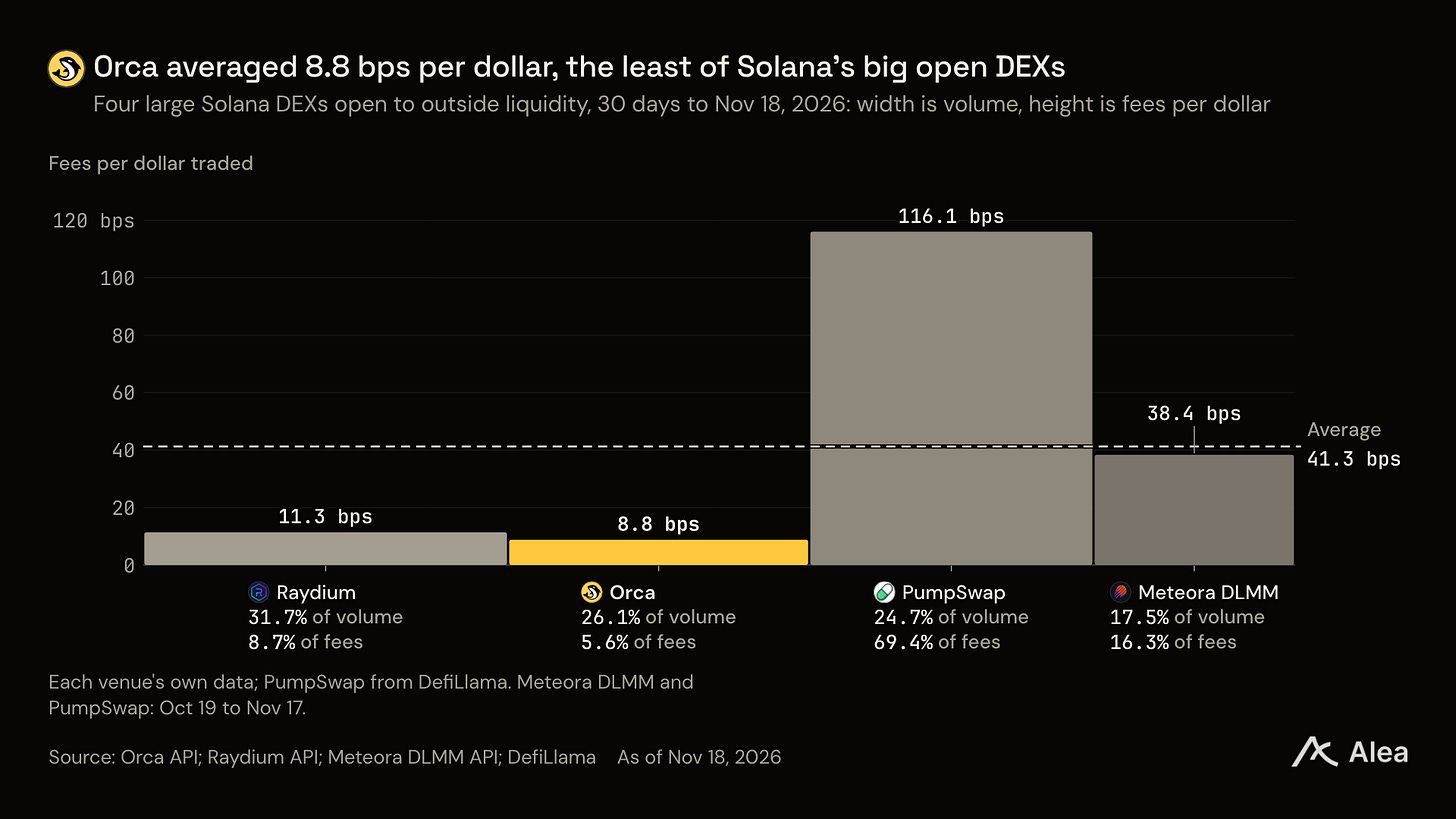
In the 30 days to Nov 18, Orca's traders paid 8.8 bps in fees per dollar swapped, the lowest average of the large Solana exchanges where anyone can supply liquidity. That's an average across Orca's pools. Raydium averaged 11.3 bps on about a fifth more volume; Meteora's DLMM and PumpSwap charged several times as much.
The low average comes from one pool. About two-fifths of Orca's volume is SOL swapped for USDC in a pool that charges 4 bps, while Orca's other pools earn most of the fees.
Prop AMMs, which trading firms funds and price, are outside this comparison. On Oct 7, Orca and the lender Loopscale announced their merger, with the combined team operating as Formation; the Oct 18 tokenholder vote funded the deal.
Key takeaways
Over the month, Orca's main pool brought 41.5% of volume and 18.9% of fees.
October fees ran 75% above June's on flat volume.
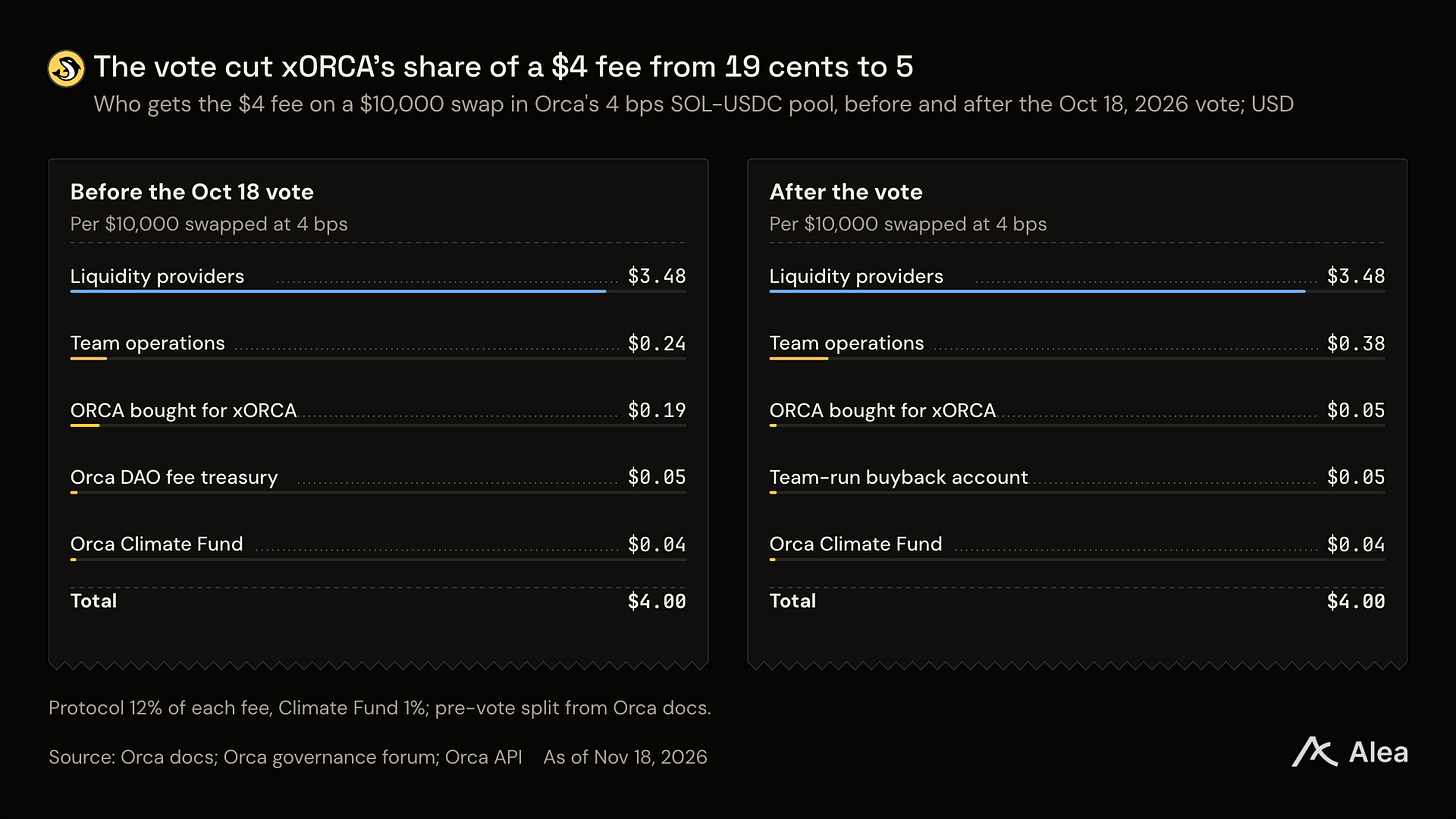
The vote cut xORCA's buyback from 40% of the protocol's share to 10%.
ORCA's fully diluted value was 9.6 times Orca's annualized 30-day fee take, mid-pack among peers.
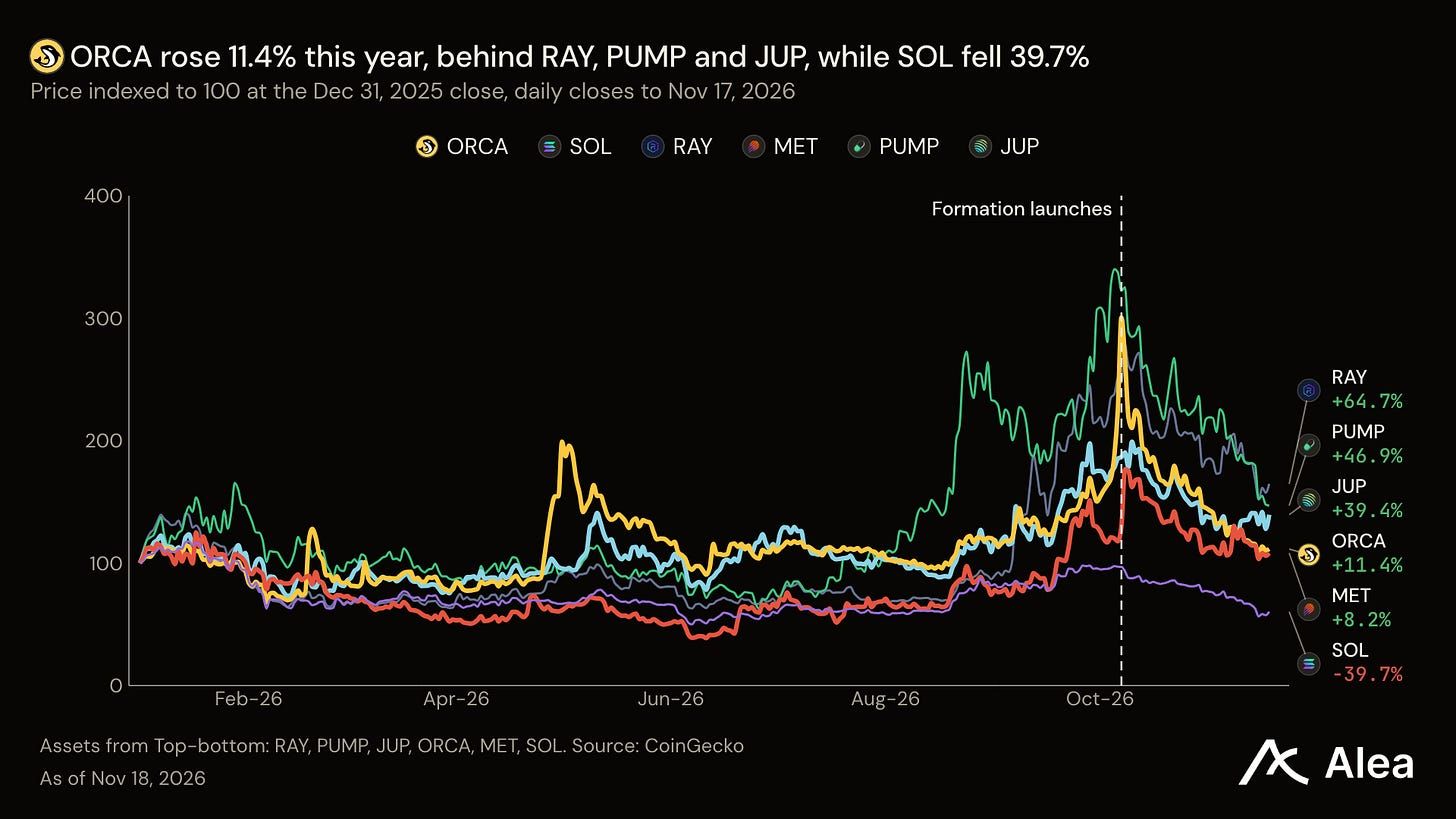
This year to Nov 17, ORCA rose 11.4% while SOL lost 39.7%; RAY, PUMP, and JUP rose more, and MET less. ORCA doubled in late April and again from Sep 29 to Oct 6, while other DEX tokens moved far less. It then fell 63% by mid-November.
Liquidity providers keep 87% of every fee Orca's traders pay
Orca is a concentrated liquidity exchange on Solana. Each liquidity provider (LP) picks a price range and earns fees only while the price trades inside it.
Whoever opens a pool sets its base fee, from 1 bp to 2% of each trade; adaptive pools add a charge when prices move fast. LPs keep 87% of that fee, while Orca keeps the remaining 13 points, splitting them into a 12-point protocol share and a single point for its Climate Fund.
ORCA is Orca's governance token. Staked ORCA becomes xORCA, which receives the ORCA that buybacks add.
A tokenholder vote passed on Oct 18 to send 80% of the protocol's share to Formation's team for development and operations. Until the new split reached the chain on Oct 30, the team got half, xORCA buying 40%, and a DAO fee treasury a tenth. Since then, xORCA gets 10%; a team-run buyback account gets the other 10%.
The proposal lets the team buy ORCA from that account at its discretion, then burn it, add it to xORCA, or grant it to contributors under a four-year lock. The team has committed to report those purchases every six months.
The same vote moved the community treasury's 14.2M ORCA, about a fifth of supply, to a team account reserved for acquisitions. Specific deal terms remain confidential.
Daily USDC spent buying ORCA for xORCA fell by about four-fifths once the new split took effect on Oct 30.
Orca's other pools earn 81% of its fees
SOL traded against stablecoins brought 43.3% of Orca's volume over the month, but only 19.9% of its fees. The 4 bps SOL-USDC pool alone handled more than two-fifths of volume, leaving 81% of fees to Orca's other pools, which averaged about 12 bps per dollar.
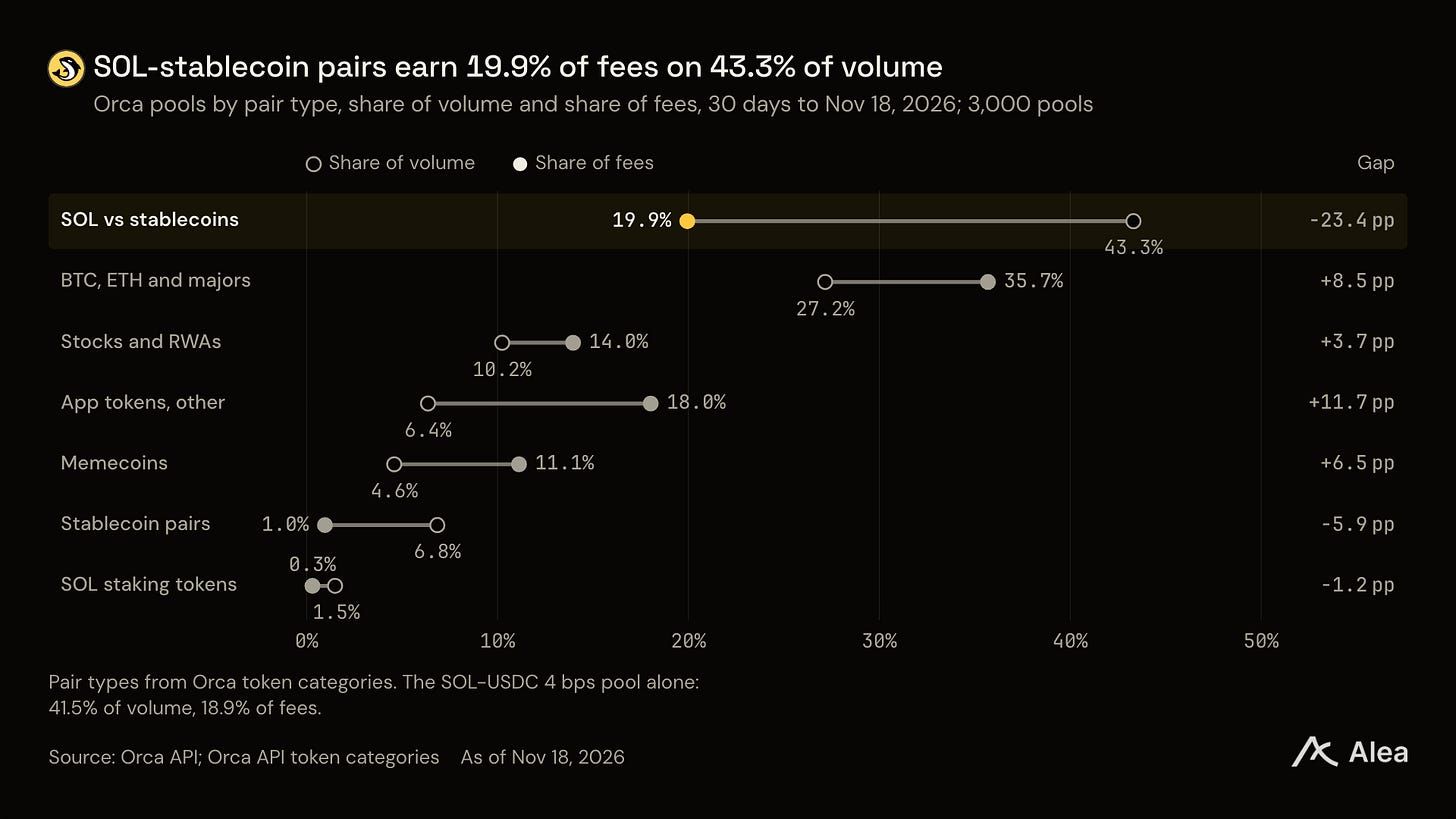
Pools for majors such as BTC, ETH, ZEC, and HYPE earned over a third of the fees. ZEC pools alone earned 16.8% on 8.8% of volume, nearly level with the main pool. Tokenized stocks and other real-world assets earned 14.0%, most of it from 95 stock and private-company tokens issued by Backpack Securities, xStocks, and PreStocks.
Pools with adaptive fees raise their rate when prices move fast. Across all pair types, they earned nearly half the fees on a sixth of the volume.
Stablecoin pairs held just over half of the liquidity in Orca's pools on Nov 18 yet earned 1.0% of its fees, a fee yield of about 0.5% a year for their LPs before any token rewards.
Since July, Orca's fees have outgrown its volume
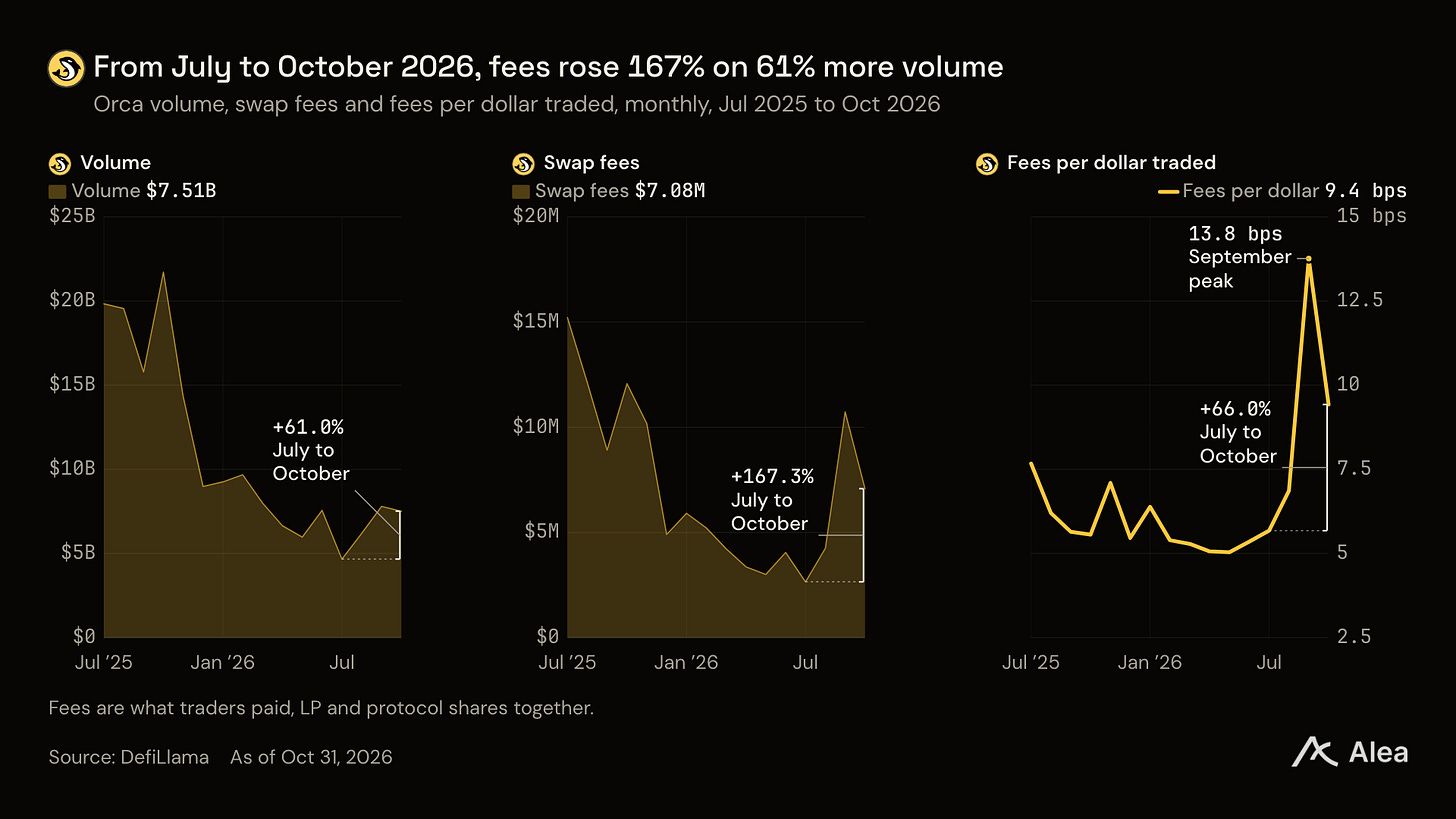
From July 2026 to October 2026, Orca's monthly volume rose 61% while its fees rose 167%. Volume and fees both bottomed in July, volume at under a quarter of its July 2025 level. Fees per dollar traded ran about 5.5 bps through the first half, peaking in September before easing to 9.4 bps in October.
Orca's volume was about the same in June and October, yet its fees rose 75% from June 2026. The SOL-USDC pool lost an eighth of its volume, while the other pools traded a tenth more than in June 2026 at twice the fees per dollar.
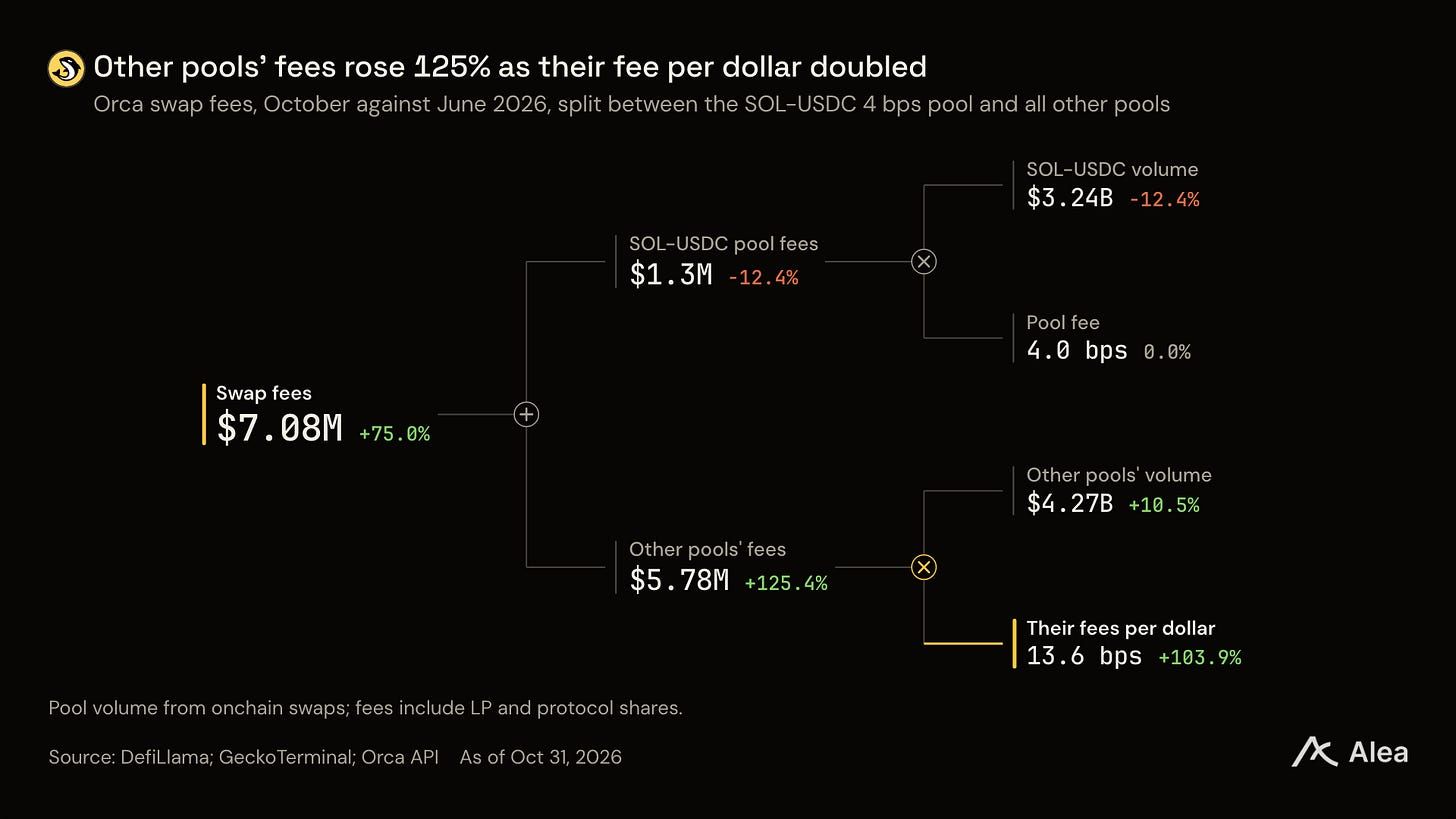
SOL-PUMP and the two ZEC pools charge 16 bps or more. Their share of Orca's monthly volume more than tripled from June to October 2026, adding at least a quarter of the other pools' fee rise.
Formation adds loans, and a planned securities venue licenses Orca's software
Formation pitches one path for a new asset: a pool on Orca, then a loan market and a vault on Loopscale. On Nov 17 it opened a waitlist for one app that holds all three.
At Solana's Breakpoint conference in mid-November, Formation added a looping vault for Corda's EPIC from R3, a launch role with Superstate, and a partnership with DigiFT.
On Nov 5 an attacker drew an undercollateralized loan of about $412K from one Loopscale vault. Loopscale said the same day that no user deposits incurred a loss. It reopened two days later.
In dollar terms, its deposits had fallen nearly a tenth from Sep 30 to the day before the attack. After it reopened, they fell nearly a quarter by the Nov 17 close, while SOL fell 16%.
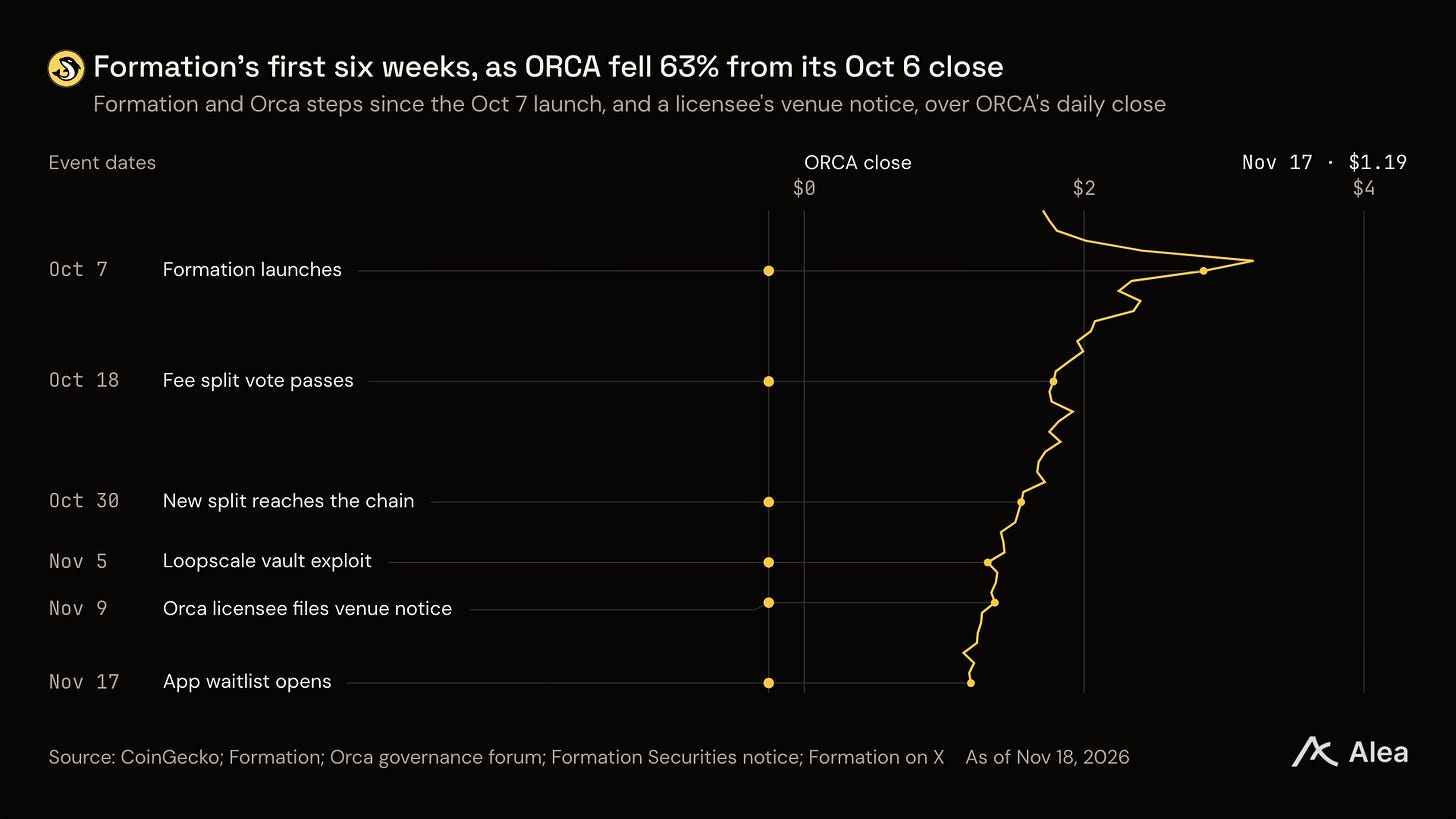
On Nov 9, Formation Securities LLC, a Valcrest, Inc. subsidiary, published a notice under an SEC exemption to run a US tokenized securities venue for permissioned wallets. The venue will use licensed versions of Orca's pool software and router. Formation Securities says Exodus, Forward Industries, and Galaxy signed on as launch issuers, with trading planned for early 2027.
On Nov 16, Kamino relaunched as one app for more than 100 real-world assets, and Jupiter opened its lending market to a token issued by Bullish.
ORCA trades at 9.6 times the fees Orca keeps and 104 times its xORCA buyback
At the Nov 17 close, ORCA's fully diluted value was 9.6 times the 13% of fees Orca kept over the prior month, annualized. Only the xORCA line, about $0.86M a year at the 30-day pace, reaches stakers; against it ORCA trades at 104 times. Counting the team-run account, which can also fund contributor grants, it trades at 52 times.
If the fee rate fell back to its first-half level, the fees Orca keeps would drop by about two-fifths, and the multiple would rise to 15.7 times.
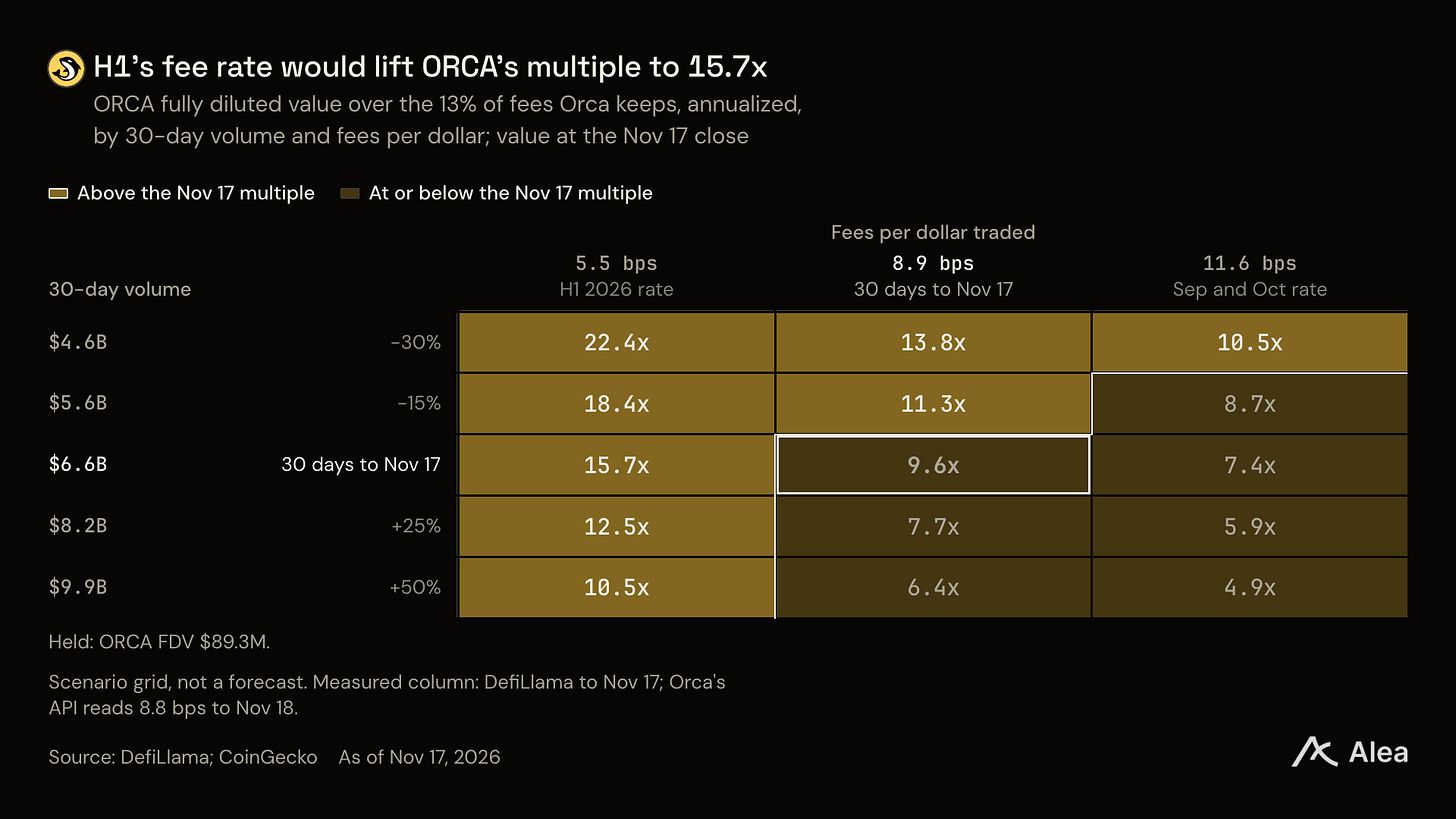
On the same basis, fully diluted value over annualized revenue, Pump.fun's PUMP and Meteora's MET trade lower, at 4.2 and 8.5 times. Jupiter's JUP and Raydium's RAY trade higher, at 22.5 and 33.4, measuring revenue before any holder distribution.
Orca earns most of its fees away from its busiest pool, and under the new split, most of what it keeps funds Formation's development and operations. Loopscale's lending income is outside that split; on Nov 18 its fee schedule was still to come.

Alea Research tracks how Solana's exchanges and lenders price liquidity and credit, and what reaches token holders. Alea's Podcast Digest summarizes Luke Truitt's Oct 28 interview on the merger.
Research reports. Deep Dives and Blueprints explain protocols and their economics. Theses and Memos examine investment cases and catalysts. Benchmarks compare performance, while Perspectives assess specific developments.
Weekly Pulse. Read a weekly assessment of macro and the major liquid markets.
Protocol Data Rooms. Research each protocol in one place, with Analytics for historical comparisons and Intel for news and governance developments where available.
Podcast Digest and Summit Digest. Read summaries of industry conversations and events. Find Alea shows and their episodes through Podcast Digest.
Governance Tracker. Follow proposals and voting activity across protocols.
For protocol teams preparing institutional conversations, discuss research for your protocol with Alea.