Markets now trade through the weekend, but the dollars that settle them still keep bank hours. Fedwire settled $1.15 quadrillion in 2025, and none of it moved on a Saturday. On Sep 30, Open USD launched, a dollar from a consortium formed by companies such as Coinbase, Mastercard, Shopify, Stripe, and Visa, which they founded together. A day later, $447M of its first $490M was on Tempo. Tempo is indeed built for the three places dollars get stuck: the weekend, the border, and the bank ledger that can't pay into the next one.
Takeaways
Weekend settlement stays closed for years. Fedwire adds Sunday in 2028 or 2029 and keeps Saturday closed. A bank's weekend stablecoin pool on Tempo breaks even at 1.5 bps, inside the 1 to 3 bps a tri-party collateral move costs.
Open USD put most of its first dollars on Tempo. On Oct 1, its first full day, $447M of the $490M in circulation was on Tempo, and the network's dollar supply was $697M, twice its Sep 29 level.
Cross-border payments miss their own targets. In 2025, 2.2% of business-to-business payment services credited the recipient within an hour, against a G20 target of 75% by end-2027.
Tempo prices the transfer near zero. From the Jul 10 fee cut to Oct 1, the median fee averaged $0.00003 per transaction, and the sender pays it in the stablecoin they already hold.
The money is in the float and the services around each payment. Reserve income goes to issuers and, for Open USD, to the partners that bring the supply. Tempo sells API access and advisory work, and there's no token.
A dollar that settles on Saturday
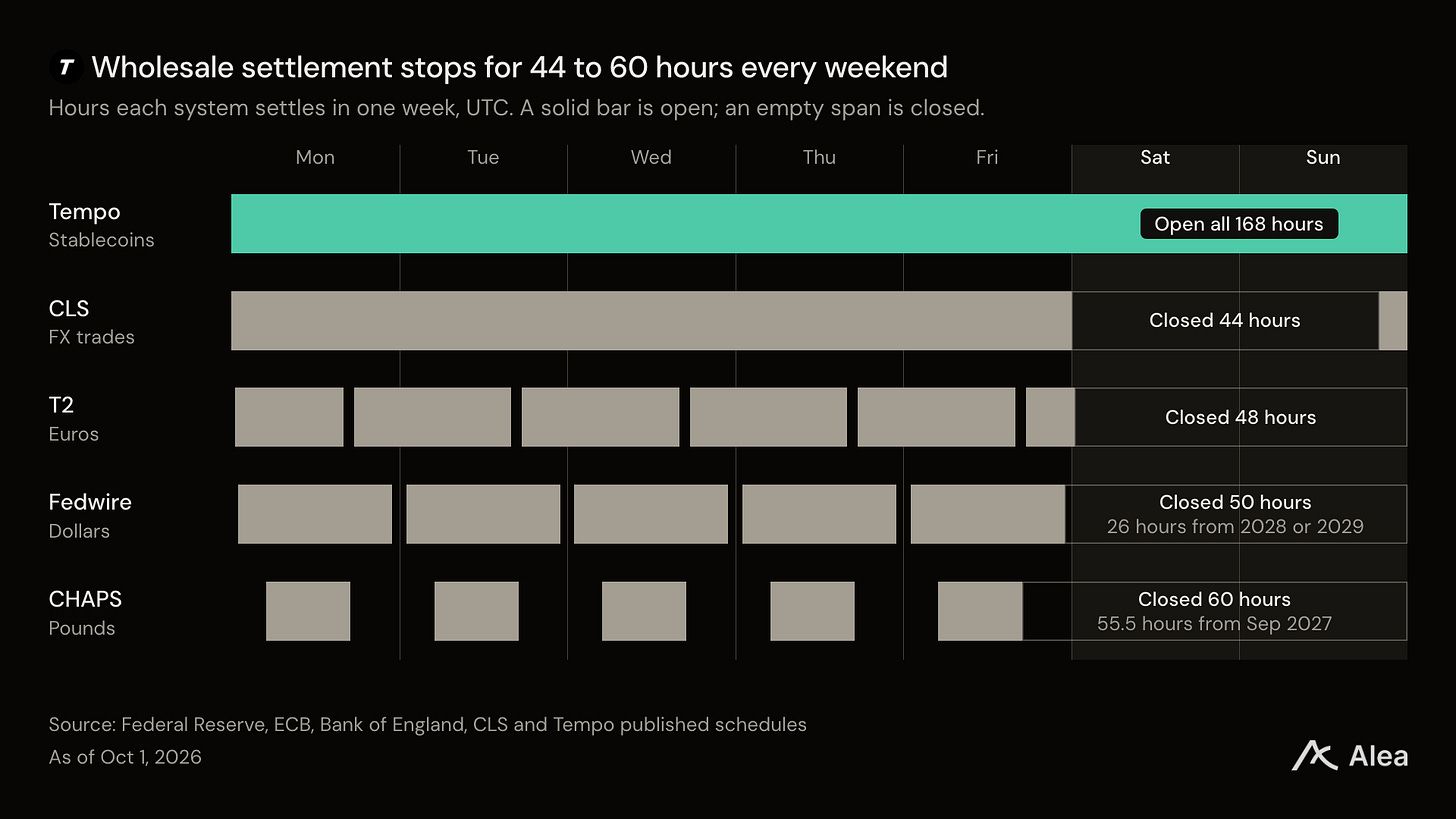
Over one April weekend, trade.xyz cleared $1.5B of oil and stock-index contracts in stablecoins while the systems that settle large payments were shut. Those systems run on a business-day clock. Fedwire opens at 9 p.m. New York time on the evening before each business day, closes at 7 p.m., and shuts for 50 hours every weekend. The euro system T2 closes for 48 hours, the sterling system CHAPS for 60, and CLS, which settles FX trades, for 44.
Those hours change slowly. The Federal Reserve will add Sunday to Fedwire in 2028 or 2029, and Saturday stays closed. The Bank of England moves the CHAPS opening to 1:30 a.m. from Sep 2027. Instant systems such as FedNow already run every hour, but they cap each payment at $10M.
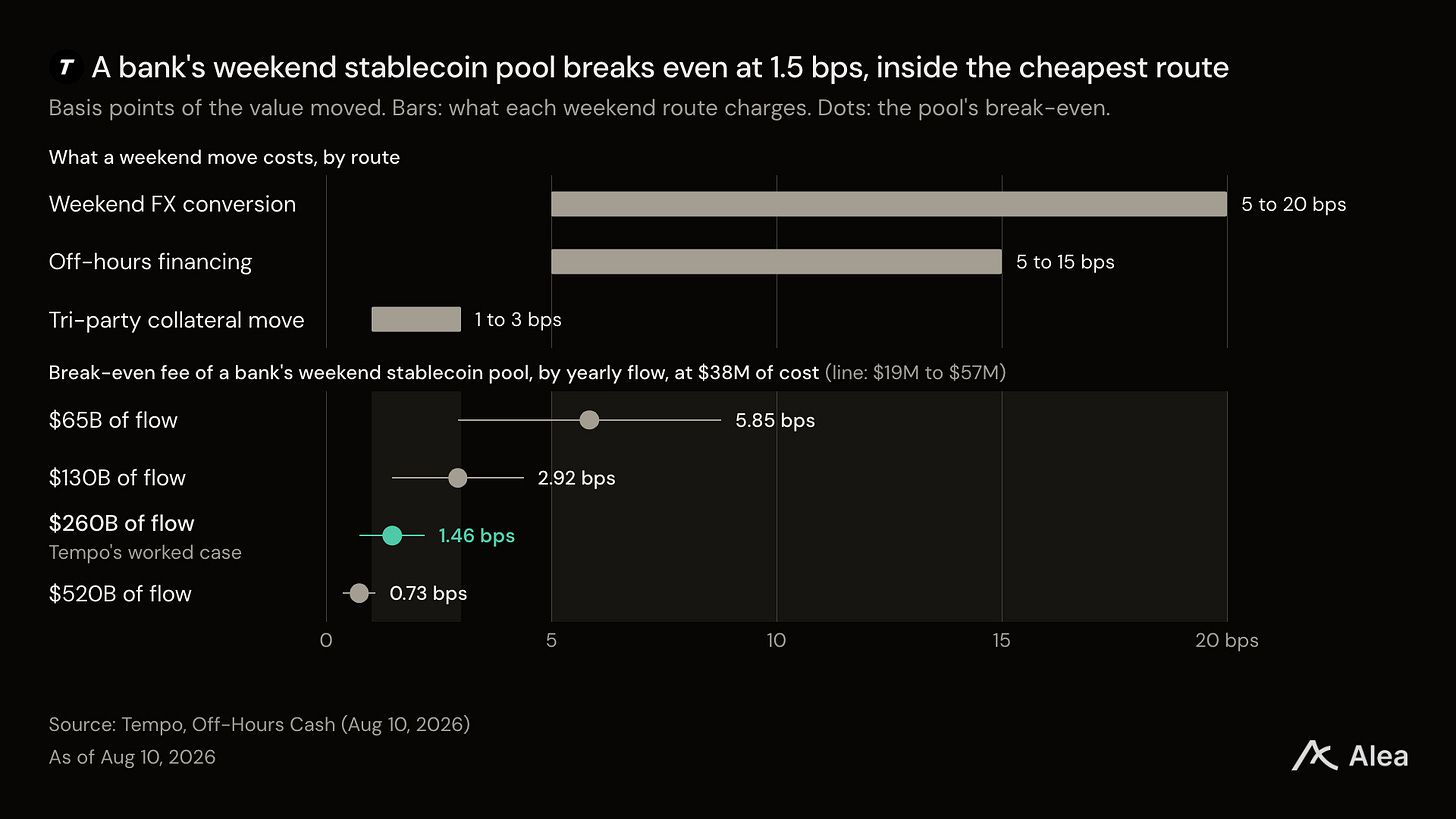
Tempo's team built its bank case around the closed weekend. Its Off-Hours Cash paper models a bank that converts wholesale deposits into its own stablecoin at 4:30 p.m. on Friday. Clients post margin or settle trades with it through the weekend, and the unused balance sweeps back to deposits on Monday. A $5B peak pool at a $500B bank costs about $38M a year and serves about $260B of flow, which works out to a break-even fee of 1.5 bps.
That's inside or below the price of every weekend alternative. A tri-party collateral move costs 1 to 3 bps, weekend FX conversion 5 to 20 bps, and off-hours prime brokerage financing a spread of 5 to 15 bps.
Cash that stops waiting at every border
A cross-border payment waits because each corridor needs cash parked at the far end before anyone pays. Corporates move about $23.5T across borders a year and pay about $120B in transaction charges to do it. FX spreads and the cost of the parked cash come on top.
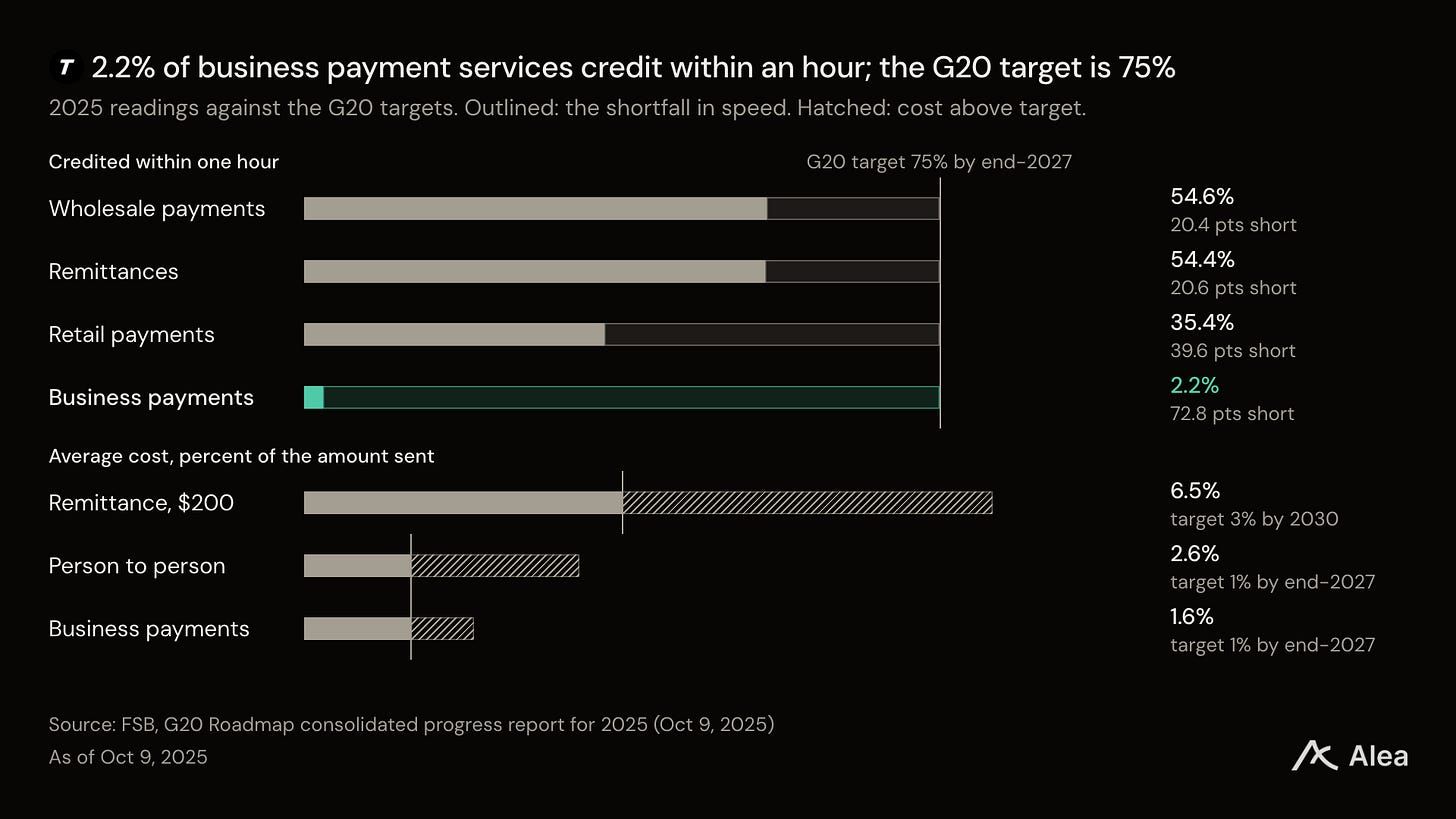
The G20 set targets for end-2027: 75% of cross-border payments credited within an hour, and retail payments at 1% average cost. The FSB's 2025 monitoring found 54.6% of wholesale payments and 35.4% of retail payment services credited within an hour. However, for business-to-business services the share was 2.2%. Sending $200 abroad cost 6.5% on average, against a 3% goal for 2030, and the FSB doesn't expect satisfactory global progress by 2027.
The firms that feel this first pay out every day, and several already run on Tempo. MoneyGram joined as Tempo's first remittance validator and settlement partner, and Felix settles remittances on Tempo. Deel launched DLUSD, a stablecoin wallet for contractors, with Tempo as its only chain. Coastal Bank built a corridor where messaging, screening, and bank confirmations stay in place and only the value leg moves to Tempo.
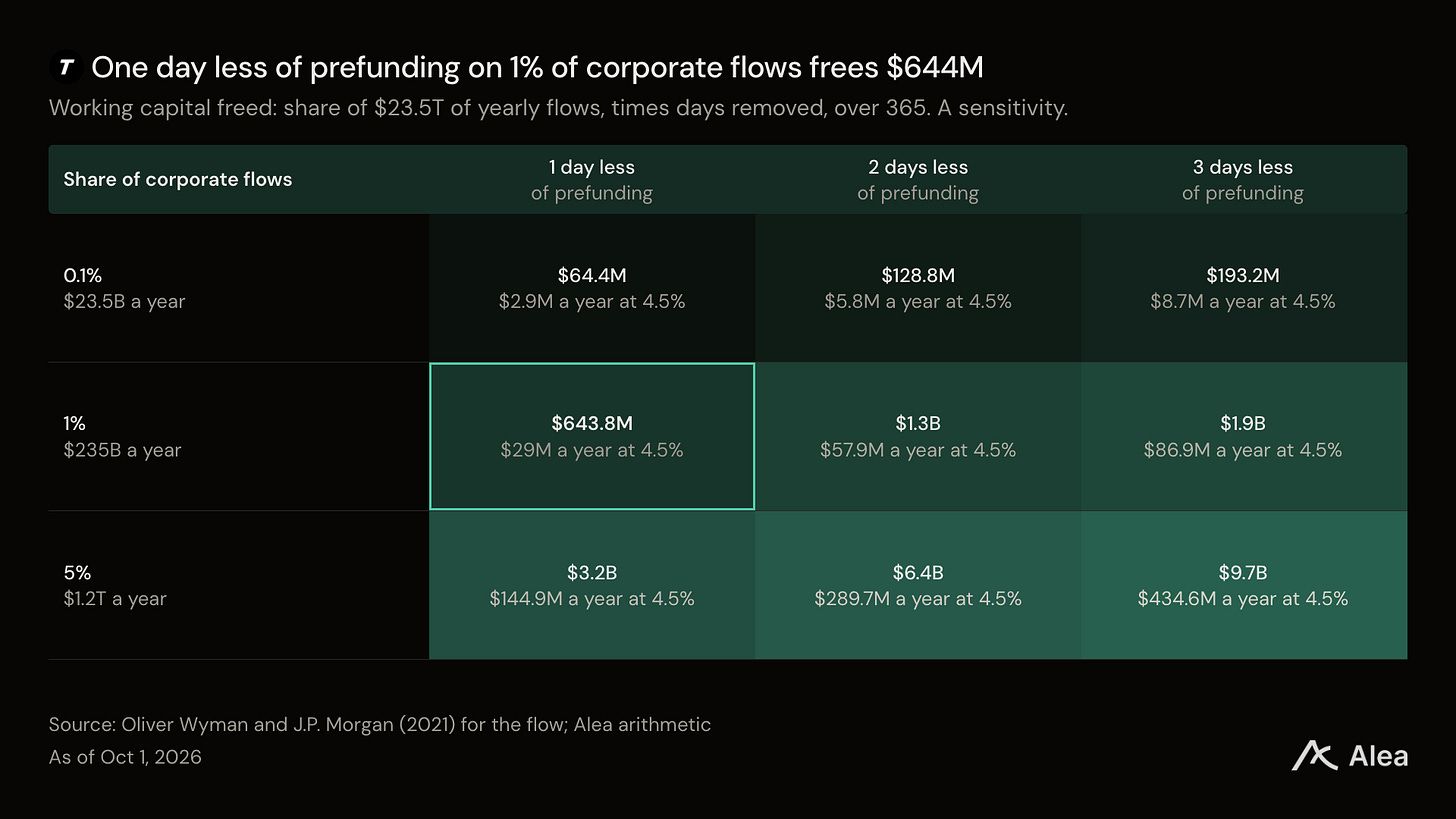
Every day of prefunding removed frees cash, and on 1% of corporate cross-border flows one day less is worth about $644M of working capital. At an assumed 4.5% cost of capital, carrying that balance costs about $29M a year.
One pool of cash, many markets
Tempo's own research says speed no longer separates settlement networks. Its July paper calls the property that does liquidity mobility, meaning that "the same cash can clear a repo trade, fund a cross-border payment, post margin at a derivatives venue, and settle a tokenized securities trade." None of those steps reissues the cash. On Alea's Market Cap, Borja Neira, one of the paper's authors, said that each generation of market infrastructure frees trapped cash and then traps it somewhere new.
Existing networks force a choice between privacy and mobility. Suppose that public chains spread about $40B of liquidity across more than twenty rollups, while the largest private bank ledger clears almost $400B of repo a day with cash that serves only that market. Tempo separates private execution from shared settlement. Tempo Zones run private transactions on parallel chains while balances stay on one shared network. The first Zone goes live in October for one customer.
Open USD now also gives the companies that move money a dollar of their own. Open Standard, which Coinbase, Mastercard, Shopify, Stripe, and Visa founded, launched it on Sep 30 on Base, Ethereum, Solana, and Tempo. Bridge, a Stripe company, issues it, and BlackRock, Lead Bank, and BNY hold the reserves. Those reserves stood 88.3% in Treasuries and 11.7% in cash on Oct 2.
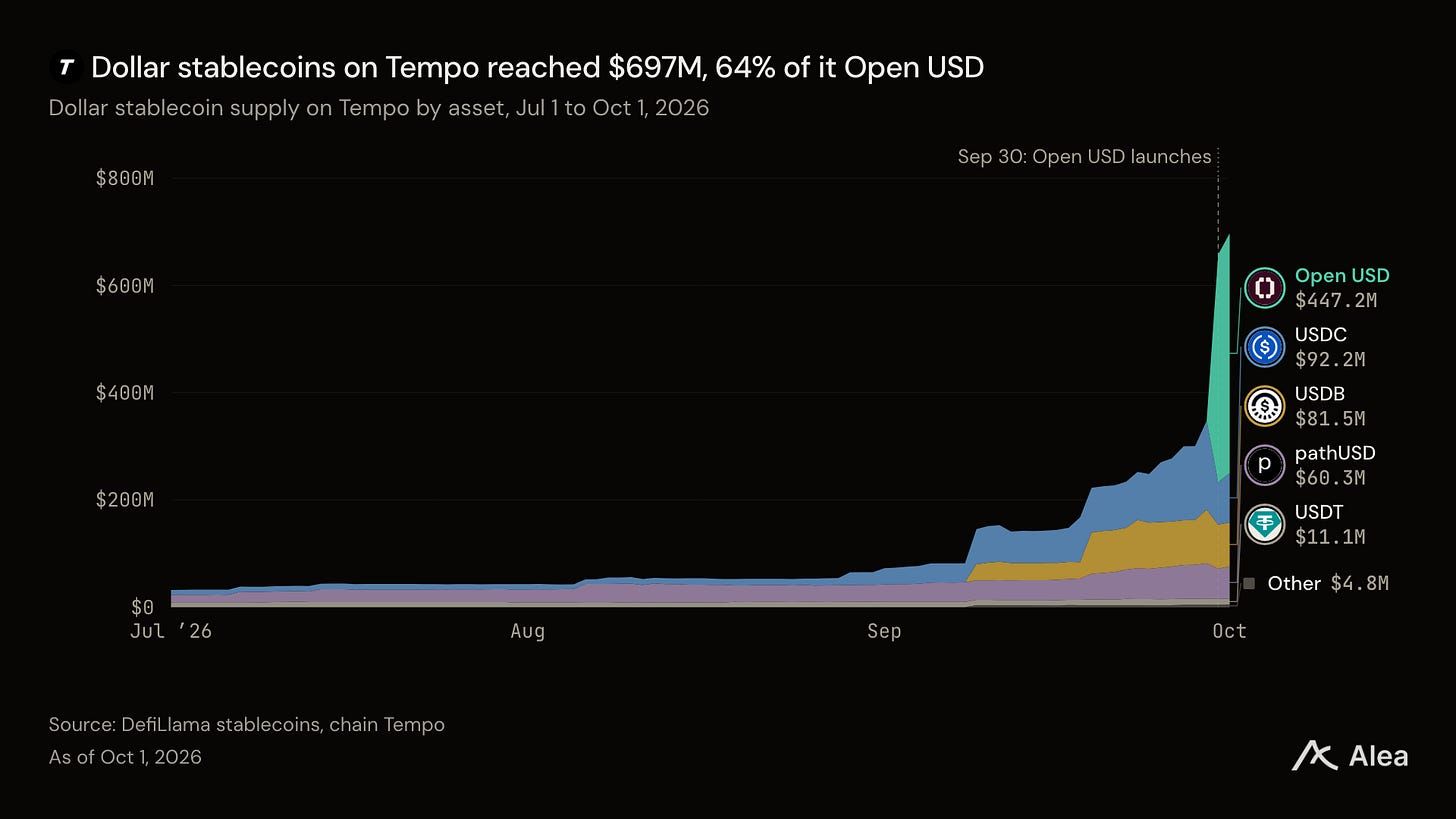
Most of the new dollar went to Tempo. On Oct 1, the first full day, 91% of the Open USD in circulation sat on Tempo, where it made up 64% of the network's dollar stablecoins. On launch day Open USD added $424.3M while USDC, USDB, and pathUSD on Tempo fell by $114.5M, which left the network's total up $309.8M. Businesses mint and burn Open USD on Tempo at no cost through Coinbase, Stripe, and Visa.
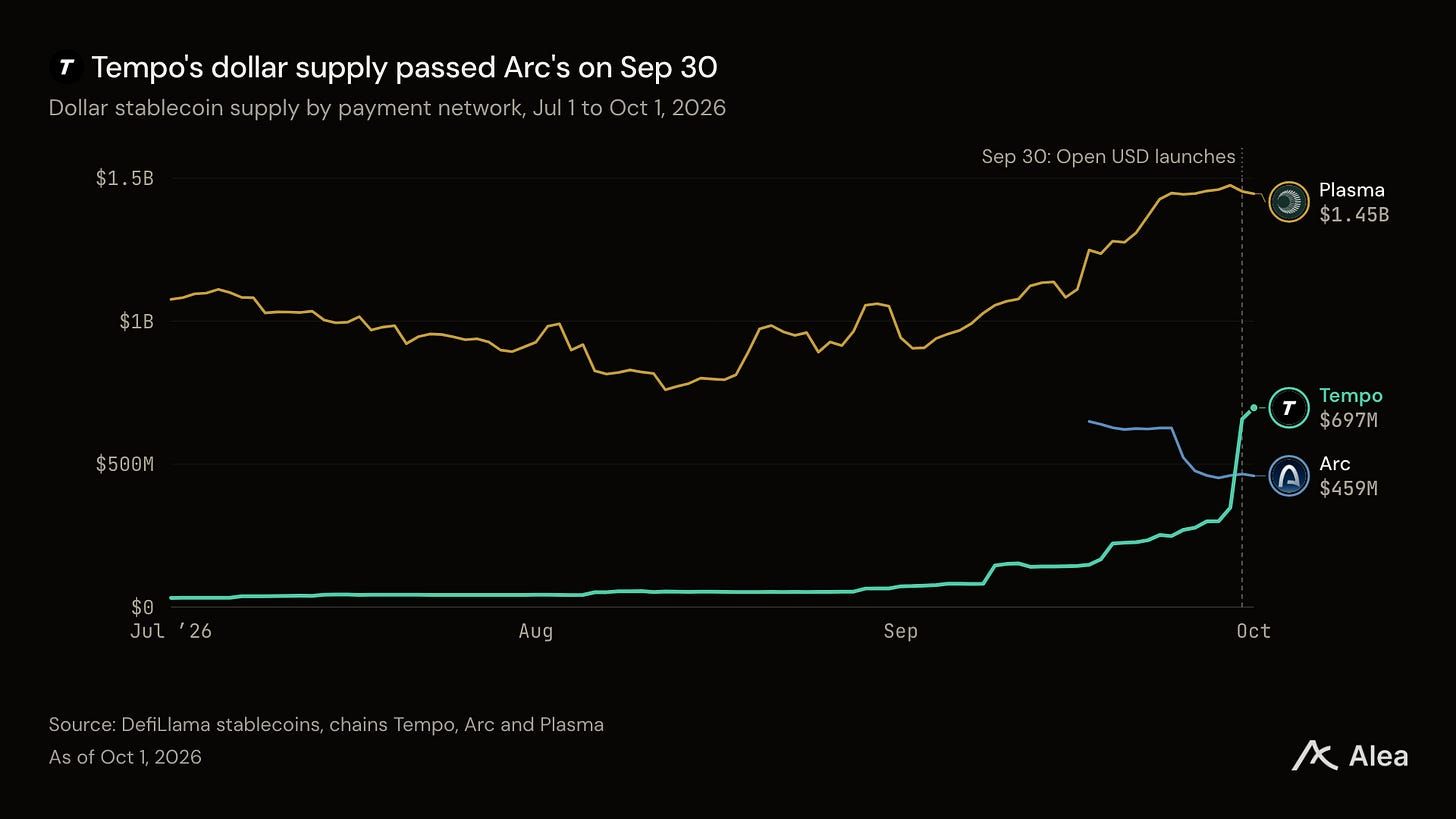
That supply puts Tempo between Arc and Plasma. It passed Arc on Sep 30, two weeks after Arc's mainnet, and on Oct 1 it held about half of Plasma's $1.45B.
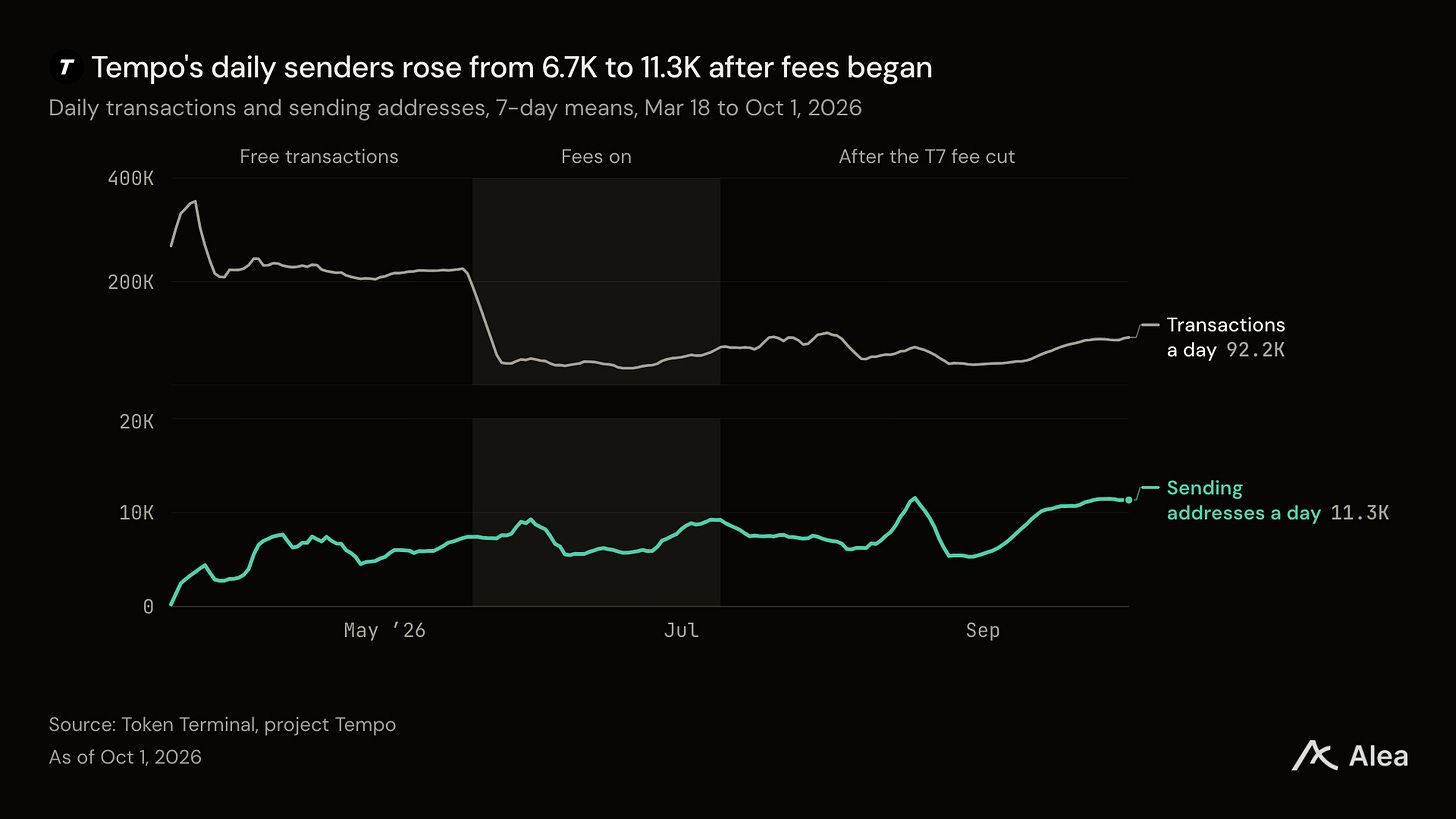
Sending addresses kept rising after free traffic left. While transactions cost nothing, the network carried about 230,000 transactions a day. Fees switched on May 19, and daily transactions fell to about 42,000 over the next month while daily sending addresses held near 6,700. By Oct 1 the seven-day mean had reached 11,338 sending addresses and 92,228 transactions.
Built for the finance team
Tempo starts from the work a finance team does after money arrives. Senders pay fees in any supported dollar stablecoin, and an app can pay the fee for its users. Each transfer carries a memo that ties it to an invoice, and issuers set roles and transfer policies on their tokens. Tempo reserves about 94% of every block for payment transactions and leaves the other 6% for general computation.
Rival stablecoin networks differ in what a payer must hold to cover the fee. Arc, which Circle launched on Sep 16, charges fees in USDC. Plasma charges fees in its XPL token and makes USD₮ transfers free. On Tempo, every supported dollar stablecoin pays its own fee, whether a bank issued it, a fintech issued it, or it's USDC.
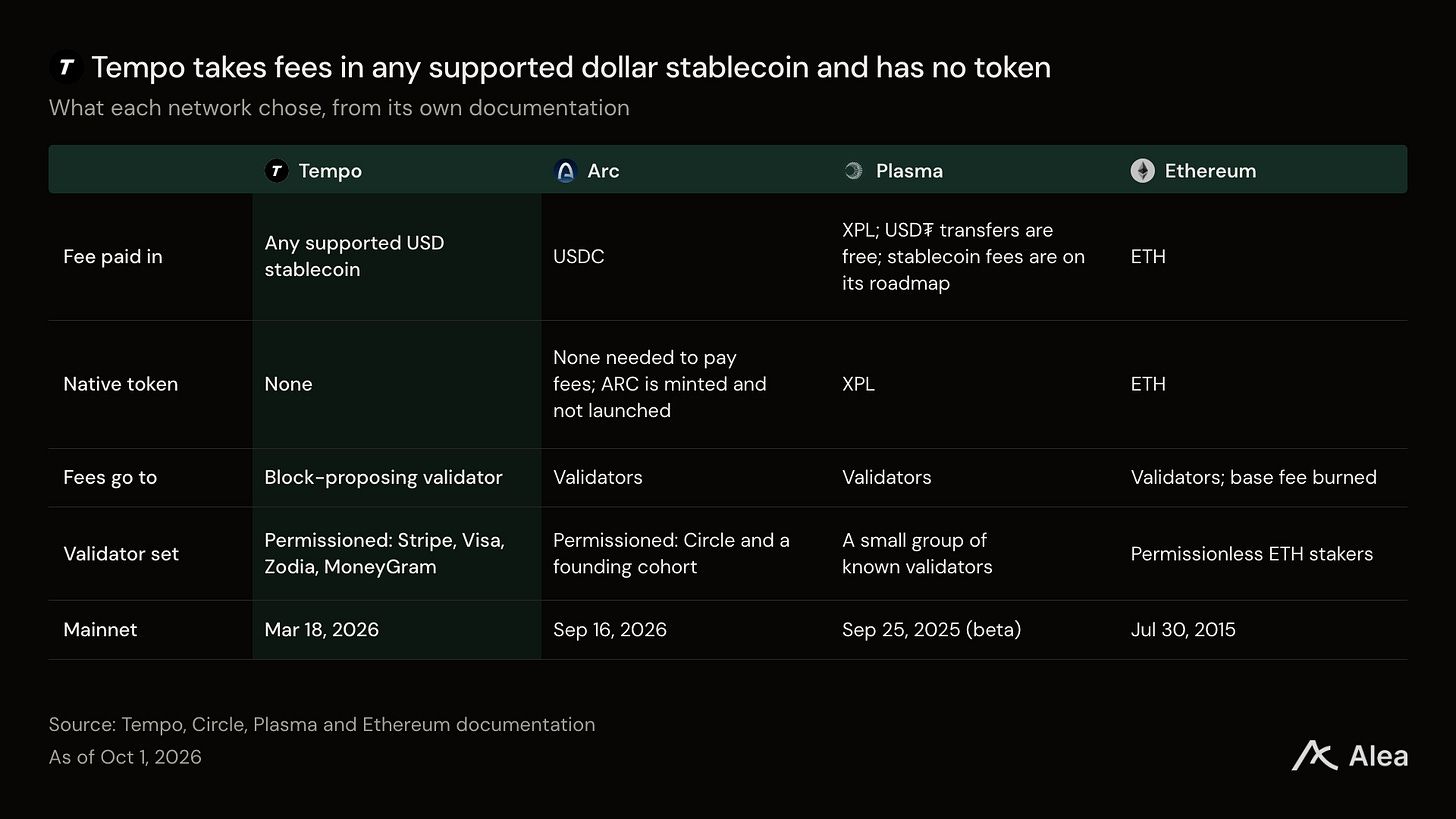
Tempo also arrived with distribution. Stripe, Visa, and Zodia run validators alongside MoneyGram. The validator set is permissioned, and Tempo has described a path to permissionless validation but hasn't given a date. Businesses on Stripe processed $1.9T in 2025, up 34%, about 1.6% of global GDP. Stripe runs its money management on Tempo in more than 100 countries, and since Sep 30 it also offers Open USD to its businesses, who can fund Stripe Treasury accounts from wallets on Tempo.
Who earns what when a dollar moves
The money a payment generates goes to four parties.
Validators receive every network fee, and the fees are small by design. From the Jul 10 fee cut to Oct 1, the network collected $1,185 in 84 days on 5.8M transactions.
Liquidity providers keep 0.3% of a fee when the Fee AMM converts it into the stablecoin a validator accepts.
Issuers and their partners earn the yield on the reserves behind each stablecoin. Open USD passes its reserve earnings to partners, less a small management fee. Tempo Earn, launched on Aug 12, lets platforms put idle balances into tokenized money market funds, onchain lending, and institutional credit, and set how rewards split with their users.
Tempo sells the services around the network: a hosted API that bills for usage, including fee sponsorship, and a Stablecoin Advisory team that works with banks. Tempo has not disclosed a take rate.
Business model: senders or sponsors pay network fees in stablecoins, and every fee goes to the validator that proposes the block. The Fee AMM pays its liquidity providers 0.3% of converted fees. Issuers keep reserve income or pass it to partners, as Open USD does, and Earn platforms choose their reward splits. Tempo earns from API usage and advisory work, with no disclosed take rate. There is no token, no buyback, and no holder claim on network flows.
For a business, the missing token removes a volatile asset from every payment. For Tempo, revenue comes from the services it sells, and demand for them grows with the money on the network.
How much money can move this way
Stablecoin payments run at about $390B a year, 0.02% of the more than $2 quadrillion the world moves each year. That count covers payroll, supplier, and remittance payments. Stablecoin transfer volume reaches $35T a year, and most of that is trading and internal moves.
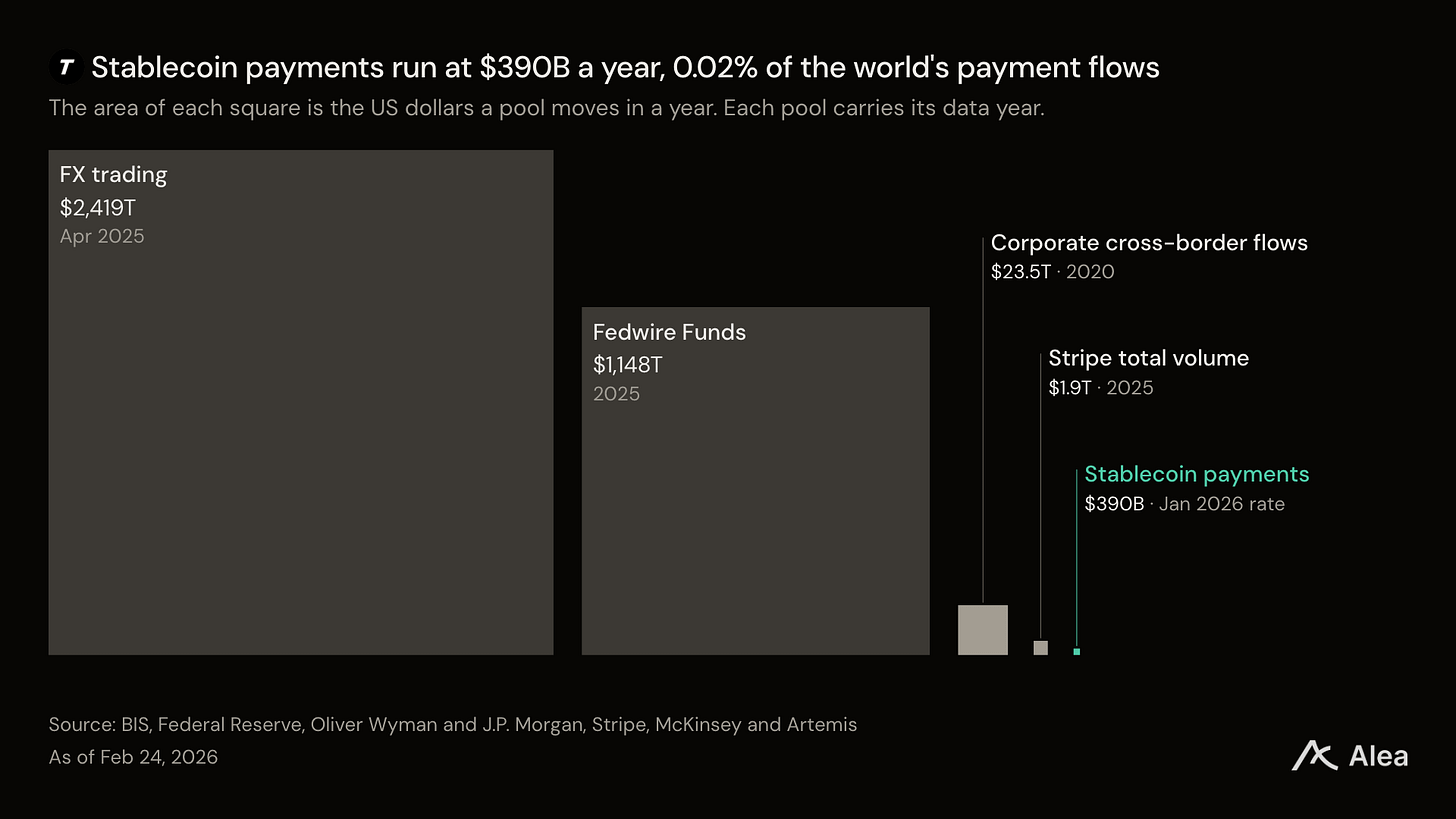
The pools around that figure are far larger. Fedwire alone settled about 2,900 times as much in 2025, and FX markets trade $9.6T a day. Corporates move $23.5T across borders, 60 times the stablecoin figure.
What ships before January
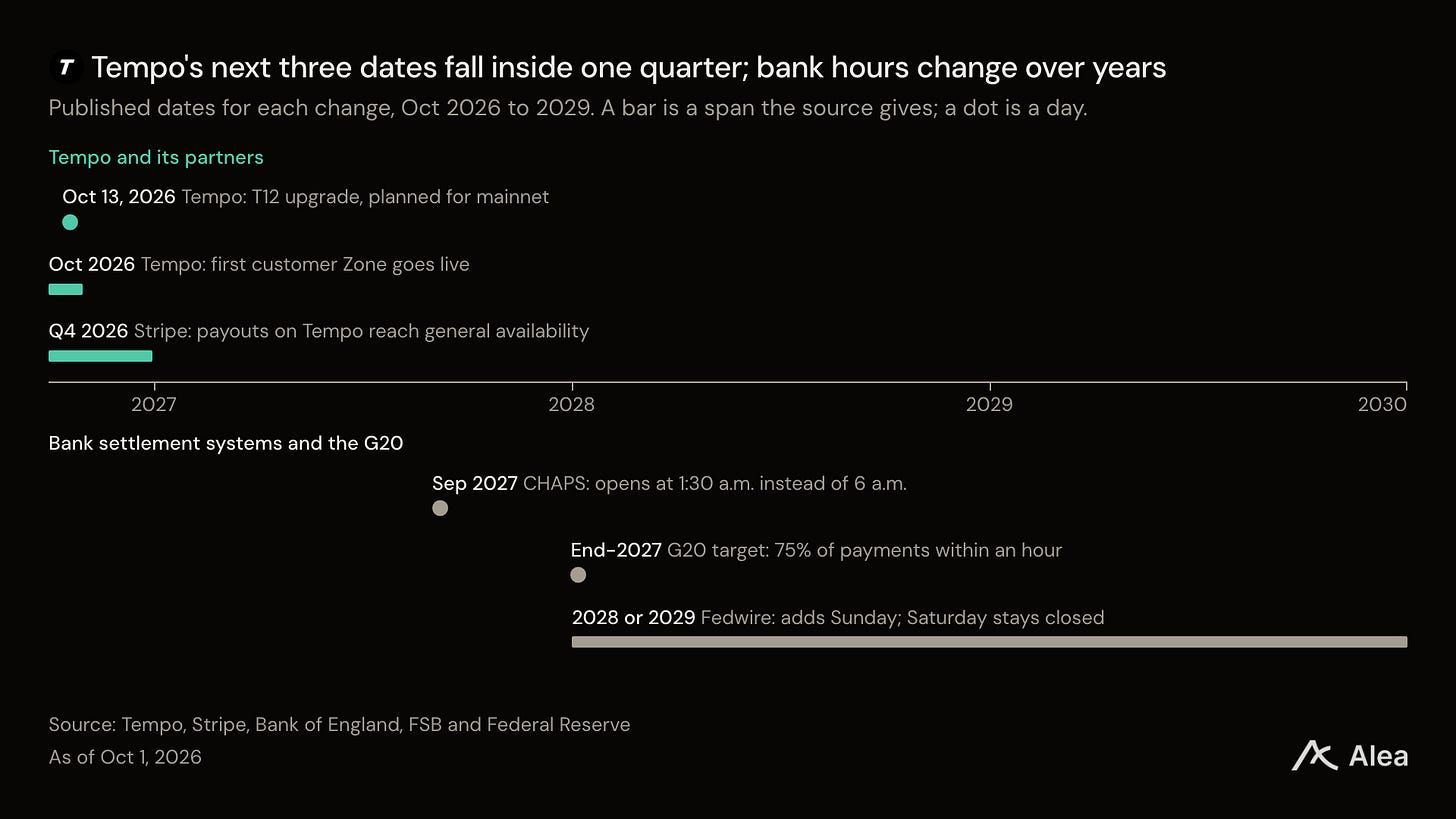
Tempo's next three dates all fall in the fourth quarter. The T12 upgrade is planned for mainnet on Oct 13. It adds payment sessions for closed-loop stablecoins, and issuers can bridge a token by burning and minting it with no separate approval from the user. The first Zone goes live in October, and Stripe plans general availability of payouts on Tempo in Q4. Tempo also lists two Open USD additions as coming soon: access through Mastercard and support in Tempo Earn.
Bank settlement hours move on a longer calendar. CHAPS opens at 1:30 a.m. from Sep 2027, Fedwire adds Sunday in 2028 or 2029, and the Bank of England proposes Sunday settlement no earlier than 2029.
Containers did not make ships faster
Shipping containers stopped cargo from being unpacked at every port, and trade grew around the box. Tempo does the same for cash, which moves between markets on one network without being reissued at each stop. Stripe's money management already runs on it, and it held $447M of Open USD on that dollar's first full day. Fedwire won't settle on a Sunday before 2028, and Tempo already settles every hour of the week.
Important Links

Alea Research covers the networks that move money and the economics behind them.
Research reports. Deep Dives and Blueprints explain protocols and their economics. Theses and Memos examine investment cases and catalysts. Benchmarks compare performance, while Perspectives assess specific developments.
Weekly Pulse. Read a weekly assessment of macro and the major liquid markets.
Protocol Data Rooms. Research each protocol in one place, with Analytics for historical comparisons and Intel for news and governance developments where available. Open Tempo Analytics. Open Tempo Intel.
Podcast Digest and Summit Digest. Read summaries of industry conversations and events. Find Alea shows and their episodes through Podcast Digest.
Governance Tracker. Follow proposals and voting activity across protocols.
For protocol teams preparing institutional conversations, discuss research for your protocol with Alea.