On Sep 18 Kalshi filed for CFTC approval of perpetual futures on 58 US equities, including Apple, SpaceX and the SPY fund, and self-certified the rulebook chapter to carry them. In the same nine days the venue called the Fed, moved October to 55%, and open positions gained 16.0%, half of that a football parlay book that dies every Sunday.
Kalshi filed to become an equities venue. 58 perpetual futures on US equities went to the CFTC on Sep 18, including Apple, SpaceX, SPY and QQQ, filed with no announcement and nothing trading yet.
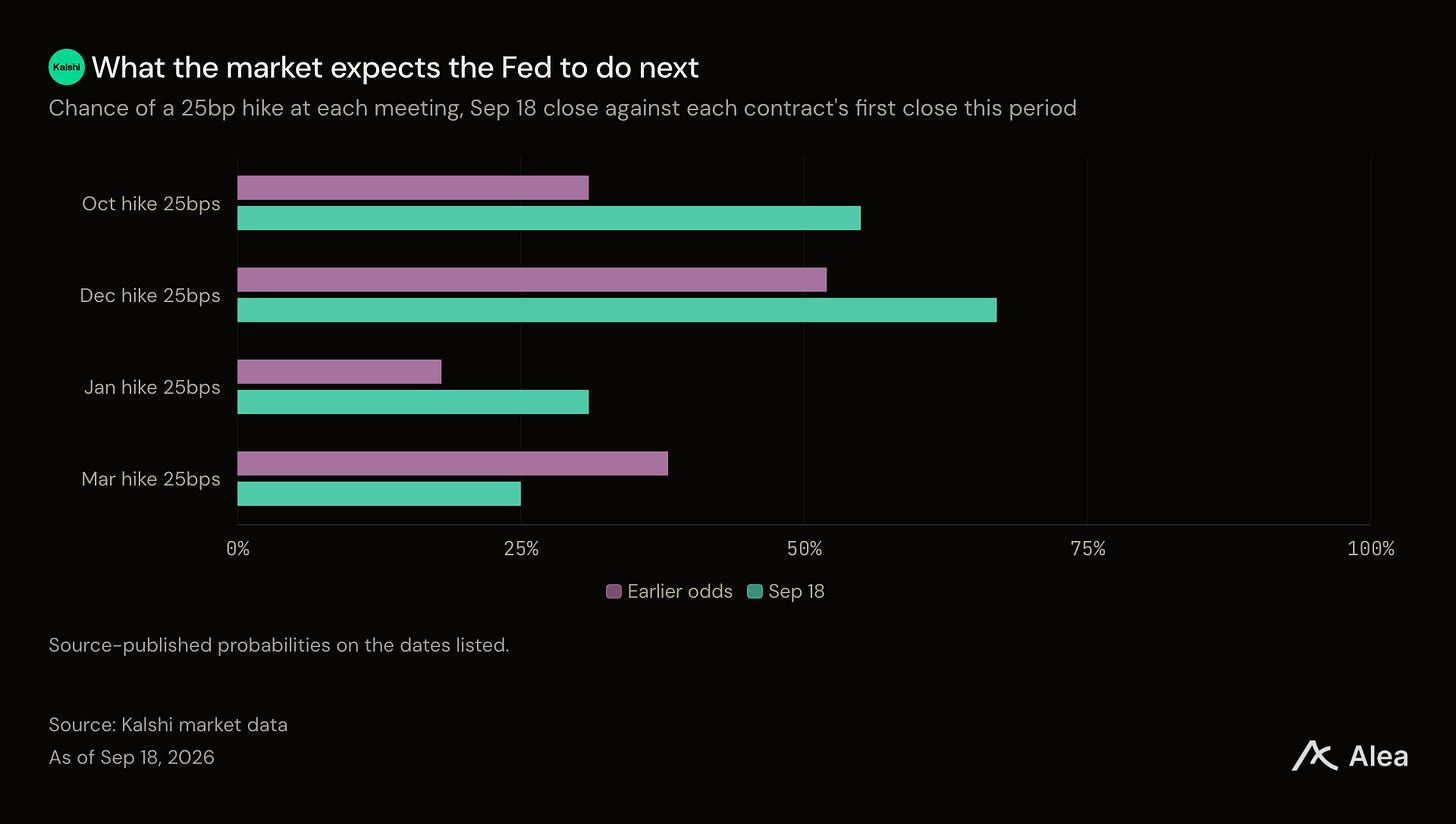
The venue read the Fed, then bet it is not finished. Kalshi closed the September hike contract at 88% the day before a unanimous 25bp move, and took October from 31% to 55%.
The market prices more tightening than the committee does. October at 55% and December at 67% sum to 1.22 twenty-five-point moves across the two meetings, against a committee median of exactly one.
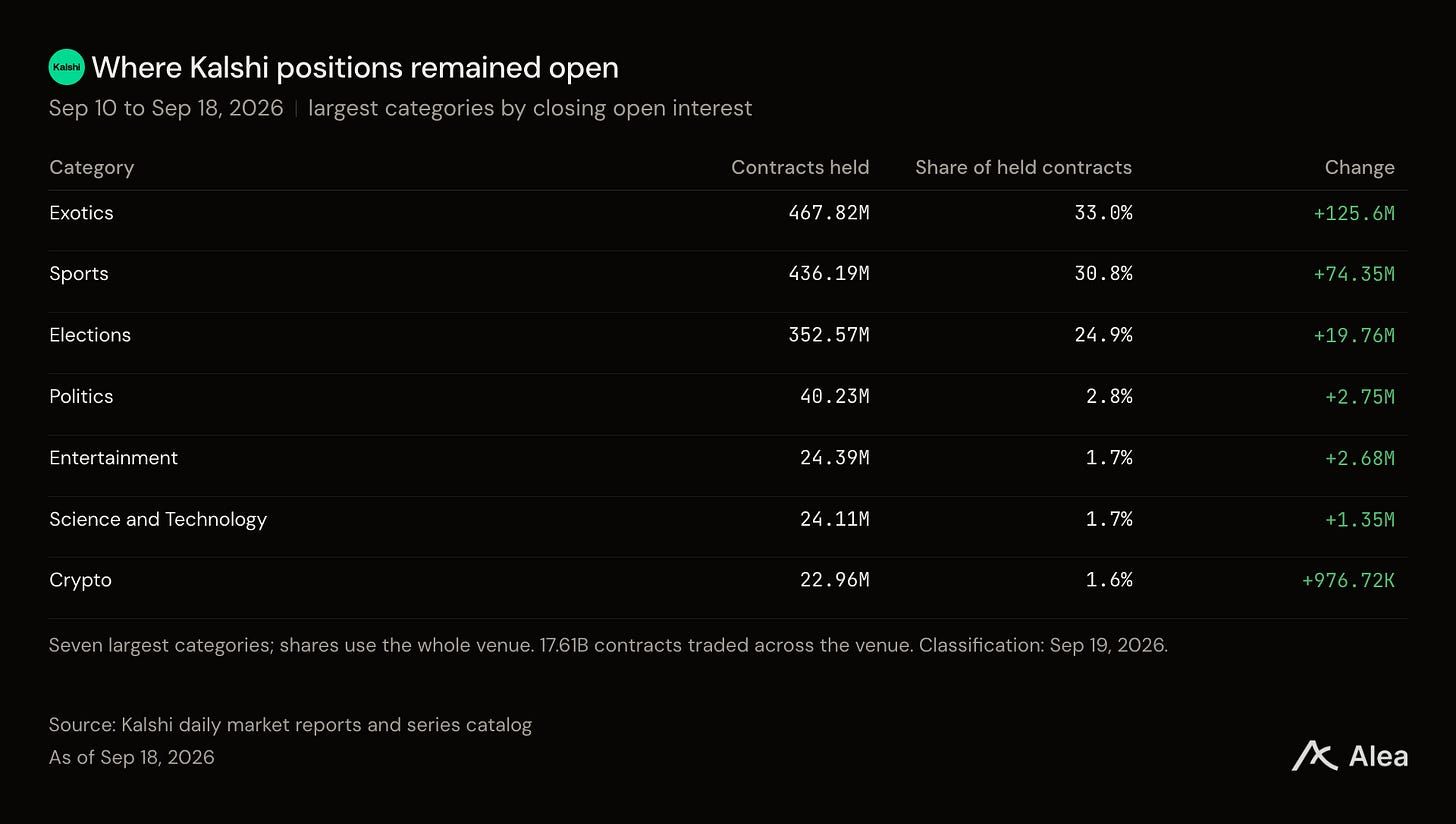
Half the record was a parlay cycle. Open positions closed +16.0% at 1.417B. Strip the football parlay book and the rest of the exchange grew +8.0%, with no weekend give-back.
The deepest books belong to the market nobody trades. Elections holds 24.9% of open positions on 0.2% of volume, and 6 of the 10 markets that absorb a $5,000 clip inside 2% of the quote are nomination contracts.
What shipped, and what a court said
Three days changed what the exchange is and what it may sell.
On Sep 18 Kalshi filed for CFTC approval of 58 perpetual futures on US equities: 55 common stocks, the Alibaba ADRs, and the SPY and QQQ funds, a list running from Apple to Exxon that includes SpaceX. Each contract covers 100 shares, and minimum customer margin is 15.50% of current market value, set by the exchange rather than chosen by the trader. These are security futures products, which puts them under the SEC as well as the CFTC, and Kalshi is notice-registered as a national securities exchange to trade them. Nothing trades yet, no date has been set, and there was no announcement.
Two days earlier the Ninth Circuit stated in Blue Lake Rancheria v. Kalshi that “the substance of the sports event contracts offered on Kalshi’s DCM is sports gambling, regardless of whether Kalshi calls them swaps,” reversing the denial of a preliminary injunction and sending the case back. Nothing is blocked by a court order and nothing came off the platform. Sports and football parlays are 63.8% of open positions.
The money, and what it bought
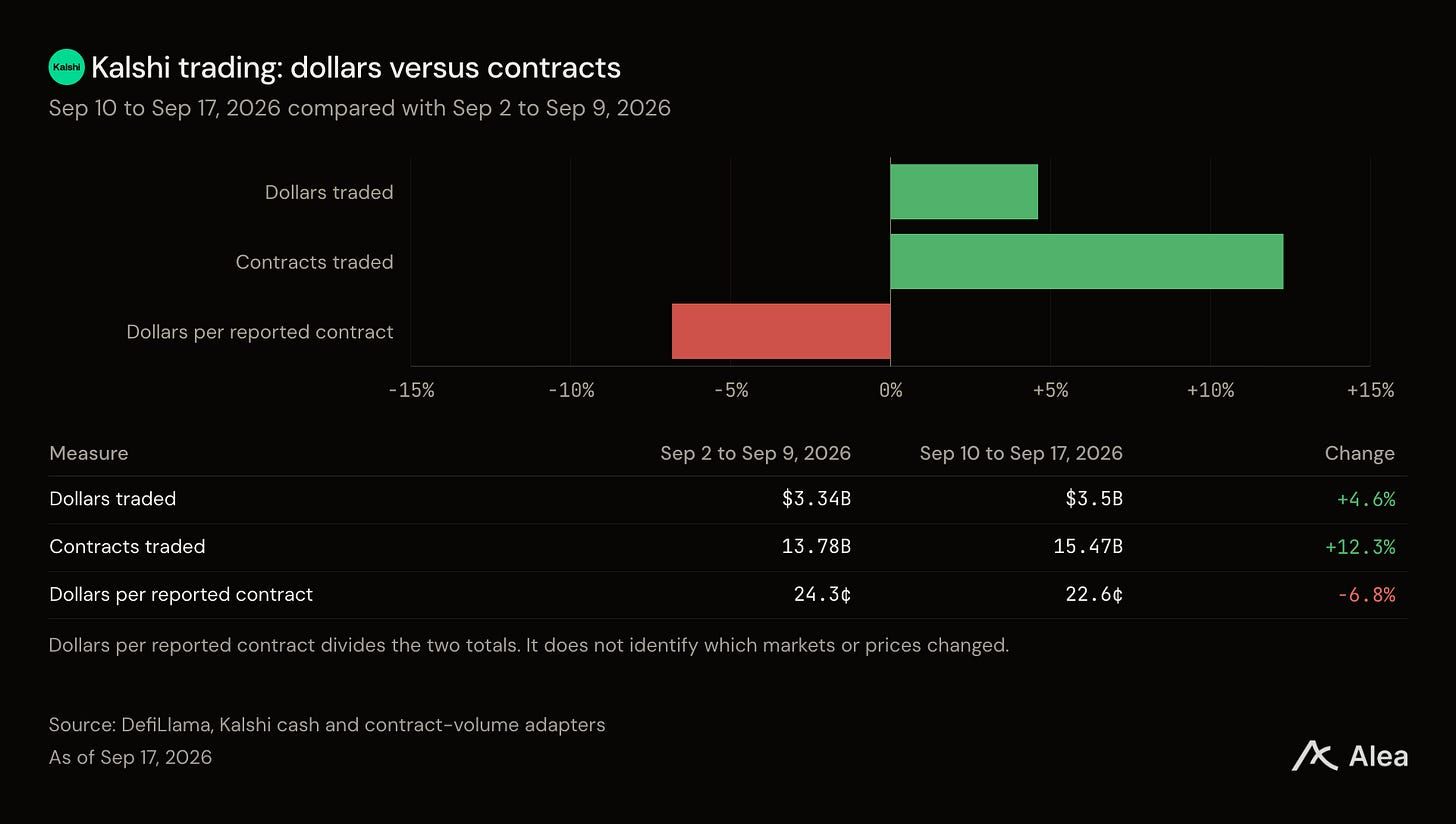
Across the eight days both cash and contract records cover, traders paid $3.50B against $3.34B in the eight days before, up 4.6%, while the exchange reported 12.3% more contracts traded.
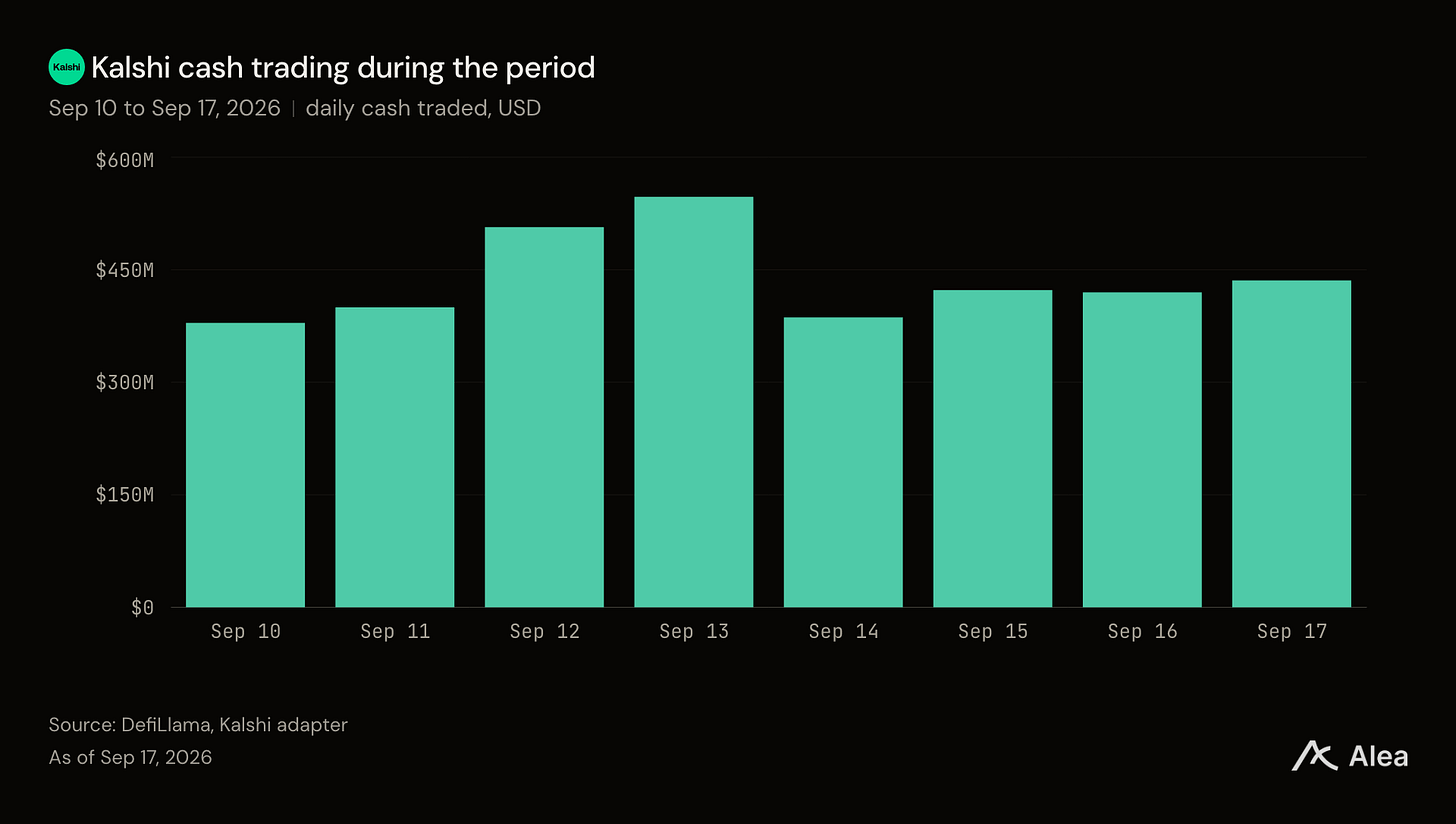
The busiest day for money was Sunday Sep 13 at $547.3M, 15.6% of the eight-day total, on a weekend with a full football card.
Two businesses, one exchange
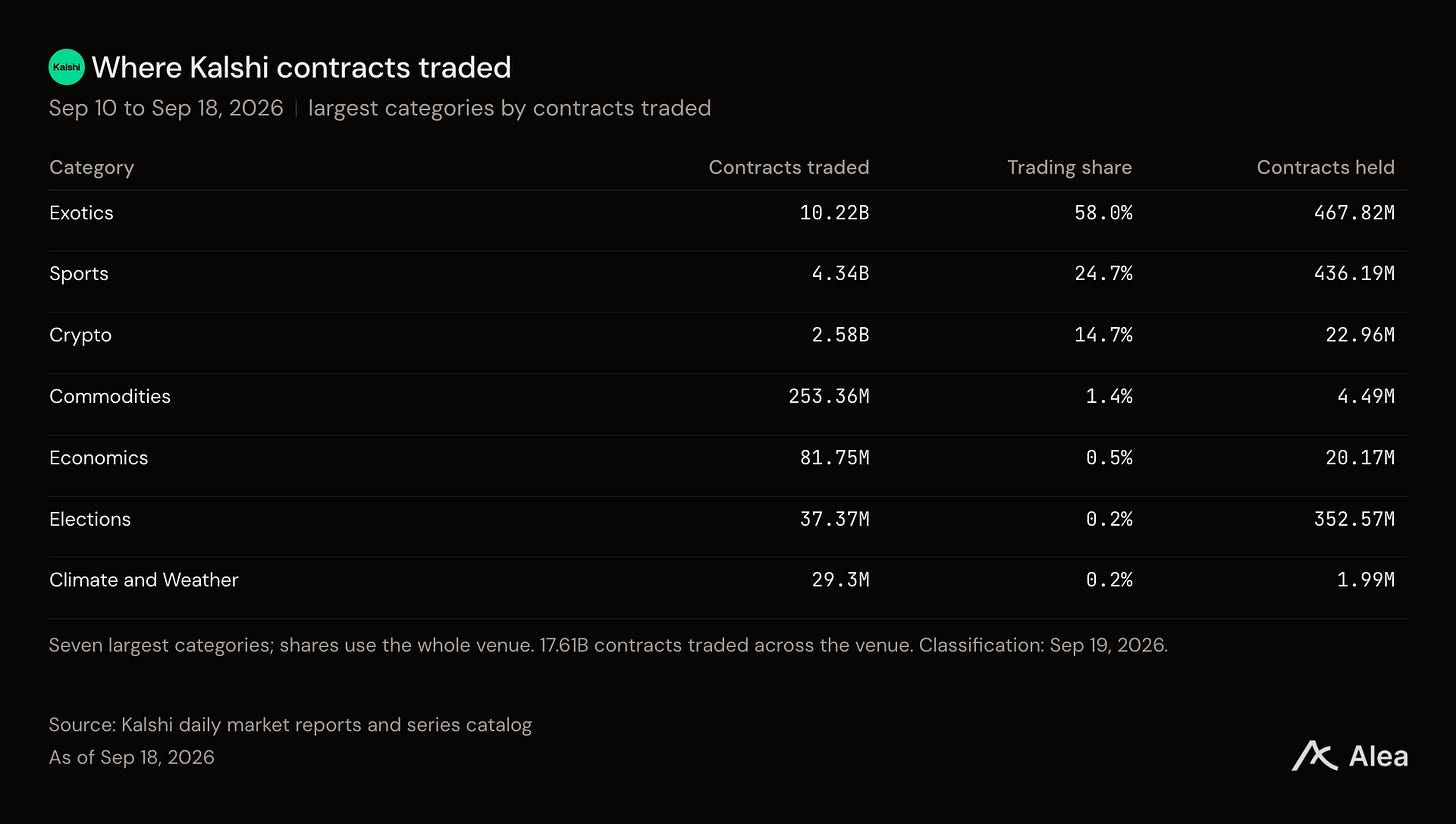
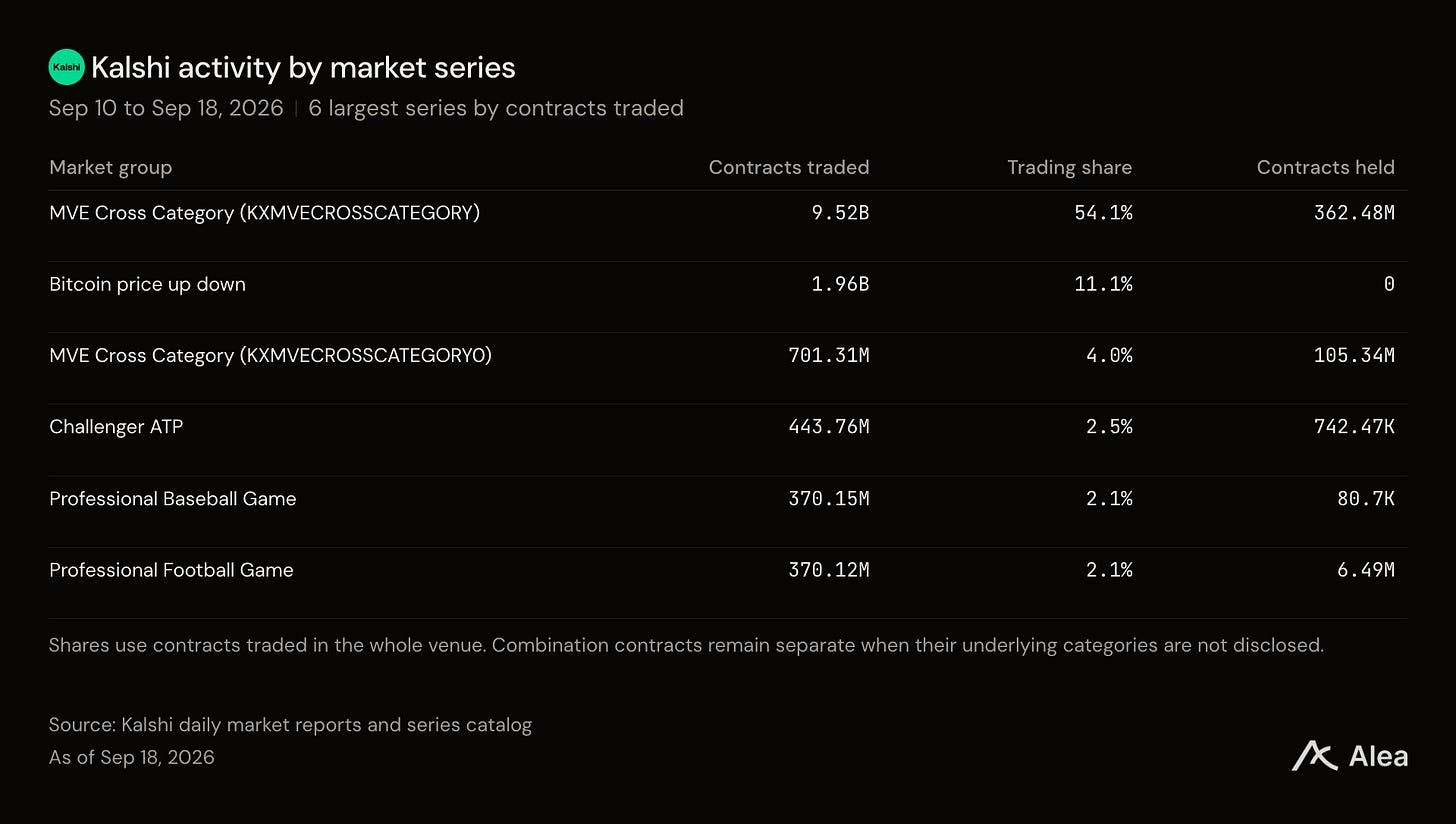
Kalshi’s volume and Kalshi’s convictions live in different places, and the gap is not subtle. Football parlays took 58.0% of the contracts traded and hold 33.0% of the positions. Crypto took 14.7% of the volume and holds 1.6%. Elections is the mirror image: 24.9% of every open position on 0.2% of the week’s trading. Nobody trades it. Everybody holds it.
Turnover puts numbers on that. Crypto turned over 115.7 times its average held position in nine days, on an average of 22.33M contracts held. Football parlays turned over 34.7 times, on 294.87M. Elections turned over roughly a tenth of its book.
The fast half of the venue carries the volume; the slow half carries the forecasts.
The record that was not one
Open positions closed the period at 1.417B, up 16.0% from the 1.221B nine days earlier. Half of that is one product cycling.
The football parlay book is built and destroyed every week. It held 431M contracts on Friday Sep 11, 89M by Sunday Sep 13, and 468M again by Friday Sep 18.
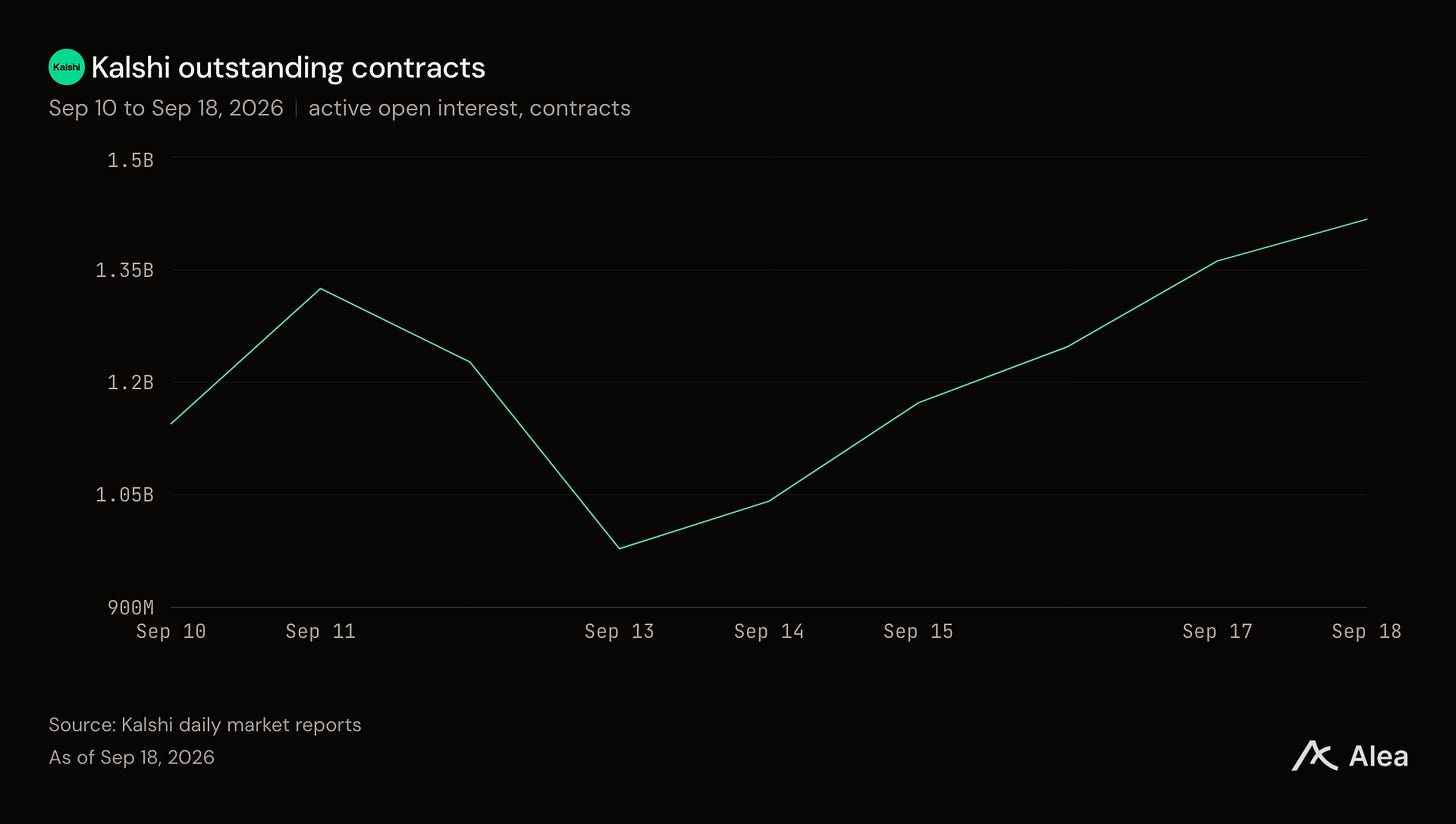
Take the parlays out and the exchange went from 879M contracts held to 949M, up 8.0%, with no weekend give-back in the whole series. Friday’s 1.417B was the highest daily close in the period, but excluding parlays Friday sat below Thursday.
The forecast that paid
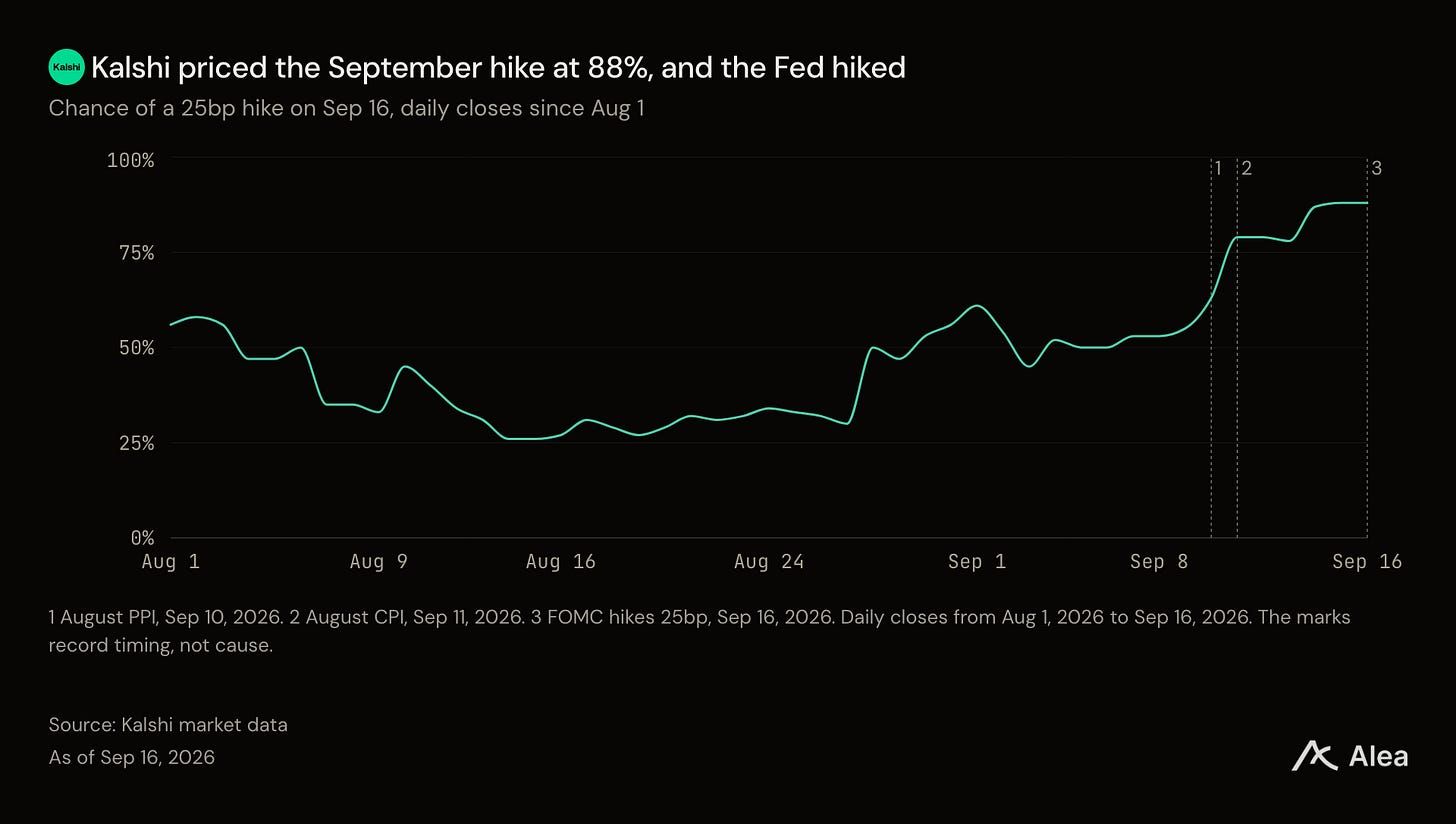
Kalshi’s September hike contract opened August at 56%, fell to 26% on Aug 14, and sat at 30% on Aug 27. The next day it printed 50%, hours after Fed Chair Kevin Warsh spoke at Jackson Hole. From there the climb was mechanical: August PPI landed on Sep 10 at +5.4% year over year with diesel up 24.1%, and the contract closed at 63%; August CPI landed on Sep 11 at +3.4% with gasoline up 3.9%, and it closed at 79%. By Sep 15 it was 88%, where it stayed into the decision.
The Committee approved a quarter-point rise in the target range to 3.75-4.00%, by 12-0. Warsh tied the decision back to his own August remarks: “as I said at the policy symposium in Jackson Hole, I would be hard-pressed to describe broad financial conditions as restrictive. This view was widely shared by the Committee. So we removed a dose of accommodation.” Two months earlier the same Committee had split 9-3, with Hammack, Kashkari and Logan dissenting in favor of a hike. Kalshi’s price tracked that argument being settled, from 26% to 88%.
Then the market moved to October
The Fed published projections alongside the decision, and this set was hawkish in every direction: growth up, inflation up, rates up, unemployment down two tenths. The median participant put the funds rate at 4.1% at the end of 2026, up from 3.8% in June. Warsh endorsed none of it. “I’m not in the forward guidance business,” he said, and of the projections, “those aren’t my forecasts. Those are the forecasts of my 18 colleagues.” He submitted none of his own.
The spread under that median is the part worth reading. The lowest of the eighteen individual projections was 3.9%, the new midpoint rounded, and not one participant projected a cut this year. Twelve of the eighteen sat at 4.125%, the midpoint of a 4.00-4.25 range, which is exactly one more hike with two meetings left to place it.
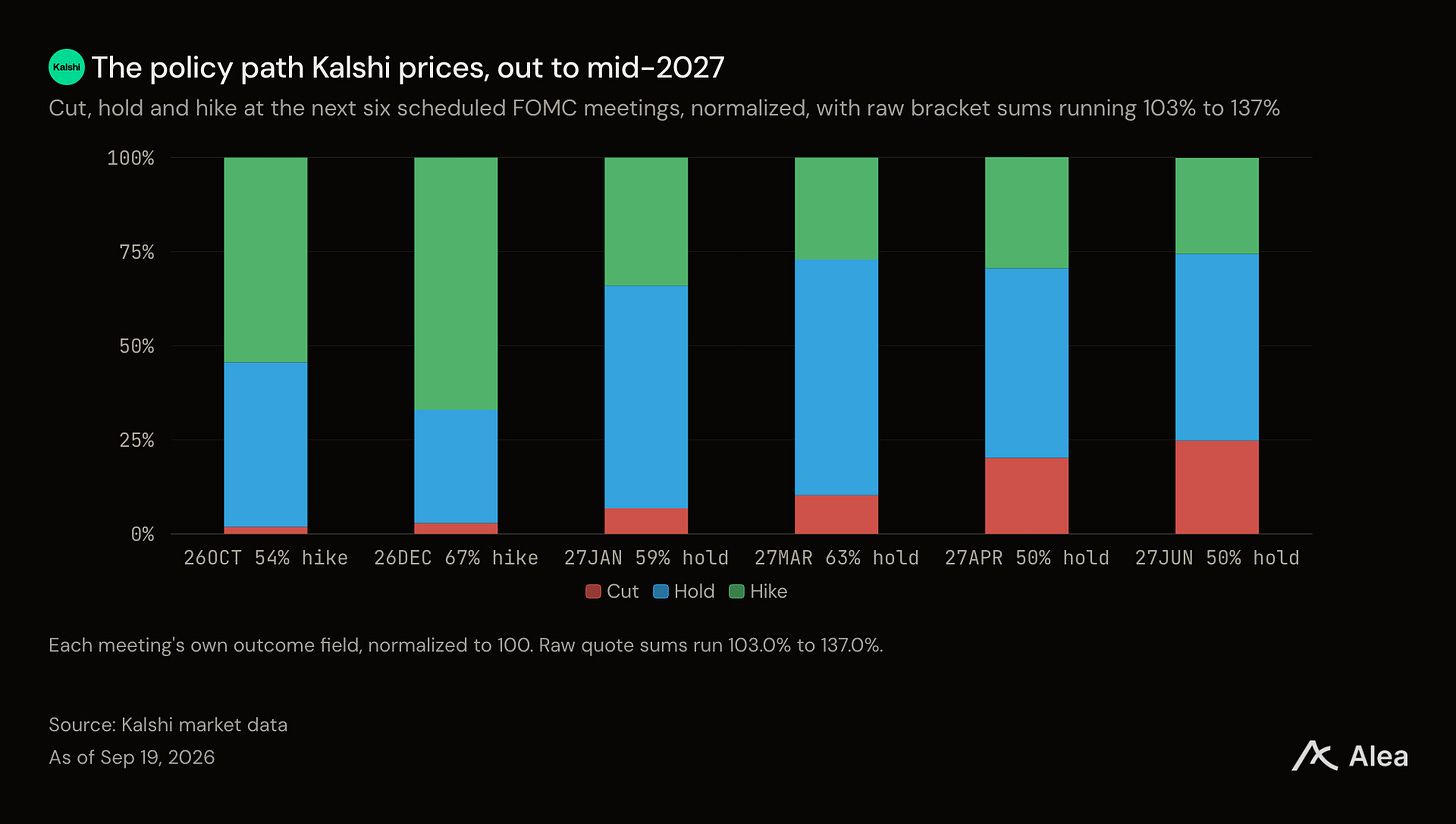
Kalshi closes October at 55% and December at 67%. Add the two and the exchange prices 1.22 twenty-five-point moves across the two meetings, against a committee median of one. Two thirds of the committee carries a hike by year end, and the next meeting is priced barely above even.
This repricing is easier to attribute than most. The Fed was in blackout from Sep 5 to Sep 16, and the only remarks afterwards were two Bowman speeches on Sep 18, both about bank supervision. No policy communication ran alongside October’s move from 45% to 55%. The competing explanation is the data on those same days: initial claims fell to 196,000 on Sep 17 and August retail sales rose 1.2%.
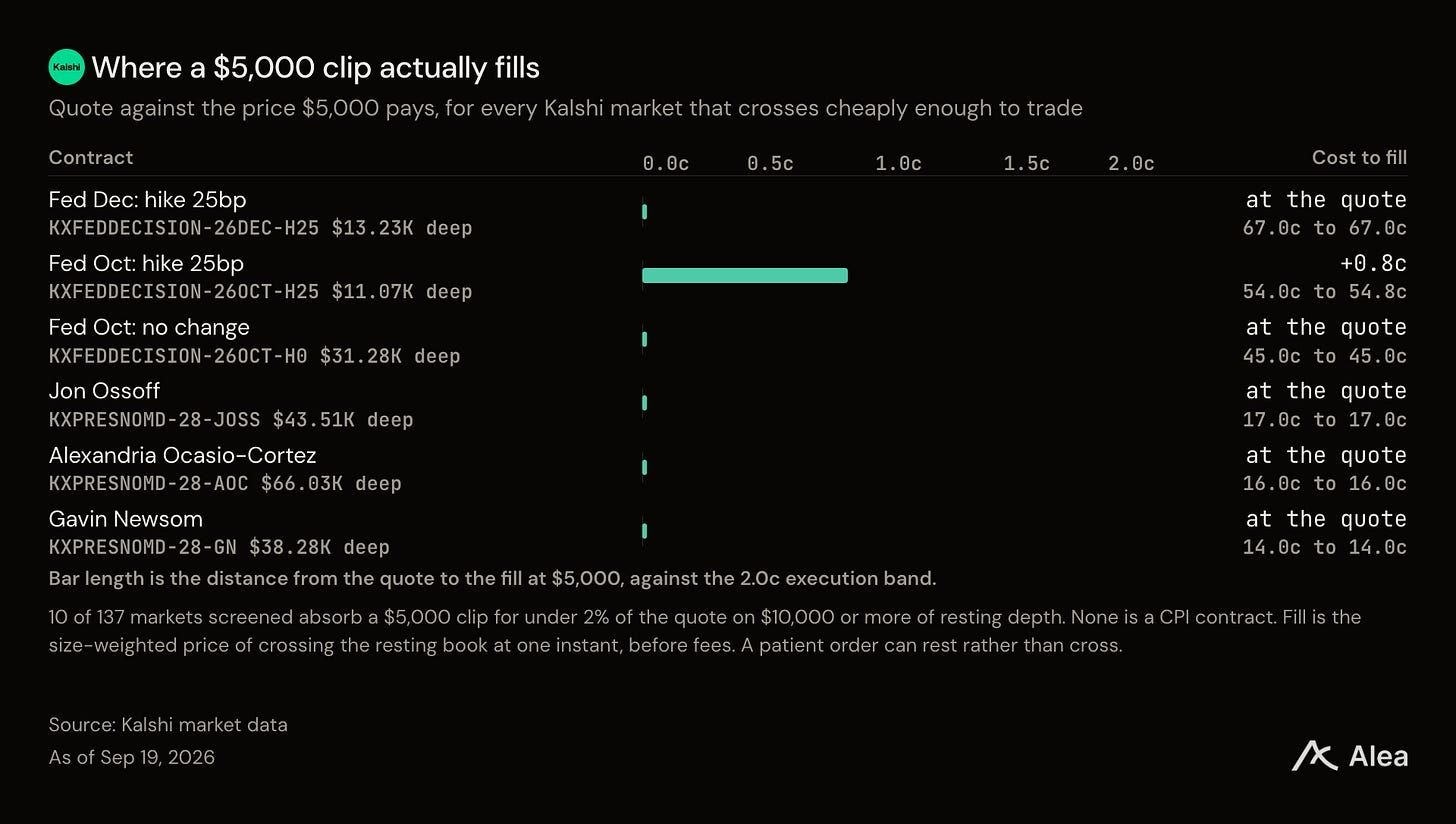
Of 137 Fed, CPI and Democratic nomination markets walked on Sep 19, ten absorb a $5,000 clip for under 2% of the quote on $10,000 or more of resting depth. None of the ten is a CPI contract. The October hike contract is the most expensive survivor to cross, at 0.8c against a 54c quote, and it is the one carrying the week’s repricing.
The deepest books on the exchange belong to a market almost nobody trades.
What the decision did to the book
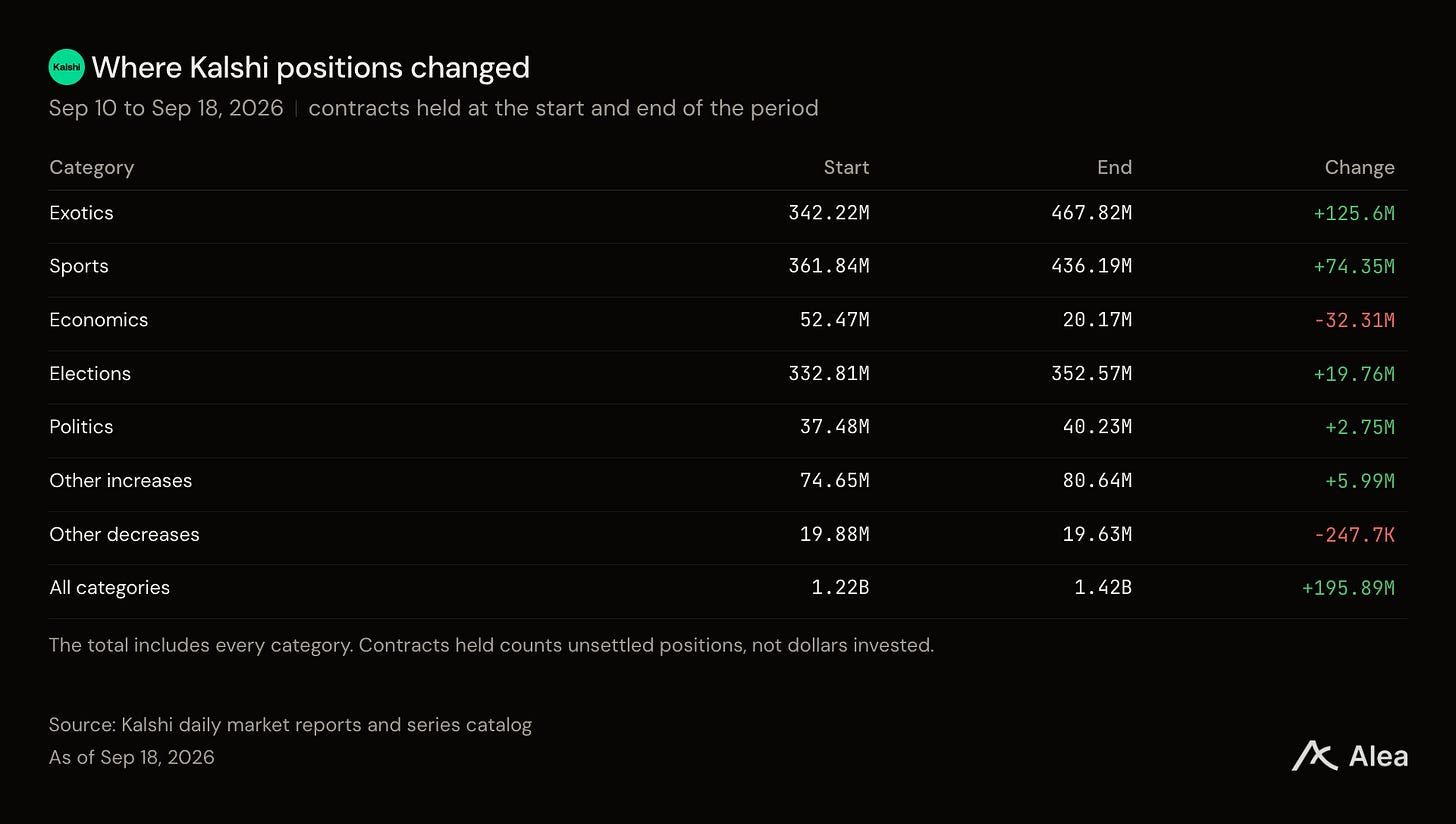
Economics was the week’s loudest category and its biggest loser. Contracts traded rose 152.1% to 81.7M while open positions fell 32.3M as the September Fed contract traded 62.3M contracts and went from 32.5M positions held to 1.8M after it settled. The category did not lose interest; the thing everyone was holding resolved, and the money left with it. The only meaningful build underneath was KXRATECUTCOUNT, which asks how many moves rather than whether, and gained 1.0M.
What people actually bought
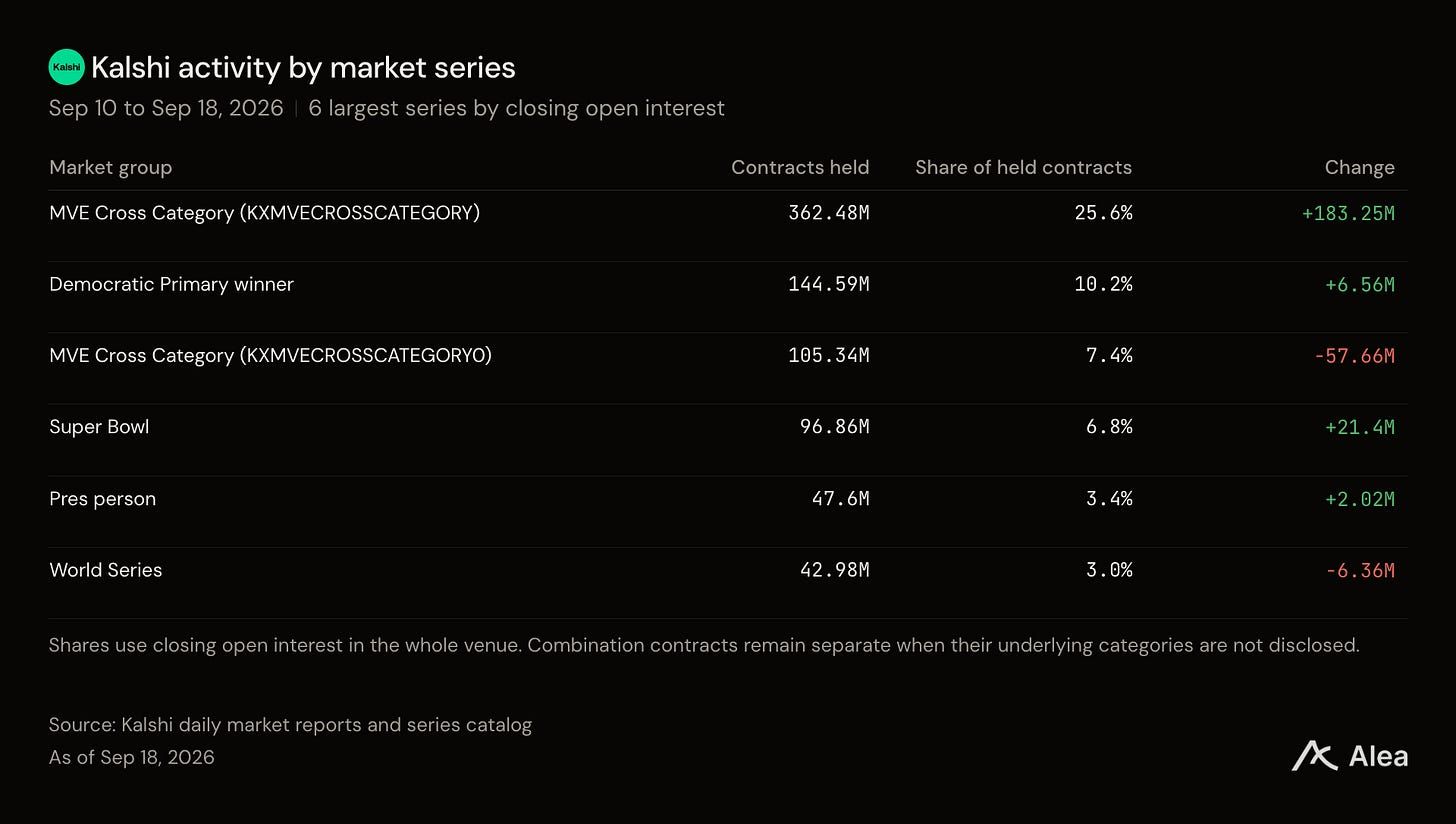
KXMVECROSSCATEGORY, the football parlay book, traded 9.52B contracts, 54.1% of everything the exchange traded, and finished holding 362.5M positions; these are NFL and NCAA combination contracts settled by the league governing the game.
KXPRESNOMD, the Democratic nomination, traded 6.8M contracts and gained 6.6M positions to finish at 144.6M held, almost one position kept for every contract traded, against parlays that trade twenty-six times for every position they keep.
Elsewhere the Super Bowl gained 21.4M positions, the World Series shed 6.4M, and both US Open singles books went to zero when the tournament finished.
The other book
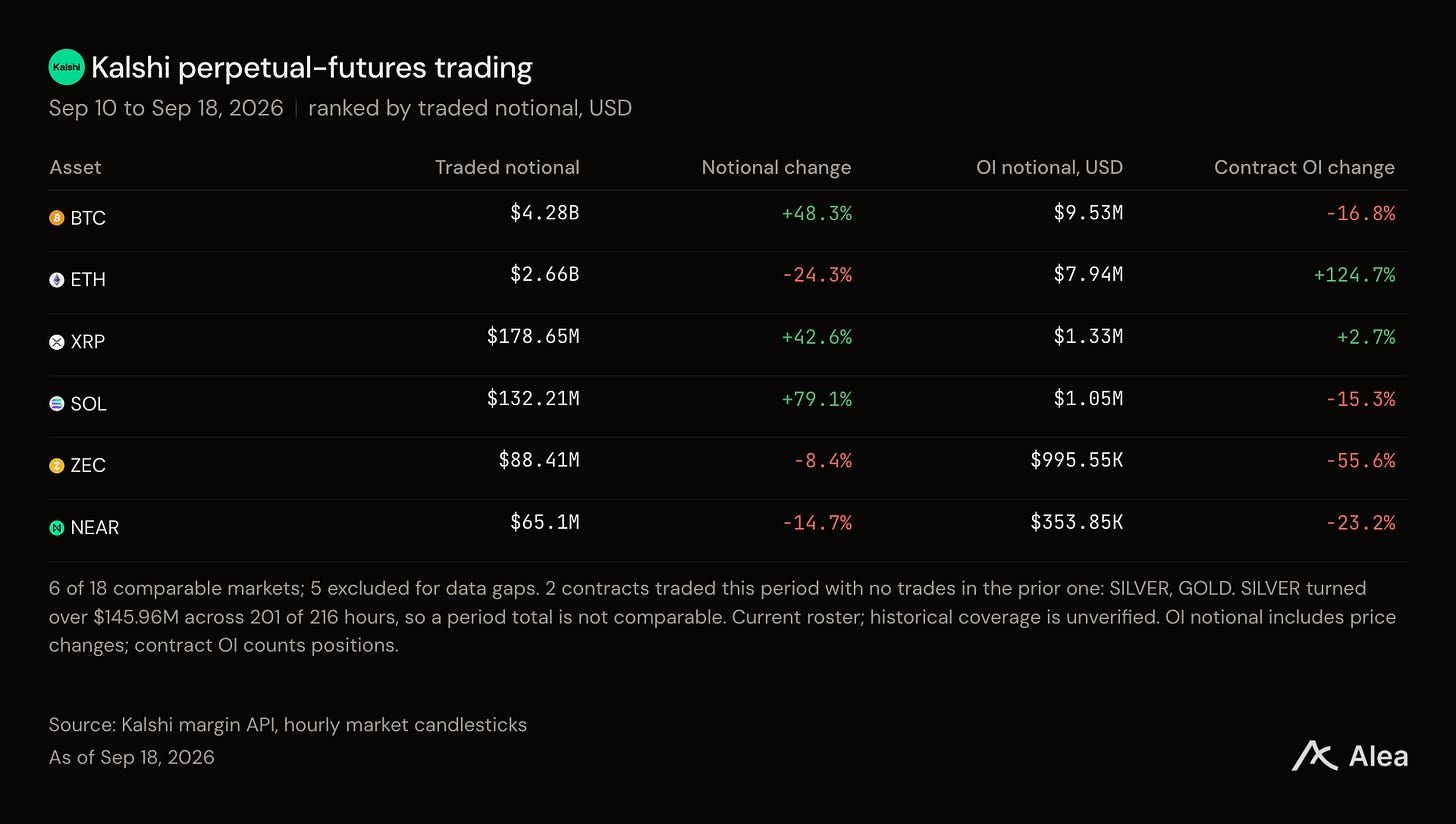
Kalshi’s perpetual futures traded $7.62B of notional, up 8.6%. That is roughly twice the cash that changed hands on event contracts. The two are not the same measurement: notional is price exposure on a leveraged contract, cash is money paid for one.
Inside that book, the two largest markets moved in opposite directions. Bitcoin notional rose 48.3% to $4.28B. Ether fell 24.3% to $2.66B while the contracts held against it rose 124.7%. Falling turnover on a rising position is a book being built rather than traded, and it is the clearest positioning change in the perp complex this week.
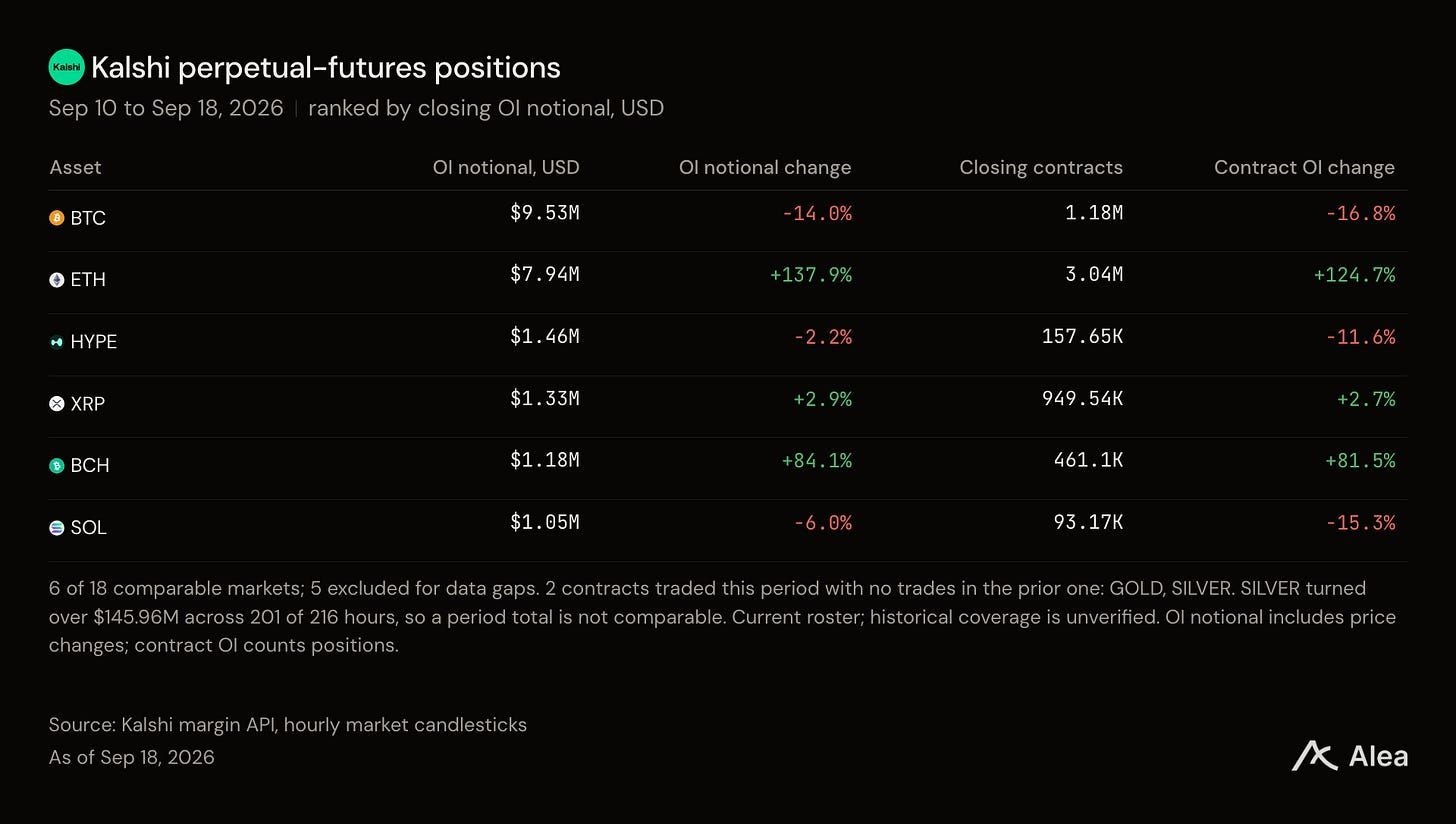
The product is sixteen weeks old. Kalshi listed the first American perpetual futures on May 29 and crossed $1B in its first week, and on Sep 10 it added gold and silver, the first non-crypto perpetuals it has listed. Metals also drew the only two fee changes in the window, both setting the market-maker fee multiplier to zero for a metals contract at 04:00 UTC on Sep 10, and neither has been reversed. Silver then traded $145.96M across 201 of the period’s 216 hours, and gold across 202.
New listings, and the one that stuck
513 series traded this period and not the period before, counted from first observed trading rather than the exchange’s listing date. The wave is mostly sport: 176 are Sports series, led by golf, with the PGA Tour book at 26.76M contracts, then boxing, the WNBA, the Europa League, the AFC Champions League, and hourly temperature markets for New York and Chicago.
One comparison inside that group is the whole edition in miniature: PGA Tour holds 16.67M of its 26.76M contracts, while Davis Cup match markets traded 26.18M and hold 0.14M. Near-identical volume, and 119 times the difference in what anyone kept.
Was the crowd right, and what settles next
One forecast went out in advance last week: an 88% chance the Fed would raise on Sep 16. The Fed raised on Sep 16. What settled inside the period, ranked by contracts traded, was the September Fed decision, both US Open singles titles, and the week’s Champions League fixtures.
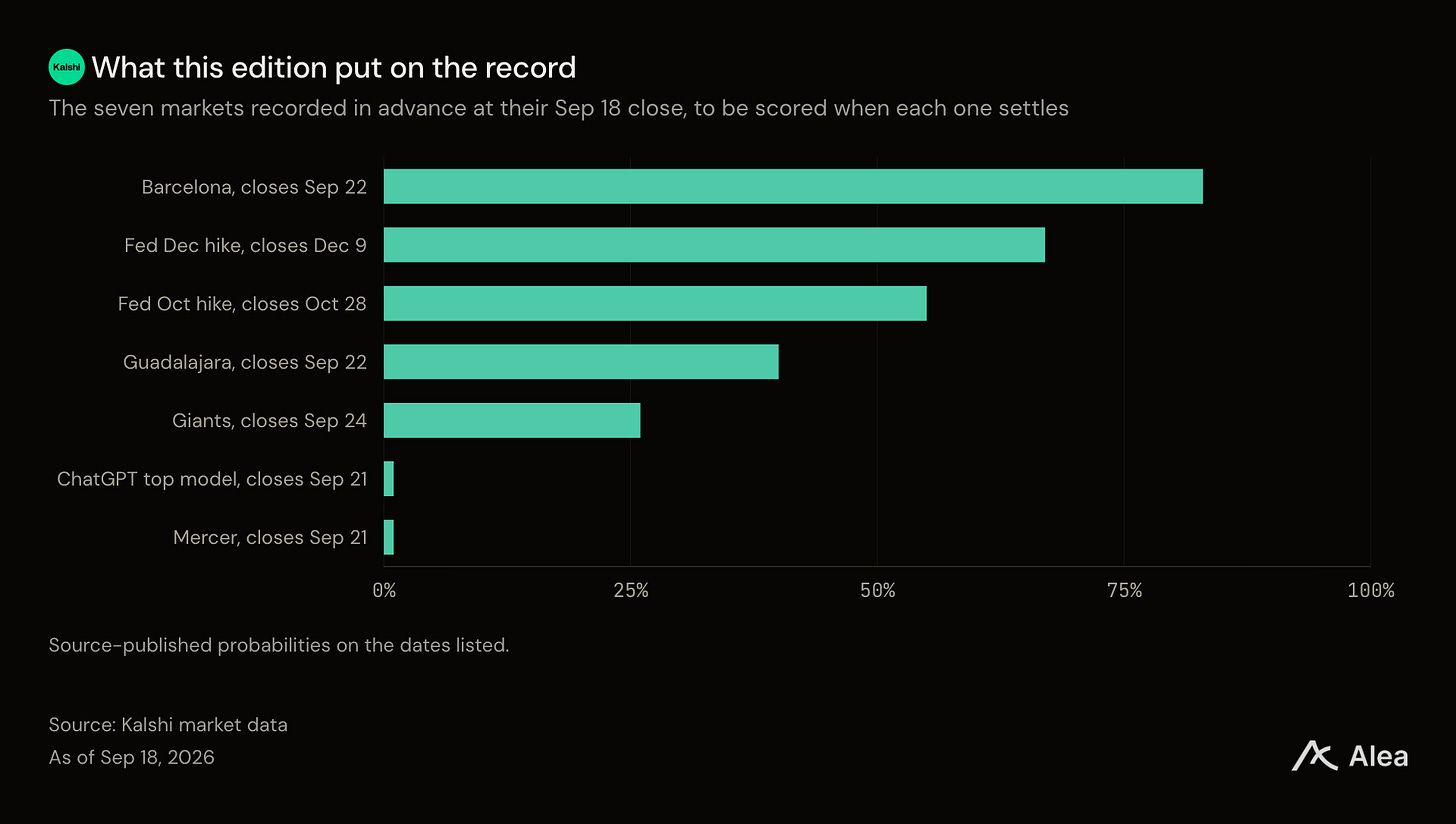
Kalshi closed October at 55%, its first close above even and up from 31% nine days earlier. Twelve of eighteen FOMC participants carry one more hike in their projections, and two meetings remain to place it. The October contract settles Oct 28. December, at 67%, settles Dec 9.

Kalshi prices one week of macro. The Weekly Pulse reads the same week across every major liquid market.
Research reports. Deep Dives and Blueprints explain protocols and their economics. Theses and Memos examine investment cases and catalysts. Benchmarks compare performance, while Perspectives assess specific developments.
Weekly Pulse. Read a weekly assessment of macro and the major liquid markets.
Protocol Data Rooms. Research each protocol in one place, with Analytics for historical comparisons and Intel for news and governance developments where available.
Podcast Digest and Summit Digest. Read summaries of industry conversations and events. Find Alea shows and their episodes through Podcast Digest.
Governance Tracker. Follow proposals and voting activity across protocols.
For protocol teams preparing institutional conversations, discuss research for your protocol with Alea.