The success of VVV in terms of both price rally and product adoption has caught the eye of liquid investors, which now believe in the possibility that tokens at the intersection of crypto and AI can accrue value and leave behind the old tales of DePIN-like highly inflationary emissions. Those models of the past set a precedennt for incentivizing the supply-side of a network, which is so important for the initial bootstrapping stages. Today, however, liquid holders demand value accrual for the asset they own, requiring that product demand offsets a larger portion of issuance rewards.
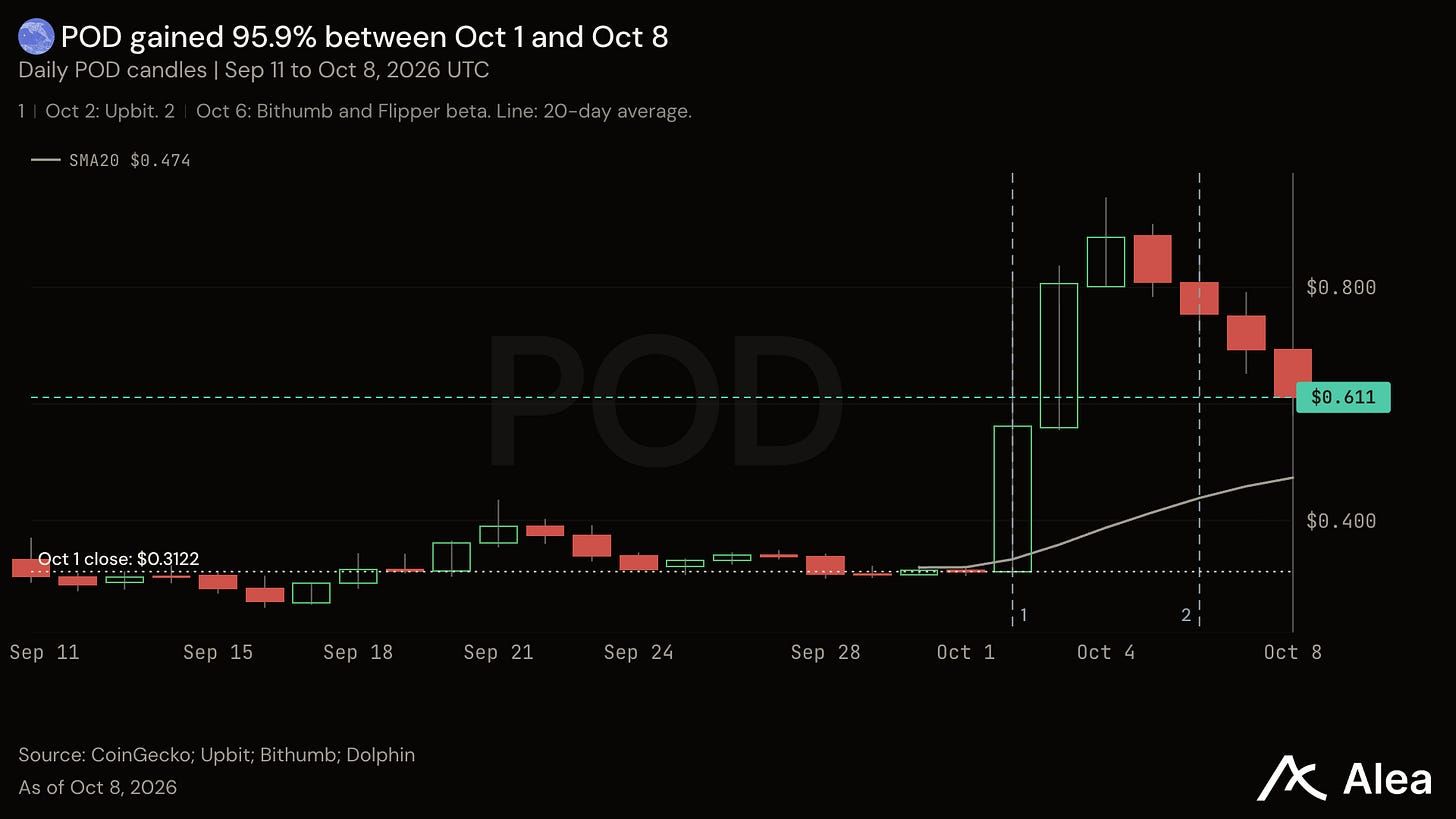
Today we focus on Dolphin and its POD token, an archetype of the type of asset that sits at the intersection of crypto and AI, balancing supply-side emissions to operators with demand-side value accrual to POD. It is a token that recently experienced a large rally doubling in price upon an Upbit listing. The subsequent retrace from that local peak offers a new perspective to re-rate the asset, assigning new odds to the potential speculative premium and actual revenue-accruing dynamics.
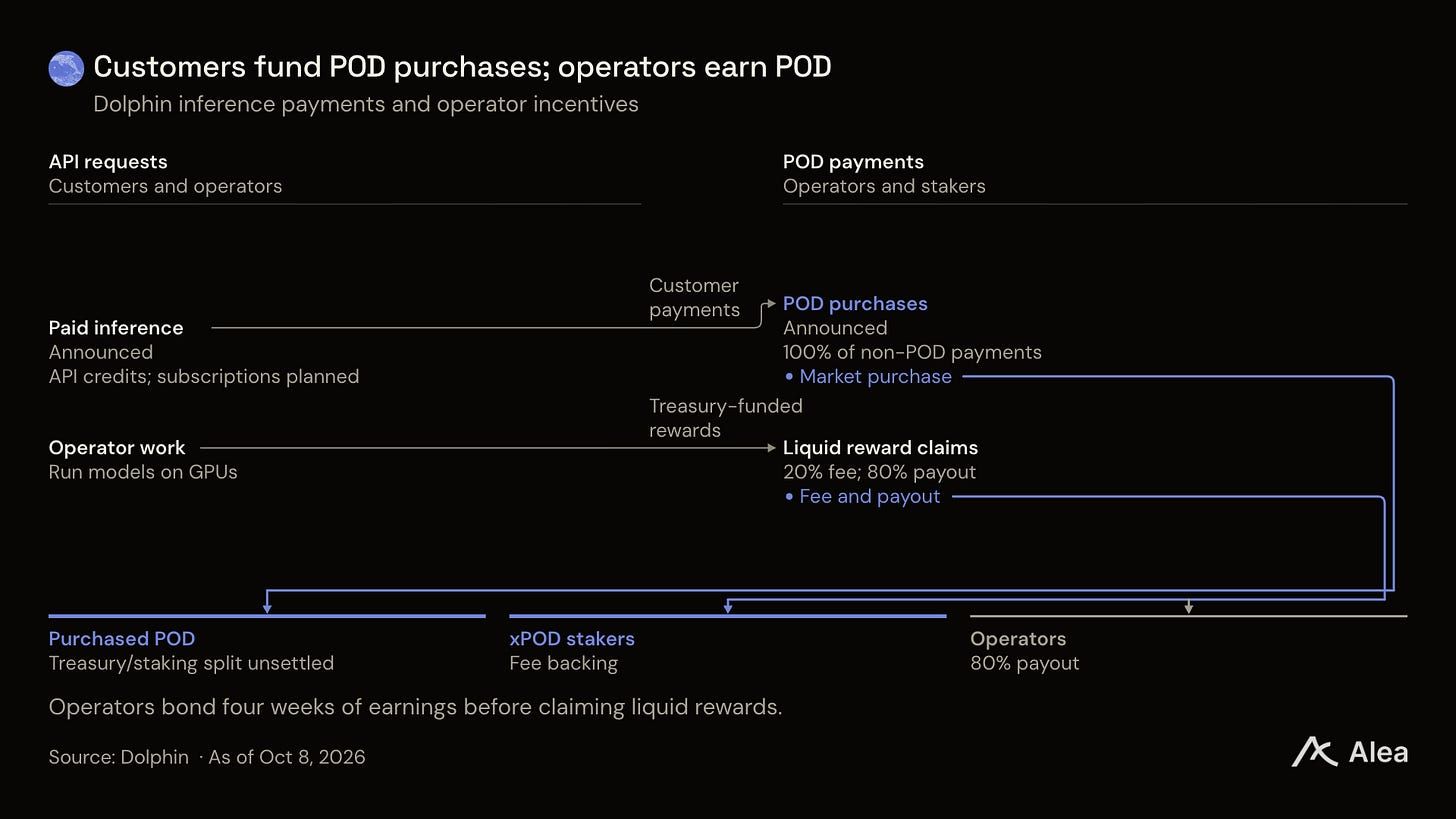
POD is Dolphin’s token for its AI inference network: customer payments for AI responses are routed into POD purchases, while the treasury separately pays the GPU operators who run its open models in POD.
POD reached $0.9545 on Oct 4 before closing at $0.6114 on Oct 8, a 35.9% decline from that intraday high. Upbit added POD on Oct 2, and Bithumb added it on Oct 6.
Takeaways
Dolphin allocates non-POD customer payments to POD purchases, while the treasury pays operators in POD for running the models.
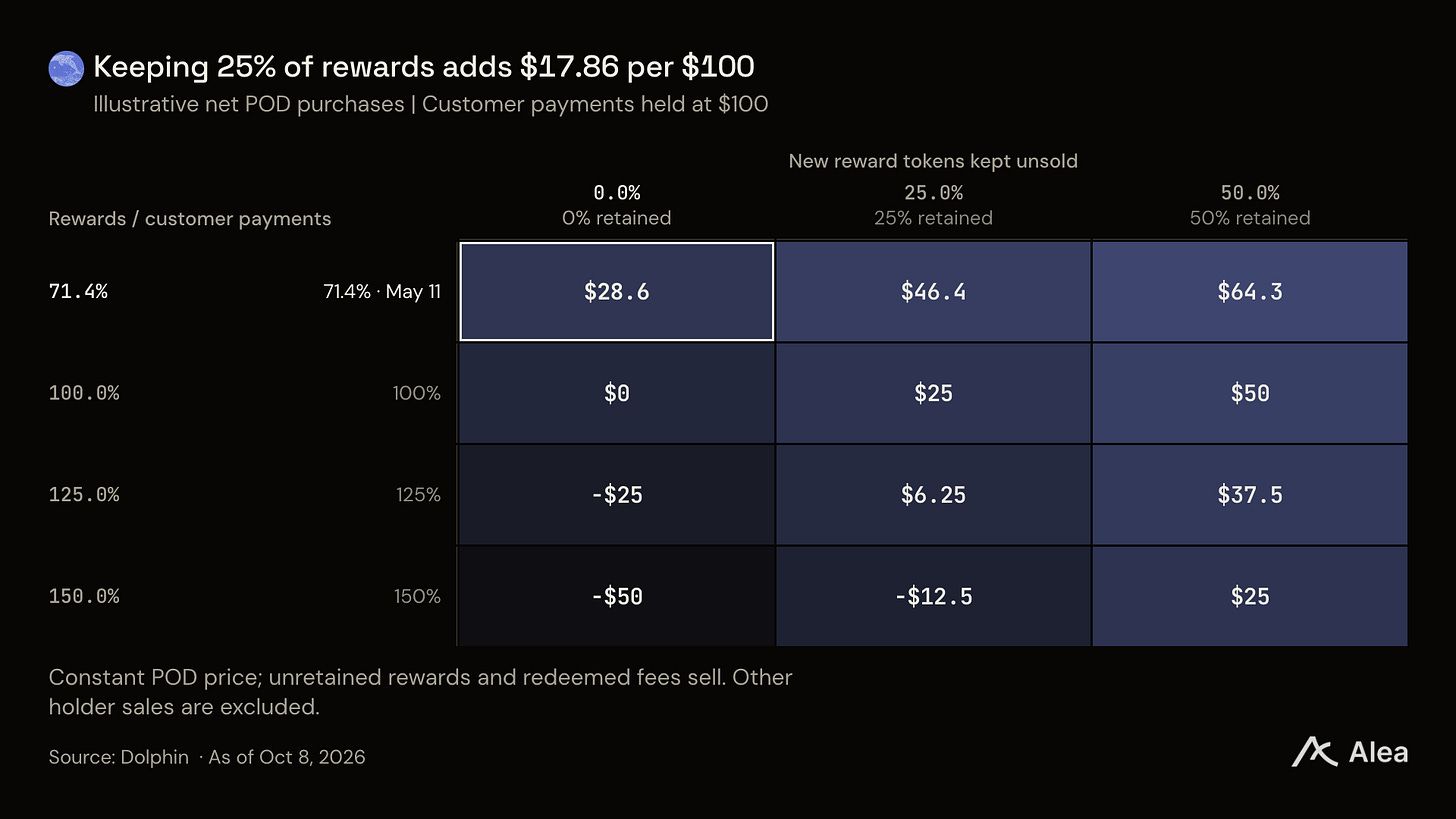
At Dolphin’s May 11 tariff, full reward selling leaves $28.57 of net purchases per $100, assuming an unchanged POD price.
POD gained 77.8% against VVV’s 32.3% from May 11 to Oct 8, leading on 92 of 151 daily price dates.
Venice cut annual VVV issuance to 2M on Oct 1; its customer-funded burns now operate alongside a lower issuance rate.
Dolphin opened its inference API on Oct 11, giving the first 1,000 signups $30 in free credits.
Customers pay for responses; operators earn POD
Customers pay for an AI response, and Dolphin assigns their request to a GPU operator running the selected open model. Dolphin then allocates non-POD payments to POD purchases, while customers paying directly in POD skip that market purchase.
Unlike many older AI tokens that rest on roadmap promises, the new cohort of players entering this sector, like Dolphin, already have a live working product. It opened API access on Oct 11, 2026 serving DeepSeek V4.1 Flash (with $30 in free credits to the first 1,000 signups and coupon-redeemable access at $0.01 input / $0.07 output per million AI text tokens).
Dolphin’s inference network runs user-controlled open-weight models that anyone can download and run (without POD). They co-developed and released Dolphin Mistral 24B Venice Edition with Venice in April 2025 (which Venice distributes, though POD holders get no claim on Venice revenue). This model operates a Flipper closed beta that includes coding credits and a hosted sandbox.
In parallel, Dolphin funds treasury-backed synthetic training-data jobs across a network where GPU operators earn and bond POD. Validators check their work, and xPOD stakers collect fees. Before claiming liquid rewards, operators bond four weeks of expected earnings and pay a 20% fee, which increases the POD backing held for xPOD stakers. Operators risk losing their bonds if they falsify work, and withdrawing existing bonds takes a three-month cooldown followed by a one-week exit window.
Venice links inference credits to VVV
To understand how Dolphin’s mechanism design can evolve, we now turn our focus into Venice’s VVV.
Venice essentially sells access to open models. Its users stake VVV to mint DIEM and receive $1 in daily inference credits for each staked DIEM. In other words, the mechanism turns inference into a staked, prepaid-capacity model rather than pay-per-request. Instead of charging per token, Venice lets any user or AI agent stake VVV to claim a pro-rata share of the network's total daily inference capacity. This is measured in "Diem," where 1 Diem ≈ $1 of credit, so if you stake 1% of all staked VVV you can draw ~1% of capacity every day.
Stakers earn yield from new VVV emitted annually (issuance runs at 2M VVV/year), split between stakers and the Venice treasury according to a utilization rate (favoring stakers near 0% and 100% usage, favoring Venice-funded expansion near the 50% target; ~80% to stakers near 0%/100% usage, ~80% to Venice near the 50% target to fund expansion). The idea is to drive an agent's marginal cost of inference below zero while aligning token holders with network growth.
As Venice adds compute, total Diem rises, and each staked VVV commands an ever-larger slice of inference. The system also supports staked VVV to mint sVVV, which can be locked to mint tradable DIEM tokens that are themselves staked for the $1/day-per-DIEM credit, formalizing capacity as an ownable, transferable asset.
Against that inflation, Venice runs programmatic revenue-funded buy-and-burns—$2/$5/$10 per Pro/Pro+/Max subscription plus $5 of every $100 of API credits bought—which has burned ~33.91M VVV (~20% of supply; though that includes discretionary burns), gradually aiming to push VVV toward net-deflationary.
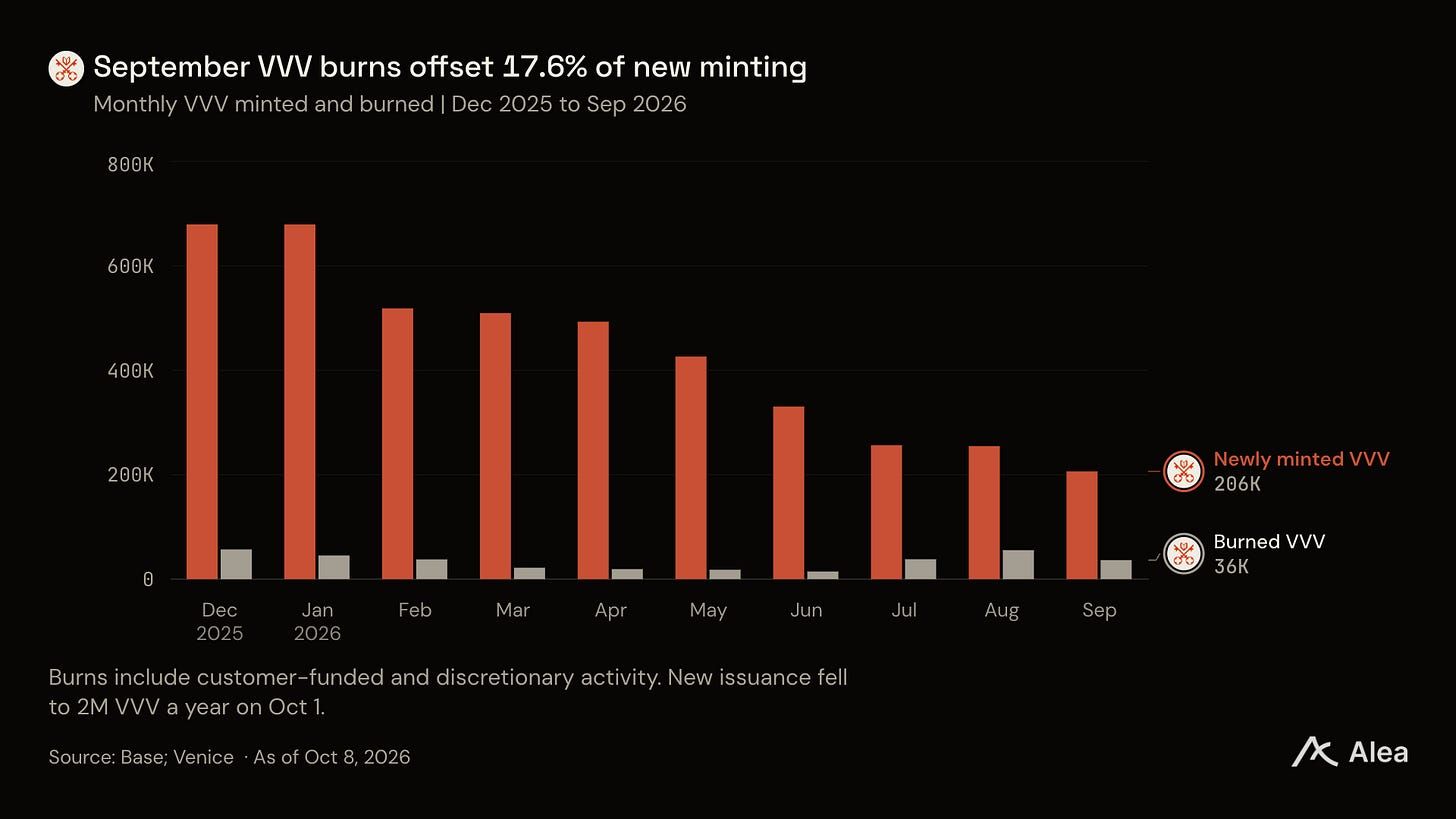
Most recently, Venice reduced annual issuance to 2M VVV from Oct 1, after launching at 14M. September burns offset 17.6% of minting, including customer-funded and discretionary burns before the Oct 1 issuance cut.
That sets the stage: reduce emissions first, increase buybacks after. Gradually, the lines will eventually cross as product adoption materializes.
So, how much customer spending becomes token demand?
Going back to Dolphin, it is designed as a peer-to-pool system that repurposes idle GPUs. Unlike other DePIN that links buyers of compute into a session that rents a node from a provider, each model in Dolphin runs across a pool of GPUs. Nodes are randomly assigned jobs based on their availability and get rewarded with POD from the treasury based on how many inference tokens they processed.
Suppose Dolphin’s May 11 Qwen 3.6 35B example, which priced requests at $0.70 per million AI text tokens, allocating $0.50 to operators. Those prices put treasury-funded operator rewards at $71.43 per $100 of customer purchases (a reward-to-revenue ratio of $0.50 / $0.70 = 0.7143). After the 20% liquid-claim fee, operators receive $57.14 and xPOD receives $14.29. If operators sell their payouts, $42.86 of net POD purchases remain ($100 − $57.14); redeeming and selling the fee tokens ($42.86 − $14.29) reduces that amount to $28.57.
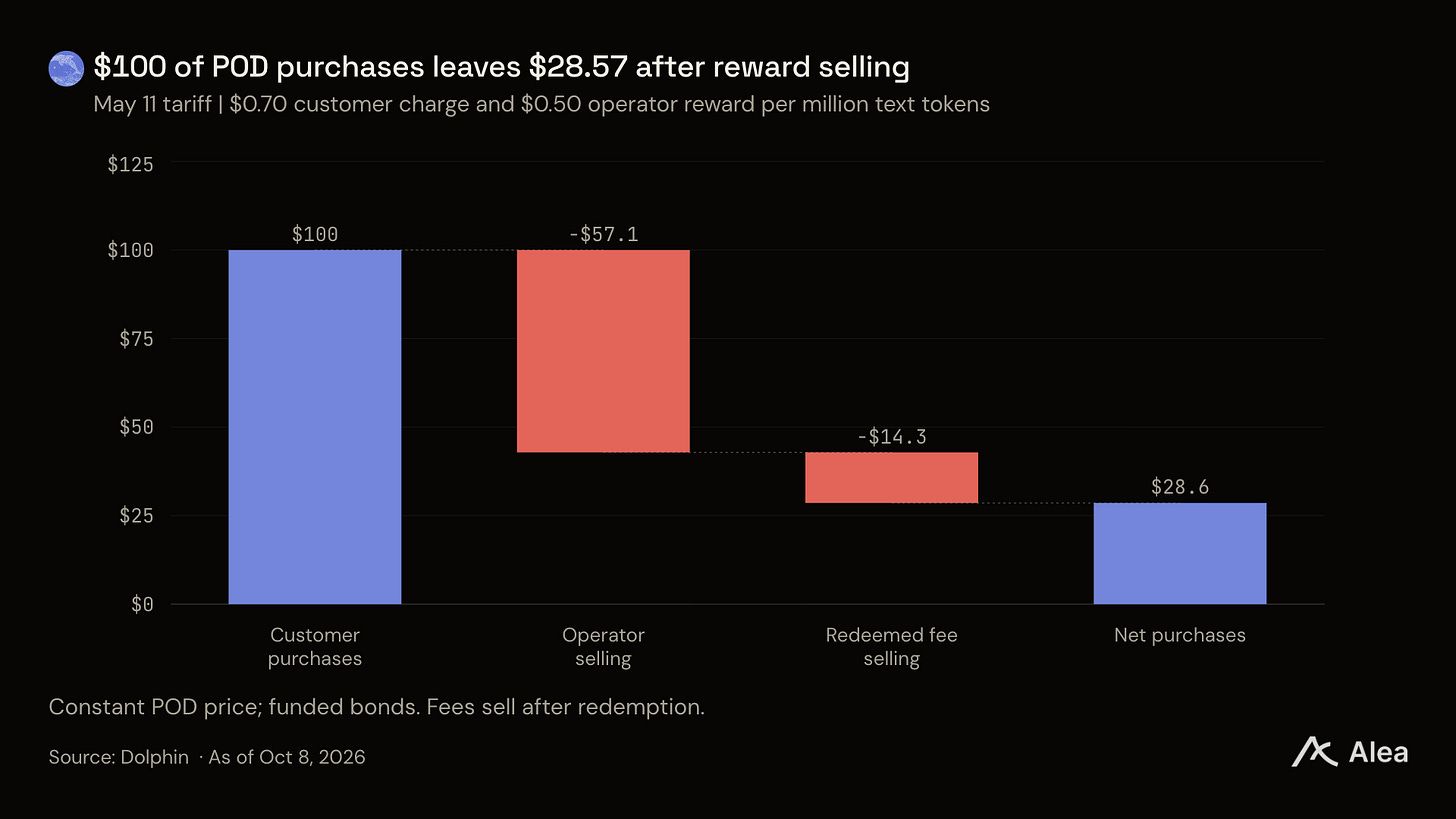
Subtracting all rewards from the customer payment gives $100 − ($100 × $0.50 / $0.70) = $28.57, or 28.6%, holding POD’s price constant and assuming operators have funded their bonds. So even in the worst case where operators dump every reward, each $100 of customer spending still creates $28.57 of net POD demand (28.6%). And if operators hold even 25% of rewards, that becomes $46.43.
This is possible because Dolphin routes 100% of non-POD customer payments into POD buybacks, while it separately pays GPU operators in POD from its treasury. Since those two sides are decoupled, the treasury can hand out more POD in rewards than the buybacks absorb, leaving the net effect on token demand depending on whether operators sell what they earn.
Dolphin allocated 87.5M xPOD and 37.5M POD to its team, with May 2028 cliffs. Each main stream releases 1% at its cliff and the remaining 99% over ten years.
Total supply: 500,000,000 POD
Treasury — 214,634,419 POD (42.93%): reserved for node emissions and future fundraising
Team — 125,000,000 POD (25.00%): active team allocations plus a reserve for future hires, vesting through 2038
Seed — 117,600,000 POD (23.52%): sold for $886K in June 2024, fully unlocked since June 2025
Uniswap v4 pool — 42,765,581 POD (8.55%): on-chain liquidity
POD led VVV on 92 of 151 daily price dates
POD gained 77.8% from May 11 to Oct 8, while VVV gained 32.3%. Using each token’s May 11 USD price as the starting point, POD recorded the higher return on 92 of 151 dates.
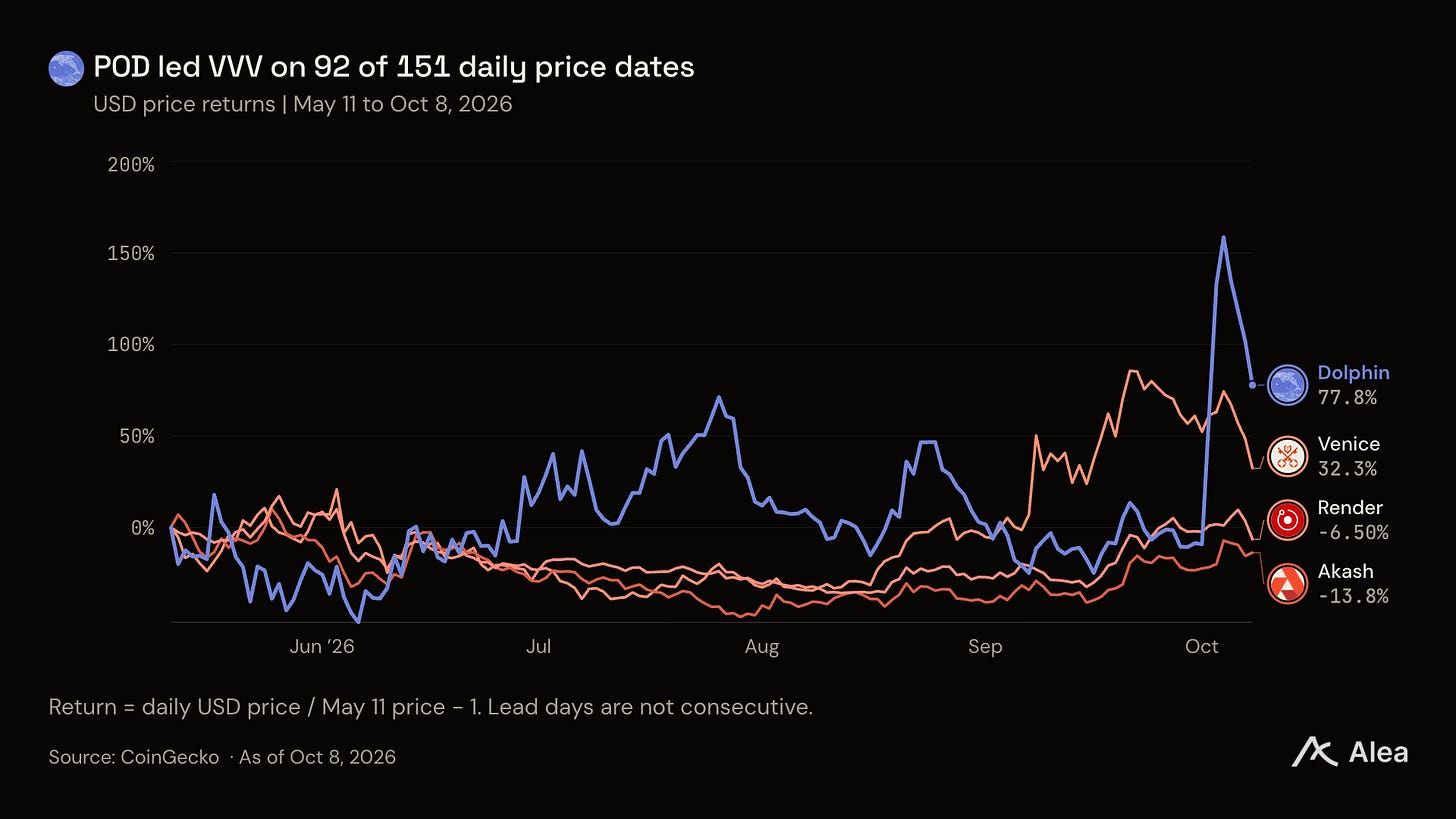
Akash sells cloud capacity, while Render uses customer job payments to buy and burn tokens. AKT lost 13.8% over the same period and RENDER lost 6.5%; their BME (Burn-Mint Equilibrium) make the token the mandatory settlement medium (burn-and-mint through every job), whereas Dolphin keeps buy-side and sell-side separate (buyback vs. treasury emissions) and Venice sidesteps per-transaction flow entirely (stake once, draw capacity daily).
After a >100% rally on an Upbit listing, MEXC announced POD spot trading for Oct 2, and HTX added it on Oct 4. MEXC also announced a perpetual market for Oct 2, and Gate announced its own for that date. Upbit accounts for 52.1% of reported volume across 11 spot pairs, concentrating more than half the turnover on one venue.
Important Links

Research reports. Deep Dives and Blueprints explain protocols and their economics. Theses and Memos examine investment cases and catalysts. Benchmarks compare performance, while Perspectives assess specific developments.
Weekly Pulse. Weekly Pulse covers macro and the major liquid markets.
Protocol Data Rooms. Research each protocol in one place, with Analytics for historical comparisons and Intel for news and governance developments where available.
Podcast Digest and Summit Digest. Read summaries of industry conversations and events. Find Alea shows and their episodes through Podcast Digest.
Governance Tracker. Follow proposals and voting activity across protocols.
For protocol teams preparing institutional conversations, discuss research for your protocol with Alea.