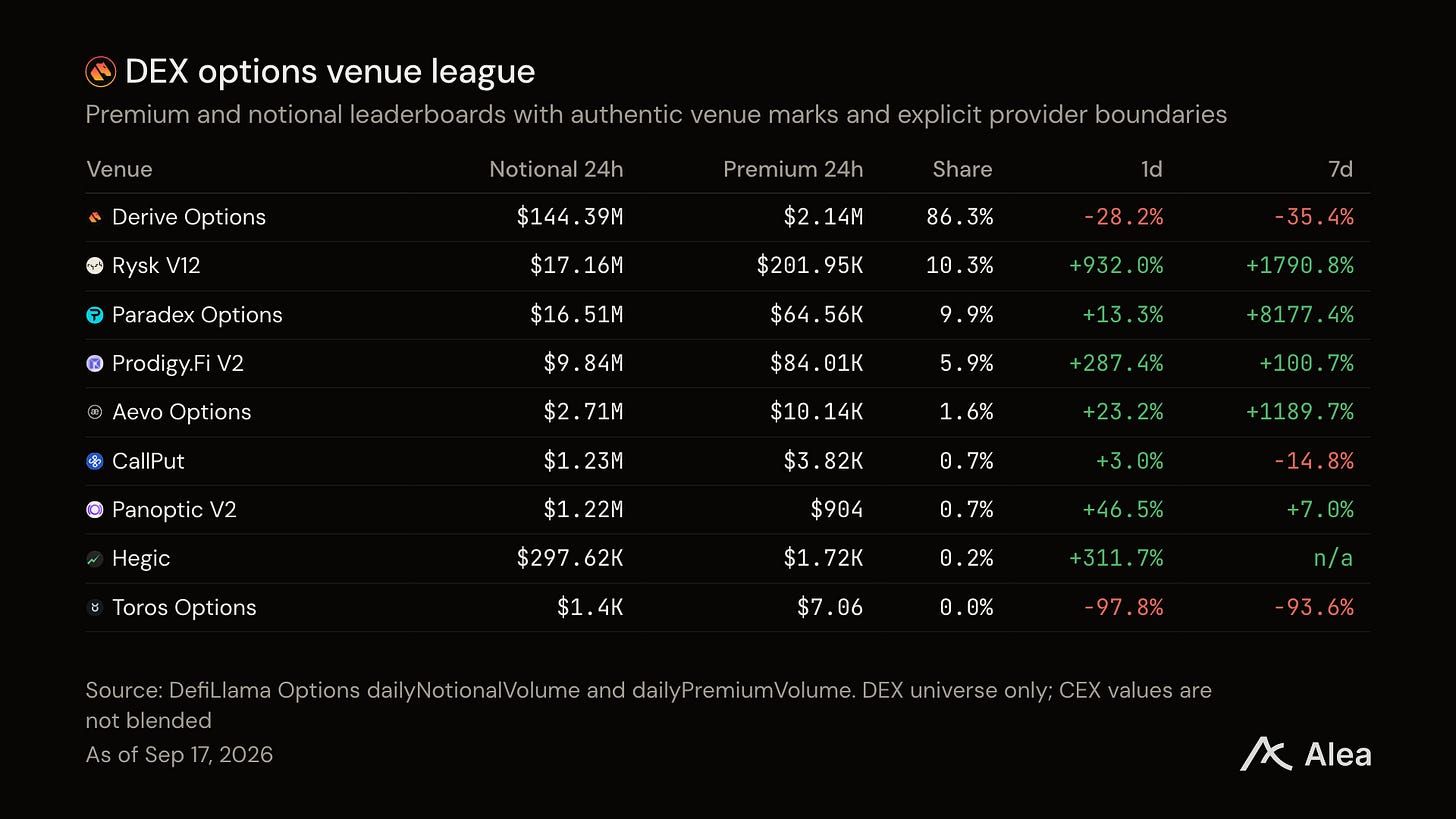
Derive has collected $362.5M of option premium this year. That is 87.4% of everything paid for an onchain option, and it rose 191.9% from its 2025 total of $124.2M. On Sep 17 DRV closed at an all-time high of $0.2877. By Saturday price reached $0.3857 ($385M mcap; $577M FDV), up 158% on the week. Coinbase paid $2.9B for Deribit in May 2025.
Takeaways
Derive owns onchain options outright. It took $362.5M of the $414.9M paid for onchain option premium this year, against $124.2M in all of 2025.
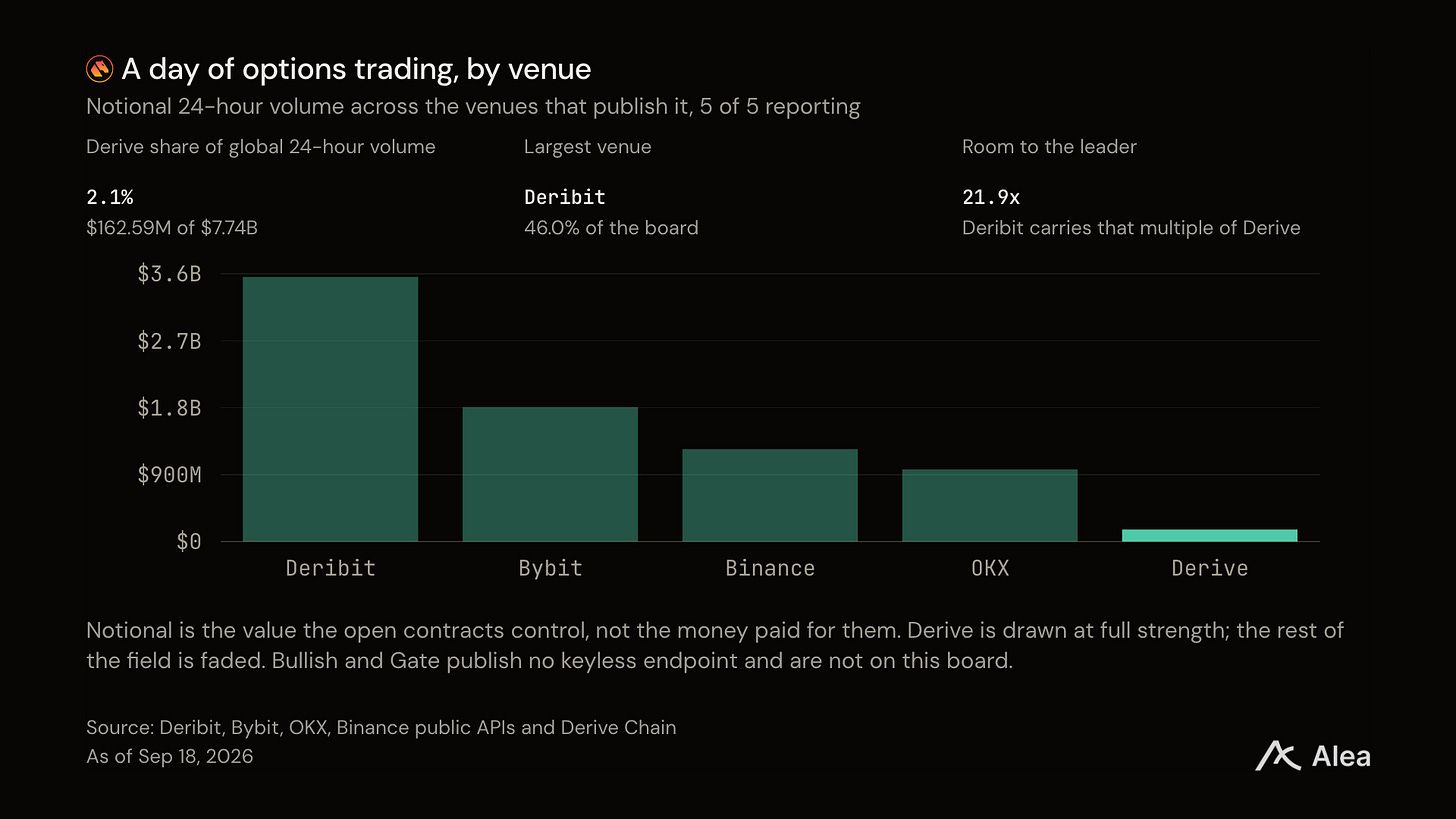
The room above it is Deribit. In one day Derive traded options covering $162.6M of assets, and the venues with public figures traded $7.74B between them.
The perpetual book is not a sideshow. It earned $1.76M of the venue’s $4.51M in fees this year, 39.1% of the total, and out-earned the option book in February.
Fees reach the holder through buybacks. The venue kept $3.37M of $4.51M in fees and pointed 35% of them at buying DRV back, retiring 16.6M tokens this year against 6.1M in staking rewards.
Option fees fell from 2.94 cents per $100 traded to 1.27, while the market re-rated the earnings from 22.5 times to 48.7.
The year Derive stopped sharing
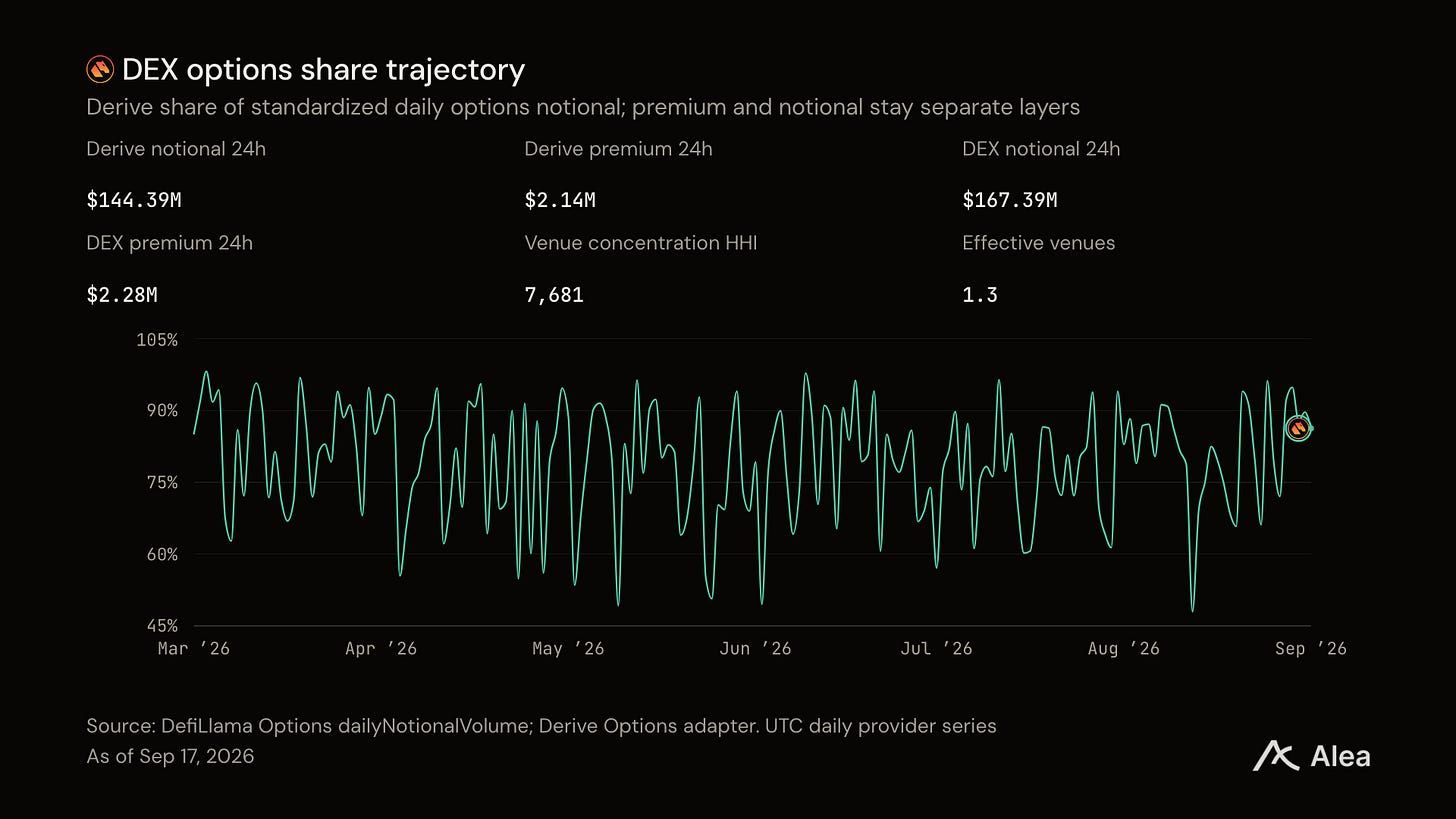
Onchain options had several venues in January. It has one now, and second place is no longer close enough to call it a race.
Deribit still traded $3.56B of options in a day against Derive's $162.6M, almost 22 times more.
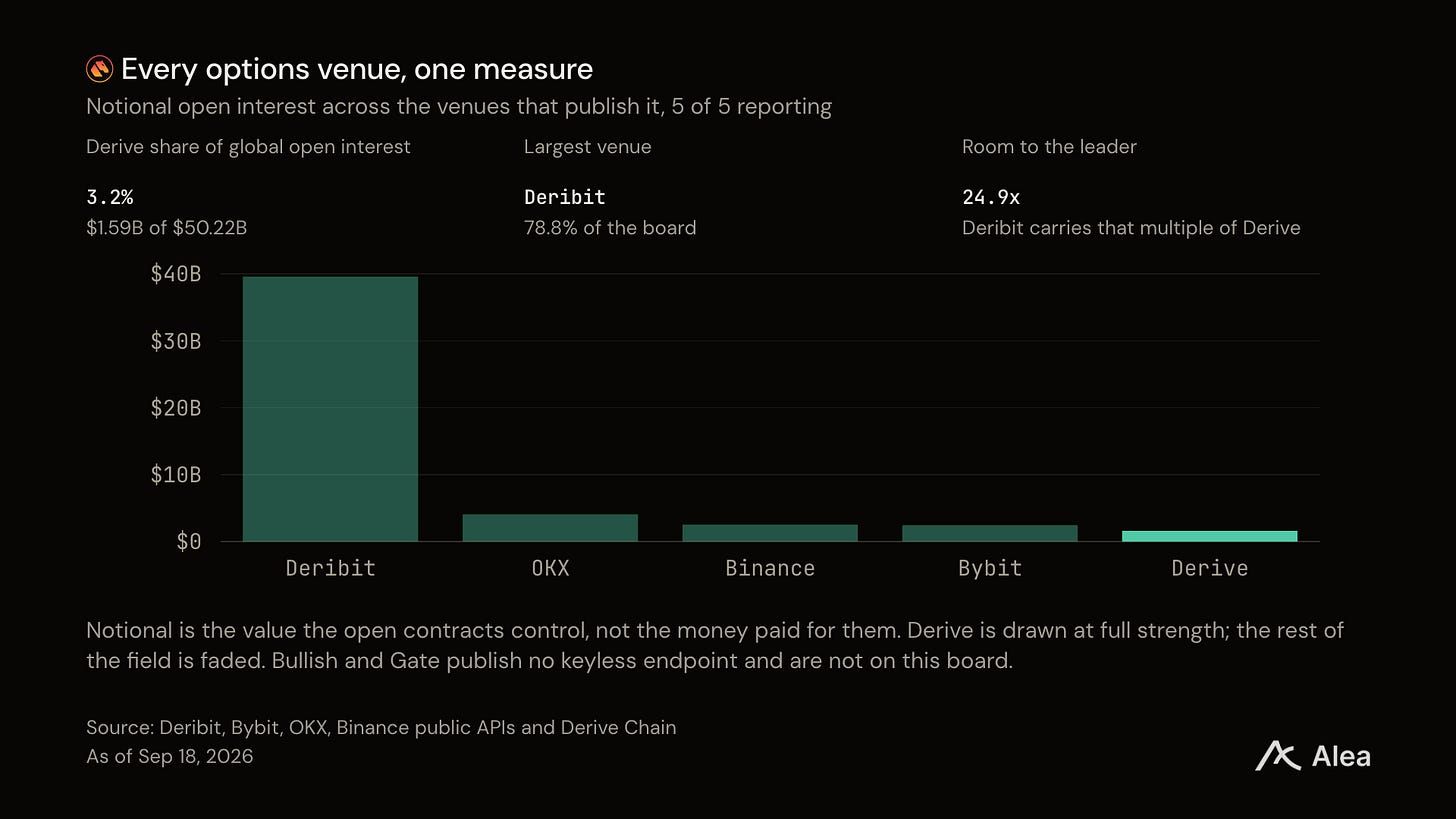
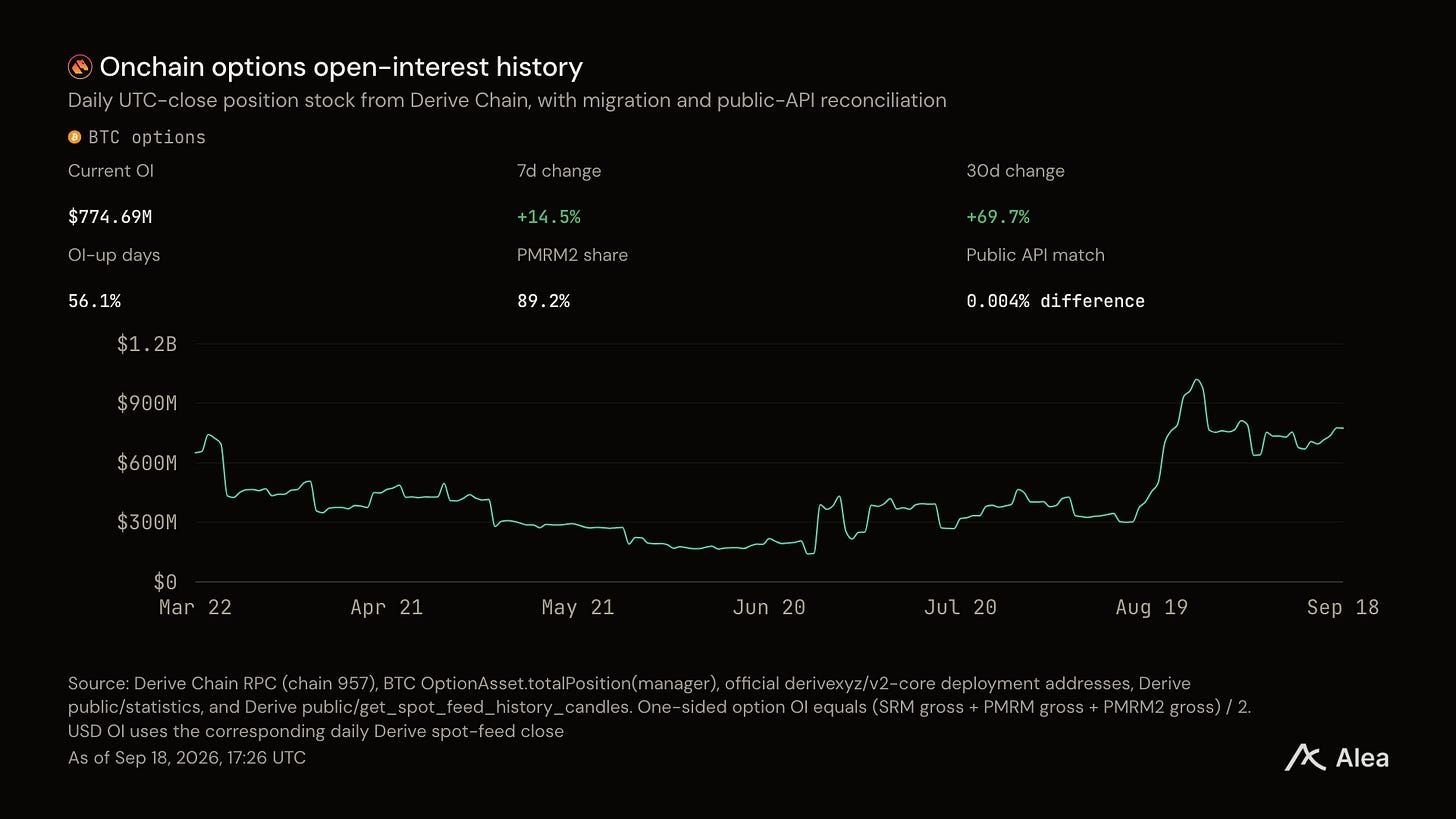
Open interest tells the same story. Derive carries $1.59B of positions inside a book of $50.22B, which is 3.2%. Deribit alone holds 78.8% of it.
Nearly three times last year, in nine months
Premium is the money buyers handed over, and tells us whether, and how much, a venue is used. Notional grew from $5.38B to $12.46B.
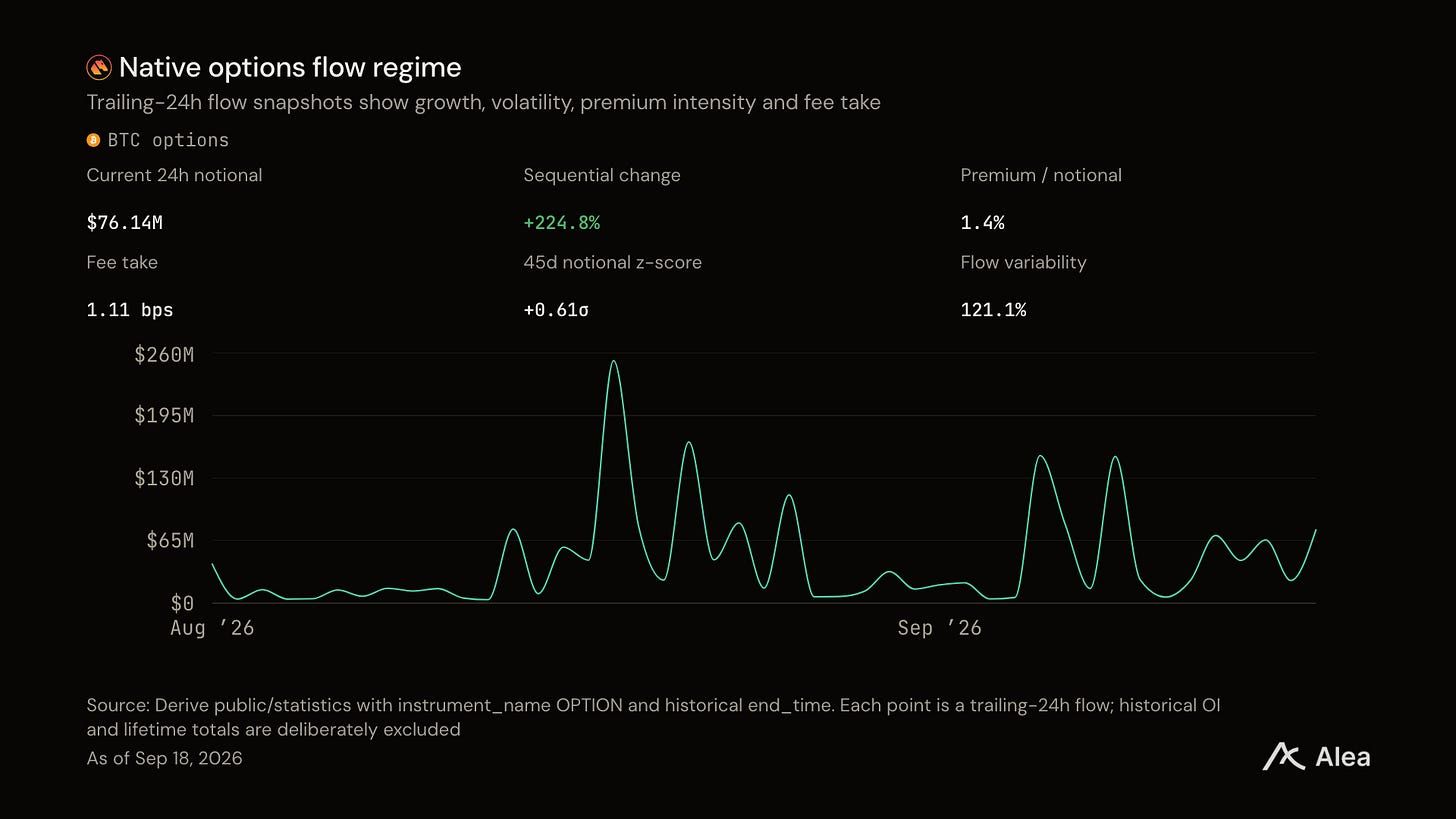
Buyers bought more exposure and paid more for each dollar of it.
What a dollar of exposure cost
Premium divided by notional is an option's price as a share of the exposure it controls. It rises the longer the option runs, the closer its strike sits to the current price, and the more the market expects that price to move.
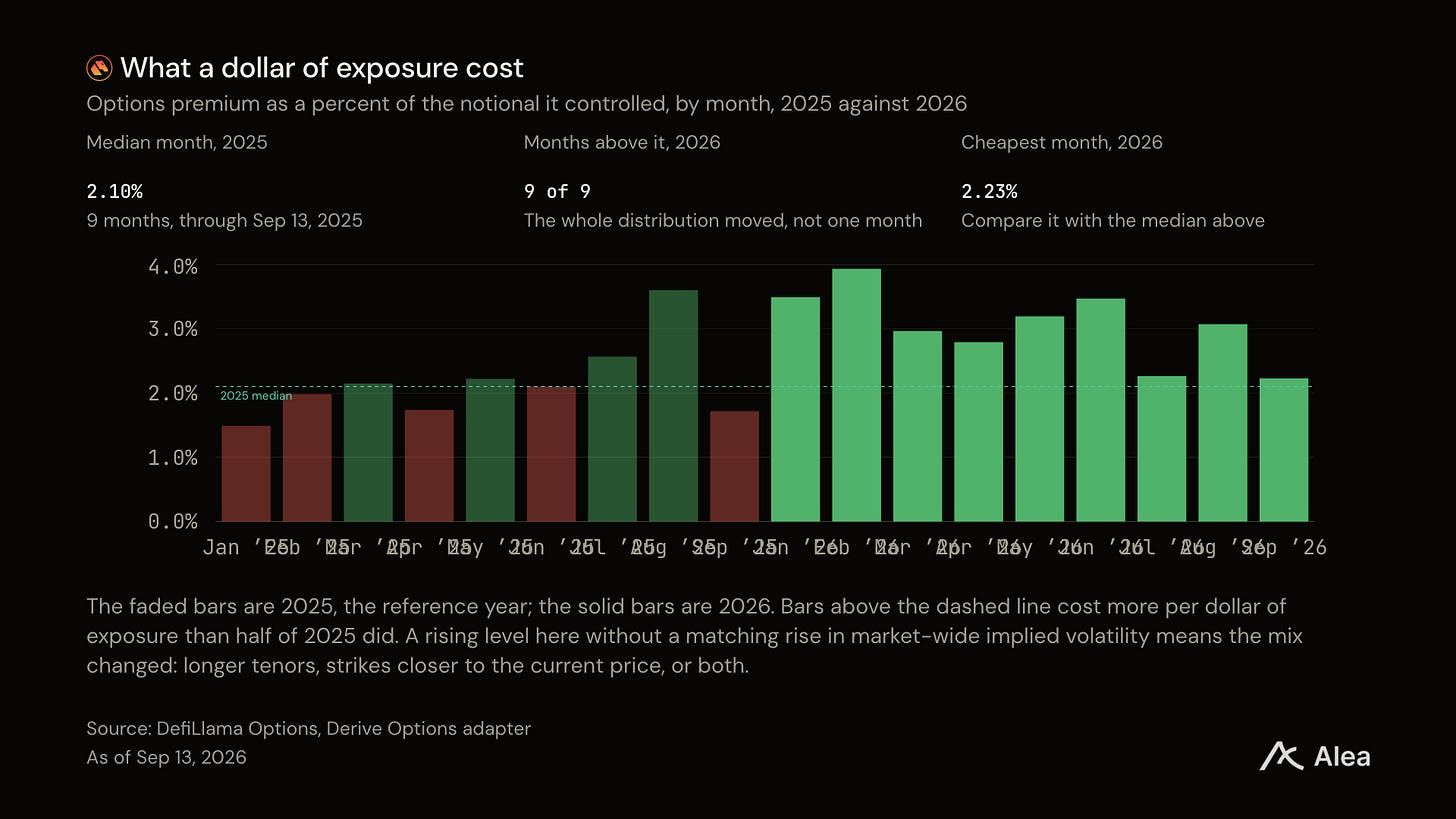
All nine months of 2026 cleared 2025's median of 2.10%, and the cheapest still reached 2.23%. Over the same year 30-day implied volatility fell 7.0%. Buyers paid more per dollar of exposure while volatility fell.
That points at longer-dated options struck nearer the current price. Derive is being used the way Deribit is used.
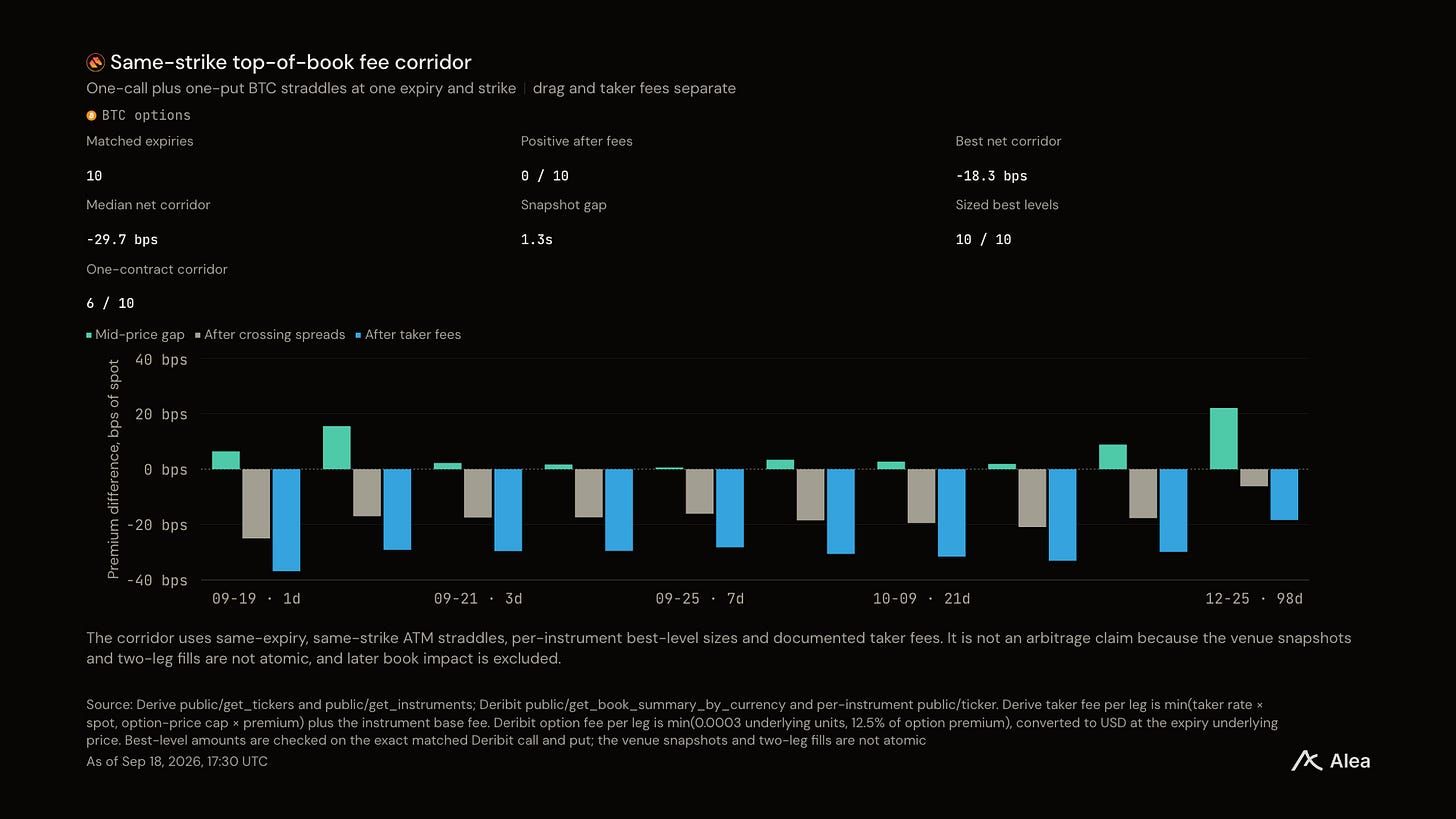
What the venue quotes against the venue above it
Before moving venue, a trader wants one number: what the same risk costs in each.
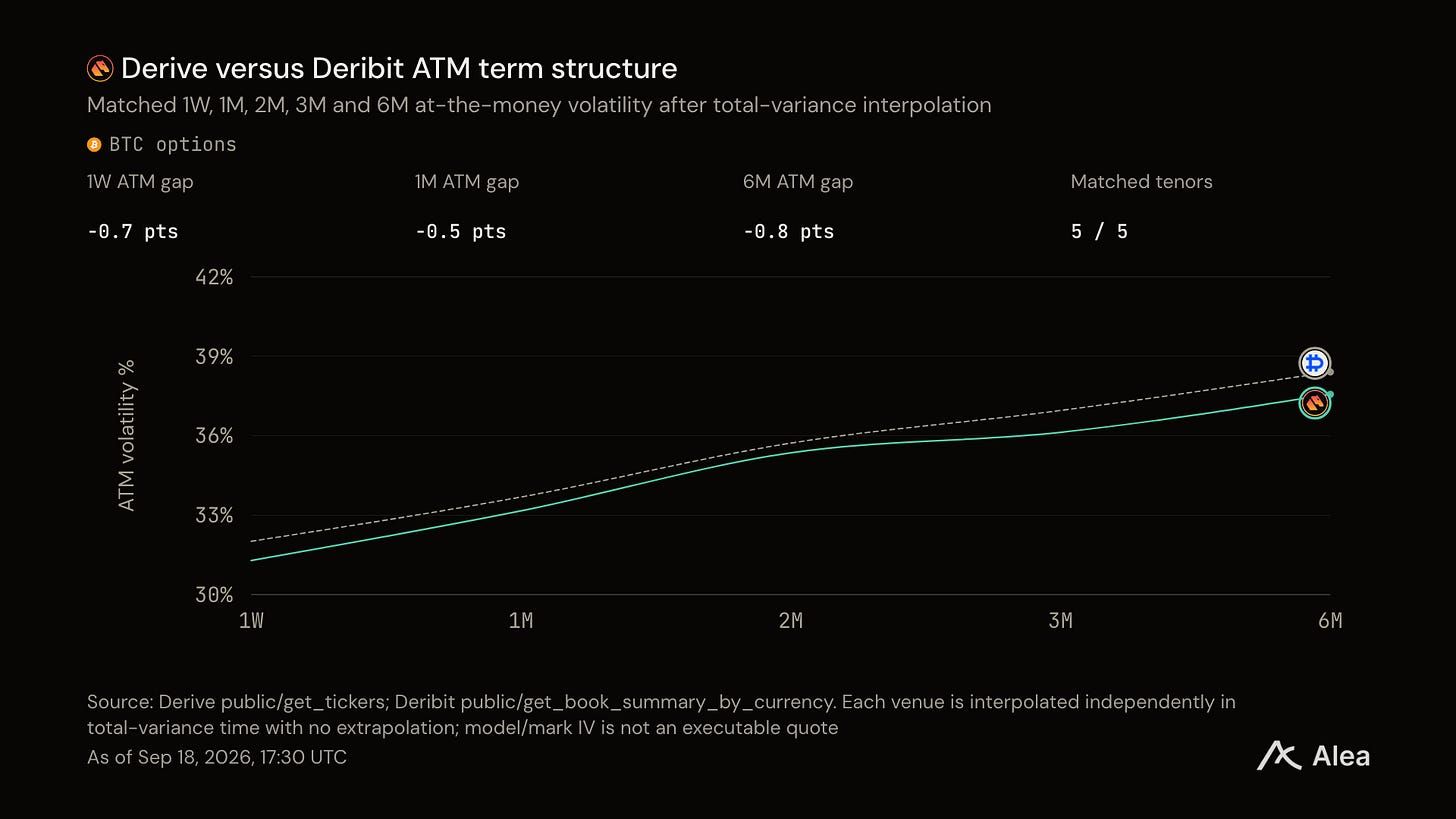
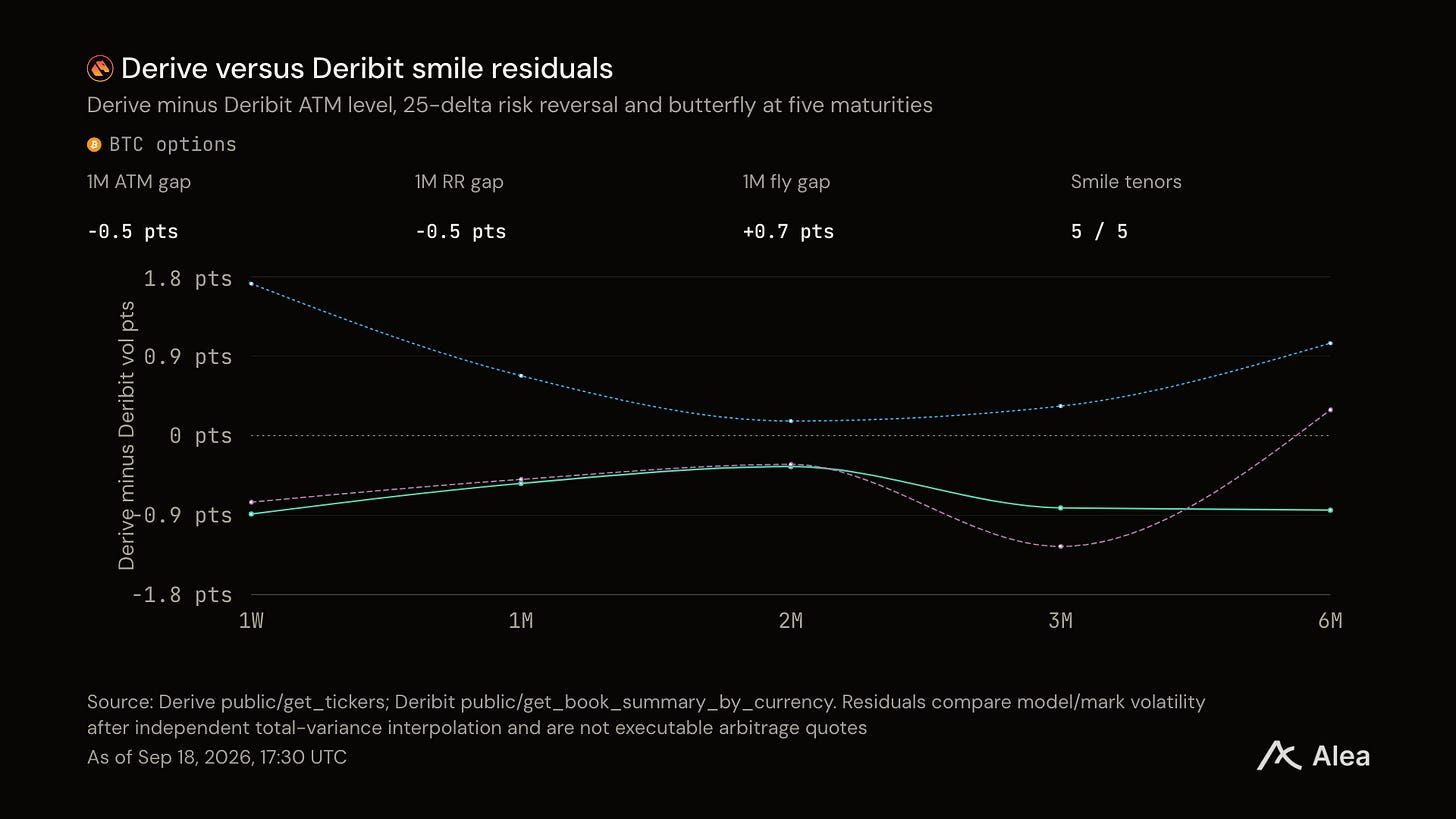
Quoting is only half of it. The other half is what crossing the spread costs.
Whether sellers were paid for the risk
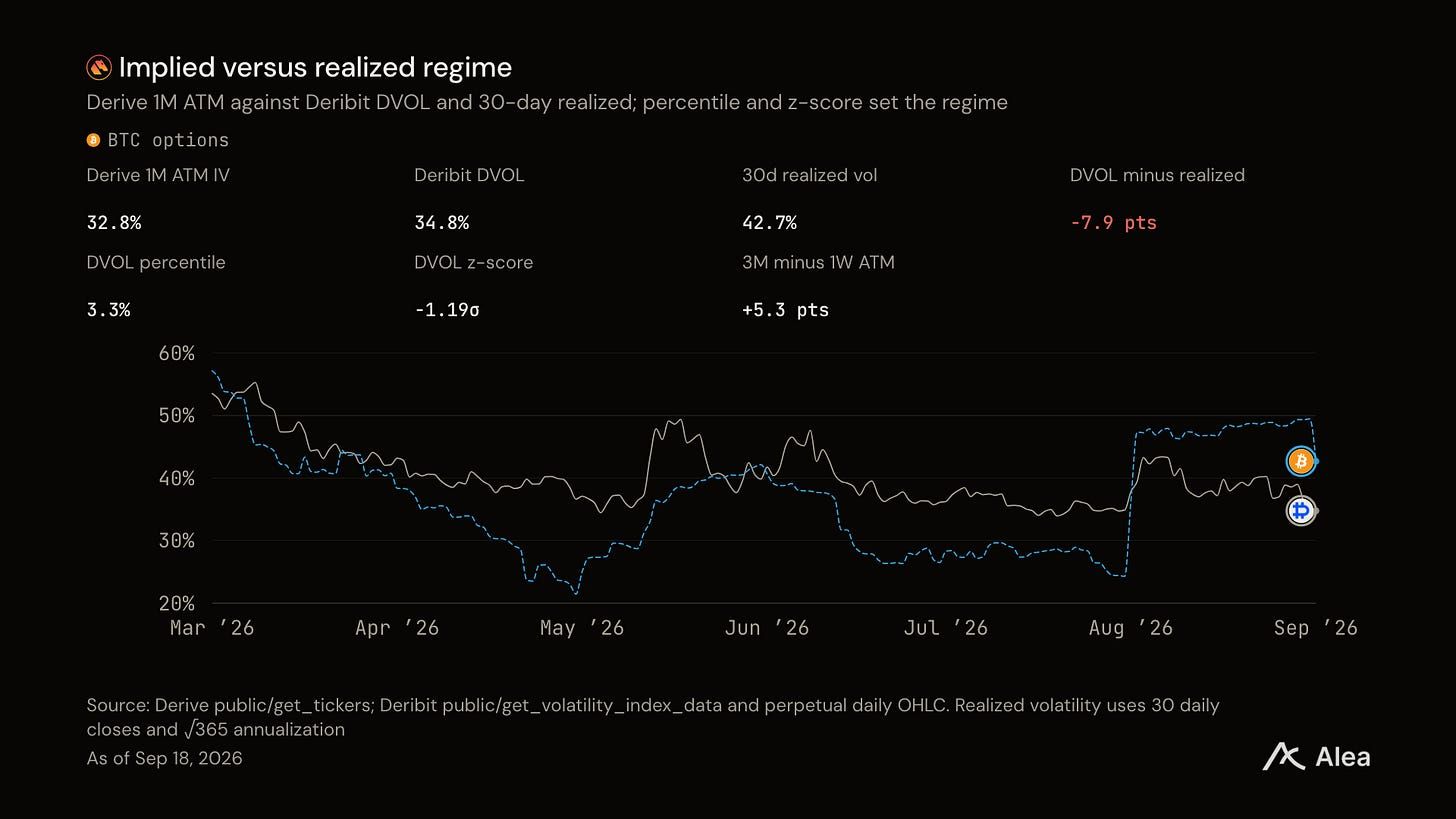
Implied volatility is what buyers paid for a move. Realized volatility is the move that arrived. The gap between them is the option seller’s year: implied fell 7.0% across it.
What the book is holding
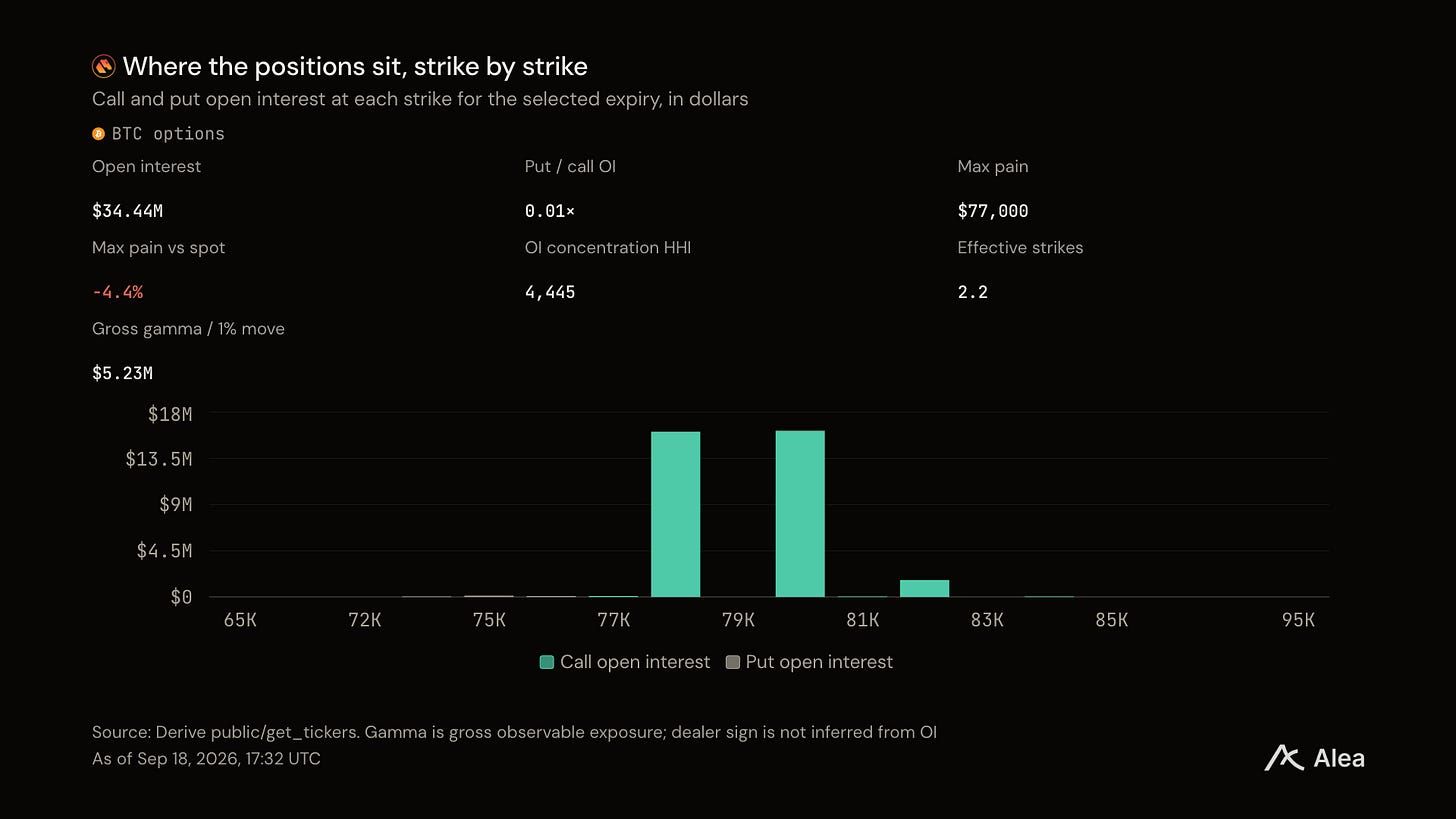
Open interest is the dollar value of positions still open. A venue people trade through looks different from one they hold positions on.
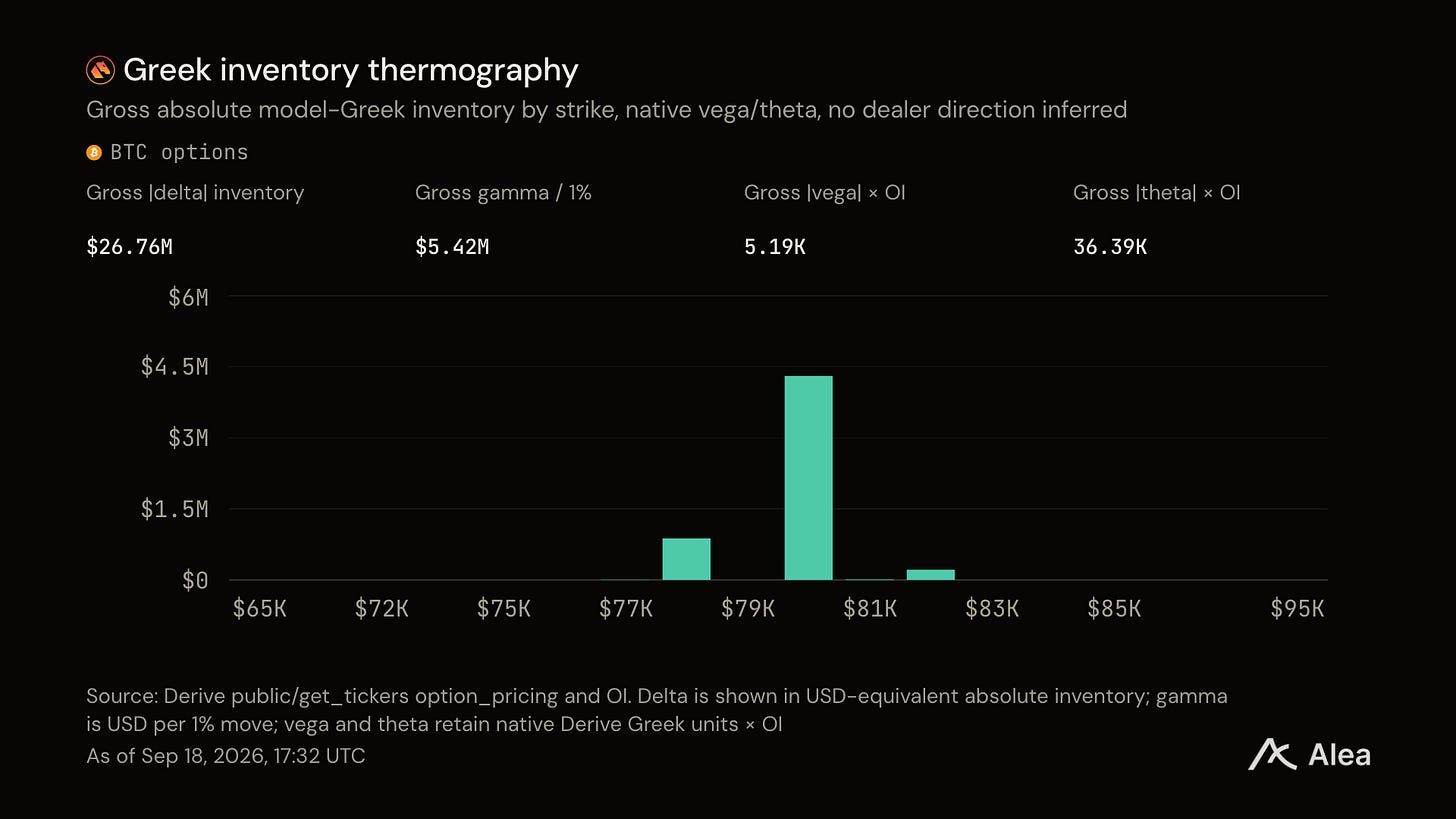
Where the positions sit
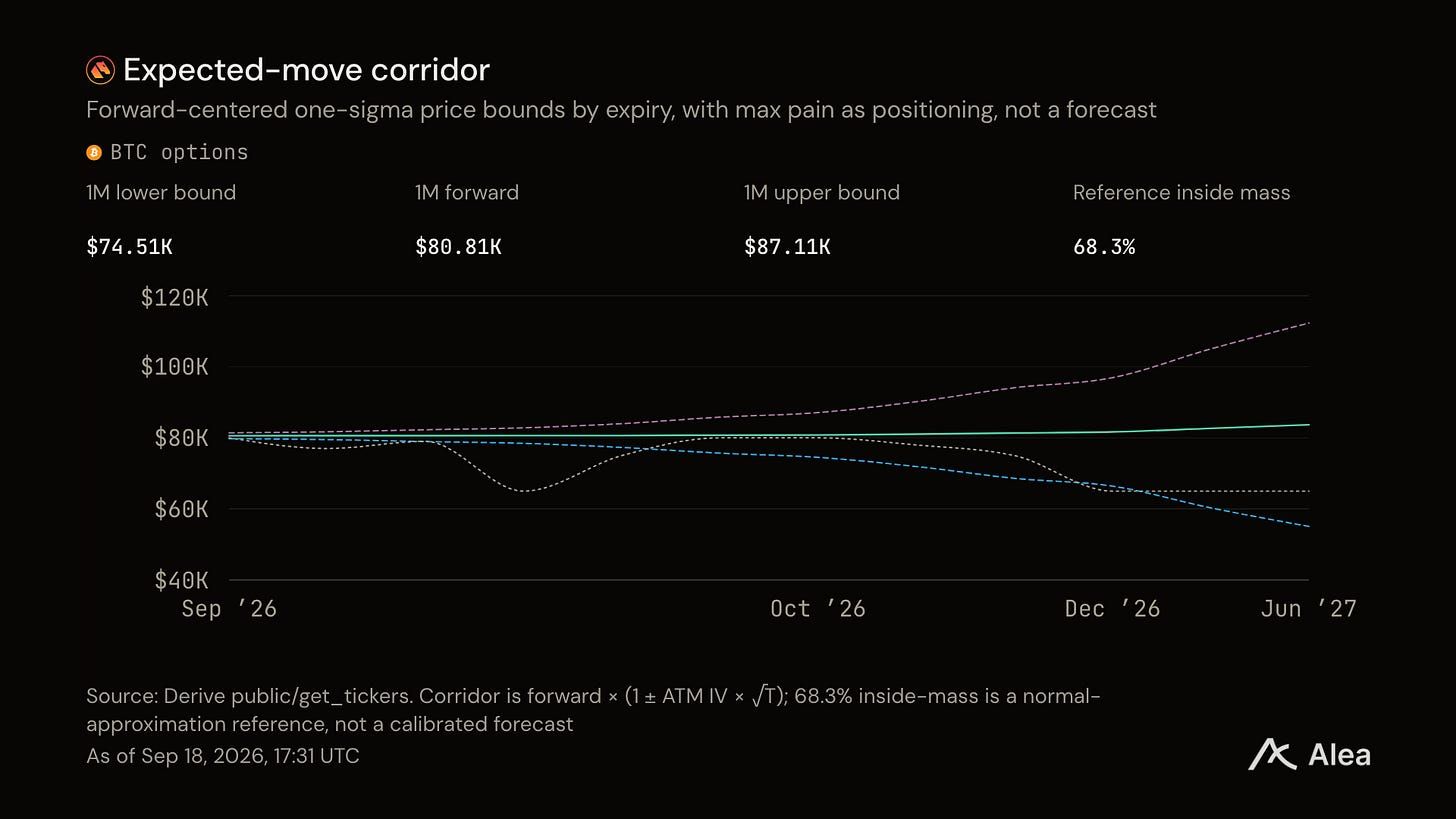
Expiry date and strike prices decide who is exposed to the next move.
Who actually trades it
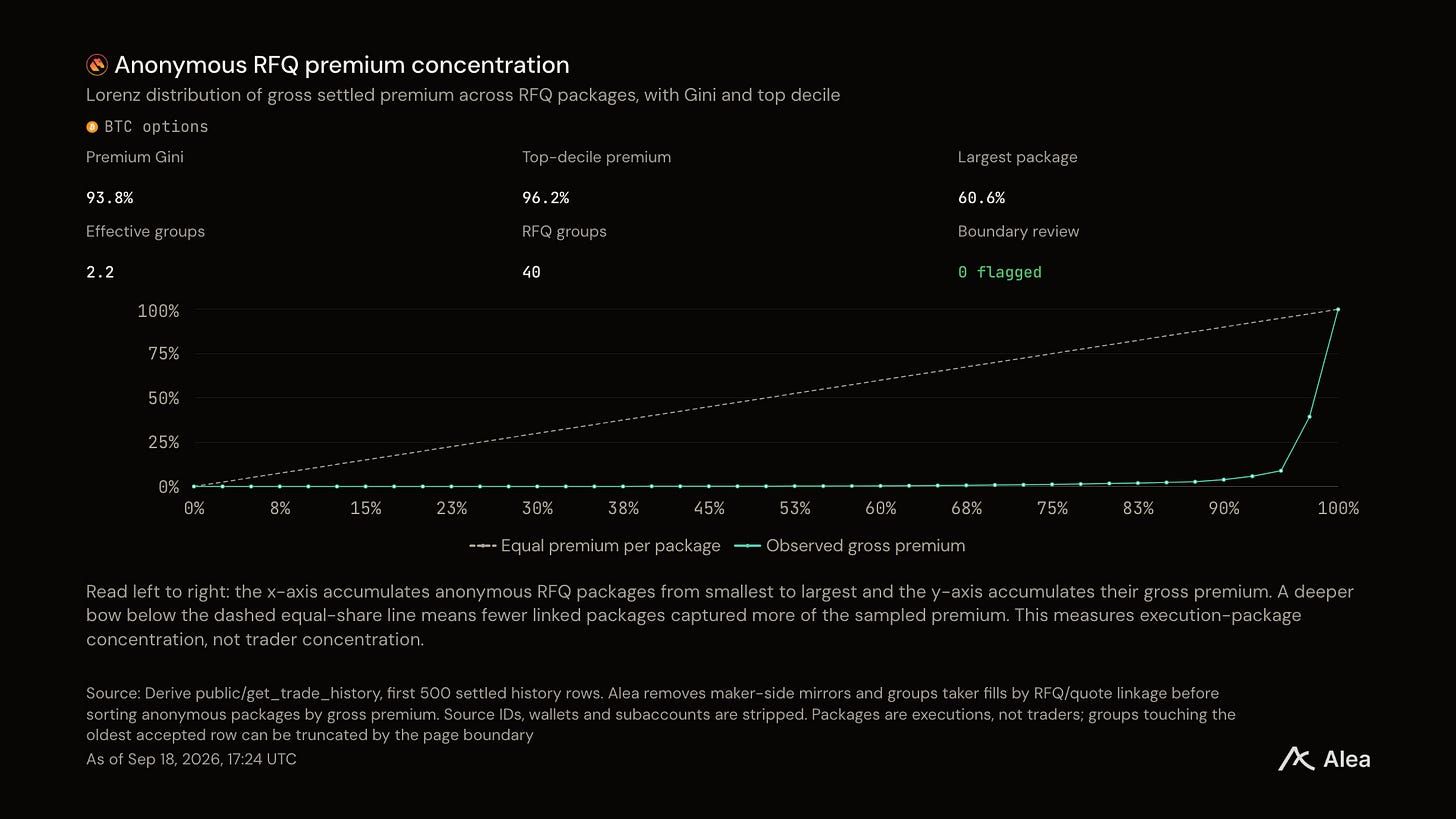
Block and negotiated trades are how institutional size gets filled without moving the screen. Their share of premium says who is on the other side.
The other book
Derive also runs perpetual futures, which are bets on a price that never expire. That book traded $5.20B of notional this year and earned 39.1% of the venue's fees.
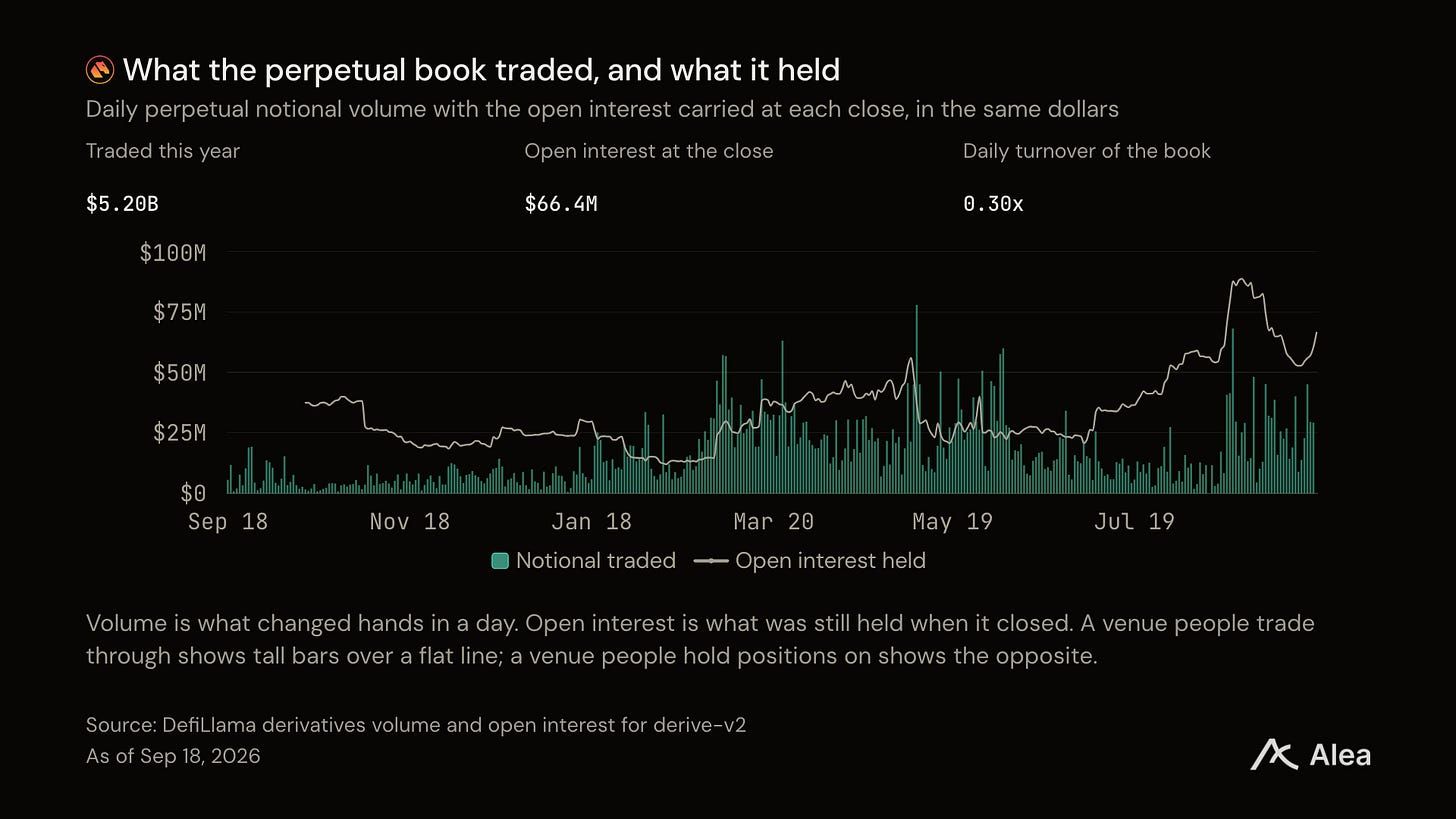
Each day the venue trades 0.30 times what it holds. Traders sit on positions here rather than passing through.
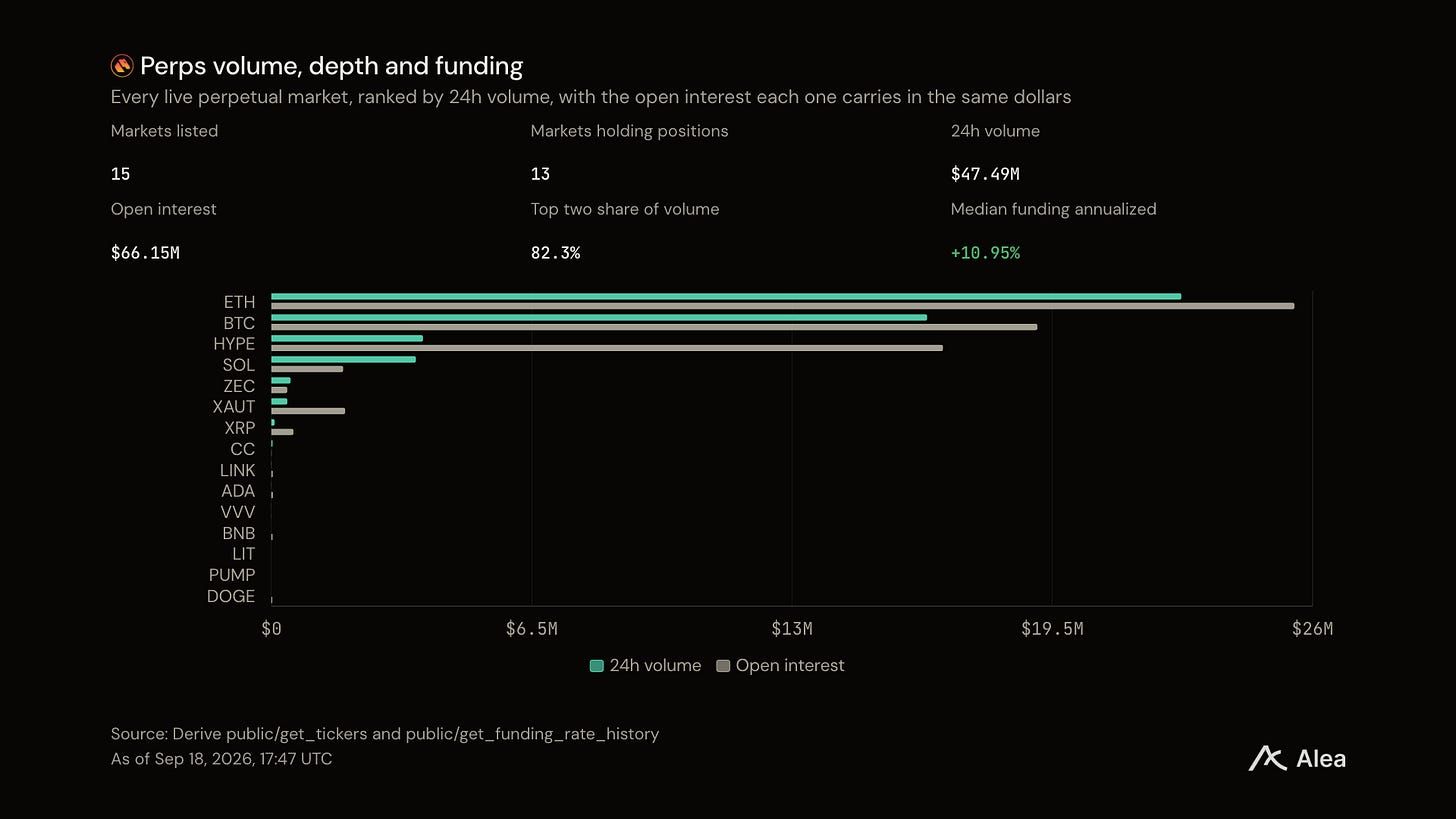
Fifteen markets are listed. Two of them carry 82.3% of the volume.
Funding is the periodic payment between the long side and the short side, and it only moves when one side is crowded. On most of Derive’s markets it does not move at all.
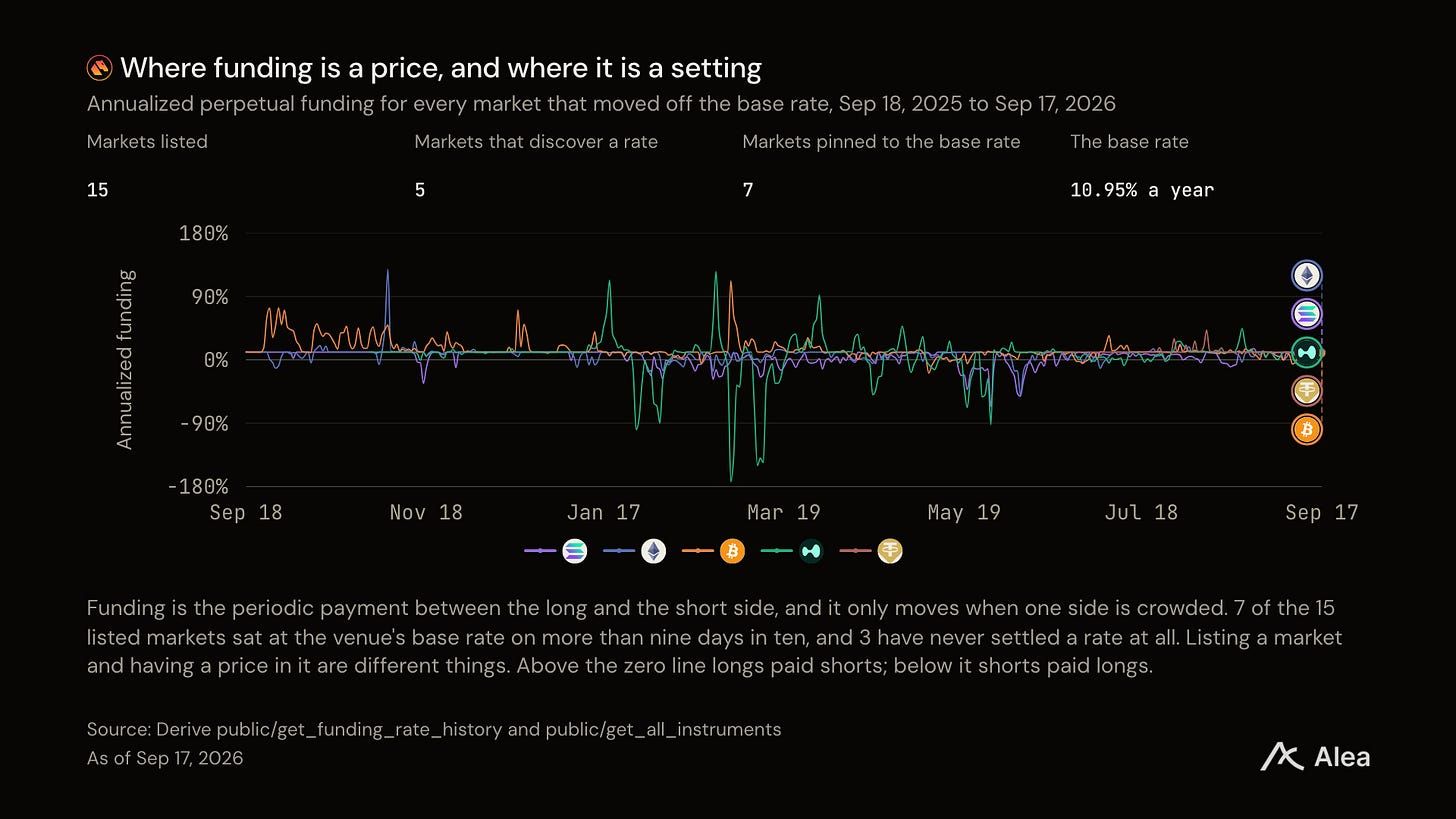
Five markets discover a rate of their own: Bitcoin, Ether, Solana, Hyperliquid and tokenized gold. Seven sat at the venue's base rate of 10.95% a year on more than nine days in ten. The five that discover a rate also went quiet. Funding on those markets reached 128.5% a year before May and 44.6% since, and the deepest negative reading halved from 173.0% to 92.2%.
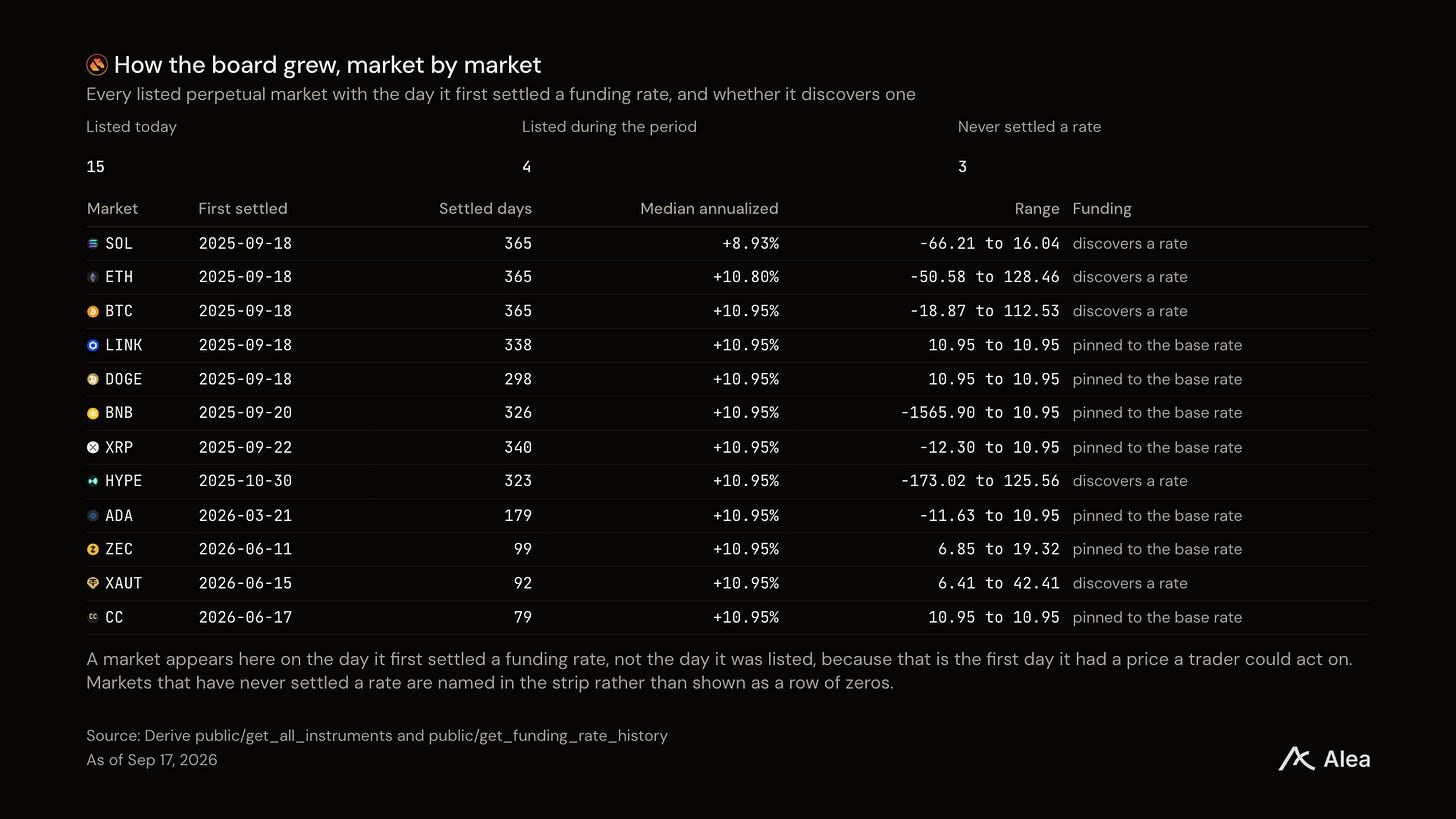
The board is widening faster than the flow is filling it, especially for newer markets.
Where passive capital went
Vaults are where capital goes when it wants the venue's strategies without running them. On Derive a vault does one of two things. It sells options and keeps the premium. Or it buys the asset, bets against it in the futures market, and pockets the gap between the two prices.
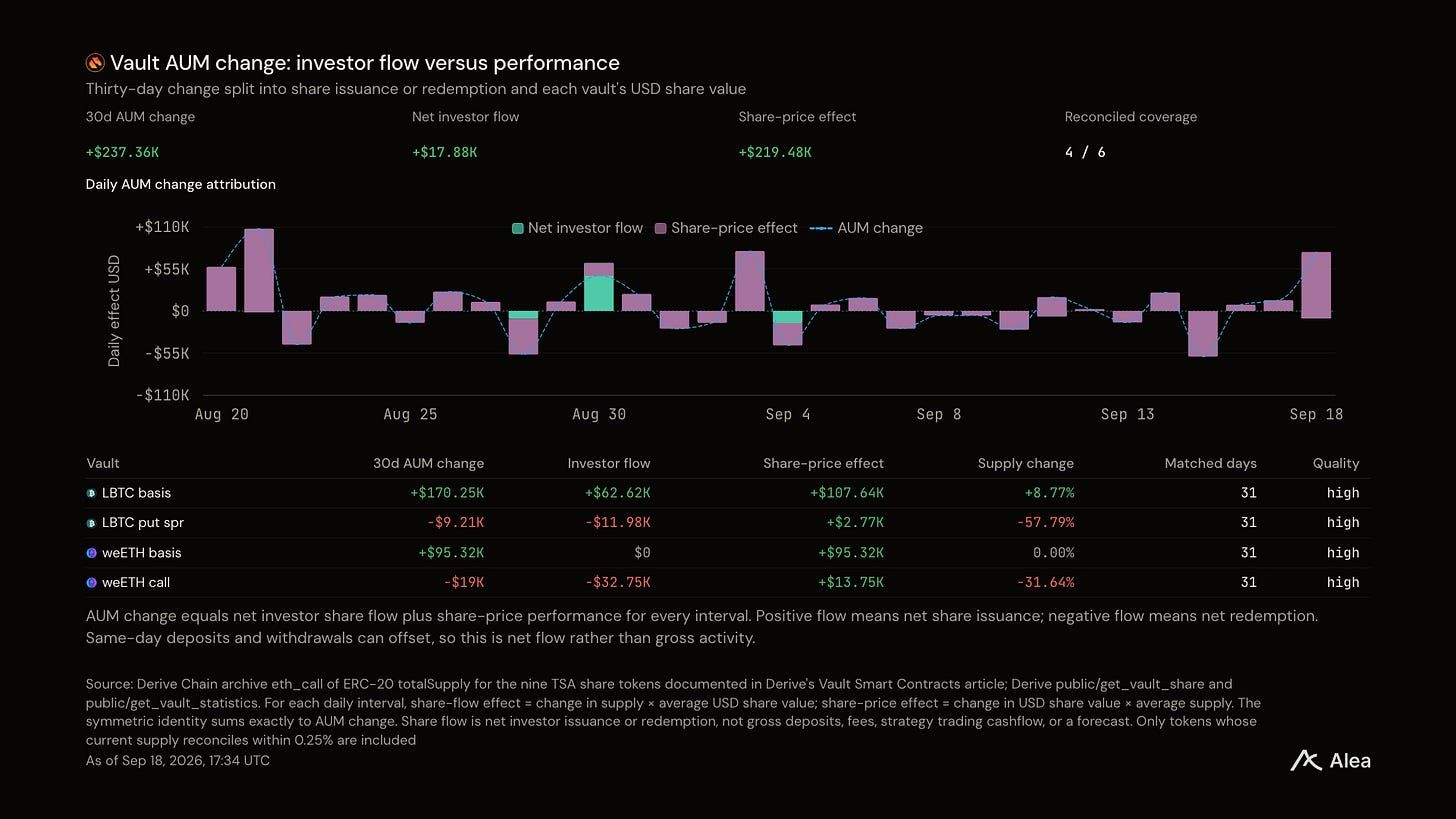
New money and performance are different reasons for a vault to grow, and only one of them is the strategy working.
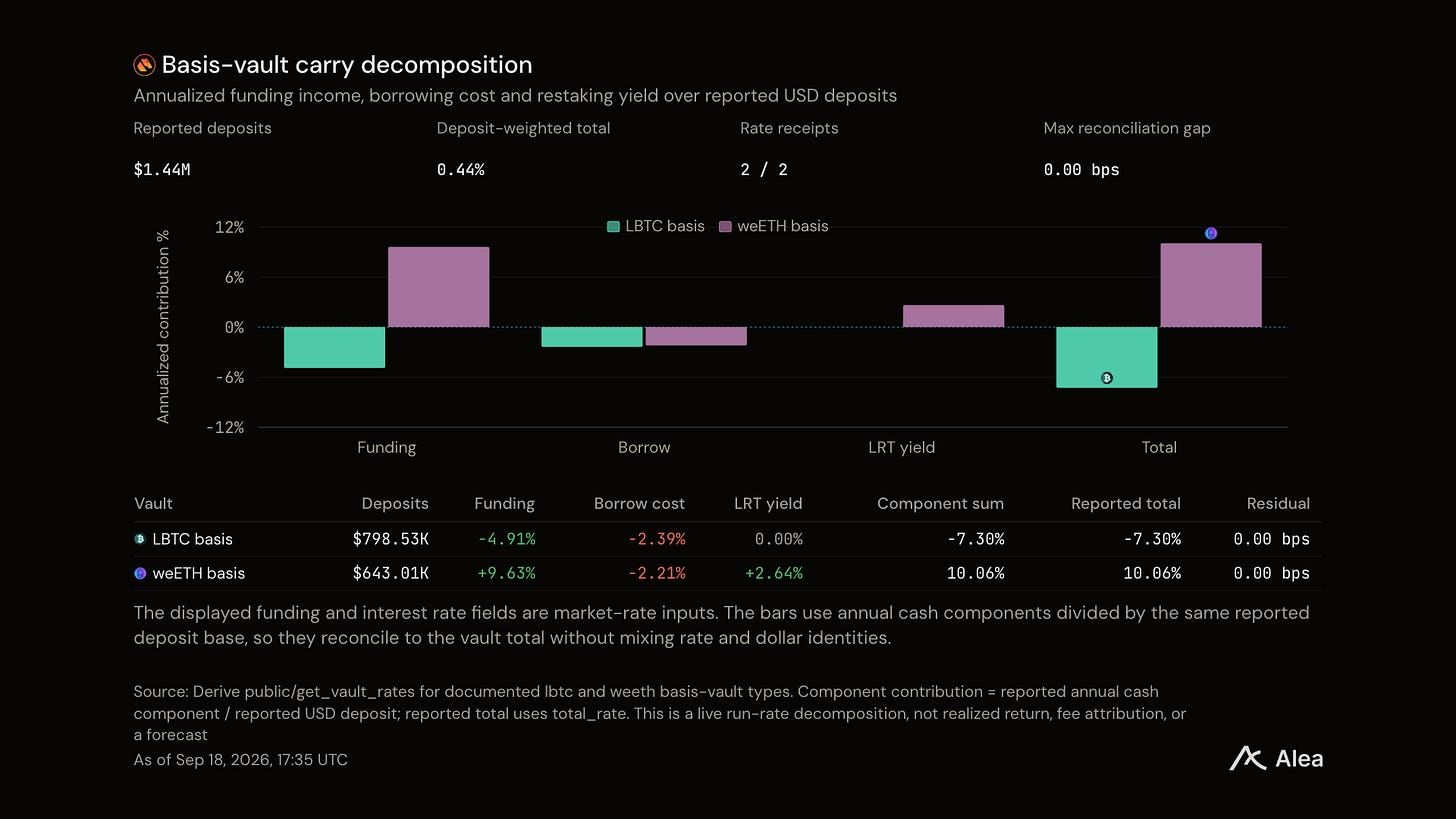
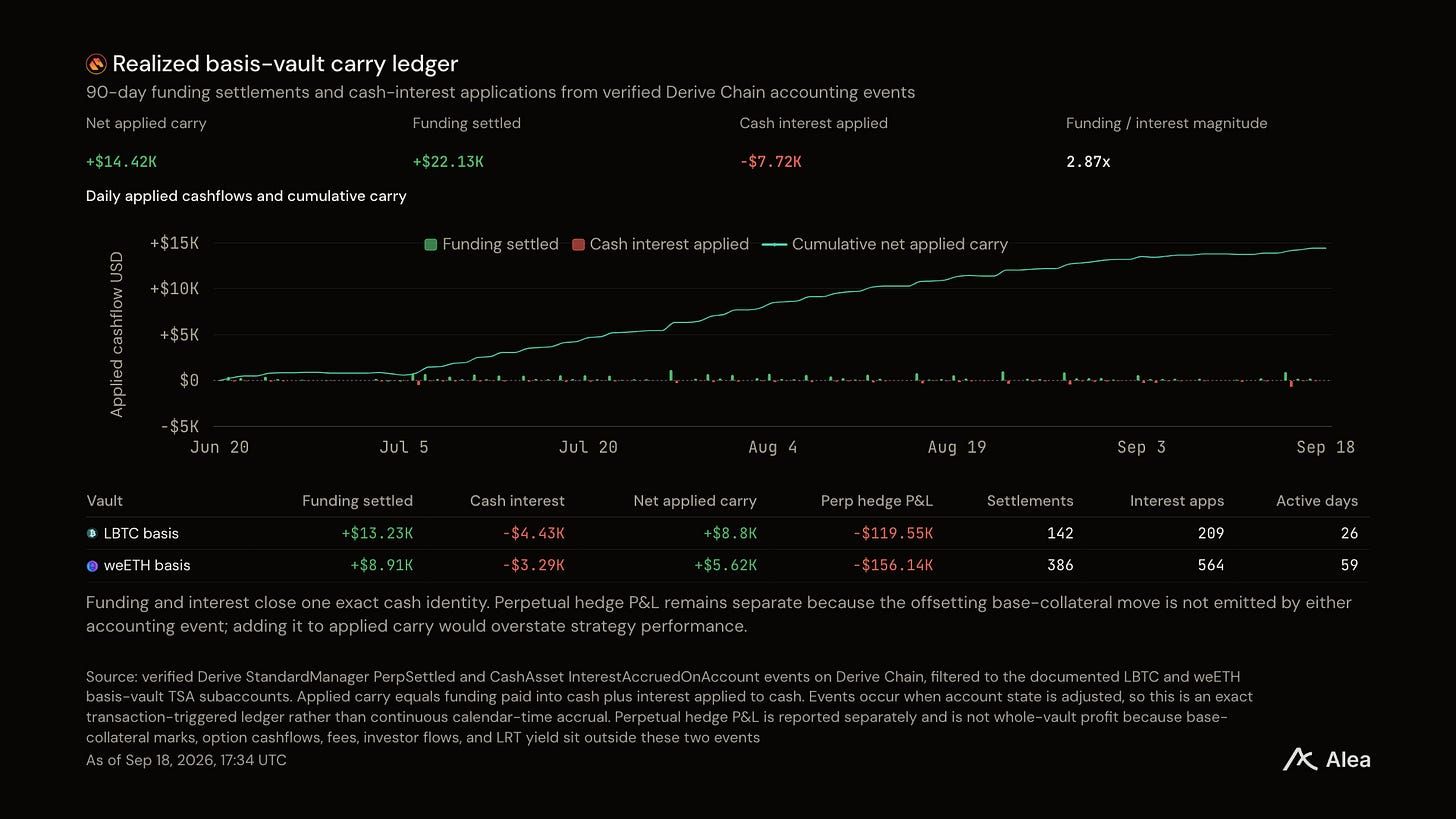
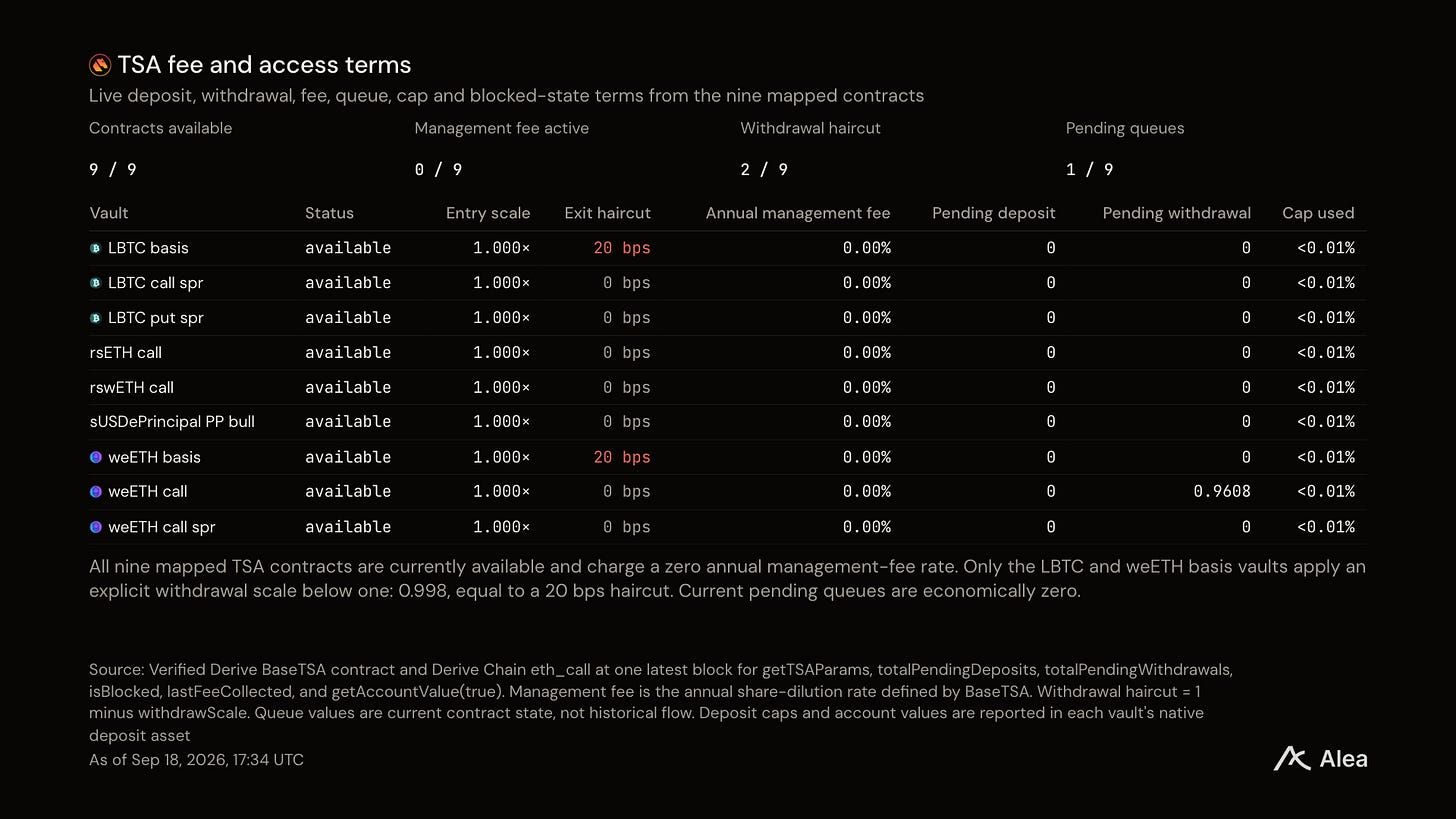
What a depositor keeps depends on what the vault charges and how much room it has left.
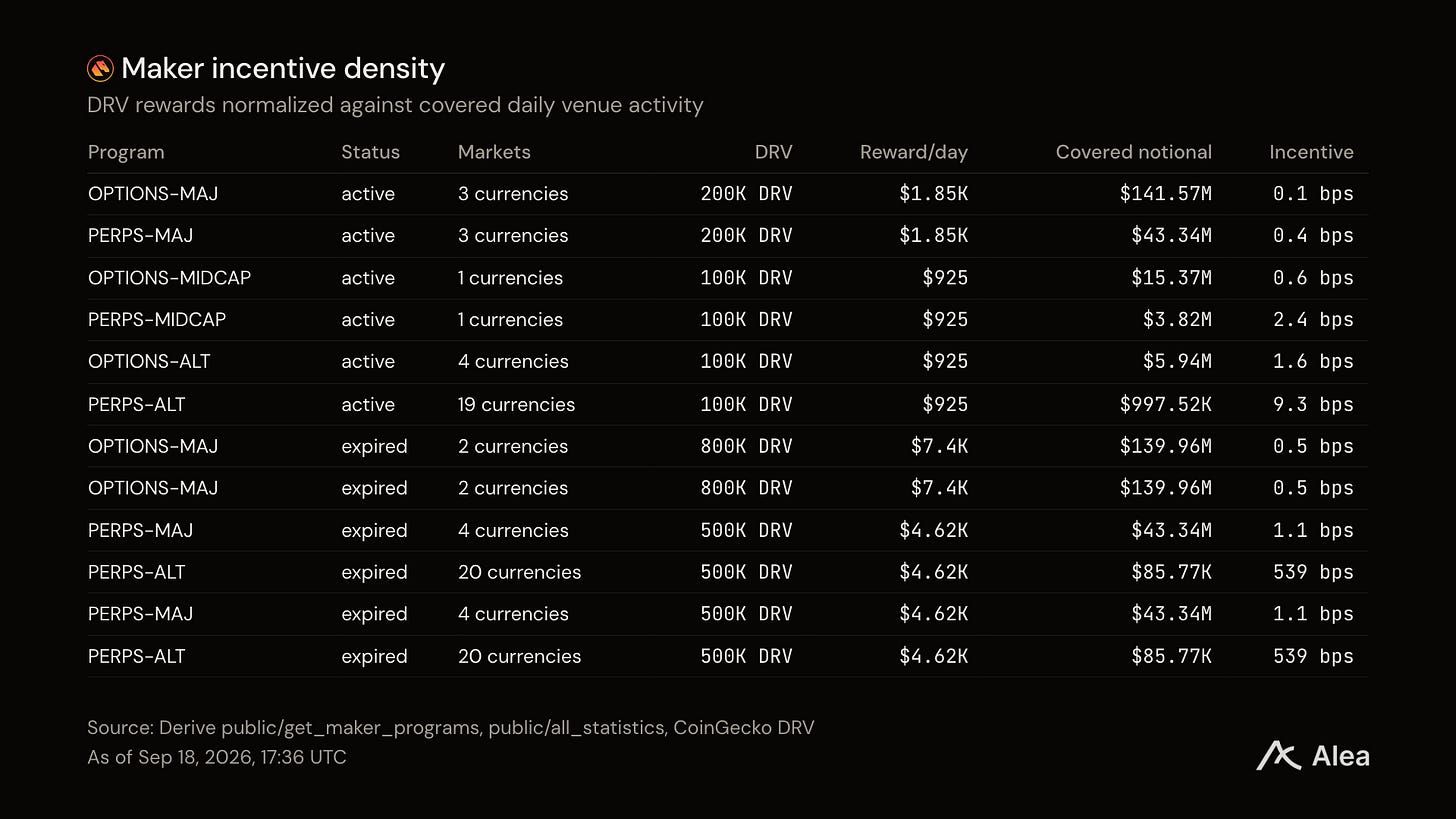
Some of the venue’s volume is bought rather than earned.
What the venue earns, and who gets it
Fees are what traders paid. Revenue is the part the venue kept: $3.37M this year.
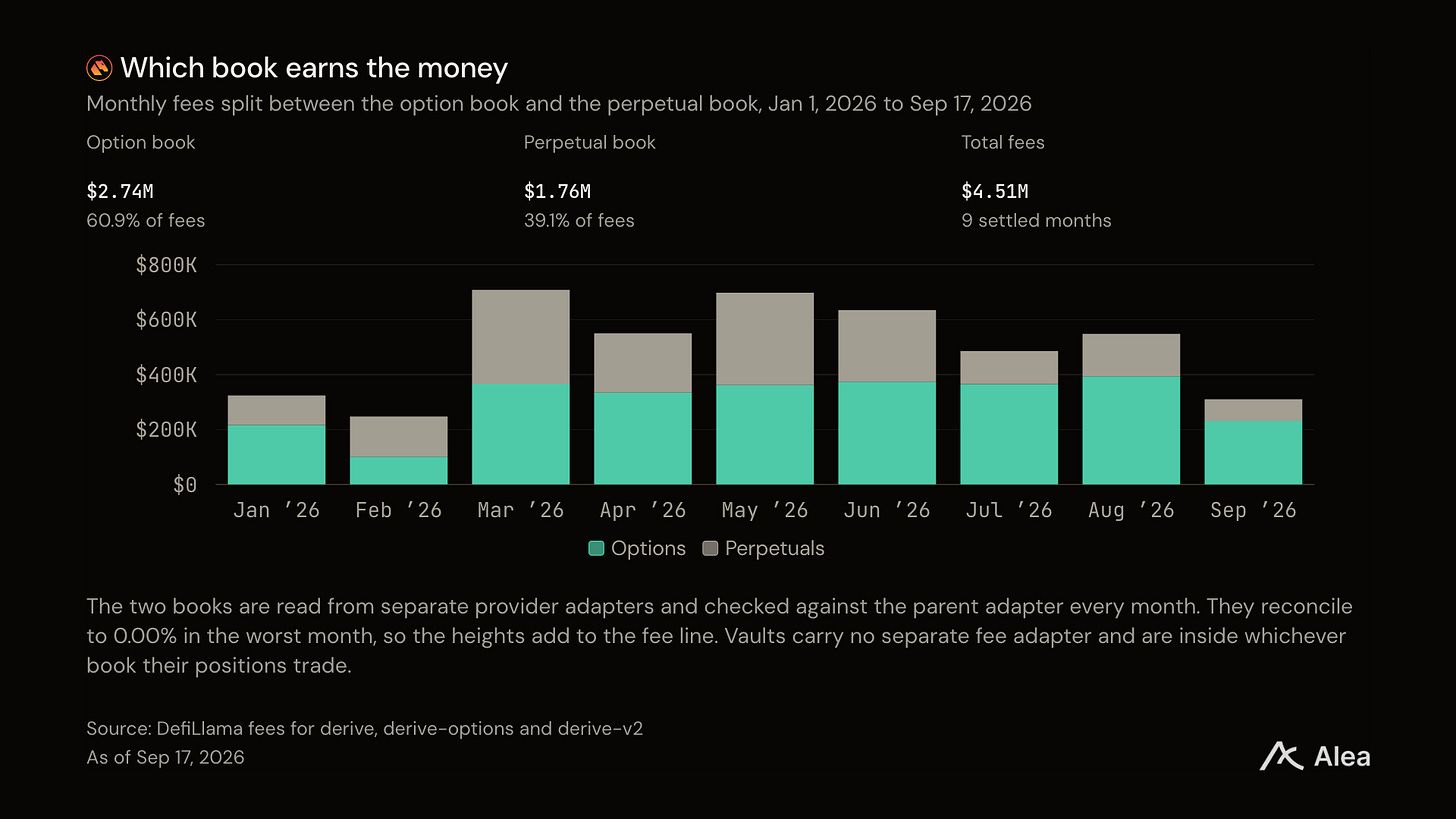
The option book earned $2.74M and the perpetual book $1.76M, which is 60.9% against 39.1%. In February the perpetual book earned more than the option book.
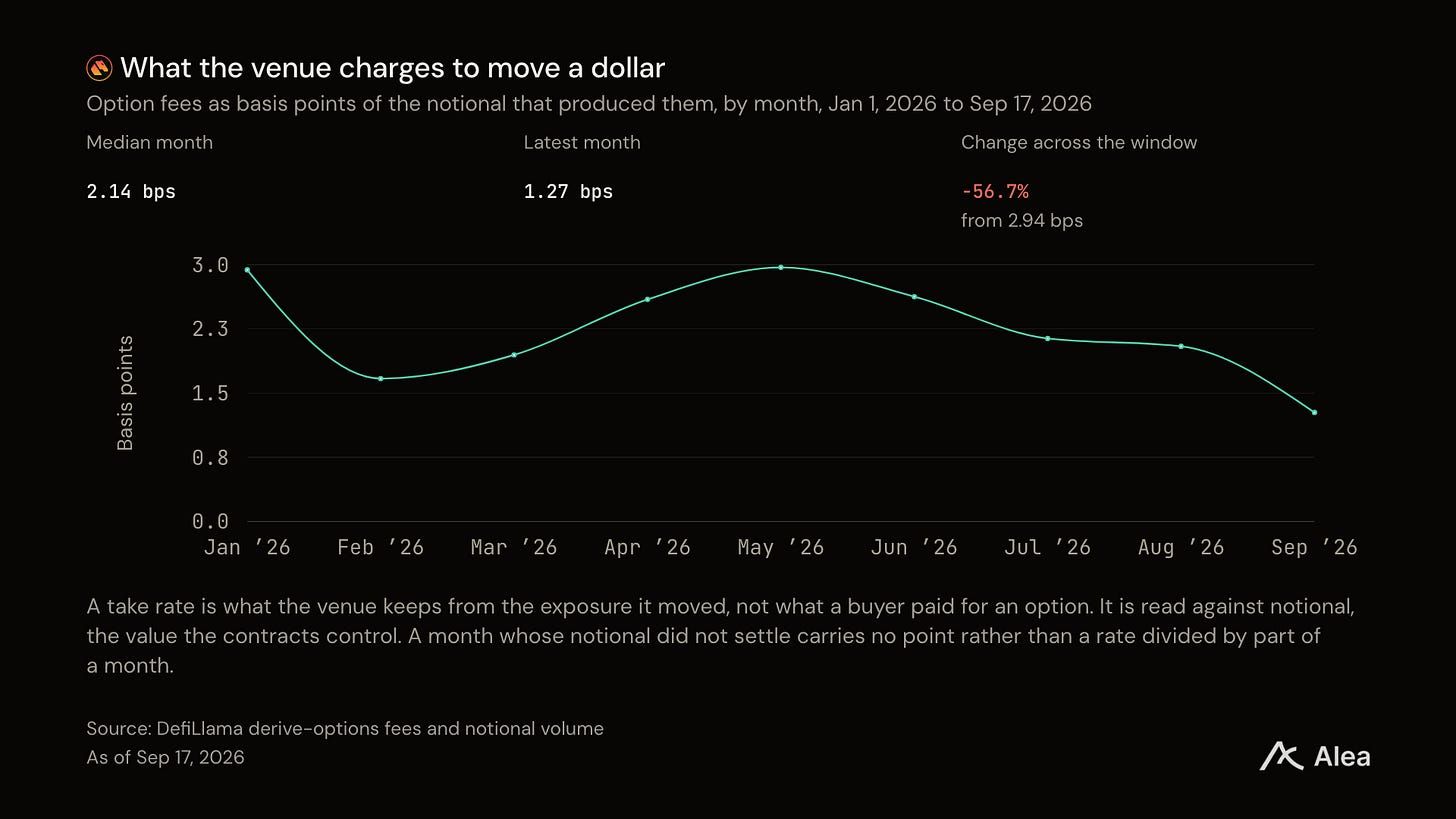
Option fees fell from 2.94 cents per $100 traded in January to 1.27 cents in September, a 56.7% decrease year to date. Volume rose over the same months and fees still grew.
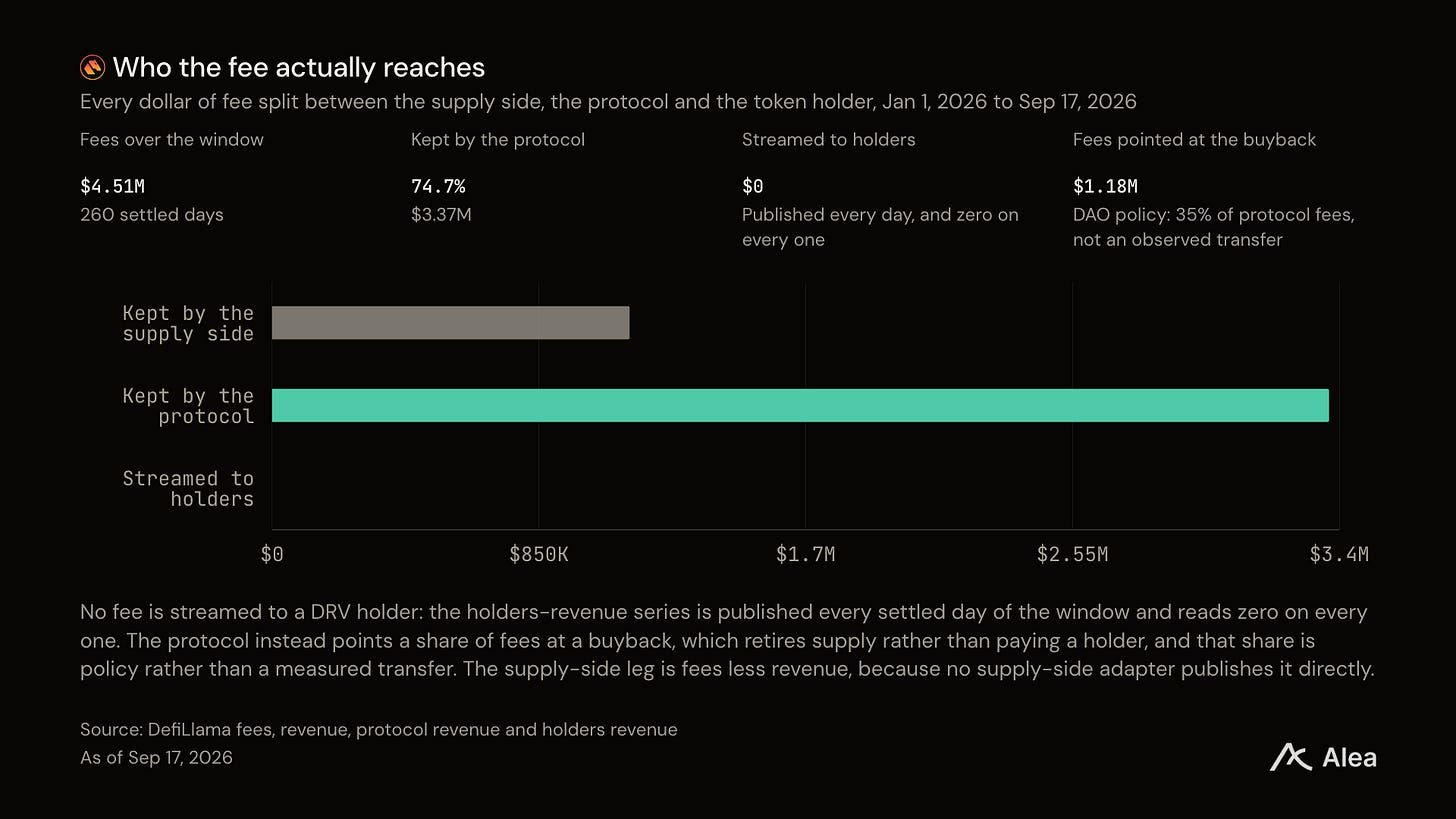
Derive routes its share of fees at a buyback rather than a distribution. It retires supply instead of paying a holder.
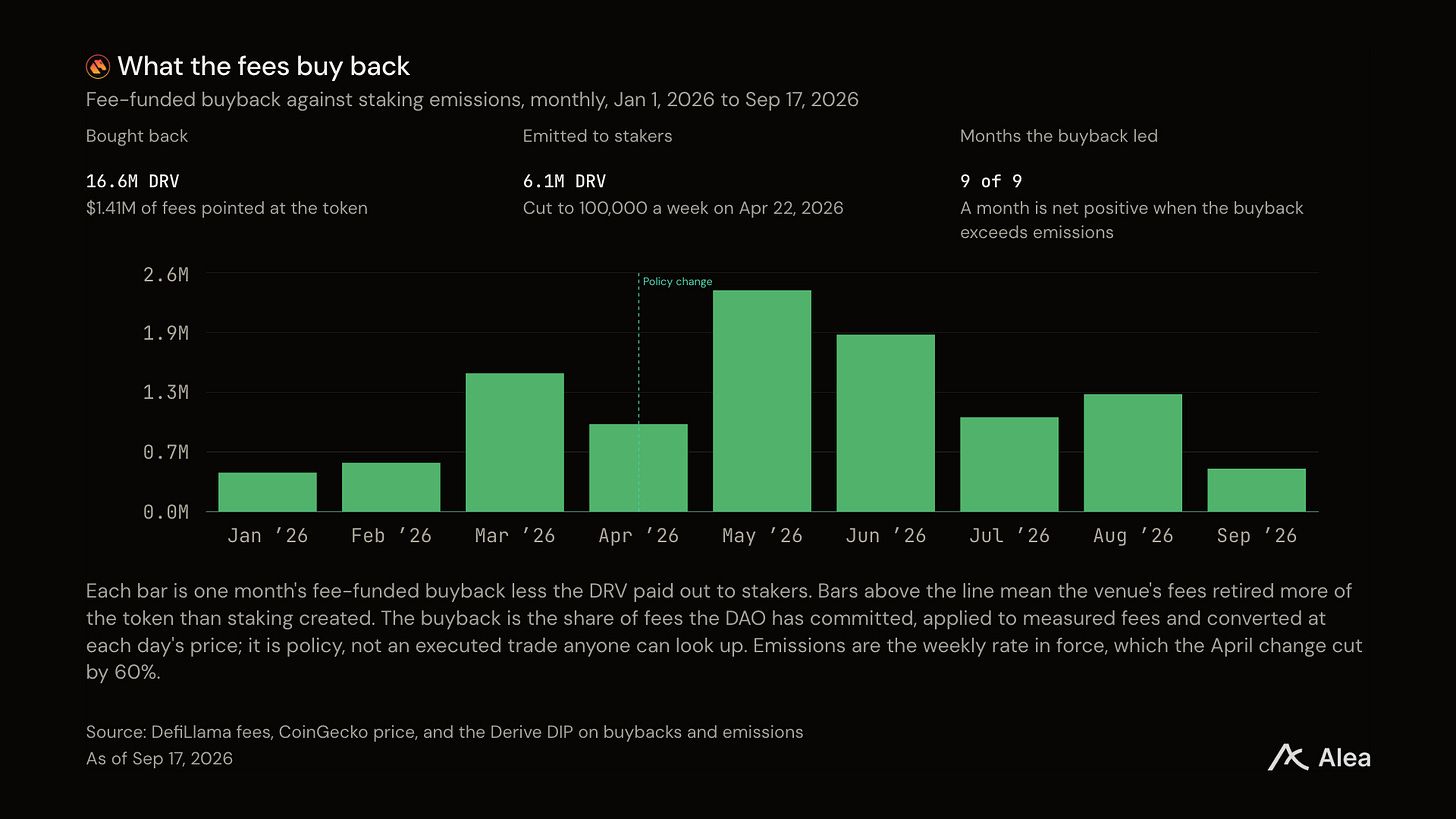
All nine months are positive: 16.6M DRV retired against 6.1M emitted. The DAO has retired 27,645,461 DRV in total, at 35% of fees. In April it raised that share from 25% and cut weekly staking emissions from 250,000 DRV to 100,000, taking annualized emission from 3.8% to 1.5%. The unstake period fell from 28 days to seven.
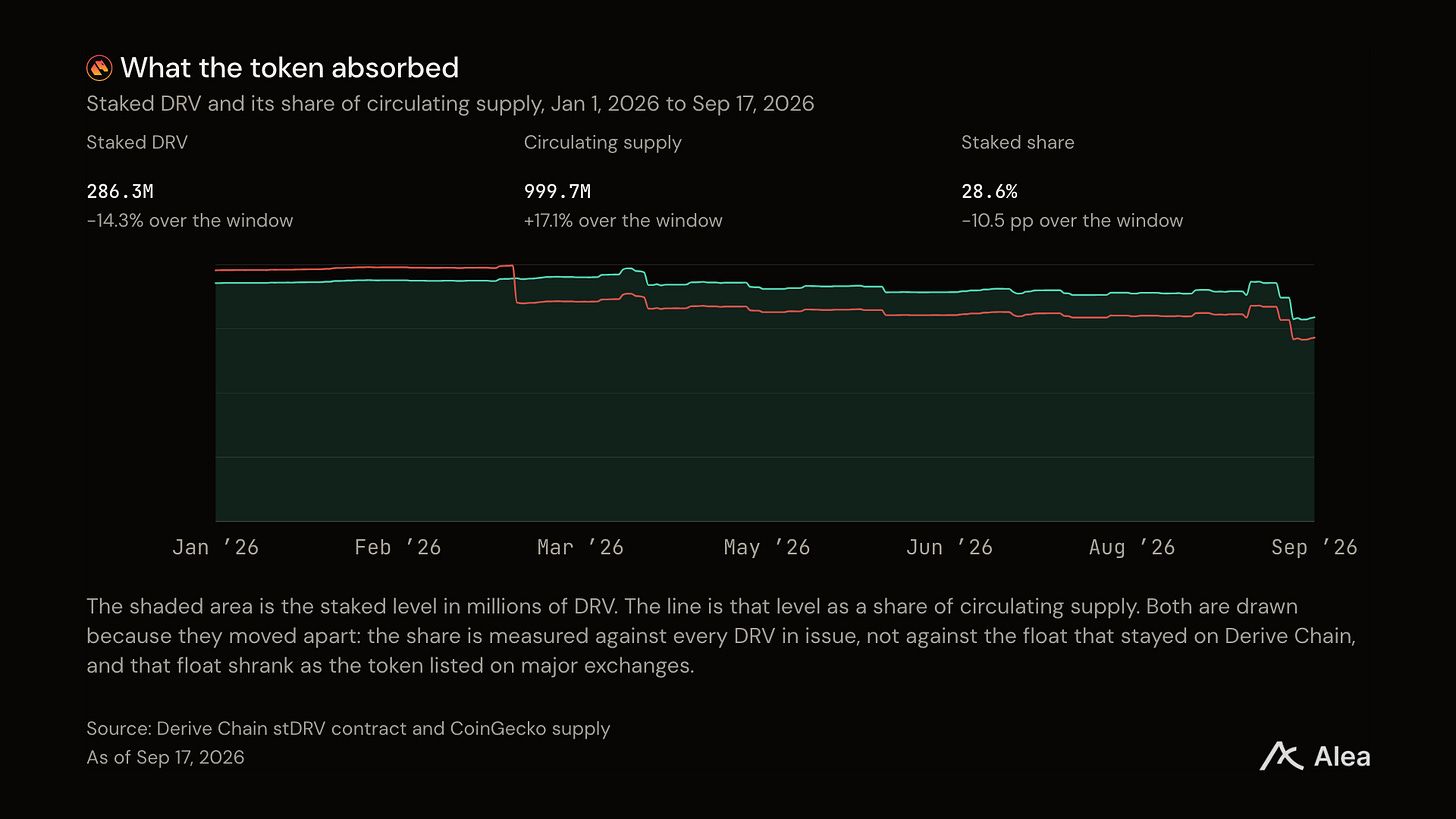
Circulating supply rose 17.1% this year while the staked share fell from 39.1% to 28.6%.
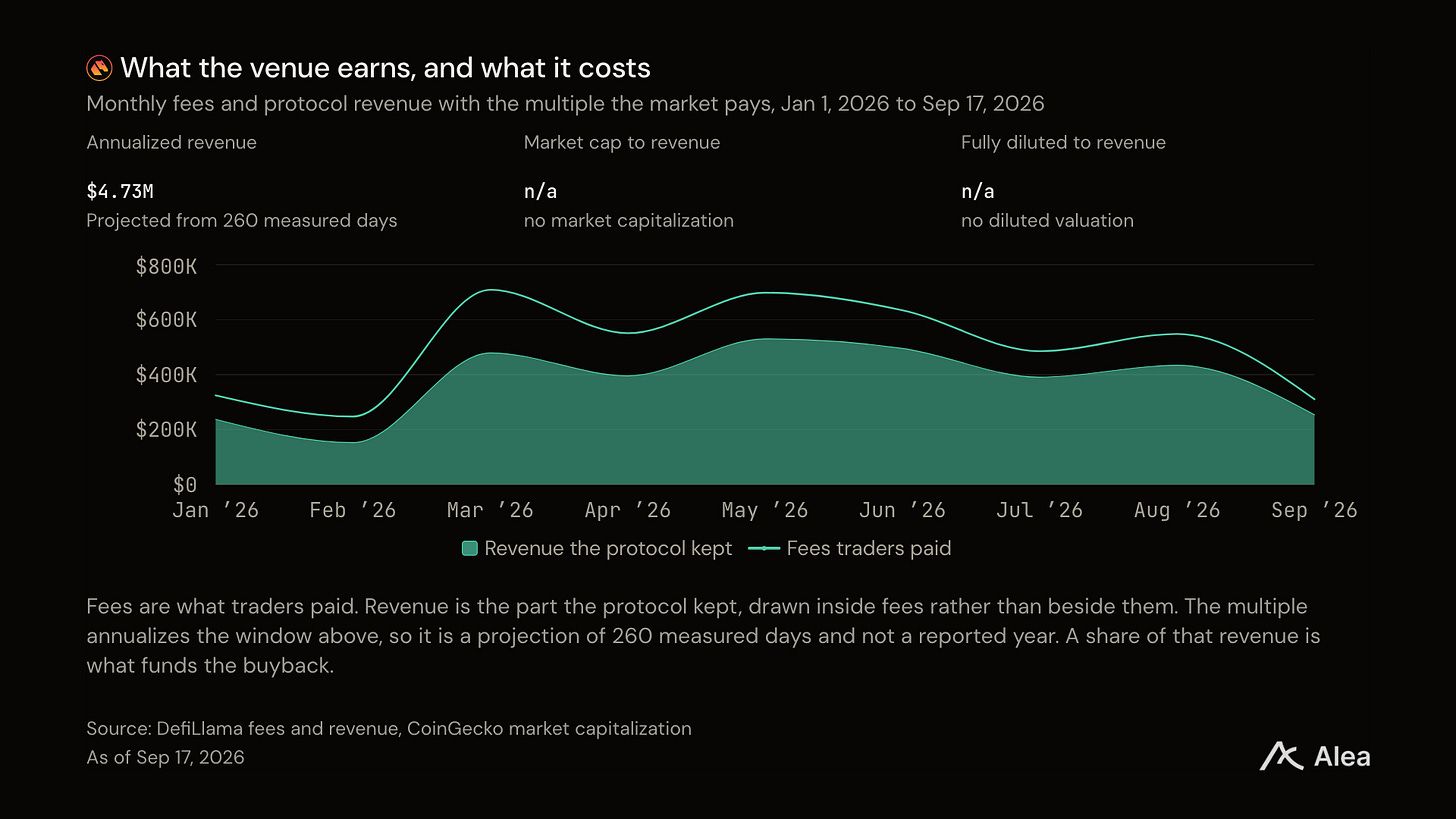
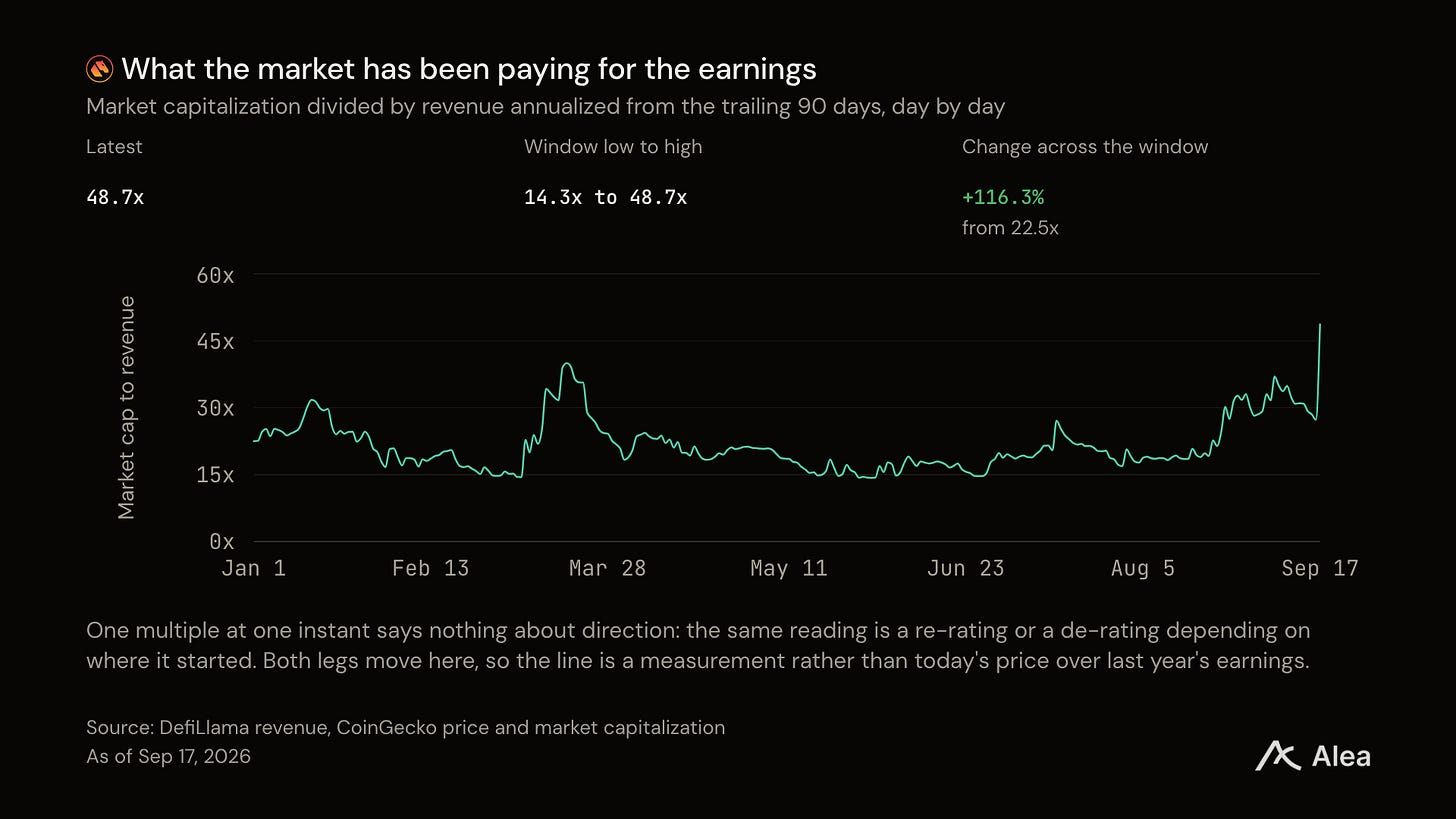
The multiple moved further than any other number this year. The market paid 22.5 times the venue’s annualized revenue in January and pays 48.7 times now, a 116.3% increase. The low was 14.3 times. Revenue grew through the same months, which means the re-rating is not a shrinking denominator.
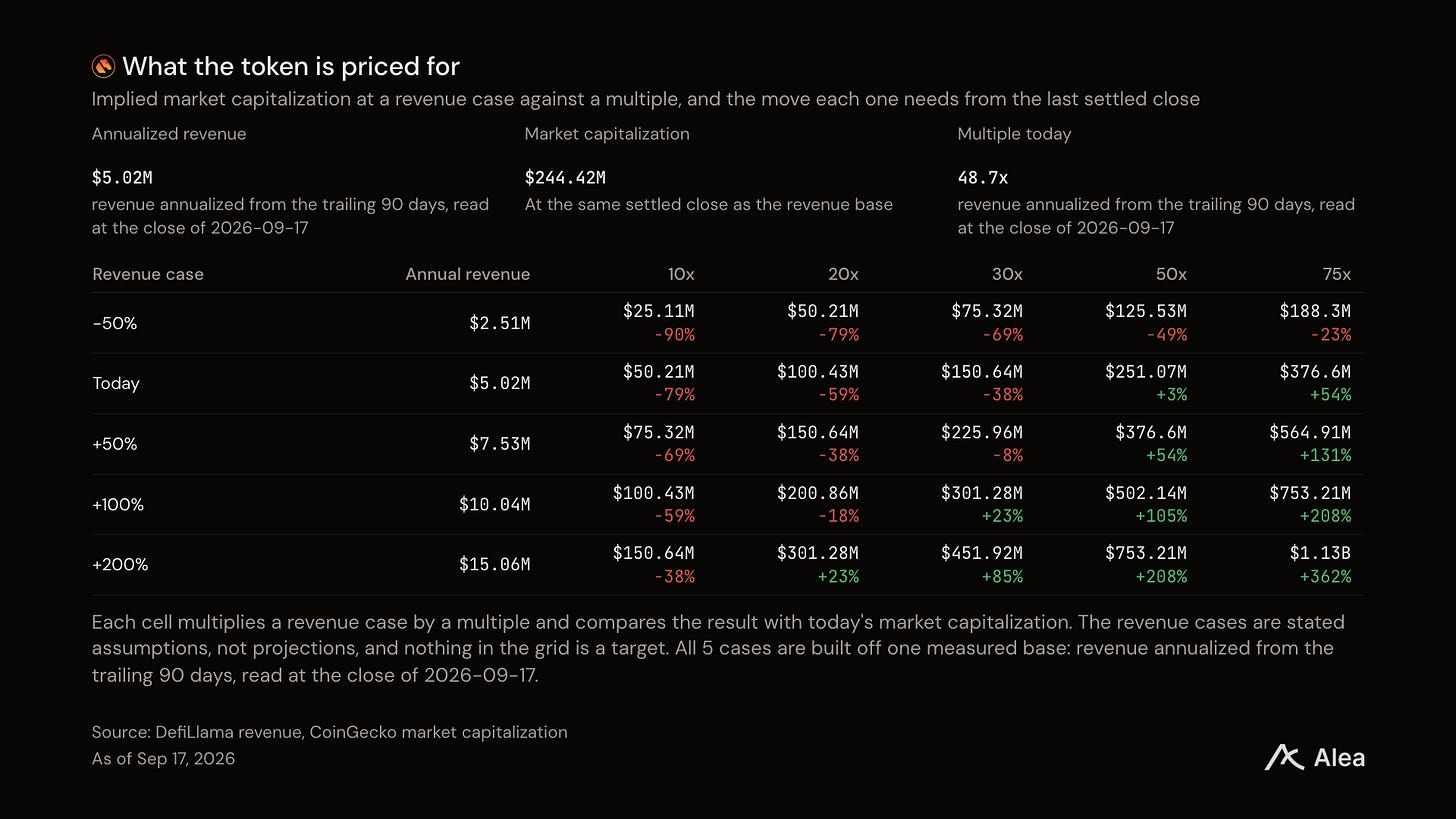
At 48.7 times, the price holds revenue that has to keep growing to justify it. The grid above prices each assumption.
What is scheduled
On Sep 14 a member filed a proposal to deploy Derive V3. Matching and sequencer state transitions would run inside a zero-knowledge virtual machine and settle on Ethereum. User funds would sit in Ethereum contracts. Derive Chain would wind down once V2 positions, balances, and rewards migrate into the V3 genesis state. The stated target is L2Beat Stage 1, the tier at which a user can exit without the operator’s help.
Derive said on Sep 16 that it had named Alex van Voorhees as Chief Legal and Compliance Officer, and that he came from FalconX, where he ran derivatives legal and served as interim compliance officer.
V3 settles on Ethereum, the ZEC book now runs to Mar 2027, and the venue reports 96% of the 89,100 ETH calls open at $5,000 and $7,000 for that month sitting on Derive.
Important Links
DIP: Launch Derive V3, filed Sep 14
DIP: Update DRV Buybacks, Staking Emissions and Unstake Period, April

Research reports. Deep Dives and Blueprints explain protocols and their economics. Theses and Memos examine investment cases and catalysts. Benchmarks compare performance, while Perspectives assess specific developments.
Weekly Pulse. Read a weekly assessment of macro and the major liquid markets.
Protocol Data Rooms. Research each protocol in one place, with Derive Analytics for historical comparisons and Derive Intel for news and governance developments.
Podcast Digest and Summit Digest. Read summaries of industry conversations and events. Find Alea shows and their episodes through Podcast Digest.
Governance Tracker. Follow proposals and voting activity across protocols.
For protocol teams preparing institutional conversations, discuss research for your protocol with Alea.