DeFi pays you a yield to hold its tokens, and those tokens can still fall below the value they promise. Insuring that fall has stayed costly because the people who sell cover keep their capital outside the yield they cover. DeFi's cover pools hold about $130M against $94.7B of deposits, or 14 cents per $100. The largest, Nexus Mutual, is down 85% from its 2021 peak. Tapir, now live on Base, splits a yield-bearing deposit in two. One half is covered against the first 50% of a loss, and the other half takes that loss first and earns more. Both halves keep earning the deposit's yield.
Takeaways
Tapir's cover sellers keep earning the yield they cover. Both of Tapir's tokens hold the same yield-bearing asset, which means the money behind the cover never leaves the yield. The seller earns the asset's yield plus the price of the cover.
One rule sets every payout. DP keeps its full value until the asset falls 50%, and YB loses 2% for each 1% fall. A formula on oracle prices pays both sides at maturity, with no claim to file and no vote.
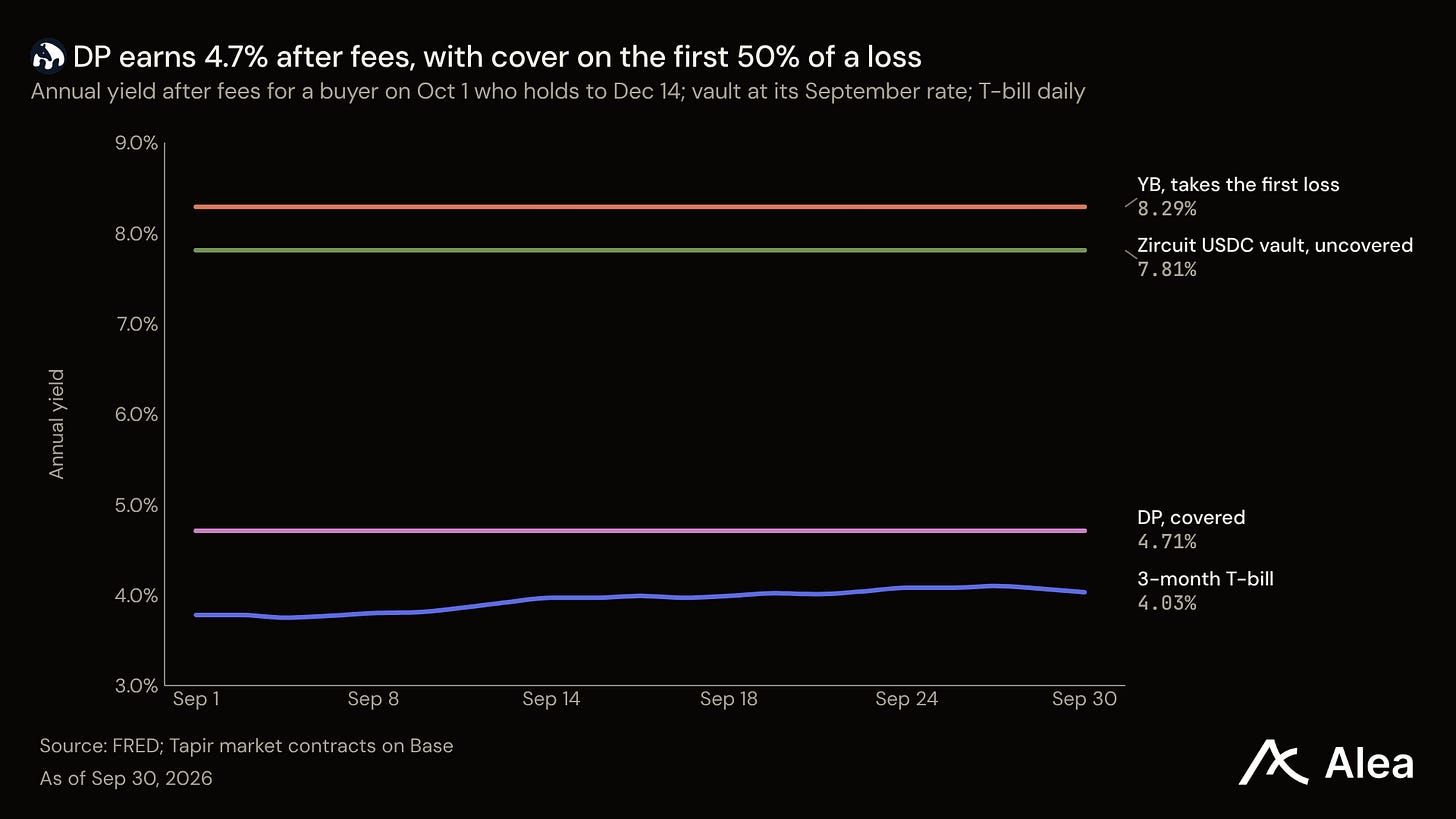
A holder of Zircuit Finance's USDC vault can now pick a side. DP pays about 4.7% a year after fees and holds its value through a 50% fall. YB pays about 8.3% and takes the loss first. The uncovered vault earned a 7.8% annual rate in September, and 3-month T-bills pay 4.03%.
Tapir charges 0.22% on each exit, set at a tenth of the yield a term is expected to earn. Its token plan sends half of all fees to buy back and burn TPR. Points launched on Sep 25, and Tapir stated that it'll set a token launch date when its deposits reach $10M.
One deposit becomes two tokens
A yield-bearing token pays you to hold it. A vault share grows as the vault earns, and a staked-ETH token grows with staking rewards. Each one promises to hold a value while it earns. A depeg breaks that promise: the token falls below the value it tracks, or the vault behind it loses money.
Tapir splits each base token by half into a DP token (depeg protected) and a YB token (yield boosted). With no loss, each DP and each YB redeems for one base token at maturity. Both sides earn the full yield, since the base yield-bearing asset itself grows.
When the asset falls, YB pays DP. Split $2,000 of the asset and you hold $1,000 of DP and $1,000 of YB. After a 10% fall, your DP is still worth $1,000 and your YB is worth $800, which together make the $1,800 the asset is now worth.
That example follows one rule you can apply to any case. DP holds its value until the asset falls 50%, and YB loses 2% for every 1% the asset falls. Past 50%, YB is worth nothing, and DP is worth twice what the uncovered asset keeps.
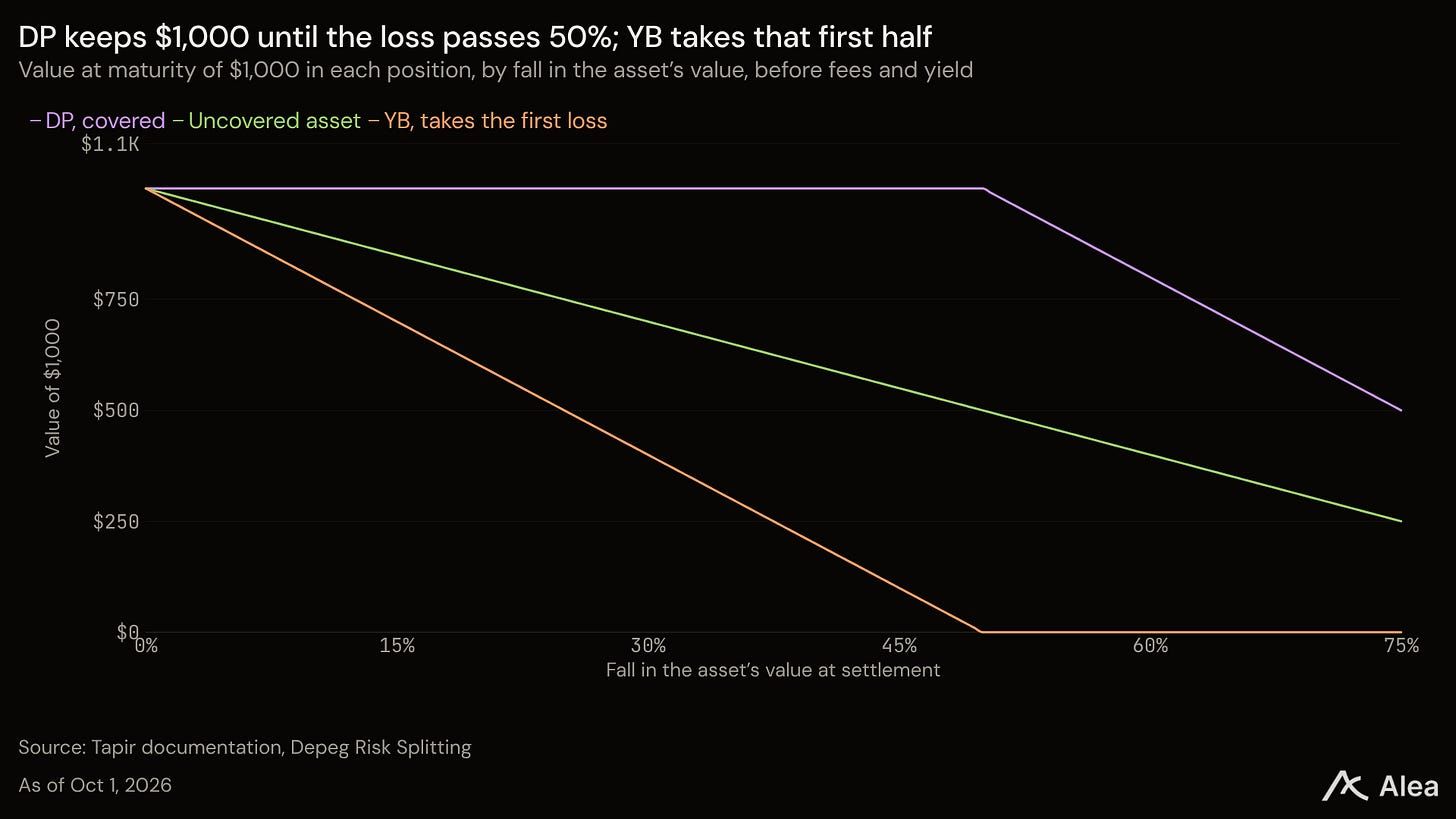
The 50% limit keeps every DP fully funded. Each DP has one YB behind it, and a YB can't lose more than its own value. That's why Tapir needs no separate reserve.
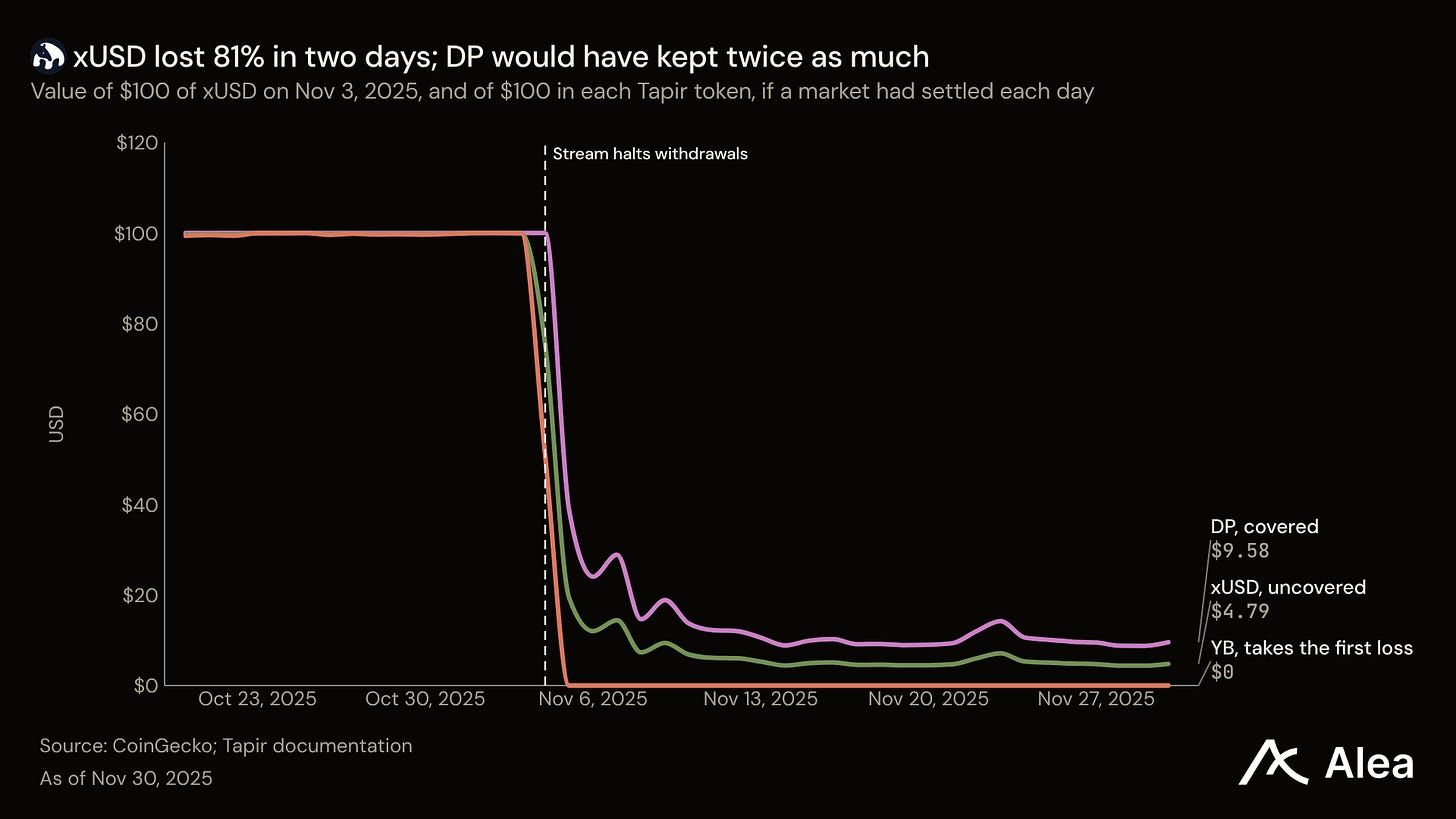
Stream Finance's xUSD shows what happens past the limit. xUSD was a dollar token that paid a yield. On Nov 4, 2025, Stream disclosed a $93M loss at an outside fund manager and halted withdrawals. Over the next two days, xUSD fell 81%.
Tapir never listed xUSD because the protocols wasn’t live yet, but its formula shows what a DP holder would have kept. Applied to xUSD's price on Nov 5, it would have paid DP holders $39 for every $100 they held at the Nov 3 high, twice the $19 left to uncovered holders. YB holders would have lost everything, which is the first loss they're paid to take.
At maturity, the pool compares two prices. The high watermark is the best level the asset held during the term, and the closing price is the median of recent days. A close that trails the high watermark by 0.1% or more triggers the payout by Tapir’s oracle. This formula replaces having to claim.
What you can do on the first market
Tapir's first market launched on Sep 22, on Zircuit Finance's USDC vault on Base. The vault lends USDC to fund managers and onchain lending markets, and its share value gained 0.64% in the 30 days to Oct 1, a rate of 7.8% a year. The market matures on Dec 14, with terms stating that DP covers two events: a USDC depeg and a fall in the vault share's value.
Tapir's app offers four actions:
Cover your deposit with DP. On Oct 1, DP paid about 4.7% a year, against 7.8% for the uncovered vault.
Earn more for the first loss with YB. YB paid about 8.3% a year.
Provide liquidity. Liquidity providers earn the 0.08% swap fee on DP and YB trades, plus points on those fees.
Earn points. DP and YB holders earn points for each full UTC day they hold. Each finalized point converts into one TPR token.
Both yields are after fees. They assume a buyer on Oct 1 who holds to Dec 14 and a vault that keeps its 30-day rate, and they count the 0.08% swap fee and the 0.22% exit fee.
Access runs through a request form Tapir published while liquidity builds.
What sets Tapir apart
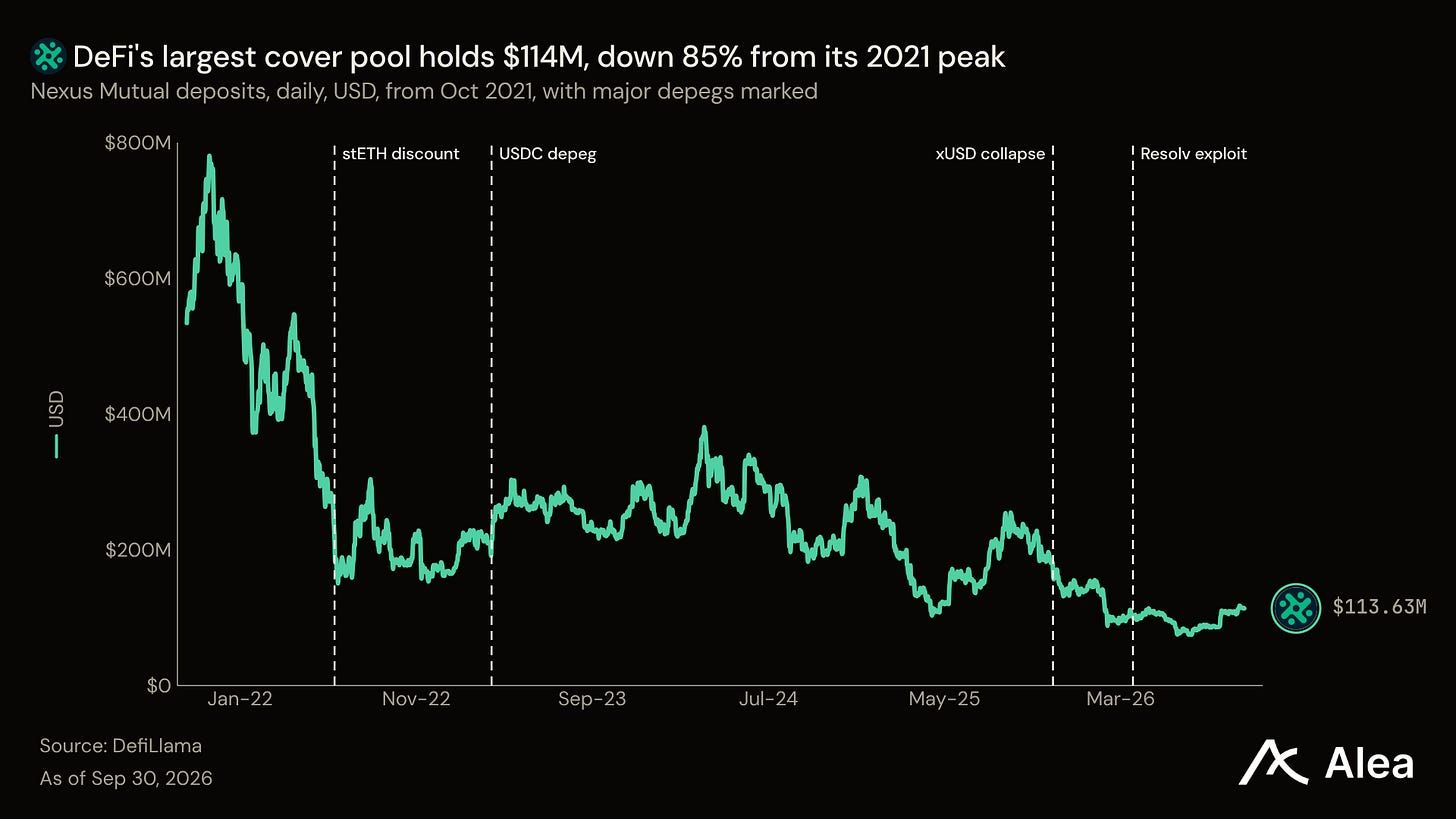
Cover in DeFi has shrunk for five years. Nexus Mutual, the largest cover pool, recorded $113.6M of deposits on Sep 30, down 85% from $780.6M in Nov 2021. Over those years, USDC, xUSD, and Resolv's USR all broke their pegs. The 31 protocols in DeFi's insurance category recorded about $130M in total.
On a Jul 8 podcast, Tapir co-founder Marko said that cover capital usually sits in assets that don't earn the yield it covers. That idle capital sets the price. A seller who covers a 5% asset with capital that earns nothing needs more than 5% in premiums before the trade pays.
Tapir removes that cost. A YB holder sells cover and still holds the yield-bearing asset, and YB earns the asset's yield plus the price of the cover. That's why YB pays 8.3% on a vault that pays 7.8%. Tapir's design lets the seller keep the underlying yield.
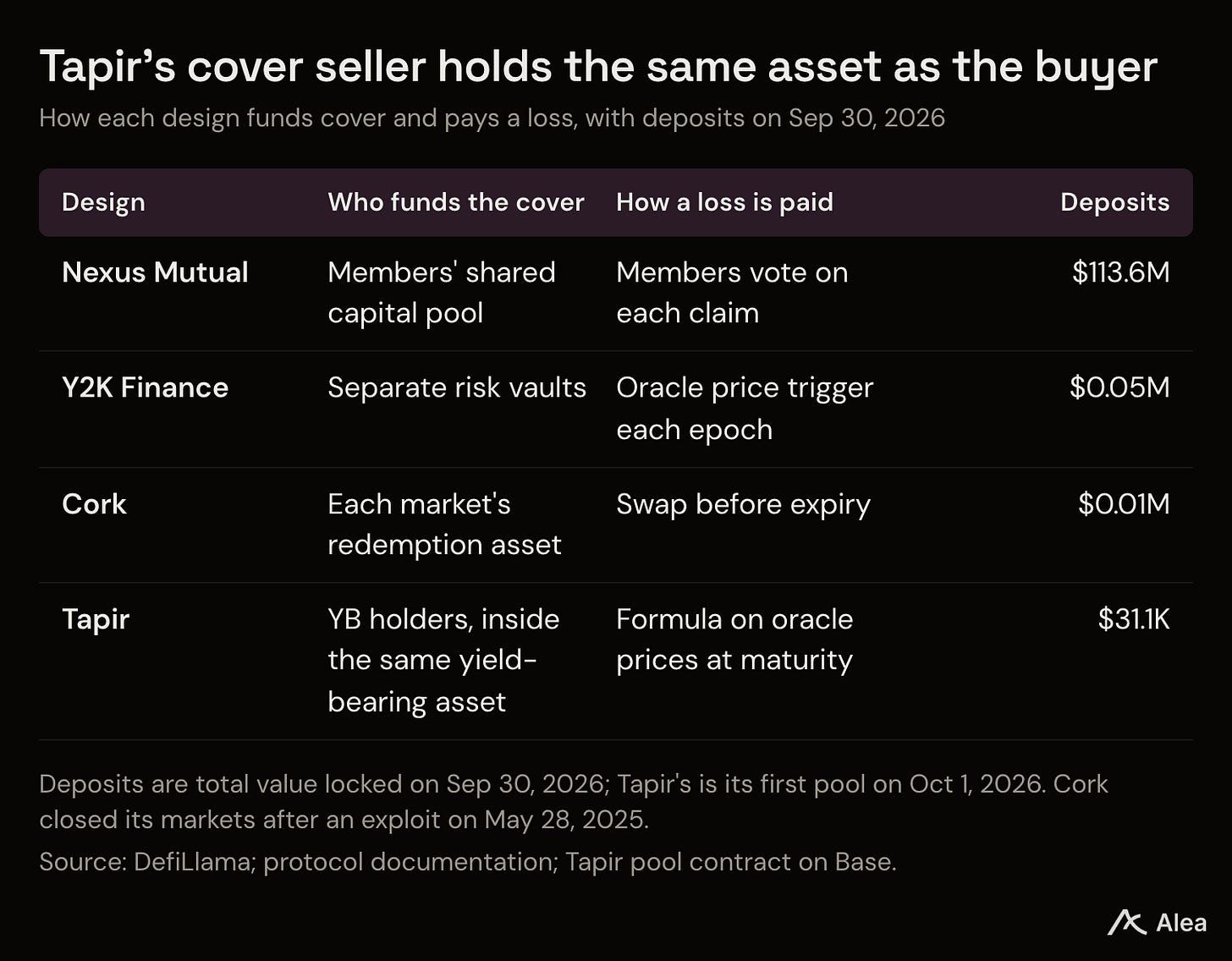
Other designs fund cover in other ways. Nexus Mutual pools its members' capital, and members vote on each claim. Y2K Finance paired hedge vaults with risk vaults and paid out on an oracle price. Cork sold depeg swaps until an exploit closed its markets on May 28, 2025.
Pendle is the closest relative at the primitive level, but for another use case. It splits a yield-bearing token into a principal token, which locks a fixed rate, and a yield token, which takes the floating yield. Both Pendle tokens still carry the loss if the asset breaks. Tapir splits the loss instead, and the two designs stack. Tapir launched an oracle for Pendle principal tokens, and with it a fixed-rate holder can buy DP on the same position.
How Tapir earns
Tapir charges nothing to split. It charges 0.22% when a holder unsplits or redeems, and that fee goes to Tapir's treasury, while swap fees go to liquidity providers. The exit fee equals 10% of the yield expected over the term. An 8% vault earns about 2.28% in 104 days, and a tenth of that is about 0.22%. For comparison, Pendle uses a fee of 5% of the yield its yield tokens collect.
If deposits roll from term to term, the fee comes to about 0.77% of deposits a year. Take Nexus Mutual's 2021 peak as a sensitivity: it held 0.44% of DeFi's deposits. At that share, Tapir would hold about $417M and collect about $3.2M a year.
Tapir's revenue is the exit fee, and its treasury receives it. Tapir published a plan for a TPR token with a supply of 1B, with 33% for the team and 18% for pre-seed and seed investors. Half of protocol fees would buy back and burn TPR, and half would fund a DAO treasury. The current contracts carry neither the token nor the buyback, and points are the only incentive that runs now.
What comes next
Points. Points launched on Sep 25 in weekly epochs. This market's 12 weeks carry 314,700 points, out of a 120M-point program.
A token date. Tapir stated that it'll announce a token launch date when protocol deposits reach $10M.
Maturity. The Zircuit market matures on Dec 14. Swaps pause on Dec 11, and holders redeem after the final price.
New markets. In July, Marko said that the next pools target higher yields, near 15%. The Pendle oracle lets a principal token become the base asset of a market.
Cover that keeps earning
Tapir changes who can sell cover and what it costs them. A YB holder sells cover without leaving the yield, which means the cover comes from capital that already earns. A DP holder keeps most of the yield and holds a 50% cushion that a formula pays. Each new market also puts a public, onchain price on the first loss of one yield-bearing token.
Important Links

Alea Research follows how DeFi prices and moves risk, protocol by protocol.
Research reports. Deep Dives and Blueprints explain protocols and their economics. Theses and Memos examine investment cases and catalysts. Benchmarks compare performance, while Perspectives assess specific developments.
Weekly Pulse. Read a weekly assessment of macro and the major liquid markets.
Protocol Data Rooms. Research each protocol in one place, with Analytics for historical comparisons and Intel for news and governance developments where available.
Podcast Digest and Summit Digest. Read summaries of industry conversations and events. Find Alea shows and their episodes through Podcast Digest.
Governance Tracker. Follow proposals and voting activity across protocols.
For protocol teams preparing institutional conversations, discuss research for your protocol with Alea.