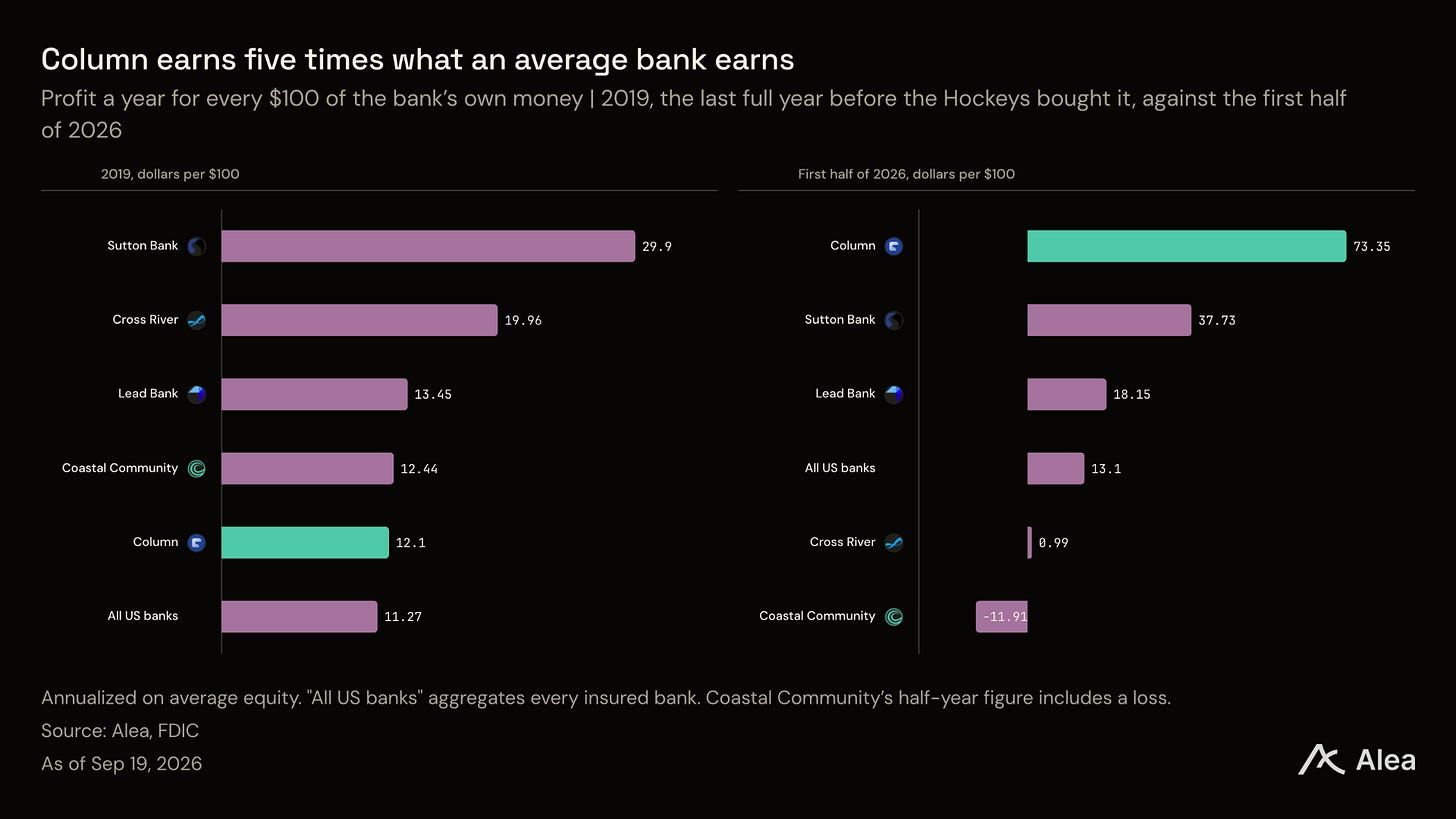
Every fintech founder of the last decade rented a bank. William Hockey bought one. He and Annie Hockey paid about $50M for a single-branch bank in Chico, California, then spent two years making it worse, because they were rewriting every piece of software inside it. Back in 2019 that bank was ordinary. Every $100 its owners kept inside it came back as $12 of profit a year, roughly what any American bank managed. It now comes back as $73, up 506%.
Takeaways
Column has the government's permission to hold deposits. It also wrote its own record of who owns what and approves its own card payments. Almost no bank does the third.
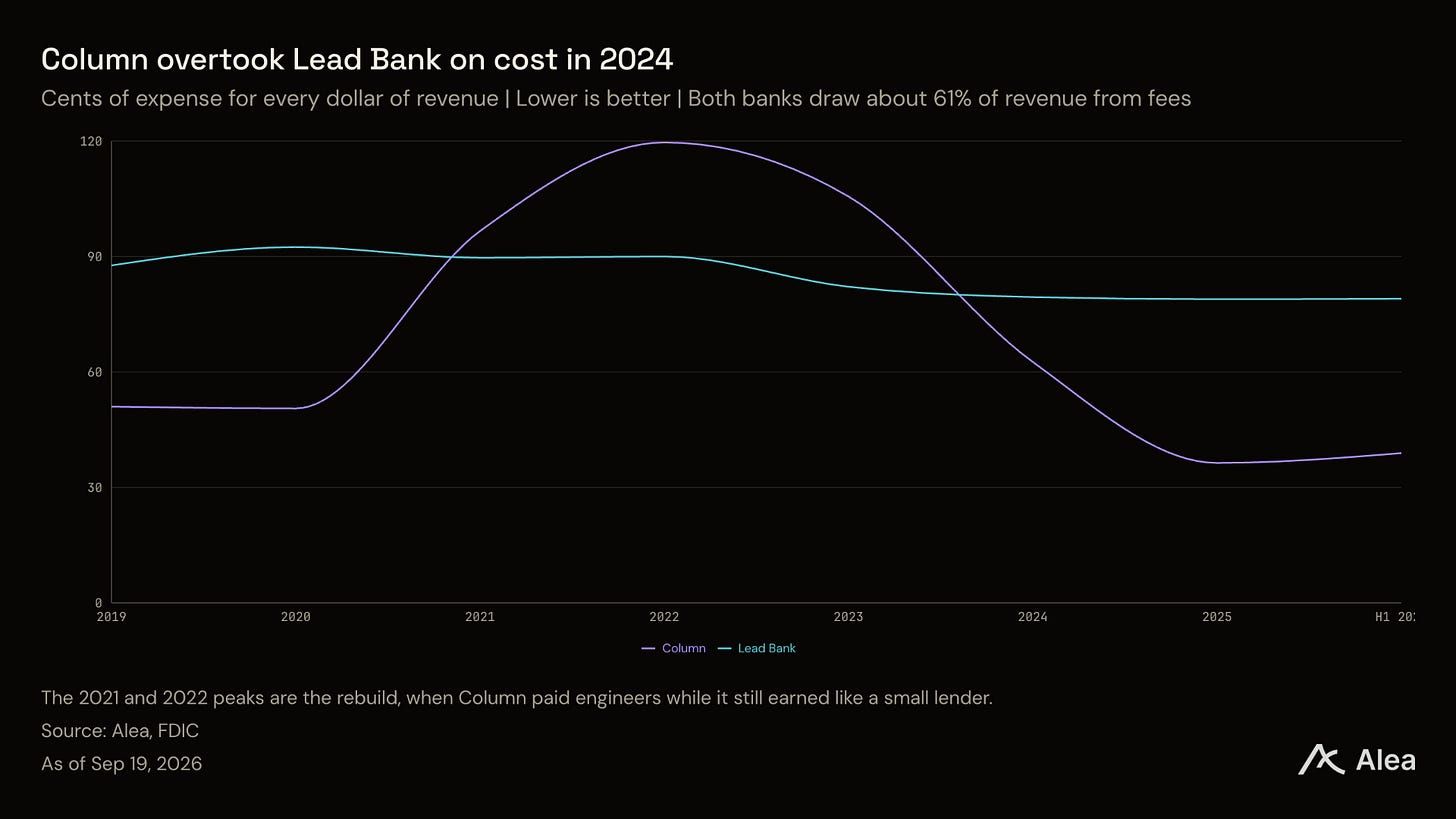
Owning those pieces shows up in what the bank spends. Column spends 39 cents to earn a dollar. Lead Bank spends 79 cents, and both take about 61% of their revenue from fees.
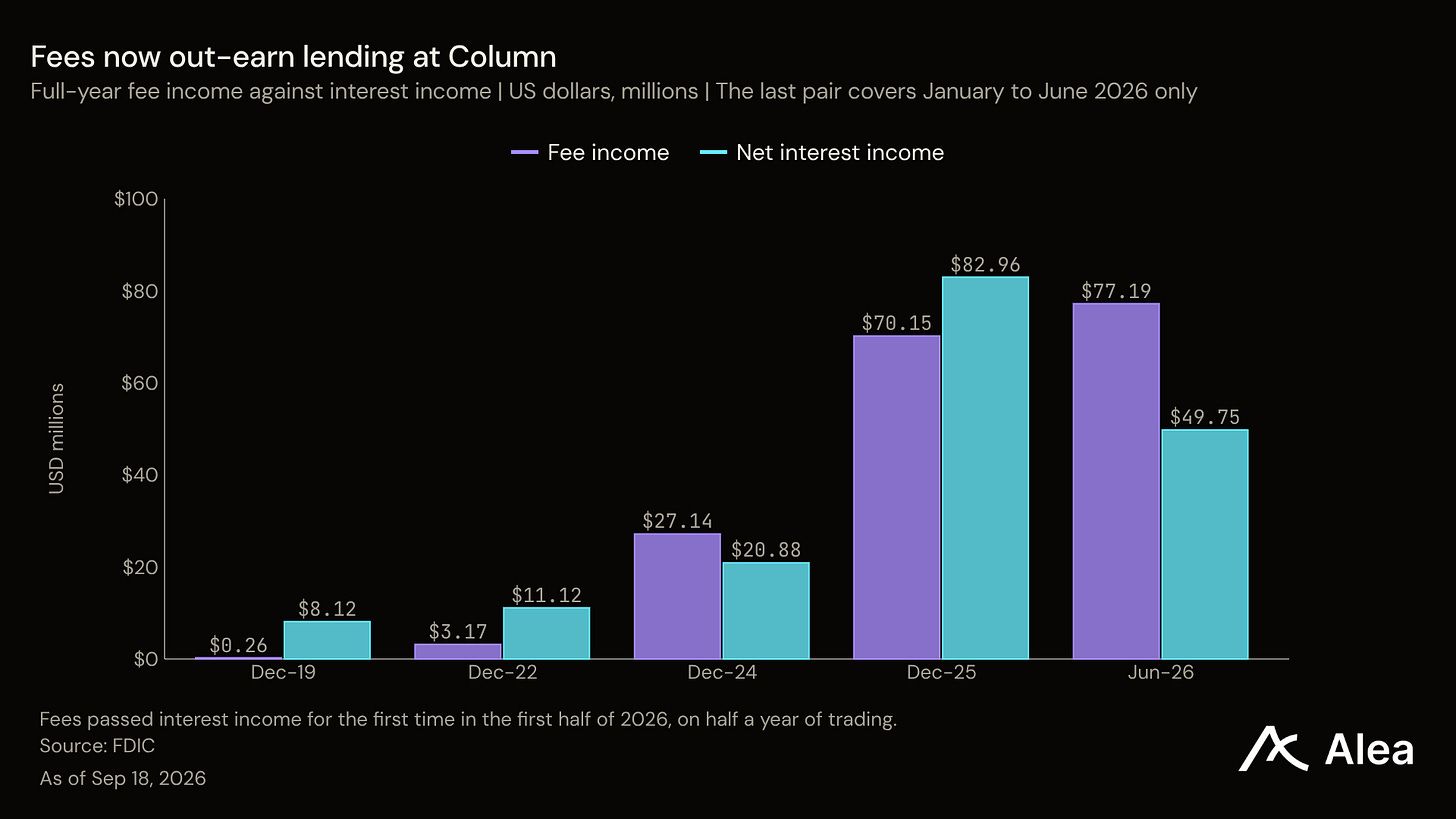
The bank now earns more from fees than from lending. Fees reached $77.2M in the first half of 2026, more than the whole of 2025.
A cardholder can spend a digital dollar the second it arrives, with nothing parked at a card company first.
What a fintech normally has to rent
Holding other people's money needs permission from the government. That permission takes years and a fortune in lawyers. Regulators rarely hand one to a company with no history, and a fintech does the sensible thing instead. It pays a small bank to hold the deposits under that bank's license, then builds the app on top.
Renting the license is only the first bill. A company that wants to hold money and put a card on top of it hires a string of other firms. One bank to hold the charter. One go-between to keep the record of who owns which dollars. One card company to approve each payment as it happens. And one specialist for money leaving the country. Each takes a cut, and none of them can see the others' records.
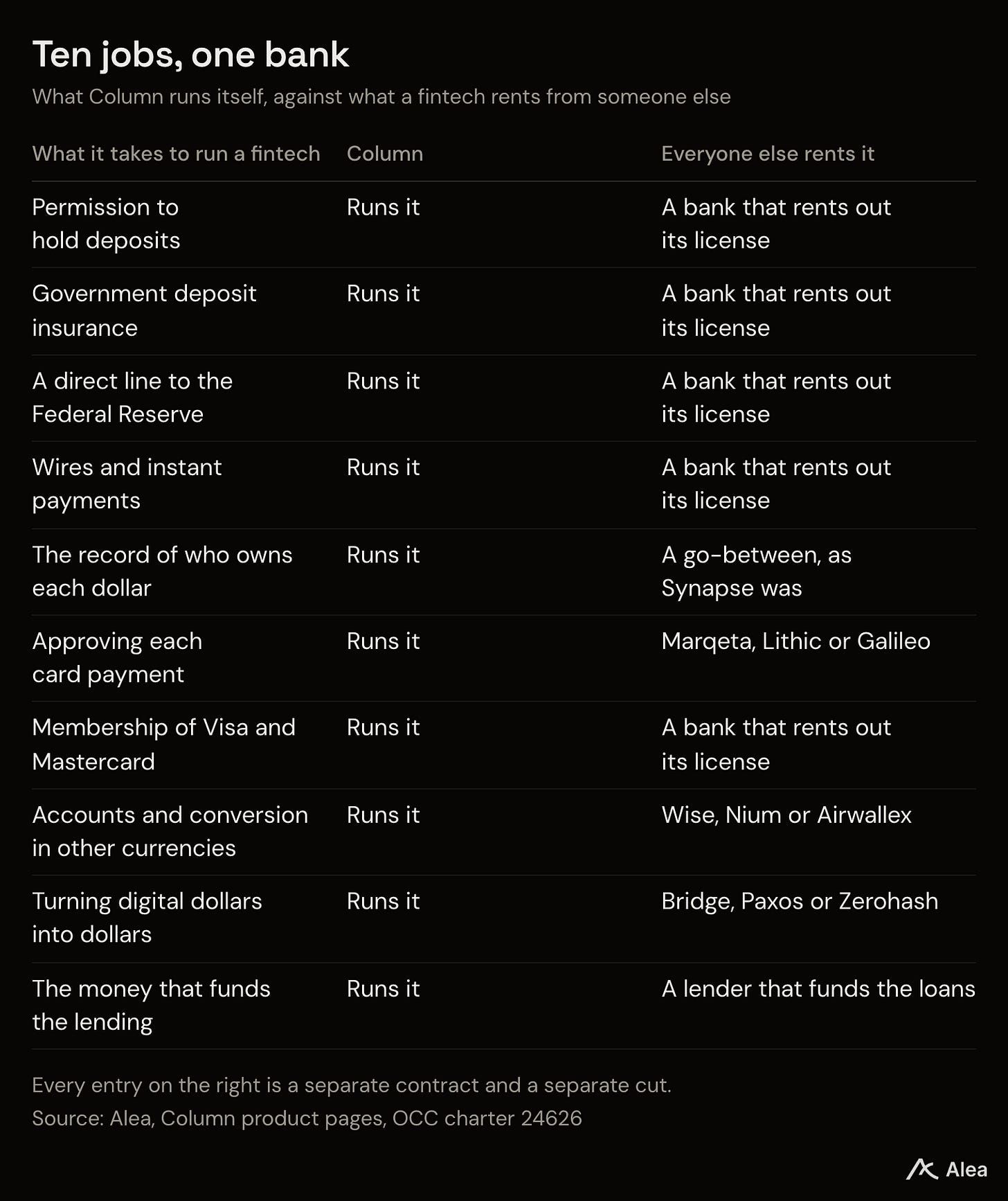
Column does every one of those jobs itself. It holds the charter and built its own ledger to track who owns what. It issues cards on both Visa and Mastercard, with no other bank in the middle. It also runs its own hardware, wired straight into the Federal Reserve at home and Swift abroad.
Hockey puts it plainly: "Instead of stitching together banks, orchestrators, issuer processors, and a dozen other vendors, you now only need one bank."
Who actually banks with Column
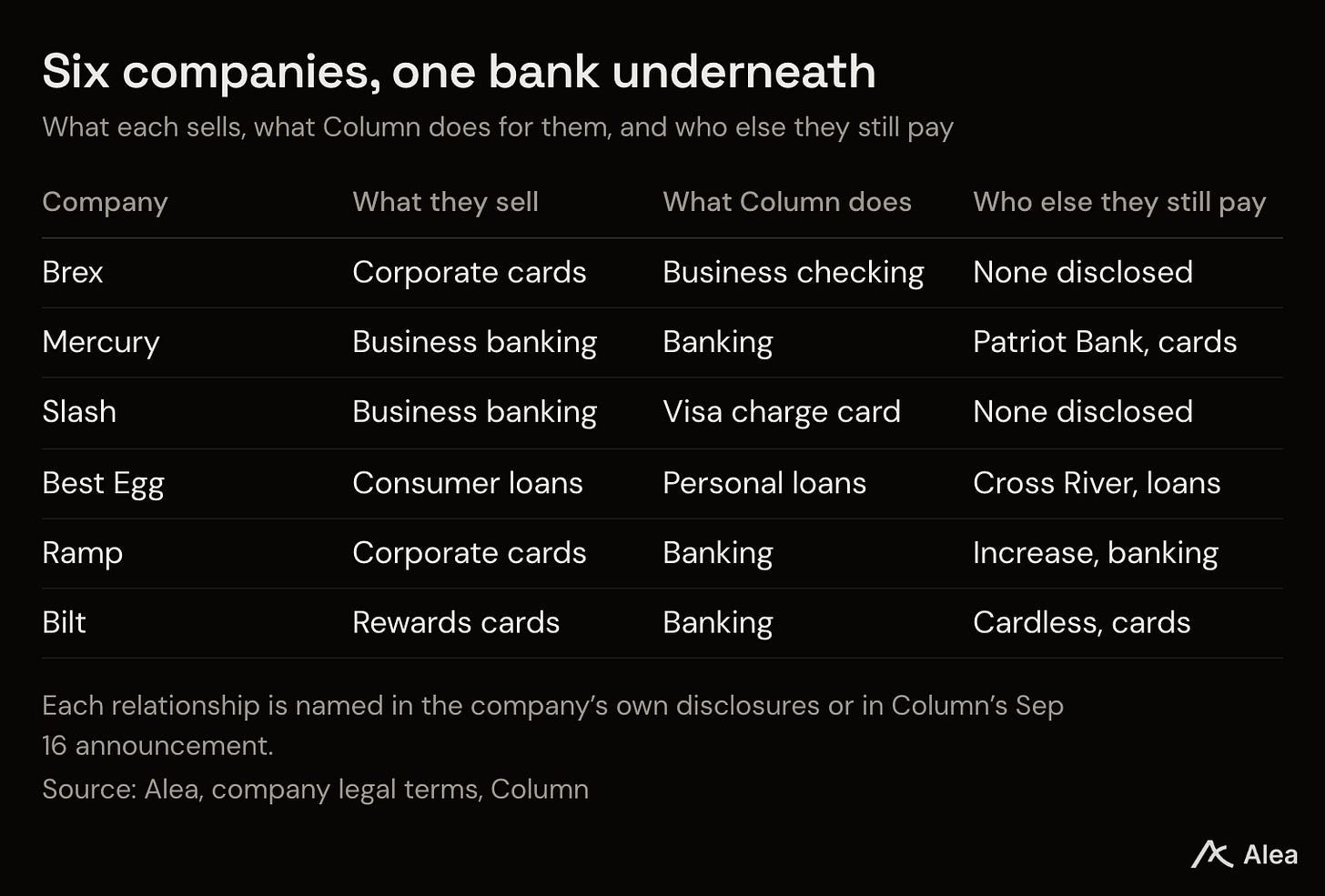
You can check the customer list, because a bank has to be named in its partners' own disclosures. Brex disclosed that Column holds its business checking. Mercury stated that its banking runs through both Choice Financial and Column. Slash confirmed that Column issues its Platinum card on Visa. Best Egg disclosed that its personal loans come from Cross River or Column. Ramp, Bilt, and Kapital were named as customers when Column launched on Sep 16.
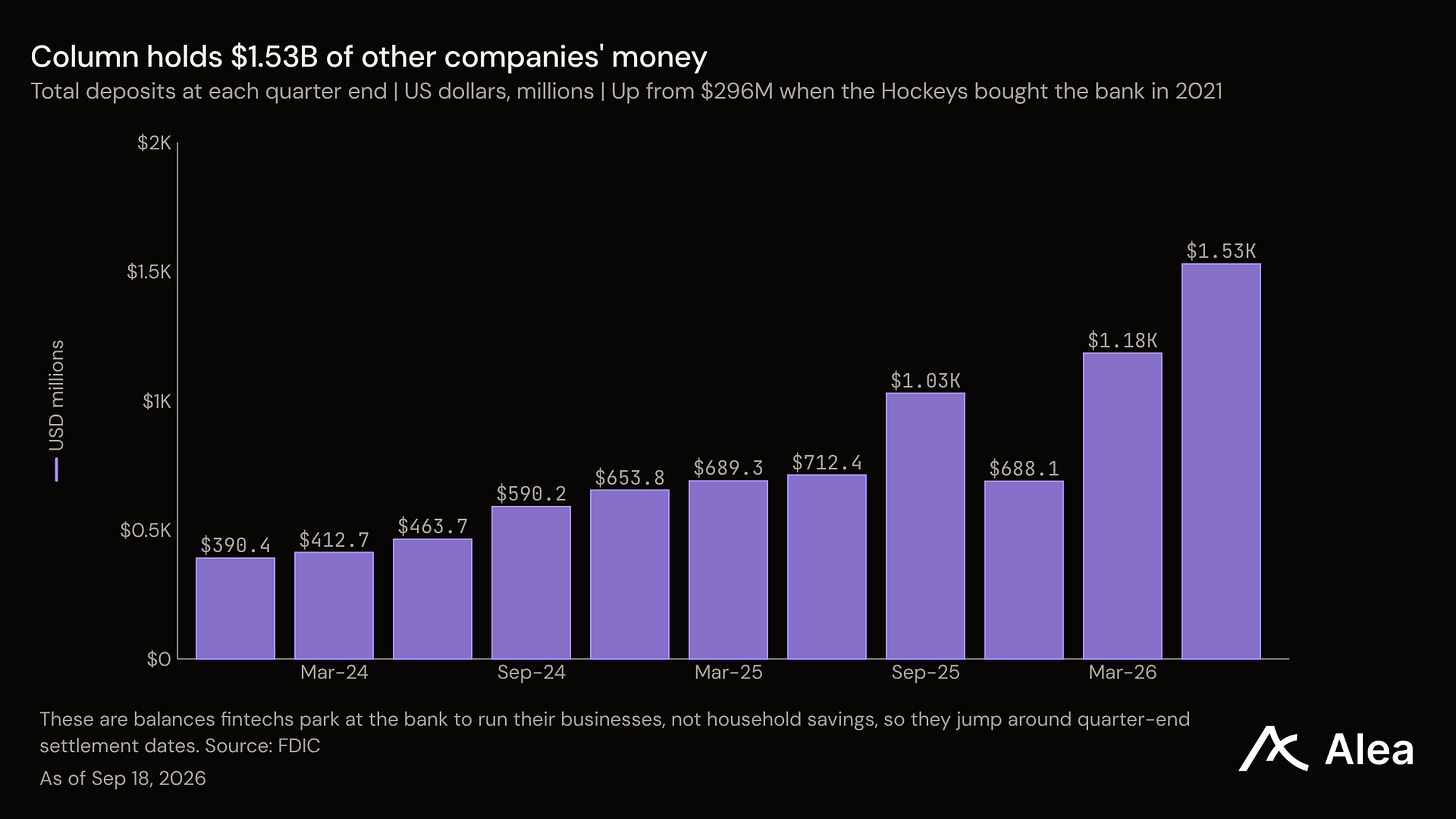
Deposits rose to $1.53B at the end of June, up from $296M in early 2021. This is money fintechs park at the bank to run their businesses, and it swings with their settlement dates. The figure fell to $688M at the end of December before more than doubling in six months.
Why your money needs a name on it
A bank account has your name on it, but money held through an app often does not.
As an example, Synapse sat between fintech apps and their partner banks, pooled thousands of customers' balances into one big account, and kept the record of who owned which slice in its own database. That database failed. The firm filed for bankruptcy on Apr 22, 2024, and the trustee reported that $65M to $96M of customer money was missing. People who thought they held insured deposits had no way to prove which dollars were theirs.
Column builds accounts the other way around. When it holds money for a platform's customers, each customer gets a numbered account inside the bank's own books. Column’s new foreign-currency accounts also carry an account number in the customer's own name.
The bank keeps the list, and the bank is the one the government examines (Column has never had an enforcement action from a regulator).
What it costs to run a bank you wrote yourself
Rewriting a bank is expensive while you do it and cheap afterwards. Banks keep their records on software sold by a handful of vendors, where every change is a ticket and a fee. Hockey's team threw that out and wrote its own. For two years the bank paid engineers while it still earned like a small lender. That is the whole story of the 2022 number: 119.64%, or $1.20 of expense for every $1.00 of revenue.
Now take Lead Bank, which draws 61.9% of its revenue from fees, almost exactly Column's 60.8%. Both banks earn the same way. But Lead Bank still earns $18 a year on every $100 of its own money, against Column's $73.
What shipped on Sep 16
Stablecoins put a digital dollar address on the same books as the bank account. Column launched it with Slash and Brex, runs it on Solana and Ethereum, and wires it into Swift, RTP, ACH, and checks, which are the pipes dollars travel through. This way, the money a platform normally parks in advance stops being necessary. A platform can take USDC at 9pm on a Saturday and pay it out a second later.
Full-stack card issuing is the piece that was missing. A card program normally needs three firms: a bank to settle with the networks, a processor to approve each payment, and someone to fund the spending until the cardholder pays.
Almost no bank does the approving, which is the most technical of the three. Column now does all of it, and its cards can be backed by stablecoins, or settled in them.
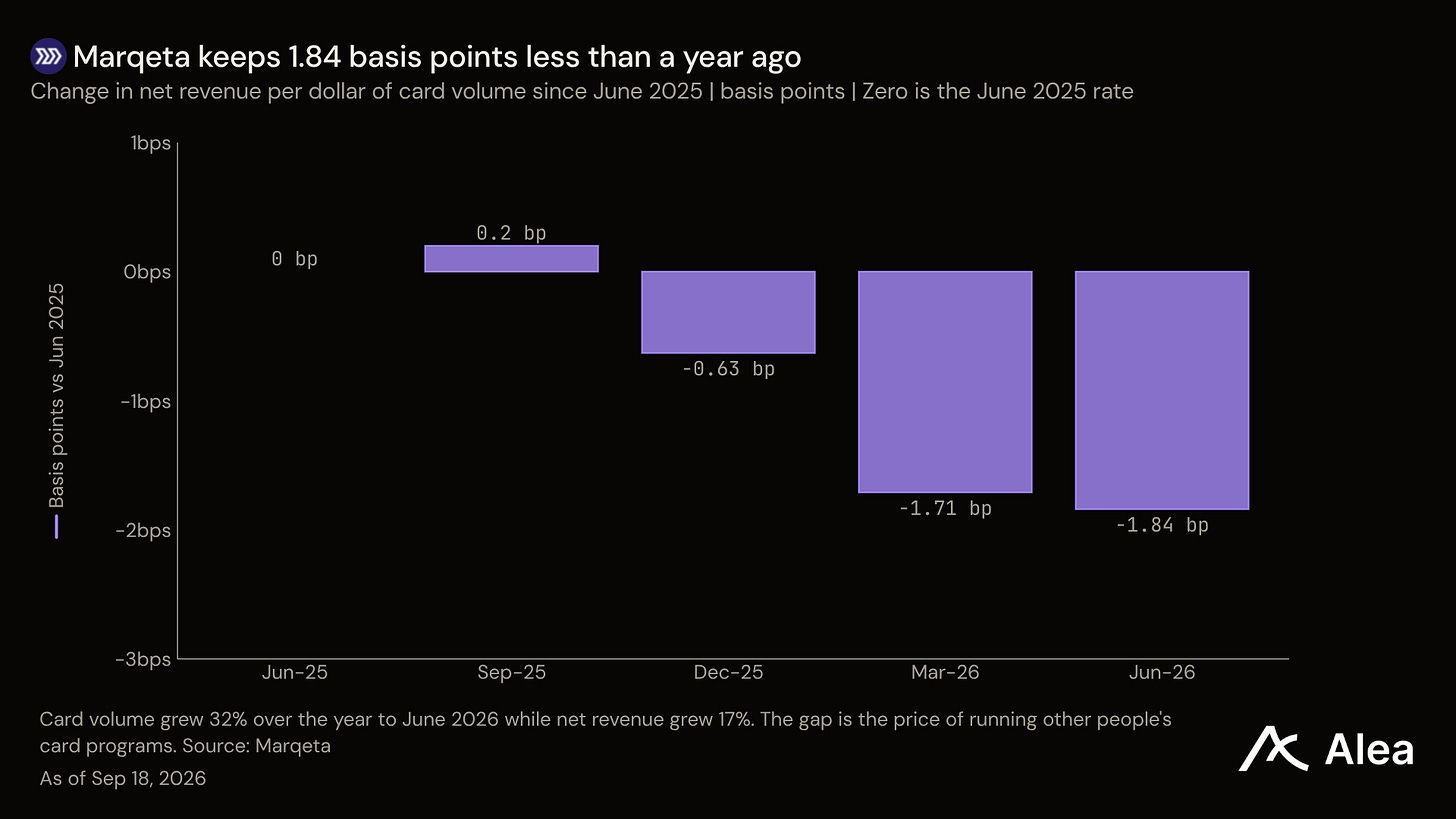
That approving layer keeps less of every dollar it handles each quarter. Marqeta, a listed company that does card processing and nothing else, reported $120.4B of card payments in the June quarter, up 32% year over year. Its revenue after network costs rose 17% year over year, to $176.0M. Volume grew at twice the rate of revenue, and Marqeta disclosed that one customer supplies 41% of it.
Global banking and multicurrency finish the set. Column launched dollar and local-currency accounts for customers outside the US, with instant conversion between them and a connection to Europe's instant-payment systems. It already moves hundreds of billions of dollars a year across borders.
What a bank charter actually buys
A charter is the government's permission to hold other people's money, and it comes in two kinds. The OCC approved five crypto firms for the lighter kind on Dec 12, 2025, Circle and Ripple among them. Stripe's Bridge announced its own approval in February.
A trust charter lets a company look after assets for other people. It stops short of taking a deposit, making a loan, or carrying government insurance, and the Federal Reserve account that moves money between banks takes a separate application.
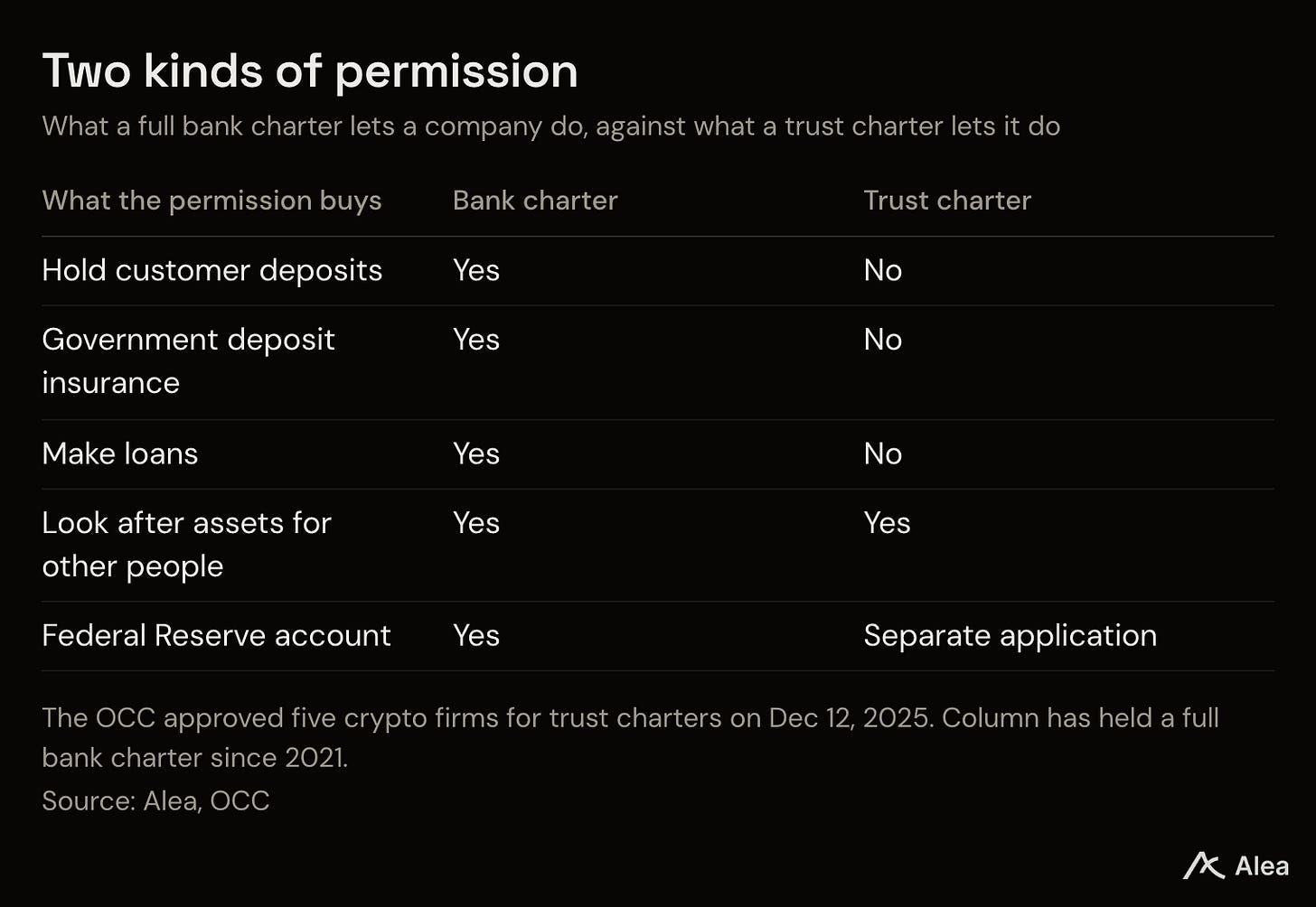
That difference has a deadline on it. The GENIUS Act, signed in July 2025, requires a license to issue a payment stablecoin in the United States from Jan 18, 2027. A subsidiary of an insured bank is one of the routes the law permits. The OCC published its proposed rules in February and closed comments on May 1. Column already holds the kind of charter the law describes, and it moved the bank's head office to Salt Lake City on Jun 12, 2026, three months before the launch.
How the money comes in
Column's revenue reached $153.1M in 2025, up from $48.0M the year before. The filing splits that into $83.0M from lending and $70.2M from fees. The fee line alone rose 158% year over year.
Then the first half of 2026 produced $77.2M of fees on its own, more than the whole of last year. And fees passed lending income for the first time.
The filing recorded 170 people in June, which works out to about $1.49M of revenue a year each at the pace of the first half.
Lending is growing again too, after three flat years. Net loans sat between $187M and $213M from 2021 through 2025, then rose 70% in the six months to June, to $356.6M.
Where Hockey is taking it
The sponsor-bank market Column already leads sits beneath its ambition. "Our ambition is not to dominate sponsor banking in Silicon Valley," Hockey said in February, and he describes the goal in much bigger terms: "the world is dollarizing, and we want to be the operating system for that."
The hiring backs the sentence. Column has published three emerging-markets roles, two in Dubai covering the former Soviet states and the Middle East and one in Tashkent. Each is tasked with "driving 0-to-1 growth for a new banking product" in its region. A fourth role, in San Francisco, opens correspondent relationships with banks abroad.
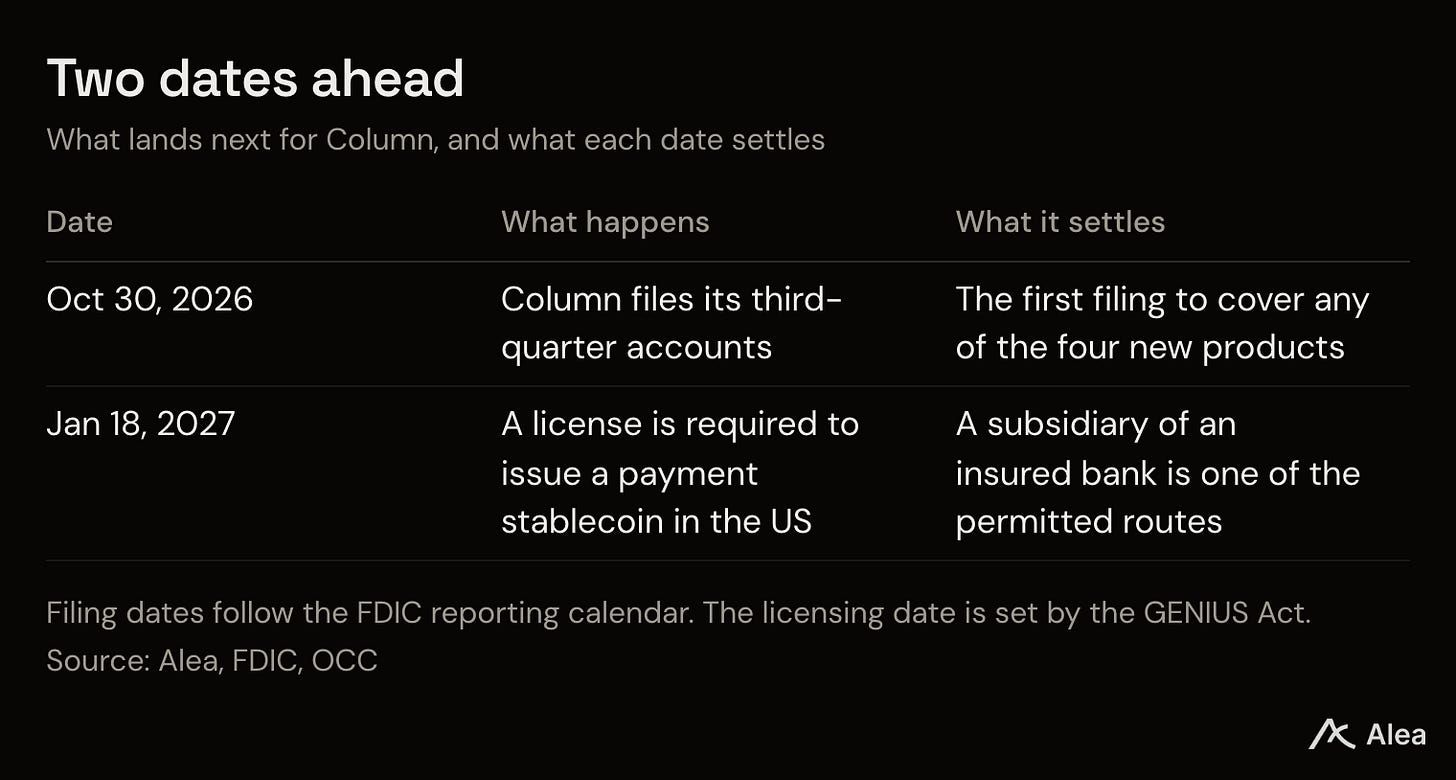
That is what Sep 16 gives Column.
Important Links

If this edition was useful, the rest of Alea's work covers the same ground: what a company owns, how it earns, and what the filings show. Here is where to find it.
Research reports. Deep Dives and Blueprints explain protocols and their economics. Theses and Memos examine investment cases and catalysts. Benchmarks compare performance, while Perspectives assess specific developments.
Weekly Pulse. Read a weekly assessment of macro and the major liquid markets.
Protocol Data Rooms. Research each protocol in one place, with Analytics for historical comparisons and Intel for news and governance developments where available.
Podcast Digest and Summit Digest. Read summaries of industry conversations and events. Find Alea shows and their episodes through Podcast Digest.
Governance Tracker. Follow proposals and voting activity across protocols.
For protocol teams preparing institutional conversations, discuss research for your protocol with Alea.