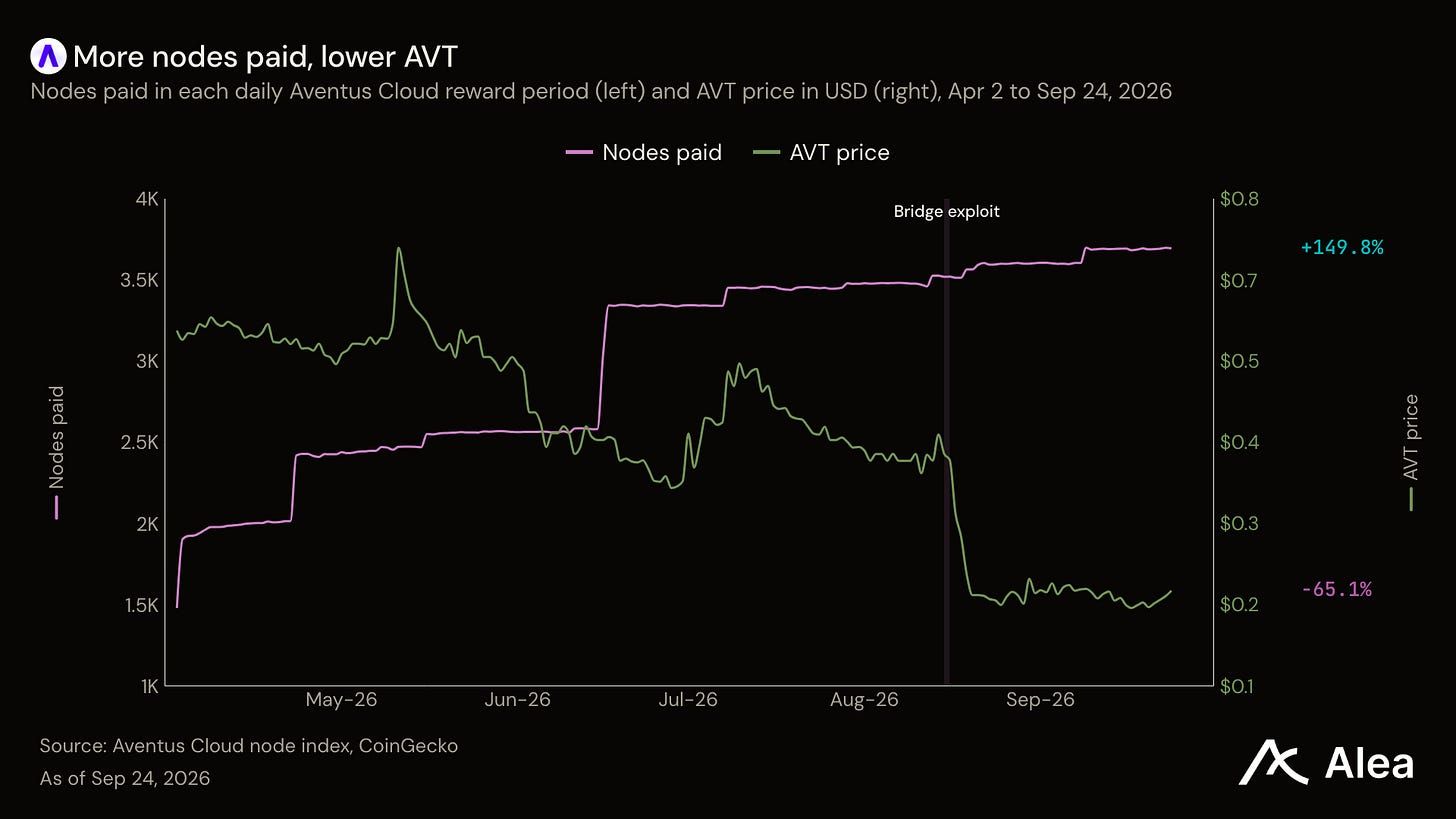
Code forks in an afternoon. The operators who make a chain worth trusting do not. Aventus lets a chain rent them. Its Aventus Cloud network paid 3,694 nodes on Sep 24, up 149.8% from 1,479 on Apr 2. Every chain that connects commits as much as 5% of its own token supply to those operators. We published our Proof of Vision episode with Aventus on Aug 12. In it, Matt Nowakowski explained how a node holder ends up with "a portfolio of tokens in your wallet rather than just earning one."
Chains built around each customer's rules
Aventus sells enterprises a setting on a dial. A company can run every validator itself for an audit trail, share the chain with its counterparties, or connect it to Polkadot, and "you can slowly turn that knob," Matt said. At the airport, he said, companies that were "blaming each other for who lost what" now keep one shared record. He argued that partners take part because "there is enough value in the data."
The product is the fitting as much as the code. Aventus has published its whole stack as open source. Matt argued that "a big chunk of the product is how do you embed that in an organization." Aventus's own comparison with Optimism's OP Stack and Arbitrum Orbit stated two differences. A builder writes business rules into an Aventus appchain's runtime in Rust. The chain then pays for its own validators instead of fees for posting data to Ethereum.
Heathrow APH. A perishables handler at Heathrow and the airlines it serves share a record of cargo on an Aventus chain.
Energy Web X. Energy Web published its chain as a fork of Aventus's parachain code.
Predictor Network. Formerly Truth Network, it stated that it runs prediction markets on an Aventus appchain. It raised about $22M by selling validator nodes.
Cloud rents operators to any chain that connects
Aventus Cloud is a network of licensed nodes that any chain can hire for work. A license holder runs a small program on an ordinary computer, and in the latest version, Matt said, in a browser. The nodes now check the weekly summary the Aventus chain posts to Ethereum, and Aventus published two more jobs for them: oracle answers and custom business logic.
A chain that connects sets aside a share of its token supply for the operators and pays it out over three years, capped at 5%. That spares the chain the cost of recruiting a network of its own. Aventus stated the pitch on Sep 4: most teams cannot fund a chain of their own from scratch, "which is what Aventus solves."
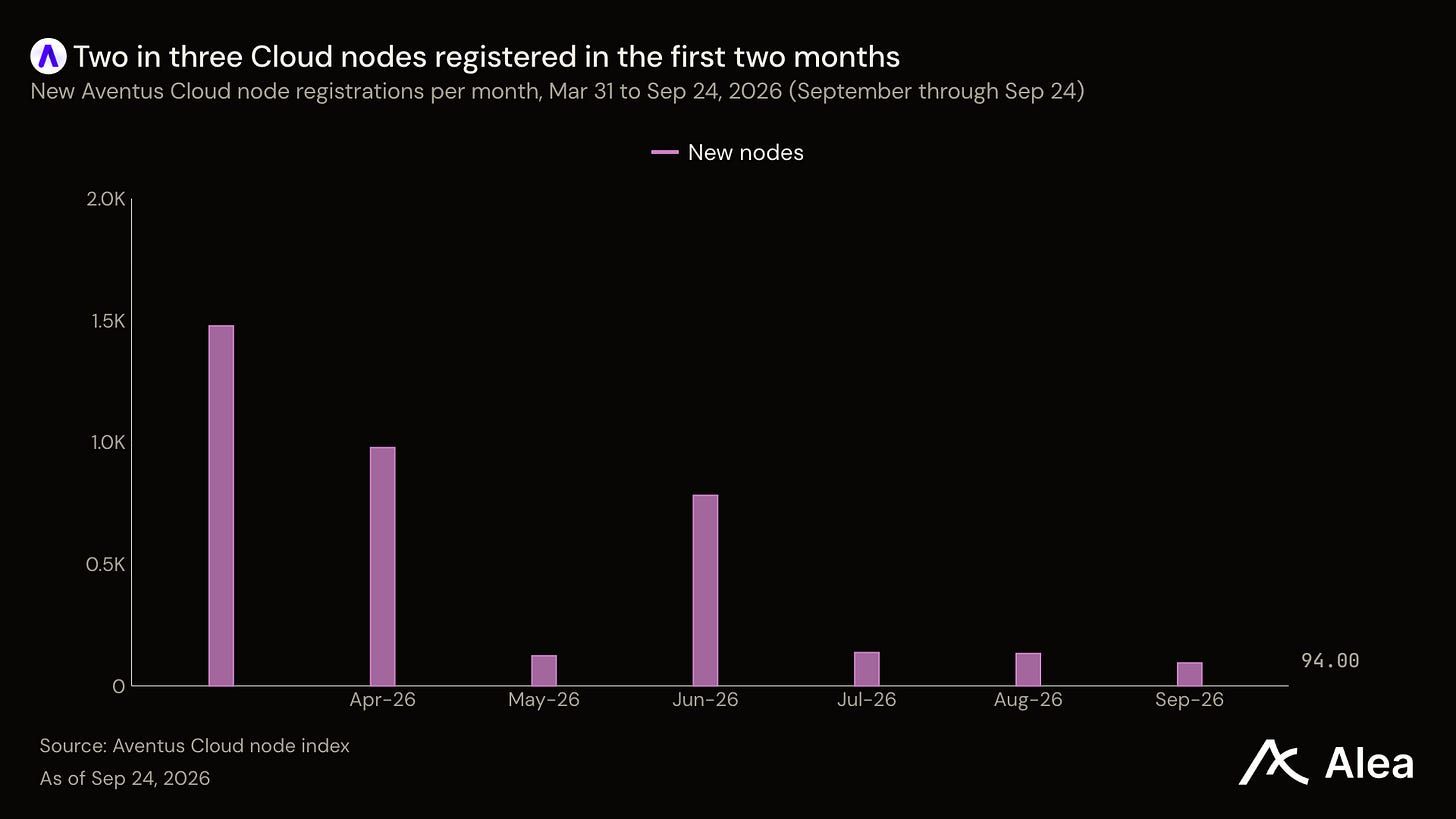
The network filled fast, then slowed. Two in three nodes registered in March and April. The Founding Tranche of 2,000 licenses at $500 sold out within weeks, and the Genesis Tranche now costs $1,755. Since July, registrations have run at 94 to 137 a month. The top 10 owners hold 38.2% of all nodes. Matt was candid about demand in August. Buying a node "is no longer as hot as it used to be," he said. Aventus's answer is the basket of appchain tokens.
AVT pays for the network's first year
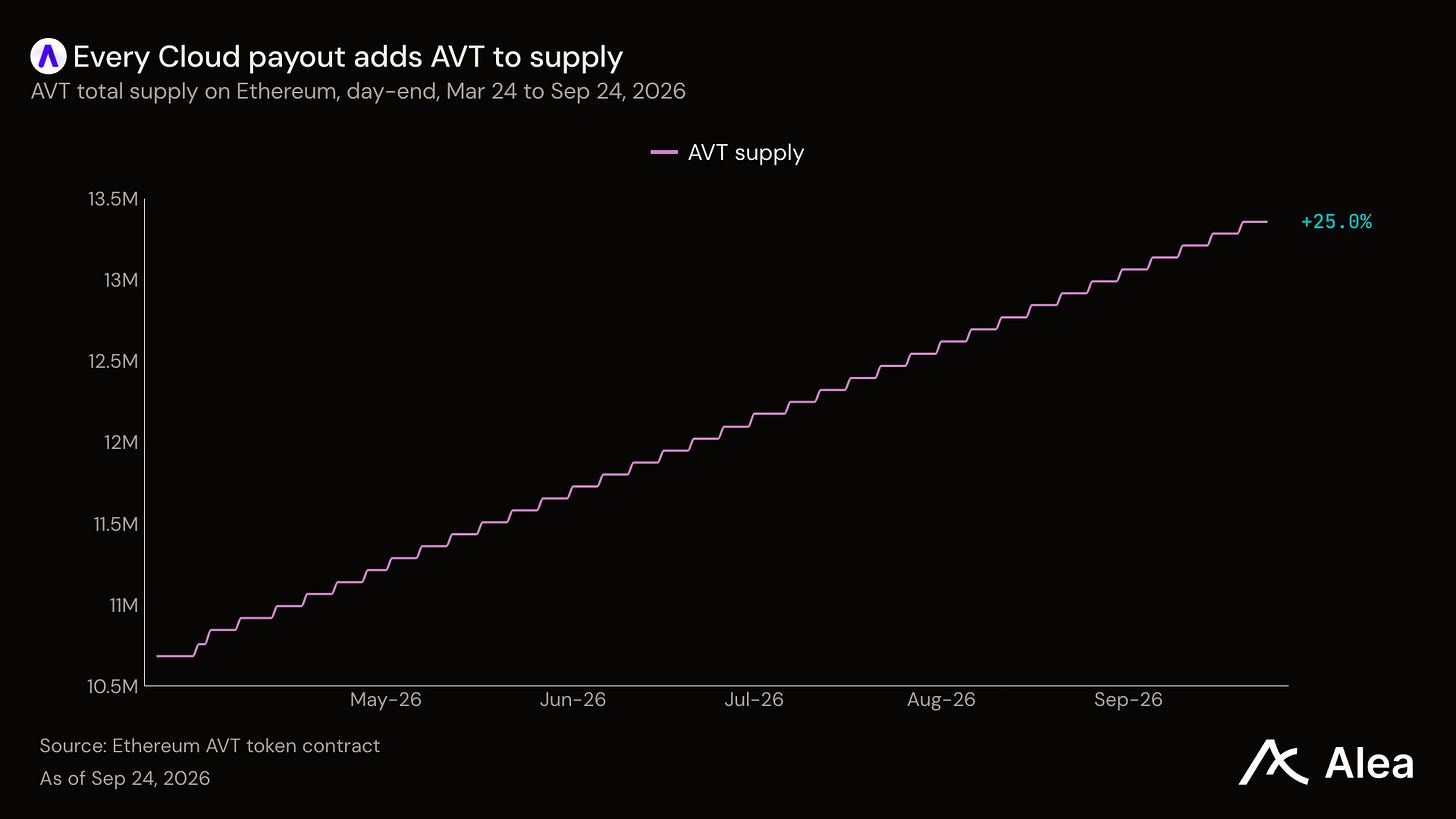
The price of that bootstrap is new supply. Cloud mints its rewards, and the AVT token contract on Ethereum recorded 13.36M tokens on Sep 24, up 25.0% from Mar 24. The first year pays 5.34M AVT, half of everything the schedule Aventus published will ever pay. At the current count, an unweighted node earns at most 3.96 AVT a day, about $0.79 at $0.20, against a $1,755 license. Under the rules holders approved in March, staking 10,000 AVT on a node buys one point of reward weight, the weight a plain license carries. At $0.1755 per AVT, the stake and a new license cost the same.
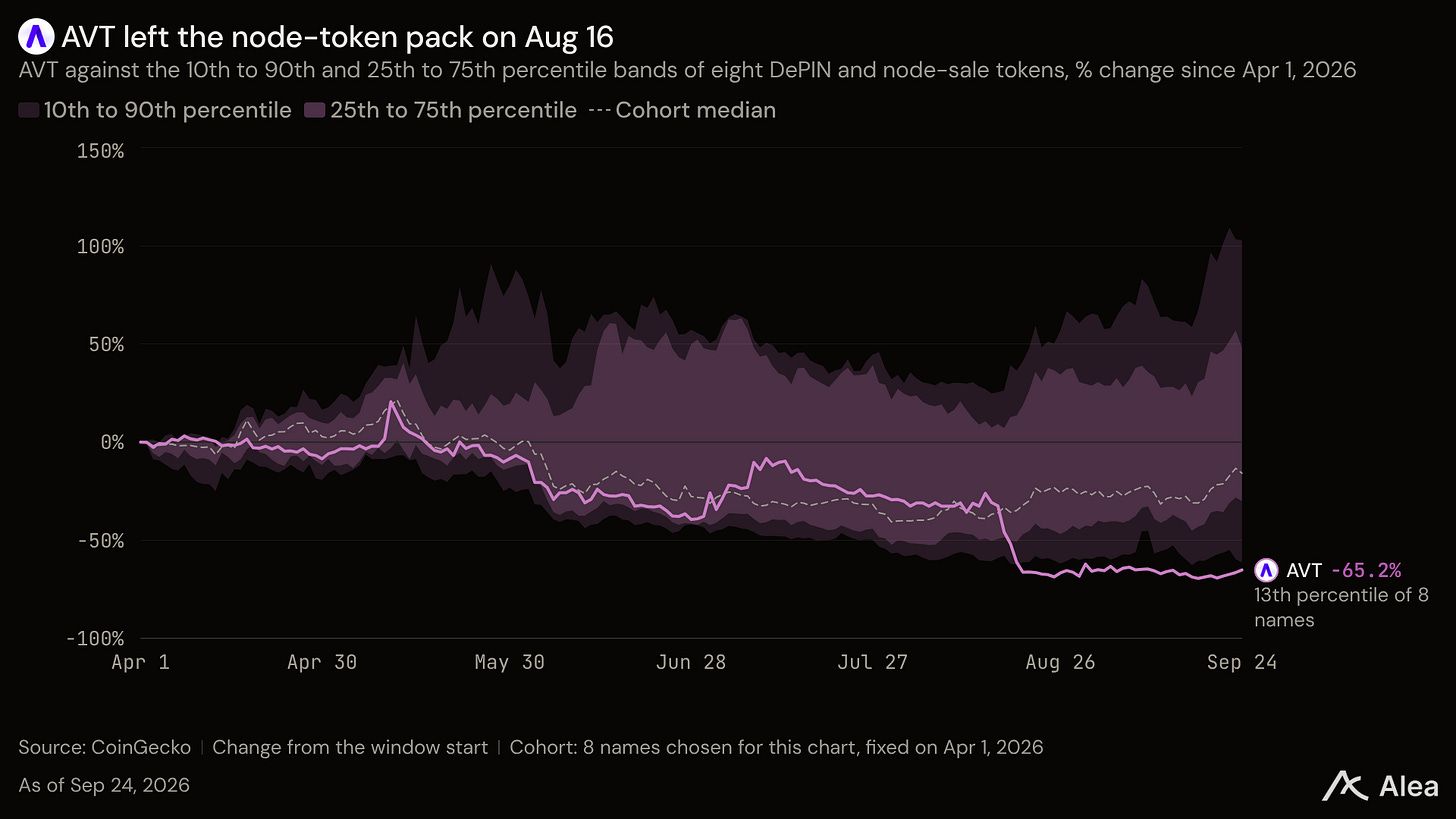
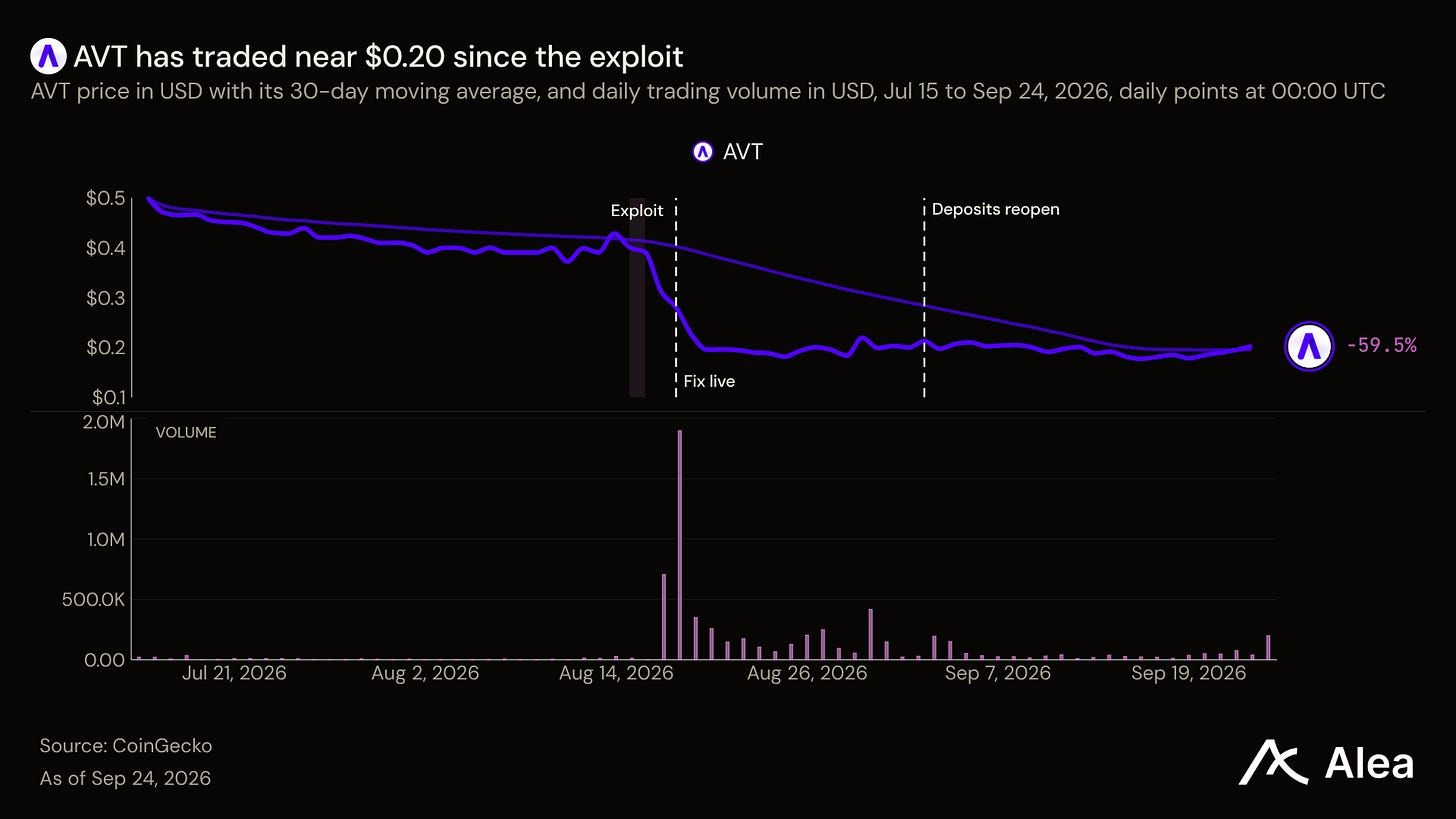
Until mid-August, AVT traded in line with eight peer tokens from networks that sold nodes or hardware to the public. It fell below their range in the week of an exploit.
What the exploit took, and what kept running
On the evening of Aug 15, the Aventus Network recorded a deposit of 3.27M AVT. A flaw in how the chain checked validator signatures let the attacker forge the approval. Aventus's fix stated that a caller-supplied key "must never be trusted for verification." On the morning of Aug 16, the Ethereum bridge recorded a payout of the same 3.27M AVT to the attacker. Its reserve fell 93% in one transaction. By the next morning, Ethereum recorded about $516K of sale proceeds at the attacker's address.
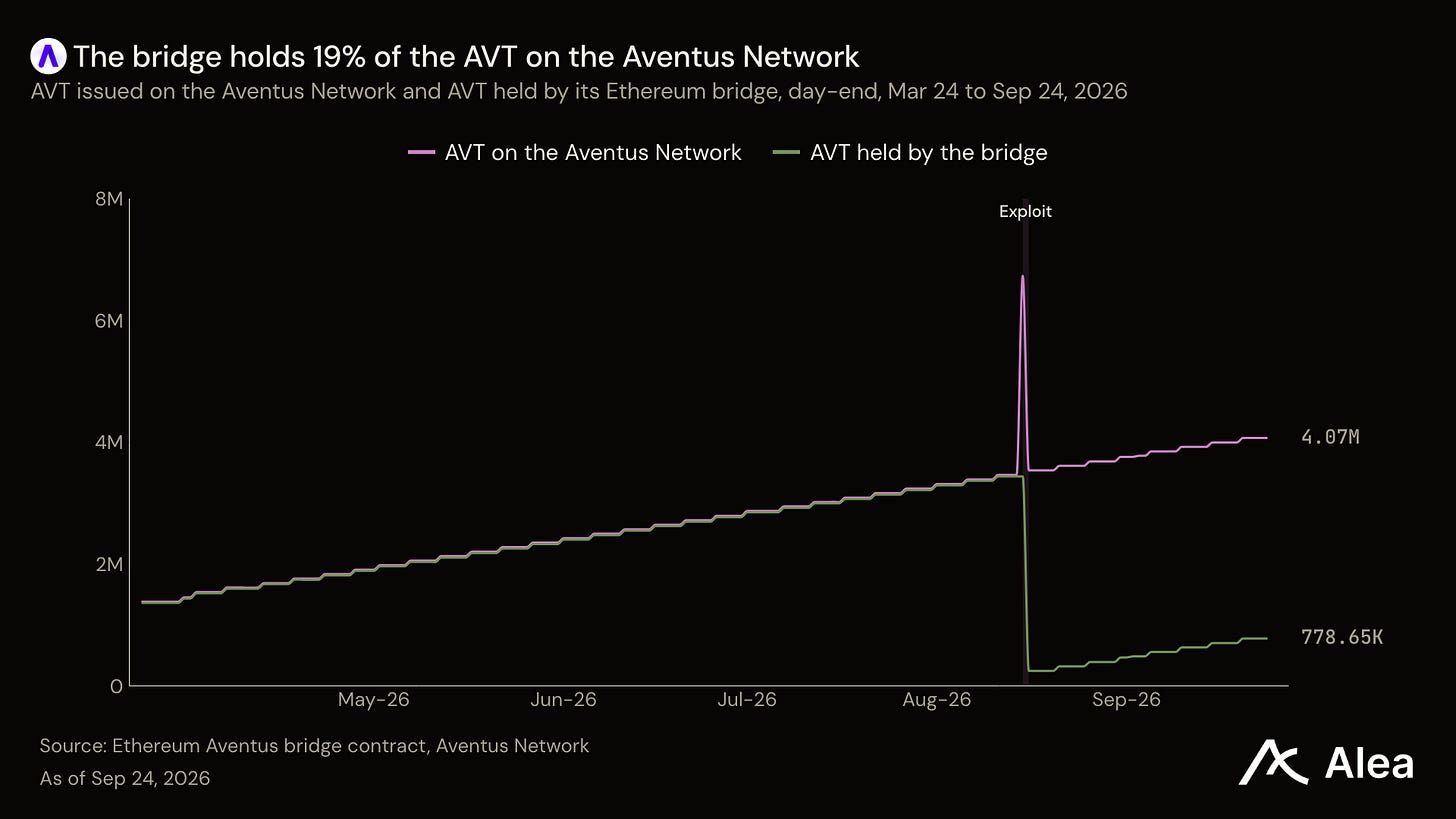
Aventus stopped deposits on Aug 17, put the signature fix live on Aug 18, and updated the chain to reopen deposits on Sep 3. In its Aug 19 statement, Aventus said the flawed code had passed an external audit and a broader external review was under way. It also said it was asking exchanges to freeze proceeds and had recovered nothing. On Sep 24 the bridge held 778.6K AVT, and the Aventus Network had issued 4.07M. No withdrawal to Ethereum has cleared since Aug 16.
The node network did not miss a payout. Cloud paid its full 14,625 AVT pool on Aug 15, 16, and 17, as it has on every other day since Apr 2. Energy Web runs the same inherited bridge module. It reported that an Aug 17 attack credited 70.1M EWT to an attacker, and that it blocked the withdrawal and reversed the balances before any token left its chain.
Built, and waiting to switch on
Appchain payouts. Aventus published the payout logic in its Jun 26 release, and no chain has paid a token yet. Predictor Network's node software updated on Sep 22 to include Aventus's node-manager module.
Fee burn. Aventus published a release on Sep 15 that burns transaction fees and raises the fee. The live chain still runs the Sep 3 version.
Oracle. Aventus published its oracle integration for review on Apr 1, and it remains open. A perpetuals appchain that joins would "claim decentralized oracle by default," Matt said.
The halving. In April 2027, the daily AVT pool falls 50% to 7,312, as Aventus published.
Aventus's edge sits in what a fork leaves behind: fitting chains inside companies since 2017, and a paid network of 3,726 nodes that a new chain can rent instead of recruiting. That network ran through the exploit without missing a payout. Each chain that connects adds its own token to what those operators earn, and Aventus built Cloud to bring those chains in.
Important Links

Alea Research covers the economics of protocols and the builders we meet on our shows.
Research reports. Deep Dives and Blueprints explain protocols and their economics. Theses and Memos examine investment cases and catalysts. Benchmarks compare performance, while Perspectives assess specific developments.
Weekly Pulse. Read a weekly assessment of macro and the major liquid markets.
Protocol Data Rooms. Research each protocol in one place, with Analytics for historical comparisons and Intel for news and governance developments where available.
Podcast Digest and Summit Digest. Read summaries of industry conversations and events. Find Alea shows and their episodes through Podcast Digest.
Governance Tracker. Follow proposals and voting activity across protocols.
Aventus joined Proof of Vision to explain why a chain should rent its operators instead of recruiting them. If your company builds infrastructure, security, or distribution for teams making that choice, sponsoring the show puts your name beside those conversations. Send us a note with your company and the audience you want to reach, and mention Proof of Vision.