The basis trade is the oldest way to earn a yield without taking a view on price: buy the asset, short the same size in perpetuals, and collect the funding that longs pay shorts. Running it took a trading desk. On Sep 9 Renzo shipped it as a product that lives inside your own Hyperliquid account, bills 5 bps a fill, and passes you every dollar of that funding. Its restaking book fell 86.4% in ETH over the past year. This is what it built next.
Takeaways
Renzo now sells execution. Renzo Basis runs a delta-neutral position inside the user’s own Hyperliquid account and bills 5 bps per fill. The structured-products roadmap reuses the same rails.
A round trip costs 37 basis points of the position: 20 to Renzo and 17 to Hyperliquid. Trading bigger does not move that hurdle. The user keeps the entire funding rate and can revoke Renzo’s trade-only key at any moment.
The yield clears the hurdle most days. Bitcoin funding on Hyperliquid beat the cost of running the trade four times a year on 292 of the past 367 days.
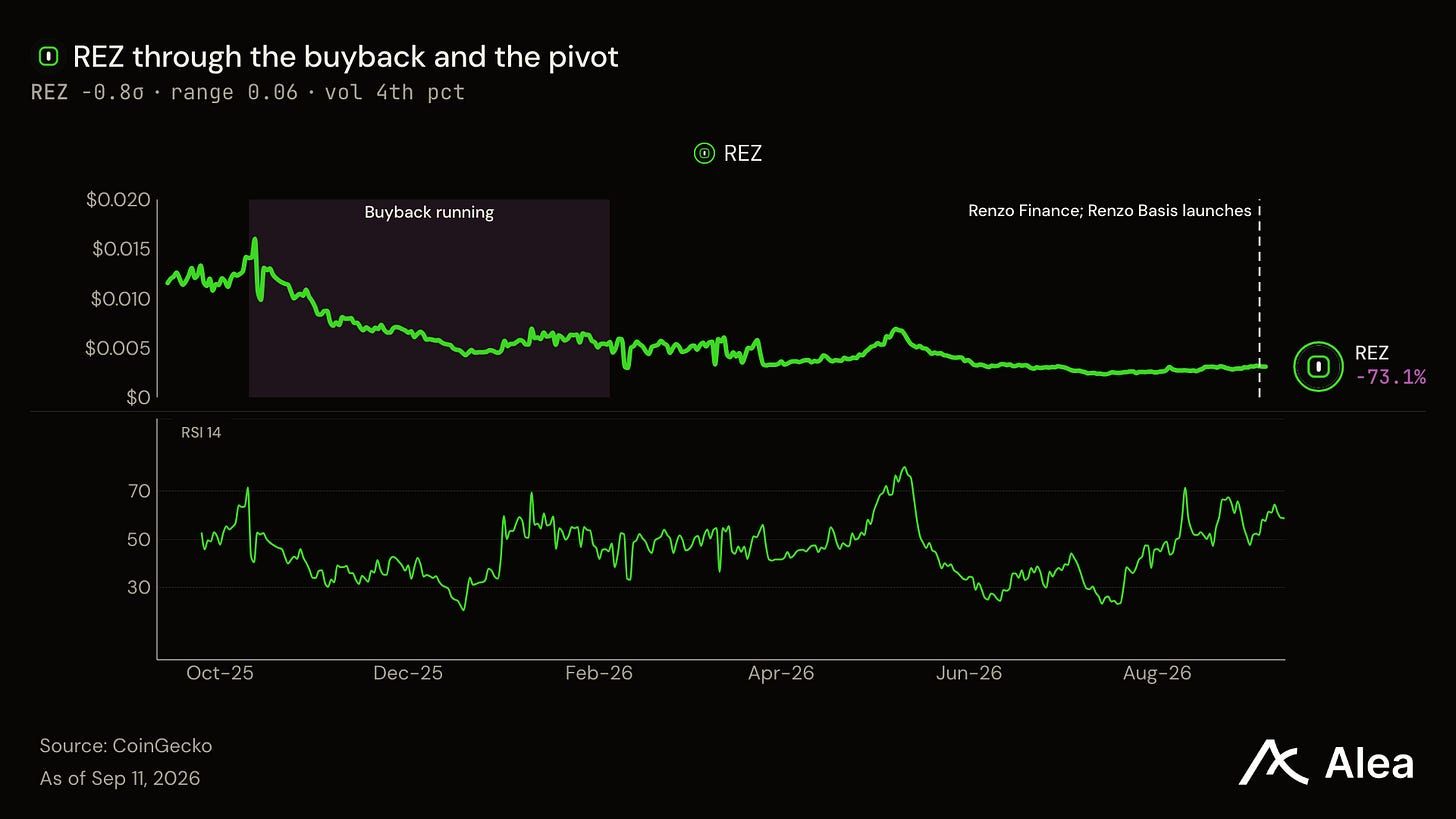
REZ trades at 68 times revenue, a $30.2M market capitalization against $442K of annualized protocol revenue.
The buyback already has a track record. It returned $1.68M and retired 185M REZ between Oct 8 and Feb 5. Restarting it is what turns new revenue into token demand.
How Renzo Basis makes money for the user
A basis trade holds the same asset twice, in opposite directions, so the price stops mattering. Renzo Basis buys spot bitcoin on Hyperliquid and shorts an equal amount of the perpetual future. The two legs cancel, offsetting the bitcoin price. What is left is funding: the payment that passes between perpetual longs and shorts every hour, usually from longs to shorts.
The money never leaves the user. You deposit USDC into your own Hyperliquid account and approve a trade-only key that lasts 90 days. That key can open, close, rebalance, and add margin. It cannot withdraw. You revoke it whenever you like.
Three guards run while the position is live: i) the hedge guard restores the two legs when they stop matching, ii) the yield guard exits to USDC when funding is net negative across two days, and iii) the safety buffer shrinks the position when the liquidation cushion falls under 10%. You choose how big the short leg runs: 2x, 3x, or 6x.
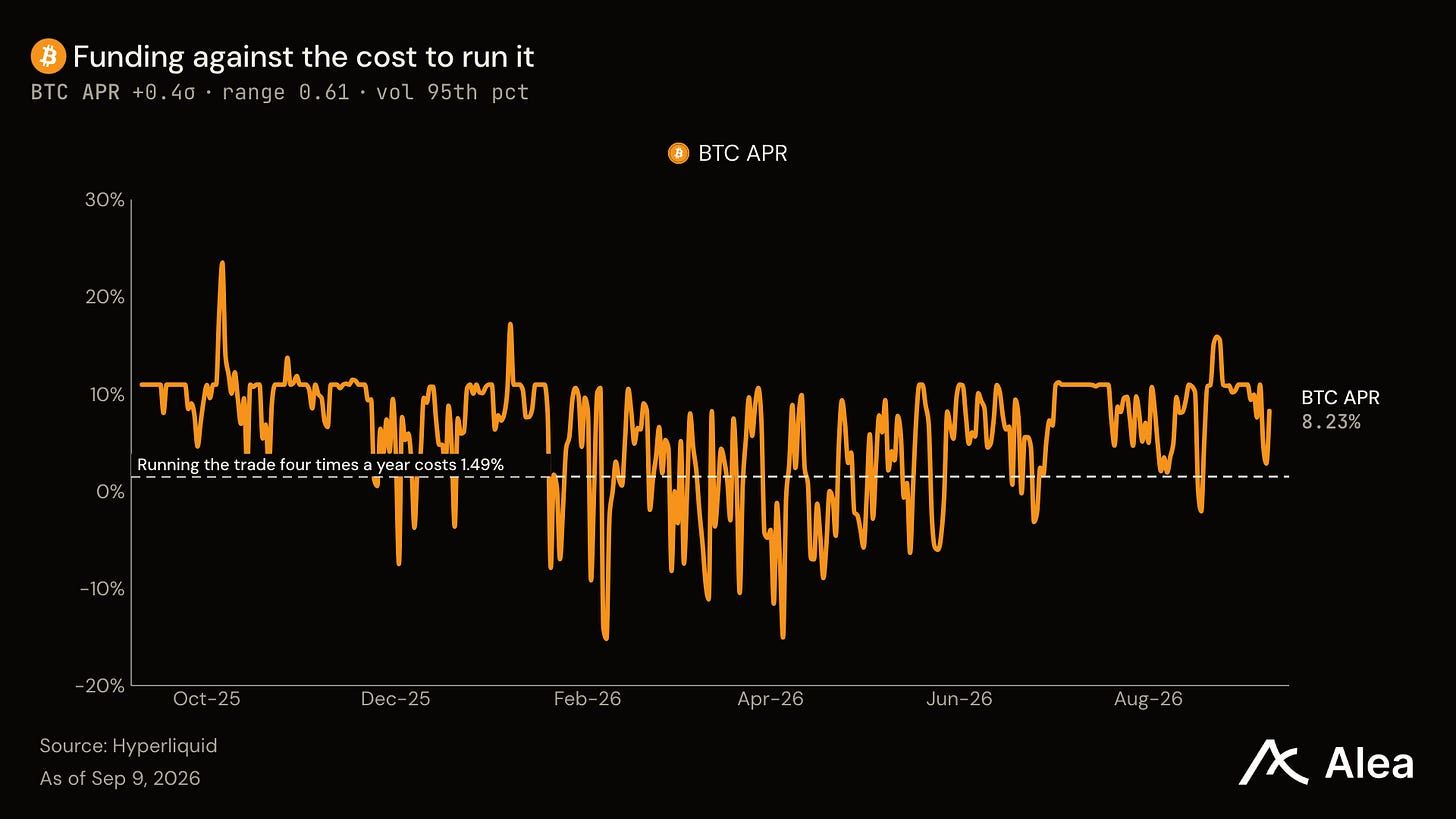
It went negative on 58 of those days, and that is exactly what the yield guard is for.
Why five basis points, and not a share of the yield
Renzo takes a builder fee of 5 bps on the notional of every fill, capped by a signature the user approves at setup. A round trip is four fills: two to open and two to close, so Renzo collects 20 basis points. Hyperliquid’s own taker fee adds 17, after the 4% discount Renzo passes back through its referral code. Call it 37 basis points a round trip.
Funding and fees both scale with the hedged notional, so they cancel out. Size changes your return on capital, but it does not change the funding rate you need to break even.
That makes Renzo a different machine from Ethena, the largest onchain basis business at $4.60B. Ethena deposits and keeps a share of the yield, so its revenue rises with assets; Renzo’s revenue rises with fill notional. One business grows by holding more; the other grows by trading more.
Where the restaking book went
Renzo built one of the larger liquid restaking books of the 2024 cycle, and it still runs the second-largest in its category. That is $116M of a $1.42B liquid restaking market across 29 protocols, behind Kelp at $1.11B.
The dollar figure moves with ether’s price as well as with deposits, so it overstates what actually left. Over the twelve months to Sep 12 the book fell from 300,272 ETH to 40,726 ETH. Ether’s own price fell −41.5% across the same window. The dollar figure therefore overstates the outflow. Units fell −86.4% and the price fell −41.5%, which compound to the −92.1% dollar figure.
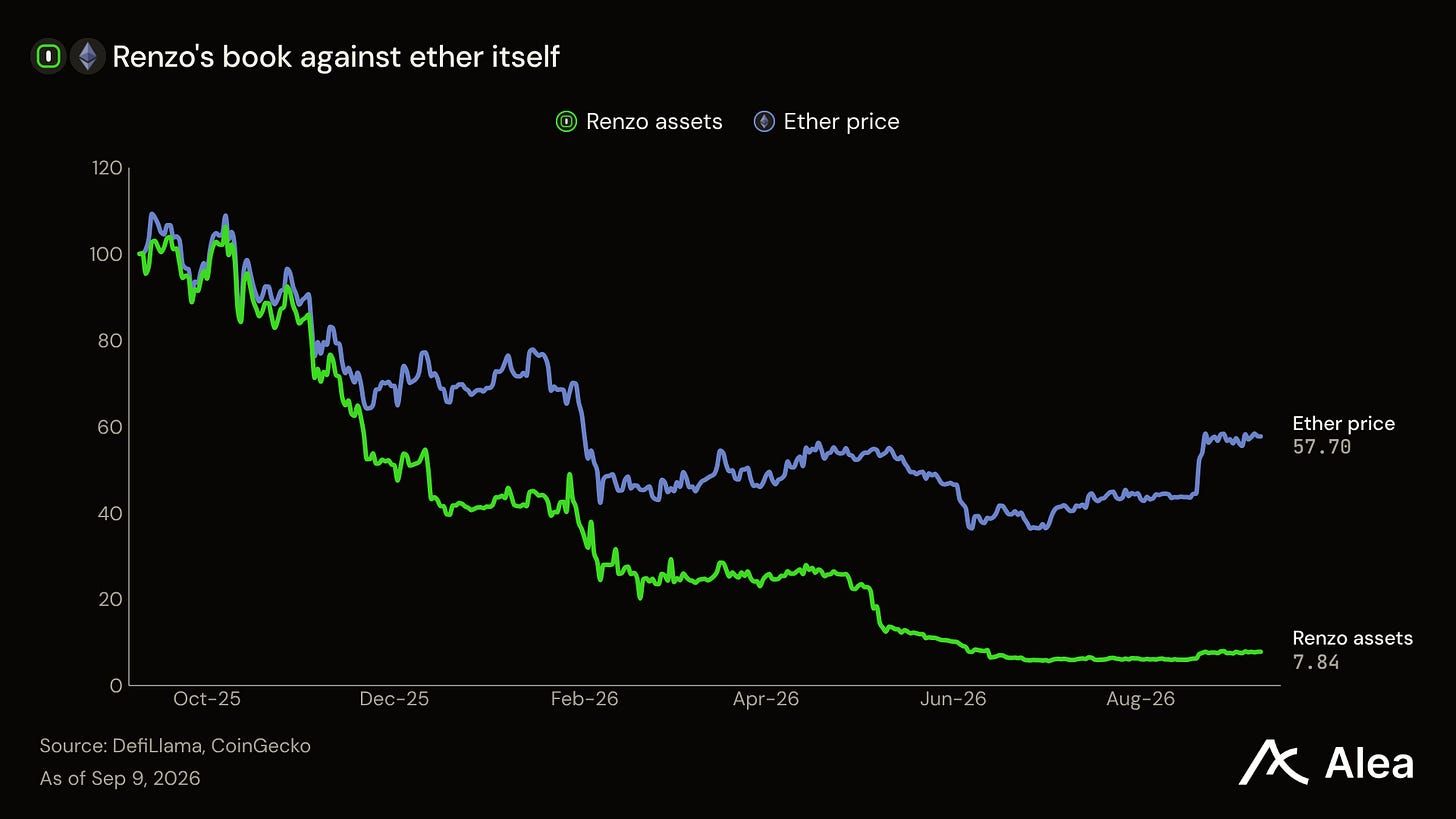
Ether kept 58 of its starting 100. Renzo’s book kept 8. The distance between those two lines is what actually left.
What the old model billed, and what it kept
The restaking business billed well and kept little. Renzo collected $14.8M in gross fees over the past year and retained $1.74M, about 12%. The rest went to stakers and depositors, which is how a liquid restaking token is supposed to work.
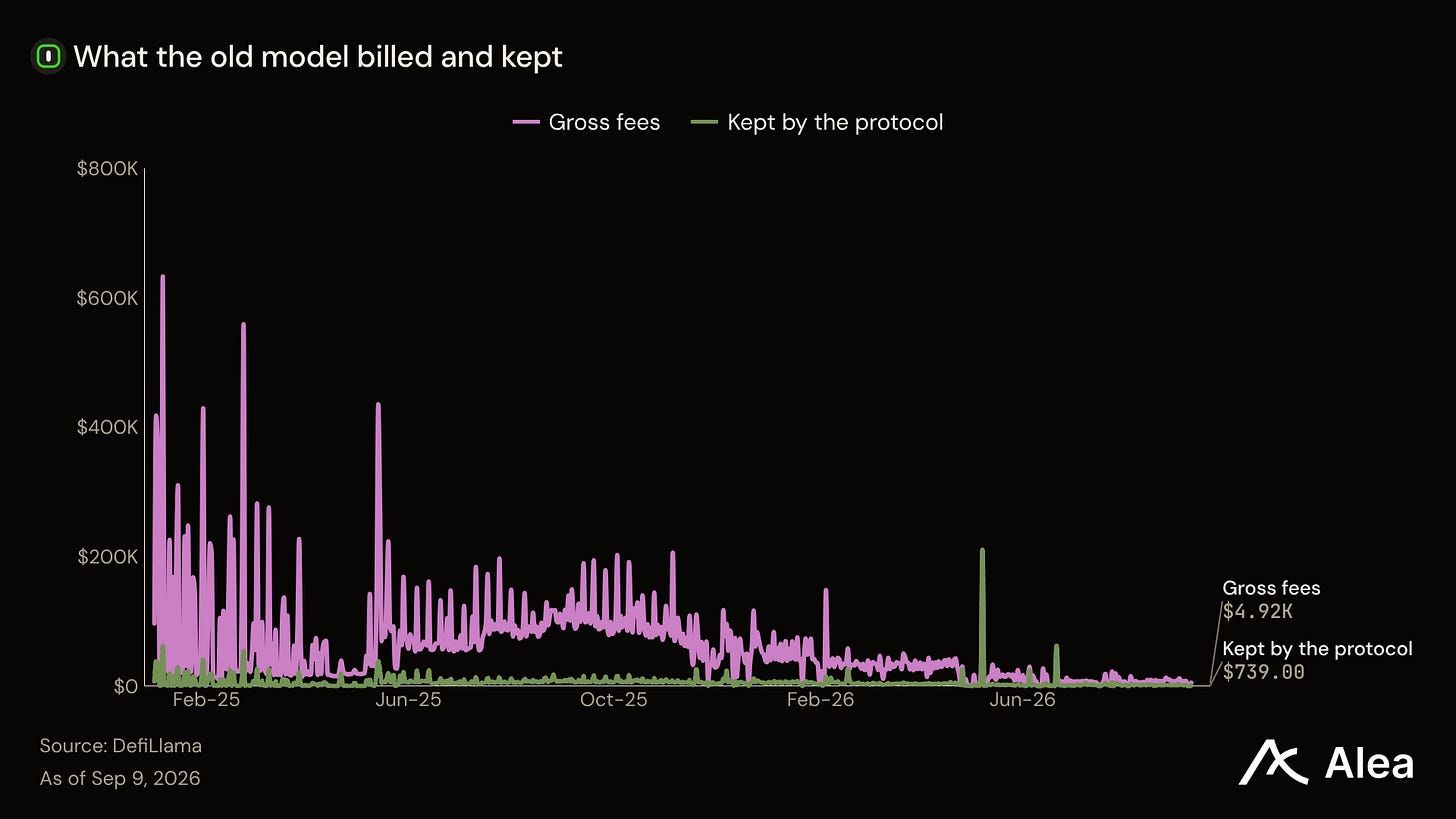
Across the last 30 days Renzo kept $36,326, an annual rate near $442K. The builder fee is a different instrument entirely. The user keeps the yield, and Renzo bills the transaction.
What the new engine has to earn
REZ carries a $30.2M market capitalization on $442K of annualized revenue. That is 68 times revenue. Volume through the rail is what moves that number, which is why the roadmap runs to more venues and more assets.
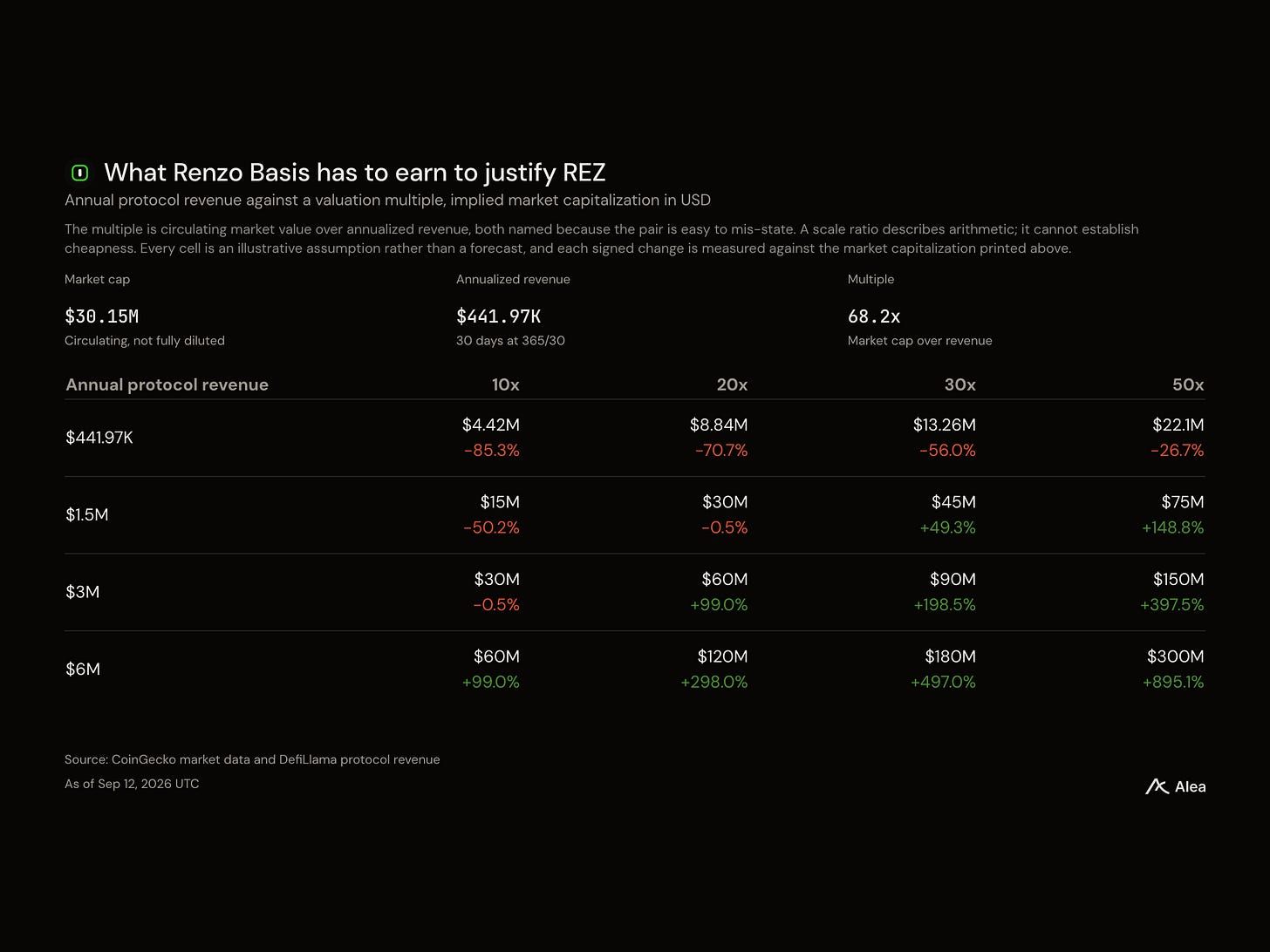
At $1.5M of annual revenue on a 20x multiple the implied capitalization matches today’s. At $3M on 30x it reaches $90M. These are illustrative assumptions rather than forecasts.
Renzo’s own share is the 20 basis points, not the full 37. At 3x a dollar of capital carries 75 cents of notional, so four round trips a year hand Renzo about 0.6% of the capital deployed. $250M running through Renzo Basis earns roughly $1.5M a year. $1B earns roughly $6M. Those are gross builder fees before any cost.
The buyback, and what restarts it
The Renzo Foundation collects protocol fees and owns the brand and the intellectual property. Governance decides how much revenue goes toward REZ buybacks. DefiLlama records the standing rule. 75% to 100% of revenue goes to a buyback bot. The bot burns 90% of what it buys and sends 10% to ezREZ stakers.
Purchases ran from Oct 8, 2025 to Feb 5, 2026, directed $1,677,741, and retired 185M REZ, or 1.85% of the ten-billion maximum supply. Supply has not moved since.
Two details set the terms for what comes next. Renzo Finance’s new documentation describes REZ as a governance token and carries no buyback language of its own. The flow therefore depends on a governance decision rather than a standing right. 91.5% of REZ already circulates against total supply (new revenue meets a supply that is close to fully distributed).
What to watch, and where it will show
Builder-fee revenue. Renzo’s DefiLlama revenue line is the first public sign that anyone is using Renzo Basis. It ran at $442K annualized across the 30 days to Sep 12.
A restarted buyback. Nothing has flowed since Feb 5, 2026. Two things restart it: a governance vote, and a live holders-revenue line that converts product traction into token demand.
Assets and venues. ETH and SOL come next, then Lighter, then centralized venues. Cross-venue hedging follows, with spot onchain and the perpetual on a centralized exchange.
Tokenized equity basis. Hyperliquid already lists equity perpetuals. Equity basis is the roadmap item that would separate Renzo from every crypto-only competitor.
The bet, stated plainly
Renzo has traded a business that collected part of a staking reward for one that bills a transaction. The new model asks less of the user, who keeps both the yield and the custody. It asks more of the product, which now has to attract capital and turnover.
Five basis points is a small number, and that is the point. It clears out of the way of a funding rate that beat it on 292 of 367 days. Renzo now earns on turnover instead of on assets held, which its old book never did at any size. The rail is live on Hyperliquid, and every fill it routes bills the same 5 bps.
Important Links

Research reports. Deep Dives and Blueprints explain protocols and their economics. Theses and Memos examine investment cases and catalysts. Benchmarks compare performance, while Perspectives assess specific developments.
Weekly Pulse. Read a weekly assessment of macro and the major liquid markets.
Protocol Data Rooms. Research each protocol in one place, with Analytics for historical comparisons and Intel for news and governance developments where available.
Podcast Digest and Summit Digest. Read summaries of industry conversations and events. Find Alea shows and their episodes through Podcast Digest.
Governance Tracker. Follow proposals and voting activity across protocols.
For protocol teams preparing institutional conversations, discuss research for your protocol with Alea.