Almost no L1/L2 token does this. Polygon's fee contracts ended August holding 141.9 million POL more than on New Year's Day, against 141.8 million minted. The chain's own traffic now takes POL off the market about as fast as it creates it. Run that pace out and it is 3% of free float a year. They are now proposing to burn 100 million POL, about 1% of the supply.
Polymarket drives its activity today; payments will do in the near future. Every added transaction pays a base fee that leaves the market. Circle's Arc or Stripe-backed Tempo are building similar payment rails with no native token, sending fees to their respective companies, but Polygon's reach the token, and POL trades at 42 times a year of chain fees, the lowest of any payments chain, even including L1/L2 chains with a liquid token and onchain fees.
Takeaways
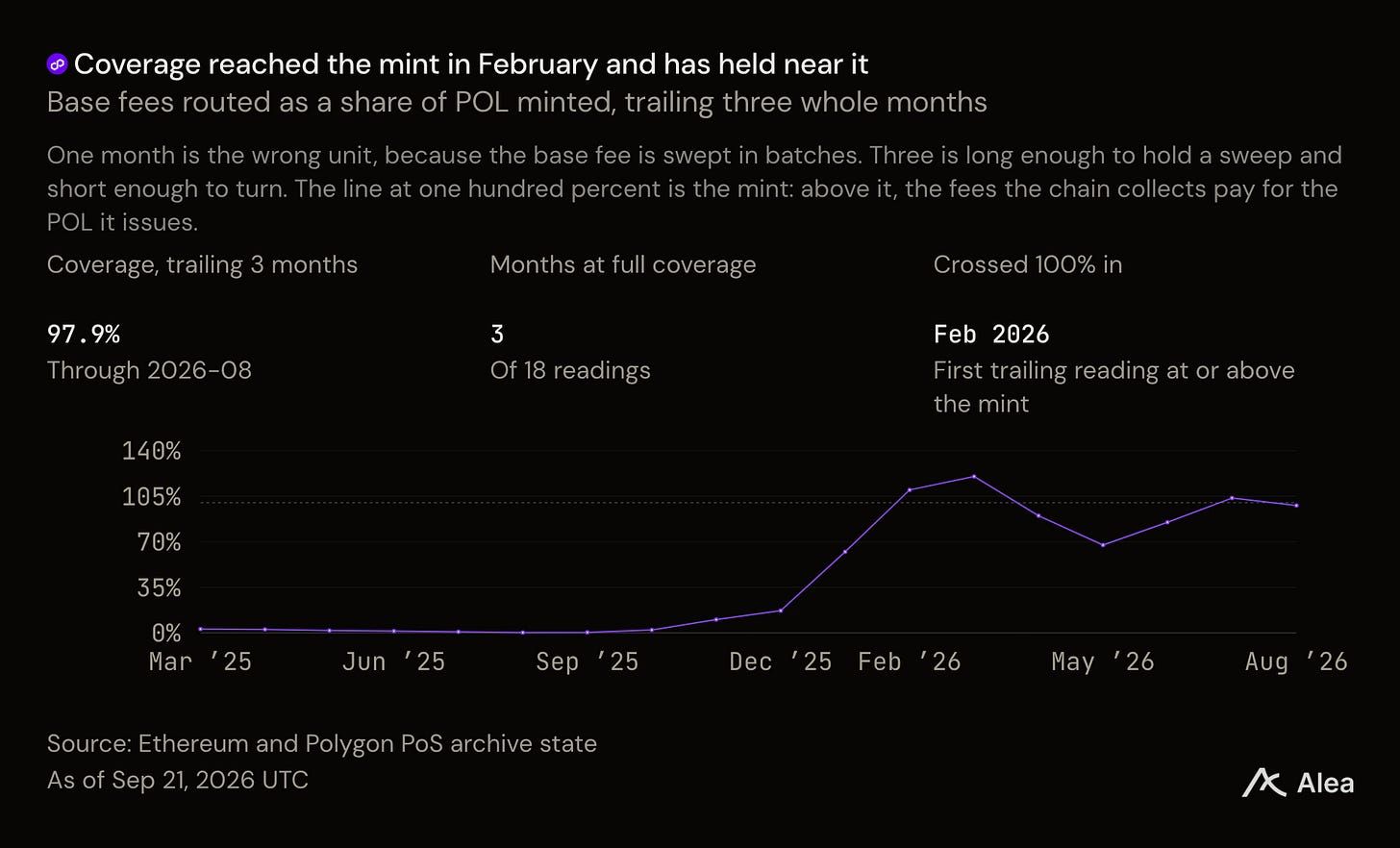
Polygon's base-fee contracts took in 141.9 million POL from January through August against 141.8 million minted. On a trailing three-month basis the series reads 97.9% through August. A year earlier it read 1.6%.
Only 66% of POL can reach a bid. The rest is staked or already sitting in the fee contracts. A year of fee collection at the current pace equals 3.01% of the float.
POL pays +0.97pp of real yield once its own supply growth comes out. Staking POL means earnings yield on a deflationary asset.
84.5% of the $39.79M users spend each month across Polygon applications and gas goes to Polymarket. Take that out and the rest of the chain still grew 10.5% over the past year, against 64.9% with it.
POL trades at 42 times a trailing year of chain fees, the lowest of the payments cohort and less than half the next chain's.
The burn contract is not live yet, and no execution date is published. The 100 million is staged rather than removed. The idea is to burn that amount to kick off permissionless once-per-quarter POL burns.
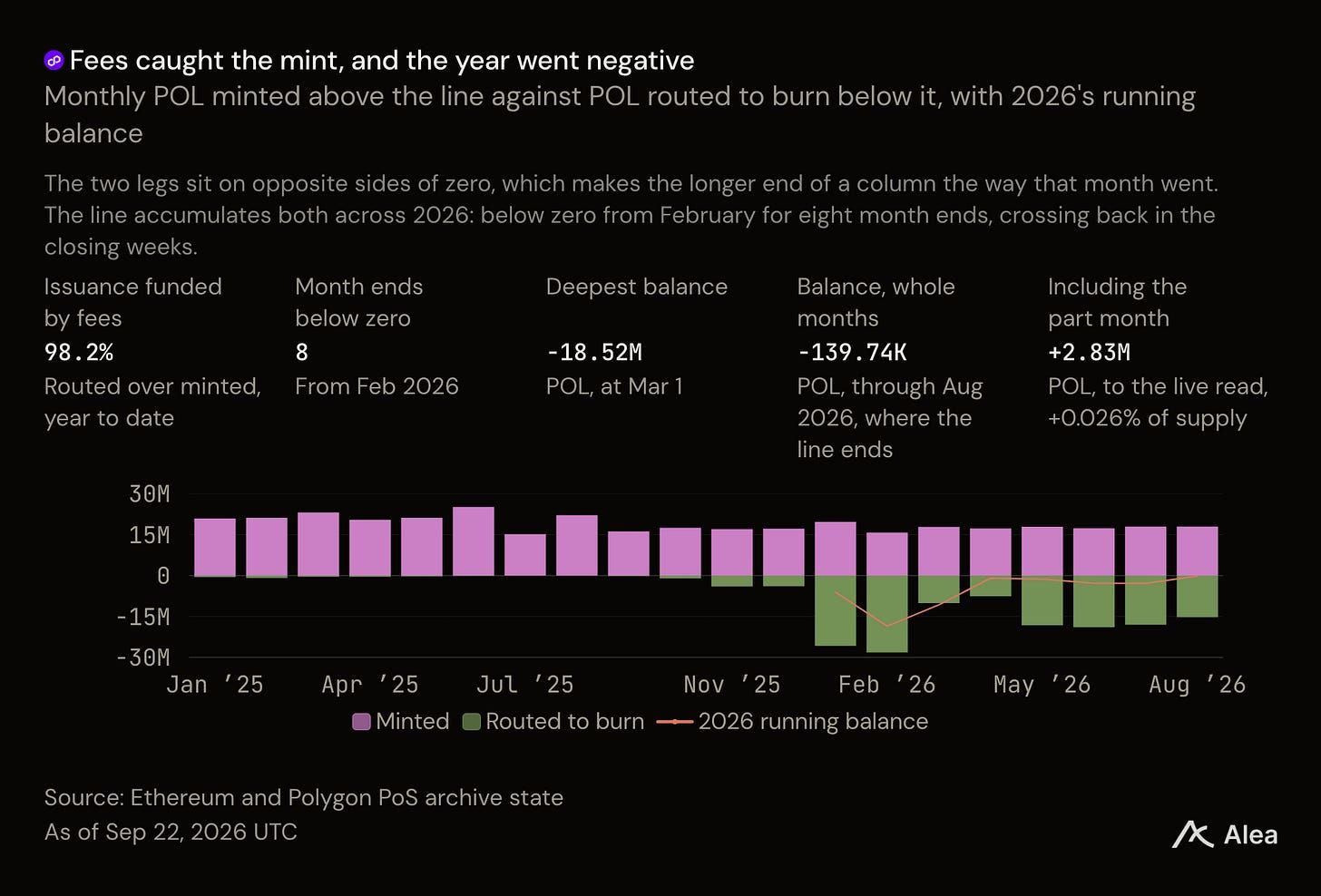
The year Polygon's fees caught its mint
For most of 2025 this was not close. Base fees leaving Polygon covered 1.6% of what the chain issued over January to August. The same window this year reads 100.1%.
That is not a rounding artifact of one good month. The trailing three-month series crossed the mint in February and has held there since, closing August at 97.9%.
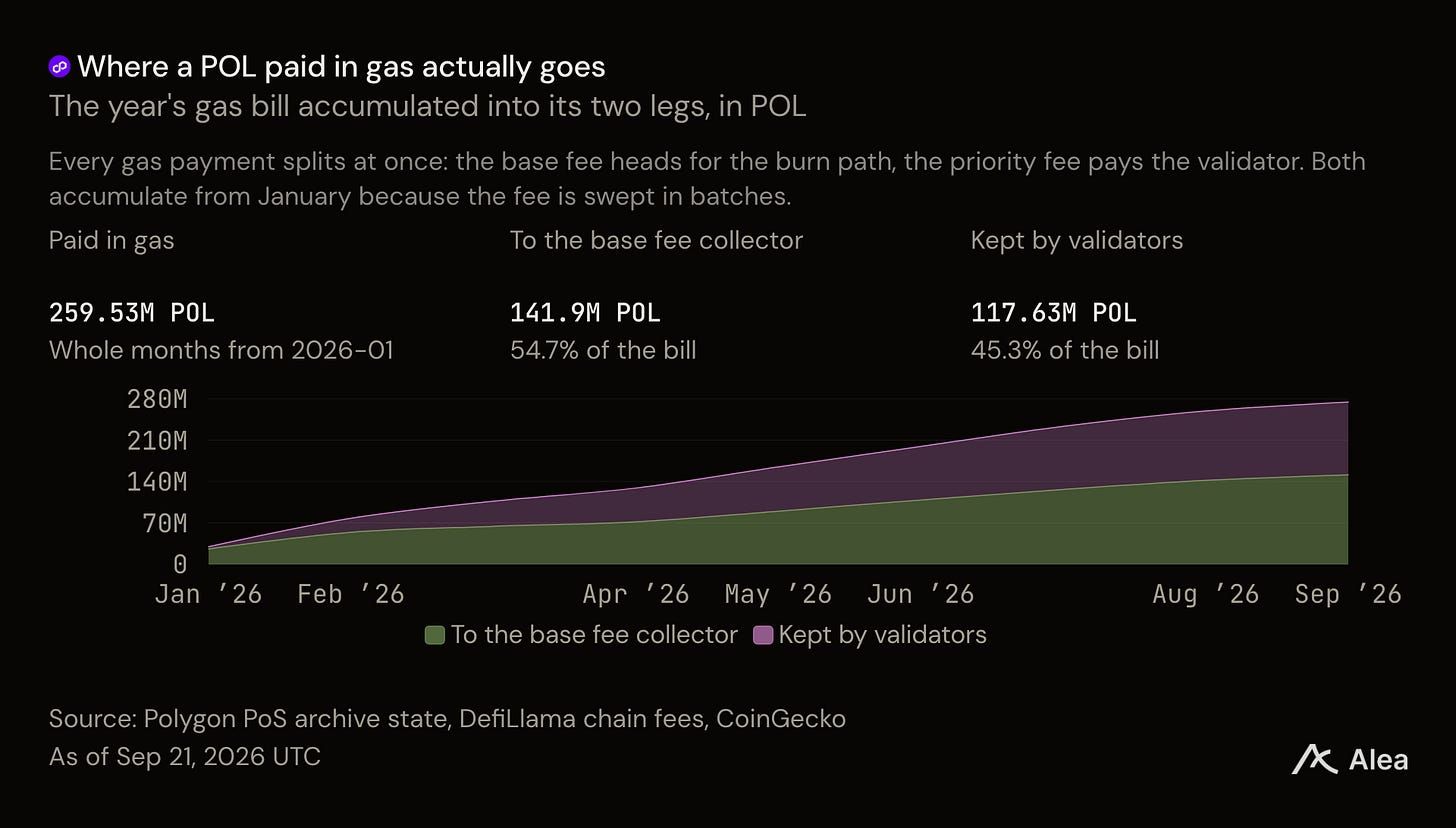
Every Polygon transaction pays gas in POL. The base fee leaves the market. The priority fee goes into a pool that governance approved under a fixed formula: 26% to the block producer, the rest to the validator set by performance-weighted stake.
Over this year's whole months, 54.7% of every POL paid in gas reached the fee contracts. Validators kept 45.3%. Single months read anywhere from 35% to 87%, because the sweep settles in batches rather than continuously.
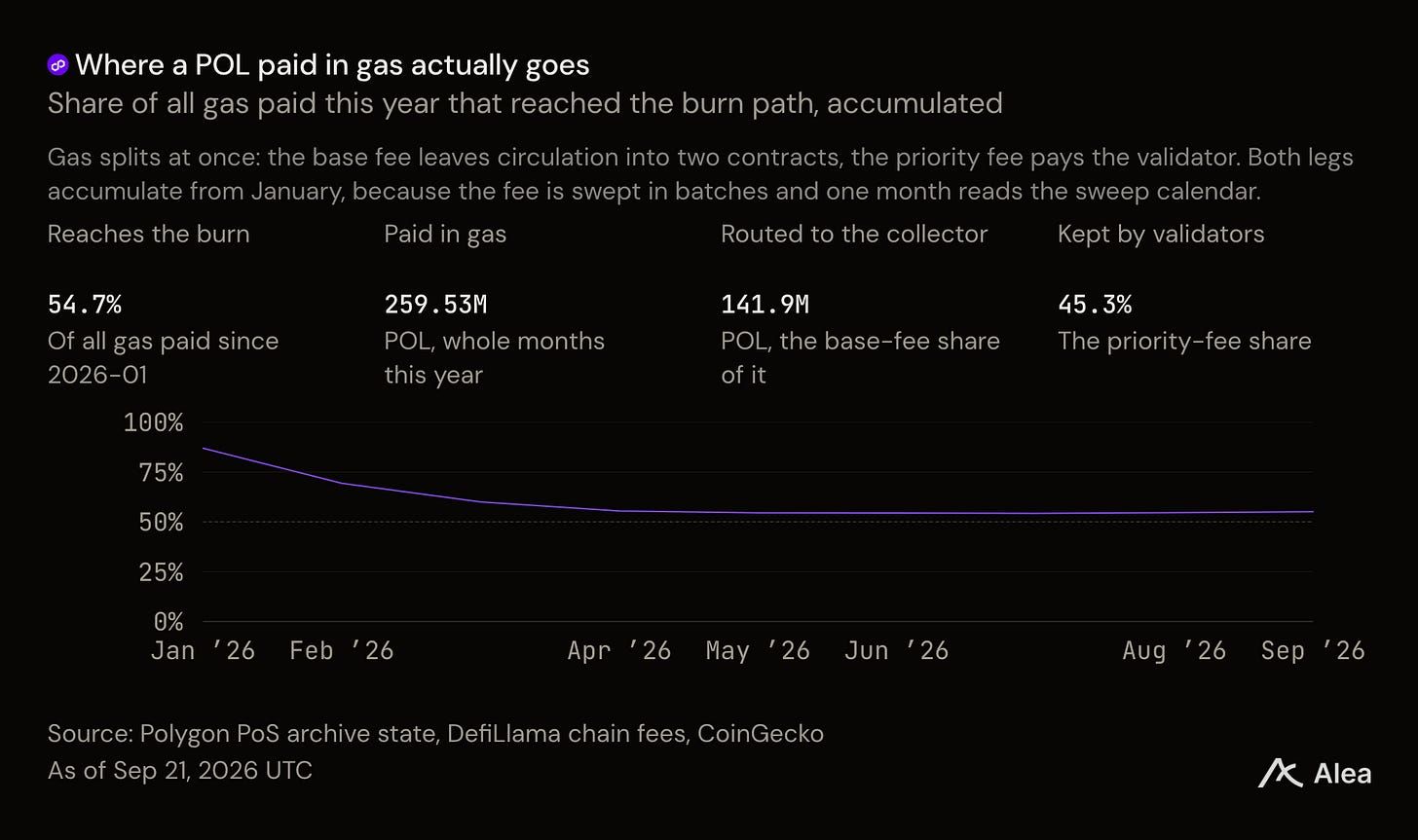
That split is what turns traffic into supply removal. The size of the bill is what makes it relevant.
Two thirds of POL can actually be sold
Every data provider reports one circulating figure for POL, identical to total supply. It is correct, but it does not answer the question a holder is asking: how much POL could actually be sold tomorrow.
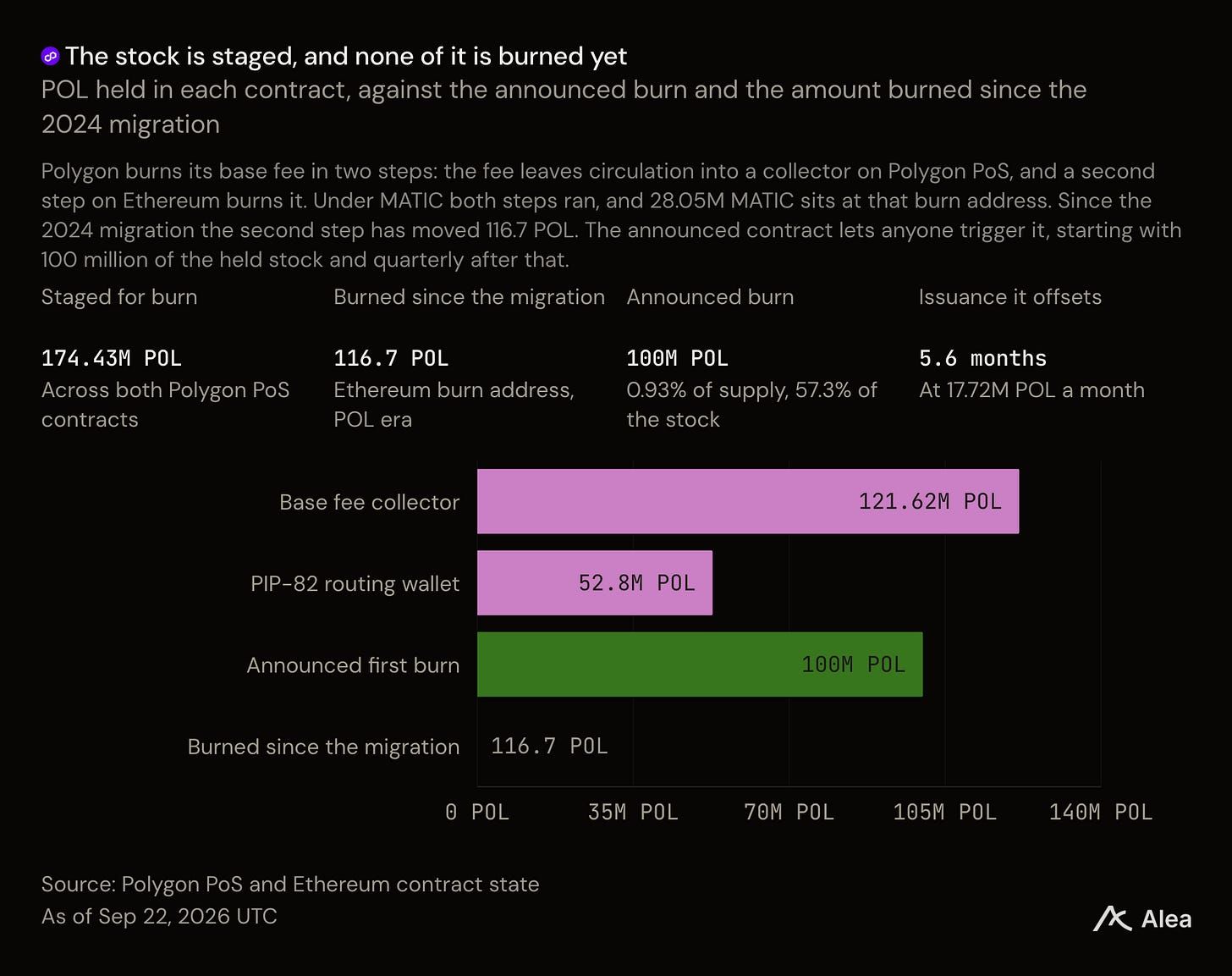
3.48 billion POL is staked across 105 validators, securing the chain. Another 174.4 million sits in the two base-fee contracts, already collected: the collector showed 121.6 million and the PIP-82 routing wallet showed 52.8 million. What is left is 7.07 billion, or 66% of supply.
That is the pool the fee engine draws from. A year of collection at the current pace is 1.6% of total supply. Against the float it is 3.01%, nearly double.
None of it is burned yet. Because it is a two-step design. POL leaves the market in one step and leaves the supply in another. The first step runs on Polygon PoS. Governance approved a base-fee collector there in 2023, then approved a second routing wallet in February. That wallet rebates up to $1M of base fees to agentic-commerce facilitators, about 9 million POL at current prices. The remainder sweeps onward. The second step runs on Ethereum, where POL's supply contract lives. Under MATIC both steps ran and 28.05 million MATIC sits at that burn address. Since the 2024 migration the second step has moved 116.7 POL.
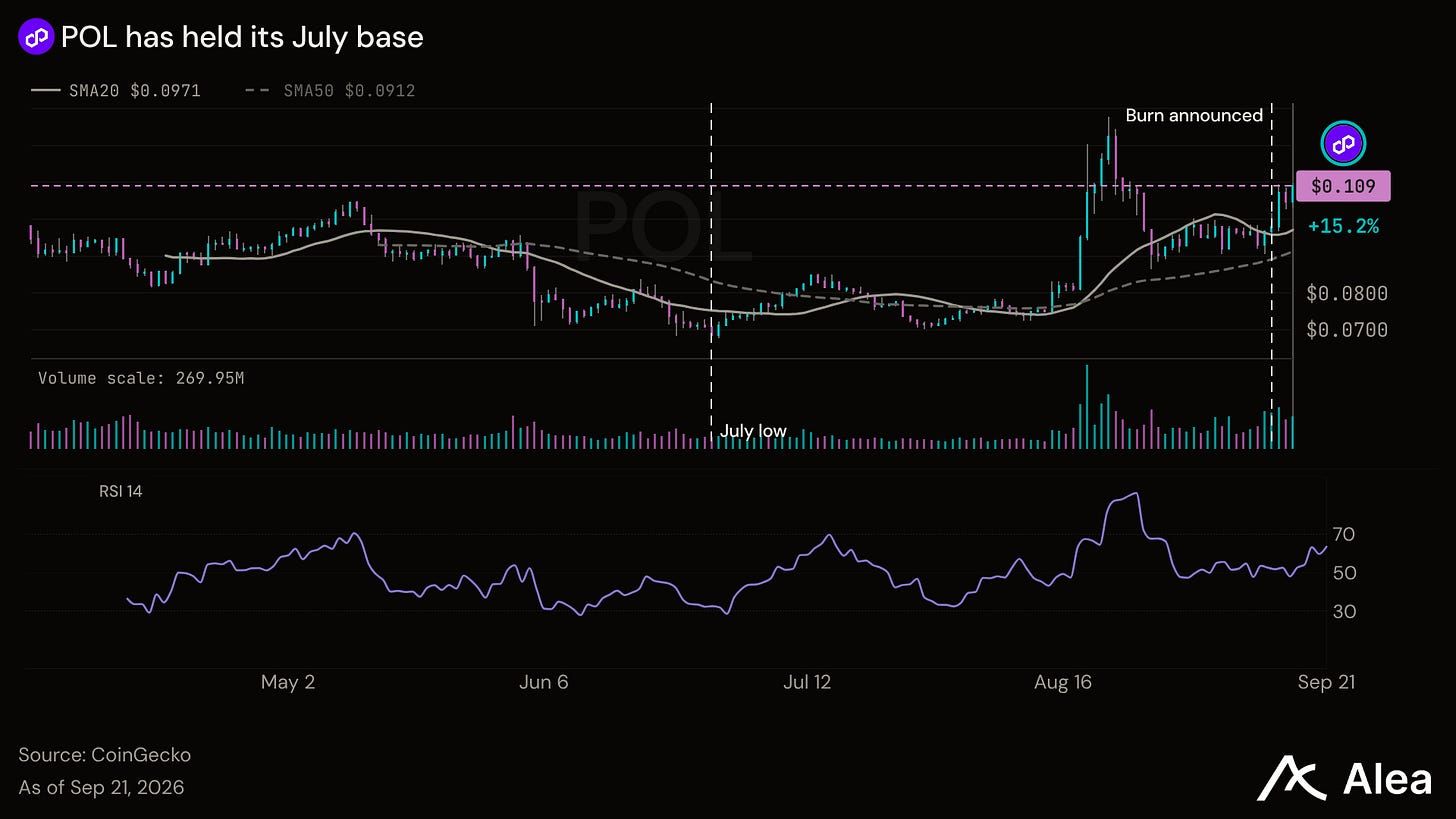
Polygon Foundation chief executive Sandeep Nailwal announced on Sep 18 that 100 million POL was ready to burn and that a change was coming to let anyone trigger it. Further down the same post he said where the work stands: the contracts are on testnet, and they reach mainnet after a final round of signatures.
Polygon governs these contracts through a 13-member Protocol Council, approved with more than one authorization route. Until that transaction is posted, no outsider can calculate the earliest execution.
But the date will soon come, and the announcement is highly unlikely to fall on deaf ears.
The size of it is bounded. The 100 million is 0.93% of supply and 57.3% of the stock already collected, about 5.6 months of issuance. It would leave 74.36 million, another 4.2 months. After that the trigger repeats every quarter.
What a staker is actually paid
Polygon's staking confirms an annual validator reward target of 103.53 million POL with a validator list showing 3.49 billion POL staked. That amounts to 2.98%, before validator commission, on emission alone, where the staking yield is paid in the token it dilutes. Meanwhile, Polygon's sPOL liquid staking token yields 3.85% with priority-fees included.
POL issues at 2% a year in two equal halves: one funds validator and delegator rewards, the other the community treasury. Against the validator half, base-fee collection has run at about twice the rate across 2026. Validators are paid from emission and priority fees, never from the base fee, which is routed to be burned. That’s how the chain now takes twice as much POL out of the market as it mints for the people securing it.
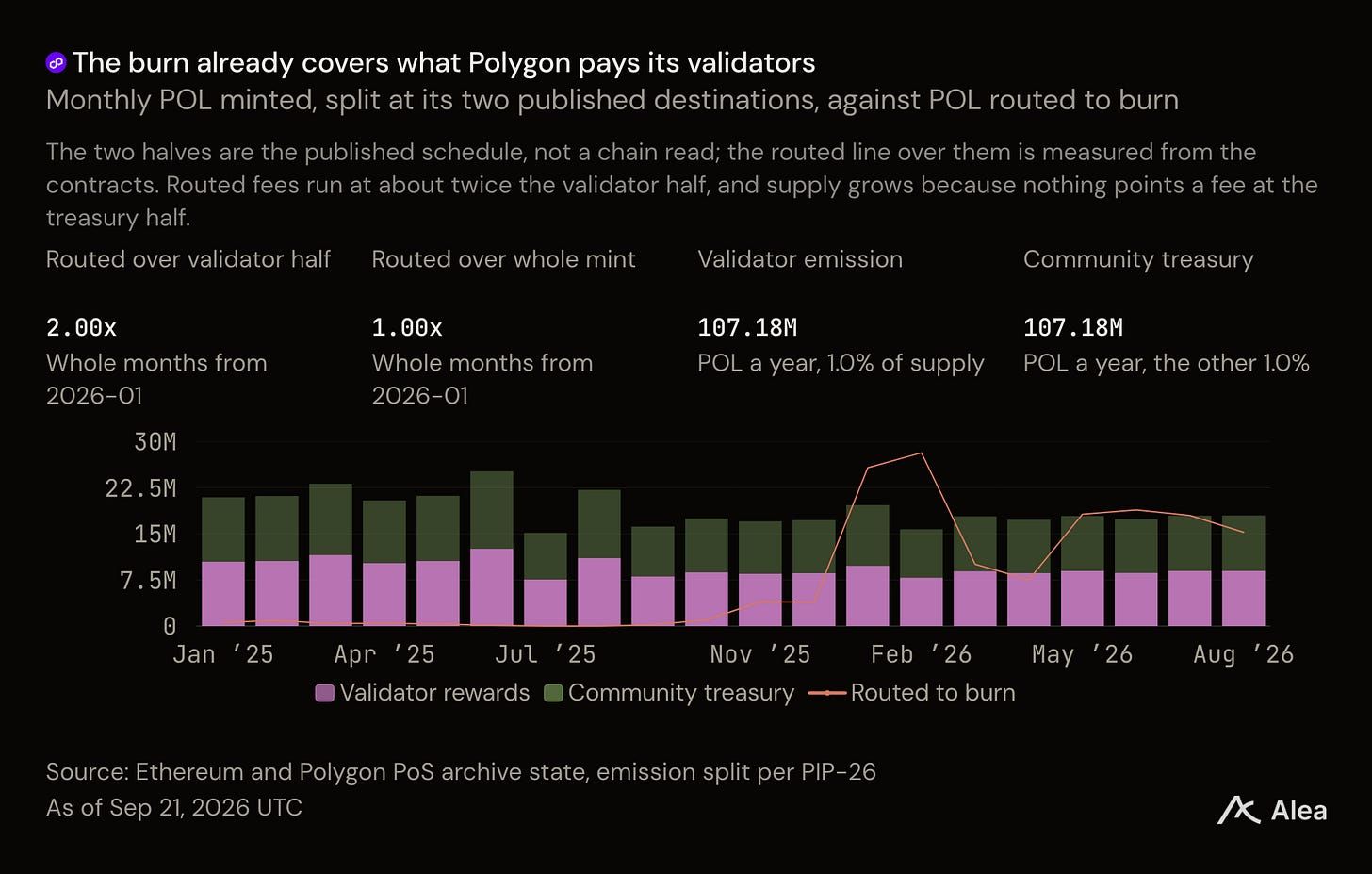
Total supply keeps rising for the treasury half, while collected POL from base fees has moved to a contract and stopped there. That’s the target to be burned, kicking off with a 100M inaugural burn.
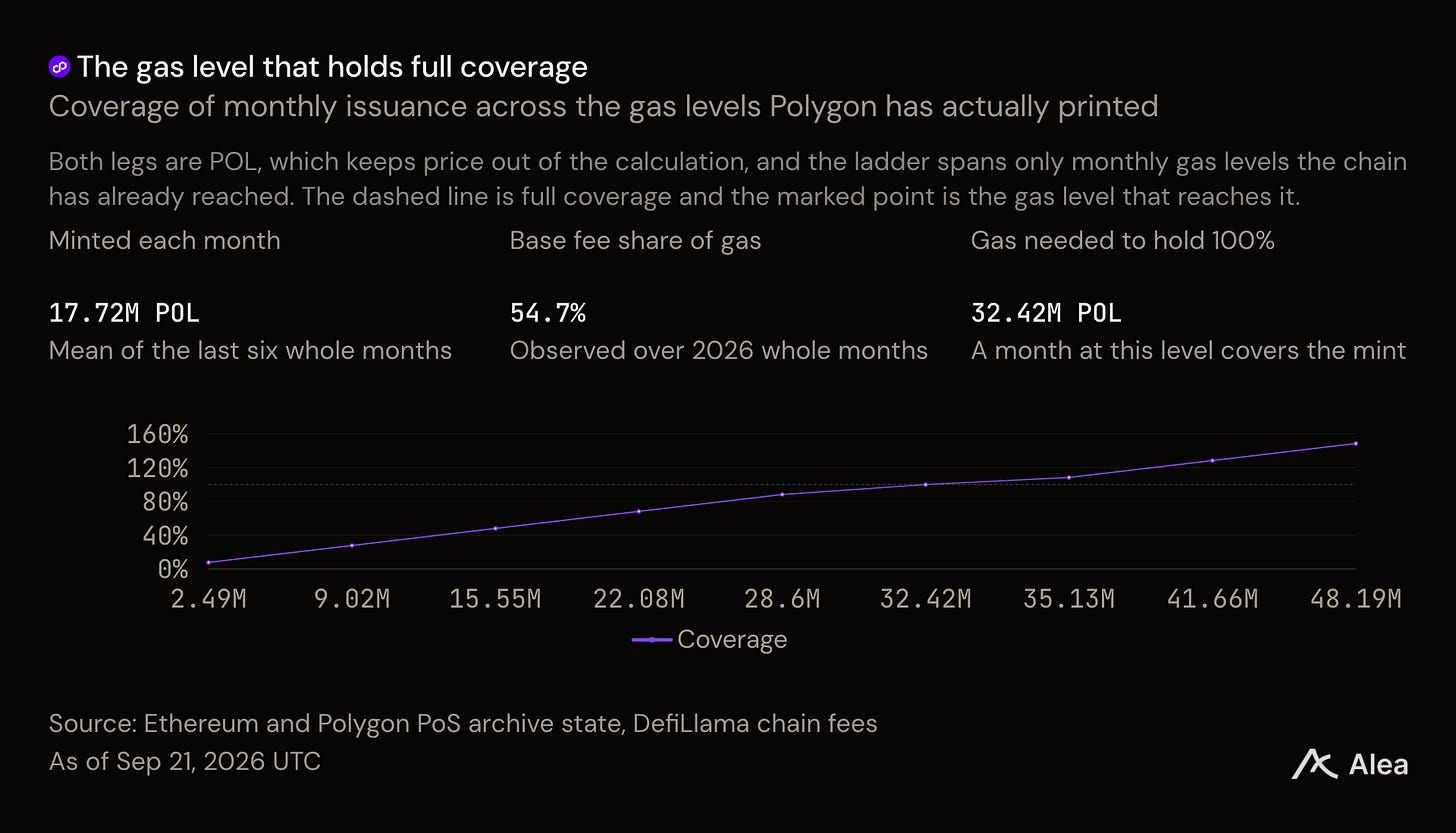
Polygon needs about 32.42 million POL of gas a month for the base-fee share to match what it mints. Whole months since March have averaged 30.3 million.
Polymarket still pays for most of this
Users spent $39.79M on Polygon over thirty days across the applications built on it and the chain's own gas.
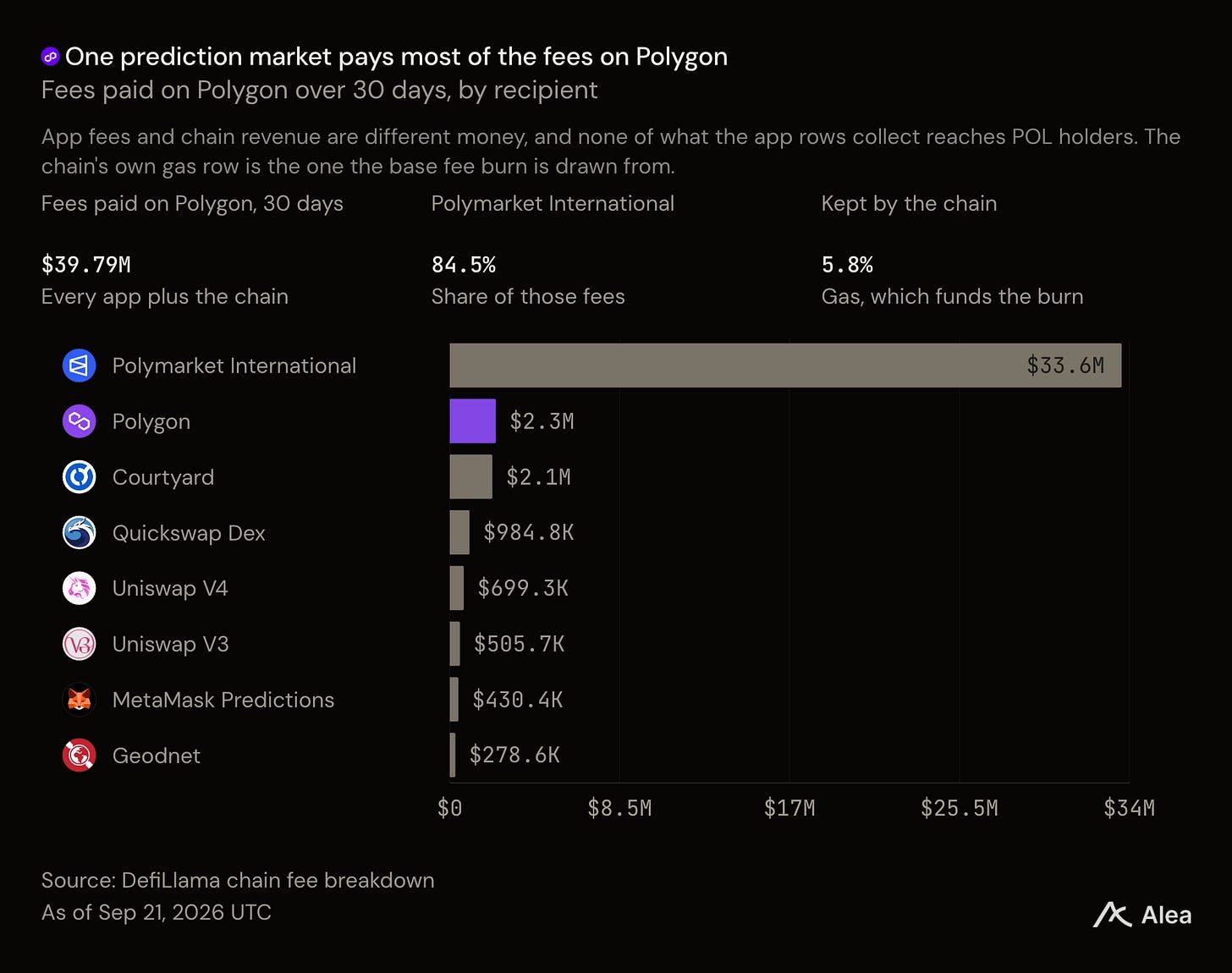
The largest app, Polymarket, took 84.5%, and a second prediction market another 1.1%. Polygon's own gas row, the one the base fee is drawn from, is 5.8%. These are different pools of money, since application fees do not automatically reach POL holders. For the burn, the relevant measure is gas, not application revenue. A sample of 300 blocks over the thirty days to Aug 9 showed Polymarket at 38.7% of transactions and 62.2% of gas consumed.
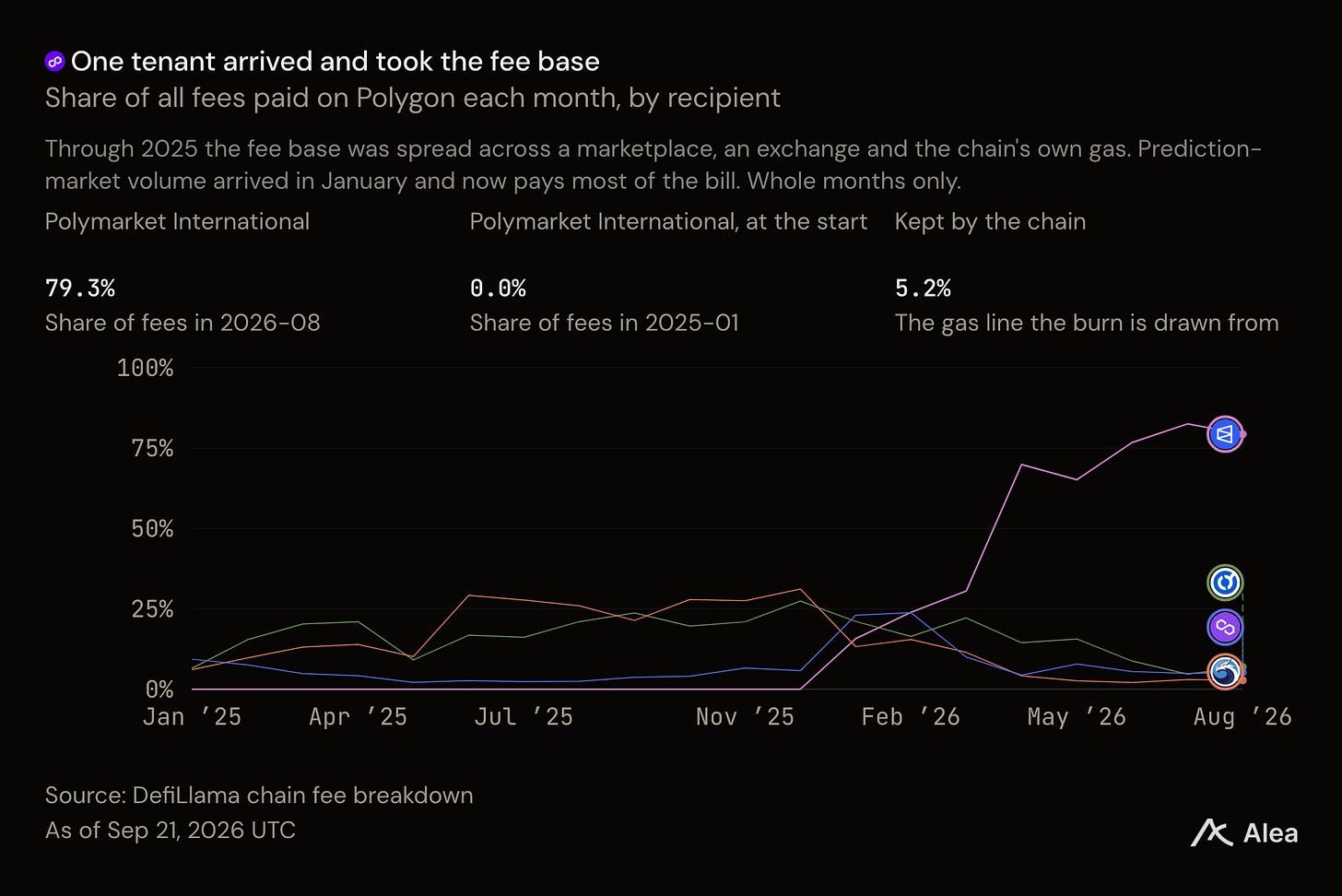
Polygon handled 120 million transactions in Aug 2025 and 197.9 million in Jul 2026, 64.9% more across those eleven months. Take Polymarket out of both ends and the rest of the chain grew 10.5%.
Some still remember that Polymarket has been candid about wanting more. Its engineering lead for DeFi said on Apr 25 that traction had "massively outpaced our infrastructure". Chain migration went on his list alongside more block space, cheaper gas and smaller block times. But the person named no destination and no date. Five months on, nothing has moved.
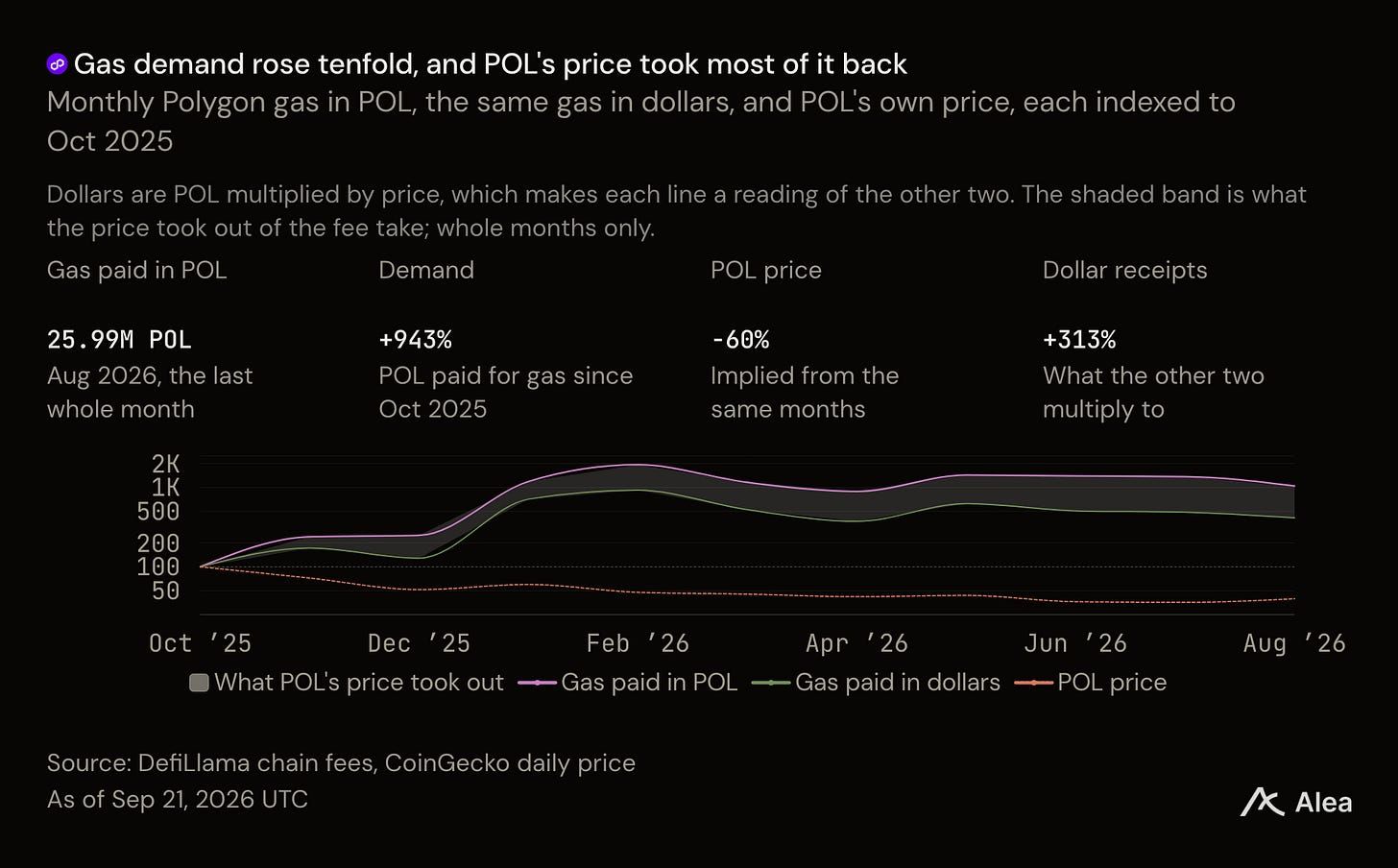
Gas paid in POL is up 943% since October 2025. The same gas in dollars is up 313%. POL's 60% fall over those months is the entire difference.
The payments build is what widens the base
Polygon spent the year assembling a payments business rather than a blockchain with a bridge. The Open Money Stack it announced now covers pay-ins, pay-outs, virtual accounts, and orchestration behind one API. Polygon Labs confirmed a SOC 2 Type 1 examination of it on Sep 2. That is the document regulated counterparties ask for before they route customer money.
Customers followed. Kansai Electric's rewards subsidiary MOACT launched loyalty points converting into a yen-pegged stablecoin on Jul 30, spendable through a consumer wallet. Revolut launched its euro stablecoin EURR on Ethereum and Polygon on Aug 26. Stable.com announced direct-to-bank stablecoin transfers on Sep 17 from self-custodied wallets into a partner network covering 180 countries. Polygon also announced routing between Solana and twenty EVM chains on Aug 3. And Polygon Labs entered phase two of the Bank of England's Digital Pound Lab.
The chain underneath moved at the same rate. Polygon published the Ithaca upgrade on Jul 30, its fourth mainnet upgrade in under five months, improving failover and predictable behavior under load, which is exactly what a payments chain has to sell.
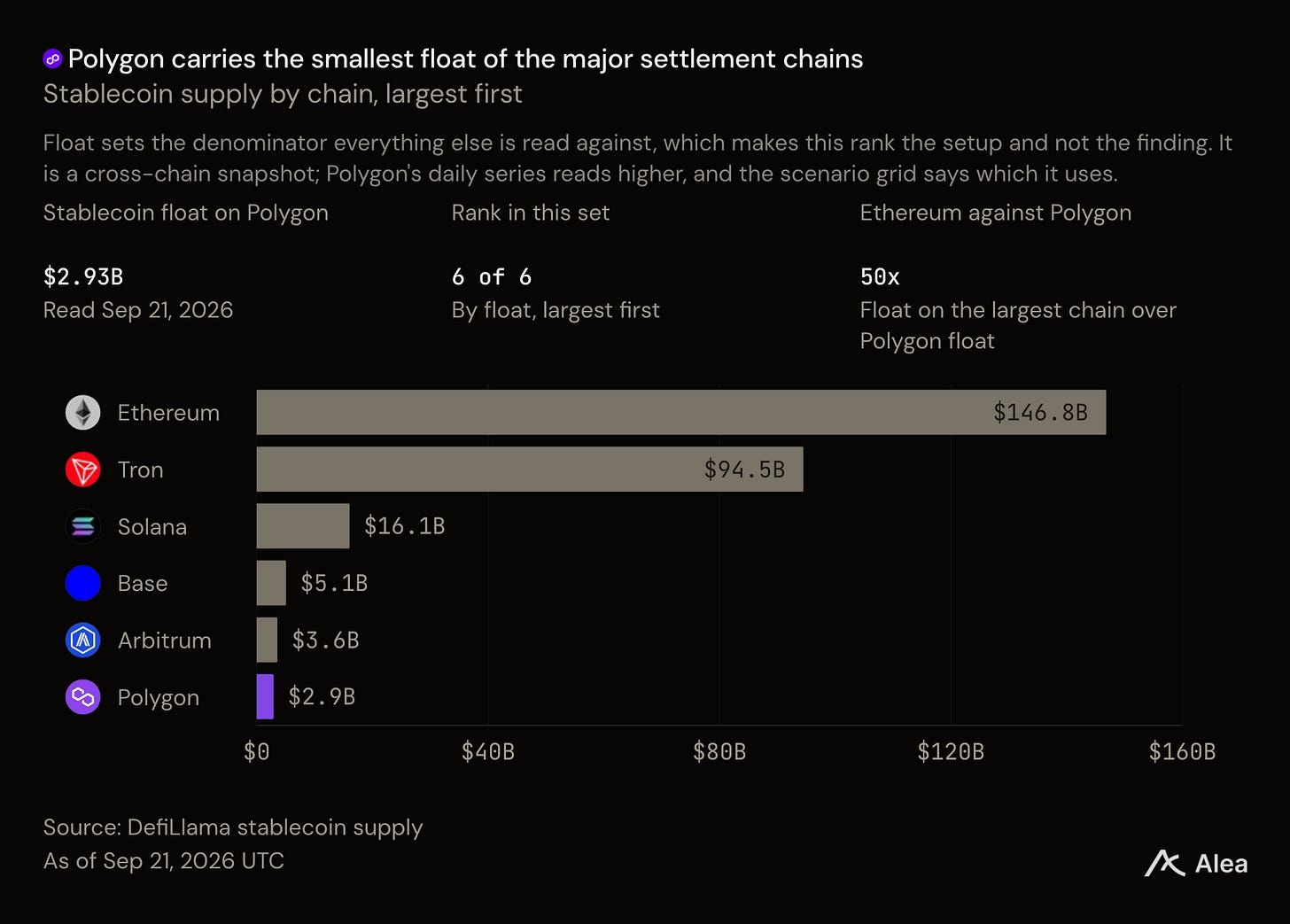
Most sector ranks classify payments chains on stablecoin float, but that yardstick misses how this business earns. A dollar that moves twenty times a month pays twenty fees out of the same balance. Turnover is what pays, not the balance. Chain balances showed Polygon holding $2.93B, the smallest of the six major settlement chains. But its gas take is 1.06% of that float a year.
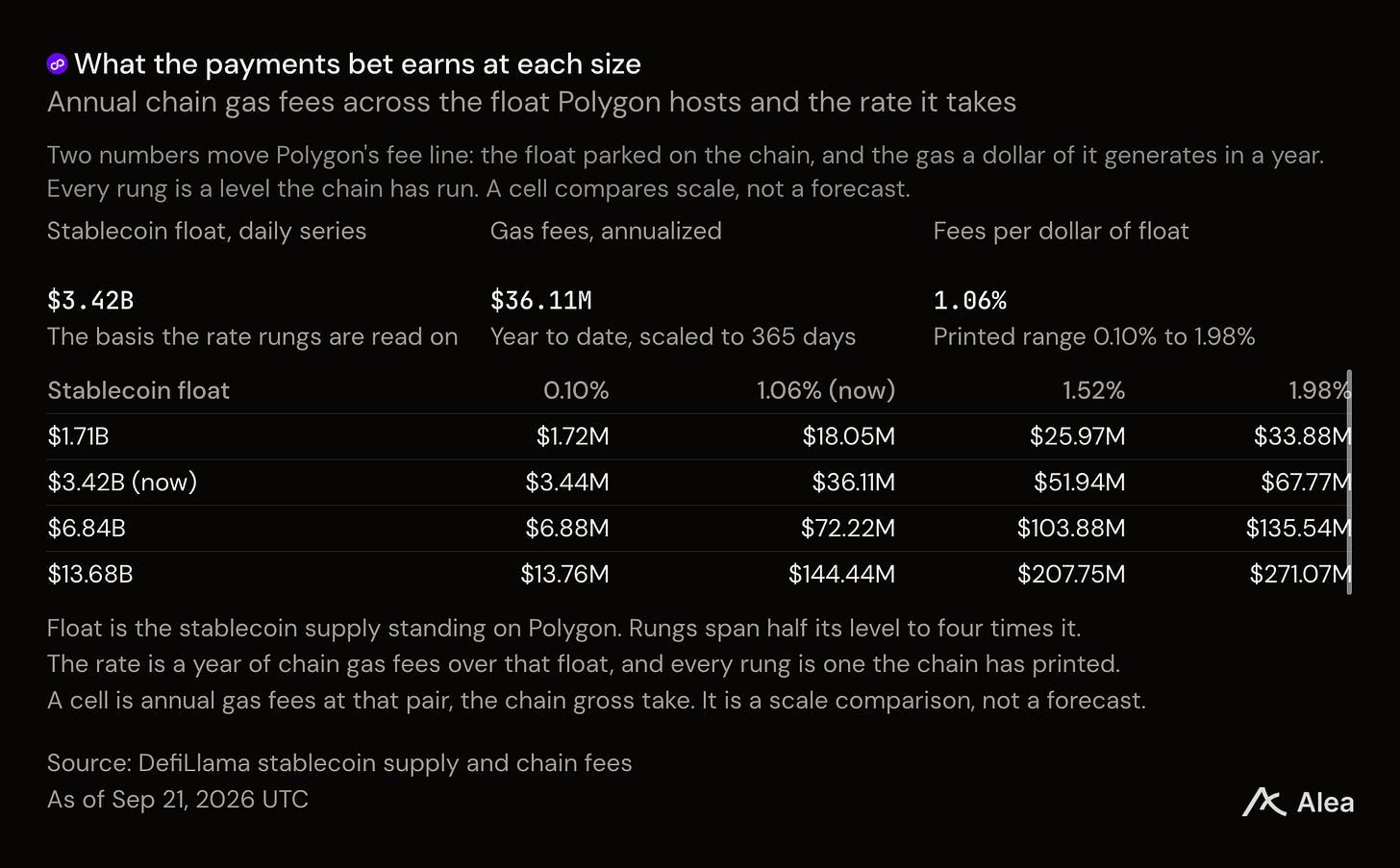
The engineering efforts are now focused on improving throughput for payments, targeting 100,000 transactions a second.
What the peers do with their fees
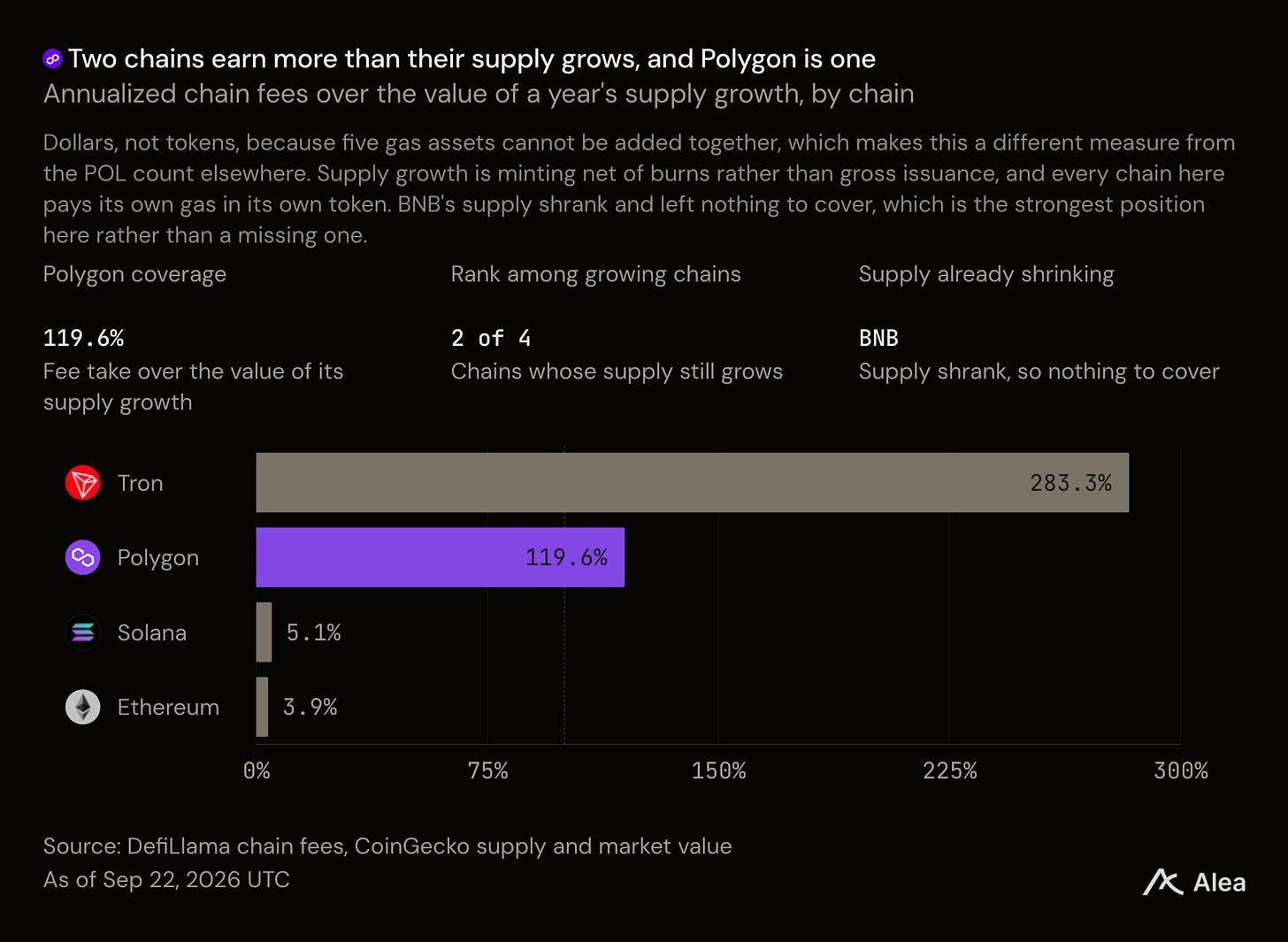
Earning more than your own supply grows is rare. Measured in dollars over a trailing year, Polygon's fee take covers 119.6% of the value of its supply growth. Tron covers 283.3%. Solana covers 5.1% and Ethereum 3.9%.
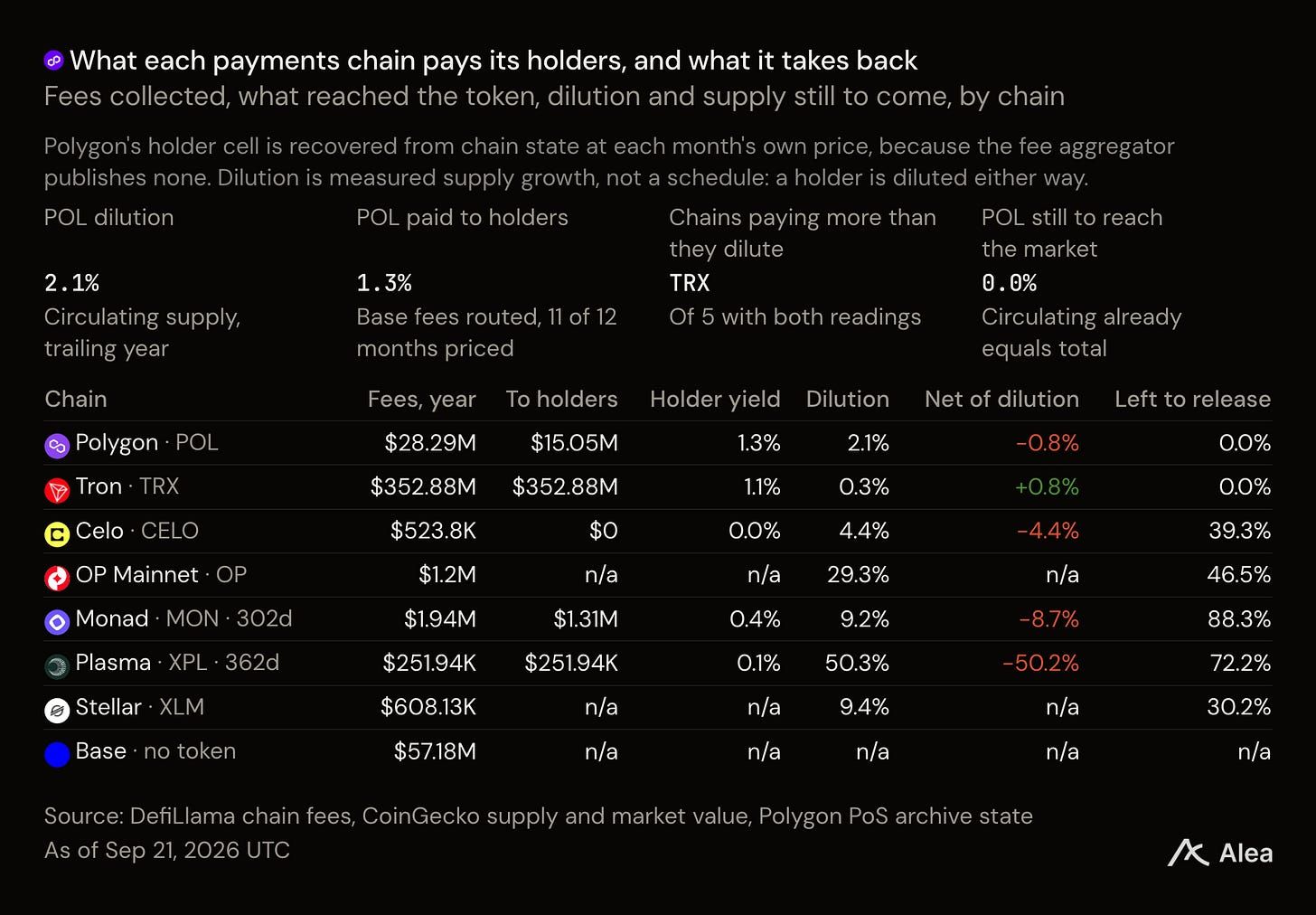
Polygon's $15.05M over the trailing year of base fees collected onchain, valued at each month's own price is 1.26% against 2.06% dilution, and that’s also against just $1.19B in market value. Plasma carries $1.23B of stablecoins and collected $251.94K in fees across twelve months. Polygon collected $28.29M.
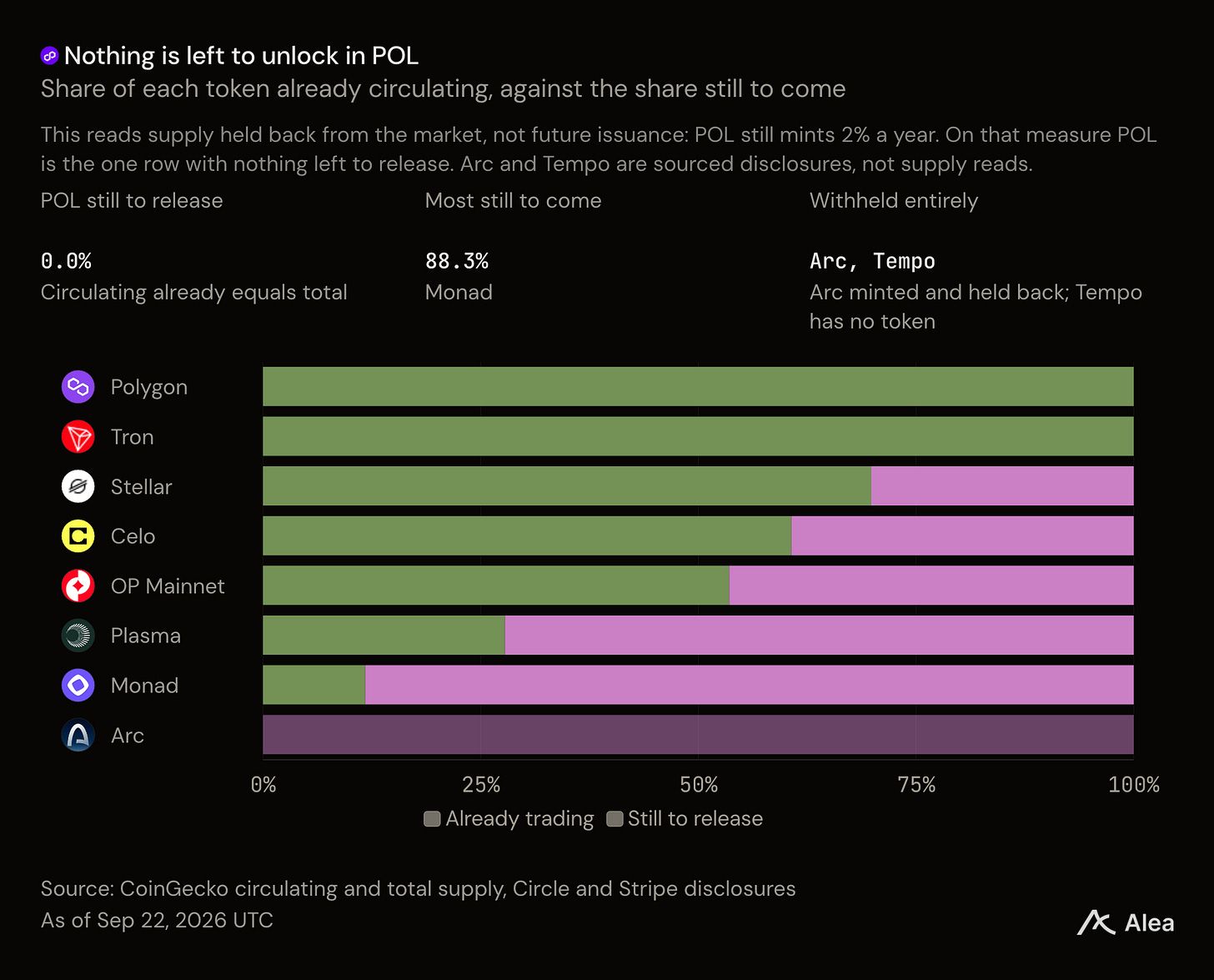
The competitive question this year is whether a payments chain needs a token at all. Circle's Arc launched on Sep 16 with a founding validator cohort of eleven institutions alongside Circle, BlackRock and Visa among them. All ten billion ARC were reported minted at genesis, with distribution withheld. Stripe-backed Tempo went further and launched in March with no native token, paying validators in stablecoins.
Polygon's advantage sits exactly there. The base fee is what the burn draws on. It is set in the chain's own configuration and changes only through governance in public.
What you pay for it
POL last recorded $0.111, putting fully diluted value at $1.19B. The token set its high at $1.29 on Mar 13, 2024 and trades 91% below it.
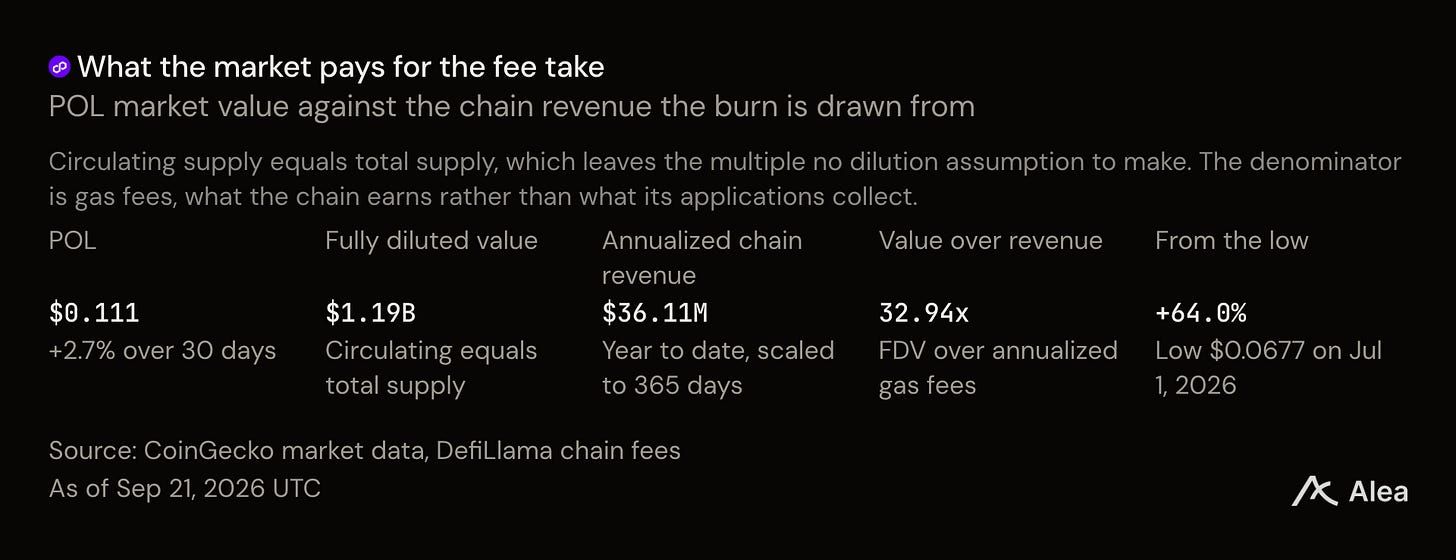
Against a trailing year of collected fees POL reads 42 times. Tron reads 93, Celo 176, OP Mainnet 444, Monad 1,315, Plasma 3,937, Stellar 17,196. Polygon's is the lowest here and the next lowest is more than twice it.
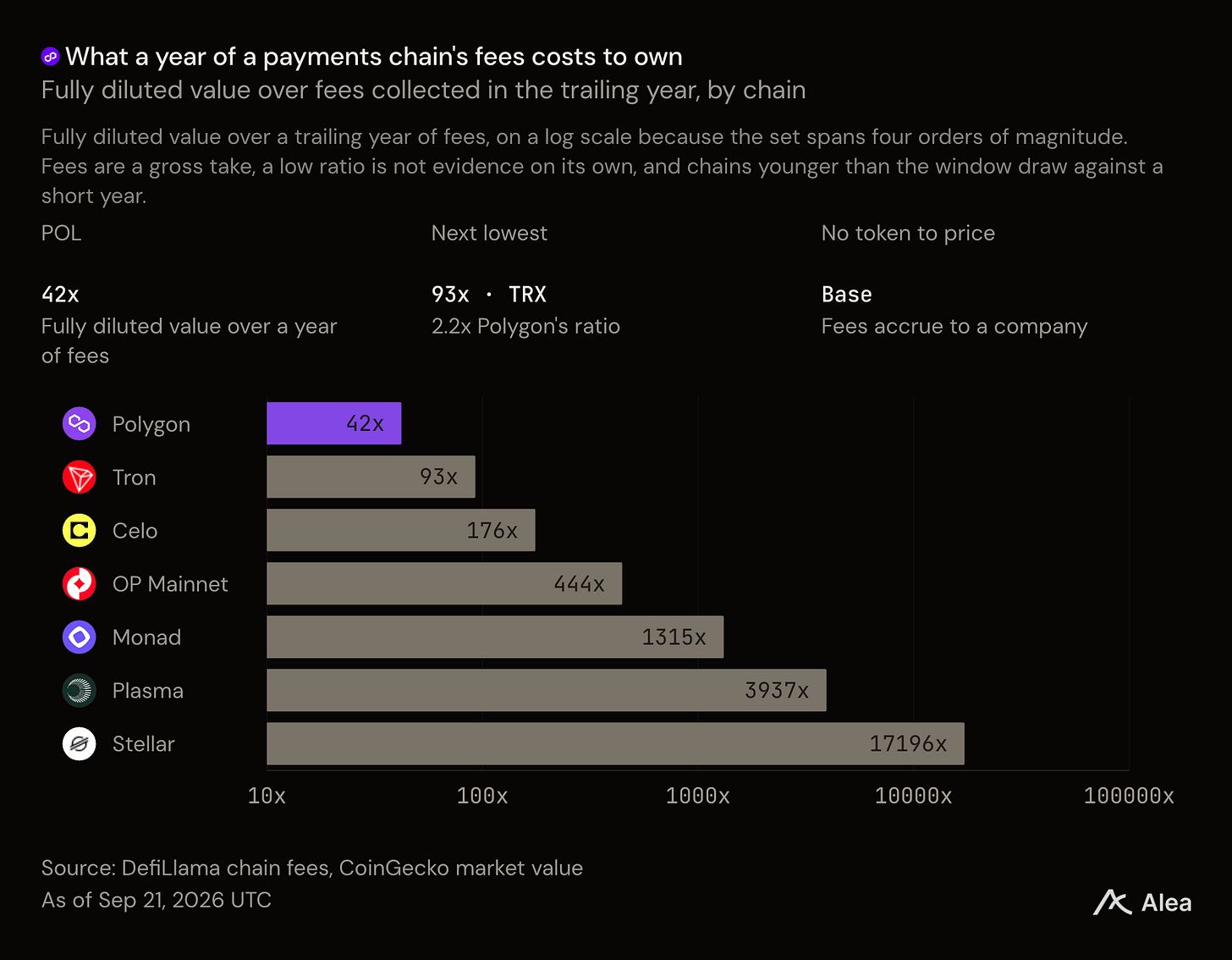
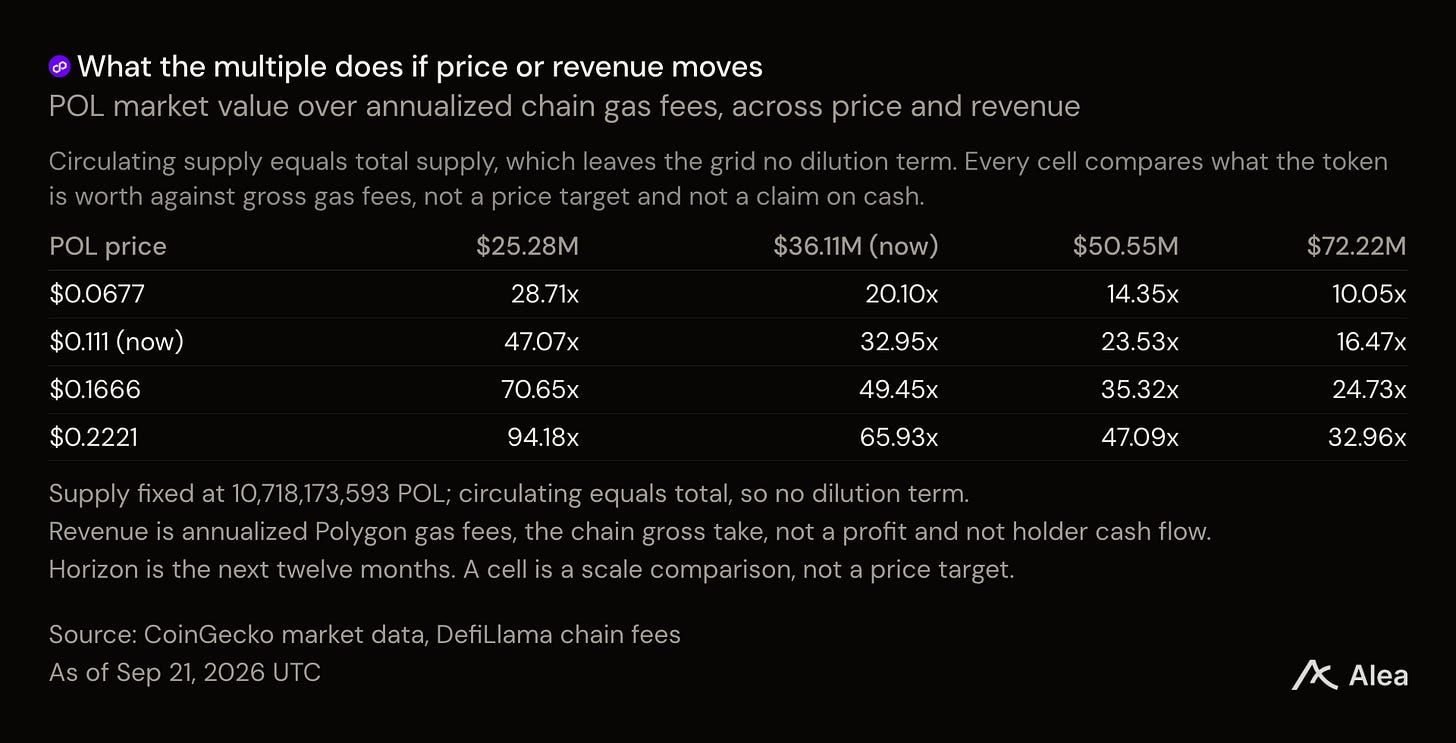
What happens to that multiple if the business grows?
Hold Polygon's fees where they are and lift only the ratio to Tron's, which is the one other chain whose fee take covers its supply growth, and POL reads $0.2445. At Celo's ratio it reads $0.4648.
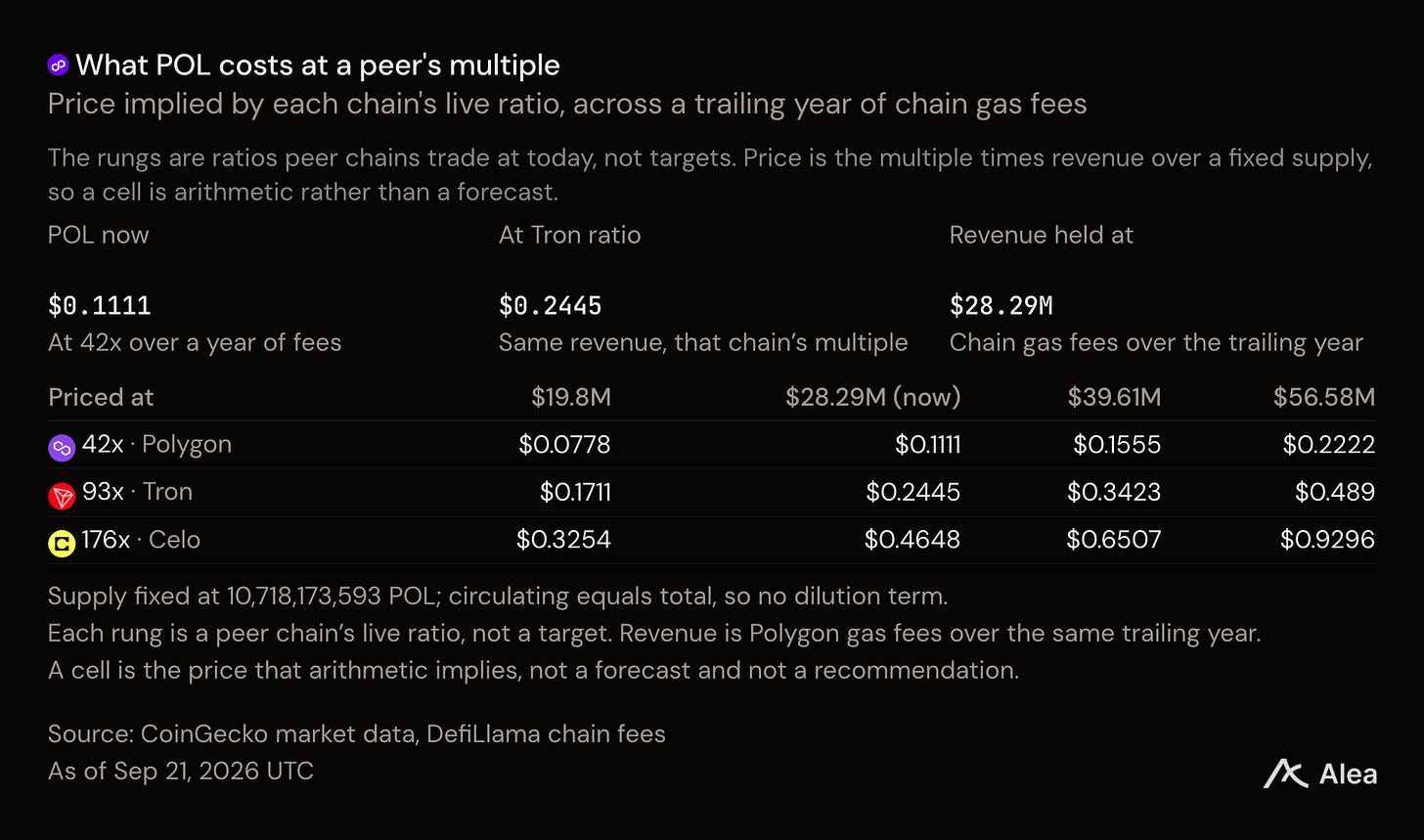
None of that is a forecast. The repricing that already happened is the larger move.
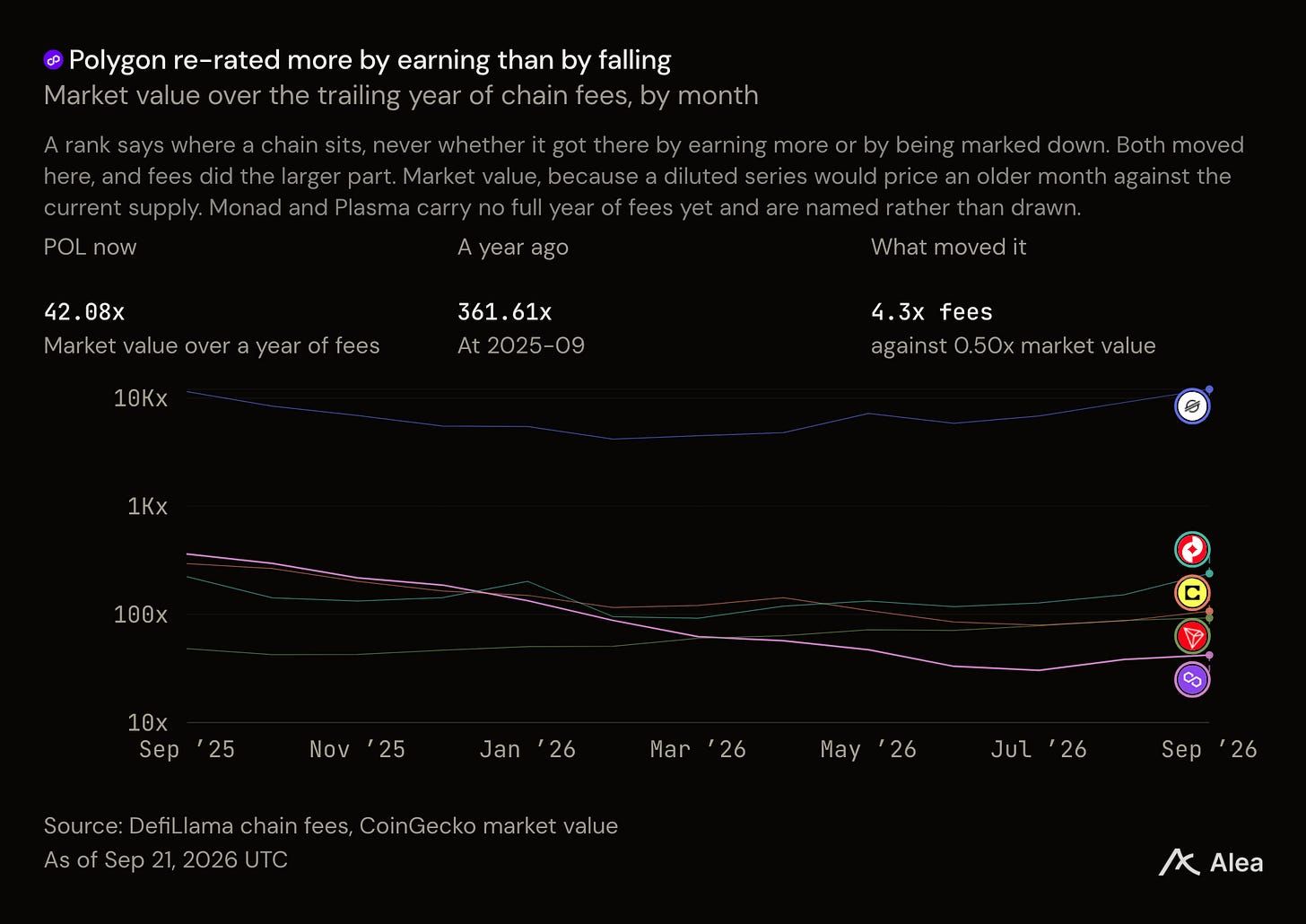
Polygon's multiple fell from 361.61 times to 42.08 across the twelve months to September. Fees grew 4.3 times while market value moved 0.50 times. Nine months in, Polygon's fees match what it mints. 100 million POL in the queue for burning.
Important Links

Alea Research covers protocols and the economics underneath them.
**Research reports**. Deep Dives and Blueprints explain protocols and their economics. Theses and Memos examine investment cases and catalysts. Benchmarks compare performance, while Perspectives assess specific developments.
**Weekly Pulse**. Read a weekly assessment of macro and the major liquid markets.
**Protocol Data Rooms**. Research each protocol in one place, with Analytics for historical comparisons and Intel for news and governance developments where available. Open Polygon Analytics. Open Polygon Intel.
**Podcast Digest** and **Summit Digest**. Read summaries of industry conversations and events. Find Alea shows and their episodes through Podcast Digest.
**Governance Tracker**. Follow proposals and voting activity across protocols.
For protocol teams preparing institutional conversations, discuss research for your protocol with Alea.