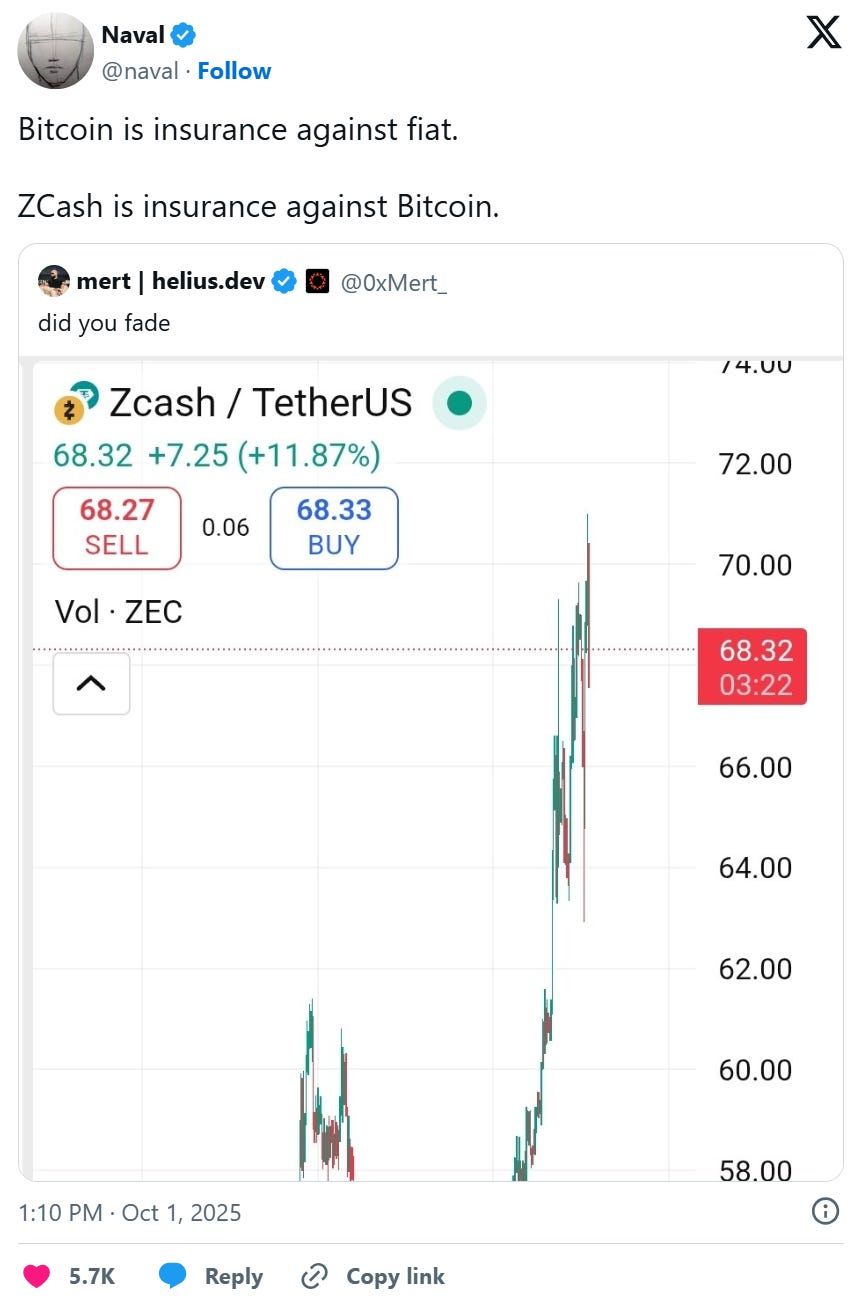
Zcash gained over 400% the past month, in part due to Naval’s shout that “Bitcoin is insurance against fiat, and Zcash is insurance against Bitcoin”. The tweet sparked a wave of privacy‑coin narrative enthusiasm, drawing from notable figures like Mert, arguing that Zcash offers stronger privacy and scaling than Monero.
This sudden attention on privacy tokens highlights the growing discomfort with visible transaction data particularly with the institutionalization of Bitcoin and the search for compliant ways to protect financial history.
Amidst all this, a Solana-based privacy protocol emerged, marketed as “incognito mode for finance.” Umbra promises auditable privacy where users can make confidential, unlinkable transfers while still generating a voluntary opt‑in viewing key for auditors or regulators.
In this edition, we’ll explore the privacy narrative resurgence, how Umbra’s architecture works, and why it differs from mixers or Monero.
Stay informed in the markets ⬇️
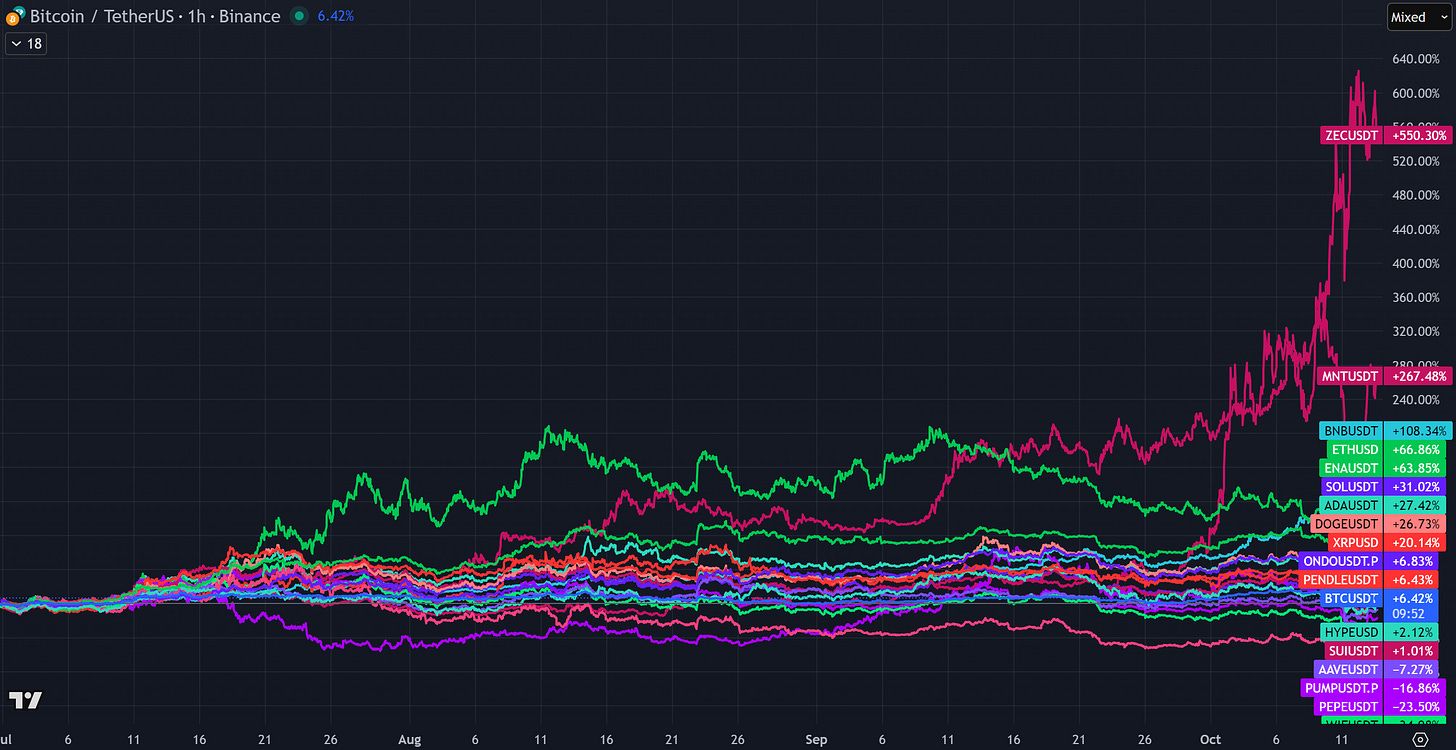
Recent ZEC Rally
Zcash’s 430% October rally demonstrates how quickly sentiment can pivot towards privacy, surging from low $50 to almost $300.
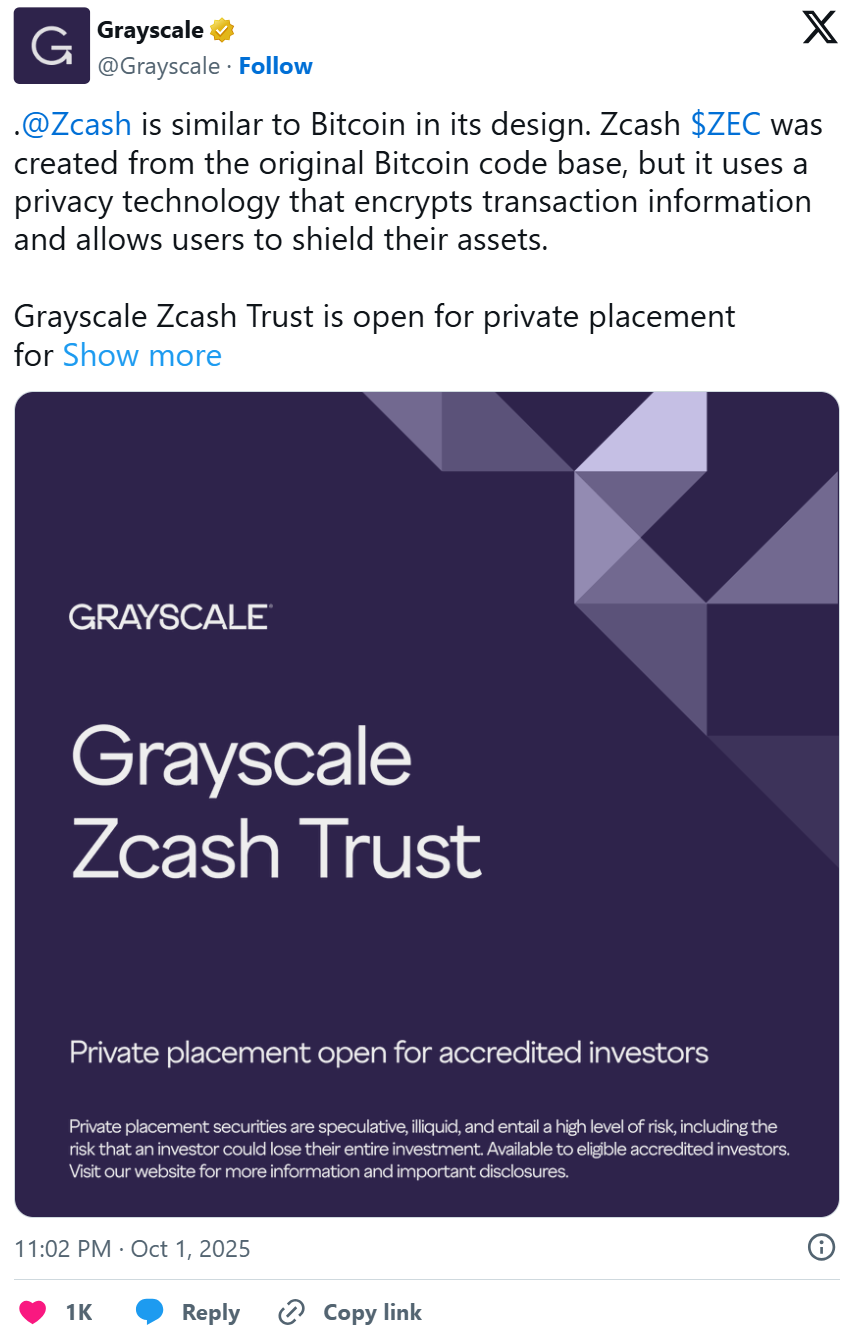
This was partly due to a wave of high-profile endorsements from thought leaders like Naval or Mert from Helius, and renewed institutional access via the reopening of Grayscale’s Zcash Trust.
Alongside this, Railgun, a privacy smart contract system, surged 240% in the same period, helped by the Ethereum Foundation’s Kohaku roadmap, which integrates zk‑multisig and aims to make privacy a protocol‑level default.
Context - Why Onchain Privacy Matters
The market’s recent chatter around privacy underscores a broader consideration of crypto’s infrastructure particularly with the rapid institutionalization of Bitcoin. Public chains excel at verifiability but leak sensitive information about holdings, strategies and business operations, which is the key suspicion on what TradFi (at least regulators) could be doing with the transparent Bitcoin ledger.
Builders are now exploring ways to offer auditable privacy which isn’t fully opaque, but configurable by users or regulators. Umbra bills itself as “stealth mode for Solana,” but unlike Monero or Tornado Cash, it supports auditable privacy. Other solutions such as Aztec which is an L2 rollup, allows developers to build applications where users control data disclosure.
Ethereum’s Kohaku roadmap also shows the industry-wide shift towards adopting privacy-preserving tech, elevating privacy from an optional feature to a protocol-level commitment by the team

Umbra’s Auditable Privacy
Umbra brands itself as the “Financial privacy layer for Solana”. It is designed as a shared‑state system that provides confidential, unlinkable and auditable transfers on Solana. It addresses the problem of on-chain transparency exposing financial history, which leaks behavioural patterns, and reveals strategic positions.
Umbra has several core functionalities:
Unlinkable transfers. Using a shielded pool and zero‑knowledge proofs, Umbra breaks the on‑chain link between sender and receiver addresses.
Confidential amounts & encrypted balances. Every transaction amount and user balance is encrypted, preventing observers from inferring value flows or balances.
Gasless withdrawals via relayers. A relayer network allows users to claim funds without pre‑funding new addresses with SOL and fees are deducted from the transferred amount.
Voluntary auditability. Users can generate viewing keys that grant read‑only access to selected third parties, enabling regulatory compliance and reporting.
Device‑side encryption and Arcium’s multi‑party computation (MPC) allow users to conceal transaction details without sacrificing network speed.
An auditor program creates encrypted links between shielded and public wallets and will only disclose information under court orders. This design aims to prevent the regulatory scrutiny that led to the forced shutdown of Tornado Cash, while still protecting users.
Umbra vs. mixers and shielded L1s
Traditional mixers obscure sender‑receiver links but leave amounts visible, making them vulnerable to statistical tracing (e.g. habitual precise movements of funds, or timing footprints where a wallet receives funds after x amount of time from a payroll wallet, etc.).
Umbra’s approach encrypts linkage, amounts and balances, making doxxing through heuristics nearly impossible.
Meanwhile, shielded L1s like Monero or Zcash provide strong base‑layer privacy but lack opt‑in transparency which limits institutional adoption. Umbra’s voluntary disclosure and compliance framework offers a middle path integrating privacy by default with user‑controlled transparency.
MetaDAO Launchpad Raise
Umbra completed an ICO on the MetaDAO launchpad raising over $150M in USDC commitments against a $3M cap, making the sale massively oversubscribed.
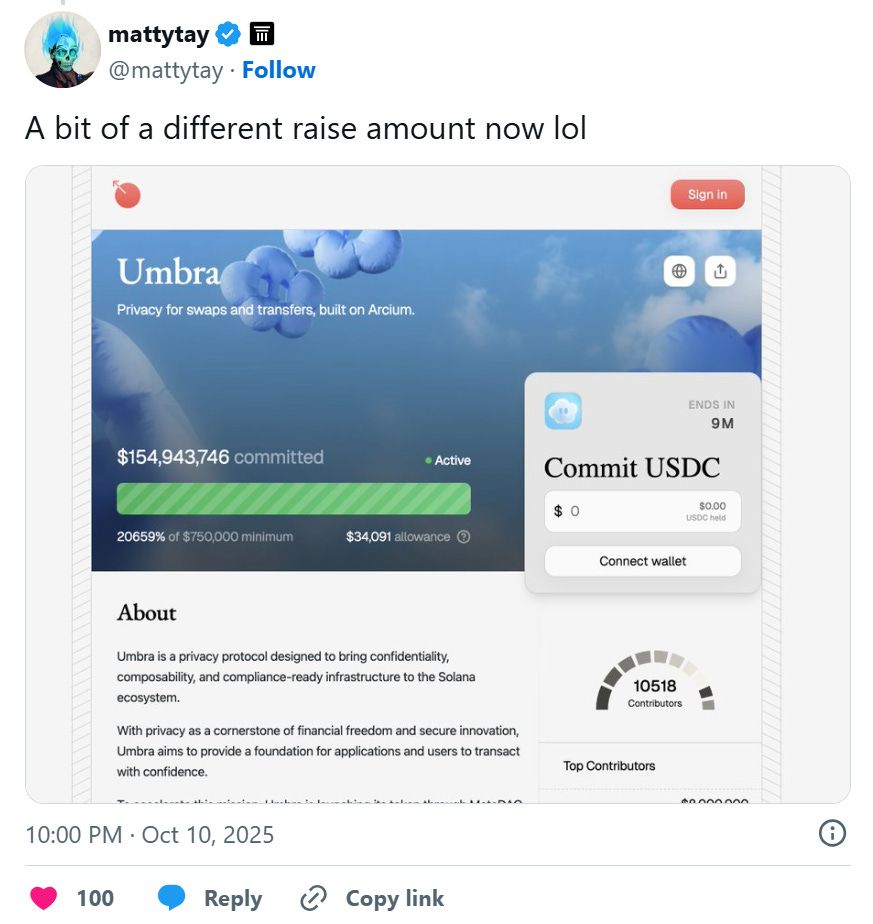
Participants got filled pro-rata (roughly ~2% of their subscription, with refunds on the rest), and listings referenced an initial sale price around $0.30 per $UMBRA. The launchpad sale represented 35% of the total supply.
The token distribution looks like this:
ICO (~35.1%): 10M tokens (fixed supply, fully circulating on TGE)
Liquidity (~17.5%): 5M tokens. 2M tokens are paired with 20% of the ICO funds raised, 3M tokens provided as single-sided liquidity on Meteora
Team (~47.4%): 13.5M team allocation (performance-gated)
Takeaways
Naval’s tweet may have sparked the ZEC frenzy, but the underlying forces are more durable. Institutional access via products like the Grayscale Zcash Trust, builders like Mert championing privacy as a necessity, and infrastructure like Ethereum’s Kohaku roadmap are all angled to transforming privacy into a default expectation rather than an edge case.