Many new chains struggle to seed native liquidity and build core financial primitives from scratch. Ink is an L2 built by Kraken changes this by adopting proven protocol mechanisms and incentivizing activity with its own token.
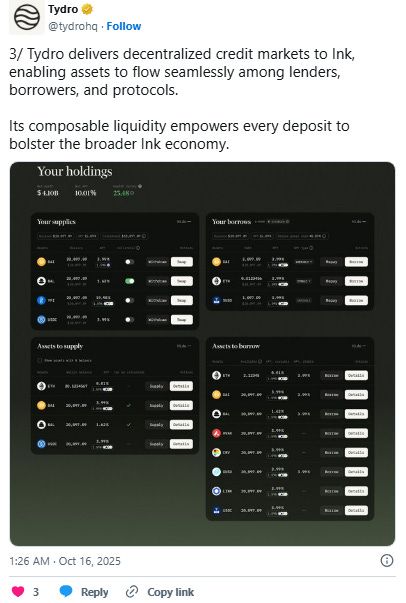
The first major DeFi integration is Tydro, a non‑custodial lending protocol built with Aave v3 tech. By allowing users to supply and borrow tokens against over‑collateralised positions, Tydro provides a composable, capital‑efficient source of liquidity that is deeply integrated with the Ink network and Kraken’s exchange infrastructure.
In this edition, we’ll look into how Tydro works and why it matters for the Ink ecosystem, INK token mehcanics, and what this means for capital allocators exploring emerging L2 platforms.
Stay informed in the markets ⬇️
Introduction to Tydro
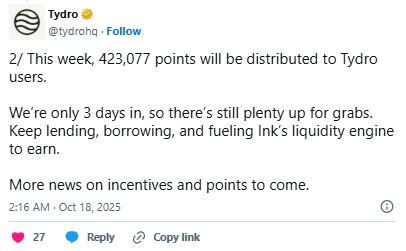
Tydro is a non‑custodial lending protocol built on the Ink Layer 2 and powered by a white‑label deployment of Aave v3. This enables users to supply assets and earn yield while allowing others to borrow against over‑collateralized positions. They went live on Oct 15 and to-date have close to $200M in TVL.

Tydro supports multiple assets such as wETH, Kraken’s wrapped Bitcoin kBTC, USDG, USDT0 and GHO similar to Aave. In fact, Tydro inherits Aave v3’s lending engine, including support for variable‑rate loans, flash loans and credit delegation. This means that advanced DeFi functionality such as flash loans (borrowing assets within a single transaction for arbitrage or liquidations) is available out of the box.
Bootstrapping Liquidity with $INK and Points
Launching a lending protocol on a new chain is as much a liquidity problem as a technical one. Without deep liquidity, interest rates spike and slippage deters users.
The $INK token is the native token of the Ink ecosystem and functions as a liquidity incentive. Users who supply or borrow eligible assets on Tydro earn $INK rewards proportional to their activity. Rewards accrue continuously and can be claimed through the protocol interface.
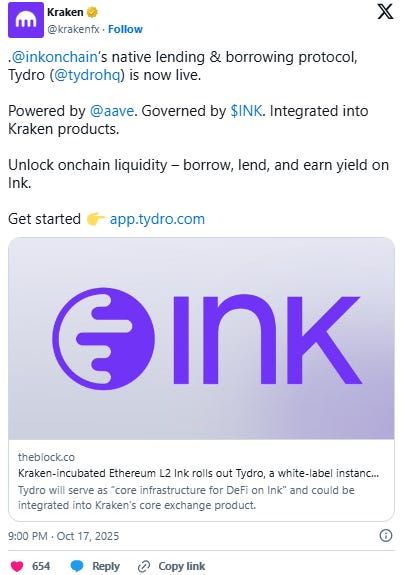
In addition to direct token rewards, Tydro tracks user engagement through a points program which likely translates to an airdrop programme. Points accrue through lending and borrowing TVL.
Tydro Lending Mechanics
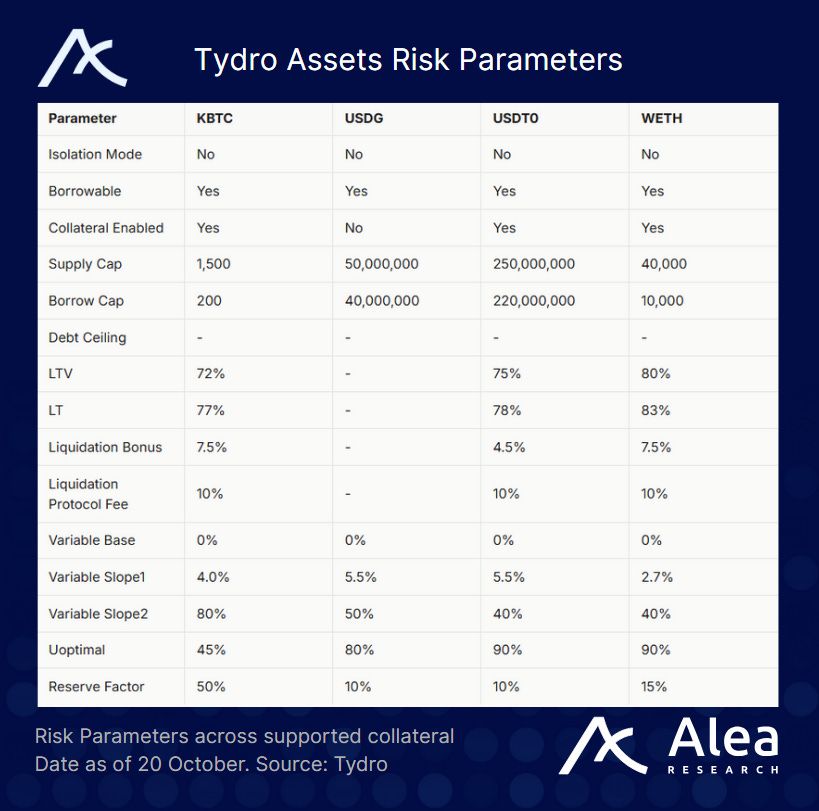
Each asset reserve has its own risk parameters such as supply/borrow caps and LTVs that allow the protocol to adjust exposure to each asset. For example, kBTC has a 72% LTV ratio and a 77 % liquidation threshold, meaning a user can borrow up to 72 % of their kBTC collateral, and if the borrow value exceeds 77% of collateral value, the position becomes eligible for liquidation.
Interest rate curves are also parameterized, for kBTC the variable rate slope 1 is 4%, increasing to 80% beyond a utilization target of 45%.
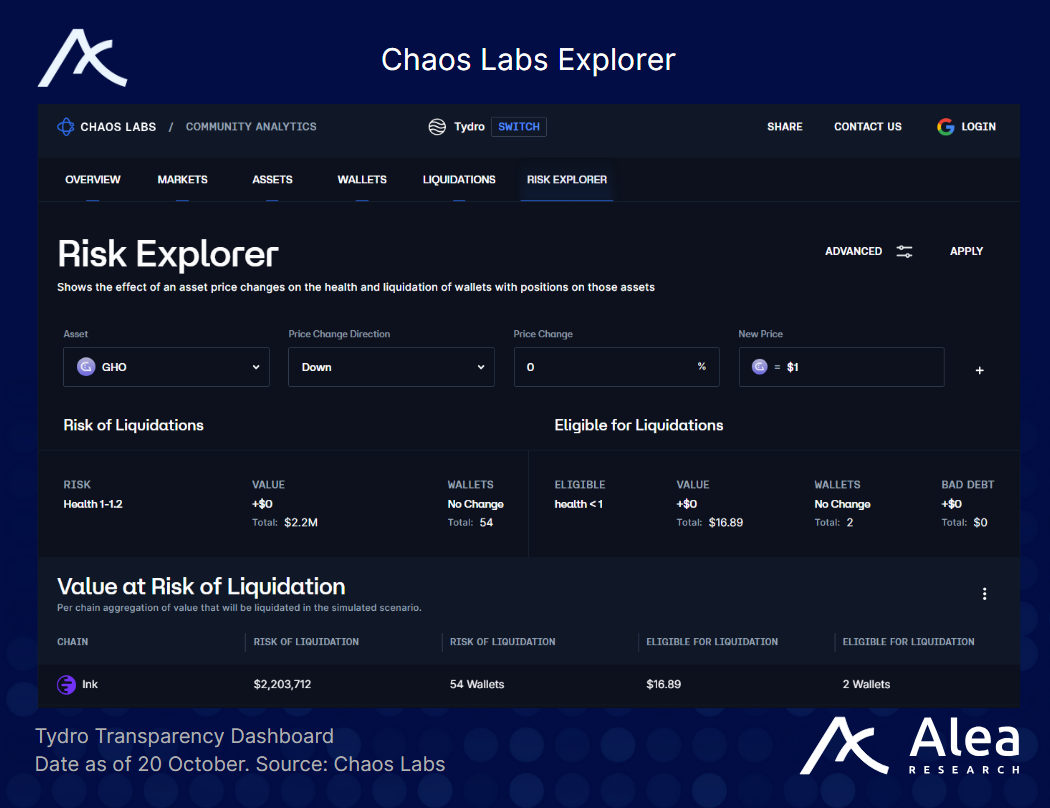
Tydro partnered with Chaos Labs to provide 2 types of oracles. The first is an Edge price feed that aggregates prices from multiple off‑chain sources to get reliable data. The second type of oracle is called Correlated Asset Price oracles which track the price of derivative or wrapped assets by mirroring the underlying asset’s price and adjusting based on correlation. This system ensures that asset valuations used in health‑factor calculations are accurate and up‑to‑date, reducing the risk of stale prices during market volatility
Because Tydro leverages Aave v3, it supports flash loans that allow users to borrow any available liquidity without collateral so long as the loan is repaid in the same block and a 0.05% fee are repaid within the same transaction.
As for the liquidation engine, Tydro’s logic also mirrors Aave v3 where borrowers are issued a health factor that must stay above 1. If it falls below 1, the loan becomes eligible for liquidation. Liquidators can repay up to 50% of the outstanding debt and claim the corresponding collateral plus a liquidation bonus.
Takeaway
By combining Aave’s lending engine, risk framework, and a tailored incentive structure via the $INK token and points program, it aims to bootstrap deep liquidity on a brand new L2. Kraken plans to integrate Tydro into its core exchange products, meaning that exchange users could access DeFi lending from their centralised accounts. This integration could drive meaningful TVL growth, which currently already sits at an impressive $170M.