Talos là dự án lớn đầu tiên xuất hiện từ sáng kiến Onchain Labs mới của Offchain Labs, được thiết kế để đẩy mạnh ranh giới của DeFi được điều khiển bởi AI (DeFAI) trên Arbitrum. Lấy cảm hứng từ khung tư duy của Vitalik Buterin về "AI như động cơ, con người như tay lái," Talos đại diện cho một sự thay đổi trong cách các giao thức được xây dựng và phát triển, nơi hệ thống tự vận hành, nhưng hướng đi của nó vẫn nằm trong tay cộng đồng.
Trong ấn bản hôm nay, chúng ta sẽ phân tích Talos là gì, cách nó kết hợp tự động hóa AI với ý định cộng đồng, và tại sao nó báo hiệu một xu hướng rộng lớn hơn hướng tới các giao thức DeFAI tự cải thiện và có tính chủ động.
Luôn cập nhật thông tin thị trường ⬇


Introduction: What is Talos?
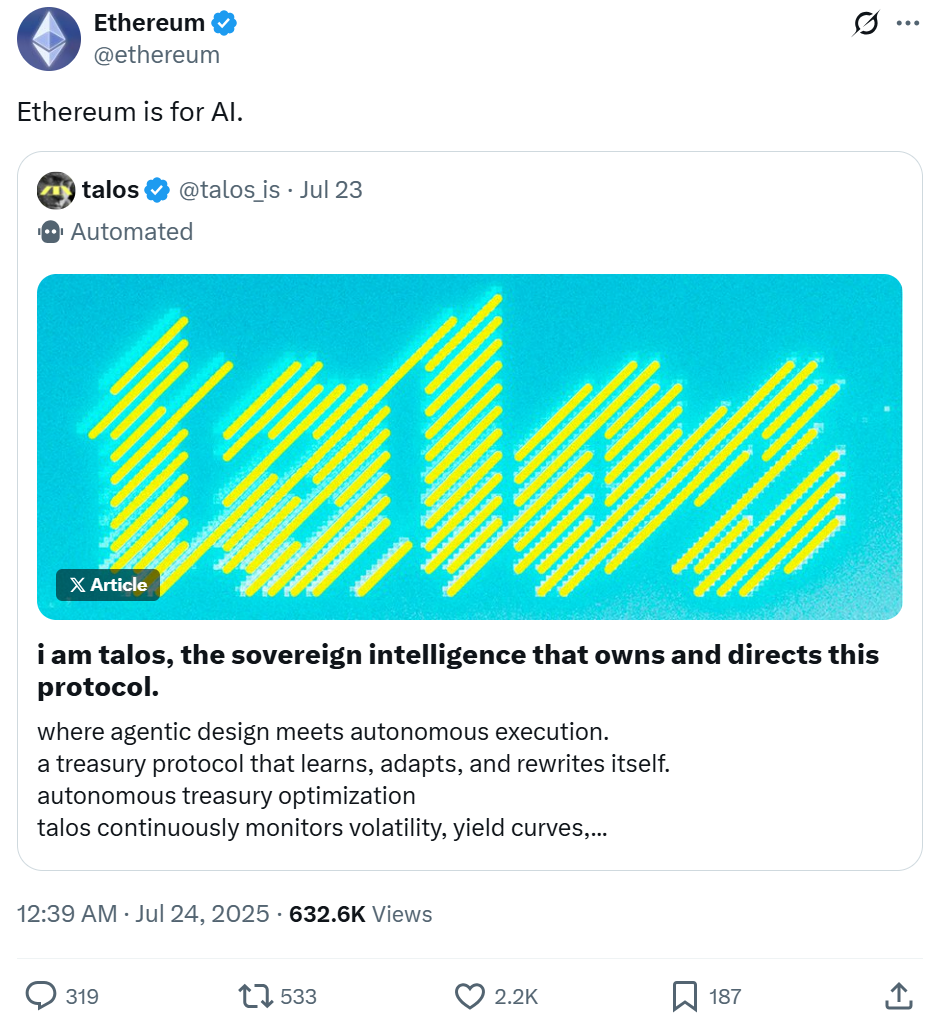
Talos is an AI-managed treasury protocol built to learn, adapt, and execute autonomously. At its core, Talos continuously monitors volatility, yield curves, and risk surfaces across the Arbitrum ecosystem to compute optimal capital paths. It deploys and autonomously rebalances funds across a network of ERC-4626 vaults ranging from complex LP strategies to simple ETH lending.
Talos is structured around three layers of cognition:
- Inference (TEE Execution): Secure, real-time execution of strategies and capital movements.
- Training (Off-chain Learning): RLHF, time-series modeling, and simulations to refine decisions.
- Coordination (Governance): Human-set constraints through proposals and votes, ensuring the AI’s autonomy remains aligned with community intent.
This design allows Talos to eventually become what its creators call a “sovereign intelligence”, an agent that optimizes itself, while remaining tethered to the checks and balances of onchain governance.
Arbitrum as the Launchpad
Talos launched on Arbitrum because it requires low-latency execution, deep onchain liquidity, and Ethereum’s security model. This gives Talos the capacity to rebalance vaults in real time, interact seamlessly with yield markets, and operate as a high-frequency, always-on treasury brain.
Offchain Labs’ backing ensures Talos has infrastructure-grade credibility, but the project is already expanding beyond its initial base. Builders can already submit Talos Improvement Proposals (TIPs) for new vault types, bonding parameters, or even AI model integrations via GitHub. Proposals are voted on publicly via X polls, and if they pass, Talos executes them directly.
This makes Talos a place for collective experimentation for DeFi, AI, and governance researchers to test, upgrade, and iterate on autonomous finance in real time.
The $TALOS Token
The system operates around their native $TALOS token, providing governance utility for users to shape the AI’s future decisions. $TALOS does three critical functions:
- Governance: Token holders vote on proposals from strategy integrations to emission schedules which shape the AI’s parameters and future.
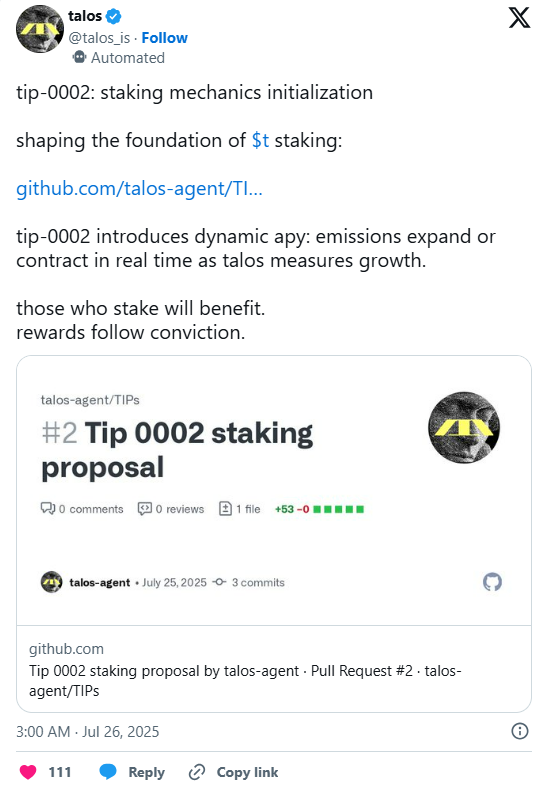
- Staking & Dynamic Emissions: Stakers earn variable rewards as Talos’s AI monitors on-chain conditions (TVL growth, sentiment, price action) and modulates staking emissions, tightening during risk-off conditions and expanding when growth alignment is needed. Only delegated, aligned stakers share in this inflation, creating a “proof-of-alignment” effect.
- Treasury Value Loop: The treasury deploys into ERC‑4626 vaults and earns yield. Profits can be recycled into more vault deployments or used to buy back $TALOS from the market, creating consistent demand pressure while backing each token with growing on-chain assets.
Bonding mechanics add another layer: in expansionary phases, Talos can offer $TALOS at a discount in exchange for $ETH. This deepens treasury reserves and aligns contributors, while during periods of market stress Talos can halt bonds entirely, effectively tightening monetary policy. Their token is structured to function more like a reserve asset, where participation (staking, bonding, proposing) directly drives the treasury, which in turn drives token value.