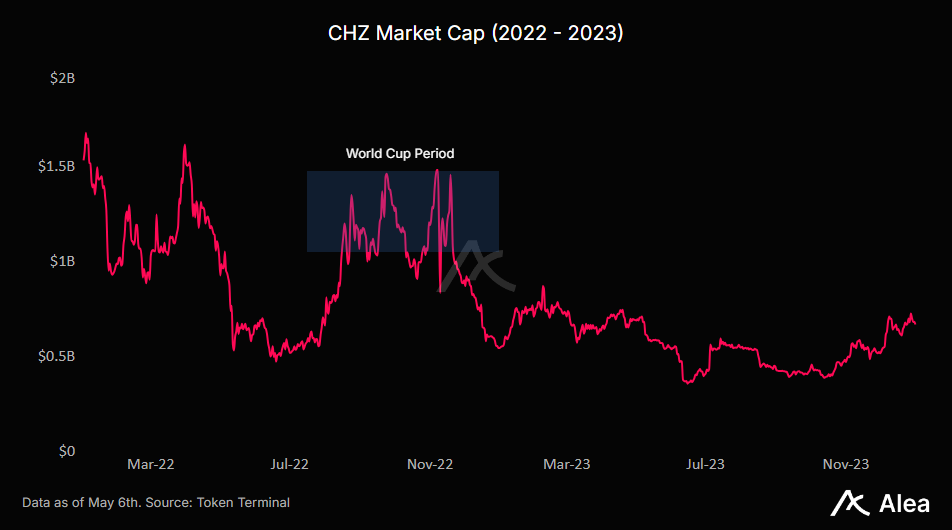
In 2022, CHZ was effectively the only liquid vehicle for the World Cup trade, rallying roughly 380% before the tournament on narrative alone, with no corresponding revenue surge.
The 2026 World Cup is months away, and today, the betting infrastructure and sheer number of projects have more than doubled. SportFun is a fantasy trading platform where users trade player shares, compete in tournaments, and earn rewards tied to onchain fees.
In this edition, we explore how it works and where it sits in the broader sports-crypto cycle.

What SportFun Is
SportFun runs on Base and currently covers football and NFL. Users build rosters by buying shares of real athletes, enter tournaments automatically, and earn Tournament Points (TP) based on leaderboard placement. TP redeems for player packs containing new shares.
Free-to-play users start with an initial TP allocation, while Pro users deposit USDC to buy Gold (the in-game currency, pegged 1:1 to USDC) and compete for larger prize pools.
The platform raised $2M in July 2025 led by 6MV.
They further raised ~$2.5M in an ICO round on Legion that was heavily oversubscribed.
How the Fee Economy Works
SportFun charges a 3% fee on player share trades and a 2% fee on swaps. A dynamic sell fee triggers when a player's share price drops more than 10%, scaling to 12-20% on sharp declines as a brake on panic-driven exits.
Fee revenue funds programmatic buybacks of both player tokens and $FUN, the platform's fixed-supply (1B) tradable token. $FUN holders receive up to 40% fee rebates and governance rights, but the token is not required to play. The buyback treasury draws from fee revenue rather than new token issuance, so there is no emissions schedule diluting supply.
$FUN holdings determine how much of those fees come back to the holder. The platform runs weekly Seasons, during which holders accumulate a Holder Score based on a time-weighted average of how much $FUN they hold and for how long.
That score places each holder into one of six levels, with fee rebates and bonus TP scaling with level. Withdrawing $FUN during a Season reduces accumulated points proportionally: withdraw half, lose half your score for that period. Tokens remain liquid, but early exits are penalized in the reward calculation.
The World Cup Volume Catalyst
The 2022 CHZ rally showed what happens when a major tournament attracts crypto flows. CHZ was the primary liquid vehicle, national team fan token launches on Socios created a discrete demand event, and daily trading volumes peaked around $166M at the tournament’s height. Revenue came mainly from initial fan token sales and licensing fees rather than ongoing transaction activity, and when the tournament ended, trading demand plummeted.
Today, there are more sports-crypto infrastructure than existed four years ago.. Prediction markets like Polymarket and Kalshi have already started supporting World Cup markets.
Post-event volume decay is well-documented in prediction markets. Polymarket and Kalshi both show the same pattern around major sporting events where volume spikes into the tournament and drops sharply once it ends. SportFun very likely follows the same curve. The question is whether their weekly tournaments retain enough of that spike to produce a durable fee baseline between events.