The Sky Savings Rate is now driven by a network of competing asset managers, not passive lending.
Stablecoin yield has mostly come from 2 places: crypto-native lending spreads that compress in bear markets, and token emissions that disappear when incentives run out. Neither scales to institutional demand. Sky solves this by making external capital allocators compete for the right to deploy USDS and route their returns back as protocol revenue that funds the Sky Savings Rate.
In this edition, we look at how the Sky Agent Network works, what it changes about the stablecoin yield model, and where the risk sits.

Why Stablecoin Yield Has Been Weak
Most stablecoin protocols earn yield by lending into DeFi markets or wrapping existing money market exposure. When crypto borrowing demand falls, yields fall with it. Token emissions can bandage the gap temporarily are likely unsustainable in the long run. The result is that stablecoin yield has been difficult to defend as a product proposition across a full market cycle.
Sky has been moving toward RWA allocation for several years through Spark and various governance-approved conduits. The recent launch of the Agent Network is the finalized product. Rather than managing RWA exposure directly, Sky now lets named third-party allocators borrow USDS and compete to generate returns across governance-approved strategies.
How the Agent Network Works
Agents — currently including Securitize, Maple Finance, Centrifuge, Spark, Grove, Keel, USDai, and others — borrow USDS from Sky Protocol and deploy it across strategies that include fixed income, structured credit, tokenized mortgages, energy project financing, and AI infrastructure. The value generated flows back to Sky as protocol revenue, which then funds the Sky Savings Rate behind sUSDS. Governance sets the rate and approves which strategies are eligible; agents compete within those constraints.
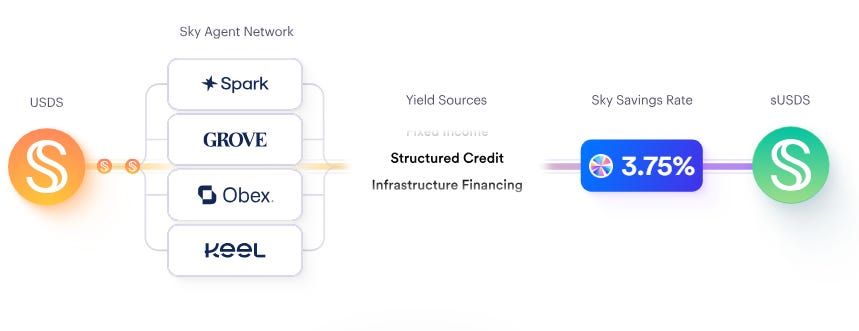
Obex, one of the launch agents, deployed $1B in USDS across eight projects at launch. That figure is self-reported and the underlying allocations cannot be independently verified, but the deployment size and partner list suggest this is live capital rather than a pilot.
What Changes and What Doesn't
Sky is describing the Sky Savings Rate as competitively generated yield from diversified RWA strategies rather than a passive rate derived from onchain lending. Whether the underlying economics are materially different depends on how much of the allocation is genuinely new exposure versus repackaged strategies already running through Spark and other conduits.
The risk profile also changes because RWA strategies introduce credit and liquidity risks that onchain mechanisms cannot address instantly and offchain borrowers cannot be liquidated in a block. Sky’s governance framework is supposed to constrain this, but the constraints are only as good as the approval process behind them. The more capital the Agent Network deploys, the more the Sky Savings Rate depends on performance across markets that DeFi has limited visibility into.
Sky has the governance infrastructure and the institutional partner network to attempt something like this. But whether the Agent Network's competitive structure actually produces better risk-adjusted returns than a simpler RWA allocation strategy is something to watch.