Rayls builds financial rails for institutions, aiming to merge the scale and governance of TradFi with the programmability and liquidity of DeFi.
It operates a multi‑layer architecture consisting of Privacy Nodes, Private Networks, and a Public Chain. This structure is designed to offer the privacy, compliance, and finality required by banks and other regulated entities while still connecting to open DeFi markets. With the upcoming launch of Rayl’s RLS token, the goal is to align economic incentives across those layers.
In this edition we explore Rayls’ core components, the institutional context behind its technical choices, and how the RLS token integrates with the ecosystem.
Stay informed in the market ⬇️
Rayls as the Institutional Financial Rail
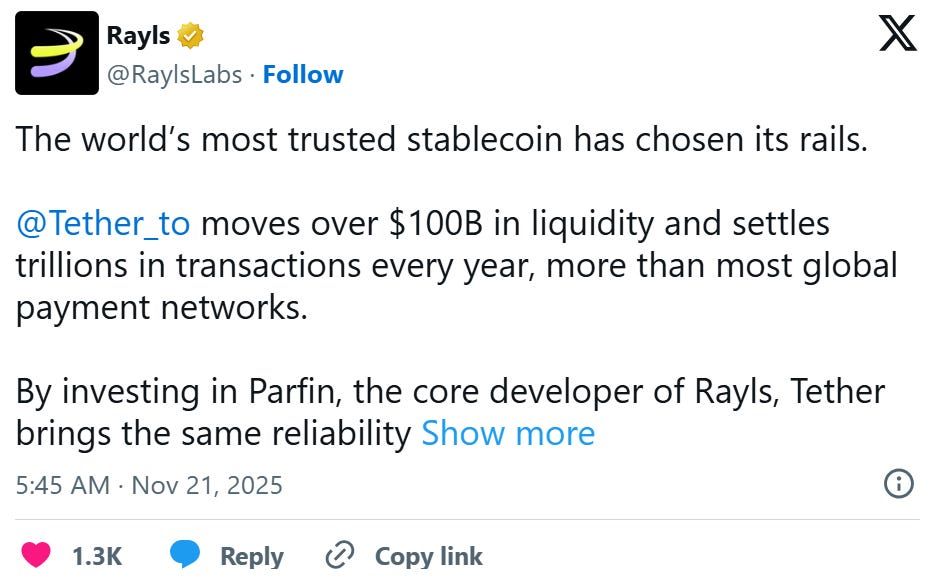
Rayls was launched by Parfin in June 2024, raising over $30M from backers like Framework, ParaFi and more. Recently, Parfin (the developers of Rayl) also closed an undisclosed funding round from Tether.
Rayls describes itself as a “financial assets chain ecosystem” built in collaboration with banks and market infrastructures to tokenize assets privately and connect them to public DeFi markets.
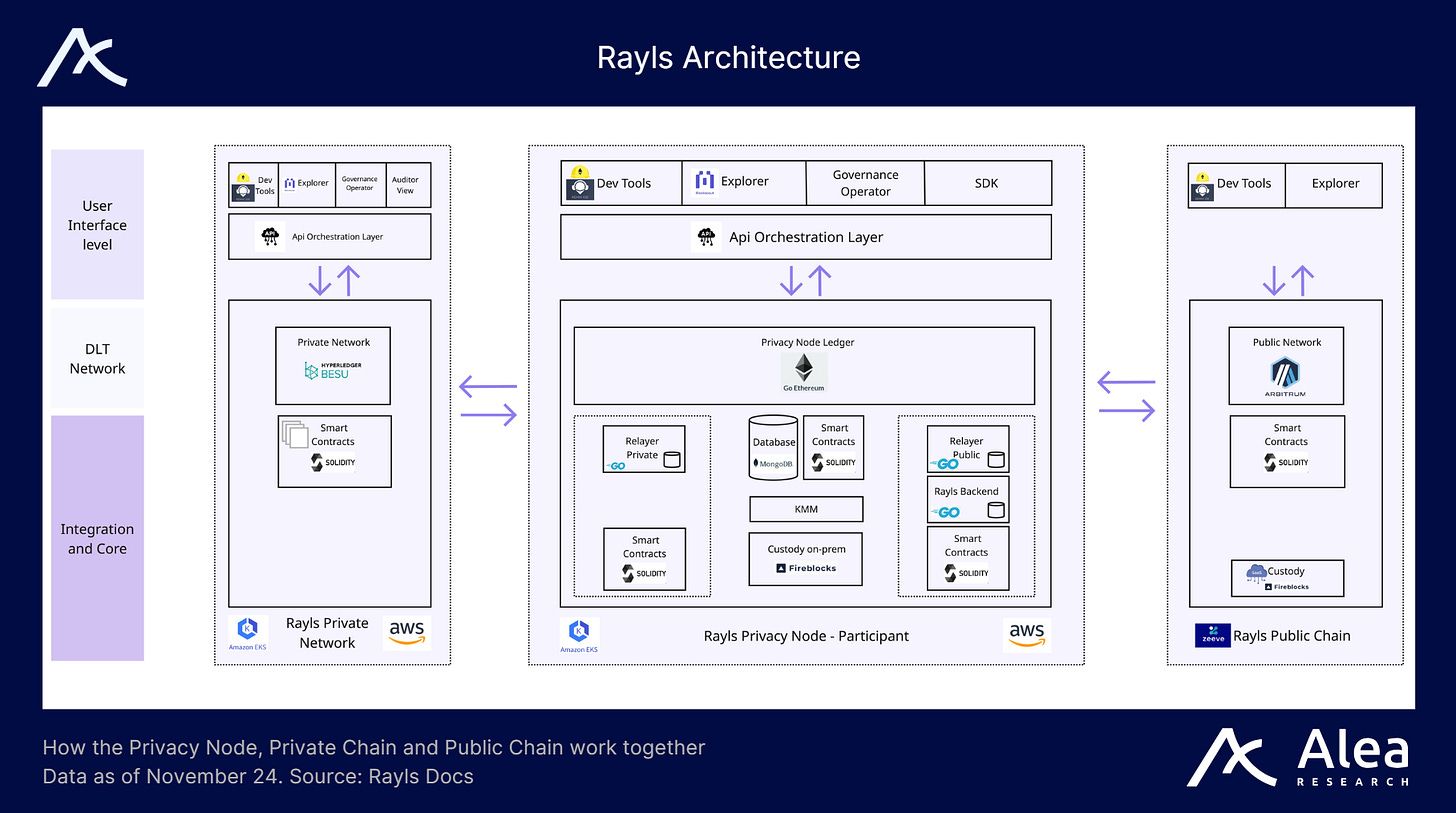
The architecture is organized into three main components:
Rayls Privacy Node - a single-node EVM ledger that an institution runs inside its own environment. Institutions can issue tokens (e.g. receivables, tokenized deposits), maintain millions of client accounts, run internal transfers, deploy smart contracts, and store all data locally.
Rayls Private Networks - permissioned EVM networks linking multiple Privacy Nodes. They allow private cross-institution settlement (e.g. interbank payments, DvP) with configurable governance, auditing, and access controls.
Rayls Public Chain - an EVM-compatible public chain with mandatory KYC, USD-pegged gas fees, deterministic finality, and MEV-mitigation features. This is the environment where DeFi users and protocols interact and where tokenized assets can be listed and traded.
When all these work together, a bank could issue tokenized loans or receivables on its Privacy Node, move it across a Private Network to another institution, and then list or distribute it on the Public Chain for DeFi investors.
Institutional Context - Why Such a Structure Needs to Exist
TradFi infrastructures require strong control, risk management, and privacy. Institutional requirements typically include:
Deterministic, non-probabilistic settlement.
Strong privacy guarantees over transaction flows.
Jurisdiction-appropriate KYC/AML.
Predictable (ideally fiat-denominated) operating costs.
Auditability for regulators and internal risk.
This presents a tradeoff of having limited interoperability and programmability. Earlier experiments with permissioned chains gave institutions privacy but left them siloed and disconnected from global liquidity.
Rayls Public Chain addresses these by combining:
Deterministic finality and MEV protections for settlement.
USD-pegged gas fees, where users pay in stablecoins but the protocol settles fees internally in RLS.
Mandatory KYC for all accounts, which changes the risk profile compared to fully anonymous chains.
Rayls Privacy Node and Private Networks then address the other side:
Private internal ledgers that can still export proofs and tokenized positions.
Configurable governance, sanctions, and freeze controls at the network level.
RLS TGE and Tokenomics
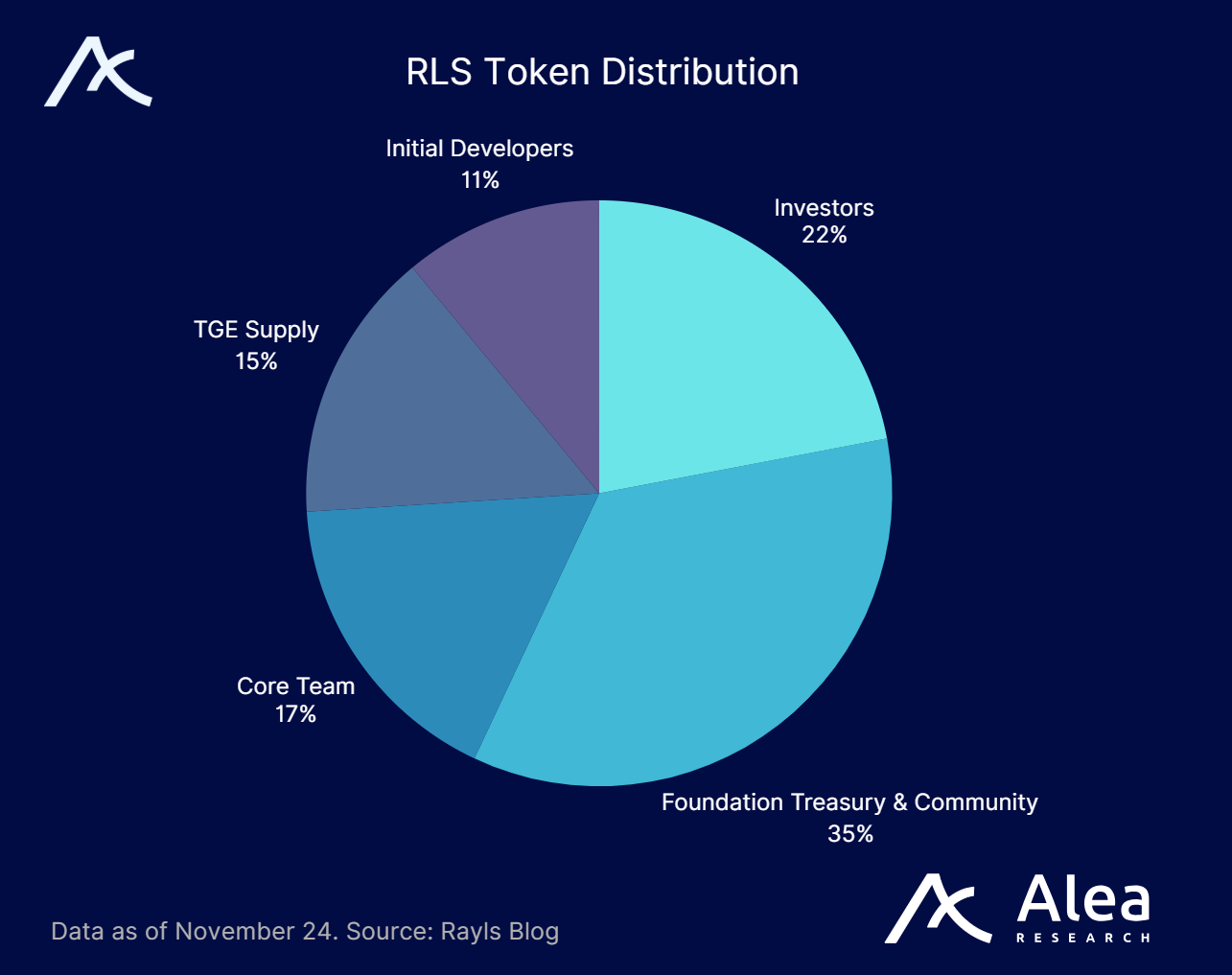
RLS is an ERC-20 native token of the Rayls ecosystem, serving as the incentive layer and governance asset of the Rayls ecosystem. The litepaper defines a fixed maximum supply of 10 billion RLS. The token distribution is as follows:
Foundation treasury and community (35%)
Investors (22%, 4-year vesting)
Core team (17%, 4-year vesting)
TGE supply (15%)
Initial developers (11%, 4-year vesting)
The RLS token is used for:
Staking and security - Validators on the Rayls Public Chain must stake RLS to participate in consensus and to validate zero-knowledge proofs from Privacy Nodes and identity services. Slashing is used to disincentivize malicious behaviour.
Transaction fee settlement - Users on the Public Chain pay transaction fees in USD-pegged stablecoins, but the protocol automatically converts those fees into RLS for final settlement. Privacy node and private network transactions also generate RLS fees.
Governance - RLS holders can propose and vote on protocol upgrades, validator parameters, emission schedules, and grant programs.
In addition to all this, Rayls implements a fee burn and a security pool which rewards validators. So 50% of RLS collected as transaction fees (across both public and private chains) is automatically burned, and the remaining 50% goes into the Network Security Pool that funds validator rewards and ecosystem development.