Pulse is our weekly flagship newsletter, where we cover macro, ai, crypto, prediction markets, and anything that deserves attention.
This week’s edition has been made free with a delay.
Rates own the week. The market has to digest Warsh at the Fed, record stress in Japanese duration, crowded AI leadership, BTC stuck below resistance, and pre-IPO equity mania moving on crypto rails. Stocks are still pretending concentration is a feature. Crypto has its own version of the same problem: everyone wants liquid exposure, fewer people care what they actually own. That is how pre-IPO markets, tokenized stocks, and equity perps become the week’s main trade.
Key Takeaways
Rates set the pace; crypto only gets a clean risk bid if duration stops bleeding.
Warsh inherits inflation above target and a committee that may resist the easy-cut story.
AI concentration still pays, but crowded leadership makes entries less forgiving.
Tokenized equities are the leading crypto narrative this week; the rights problem is the catch.
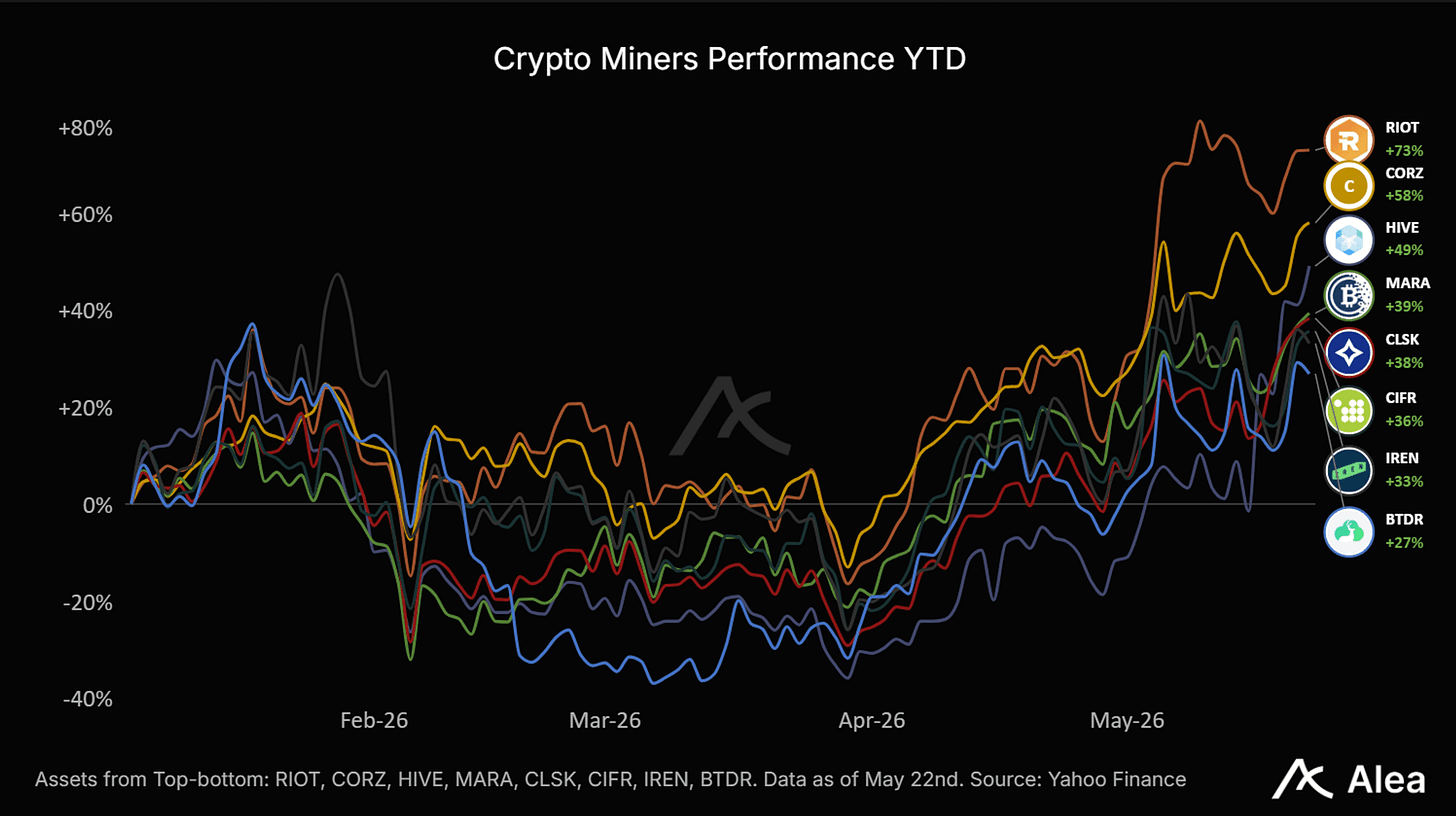
Miners are now power trades; the market will reward contracted AI capacity and punish vague AI language.
Macro: Inflation Stops Whispering
Fiscal math is the quiet pressure point, while Japan is no longer background noise. April’s Treasury surplus fell $43B YoY to $215B, while outlays rose to $622B on higher interest and military spending. Meanwhile, Japan’s 30-year JGB yield touched 4%, a record since the tenor’s 1999 debut, while the 10-year reached levels last seen in 1997. Japanese capital has long been a silent bid for foreign duration, including US Treasuries. If domestic yields become attractive enough, Japanese investors will pull money out of foreign bonds (like US Treasuries) and bring it back home. They may sell their US Treasuries and other foreign assets and reinvest that money into Japanese bonds.
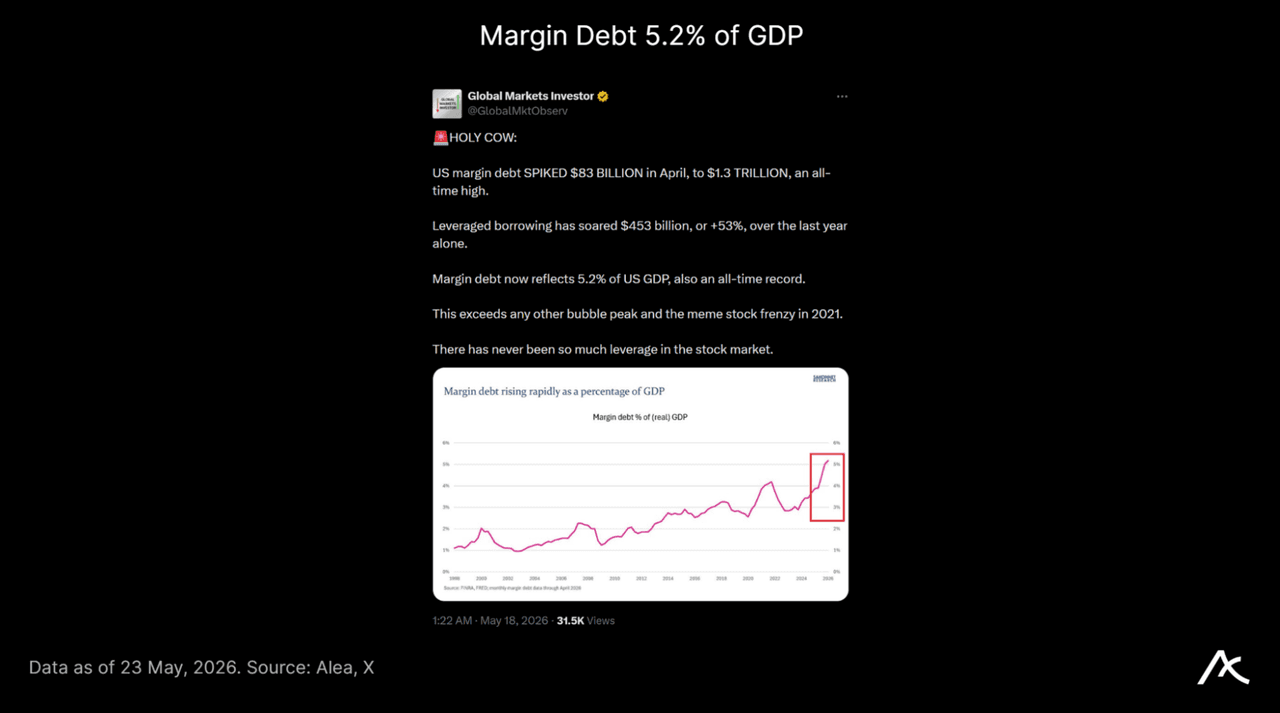
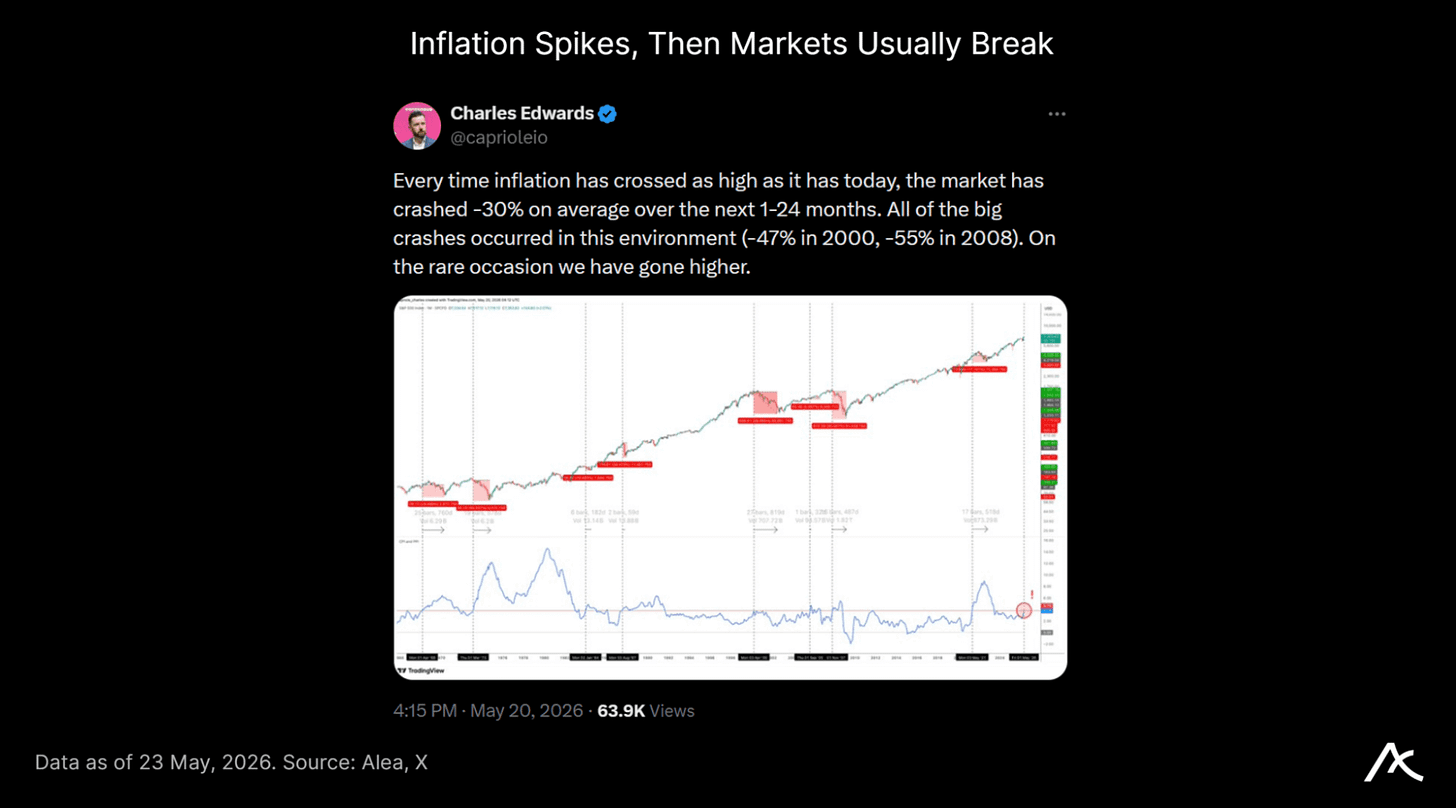
Inflation remains elevated hovering around 3.8%, far from the 2% target; aggressive easing is pure wishful thinking. People are leaning on credit, falling behind, and earning less in real terms every month. Yet equities are trading as if nothing’s wrong. This has been ongoing for 62 straight months already. Expensive equities plus sticky inflation plus rising long rates leave little room for sloppy entries. The celebration on Wall Street is funded by Main Street’s erosion. What looks like “stimulus” to wealthy investors shows up as eroded wages, weaker savings, and a shrinking path to home ownership for everyone else. The danger is that a switch from Core PCE to Trimmed Mean PCE quietly redraws the finish line. On today’s data, the “old” measure says inflation is 3.2%; the “new” one says 2.36%. In practice, this is how the game gets rigged: keep the prices people feel most—rent, food, insurance—in the monthly bill, but change the statistics on the dashboard so it flashes “mission accomplished.”
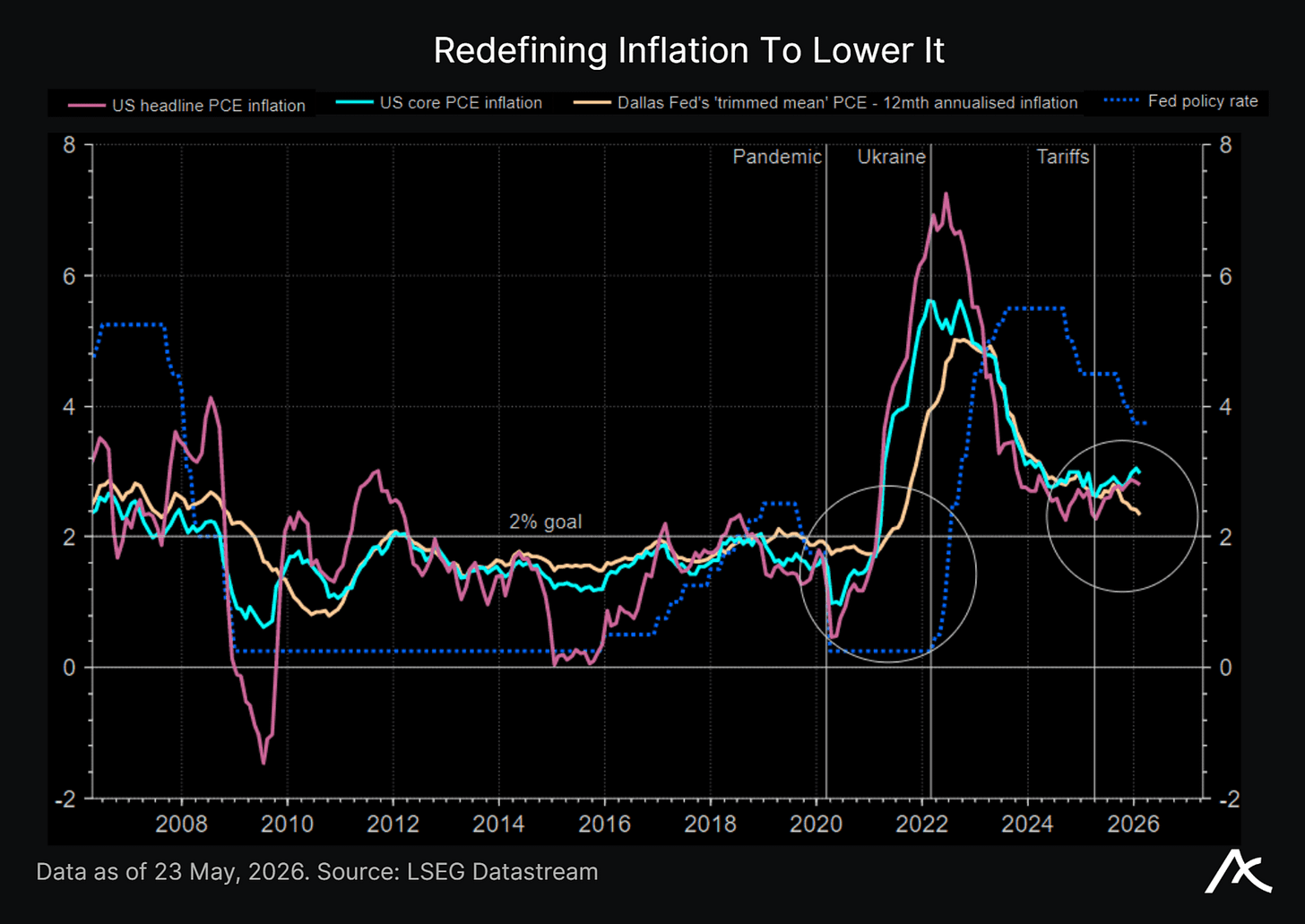
Kevin Warsh has been confirmed as Fed chair, with his first meeting expected on June 16–17; this week’s April FOMC minutes land under the Fed’s normal three-week release schedule after the April 29 statement. The trade debate is already seeking to move the inflation yardstick: core PCE looks hot, while trimmed-mean PCE gives the doves cleaner optics.
AI: Capex Has A Clock
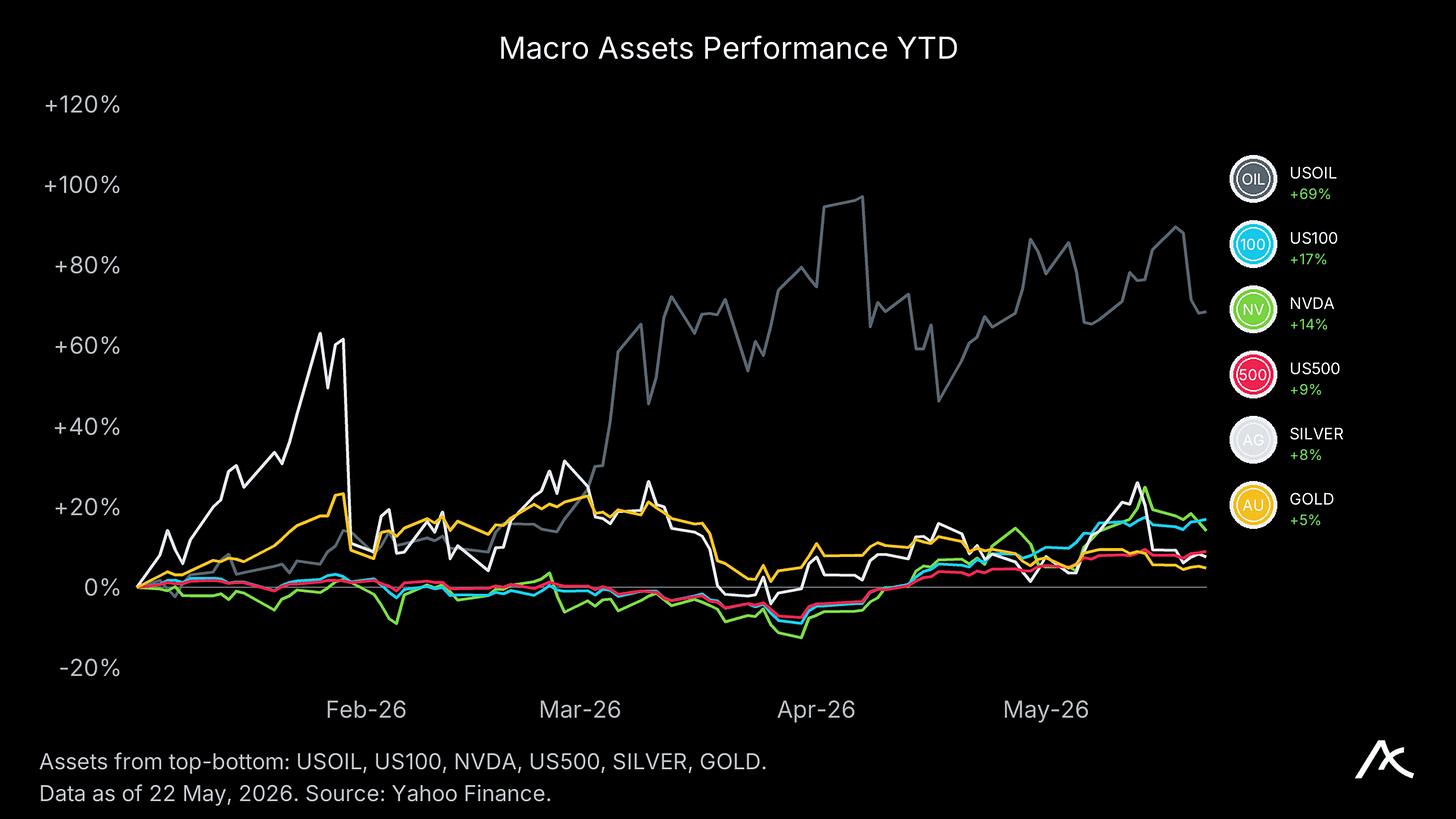
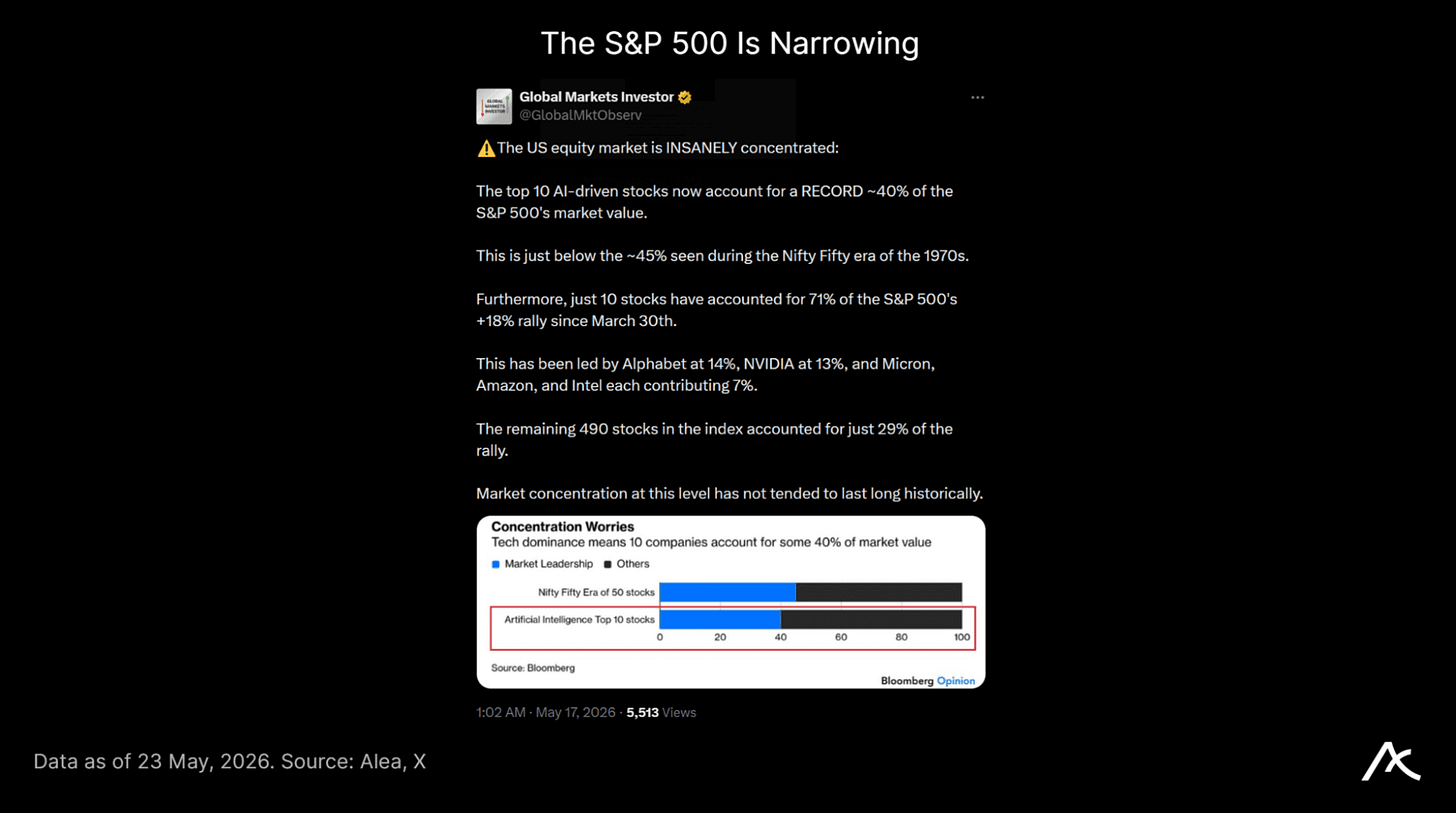
Concentration is the trade, and the flaw. Only ten stocks accounted for 71% of the S&P 500’s gains, with concentration near Nifty Fifty-era levels. Situational Awareness’s 13F reported equity exposure of $13.68B, up from $5.52B the prior quarter. They are long power, land, data-center conversion, storage, and AI cloud capacity; hedge or short the crowded semiconductor beneficiaries through puts on names like SMH, NVDA, ORCL, AVGO, and AMD.
For AI, capital arrived first: Goldman’s baseline now implies roughly $7.6T of AI infrastructure spend from 2026 through 2031 across compute, data centers, and power, with 2026 annual capex near $765B. The market has already priced a lot of that into the obvious names. The harder question is deployment: how much of this spend turns into workflows customers pay for, and how much becomes expensive capacity looking for a job?
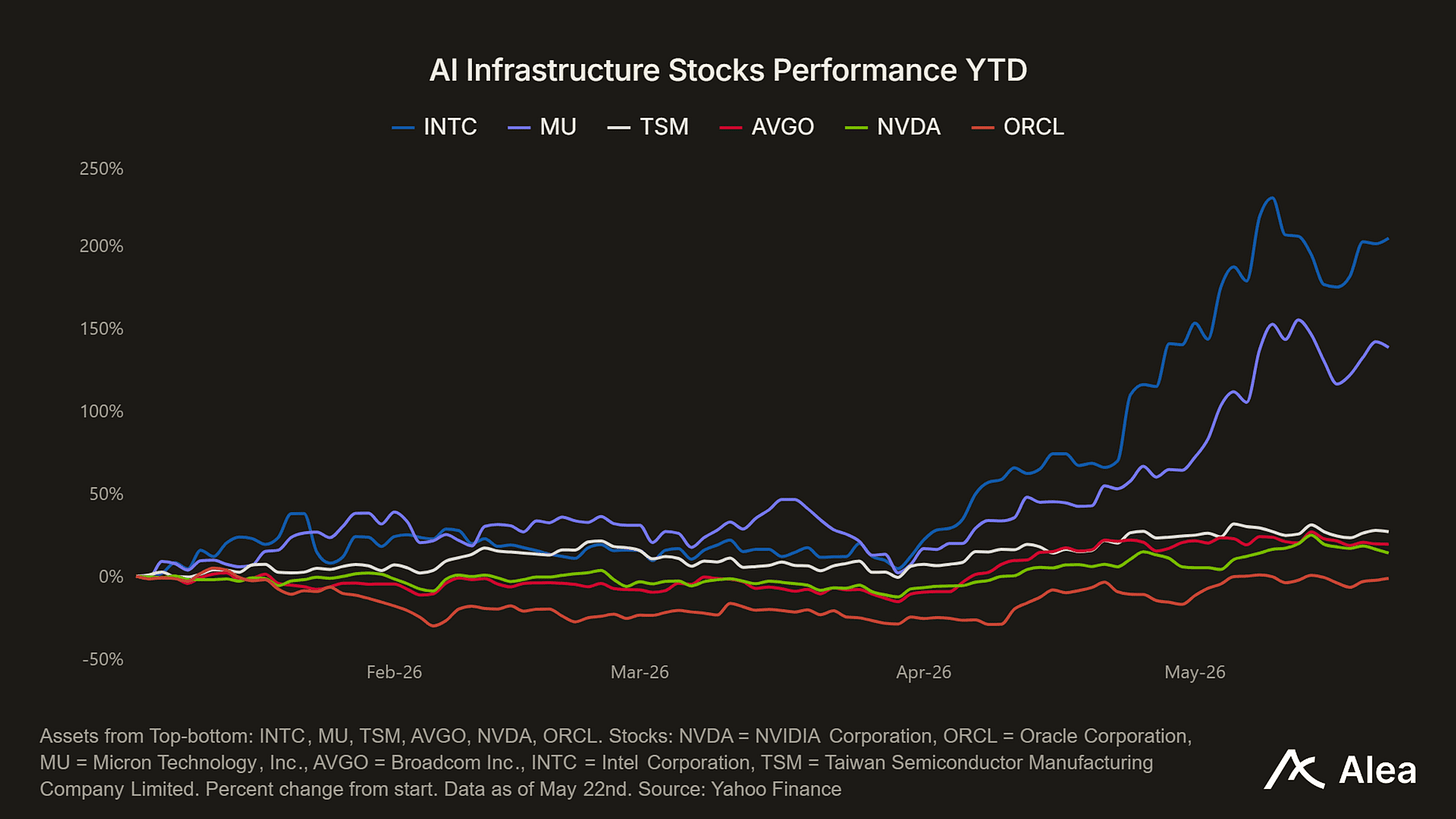
AI adoption is real, but the trade is getting less forgiving. Model quality is no longer scarce enough by itself. Distribution, workflow control, proprietary data, and the ability to turn inference into paid use matter more.
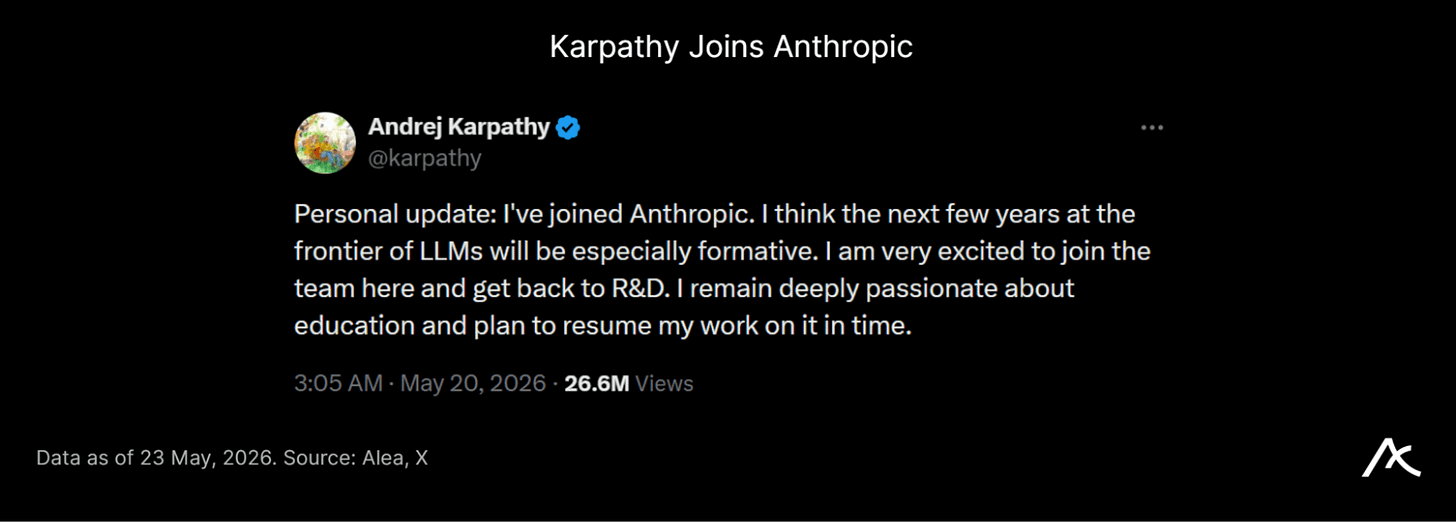
For enterprises, AI pricing is starting to become an issue. Microsoft is reportedly winding down most internal Claude Code licenses by June 30 and pushing engineers toward GitHub Copilot CLI, citing both product control and operating-expense pressure. Similarly, Uber’s CTO warned that the company’s developers burned through their yearly allocated budget in just 4 months.
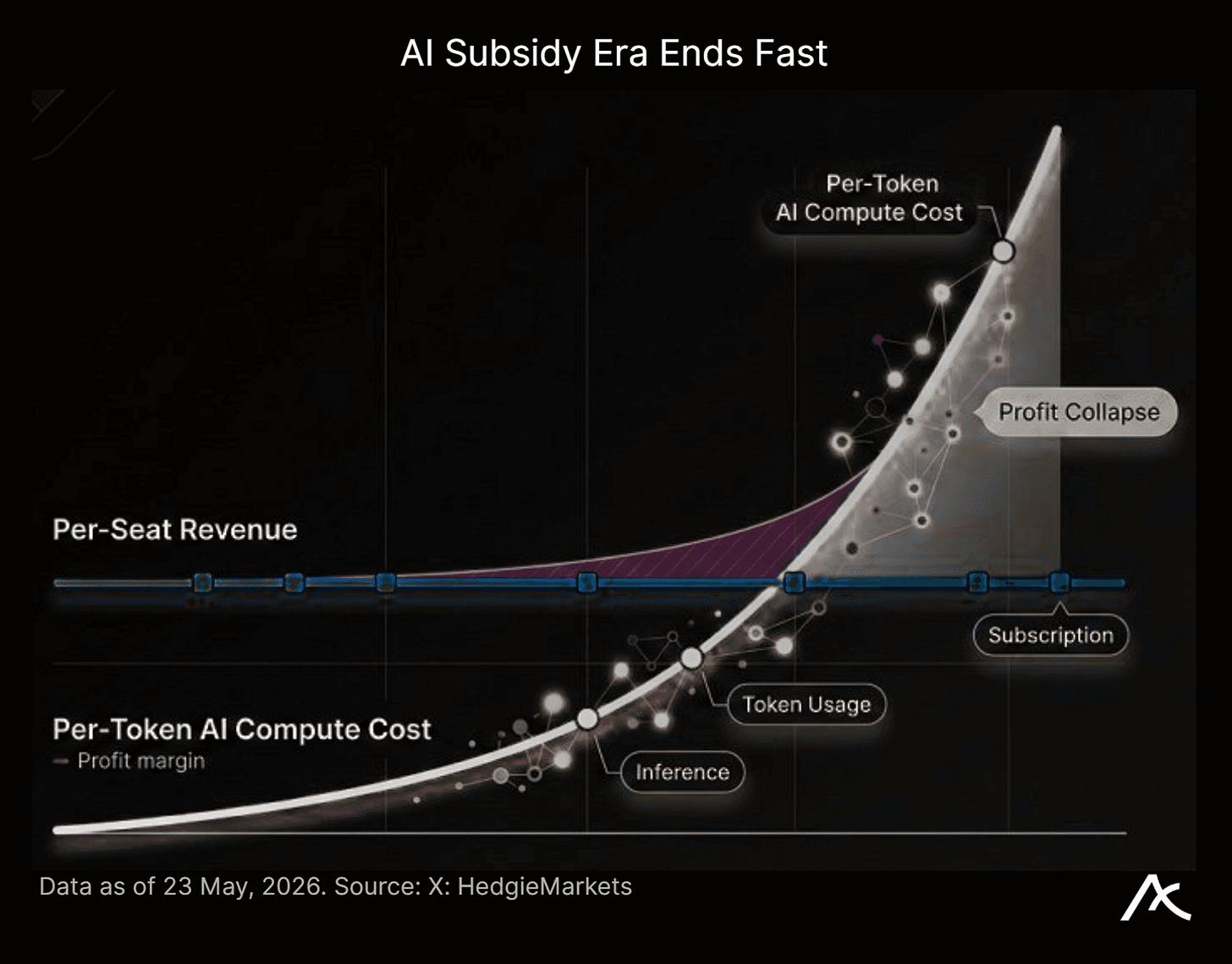
The subsidy phase is ending as flat seats turn into metered tokens, and enterprise customers now have to measure AI like cloud spend, not software adoption. If customers cap usage, the revenue ramp slows; if labs cut price to keep volume, unit economics take the hit. Either way, IPO math for OpenAI, Anthropic, and the AI-app layer now depends less on demos and more on whether workflows can pay for inference at scale.
Crypto: Ownership Gets Synthetic
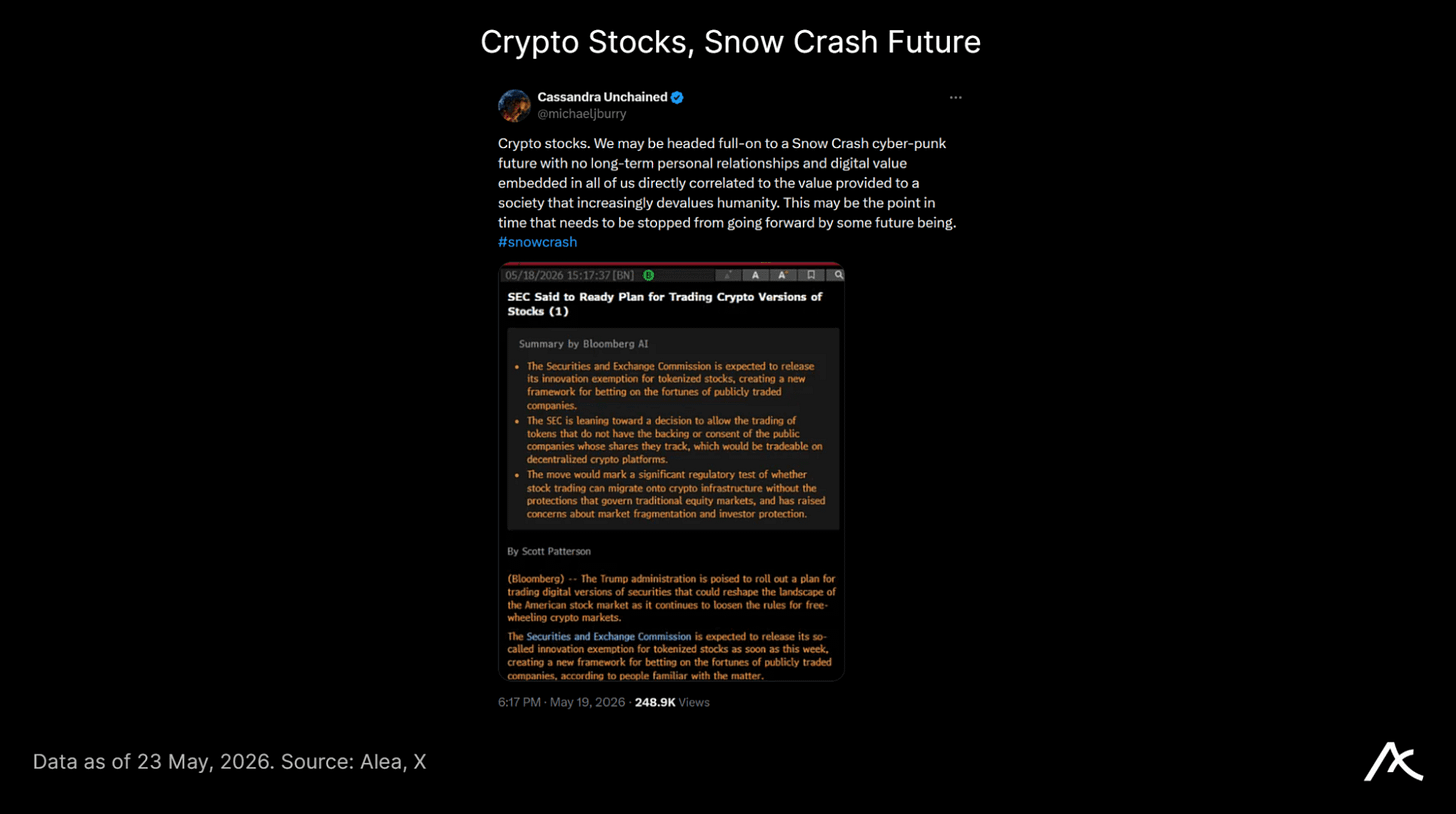
The consensus and crowded trade now is equities trading and perps onchain, just as the SEC is expected to release an “innovation exemption” for tokenized stocks, potentially allowing crypto platforms to offer stock-linked tokens that trade on decentralized venues, may lack issuer consent, and may not carry voting or dividend rights. That is the discomfort Burry’s “Snow Crash” post captured: markets are getting more synthetic, more continuous, and less tied to legal ownership.
The Polymarket/Nasdaq collaboration for pre-IPO trades falls in the same bucket. Polymarket is partnering with Nasdaq to offer prediction markets on private companies, letting users trade around valuation, IPO timing, and secondary-market marks. Polymarket already lists 182 active valuation markets, including markets around OpenAI, Anthropic, Stripe, Perplexity, and SpaceX IPO valuation; Nasdaq Private Market already provides private-company price estimates, transfer, settlement, and data products for accredited and institutional investors.
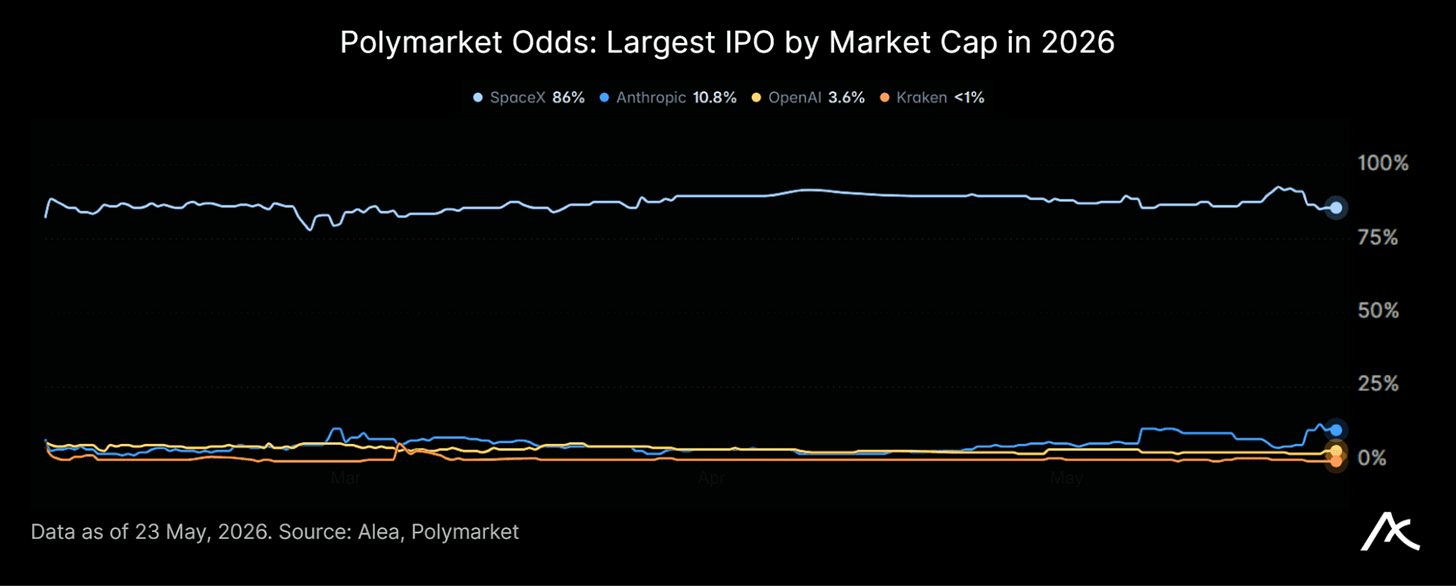
Private markets are the part of finance retail wants most and accesses least. OpenAI, SpaceX, Anthropic, Stripe, Databricks, Perplexity: these are the names people want exposure to before the IPO. Most users don’t care about equity, dividends, information rights, or liquidation preference. They simply want liquid exposure to bet on a milestone.
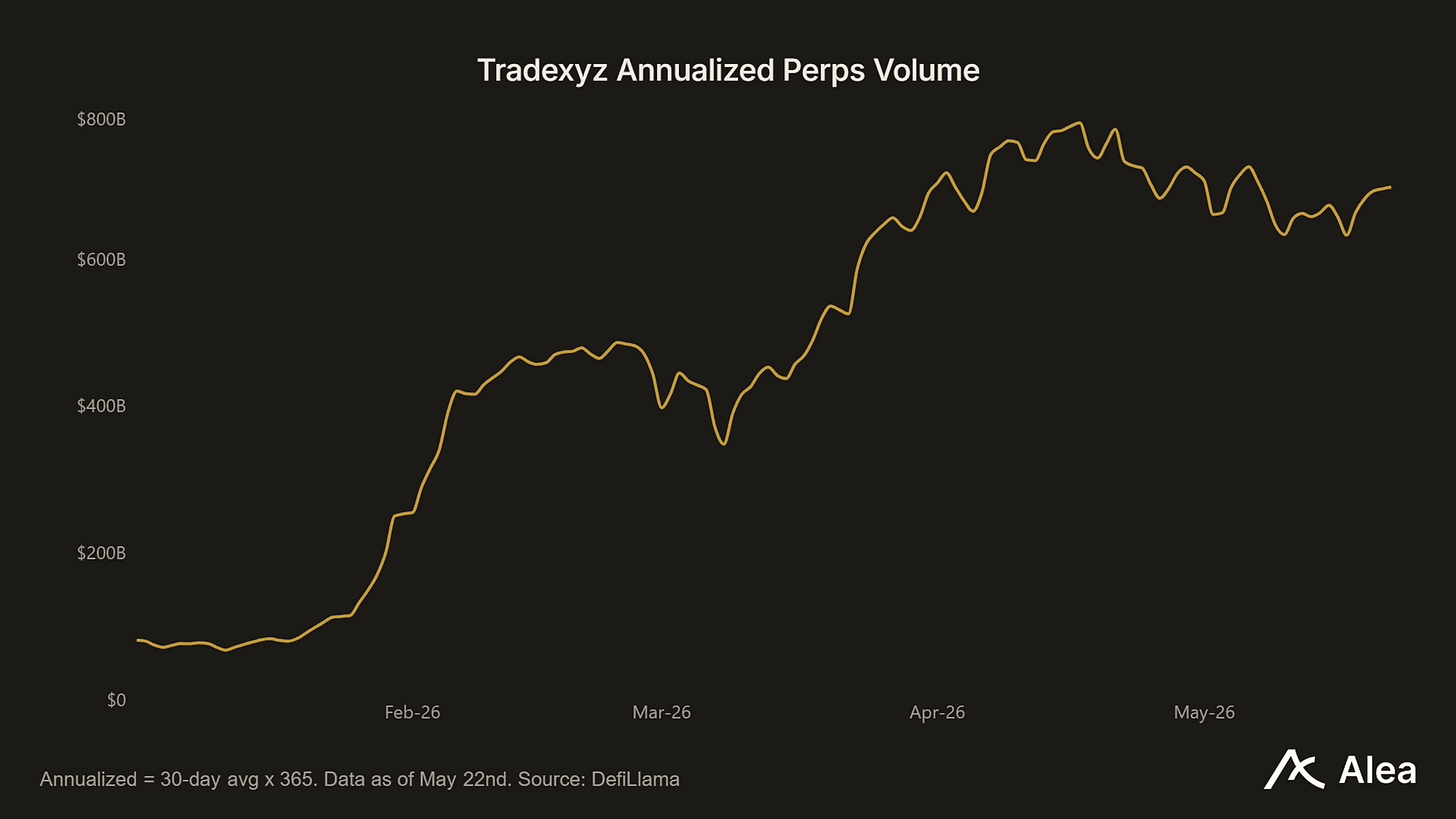
The closer prediction markets get to corporate events, IPO windows, regulatory decisions, and private valuations, the more valuable the product becomes, and the more polluted the information edge can get.
BTC — Bitcoin continues to trade like a macro instrument first and a crypto idiosyncratic symbol second. After the drop from 80k, spot BTC ETFs flipped from a six-week inflow streak to heavy redemptions. ETF buyers are now tactical, not automatic, while 10-year yields above 4.6% and oil-driven inflation risk keep the marginal buyer cautious.
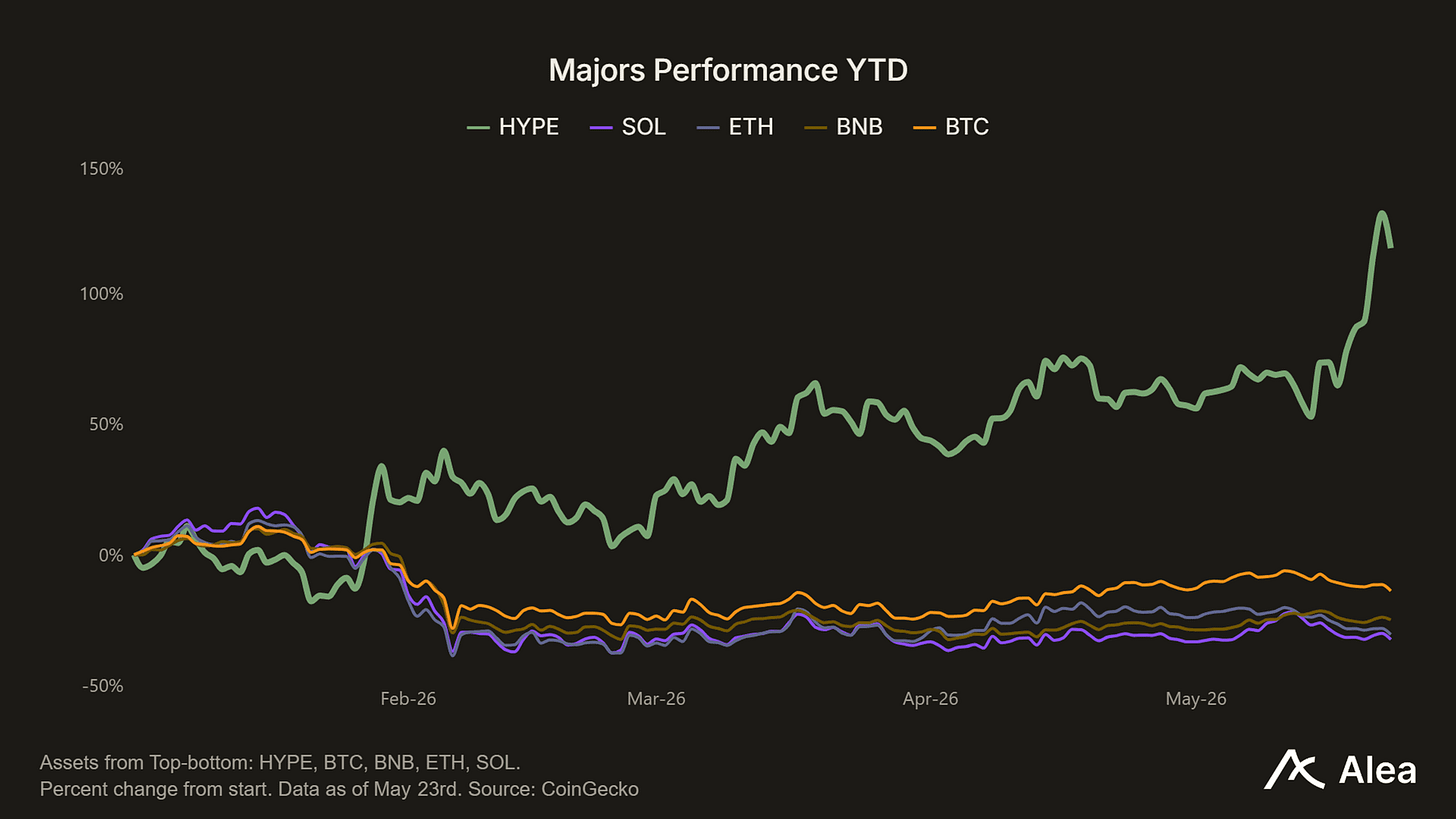
ETH — Ethereum now has a leadership-optics problem right when technical prowess is most needed for roadmap execution. On May 19, Carl Beek and Julian Ma confirmed they are leaving the Ethereum Foundation; Beek’s last day is May 29 after seven years of Beacon Chain work, while Ma exits after work on FOCIL/EIP-7805 and faster L2-mainnet confirmation design. That follows the May Protocol Cluster reshuffle, with Tim Beiko and Barnabé Monnot moving on, Alex Stokes taking sabbatical, and new leads stepping into Glamsterdam, Hegotá, and FOCIL delivery.
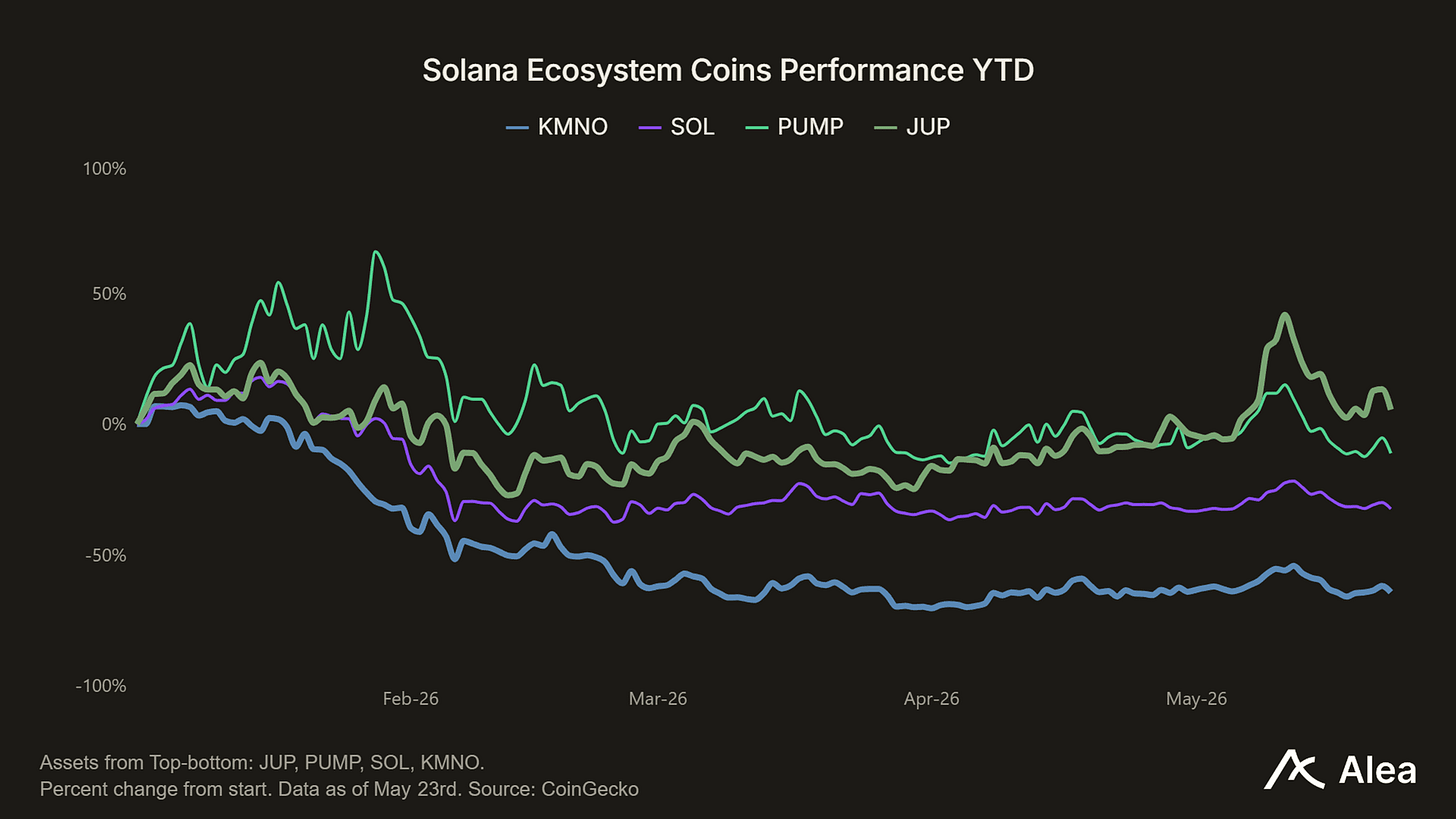
SOL — Solana is a chain growing through price damage. RWA market cap rose 43% QoQ to $2.01B, app revenue was roughly flat at $342.2M, REV slipped only 1% to $89.5M, and average daily non-vote transactions rose 50% to 112.6M. SOL still ended Q1 down 33%, while DeFi TVL fell 22% to $6.16B. The forward catalyst is technical: Alpenglow targets finality moving from roughly 12.8 seconds to 150ms. At the moment, if you are uncertain about BTC’s trajectory, SOL presents more conservative exposure than ecosystem beta.
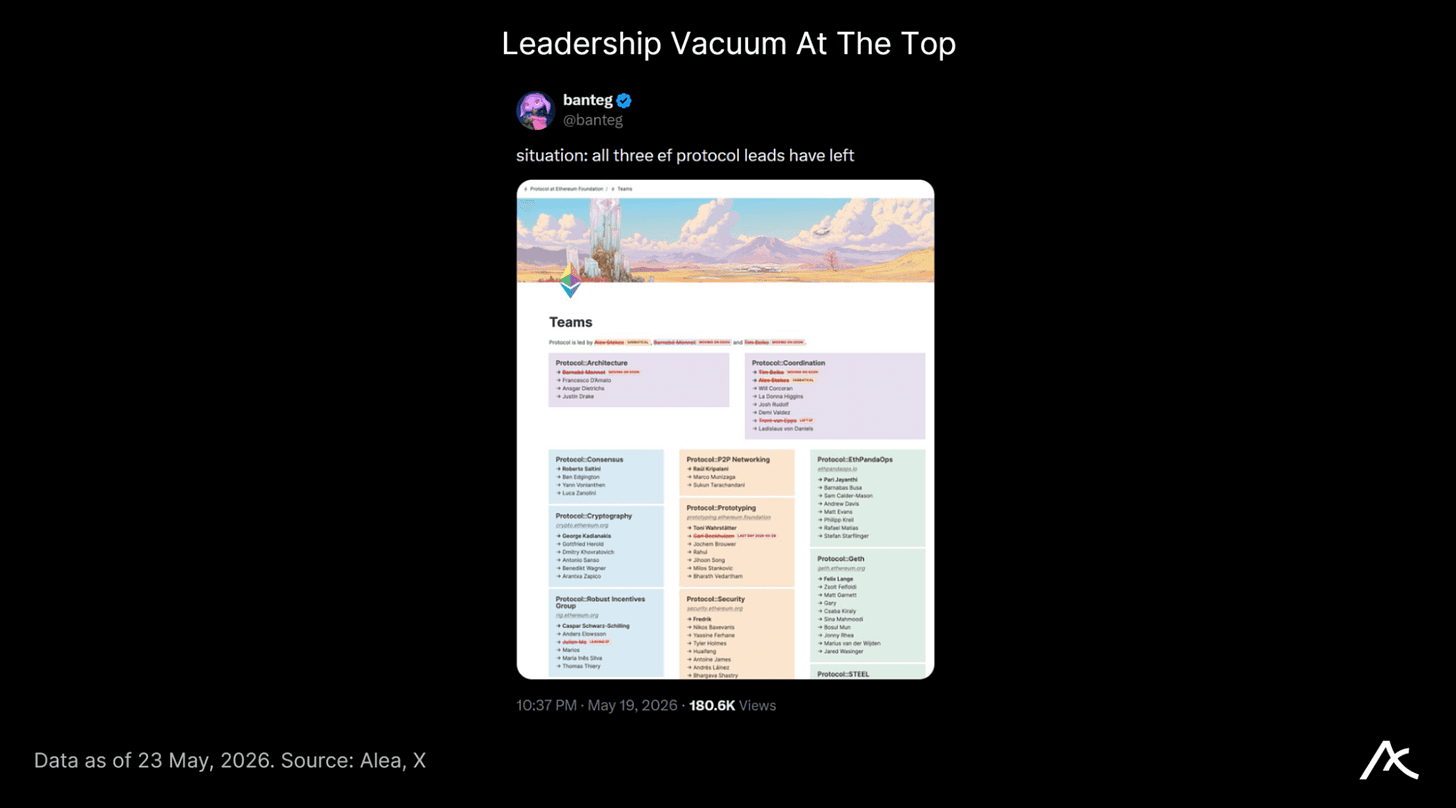
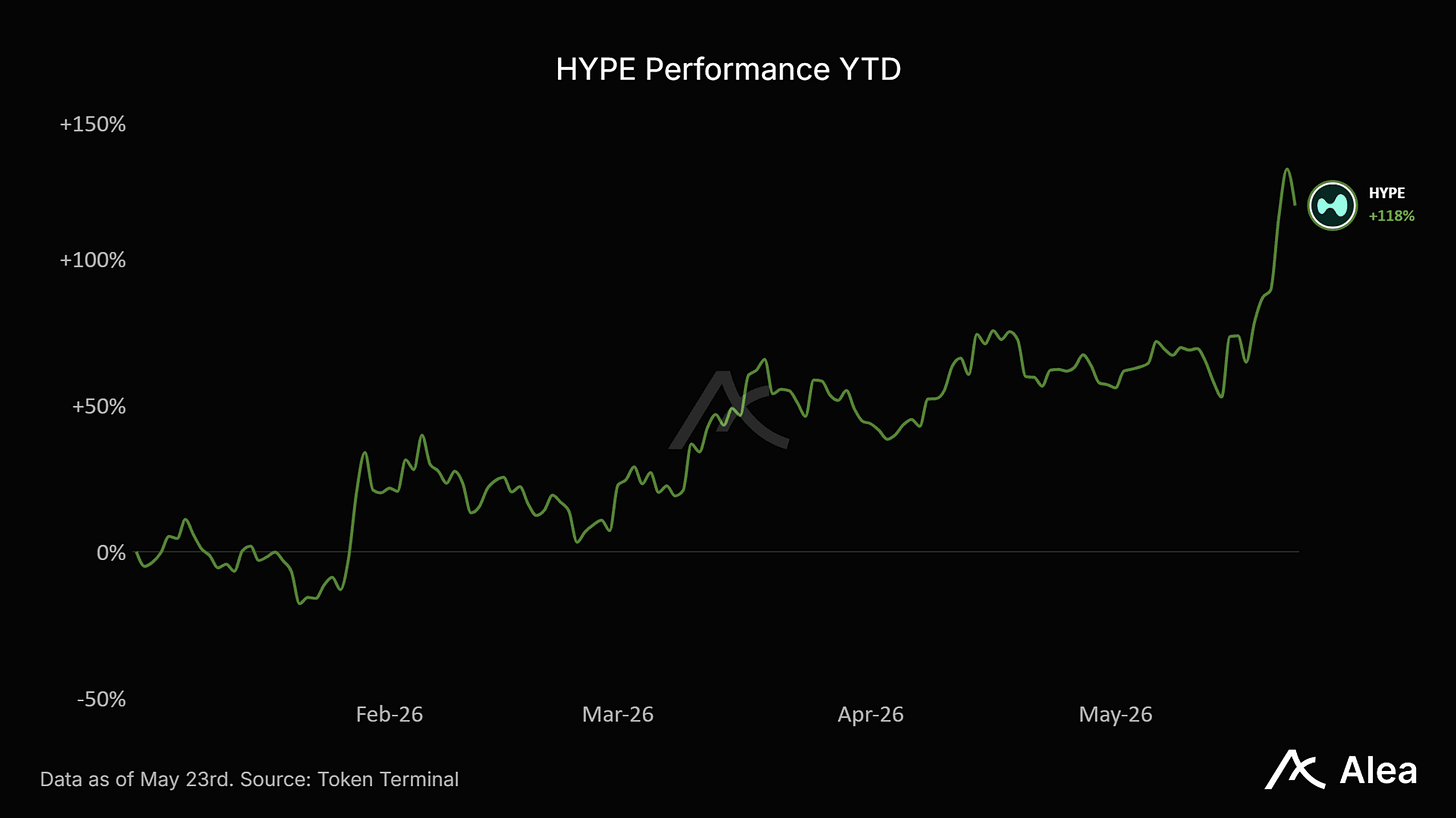
HYPE — Finally printed new all-time-highs and flipped Solana in market capitalization. The last two weeks had been about distribution, but with big news that are expected to attract long-term flows, such as 21Shares’ THYP launch on Nasdaq offering staking exposure + a 2x long product, or Bitwise’s BHYP on NYSE also with staking and a first-month fee waiver on the first $500M AUM. This week Bitwise also noted that 10% of BHYP management-fee revenue will be used to buy and hold HYPE on Bitwise’s balance sheet. Catalysts, combined with HIP-3 and HIP-4 growth, are about as good as they can get; from here it’s all about price action and reading the market’s tolerance for risk at these levels
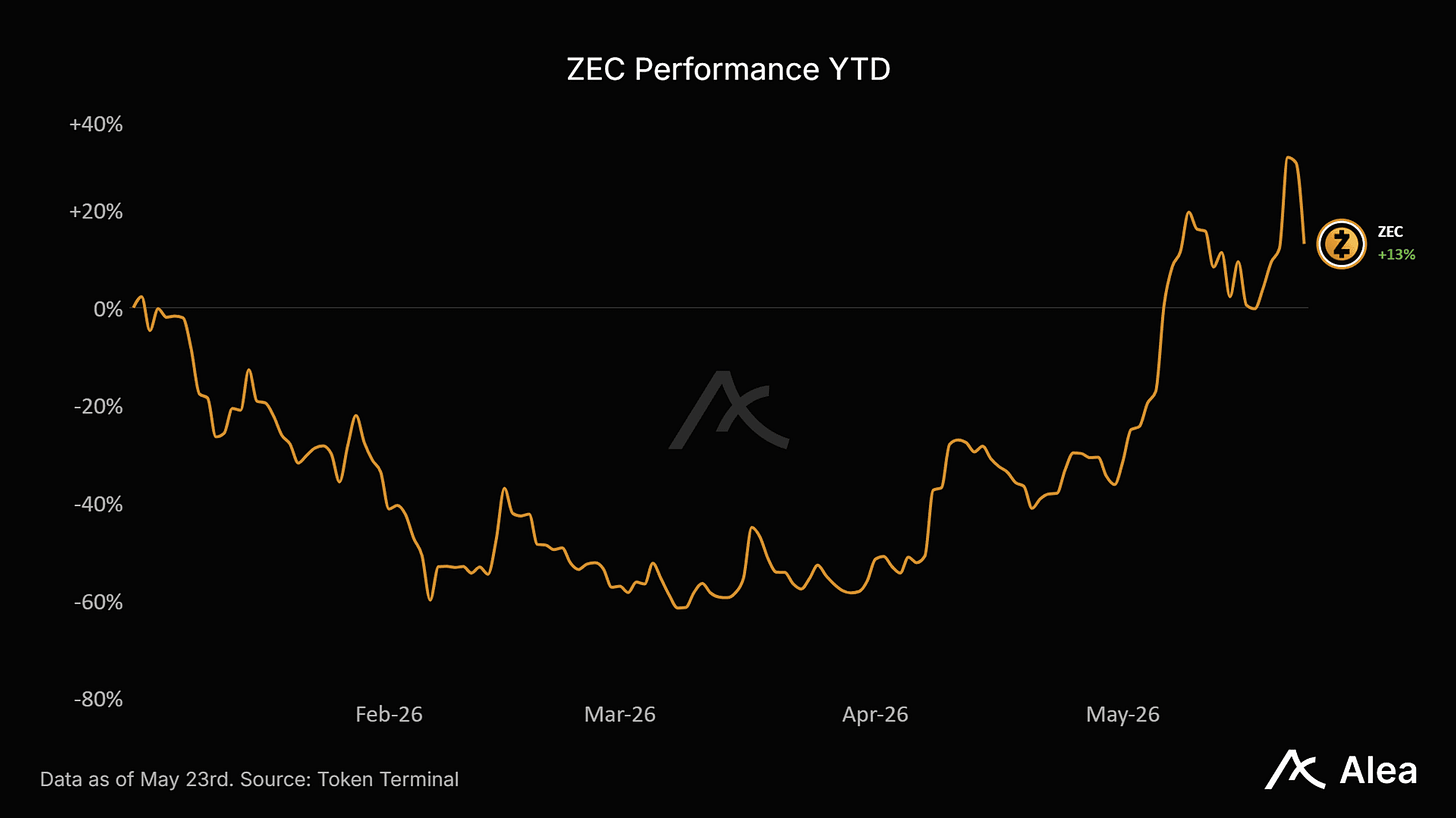
ZEC — ZEC remains the privacy leader, but the trade now carries squeeze risk in both directions. On May 20, ZEC ran from $568 to $686 in about six hours, triggering $28.25M of liquidations, mostly shorts. The fundamentals improved too: the Zcash Foundation said the SEC closed its investigation with no enforcement action, reported $36.7M in net liquid assets, and disclosed $800k of Q1 operating expenses. The roadmap keeps feeding the narrative as Zcash plans quantum-recoverable wallets within a month and aims for full post-quantum status within 12–18 months.
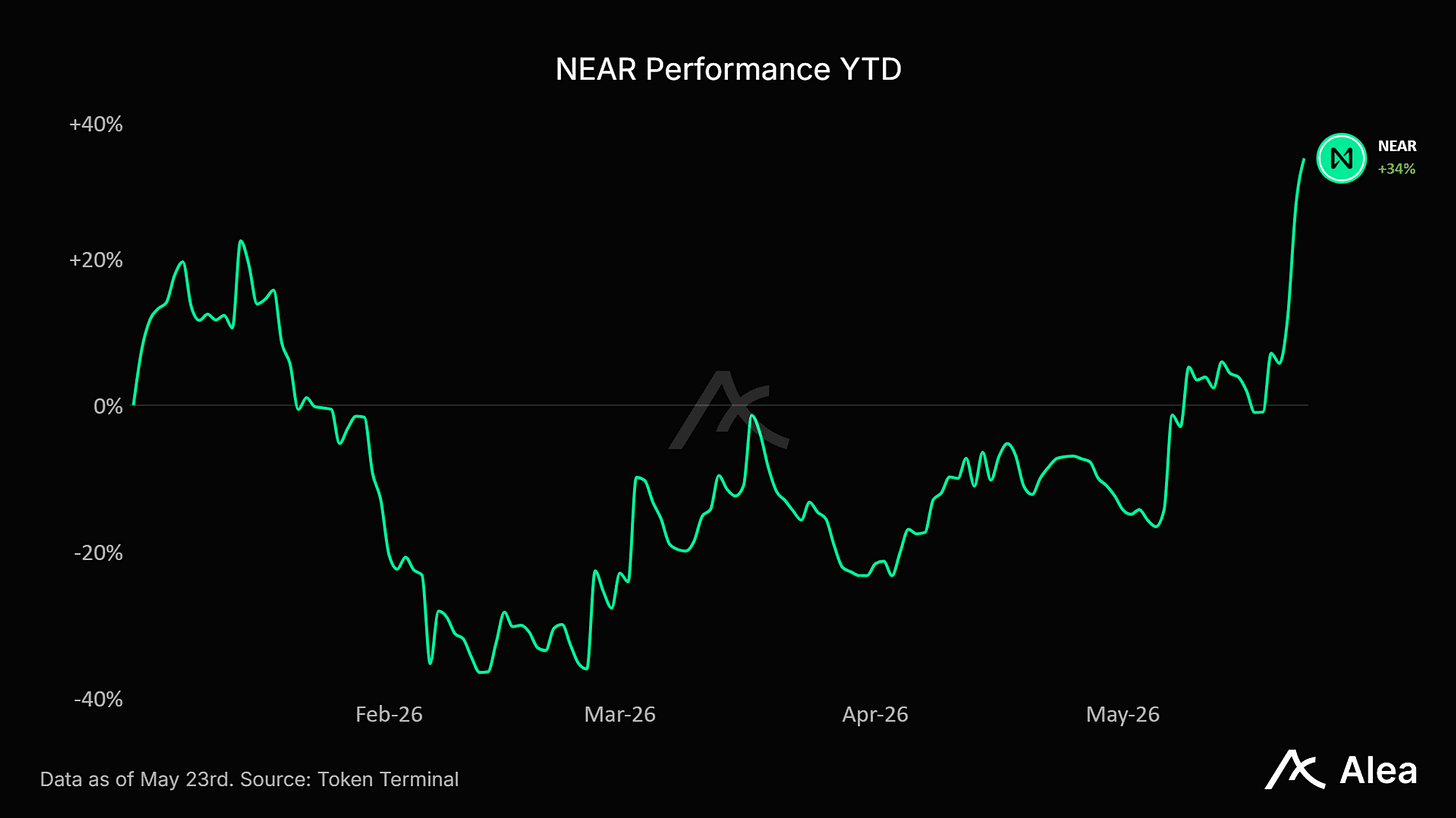
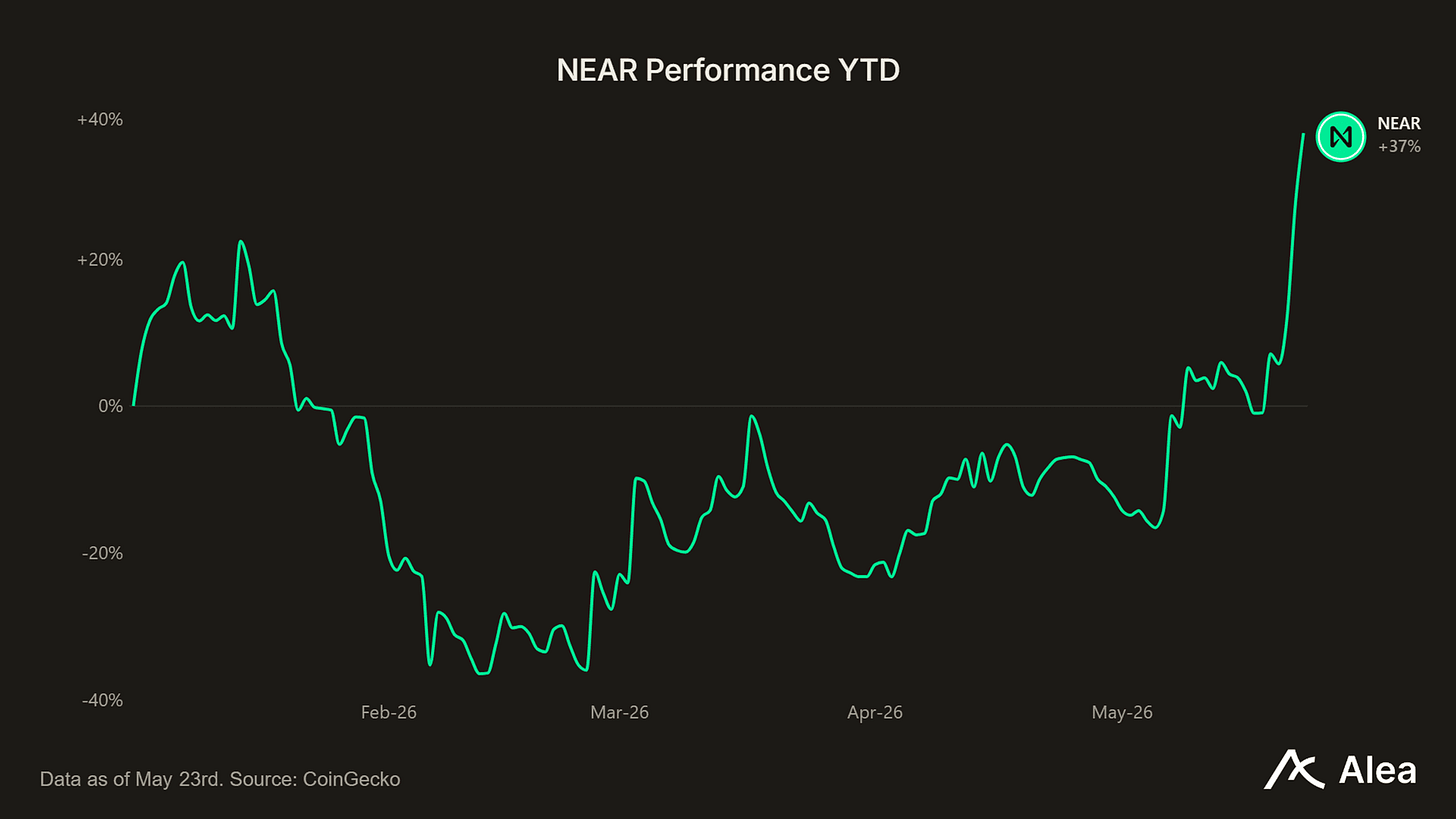
NEAR — NEAR caught a substantial bid this week riding the privacy narrative, up >40% in 7 days. The catalyst is NEAR Intents plus ZEC routing: NEAR Intents expanded direct swaps from 100+ tokens into Zcash in a single transaction, letting users consolidate cross-chain assets into a privacy-enhanced asset without manually hopping between bridges. That is the opportunity: NEAR as the routing layer for privacy, crosschain UX, and intent-based execution. The risk is timing. After a +40% week, the marginal buyer is now chasing the same privacy story as everyone else.
LINK — LINK has the strongest fundamental shape in the oracle/bridge bucket, but price still refuses to confirm. The $292M hack that pushed Kelp to migrate rsETH from LayerZero’s OFT standard to Chainlink CCIP has not been an isolated event. Many more protocols are also updating their security configurations to rely on Chainlink, including Kraken kBTC and future wrapped assets, Kelp rsETH, Lombard, SolvBTC/xSolvBTC, Re reUSD, Tenbin, and Tydro.
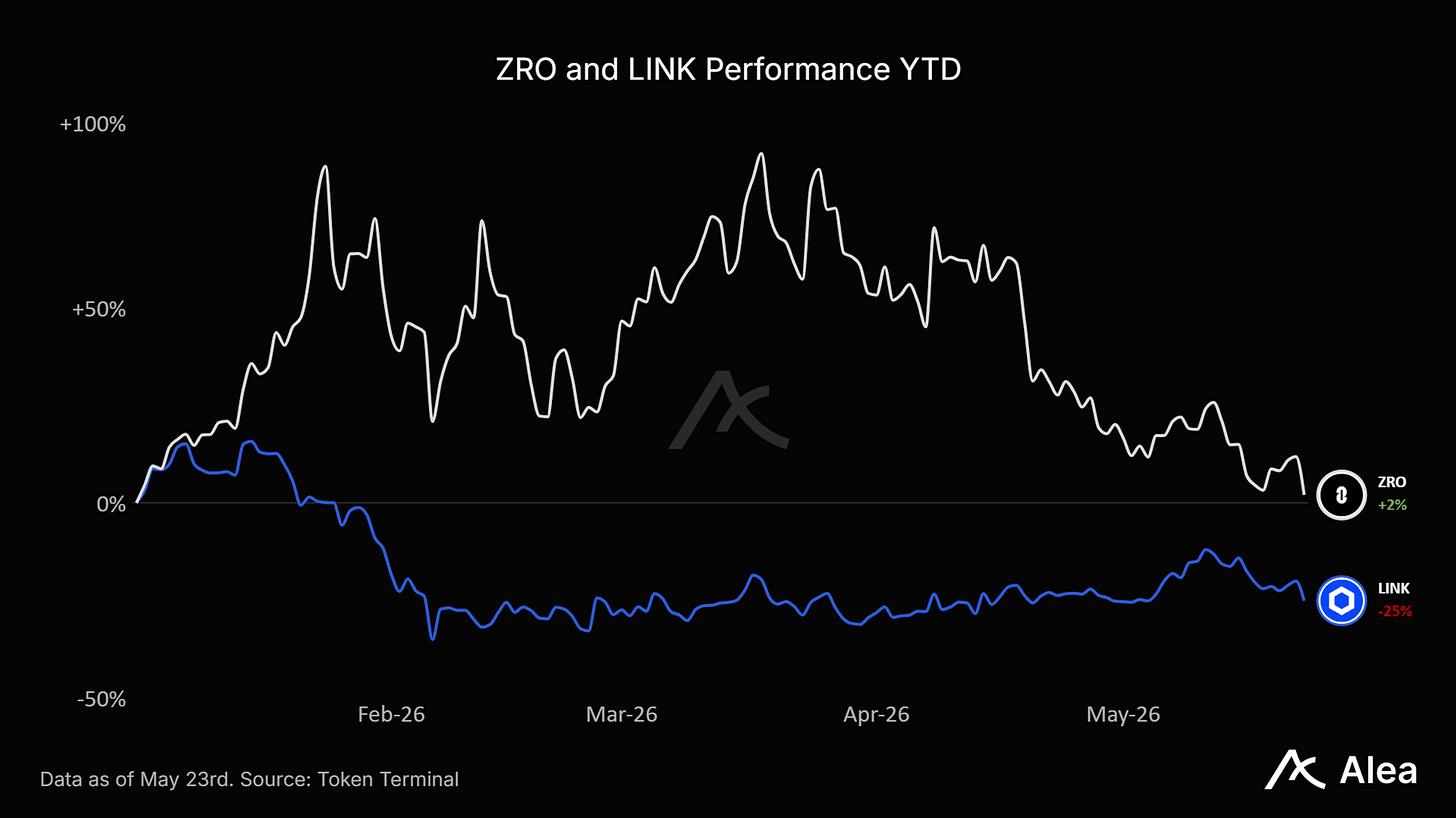
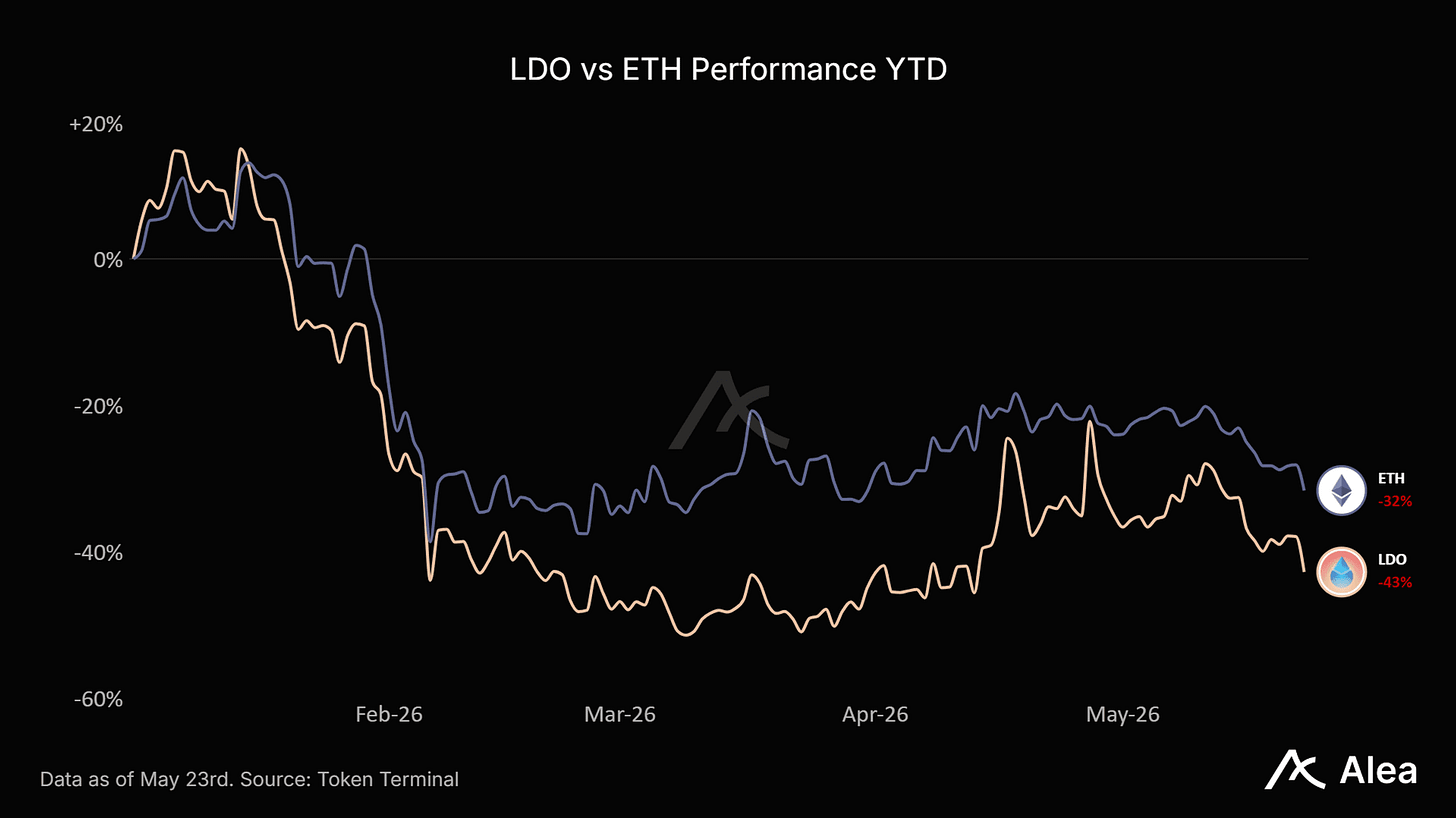
LDO — Lido’s May 21 Tokenholder Update gave the team a chance to frame market conditions, protocol resilience, and the next leg of product/tokenomics work. The live token catalyst remains NEST-style liquid buybacks: the framework activates only if ETH trades above $3,000 and annualized USD revenue clears $40M, then routes 50% of staking treasury inflows above that threshold into LDO/wstETH liquidity, capped at $10M over a rolling 12 months. Lido Labs will be reallocating resources to reduce the focus on staking in favor of new products.
ENA — ENA’s price action looks like it’s put in a bottom, and because it’s such a heavyweight, the consensus is that from here it “can only get better,” especially with a team that actually ships and is almost certainly lining up catalysts to drive both price and fundamentals higher. Fundamentals are improving with growth in Solana and ecosystems like MegaETH, proving the new stablecoin-as-a-service offering.
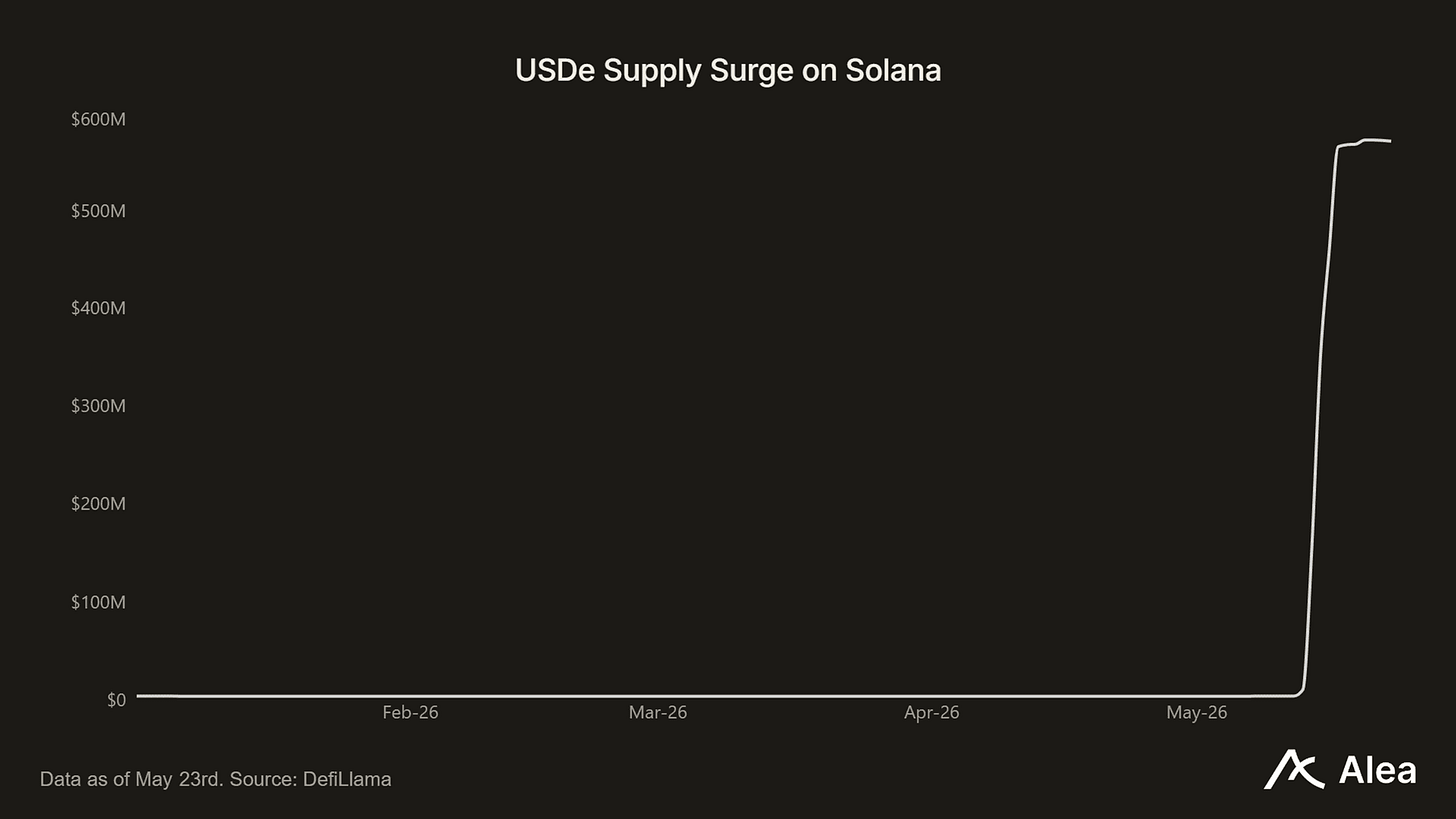
Ethena reached $1B in a matter of days on Solana, attracting Jupiter and Kamino loopers. Ethena is the only liquidity provider, which guarantees stable rates and liquidity to provide a sustainable spread between supply and borrow APY while lending markets have capped borrow rates at 2.5% (e.g. as long as supply APY is above 2.5%, looping is profitable).
FLUID — Jupiter’s May 13 Ethena market is curated by Bitwise, powered by Fluid, and designed as an isolated USDe lending market for institutional-scale capital. Fluid is now powering one of the standout Solana yield campaigns.
MORPHO — Morpho’s case rests on distribution + institutional adoption + Midnight’s fixed-rate markets as a catalyst that can boost liquidity and fee revenue. As outlined in our MORPHO memo released last week, Morpho remains the prime candidate to channel TradFi (or user-facing) deposits onchain. It’s the best example of the “DeFi Mullet” in action: TradFi in the front; DeFi in the back.
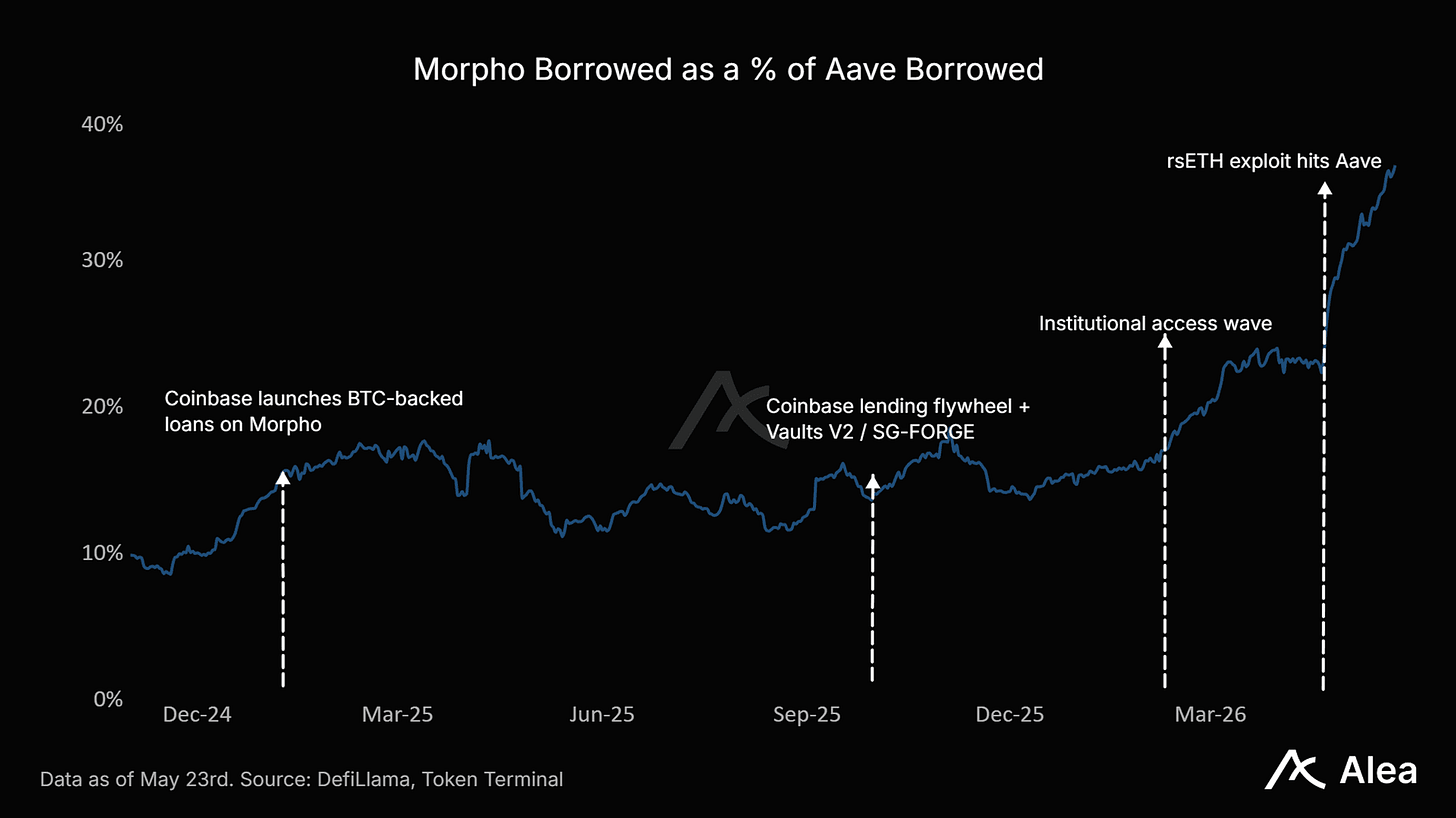
SKY / SPK — TVL is cheap; trust is scarce. And when trust is most in demand, Spark often shines with net inflows, as we saw after Aave’s rsETH incident. Often, retained capital during stress is a better signal than headline TVL, volume, or token metrics. Morpho’s April TVL drawdown was around -9% with +41.1% recovery from the low; Sky fell about -4% with +20.6% recovery; Aave fell around -47.1% with only +7.4% recovery; Ethena dropped -35.6% with +5.8% recovery.
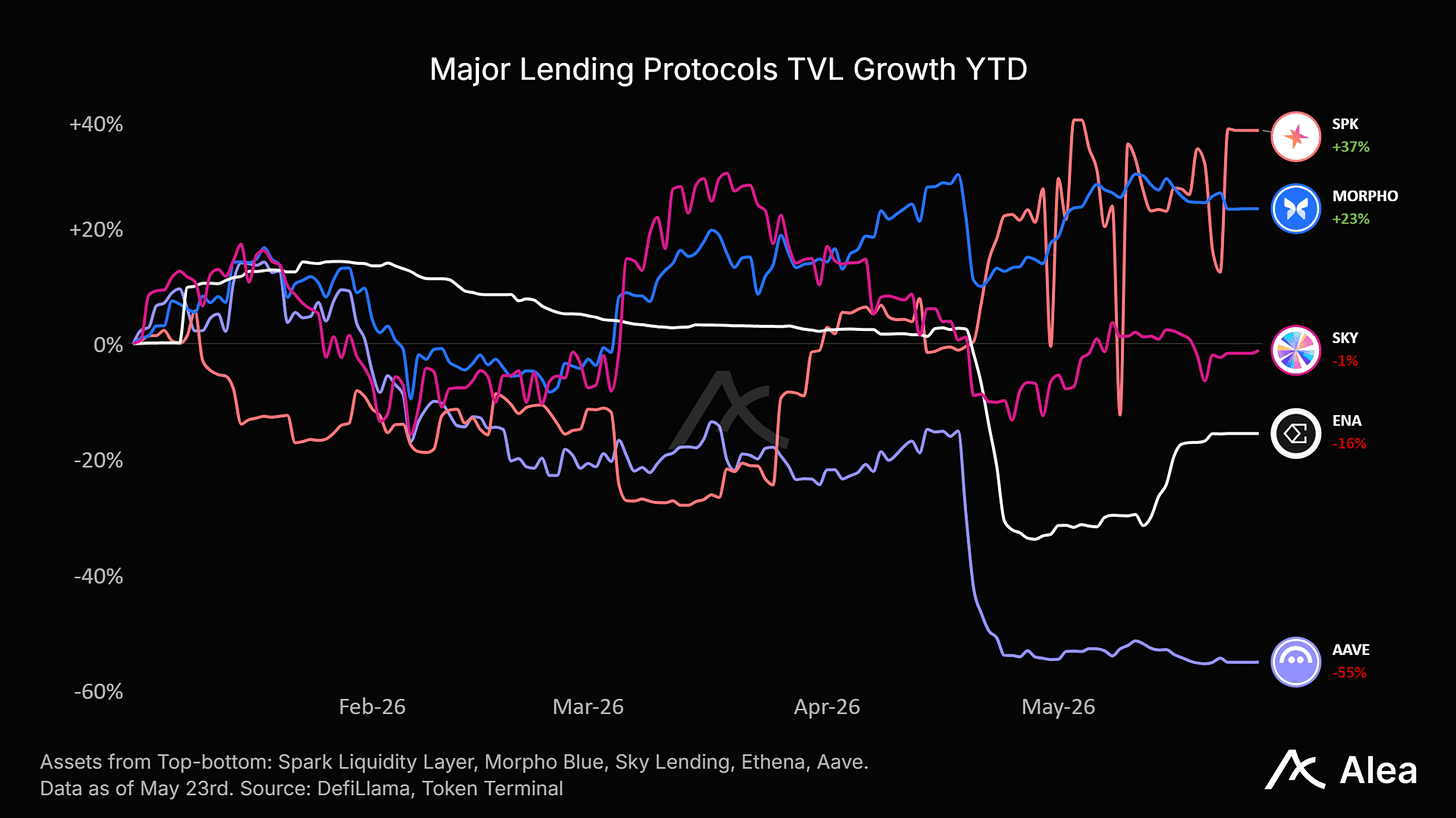
SKY is the slow-money case, while SPK tokenholders remain even more patient. Sky’s Q1 gross protocol revenue hit $123.79M, with $46.04M net protocol surplus, while governance is shifting surplus toward a $150M reserve target instead of short-term tokenholder distributions. That is good for USDS credibility and less exciting for impatient SKY/SPK holders.
EUL — Euler Labs has proposed cutting protocol fees to 0% across live and future deployments, keeping Fee Flow paused, and choosing curator/integrator adoption over near-term DAO revenue.
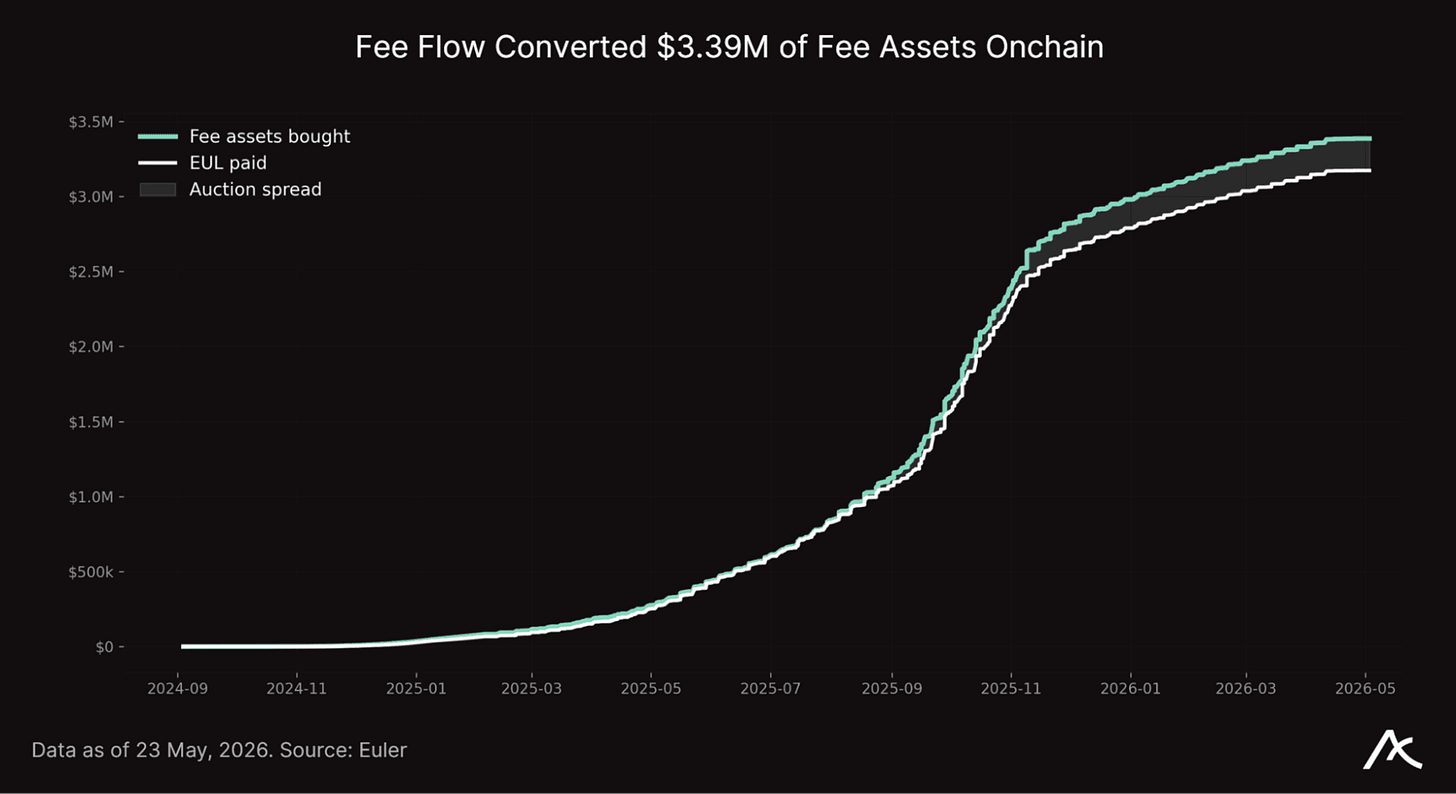
Fee Flow buybacks will be paused after setting protocol fees to zero. EUL trades around $1.28, with a $30.8M market cap and $34.7M FDV, while active loans are roughly 25x market cap. That is the opportunity and the warning in the same number.
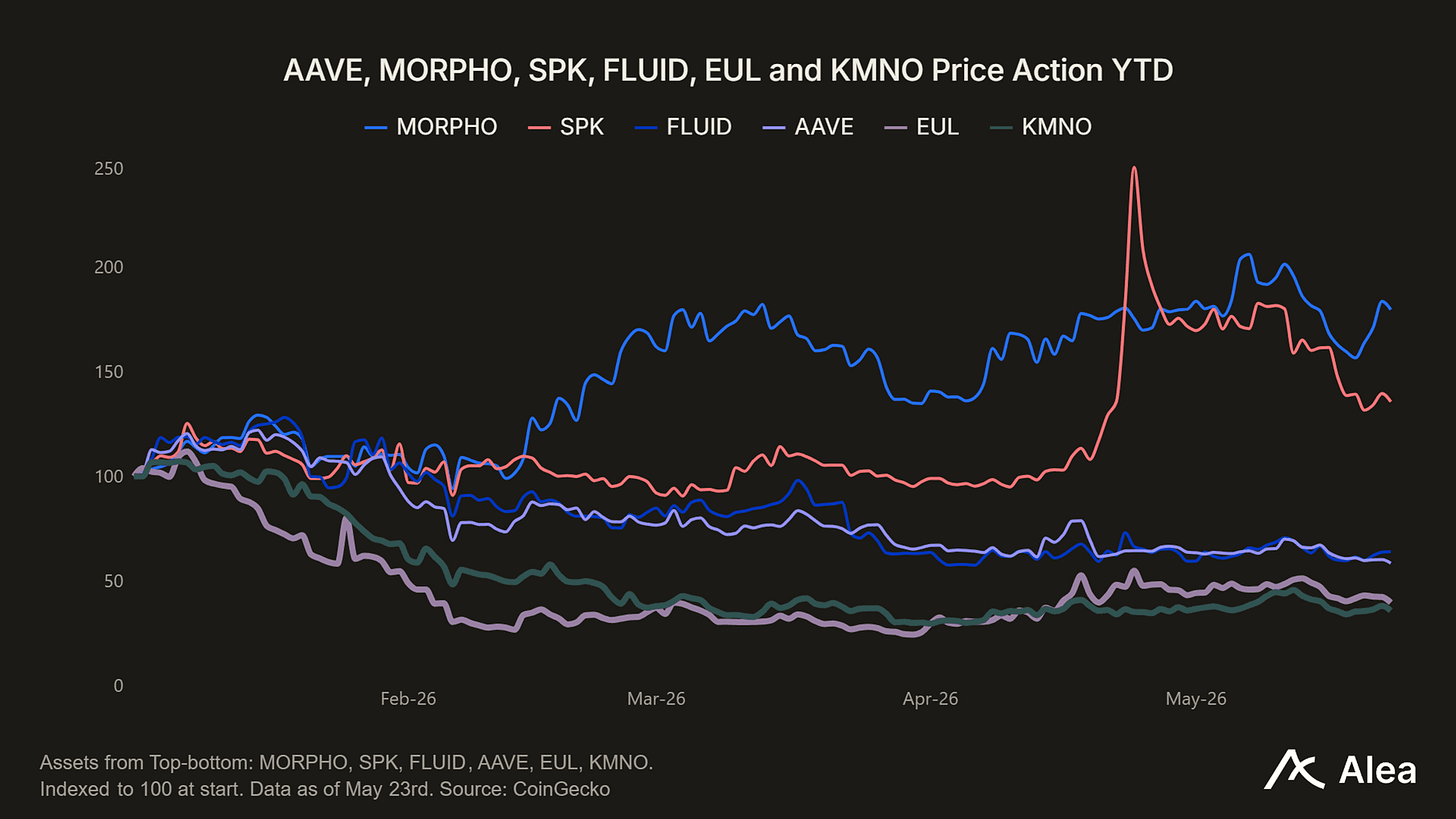
JUP — Jupiter has product catalysts, a revenue-backed bid, and a supply test coming. The product catalyst is Jupiter Lend bringing Bitwise in as the first institutional curator for an isolated Ethena USDe market, powered by Fluid. This market is purpose-built for institutional-scale, separated from existing Jupiter Lend liquidity, and designed to grow into billions of dollars of capacity. The revenue bid is Litterbox. On May 18, Litterbox added 315,152 JUP, with May accumulation at 8.39M JUP and reported total accumulation above 124.5M JUP; the mechanism routes protocol revenue into JUP purchases, holding tokens rather than burning them. Price is quietly holding better than most DeFi ahead of the next unlock coming on May 28, worth roughly $12M.
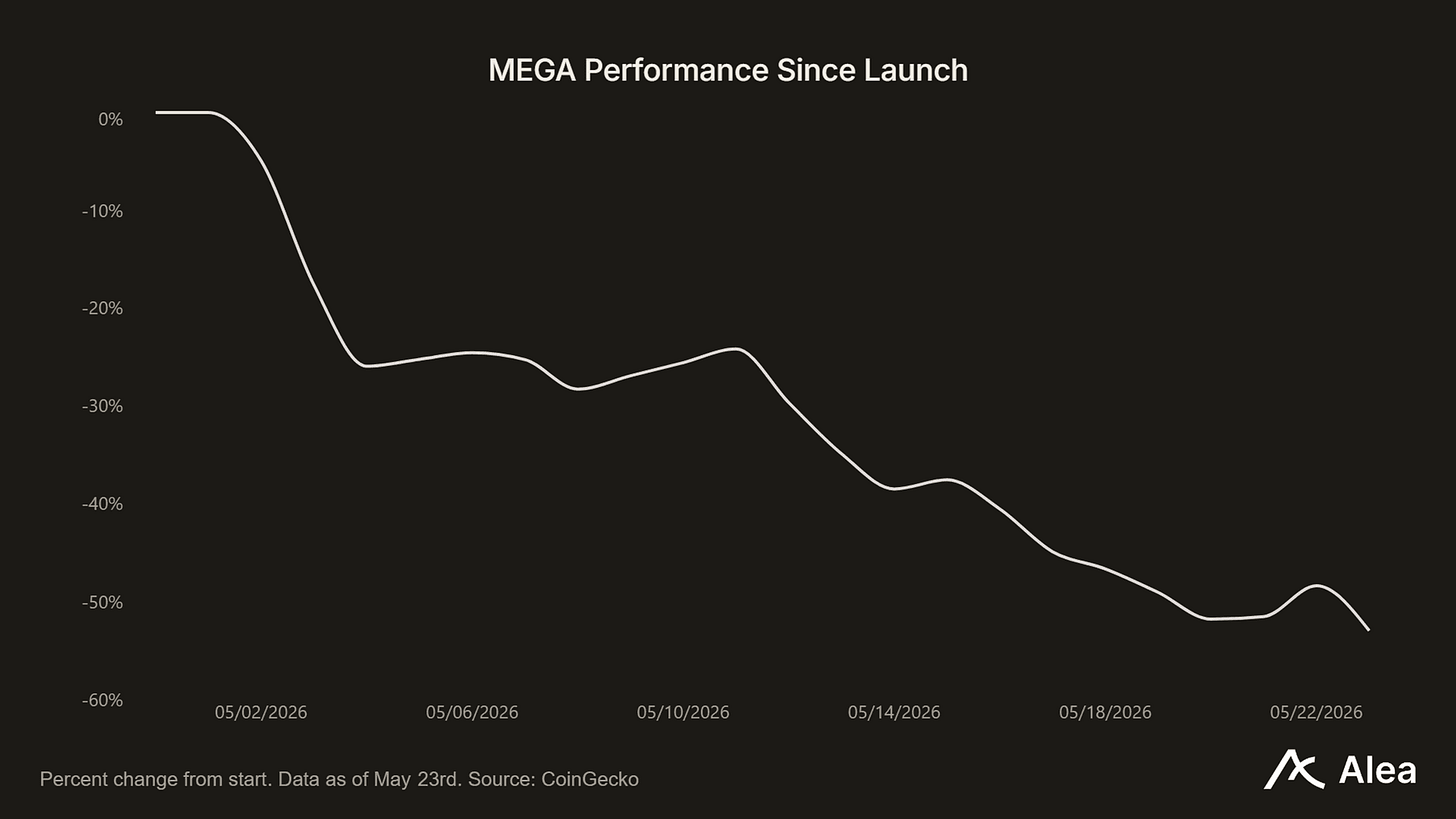
MEGA — MegaETH is ending its Terminal Points Program. They took a snapshot, will distribute extra points next week, and will pay eligible users in USDM after a one-week reward-address submission window. The skeptical read is that reward claims can create fresh churn just as price is already near launch lows.
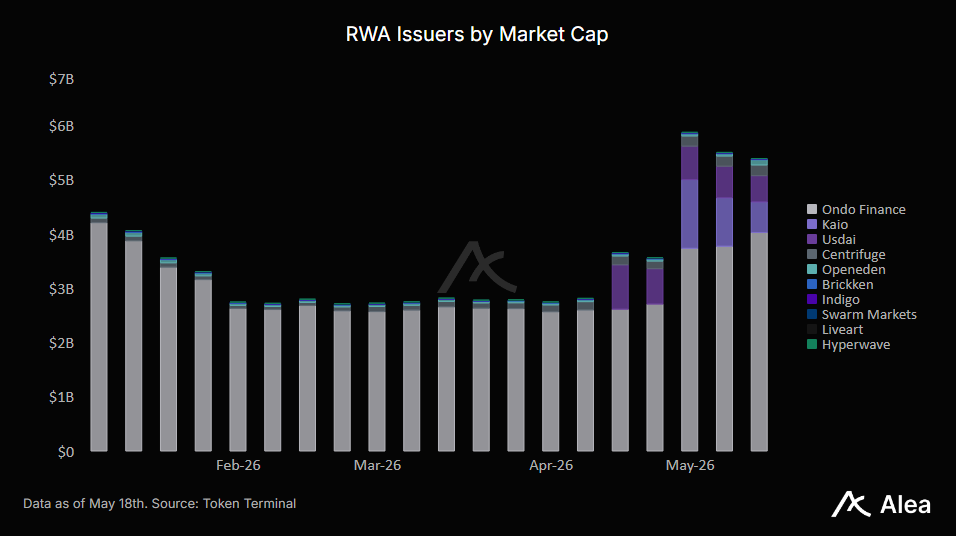
ONDO — A standout winner from the tokenized‑equities trade. ONDO’s value sits in tokenized equity distribution and settlement depth. Ondo Global Markets offers 200+ tokenized U.S. stocks and ETFs, including large equities and index ETFs, with assets backed 1:1 at licensed U.S. broker-dealers and total-return trackers that reinvest dividends net of withholding. The attractiveness of the trade improves as these assets find onchain liquidity through lending markets and DEXs.
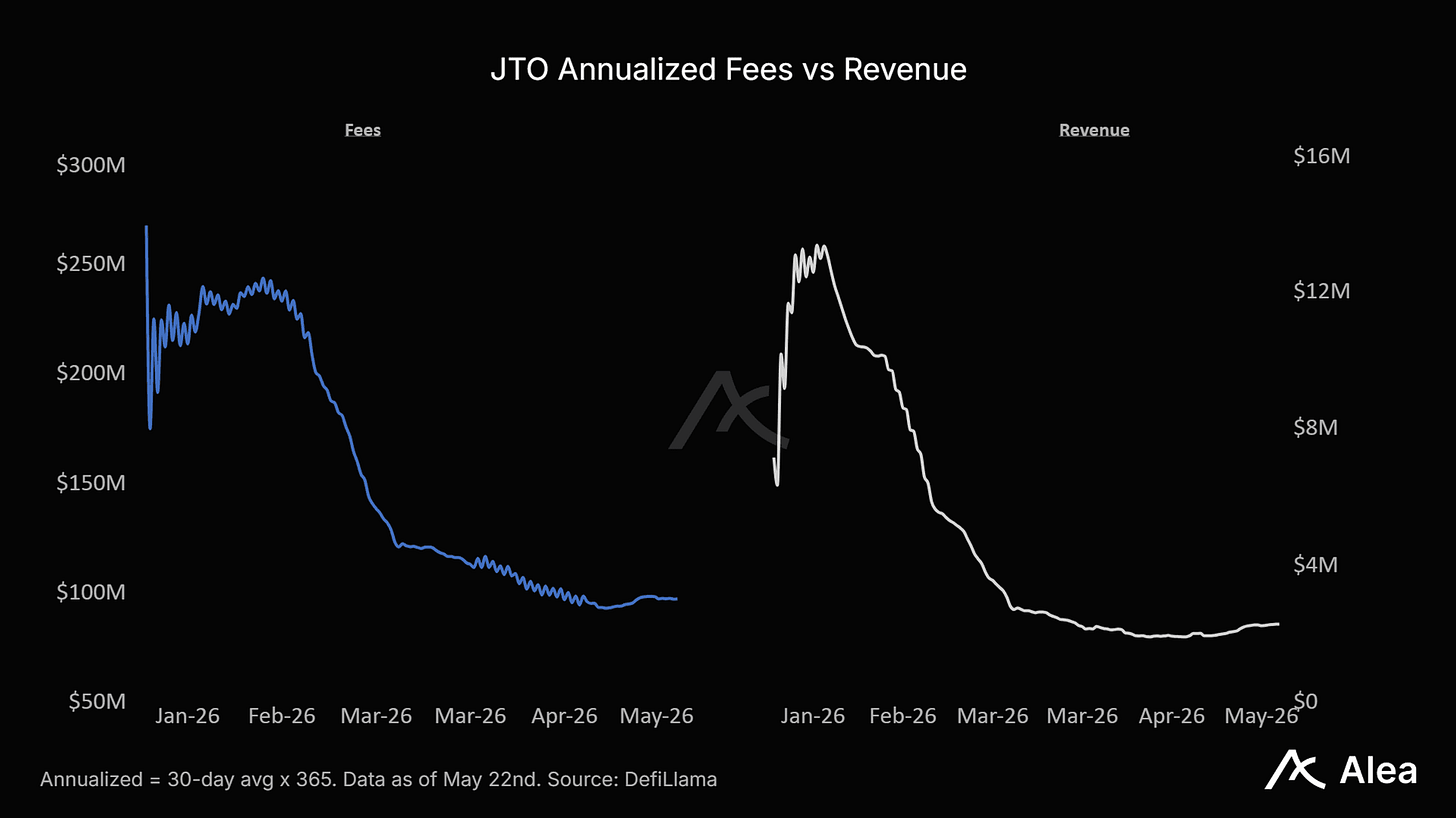
JTO — Solana’s market-structure plus consumer-app bet. BAM adoption doubled in Q1 from 14.0% to 28.1% stake share, validator count rose to 363, and SOL staked to BAM doubled to 119.3M SOL. JTX adds a new path: spot first, then perps and prediction markets, with 80% platform revenue intended for JTO value accrual. Caveat: Jito governance temporarily redirected protocol revenue toward BAM early-adopter subsidies, pausing the prior buyback cadence.
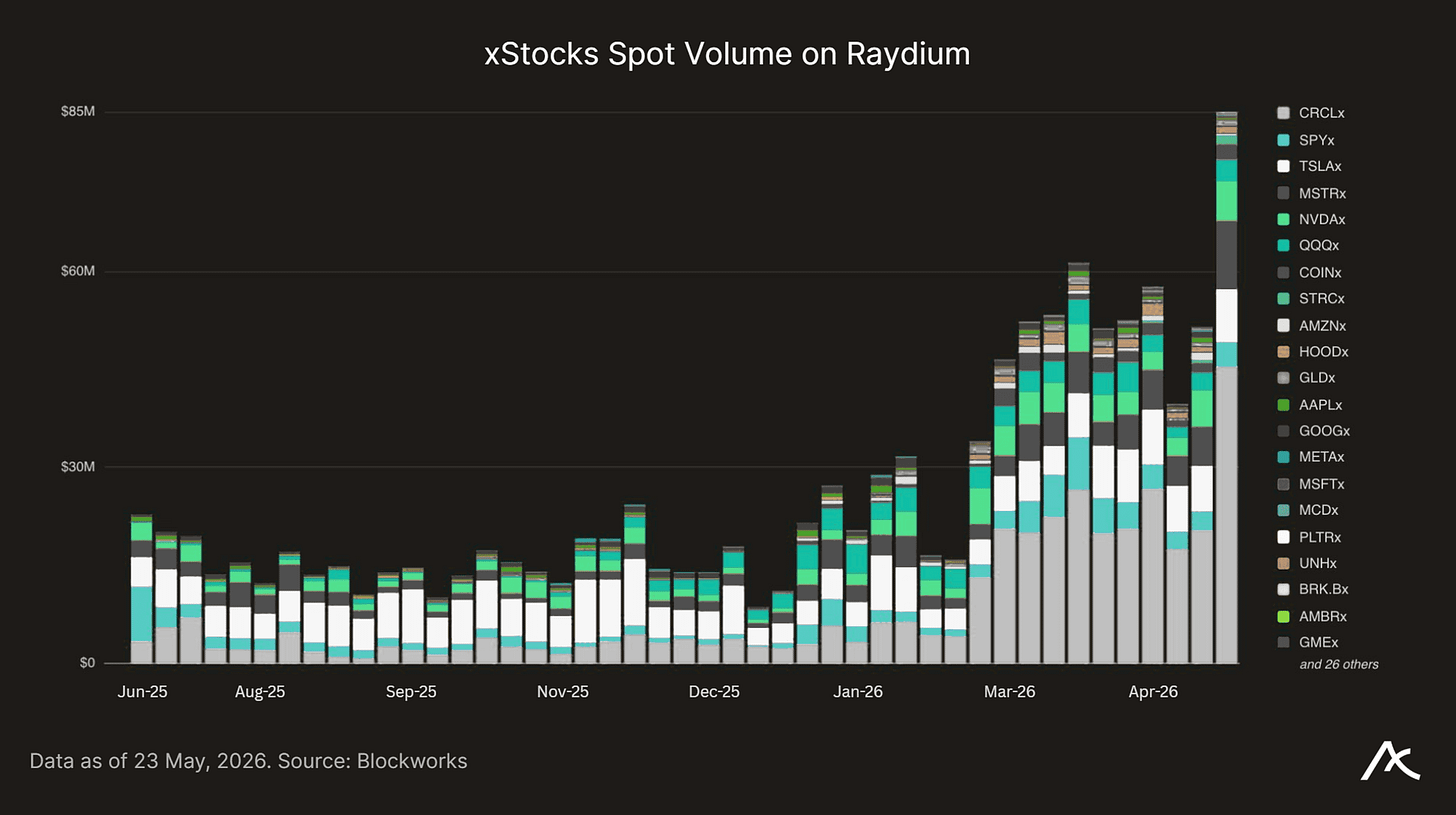
RAY — Fundamentally, RAY is a trading-volume recovery trade with an existing buyback mechanism in place. Raydium’s fee methodology allocates 12% of pool fees to RAY buybacks, while LaunchLab has its own burn/protocol fee mechanics. The May 18 CLMM upgrade adds opt-in limit orders, dynamic fees, and single-sided fee accrual. Tokenized stocks are the current tailwind.
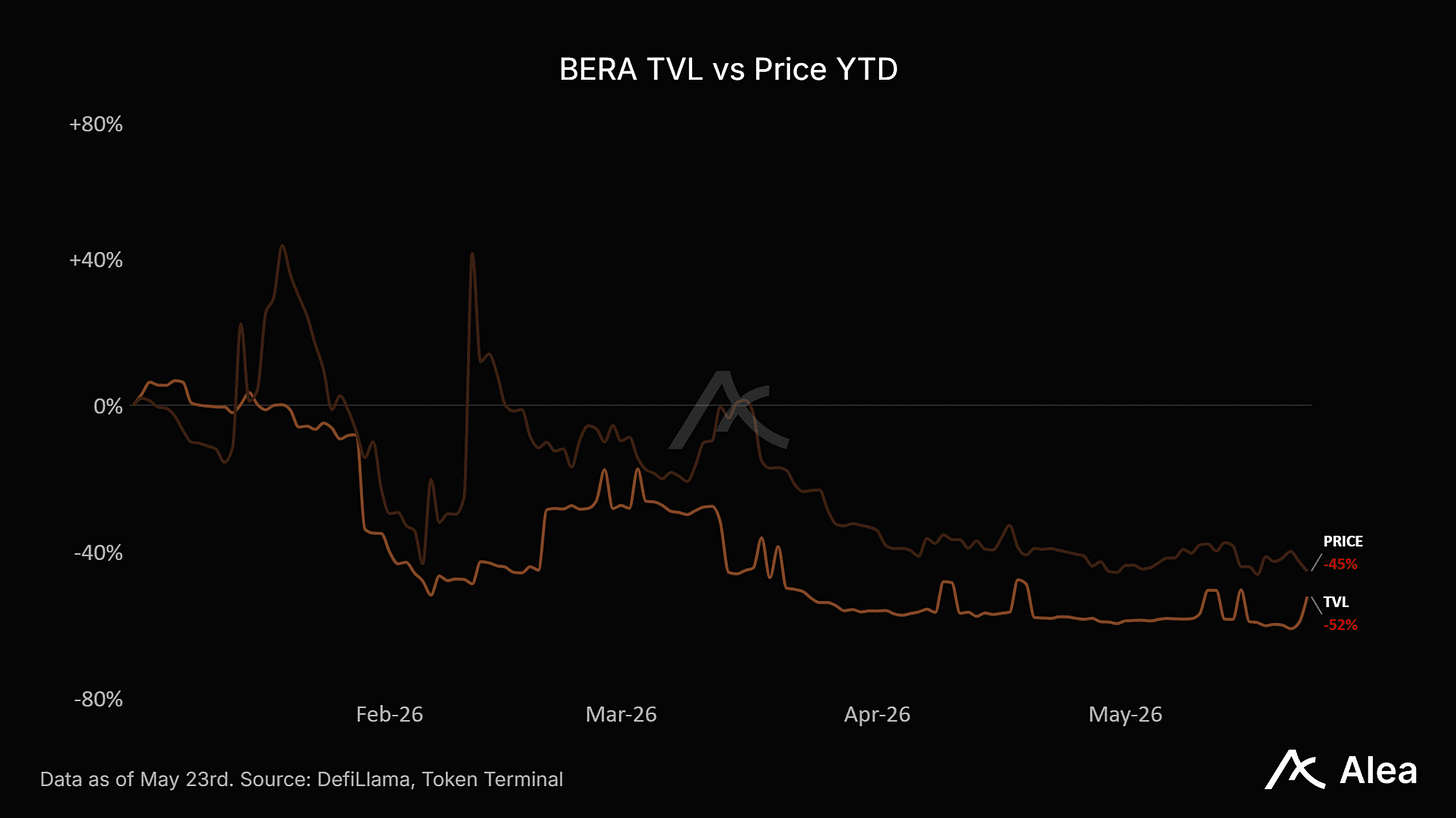
BERA — BERA is a DAT optics trade before it is a core exposure. Greenlane ended Q1 with 77.7M BERA, a $68.7M cost basis, and $34.2M fair value; BERA per share rose 44% since year-end, while staking revenue was only $0.4M. That gives the market a visible holder, but the holder is already underwater. Chain metrics remain weak, under $100M in both TVL and stablecoins market cap.
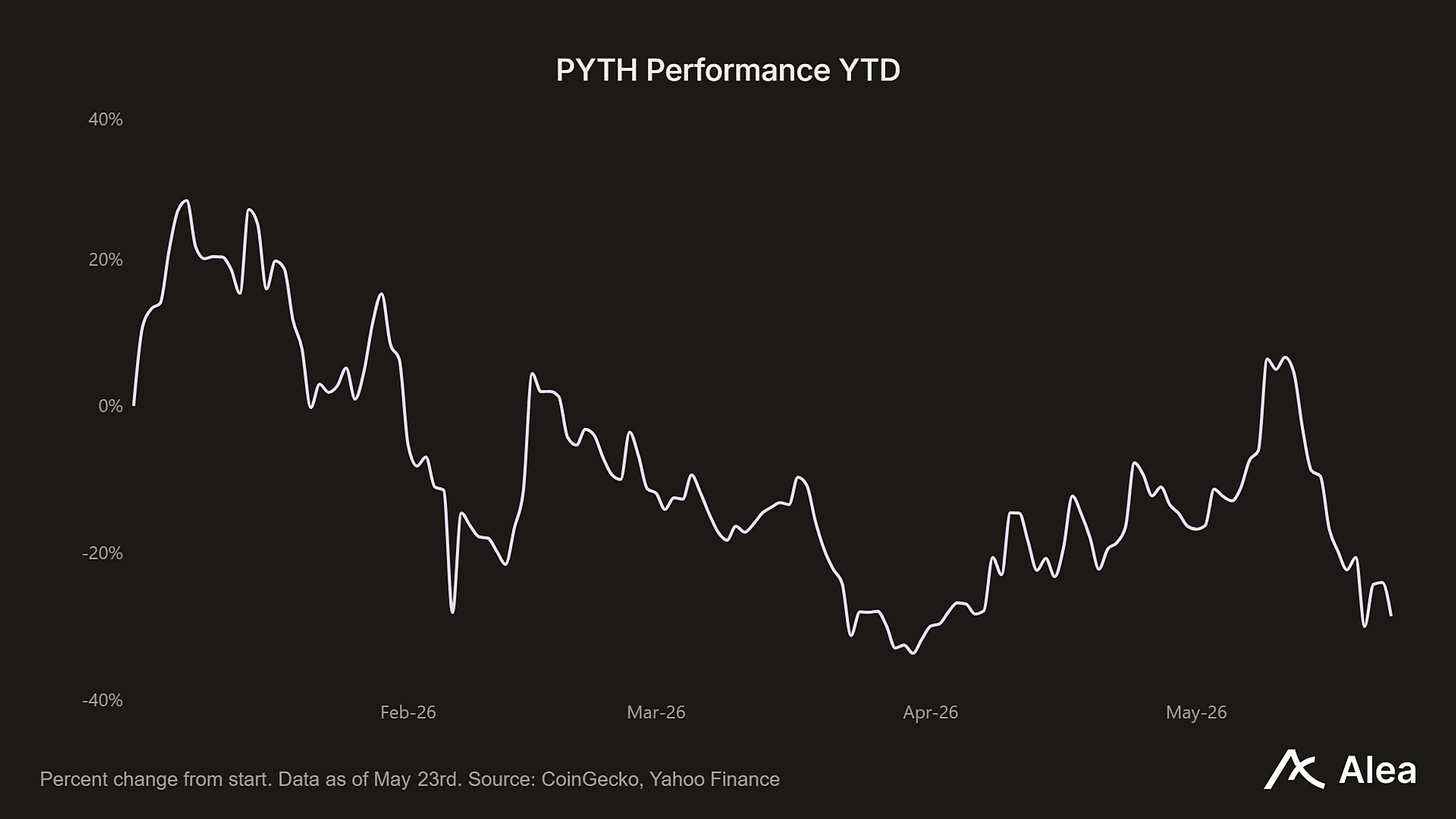
PYTH — The May 19 unlock released $95M worth of PYTH (~36% of circulating supply) across ecosystem growth, publisher rewards, private sales, and protocol management. Price held up relatively well, understanding most of it wasn’t adding up to liquid sell pressure. Trading volume is low and the token is still only 16.5% above its all-time low. The product side is better than the chart: Pyth Terminal went live on May 20 with 3,000+ feeds across crypto, equities, FX, and commodities, while Pyth is retiring Pythnet/OIS emissions and shifting economics toward Lazer, Pyth Pro, the Data Marketplace, and revenue-funded open-market PYTH purchases; the Reserve has bought about 12M PYTH so far from product revenue.
Equities: Miners Become Landlords
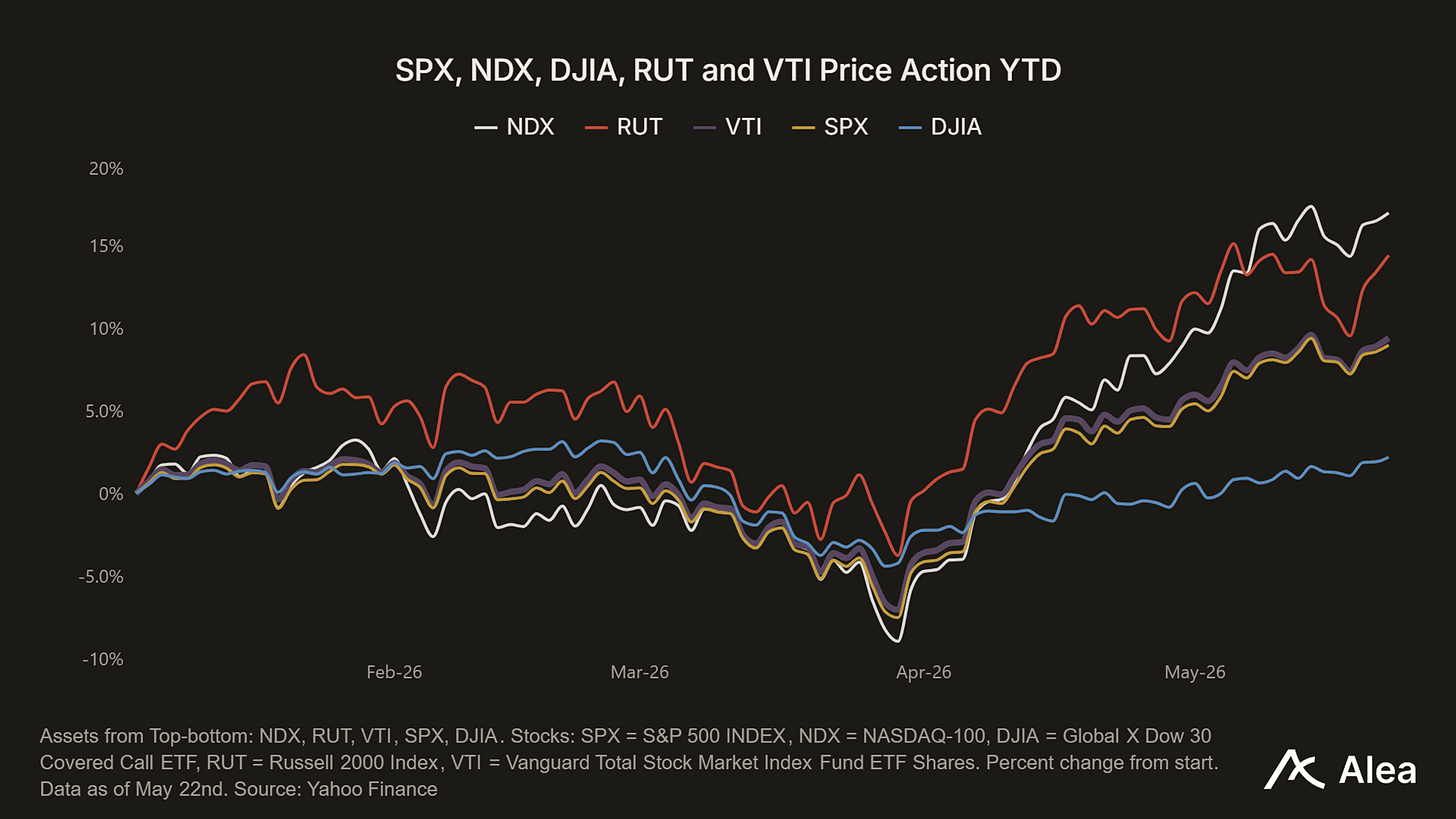
SPX — SPX is being pulled between two forces: AI earnings still support the index, but rates and oil are now tightening the collar. It can keep grinding past all-time-highs if AI leadership holds and yields stop rising. If oil stays bid and the 10-year keeps leaning above 4.6%, the index has less room to forgive consumer weakness and crowded mega-cap positioning.
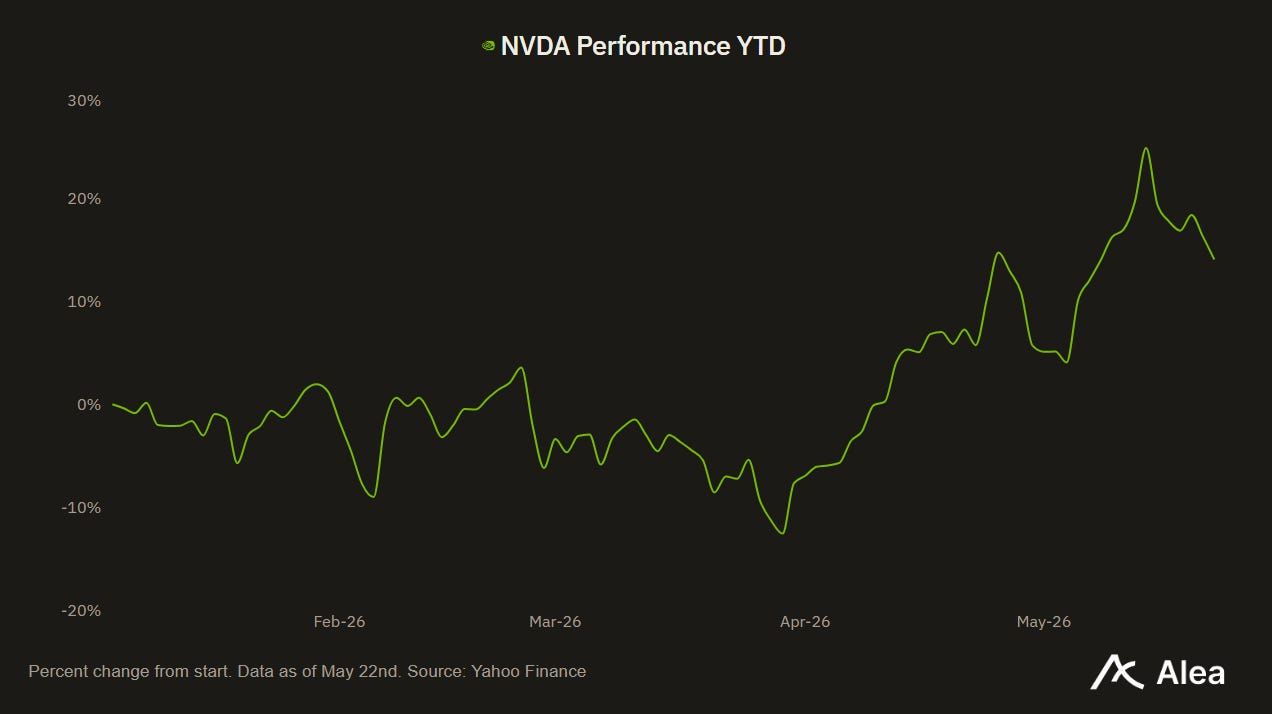
NDX — NDX still owns the leadership trade, but Nvidia’s earnings reaction showed how high the bar has moved. Nvidia printed $81.62B of revenue, up 85% y/y, guided the current quarter to about $91B, authorized an $80B buyback, and raised its dividend; the stock still slipped because investors demand proof that AI capex can keep compounding without margin or competition risk.
NVDA — The bar keeps moving up. Nvidia beat earnings expectations one more time. Q1 FY27 revenue hit $81.6B, up 85% y/y; Data Center did $75.2B, up 92% y/y; non-GAAP EPS came in at $1.87; and Q2 guidance sits at $91B, with zero Data Center compute revenue from China assumed in the guide. NVIDIA also added $80B to buybacks and raised the quarterly dividend from $0.01 to $0.25.
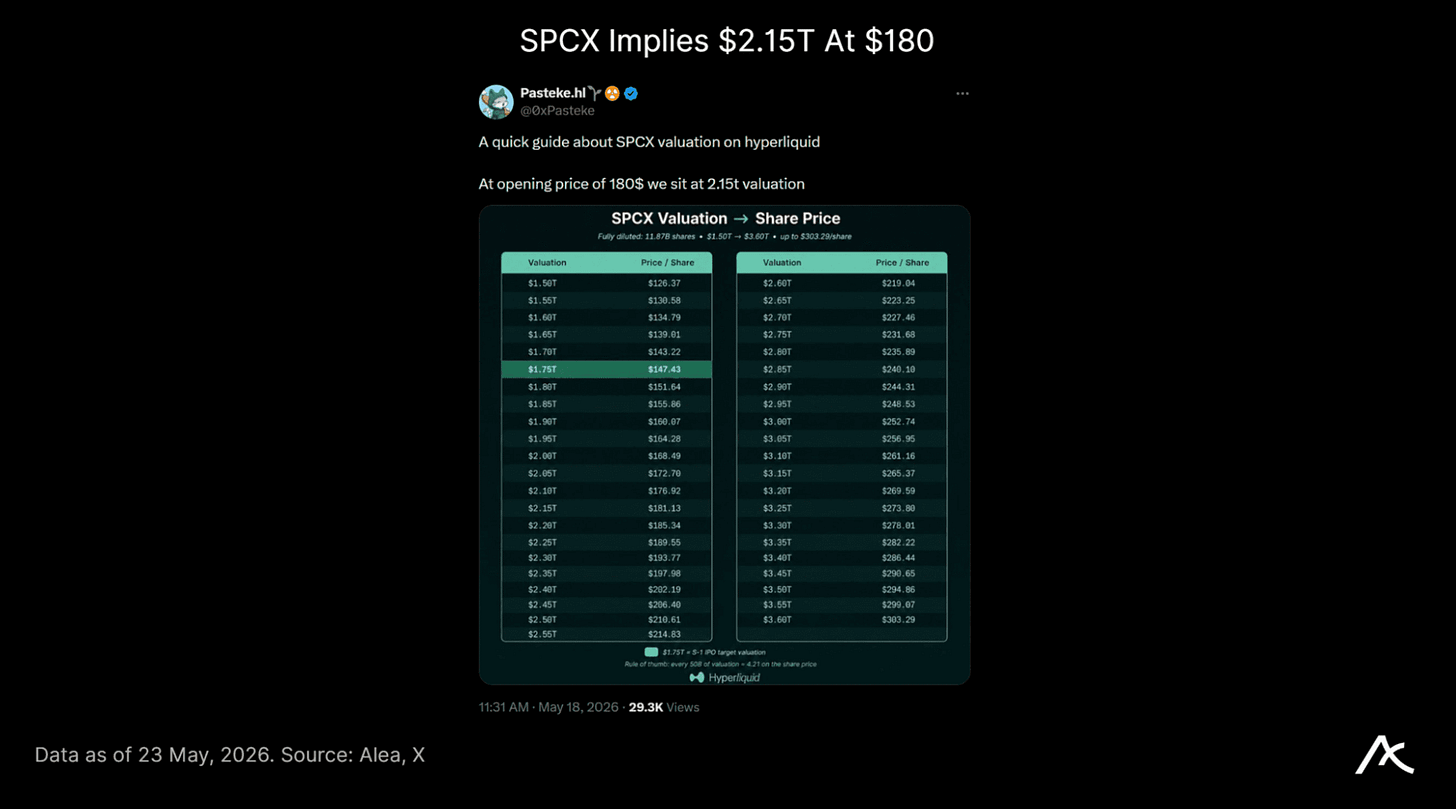
SPCX — SpaceX is reportedly targeting a Nasdaq listing under SPCX, with a roadshow expected on June 4, pricing June 11, and listing June 12; the raise target is about $75B at a $1.75T valuation. Cerebras already showed how pre-IPO perps can become real price discovery: CBRS traded nearly $100M in one hour on trade.xyz, with about $280M in 24-hour volume and $57.8M open interest before public-market trading fully settled. SpaceX will be a much bigger test.
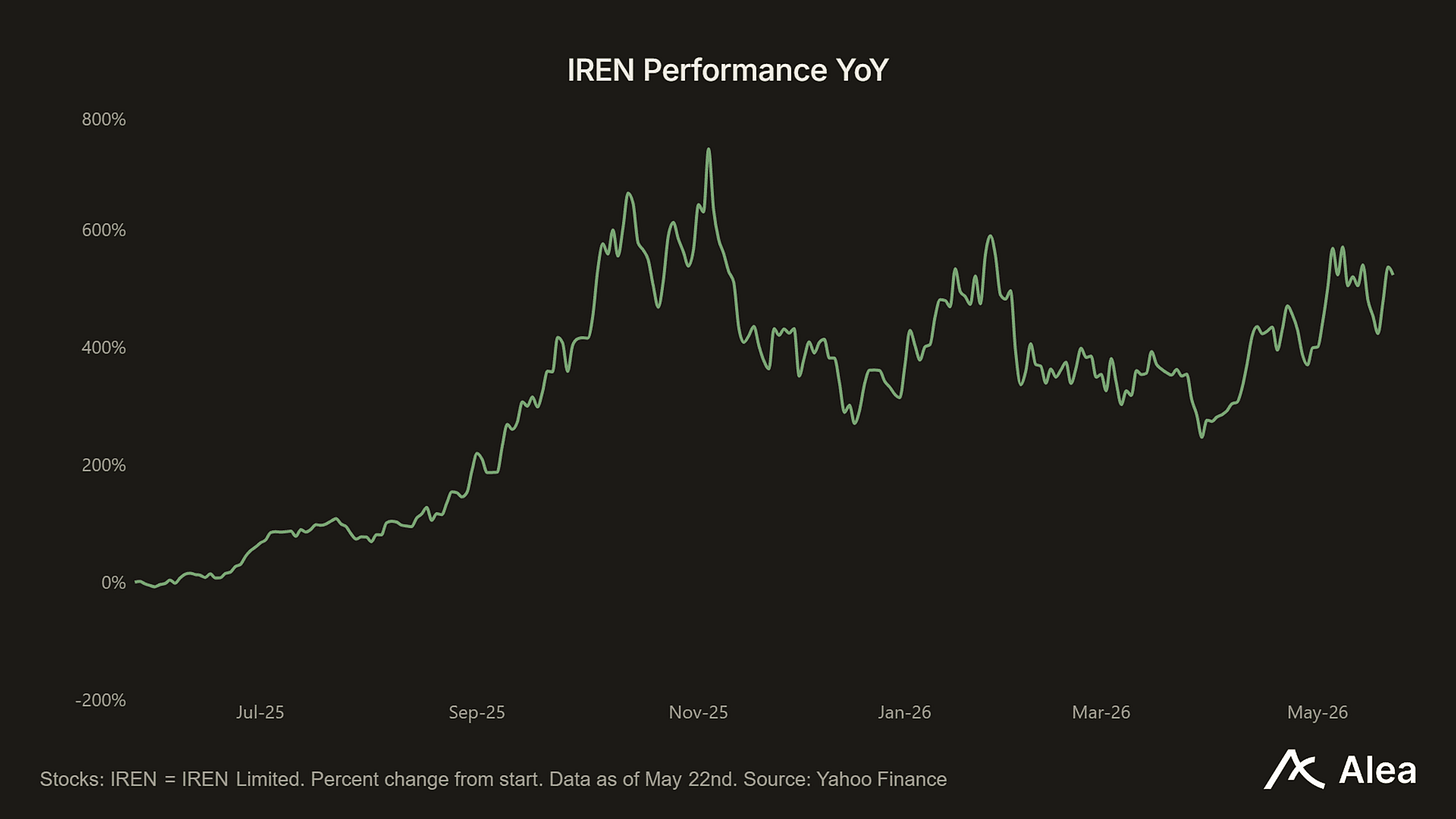
IREN — A “power becomes AI capacity” bet. The company lists >4.5GW power secured, with 810MW operational, 2.1GW under construction, and 1.6GW in development across North America. The recent catalyst stack is heavy: Sweetwater 1 energized May 1, Mirantis acquisition announced May 5, NVIDIA partnership and a $3.4B AI cloud contract announced May 7, then a $3.0B convertible-notes close on May 14. The thesis is contracted AI capacity replacing pure BTC mining beta. Risk: debt, dilution, and execution across several projects at once.
CORZ — Core Scientific is already closer to colocation than mining. Q1 revenue was $115.2M, with colocation revenue at $77.5M versus self-mining revenue of $30.1M; the company says billed capacity of 243MW implies roughly $350M annualized colocation GAAP revenue. The power pipeline is now 4.5GW, including planned 1.5GW expansions at Muskogee and Pecos, with part of the capex funded by CoreWeave. This is a contracted-capacity trade with lower BTC dependence than legacy miners. Risk: customer concentration, build timing, and capex discipline.
RIOT — Among BTC miners, Riot is the power-option trade with AMD validation. The company has 1.7GW fully approved power capacity and signed an initial 25MW data-center lease with AMD at Rockdale, with potential expansion toward 200MW. However, AMD expansion optionality may not fully convert, and BTC price still drives the market’s first read.
CLSK — CleanSpark’s management is openly pushing AI tenancy across multiple assets and says it is making headway toward a first hyperscale customer, while Bitcoin mining funds the platform until AI monetizes the sites. Q2 FY26 showed the other side of the trade: revenue fell to $136.4M from $181.7M, so the market will not reward vague AI language forever.
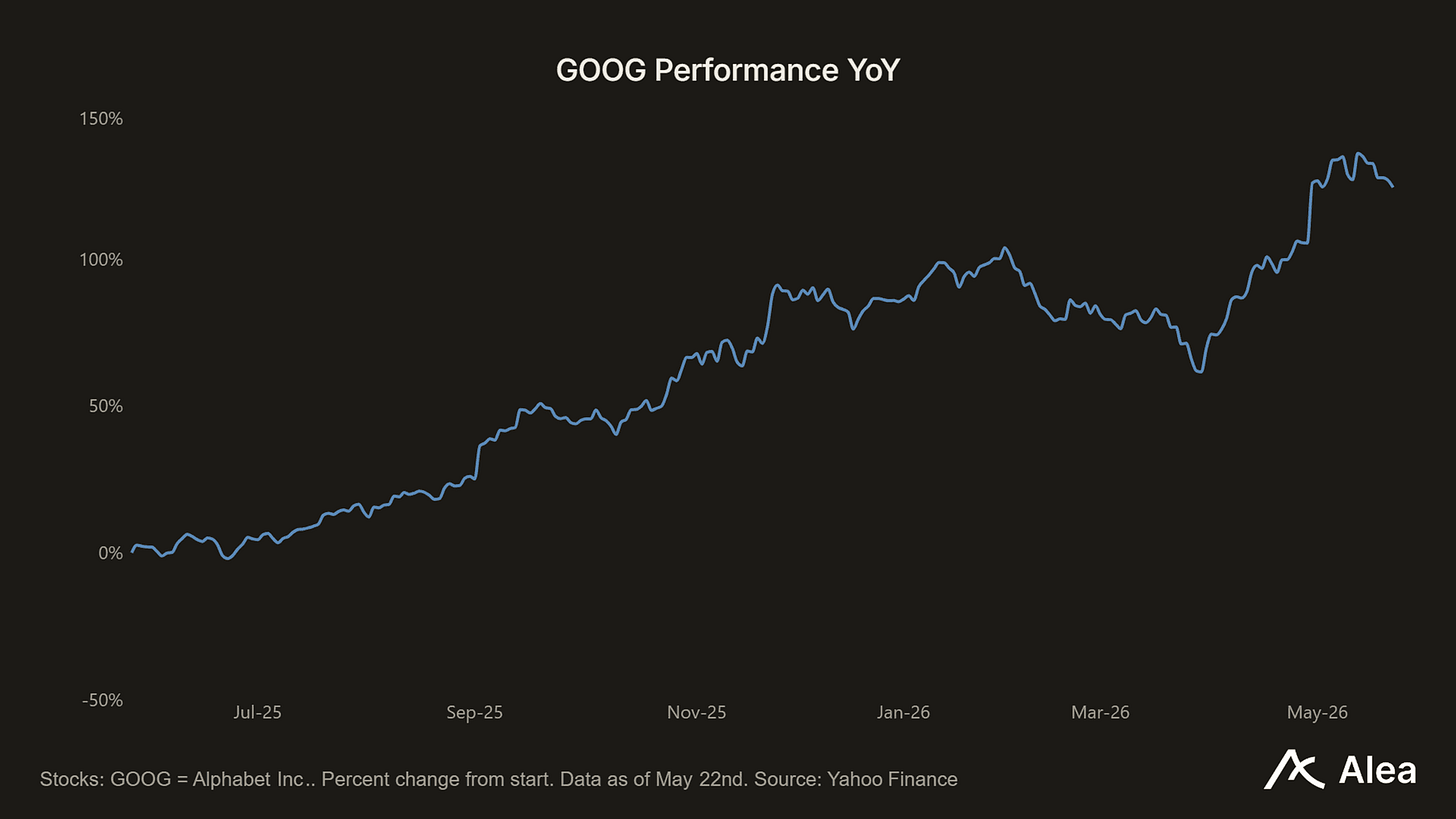
GOOG — Gemini 3.5 Flash is now live across Antigravity, Gemini API, AI Studio, and Android Studio; Google says it beats Gemini 3.1 Pro on coding and agentic benchmarks, while Gemini 3.5 Pro is still scheduled for next month. AI Mode in Search has passed 1B monthly users, Gemini app MAUs are above 900M, and daily Gemini requests are up more than 7x year over year. That is the bull case: Google does not need to win the chatbot brand war if it can route AI through Search, YouTube, Gmail, Android, Chrome, Workspace, and Shopping. The bear case is cost. Pichai said capex should hit roughly $180–190B this year, about 6x 2022 levels. That turns every Gemini rollout into a margin test.
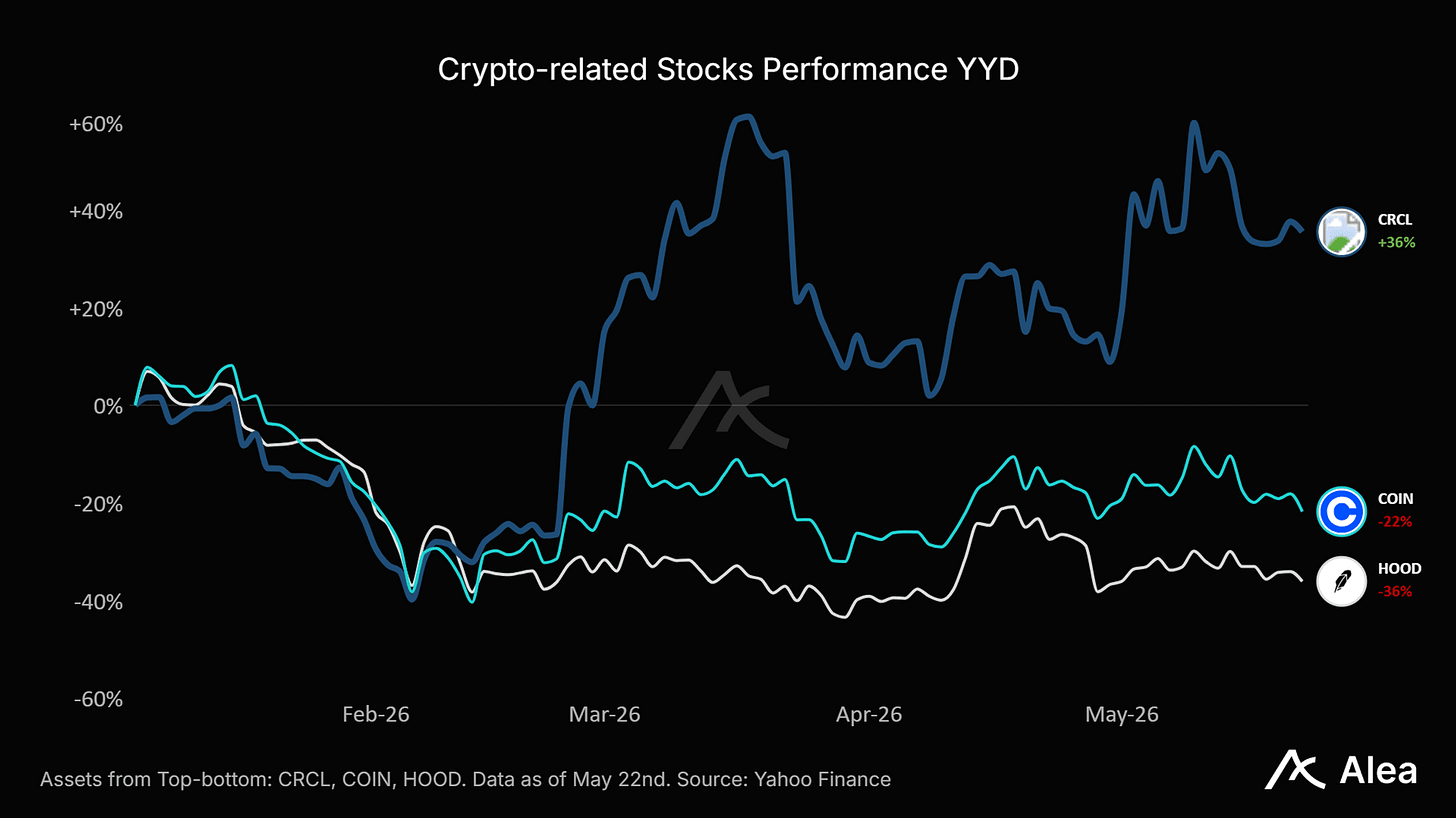
COIN — Coinbase has a credible path to offer tokenized equities in the U.S., turning its crypto exchange into a Robinhood/Schwab competitor. The trade is regulatory optionality plus distribution. This is dependent on the SEC decision which is currently leaning toward not requiring issuer backing or standard shareholder rights.
HOOD — Robinhood belongs next to Coinbase as one of the largest beneficiaries of more regulatory clarity. Robinhood already trained users to trade around the clock and sits closest to the retail equity-perps imagination. Coinbase, however, is more of a regulatory catch-up trade.
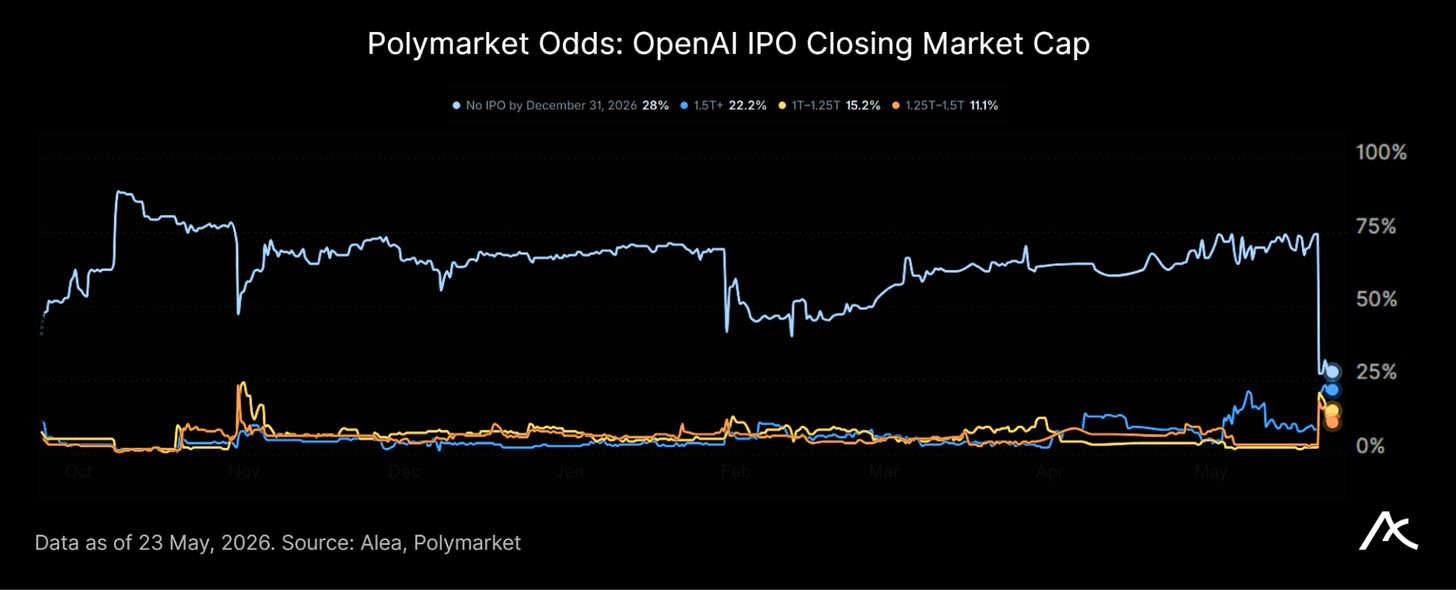
OpenAI — Rumors came out OpenAI is preparing to confidentially file for a U.S. IPO in the coming weeks, aiming for a public debut as early as September, with Goldman Sachs and Morgan Stanley working on the draft prospectus. OpenAI did not comment. The company was last valued at $852B and raised $122B earlier this year.
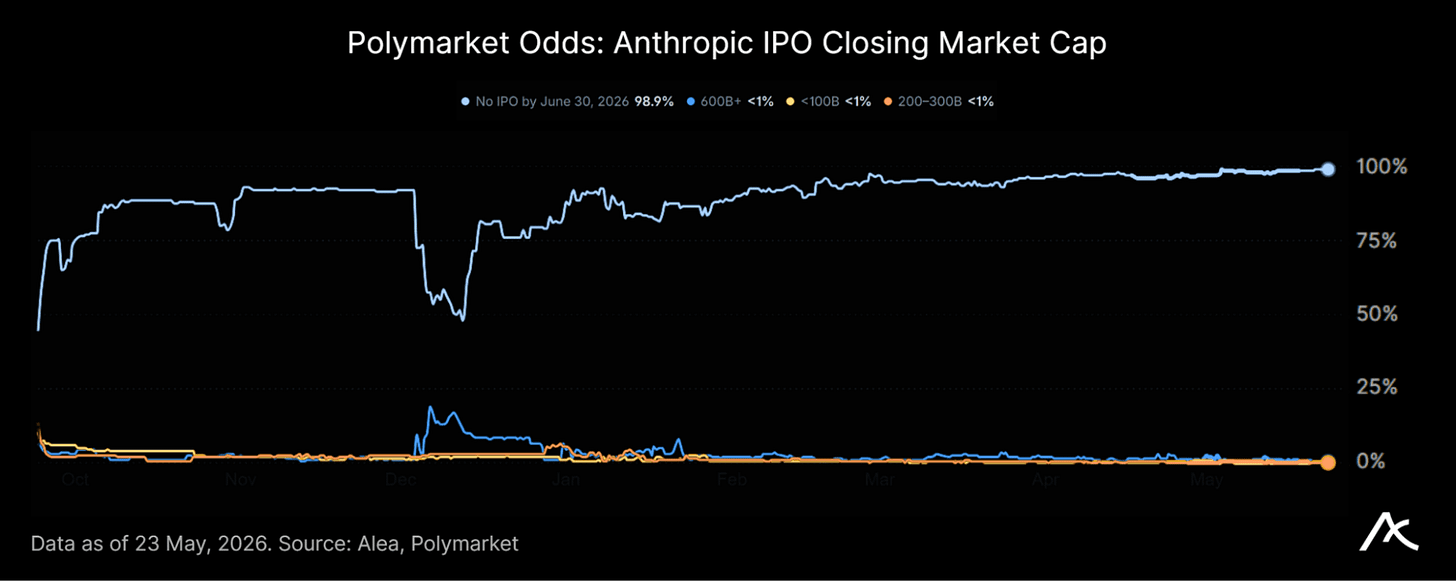
Anthropic — Karpathy joining is the pre-training signal, helping launch a group focused on using Claude itself to accelerate pretraining research. That points to the next scarce edge: better research loops, faster experiment design, cleaner training data decisions, and models that help improve the process that builds the next model. The market keeps treating frontier AI as a compute race, which is true but incomplete. Talent that can compress research cycles may matter as much as another block of GPUs. For OpenAI, this adds pressure just as IPO rumors surface.
Conclusion
The most useful tell this week is where users are choosing exposure over ownership. They want OpenAI, SpaceX, Nvidia, Stripe, and Anthropic price risk before the traditional market gives it to them. Crypto can serve that demand. The danger is that the same product can turn price discovery into a casino with poor rights and fast reflexivity. Trade it, but do not romanticize it. This is still a preservation-of-ammo regime. The best trades have visible flows, liquid exits, and a clear party on the other side: forced hedgers, crowded shorts, passive ETF buyers, or retail chasing private-market access. The worst trades are theme-adjacent tokens with no control over the actual flow. Own what gets paid. Rent what only gets mentioned.