IPO pricing is one of the last closed auctions in equities. Underwriters set the deal price in a book outsiders never see, and the true market price is shown on the opening print, hours after allocations are done. Pre-IPO perps now trade through that blackout window around the clock, and the last month showed how effective this was at pricing the opening.
Cerebras’ ($CBRS) perp landed within ~1.3% of the Nasdaq open. Quantinuum’s ($QNT) perp carried an ~80% premium which unwound on IPO day. SpaceX is the next in line, listing tomorrow, 12 June.
In this edition, we look at how HIP-3 turned Hyperliquid into a listings venue, what CBRS and QNT’s IPO showed us, and what SPCX is pricing into the open.

From Equity Perps to Pre-IPO Perps
TradeXYZ first introduced 24/7 perps on US equities such as Tesla, Nvidia, and Apple alongside a synthetic Nasdaq index, XYZ100. Tokenized equities wrap real shares and mirror a listed price. A perp needs no underlying at all, only a mark price traders agree to settle against, which is what lets the format reach companies with no public price to mirror.
Equity perps (indices + stocks) have grown to >$2B in open interest across decentralized venues.

Pre-IPO perps are synthetic derivatives on the expected value of a private company that trade 24/7. Holders receive no shares, no allocation, and no claim on the company. It relies on funding rates to redistribute money between longs and shorts without pulling the mark toward anything external. A premium on pre-IPO perps can only be corrected by traders willing to short retail enthusiasm with no convergence date except the listing itself. This is unlike traditional crypto perps where a persistent premium gets arbitraged away by shorting the contract and buying spot to collect funding.
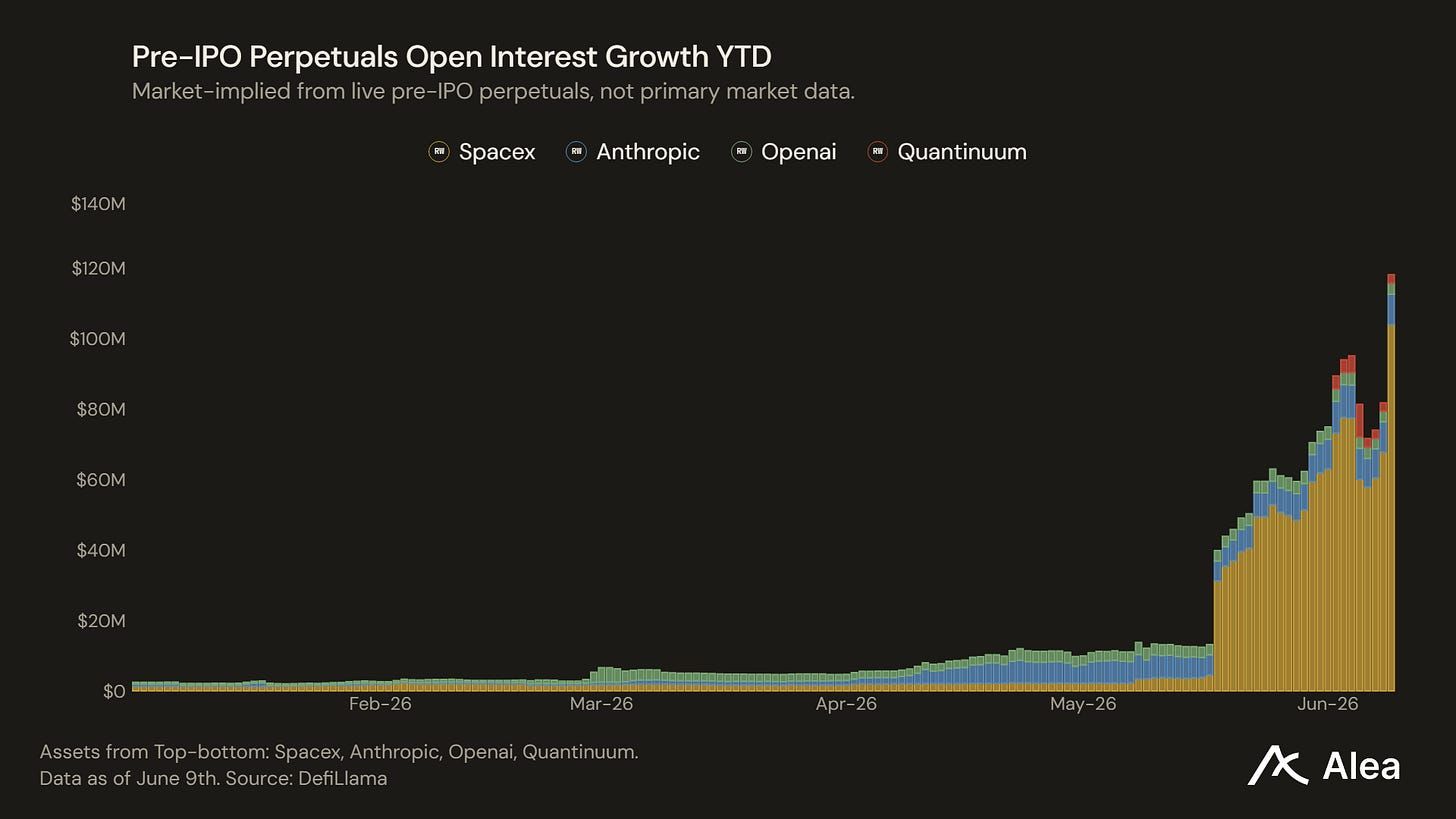
Private companies have absorbed more of the value creation that public markets used to capture. A report from a16z in Sep 2025 shows that private tech companies valued >$1B (~1.3K companies) represent almost ~40% of Nasdaq’s entire market cap if you exclude MAG7. By the time a company like SpaceX reaches IPO, investors are wondering what public markets are willing to pay after years of private-market repricing.
Traditional pre-IPO access is narrow. Secondary shares usually require accreditation, relationships, large purchases, transfer restrictions, and company approval. Tokenized equity attempts have tried to solve that by wrapping shares or SPV interests, but private companies can push back if their shareholder agreements or bylaws restrict transfers.
TradeXYZ prices its pre-IPO perpetuals (IPOPs) contracts in expected share price and uses its own orderbook as the oracle, converting to a standard equity perp once the stock lists.
Ventuals denominates in implied company valuation and blends private market data, including funding rounds and secondary transactions, into a hybrid oracle.
These pre-IPO contracts have since expanded into centralized venues such as Binance, Coinbase, and OKX.
Cerebras ($CBRS) and Quantinuum ($QNT) Price Discovery
Cerebras listed on May 14, thirteen days after TradeXYZ launched its CBRS perpetual, and that window became a price discovery experiment. Underwriters priced the deal at $185 and the stock opened on Nasdaq at $350 before closing at $311.
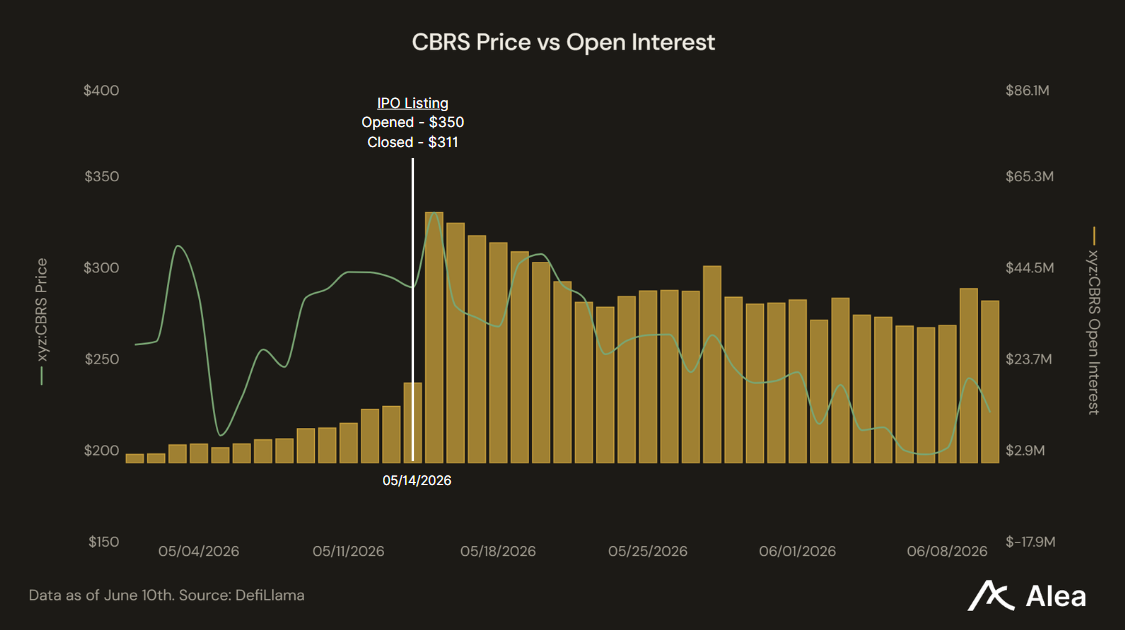
The perp read that auction almost to the dollar. Over the final hour before the opening print, the Hyperliquid contract traded at ~$354.54, 1.3% above the eventual cash open. A market with no access to the book or the allocations matched the opening auction better than the underwriters did.
Quantinuum saw the opposite result. The Hyperliquid perp traded at ~$90 while the IPO was expected to price at $45–50 per share. The stock opened at $68 and closed at ~$60, then broke below the listing price the next session.
In both instances, they carry no information about where the stock settles once stabilization ends and institutional supply arrives.
SpaceX Pre-IPO Price Action Into Friday
SpaceX officially priced its IPO at $135 per share, giving the company a $1.77T initial market capitalization, the largest IPO on record, with Nasdaq trading set to begin Friday.
$SPCX pre-IPO perps have been live for months with contracts across Hyperliquid, Binance, and other venues are trading at an implied ~$2T valuation.
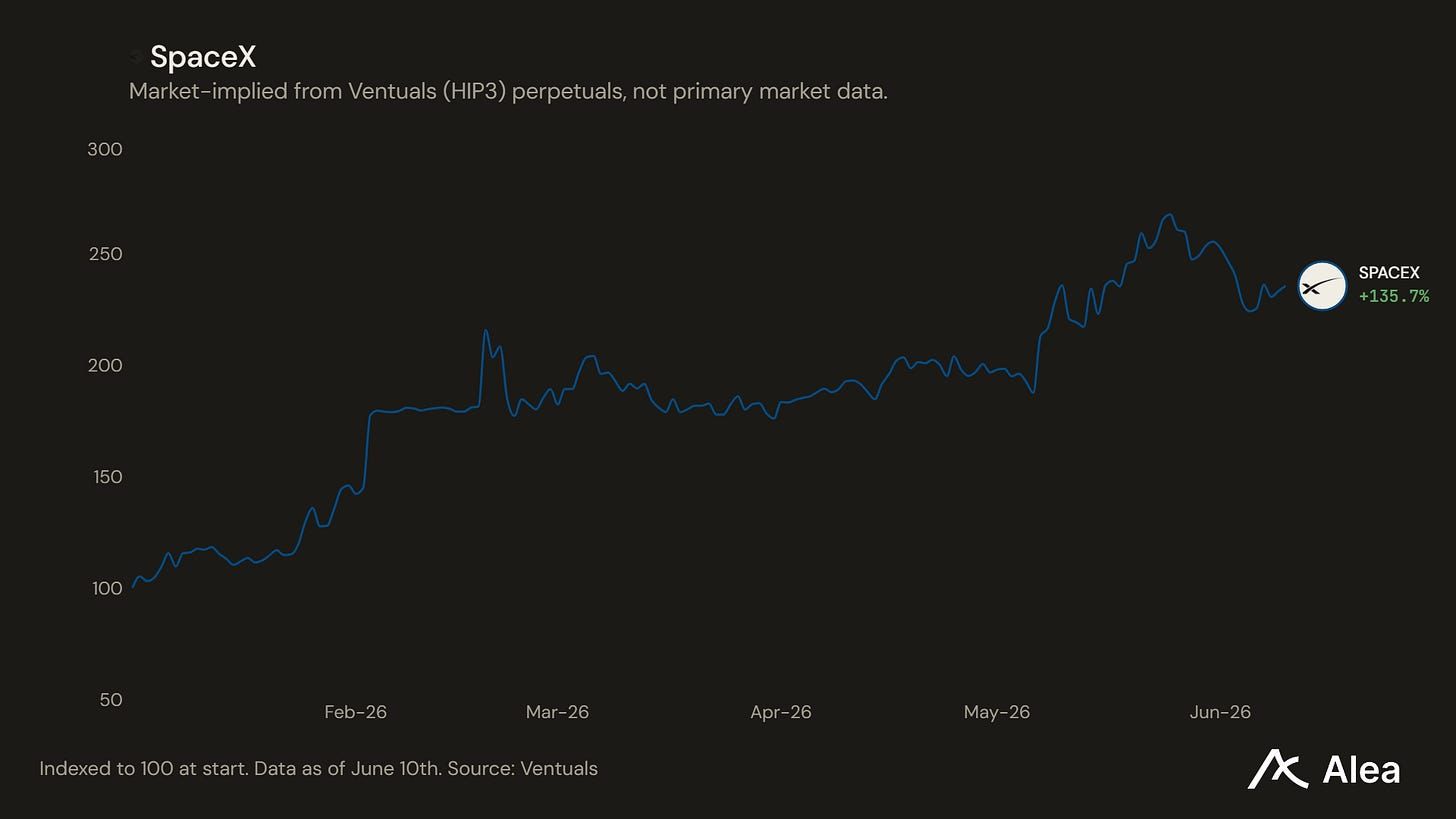
Two structural features argue for a smaller pop than Cerebras delivered: the deal is raising around $75B, an enormous slug of day-one supply, and Musk has discussed allocating up to 30% of IPO shares to retail, at least 3x the typical reservation, which pre-fills exactly the demand that normally fuels an opening surge. A 15% perp premium against that backdrop is a restrained forecast by the standards of the past month.
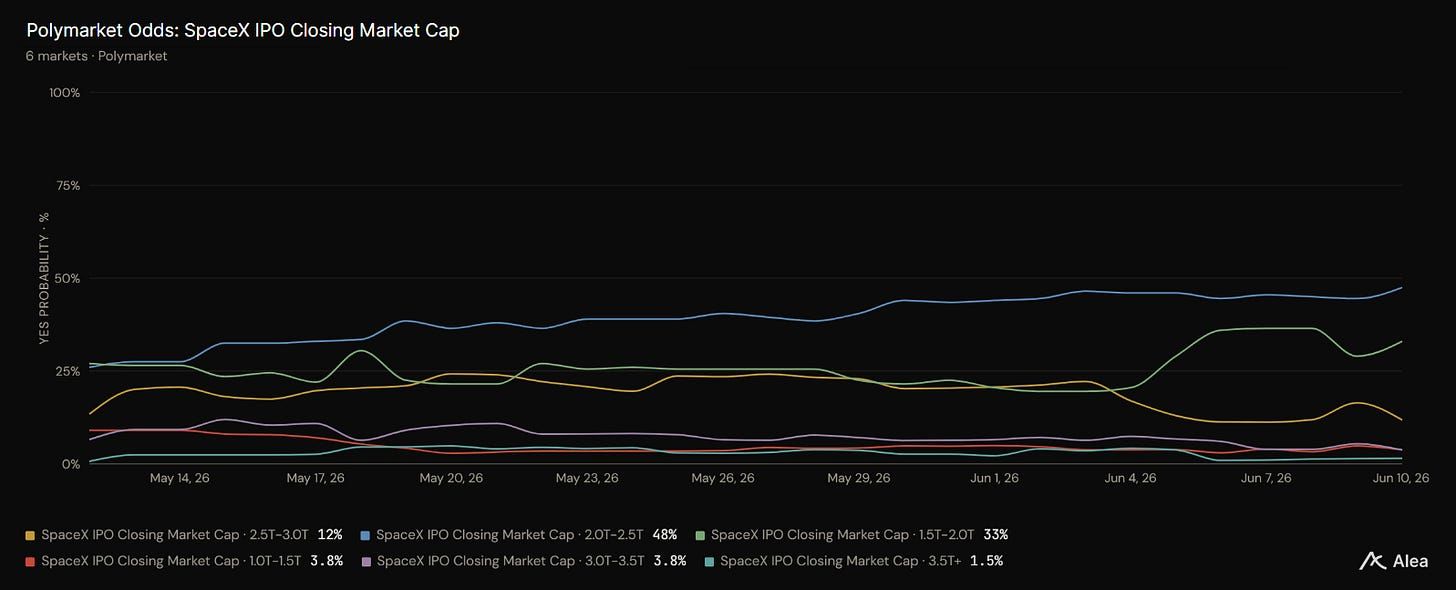
Polymarket's top “closing market cap” bucket sits at $2.0-2.5T, with an implied probability of 48%. The next bucket, $1.5-2.0T, sits at 33%. Collectively, prediction markets price an 81% probability that SPCX closes its debut above $1.5T (equivalent to ~$155 pre-IPO perp price vs ~$165 now)
For context on where private investors got in, SpaceX's valuation progression ran from its earliest ~$100M in 2002 to the most recent $800B round in December 2025. For retail, the aperture for this listing is wider than any previous IPO. Fidelity lowered its eligibility threshold to $2,000, citing SpaceX's decision to reserve up to 30% of the offering for retail clients versus the typical 5-10%.
Robinhood and Schwab are participating in the offering. Kraken's xStocks program opened IPO access to eligible retail customers across 110+ regions including the EEA, issuing allocations as SPCXx, a 1:1 tokenized representation of SpaceX equity that trades 24/7. Bybit tokenized pre-IPO SpaceX exposure separately, and Ondo Finance, Dinari, and PreStocks have signaled they will list tokenized SPCX representations once shares begin trading.
Whether expanded retail access represents genuine democratization or a distribution mechanism for early private holders is a question worth examining both ways. SpaceX adopted a staggered lockup that allows insiders to sell as soon as 2 days after its first quarterly earnings report, while reserving up to 5% of the offering through a directed-share program with no lockup at all. Musk sits outside these provisions entirely, locked for 366 days and excluded from early-release triggers.
SpaceX is the most anticipated and largest IPO. Everything above is publicly visible pre-listing data which serves as context, not a call.
References

Full report suite: Deep Dives, Perspectives, Blueprints, Theses, Benchmarks, Memos & Pulse.
Protocol Data Rooms: Standardized due diligence portals with live analytics, risk matrices, and governance tracking across 24+ protocols.
Podcast Digest & Summit Digest: Key takeaways from the conversations shaping markets, so you don’t have to listen to every pod.
Governance Tracker: Live proposal feeds and voting activity across major protocols.
Full access to the historical research archive.