Onchain perps have evolved from AMM‑style experiments into full‑fledged trading venues. The first wave (dYdX on StarkEx, GMX on Arbitrum) proved that non‑custodial perps could attract billions of dollars in open interest. The second wave with Hyperliquid, Lighter, Variational, HyENA more, pushed deeper on infrastructure, introducing custom chains, zk orderbooks, RFQs and unified margin with synthetic dollars.
Paradex is the latest entrant in this “Super Exchange” race. Born out of Starknet, it runs its own appchain and advertises a CEX‑grade experience: zero trading fees, institutional‑grade privacy, and support for hundreds of markets. While earlier perps platforms captured capital through points programs, Paradex differentiates on architecture: it aims to give traders better execution and privacy without paying taker fees.
In this edition, we’ll look into Paradex’s design, their privacy and fee innovations, and where it stands among other onchain orderbooks.

Introduction to Paradex
Paradex is a trading venue for perpetual futures (and other derivatives/spot products), built with an orderbook execution model. It operates as an appchain on Starknet, controlling its own block production, block times and fee model. This allows them to optimize for high frequency trading and avoid congestion.
All trades settle through zero‑knowledge proofs (ZKPs), so traders keep self‑custody of collateral with CEX-level execution speeds.
Paradex also leans into two product ideas that are still relatively uncommon on major perps venues:
Unified margin: cross-collateralizing positions so collateral can support multiple instruments and positions under one risk engine.
Privacy: masking account state so other traders can’t trivially infer positions, liquidation levels, or strategy.
Zero-fee retail via Retail Price Improvement (RPI)
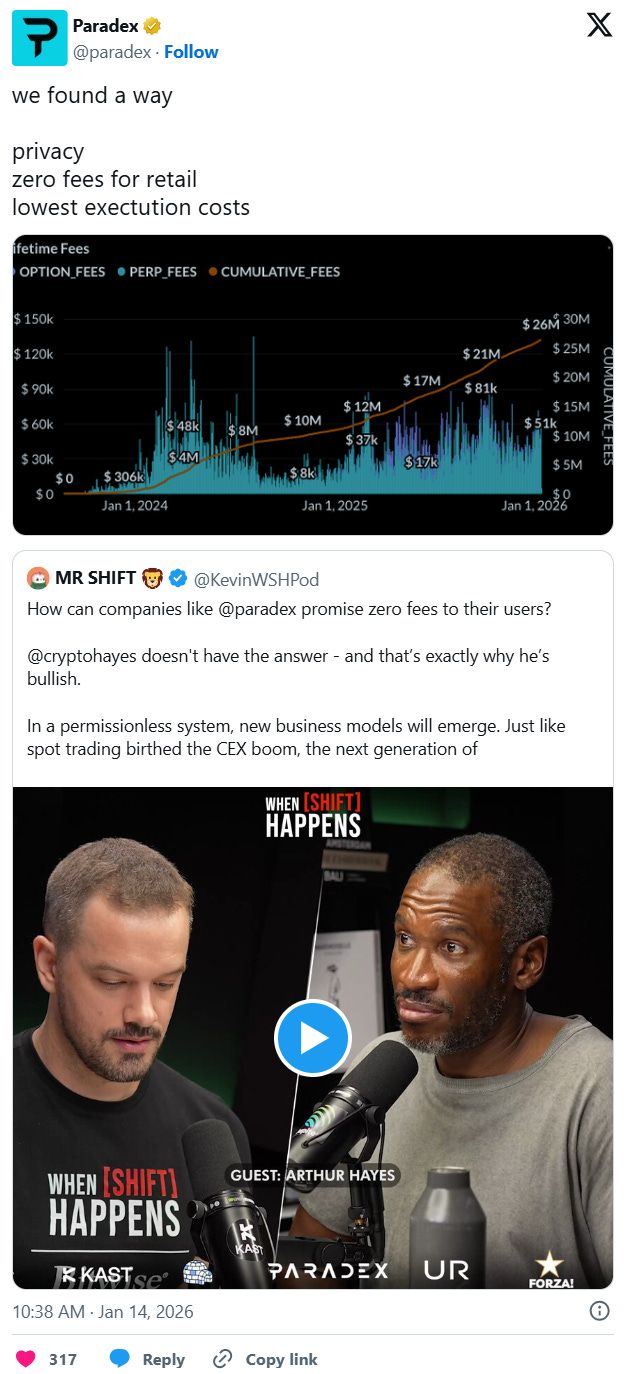
Paradex offers zero-fee trading, waiving maker and taker fees for retail users on more than 100 markets. However, “zero fee” is often just marketing as spreads often widen, or fees reappear elsewhere. Instead, Paradex’s approach is closer to an execution model where it tries to segment retail flow and let market makers compete to provide slightly better prices to that flow.
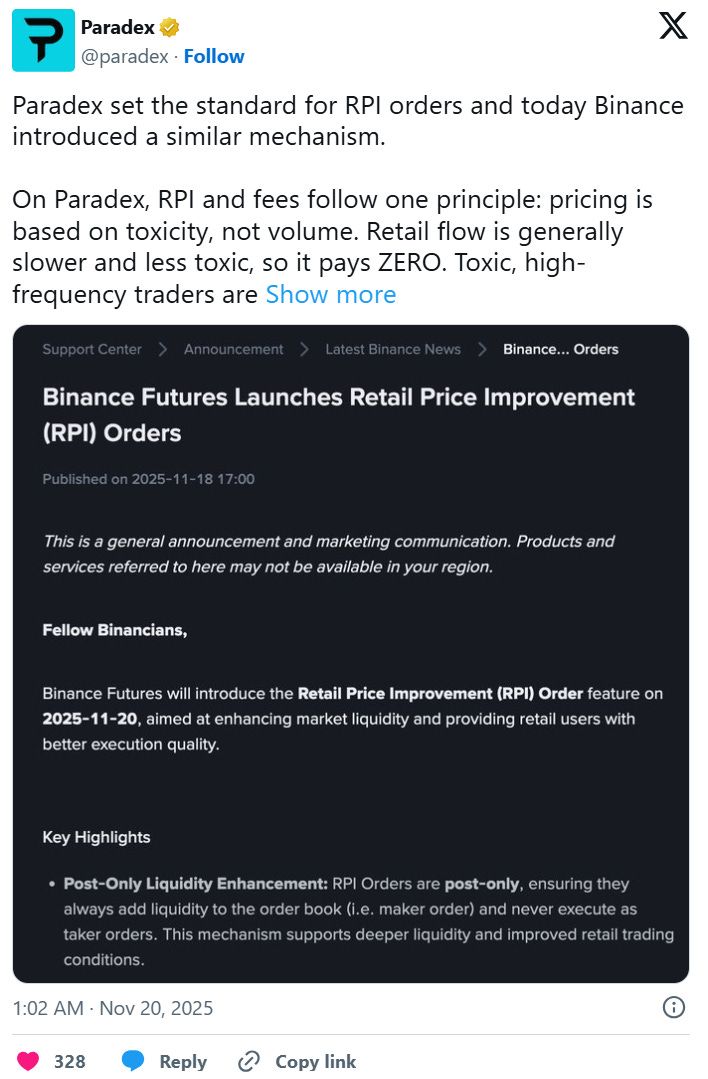
So instead of relying on explicit fees, Paradex introduces a Retail Price Improvement (RPI) order type.
RPI tags high‑quality retail flow, allowing market makers to provide slightly better prices to these orders in exchange for payment for order flow. As a result, retail orders can fill inside the prevailing spread, often beating classic maker/taker pricing.
This matters because instead of charging taker fees, Paradex is essentially trying to sell high-quality flow to market makers in a way that improves fills for retail traders.
Private Trading State
Most onchain orderbooks are maximally transparent where anyone can see the book, positions, and liquidations. That transparency is good for auditability, but it also makes sophisticated traders reluctant to show size because it leaks information.
Paradex’s privacy model is designed to make account-level state less observable. In plain terms: if you can’t easily see someone’s positions or liquidation levels, it becomes harder to trade against them, frontrun them, or map their strategy.
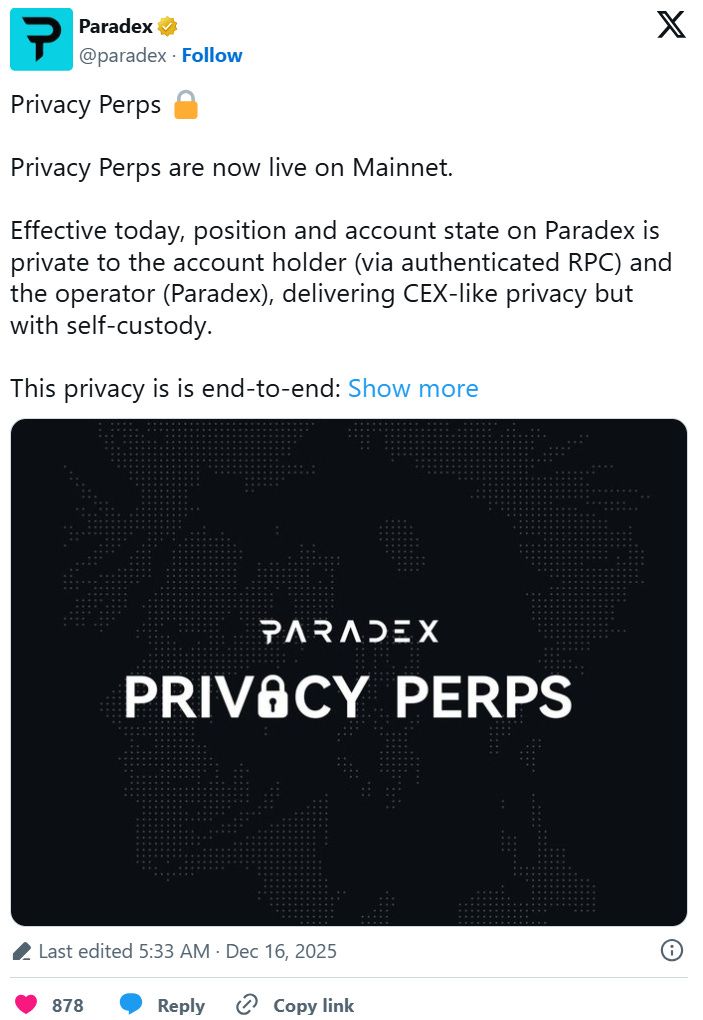
Positions and orders are stored in Paradex’s cloud matching engine and encrypted before posting to the L2. RPC nodes mask account data by default, only returning private state to the authenticated owner. This privacy architecture means other participants and third‑party RPC providers cannot see a user’s positions or liquidation levels
Perp DEX Evolution
Most new perps venues differentiate primarily on incentives (points, rebates, MM rewards) and distribution. Paradex aims to differentiate in its architecture, choosing specific design bets that shape execution quality.
Execution model:
Paradex’s orderbook is optimized around matching and execution rules like RPI.
Many newer entrants either use RFQ quotes or hybrid liquidity mechanisms that can behave differently under stress.
Chain and performance approach:
Paradex uses a Starknet appchain path to prioritize performance and trading-specific sequencing.
Others either build custom L1s/appchains, use rollup execution environments, or stay as smart contracts on a general-purpose chain and accept the constraints.
Privacy stance:
Paradex explicitly treats privacy as a feature (hiding sensitive account state).
Many competitors have transparent explorers with everything visible making it easier to audit, and thus accepting the information leak downside.
Fee philosophy:
A lot of the sector’s “cheap trading” has historically been incentive-driven and tends to decay once rewards normalize.
Paradex’s “zero fee” is framed as an execution approach (price improvement and flow segmentation), rather than a temporary subsidy.