Neutron is Cosmos’ permissionless smart‑contract hub, designed to make cross‑chain dApps feel as if you are building on just one chain. Neutron ships trading, data, and automation rails at the base protocol layer and is secured by 20 industry-leading validators. This creates a chain where dApps can access liquidity, prices, and accounts across the chains without sending users through bridges or unfamiliar UX.
Neutron is now running its Bitcoin Summer campaign to earn real BTC yield via simple vaults and optional leverage looping using maxBTC. Participants can earn yields alongside $NTRN incentives and partner rewards.
In this edition, we’ll explore Neutron’s integrated architecture, how it empowers next‑generation DeFi, and their recent Bitcoin Summer campaign.
Stay informed in the markets ⬇️
Introduction to Neutron
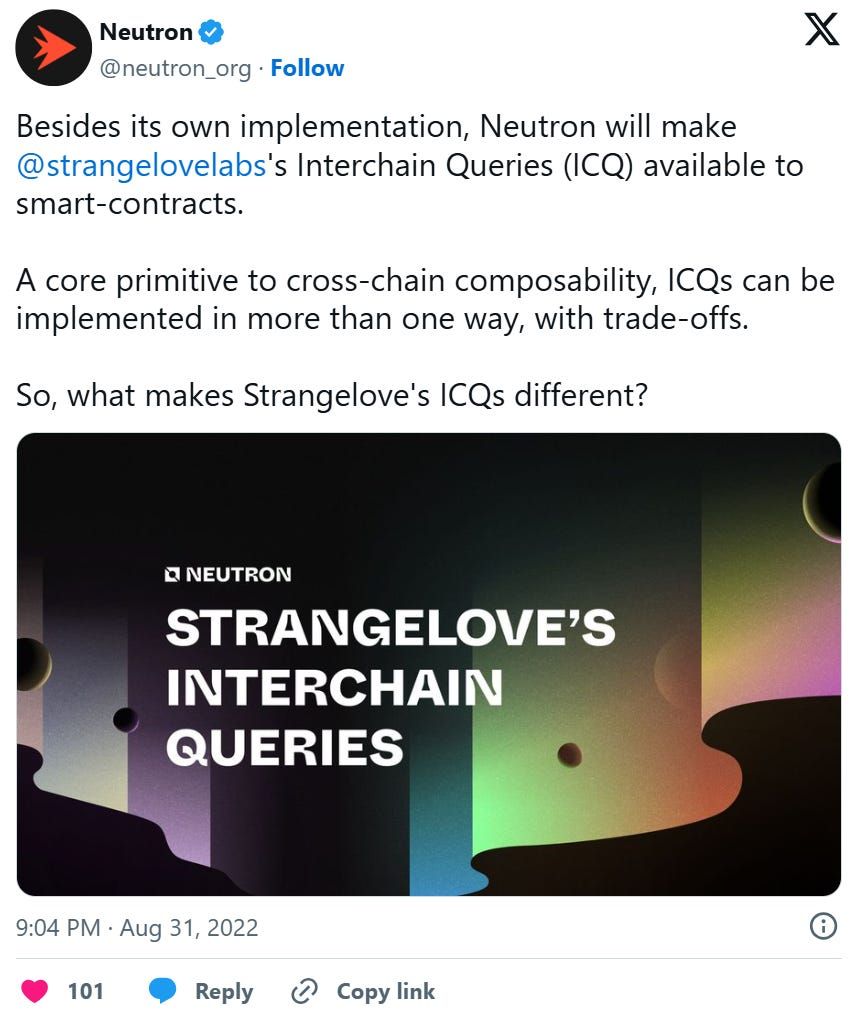
At its core, Neutron implements a custom‑built CosmWasm chain with critical DeFi modules are at the protocol layer. Neutron has several native modules including a DEX module for concentrated‑liquidity trading, an Interchain Queries (ICQ) module to read data from any IBC‑connected chain, an Interchain Transactions (ICTX) module to execute transactions on remote chains, and a Cron module for scheduled or conditional execution.
This “infrastructure‑as‑a‑service” model gives every application access to the same secure oracle, orderbook and automation engines without rebuilding them.
In 2025 it graduated from the Cosmos Hub’s Replicated Security to a fully sovereign network (the Mercury upgrade), inheriting a curated validator set and funding its own security while keeping tight IBC connectivity. The goal is to achieve faster iteration, clearer validator incentives, and tighter control over its DeFi roadmap without losing alignment with the Hub’s assets and users.
Bitcoin Summer Campaign
Neutron’s Bitcoin Summer initiative, which went live in September, is designed to showcase the network’s BTCFi capabilities and attract users to its DeFi ecosystem.
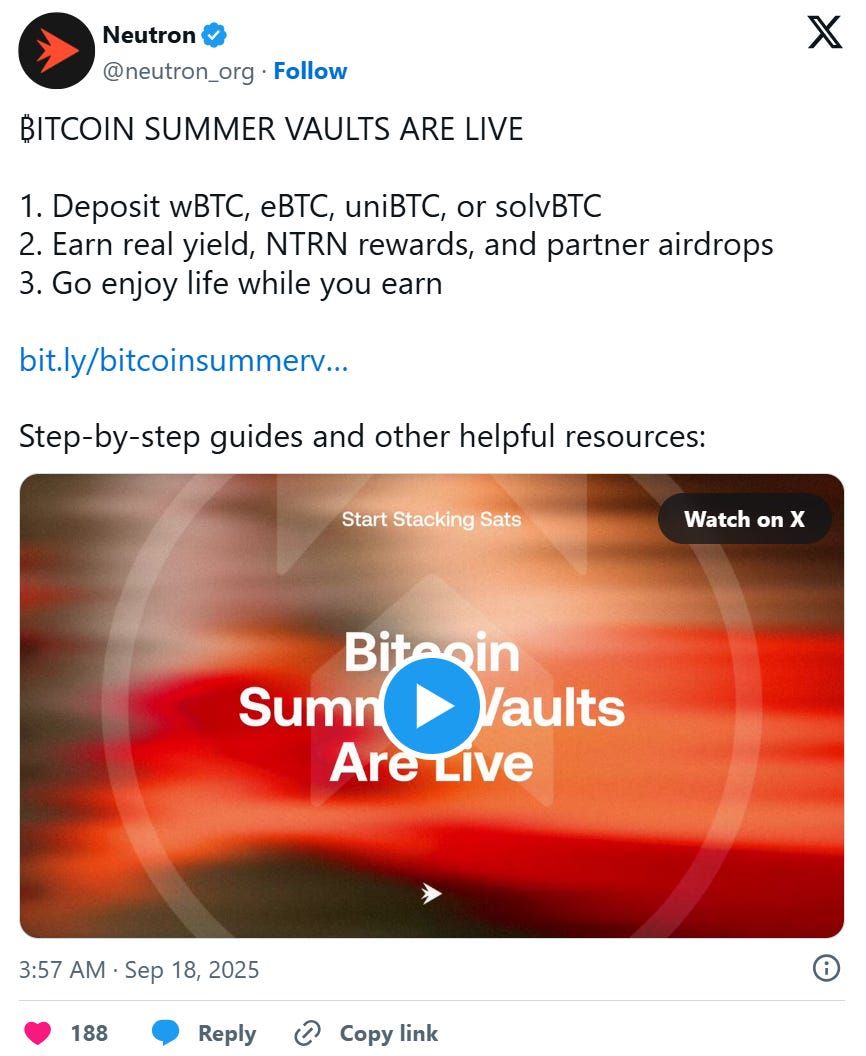
This is a multi-phase campaign where participants can deposit wrapped $BTC assets such as WBTC, eBTC, solvBTC, uniBTC and LBTC into various vaults depending on their risk and yield preferences. The campaign is structured in 2-month phases with at least 6 phases (12+months) planned.
Through maxBTC, a derivative that tokenizes real $BTC yield from onchain and offchain strategies, depositors earn a base ~5–10% APY, with opportunities to leverage their position up to 12x via looping on various LP strategies supported by Neutron’s Supervault and even protocols like Amber.

The campaign also allows users to loop maxBTC positions or lend $BTC on Amber Finance, generating lending yield and swap fees. They can also earn partner token airdrops and a portion of the $10 million $NTRN rewards allocated to the promotion. By combining lending, looping and Supervault liquidity, the campaign demonstrates how Neutron’s DeFi primitives can unlock real yield opportunities for $BTC holders without requiring them to leave the interchain ecosystem.
Rise of Interchain DeFi
DeFi is moving from single-chain silos to networked markets where users no longer want to bridge into a new stack for every app. Instead, they want one venue that can reach liquidity, prices, and positions wherever they live. Cosmos’ IBC has matured into the default way to move assets and messages without trusted third-party bridges. On top of this, two core primitives make “interchain” feel app-like:
Interchain Accounts (ICA), which let a contract on Chain A control an account on Chain B
Interchain Queries (ICQ), which let a contract verify state (balances, prices, positions) on other chains in a trust-minimized way.
We already see this in EVM chains where liquidity is fragmented across appchains, rollups, and L1s. Yields and incentives rotate rapidly, and institutions increasingly require operational neutrality.
At the same time, chain abstraction (hiding chain choice and gas from users), intents (submit a goal like “swap 100 USDC for the best net BTC” and let solvers execute), and account abstraction (programmable wallets with social recovery/policy rules) are bleeding into production. These UX rails make it feasible to compose positions across chains without sending users through bridges and separate wallets.
The bottom line is interchain DeFi is the solution to fragmentation. Neutron’s UX rails is ideal with ICA/ICQs, intents, and chain abstraction reduce the penalty of going cross-chain. $BTC, $ATOM, and other long-tail assets can be routed into strategies that would be impossible or clunky within a single isolated chain.