Most AI APIs require sending sensitive information to clouds you can’t inspect. NEAR’s pivot towards AI argues that privacy and verification should be built into the stack, not tacked on.
NEAR AI Cloud runs every inference in a trusted execution environment, and early partners like Brave Nightly, OpenMind and Phala collectively serve over 100 million users. With 95 % of requests completing in under 100ms and 1 000+ requests per second per node, Near is betting that enterprises will trade marginal latency for cryptographic proof.
In this edition, we unpack what NEAR AI is, why privacy matters in AI, and how its new cloud and chat products create a verifiable AI stack.

What is NEAR AI
NEAR started as a sharded L1 blockchain, but the team’s long‑term thesis is that the next wave of onchain activity will be driven not by human traders but by autonomous agents. To prepare for this, NEAR launched the NEAR AI initiative echoing how users should own their AI. Rather than sending prompts to opaque servers, the NEAR AI platform runs models inside Trusted Execution Environments (TEEs) such as Intel TDX and NVIDIA Confidential Computing.

Every inference generates a cryptographic proof that can be independently verified, ensuring that the model ran in genuine, sealed hardware. These proofs and attestation reports anchor trust onchain, aligning with NEAR’s roots in open verification.
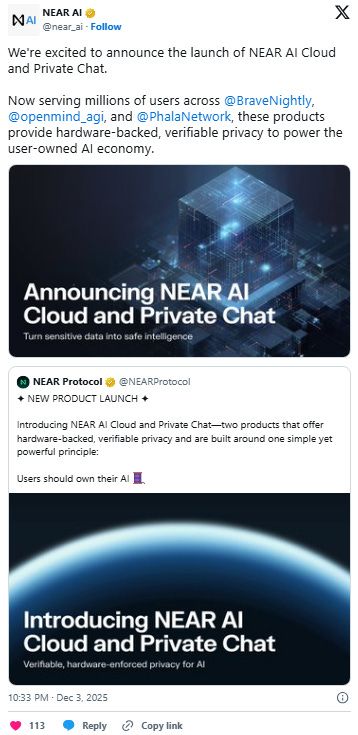
The flagship product, NEAR AI Cloud, closes what NEAR calls the “AI privacy gap.” Each request runs inside a confidential virtual machine where the data is encrypted on the user’s device, processed in a TEE and re‑encrypted before leaving. Users receive both the response and a signed attestation proving the computation occurred in secure hardware. NEAR Private Chat, sits on top of the cloud and applies these guarantees to a chat interface, making private conversations feel like talking to ChatGPT but without data harvesting.
Why AI Needs Verifiable Privacy
Enterprise adoption of generative AI has stalled because sensitive data cannot move safely into opaque AI services.
NEAR’s launch post notes that traditional “private modes” offer no proof of isolation where one misconfiguration or insider action can break trust.
The NEAR AI product suite attempts to close that gap by running every request in hardware‑isolated enclaves and returning proofs that can be independently verified. Although privacy is prioritized, it isn’t always guaranteed. Intel SGX, an earlier TEE, mitigates many attacks but does not protect against side‑channel attacks. NEAR’s confidential computing roadmap will need continual audits and hardware evolution to stay ahead of those risks.
IronClaw and the Confidential GPU Marketplace
At the recent NEARCON 2026, Near introduced IronClaw, an open‑source AI agent runtime that deploys agents inside encrypted environments on NEAR AI Cloud. It allows agents to run 24/7 with hardware‑enforced confidentiality, keeping credentials hidden from host operators.
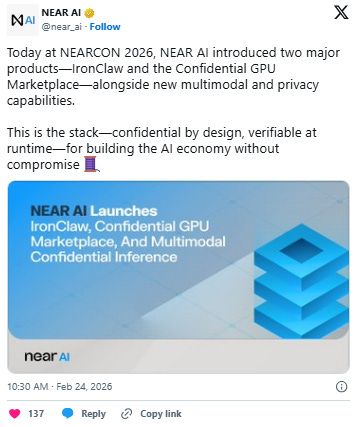
Additionally, Near also launched a Confidential GPU Marketplace where enterprise and government customers can rent high‑performance GPUs. Jobs execute inside TEEs and return hardware‑signed attestations in under 30 seconds, so data center operators cannot access memory in transit. The marketplace lets data centers monetize idle capacity and offers AI developers an alternative to centralized cloud providers.
This is part of their broader plan to converge blockchain and AI into a unified commerce layer. Founder Illia Polosukhin described the goal as enabling agents to transact and take actions securely, at global scale. The combination of crosschain execution (intents), private inference (NEAR AI Cloud) and fee‑switch tokenomics has already directed over $1 million in NEAR buybacks from protocol revenue.