Crypto is littered with token launches that made insiders rich but left communities holding worthless bags.
The 2017–2024 boom years delivered more hype than substance: founders sold tiny floats at exorbitant FDVs hired market makers to paint charts, then quietly diverted revenues away from tokenholders or abandoned projects entirely.
These misaligned incentives damaged trust and made genuine founders look like speculators.
In this edition, we’ll look into MetaDAO’s solution to fundraising, its mechanics, and structures to align founders, investors and users from day 1.

Introduction to MetaDAO
MetaDAO describes itself as a launchpad and governance protocol for "ownership coins." Instead of private rounds or auctioned allocations, projects launch a public sale where everyone pays the same price. Founders set the mission, market opportunity, minimum raise, and monthly budget; participants deposit USDC during a 4-day sale period.
If the minimum target isn't met, funds are refunded.
If it is, contributors receive ownership coins and 20% of both USDC and tokens are immediately seeded into liquidity pools. All remaining USDC and minting rights transfer to a market-controlled treasury.
Founders receive a monthly allowance and large expenditures must be approved by the community through decision markets. MetaDAO's token (META) has no protocol-enforced cap. New issuance only occurs via proposals approved by the futarchy mechanism whereby any tokenholder can stake 200k META to propose changes, and conditional markets determine whether the supply increase creates value. These proposals execute immediately after a 3-day trading period if the pass price exceeds the fail price.
Fixing Misaligned Token Launches
The misalignment problem arises because most token launches reward founders for hype rather than sustainable value.
Small floats allow teams to maintain high valuations, and private deals let insiders exit long before the product exists. Even when projects succeed, revenue often flows to the team rather than tokenholders. Countless platforms have kept millions in fees without ever distributing to users (e.g. Unibot).
MetaDAO tackles this by tying value capture to ownership. Ownership coins are backed by onchain treasuries containing the funds raised. IP and minting rights are controlled by market-governed treasuries, making them unruggable. If a token trades below NAV, anyone can propose returning capital to tokenholders, creating a floor and discouraging mismanagement.
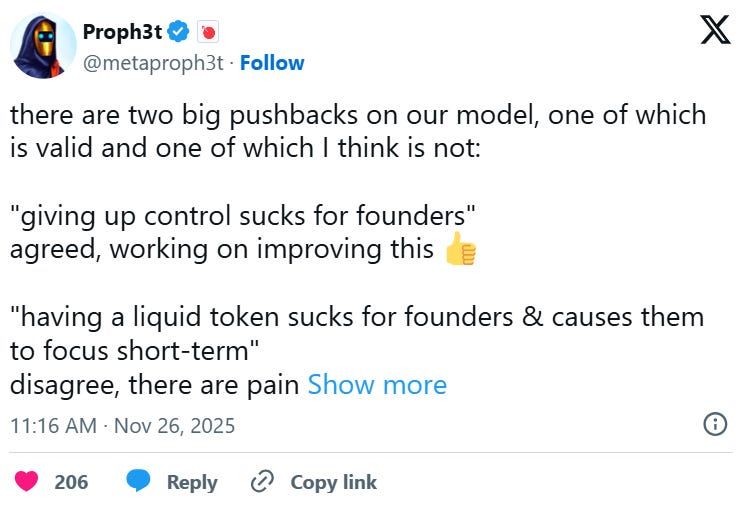
Launches are high-float by design with a typical sale issuing 10M tokens (~40% of total supply), with no private allocations. This prevents the artificial scarcity used to drive high FDVs in traditional ICO-style sales.
Core Mechanics and Investor Protections
MetaDAO's architecture has 3 core components:
Fair Launch & High Float: ICOs have no private sales. Everyone buys at the same price during a defined window, and market cap starts equal to treasury NAV. This discourages speculative supply squeezes and allows organic price discovery.
Market-Governed Treasury: All raised funds and minting rights are placed in a treasury controlled by futarchy. Founders access only their monthly budget; larger spends or token supply changes must be approved by decision markets. If the token price falls below NAV for a sustained period, investors can vote to return capital.
Legal & Mechanistic Safeguards: MetaDAO uses legal structures to tie project IP and revenue to the ownership coin. This allows tokenholders to pursue legal recourse against founders who misappropriate revenue and ensures rights can be transferred to a new team if necessary.
Launch Track Record
Since April 2025, MetaDAO has hosted 8 ICOs raising a combined $25.6 million with demand has far exceeding supply as participants committed approximately $390 million across all launches, with 95% refunded due to oversubscription. The platform's AMM has processed over $300 million in volume and generated $1.5 million in fees.
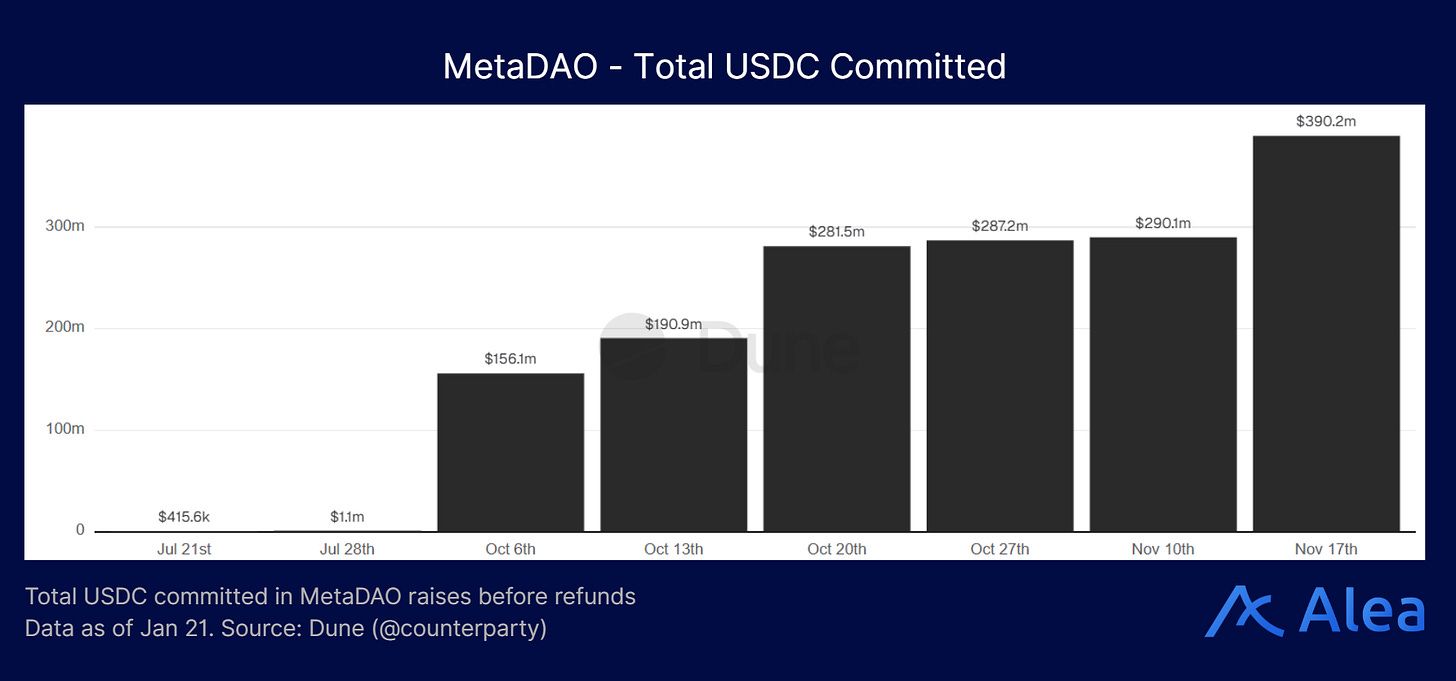
Projects have performed well relative to ICO price:
Avici (Crypto-native neobank) hit 21x at ATH. Currently ~7x.
Omnipair (DEX infra) hit 16x at ATH. Currently ~5x.
Umbra (Privacy protocol on Arcium) hit 8x at ATH. Currently ~3x.
Recent launches like Ranger, Solomon, Paystream, ZKLSOL, Loyal experienced at most a 30% drawdown from launch.
Umbra's launch was the standout: $154 million committed for a $3 million raise. The token ran from $0.30 to $2.10 within a week.
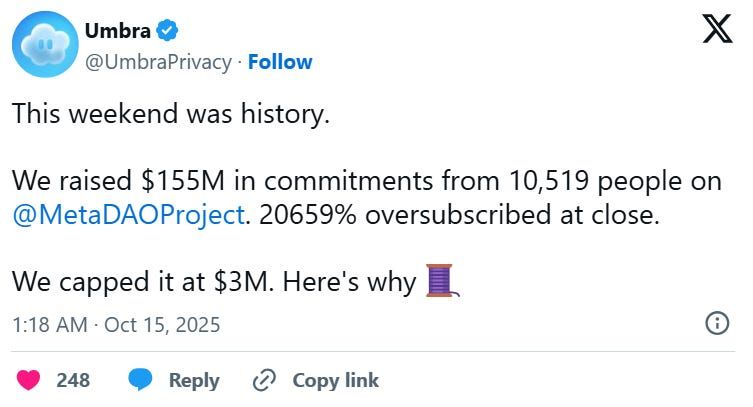
Across MetaDAO launches, there is a consistent pattern: high oversubscription signals community appetite, tokens appreciate post-launch, and most have stabilized above ICO price even after initial surges cool. This contrasts sharply with the typical memecoin launchpad dynamic where 95%+ of tokens go to 0.