Another day, another trading session driven by macro. Just yesterday, it was announced that Bessant would lead a U.S. team to meet with China on the topic of trade. Markets have done quite well since Trump announced the 90-day tariff pause, and new trade talks could provide some fuel for prices to move higher.
Even with some positive trade talks emerging, there is a lot that is unclear. Even countries like Japan have been hesitant to sign any sort of deal and have expressed a desire for tariffs to be completely removed. While the bar was set very low at first, there doesn’t seem to be much progress yet in getting trade deals signed and ensuring that tariffs can remain low after the initial 90-day exemption expires.
With this in mind, there are a couple of factors that can push asset prices, especially crypto, higher. One is the issuance of new debt and ‘soft QE’ measures that will be required to stimulate the U.S. economy if trade meaningfully reduces for consecutive months. The other possibility is that global trade fractures, and crypto emerges as a truly neutral asset class, able to court investors from both the U.S. and China side of global trade.
Stay informed in the markets ⬇


Change in Global Trade
Earlier today, it was announced that in order to facilitate oil trade between Saudi Arabia and China denominated in RMB, China would be building a gold vault within Saudi Arabia. This effectively would make China<>Saudi RMB trade gold-backed. Unlike previous gold-backed currency regimes, the other party (Saudi Arabia) doesn’t have to worry about whether its foreign currency is sufficiently backed, as the custody is held within the country itself.
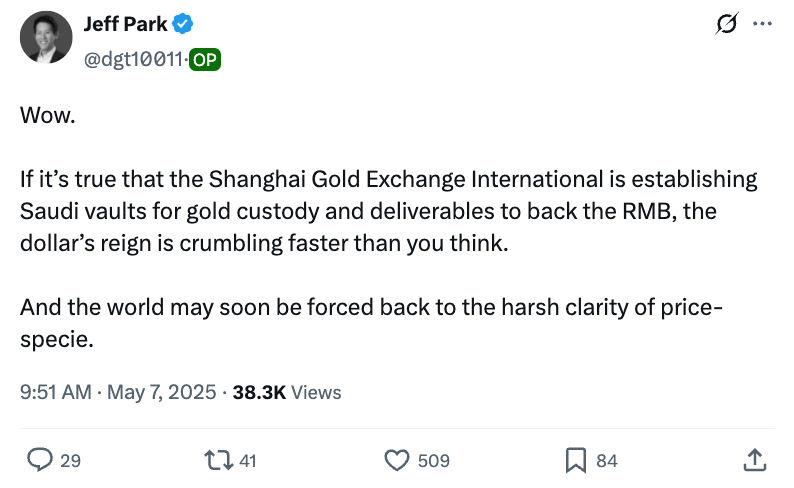
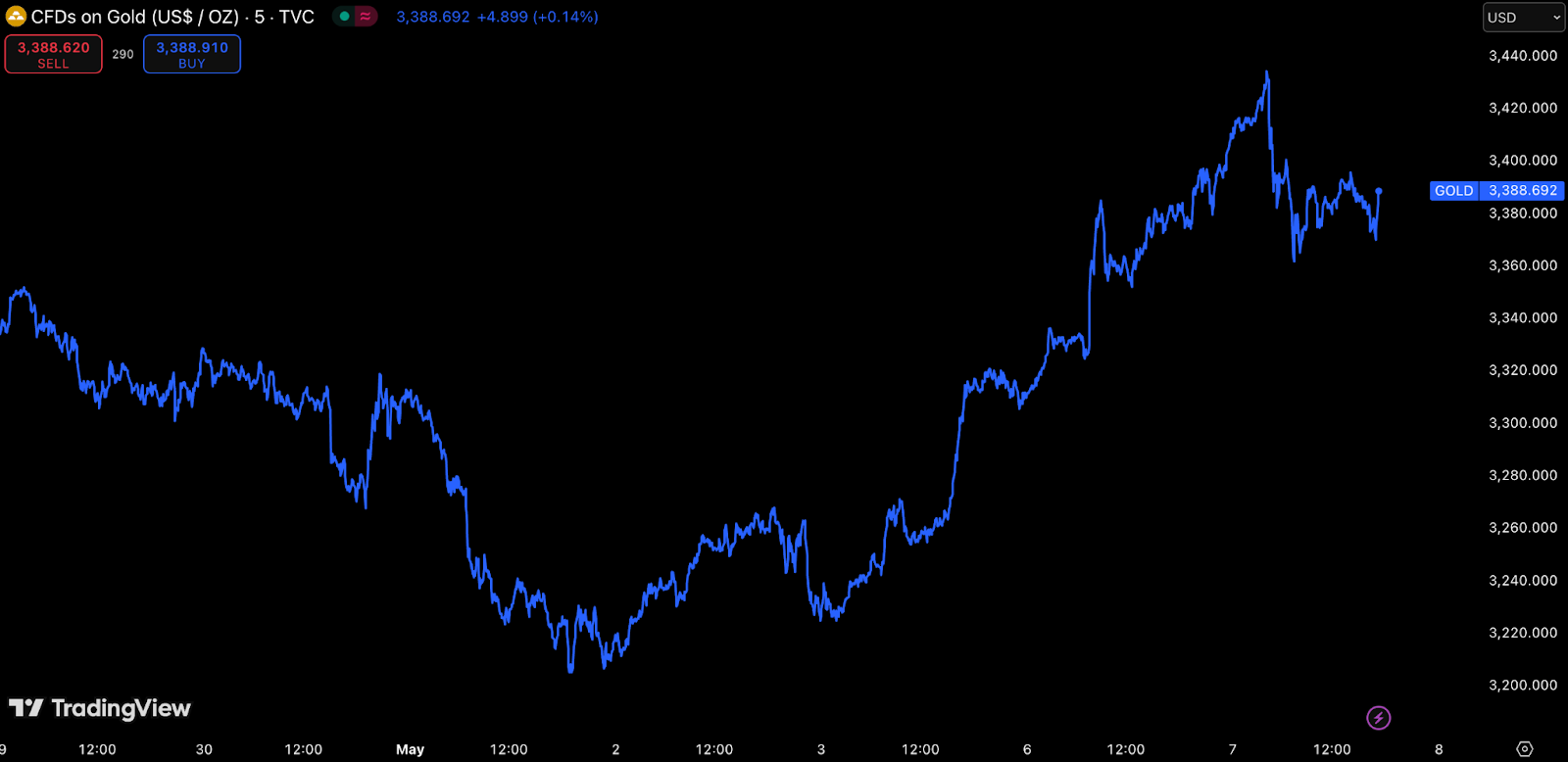
Gold soared yesterday before this news broke, now sitting at ~$3,386. While trade policy can be reversed, agreements between China and other countries may not be. So even as the market may be pricing in softening from Trump’s trade team, there may be lasting ramifications.

At this point, over 54% of China’s total trade is denominated in RMB. Helping to facilitate this is China International Payment System (CIPS), a global payments system aiming to reduce reliance on USD for trade and serve as an alternative to SWIFT. In 2025 particularly, CIPS has taken off, with the system reportedly surpassing SWIFT in daily transaction volume on April 16, reaching 12.8T RMB ($1.76T). CIPS also puts an emphasis on quick settlement times and minimal fees, even exploring blockchain as a solution.
China also collaborated with Hong Kong, Thailand, and the UAE to create Project mBridge, an international digital currency solution designed to be used for settlements. A new blockchain, the mBridge Ledger, was developed to support these global FX and payment transactions. This program is still in its pilot stages as digital currencies are developed, while CIPS is much further along and actively being used to settle trillions of dollars worth of trade each month.
Expanding China’s network of global trade into energy is crucial, as it is the global oil trade where the dollar’s dominance is perhaps the most pronounced, hence the ‘petrodollar’ moniker. Besides reducing reliance on USD, energy is also a crucial sector in which to have firm trading relationships, especially as China relies heavily on foreign imports to meet its vast energy needs. This recent news is a significant hit to dollar dominance, a win for China establishing trade networks in light of U.S. tariffs, and a testament to the importance of Store of Value assets like Gold…
It’s possible that $BTC could also be explored as a tool for global trade. $BTC ticks similar boxes as Gold when it comes to upholding the properties of money, and it is much easier to use for global payments, potentially easier to integrate into existing systems like CIPS and mBridge. It’s possible that $BTC and some select crypto assets could see inflows as a beacon for global liquidity that does not want risk tied to any one country. This could be a true source of capital inflows into crypto beyond the current risk asset rally that may or may not be sustainable.