$BTC followed stocks downward this past week, though a meaningful recovery to $88K was made beforehand. Many alts have begun trading in respective ranges, not overreacting too much to $BTC’s leading price action. Like the weeks and months prior, the source of this market uncertainty has to do with the current macro outlook.
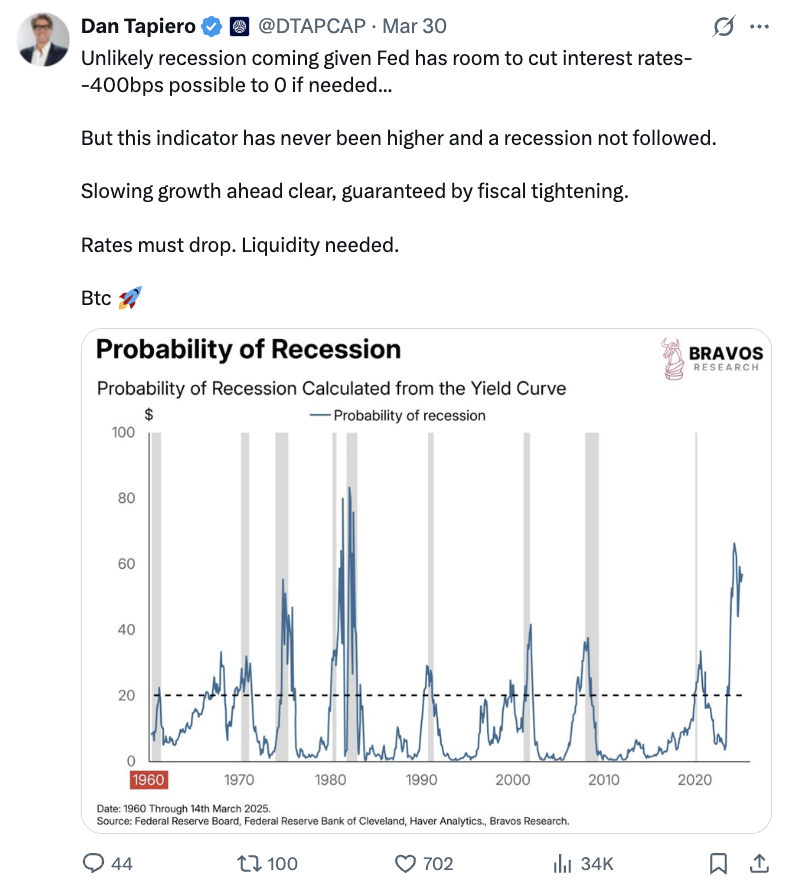
At the center of the economic outlook for the U.S. lies a shaky trade policy that changes on a nearly daily basis. On Sunday, Trump even made disruptive comments suggesting there could be a remote possibility of a 3rd term in office. This is interesting and controversial in and of itself, but what makes this uniquely troubling to some is that the 2nd Trump term is not off to a great start, especially by some economic metrics.
In today’s edition, we’ll discuss upcoming tariff announcements, potential macro and regulatory tailwinds for crypto, and more…
Stay informed in the markets ⬇


If market participants weren’t already tired of tariffs, they probably will be this week, with future tariff announcements to occur on Wednesday. One of the ways in which tariffs cause uncertainty isn’t to do with U.S. growth, but global ramifications and strain on diplocatmic relationships.
When it comes to the foreign policy ramifications of tariffs, an important distinction must be made as to how tariffs are implemented. One way in which tariffs can be employed is purely economic in nature, with no ill will towards tariffed countries. This would take the form of reciprocal tariffs or blanket tariffs that affect countries equally. The other way tariffs can be used is as a punishment for certain countries’ actions, a bargaining chip for getting something else.
The former is more common among the largest economies to protect domestic industry, while the latter starts to sound similar to sanctions in that these tariffs are used as a financial disincentive. In practice, Trump’s tariffs are a little bit of both, as he flip-flops on the reasoning behind his tariffs. Sometimes the justification cited for tariffs might be failure to stop the flow of fentanyl, as in the case of China, Mexico, and Canada, or insufficient efforts to stop war, as in the case of Russia.

“If Russia and I are unable to make a deal on stopping the bloodshed in Ukraine, and if I think it was Russia’s fault — which it might not be — but if I think it was Russia’s fault, I am going to put secondary tariffs on oil, on all oil coming out of Russia,”
- Trump to ABC News
Other times, Trump states that there’s nothing these countries can do, and tariffs employed against them are purely done to maximize the self-interest of the U.S. economy. Naturally, it’s the discretionary, antagonistic tariffs that fetch the majority of the headlines, while discussions around reciprocal tariffs are had more quietly.
When tariffs are levied as a negative consequence for actions the U.S. doesn’t like, this could deprioritize the U.S. as a consumer market for exports and reduce interest in investing in the US or acquiring USD. reserves. Countries might want to diversify their exports away from the U.S., just as countries presumably began acquiring gold and moving away from the USD as a primary store of value for central banks in light of sanctions.
The spectrum of intent behind tariffs is what is driving sentiment, as markets hope for more measured, predictable tariffs that won’t come and go based on geopolitical standings. This will be the key point to watch come April 2nd, which Trump has teased as ‘Liberation Day’, where he plans to unveil significant new tariffs. Already, Trump has cooled down some of the fiery rhetoric used in his hints. This suggests that these new tariffs might be employed with the goal of creating an actual revenue source for the U.S. government, as opposed to something that seems more like a punishment for U.S. competitors.
Macro’s Impact on Crypto
Another point that is quickly being parroted by many in the industry is that everything not named Bitcoin is not catching the attention of institutions at this moment. Taking a glance at the top ~100-150 tokens ranked by marketcap, only $BNB stands out as a token that has managed to hold its own versus $BTC. In fact, $BNB is narrowly outperforming $BTC itself, down just ~23% from its ATHs achieved 4 months ago. Binance has created some of the strongest sinks for its $BNB token, with Binance launchpool, trading fee discounts for $BNB holders, and of course, the $BNB chain itself, which uses $BNB as gas and also as a core asset in DeFi.
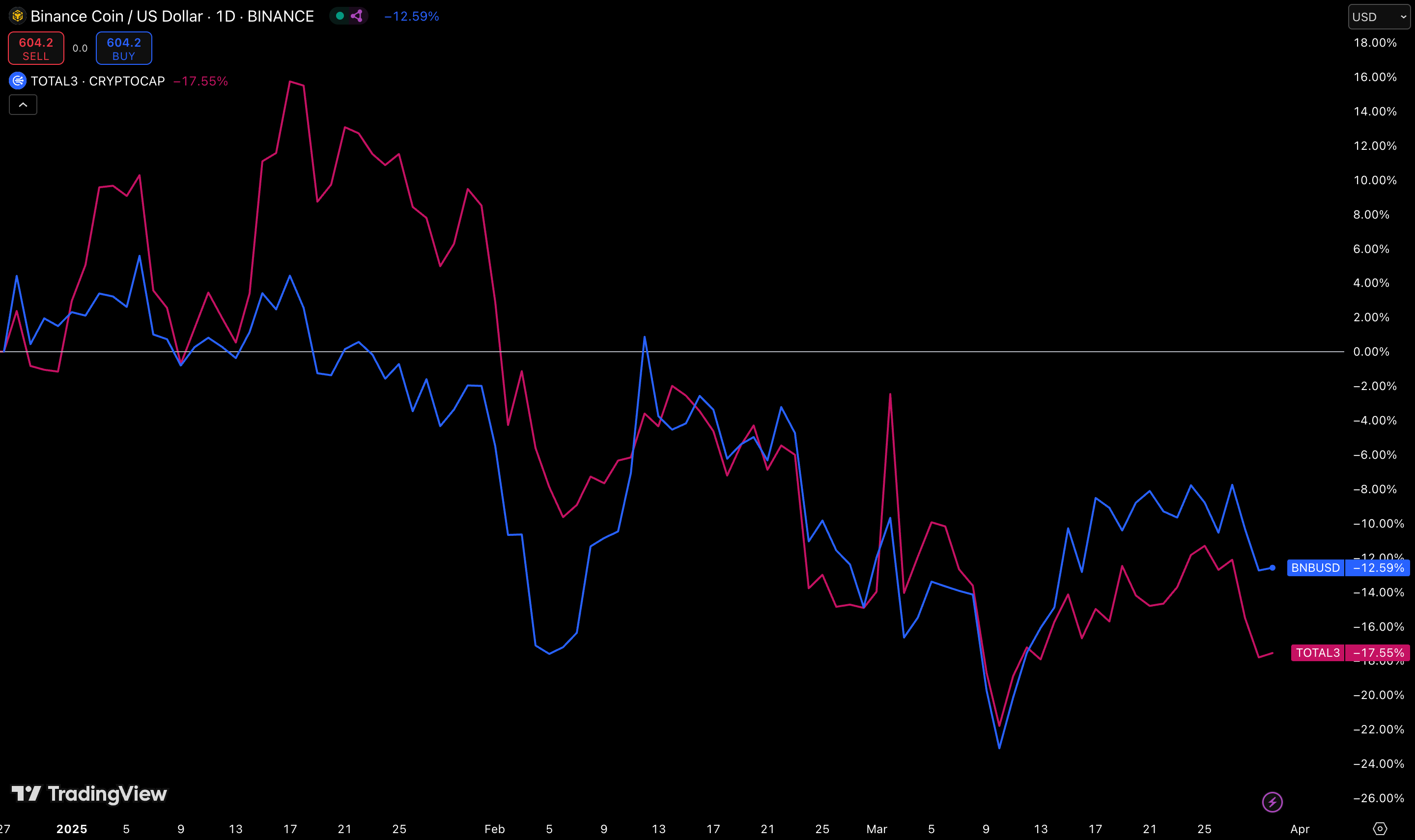
Right now, there is only room for crypto assets with the strongest of backing to hold up, with everything else stagnating anywhere from 60-80% below previous ATHs. Current macro conditions might ensure that these conditions continue for some time. New TGEs with an institutional focus, such as Kinto’s $K, which launched yesterday, could perhaps suck up trading activity. Volumes might leave less appealing tokens to pile into a launch with momentum.