Crosschain messaging has a design problem: bundling verification, execution, and liveness into a single system means any upgrade or failure in one layer affects everything else.
LayerZero V2 rebuilds around that constraint, splitting an immutable protocol core from a configurable security layer that application developers own. The $290M rsETH incident illustrated where those boundaries sit.
In this edition, we look at how V2 separates verification from execution, what the protocol guarantees versus what developers configure, and how the rsETH case maps onto that architecture.

What is LayerZero V2
LayerZero is a crosschain messaging protocol that moves data, tokens, and function calls across 60+ chains. Bridges and omnichain applications build on top of it, and it is live in production.
V2 is built around 4 components:
The endpoint is the immutable core that enforces lossless delivery (every message sent arrives) and exactly-once semantics (no duplicates), and it cannot be upgraded.
Verification modules called MessageLibs implement the signature logic and are append-only, meaning once deployed they cannot be altered.
Decentralized verifier networks, or DVNs, are independent services that verify messages; developers choose which DVNs to use and how many signatures are required.
Executors are offchain workers that pay destination gas and deliver verified messages, and anyone can run one.
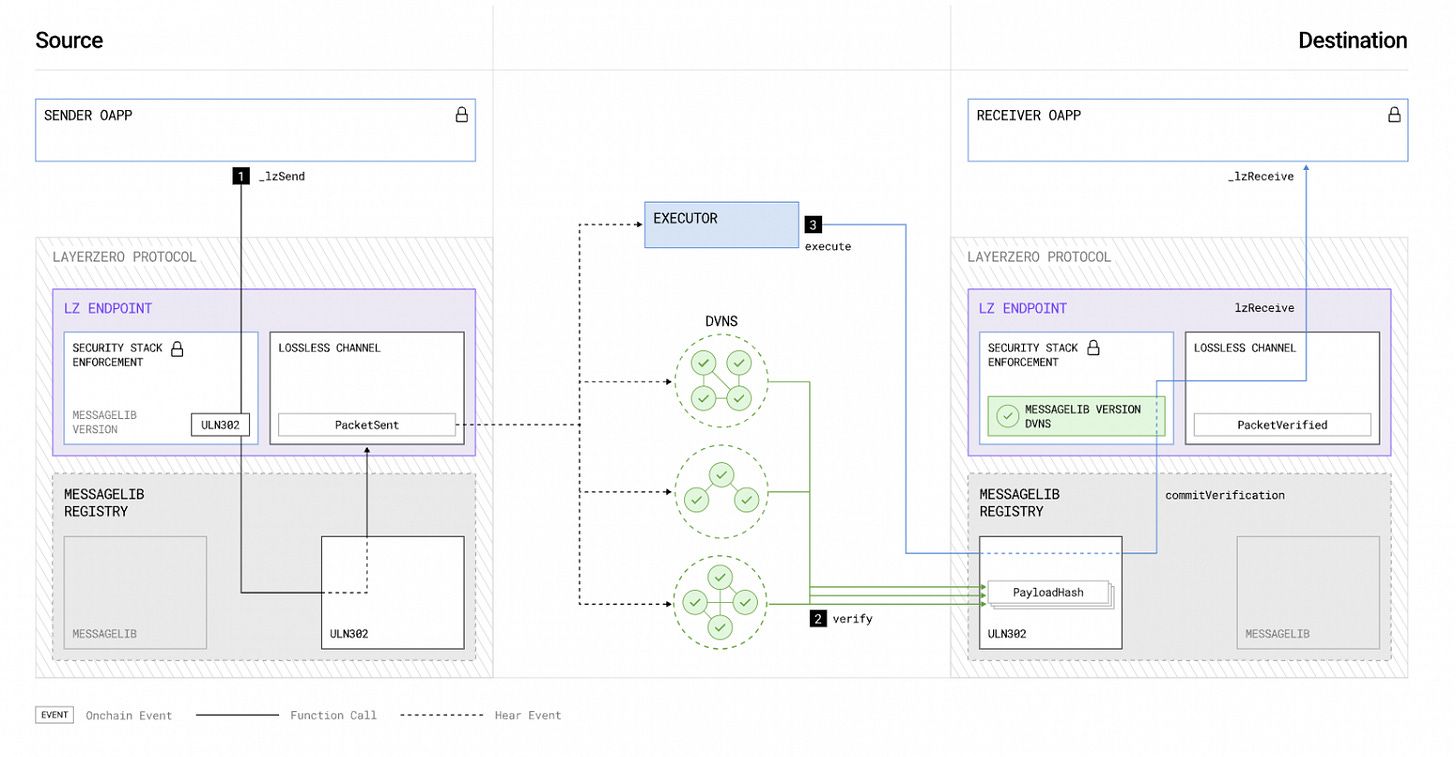
The design separates what LayerZero calls intrinsic security (the immutable delivery guarantees) from extrinsic security (the verification and execution layer that the application developer configures through a Security Stack).
How Verification and Execution Split
The biggest architectural change in V2 is that verification and execution are fully decoupled. Once a message is verified by the required DVNs, it is committed to a channel on the destination chain. No one, including LayerZero, can force delivery from there. Any entity willing to pay gas can permissionlessly execute a verified message.
The benefit is that if an executor goes down or is compromised, it cannot block delivery because another executor, or even an end-user, can step in and call the same function. The protocol’s availability no longer depends on a single offchain service.
Pre-Crime also lets applications simulate the effects of a crosschain message before it executes. An application can check invariants (total minted tokens cannot exceed total locked liquidity, for example) and halt delivery if those checks fail. Pre-Crime runs offchain and depends on DVNs and executors; it can catch bad application logic but cannot compensate for a compromised verifier.
The rsETH Exploit and Default Configuration Risk
LayerZero’s protocol-level architecture held up during the $290M rsETH exploit: the endpoint did not fail and the message channel remained lossless. KelpDAO was running a 1-of-1 DVN configuration, meaning a single verifier’s compromise was enough to authorize fraudulent messages.
KelpDAO says it followed LayerZero’s documented defaults. banteg and other researchers pointed out that LayerZero’s OApp Quickstart shipped with single-source verification as the default setup. LayerZero has since said it will stop signing messages for any application using a 1-of-1 DVN configuration.
The incident made the limits of modular security architectures concrete. The protocol’s guarantees cover the immutable layer only. Everything in the Security Stack, including DVN selection, signature thresholds, and executor choice, is the developer’s problem. Default settings carry implicit risk, and when LayerZero’s own documentation pointed developers toward a single-verifier setup, the flexibility of the protocol worked against the security of the applications built on it.
Developer Responsibilities
The separation of verification from execution removes a constraint that has limited crosschain infrastructure by coupling of liveness, security, and extensibility into a single validator set. When all three are bundled, upgrading any one of them creates risk for the other two. V2 makes it possible to add new execution logic (token swaps, mint-burn bridges, custom hooks) without touching the verification code, and to add or swap verifiers without disrupting delivery.
For omnichain applications built on LayerZero, that means security can be configured to match actual risk exposure rather than inherited from a one-size-fits-all validator set. A protocol routing $10M can make different tradeoffs than one routing $10B.
The rsETH exploit showed the cost of not exercising that flexibility: the verifier that was compromised was operated by LayerZero itself, and KelpDAO trusted it alone. The protocol gives you the tools to manage crosschain risk independently, but as rsETH showed, the default can be the most dangerous choice of all.