Monthly perp DEX volume crossed $1 trillion in late 2025, and capital allocators now treat them as serious execution venues. Competition however is heated with new entrants like Lighter or Variational driving volume spikes through points-incentivized programmes. This is the backdrop for HyENA: a perps DEX launched by Ethena and Based, designed to turn idle margin into yield by using Ethena’s USDe as collateral.
HyENA went live on Dec 9 2025, but within 48 hours of launching, they recorded over $50 million in volume, becoming the second‑largest permissionless HIP‑3 market on Hyperliquid. By early January the platform had logged >$440 million in total trading volume across 6.5k users, with cumulative USDe rewards exceeding $200k.
In this edition, we’ll unpack why traders are rotating to HyENA, how its architecture differs from other perps DEXs, and what allocators should watch next.
Introduction to HyENA
HyENA is a USDe‑margined perpetuals DEX built on Hyperliquid’s HIP‑3 framework. HIP‑3 lets builders stake 500k HYPE to deploy independent markets with custom oracles, leverage, fee structures and margin assets.
HyENA’s key differentiator is using USDe (Ethena’s synthetic dollar) as the quote asset and collateral. USDe is delta‑hedged and yield‑bearing, meaning that deposits earn interest while traders are long or short. Hyperliquid clones using USDC basically gift the stablecoin yield to Circle, while HyENA pays ~12% to depositors.
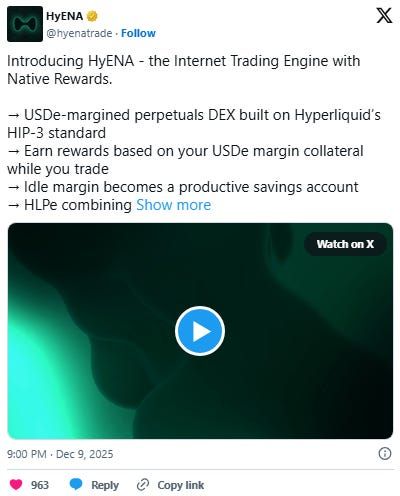
From a design standpoint, HyENA aims to make collateral economics flow back to users rather than stablecoin issuers like USDC on Hyperliquid’s CLOB. Because USDe earns yield, the opportunity cost of holding large margins is reduced and traders can maintain safer buffers and avoid forced liquidations on volatile markets
For passive liquidity, HyENA runs HLPe which is a vault that shares trading fees, funding payments, and liquidation PnL with depositors. Deposits are routed to Hyperliquid’s HyperEVM, with a 7‑day redemption period and performance/management fee structure.
Incentive‑Driven Rotations and Collateral Economics
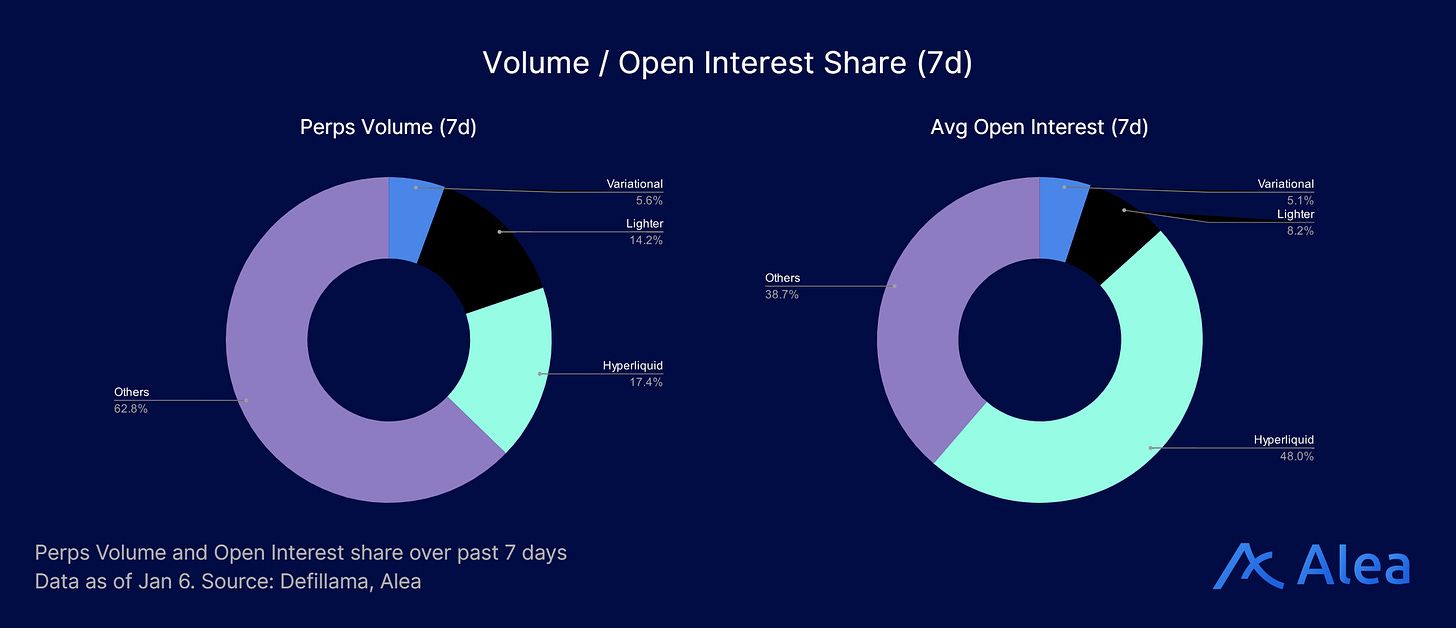
This has been the revolving theme constantly repeated and echoed throughout the indsutry: perp DEXs fighting for order flow with zero‑fee races and airdrop promises. Hyperliquid’s dominance dropped from 70% to 17% share in 2025 as Lighter, Aster, Variational, Extended, Paradex, and so many more carved out niches with points programs. This has, unfortunately, encouraged a nomadic class of mercenary traders who chase points and rewards across platforms.
HyENA enters this environment with a different carrot.
Using USDe as margin flips the traditional perp economics by offering capital efficiency and yields. Traders normally post idle stables like USDC/USDT as collateral, losing potential yield and facing funding costs.
HyENA’s design lets users earn on both legs: they collect USDe yield on posted collateral and can still receive (or pay) funding rates on positions (+ points). This positive-carry structure may attract more sustainable liquidity than one-off airdrops because it reduces the “zero-economics drag” that drives traders to chase points.

The second‑order effect is that HyENA makes Ethena’s USDe adoption a growth driver for the venue. More USDe in circulation → more potential HyENA collateral → more trading fees → more reason to hold USDe. Hyperliquid’s USDH vote showed users want yield‑bearing collateral, which HIP‑3 made possible. HyENA is the first major HIP‑3 DEX executing this, positioning itself as the got-to platform for USDe perp trading.
The risk to this of course is that it still is a farm, just a better-designed one. If points don’t materialize or USDe yield compresses, it defeats the whole thesis.
Programmes and Mechanics to Watch
HyENA’s roadmap is essentially a strategy to bootstrap sticky liquidity in a mercenary market. Their idea is that if enough incentives are stacked (points + yield + fee share + multipliers) and friction is reduced (USDe carry, isolated margin, premarket infrastructure), they can attract liquidity that doesn’t immediately rotate to the next farm.
Here’s what they have in store for 2026:
Points Program - 6-month campaign, 100M points per week, no HyENA token at the end. Points convert straight to Ethena Exchange Points. This matters because it removes the “wait for airdrop, dump token, destroy price action” loop that killed Lighter’s post-TGE volume. HyENA is essentially farming users for Ethena’s ecosystem without creating its own dilution event.
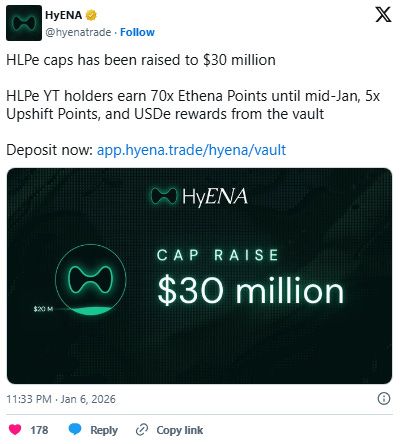
HLPe Vault - During its guarded launch, HLPe deposits filled $10 million within 24 hours, signalling strong interest from liquidity providers. Depositors earn 5x Upshift points and 70x Ethena points for the first month up till mid-Jan. There is a chance further cap raises get implemented as open interest increases.
Premarket Perps - On Dec 22 2025, HyENA introduced premarket perps that allow trading of assets before a spot market exists. These markets are modeled after Hyperliquid’s Hyperps but include tighter price clamps (3x vs Hyperp’s 10x) and an explicit Market Resolution process if assumptions like total supply or ticker differ at listing.
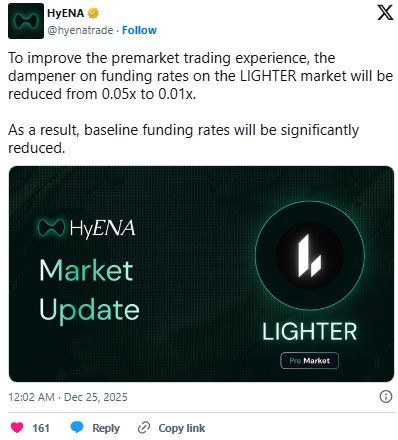
For example, the LIGHTER‑USDe premarket uses a 3x clamp to reduce liquidation risk, and traders earn up to 10 % of weekly HyENA points until Lighter’s TGE. Funding rates are also dampened to keep such speculative positions viable for longer holds.