Frax has long been known for its stablecoin, frxUSD, which is fully backed by tokenized U.S. Treasury funds from regulated providers like BlackRock and Superstate and aims to deliver real yield without sacrificing redeemability. As Web3 neobanks move from hype to serious infrastructure, it’s natural to ask where one of the longer-standing stablecoin infrastructure providers fit in.
The answer lies in FraxNet, an on‑chain money account that acts like a neobank without the usual legacy overhead. In recent posts the Frax team argued that on‑chain neobanks marry digital dollars and always‑on settlement so users hold and move real cash rather than IOUs. When those networks are tokenized, customers even gain a stake in the system, aligning incentives and accelerating adoption.
Frax’s recent “positive‑sum neobank” thesis blends three elements: frxUSD, the FraxNet account layer and Fraxtal settlement chain into an operating system that can plug into existing fintechs and neobanks.
In this edition we’ll explore why Frax is venturing into the neobank niche, how its trinity of products work together, and what a positive‑sum neobank means for users.
Stay informed in the markets ⬇️

The Frax Trinity: frxUSD, FraxNet & Fraxtal
Frax’s stablecoin stack rests on three layers:
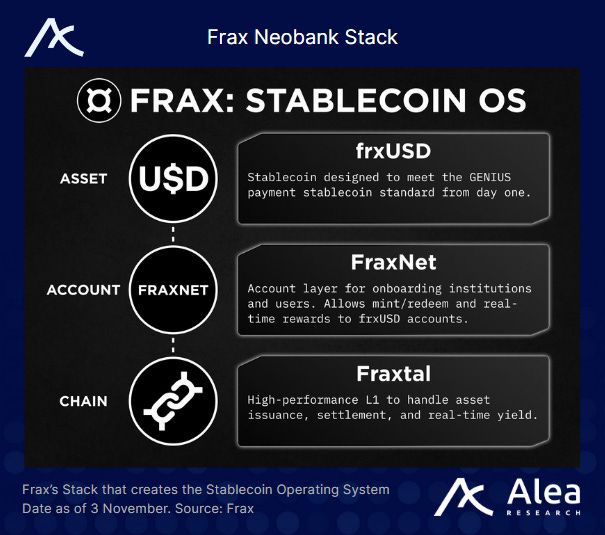
Asset layer - frxUSD: Frax’s flagship stablecoin maintains a 1:1 peg by backing every unit with tokenized US Treasuries. Users can mint or redeem frxUSD directly with USD or with other stablecoins. Staking it gives them sfrxUSD which earns yields comparable to money‑market funds (4–8% APY). The asset is built to meet the GENIUS payment‑stablecoin standard.

Account layer – FraxNet: Launched in late October 2025, FraxNet serves as an on‑chain money account for minting, redeeming and earning with frxUSD. The network integrates KYC/KYB verification, real‑time rewards and direct bank integrations, and it supports 20+ blockchains via LayerZero.
Settlement layer – Fraxtal: Fraxtal is a modular L2 using the OP stack designed to handle asset issuance, settlement and real‑time yield distribution for FraxNet. It is optimized for cross‑chain interoperability, enabling frxUSD to exist across 20+ chains and allowing instant mint‑and‑burn between networks via LayerZero.
Neobanks and the Web3 Evolution
Neobanks have already reshaped modern finance by offering mobile‑first accounts, fee‑free spending and smart budgeting tools; the biggest players (WeBank in China, Rakuten in Japan, Nubank in Brazil) now serve over 100 million users. Yet most digital banks still use legacy banking rails, meaning transfers rely on batch windows, card networks and correspondent banks.
Regulated stablecoins offer a way to merge the idea of neobanks with blockchain settlement. On‑chain neobanks can move money across borders 24/7 with finality and no intermediaries, and tokenized networks like FraxNet give customers a stake in the system they use, aligning incentives.
Stablecoins backed by tokenized U.S. Treasuries or real‑world assets let neobanks offer yields higher than traditional savings accounts, while on‑chain identity tools (zkKYC) and AI‑driven agents make compliance and user experience seamless. We are already seeing a flood of new crypto neobank projects entering the market, such as Plasma’s PlasmaOne, Mantle’s UR, EtherFi, Avici, and more.
Frax’s Positive‑Sum Neobank
With the 3 core infrastructure components, users get to hold 1:1 backed digital dollars and earn best‑in‑class rewards, while the infrastructure side supplies identity, compliance and account modules so partners can integrate digital dollars quickly. FraxNet will power programs like Balance (Canada’s largest digital asset custodian) and support whitelabel stablecoins, letting any issuer launch a fully backed digital dollar with competitive yields.
While FraxNet itself is a neobank, it is also open infrastructure that existing neobanks can leverage to issue or settle stablecoins, creating Frax’s “positive‑sum” position.

Frax intends to partner with projects like EtherFi, Bridge and others so that FrxUSD becomes one of the digital dollars with the highest total addressable market. Rather than issuing its own card, Frax will offer API endpoints and a FraxNet conversion panel for minting and redeeming frxUSD, while working with banks like LeadBank and consumer‑facing card teams to power their products.