A wider financial account. Ether.fi combines investing with everyday payments, creating more ways to earn from each customer.
Cash spending +85%. Monthly volume grew from $54.3M in January to $100.3M in July. Its share of tracked card spending stayed near 10%.
ETHFI: -21% YTD. At $0.55, it trades at 14.2x tracked annualized revenue on a fixed maximum-supply basis.
$16M in annualized buyback funding. That is the proposal’s July-based illustration, subject to approval and before reward distributions.
September 3: voting closes. The proposal needs 1M ETHFI for quorum. Borrowing joins the funding pool at $50M, versus $26M in the proposal.
Ether.fi’s account vision
Ether.fi wants customers to manage their money in one self-custodial account. It announced the integrated Stake, Liquid, and Cash vision in May 2024. Today, the account combines four functions:
Save and earn. Hold assets in self-custodial vaults with access to staking and investment strategies.
Spend and transfer. Pay with Cash and move money through fiat and crypto rails.
Trade. Buy and sell crypto, tokenized stocks, and metals, subject to local availability.
Borrow. Access liquidity against eligible collateral through a dedicated Aave market.
Ether.fi also offers business accounts for company treasuries and employee cards. Its customer interface combines services built partly on partner infrastructure, including Aave lending and card rails. It is its vertical integration and how everything together forms a feedback loop where they have a strategic edge.
The business model and utility for end users stands out for how practical it is. Yield-bearing assets support collateralized borrowing, and the proceeds can fund Cash spending without an asset sale. This creates fee income while reducing the need to move assets to another provider. Membership benefits also encourage customers to stake ETHFI, which accrues value from all business lines.
That makes Ether.fi a not only differentiated but also highly sticky onchain financial account.
Cash spending nearly doubles
Paymentscan recorded monthly Cash spending of $54.3M in January and $100.3M in July, up +85%.
Monthly active addresses reached 40,040, up +83% from 21,898. Spending per address barely changed, from about $2,479 to $2,505. Monthly transactions per address declined -22%, while the average ticket rose +29%.
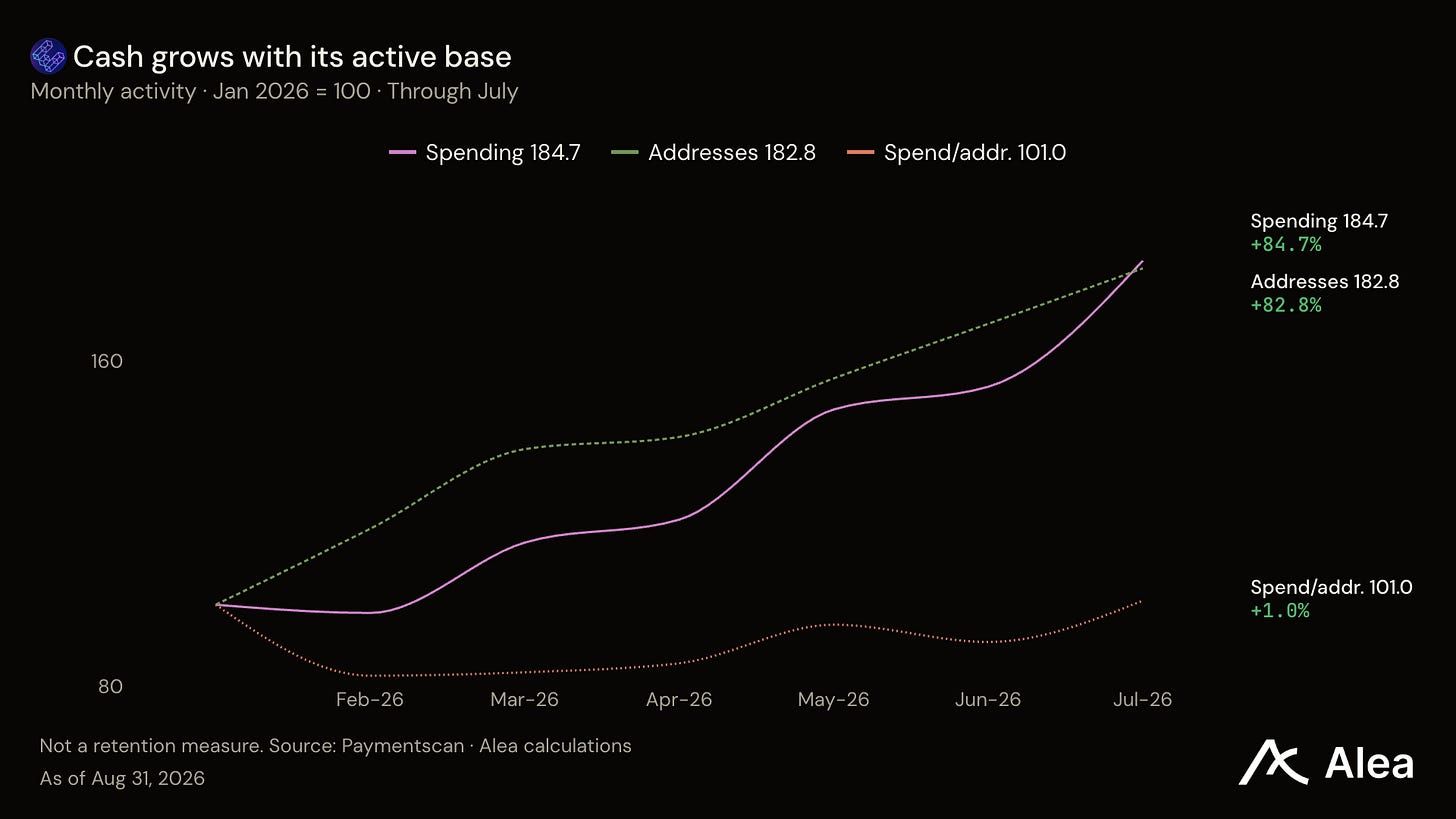
A larger active base explains most of the spending growth.
The wider tracked market expanded +81% over the same period. Cash’s share moved from 9.5% to 9.7%, a +2% relative increase. Cash has largely kept pace with a fast-growing category. Paymentscan disclosed that its coverage includes self-reported offchain data. The sample excludes parts of the card market.
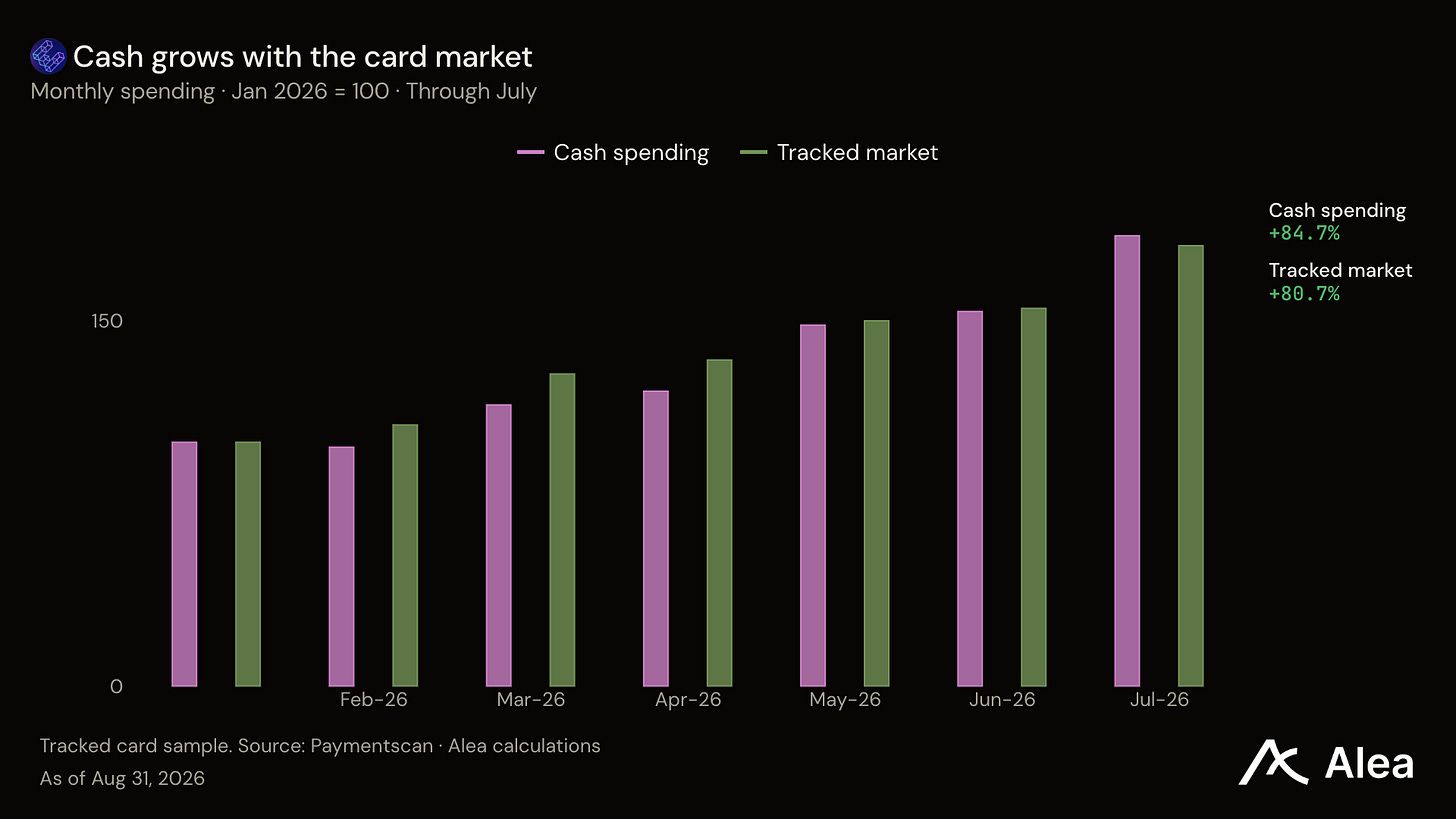
Cash has kept pace with a growing category.
Nexo already combines borrowing and spending. KAST combines cards with accounts and yield. Gnosis Pay supports self-custodial spending. RedotPay leads Paymentscan’s current volume ranking. However, it’s convenience across services where the competitive opportunity lies. Repeat use and contribution profit after rewards will establish the strength of that advantage.
How the account earns fees
Cash monetizes spending through interchange. DefiLlama published an adapter that estimates revenue at 1.38% of spending: each $1B of annual volume implies $13.8M before company costs. Earn collects staking and vault fees. Trading adds transaction fees. Borrowing adds a share of the fees retained by its lending market.
The July 14 Aave proposal disclosed a split of 80% of instance protocol fees for ether.fi and 20% for Aave. That split excludes loan principal and interest paid to lenders while Ether.fi takes responsibility for operating costs and risk management.
Using DefiLlama reported revenue across four business lines, their trailing 30-day total annualized reached $38.5M on August 30, including $17.6M from Cash. Cash’s run rate almost doubled from January 1, while total tracked revenue declined -22% as staking weakened and ETH’s price declined.
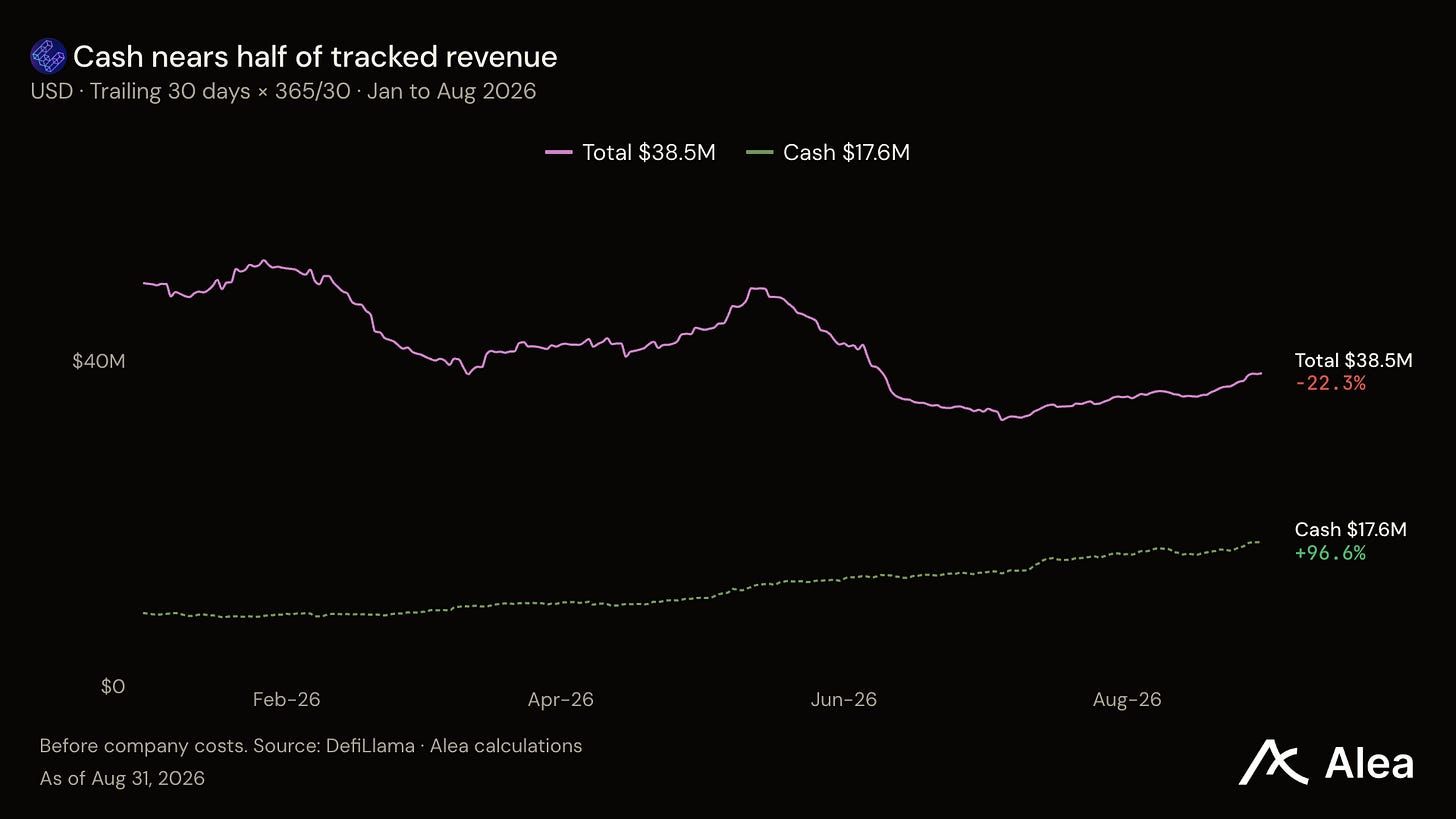
Cash is diversifying revenue as staking weakens.
Cash’s share of monthly revenue rose from 17% in January to 46% in July.
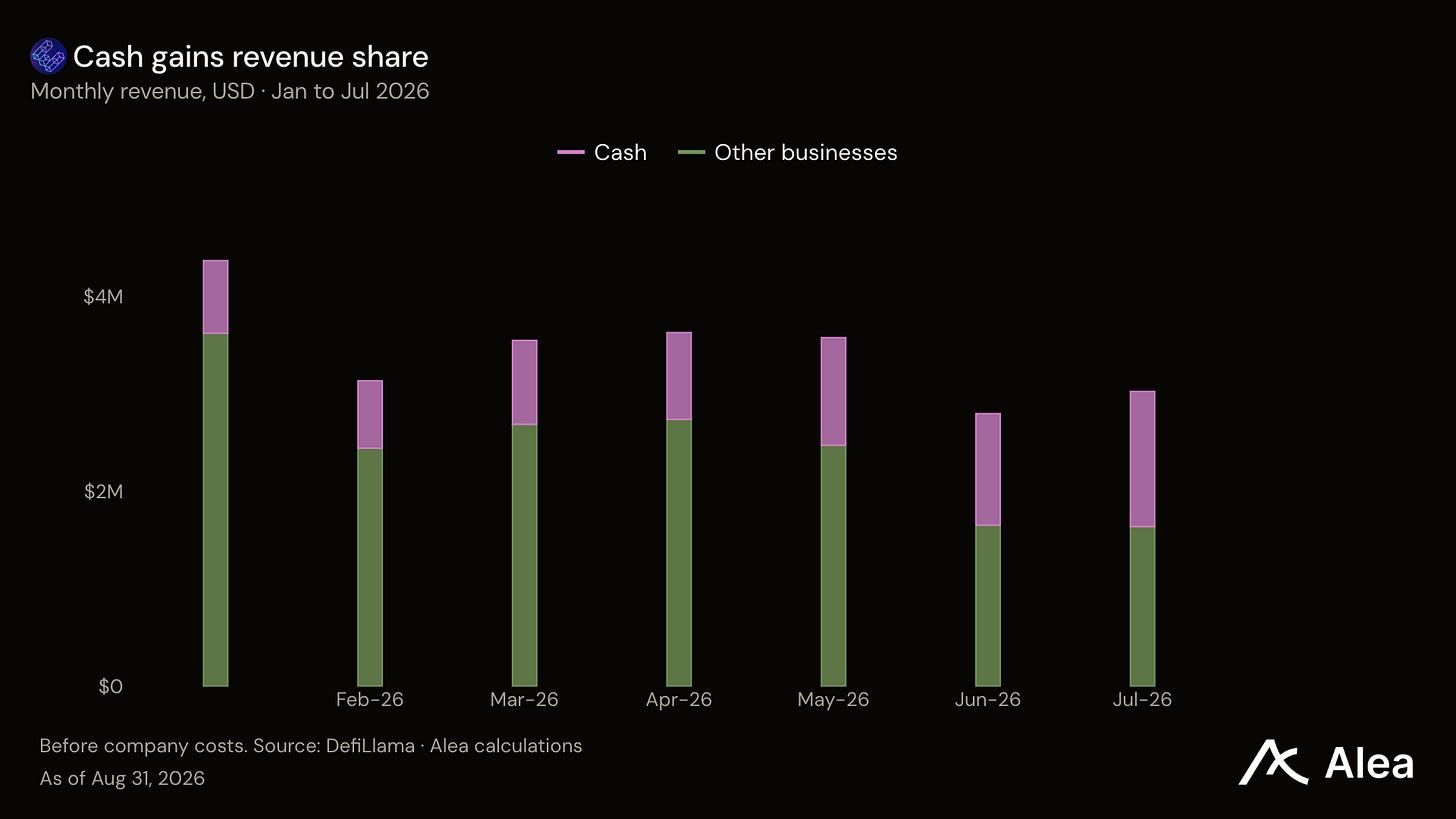
Cash earns a larger share of a smaller total.
What shipped on August 13
The August 13 summer release announced tokenized stock and metals trading alongside an integrated Aave market. A redesigned app added 30+ new currencies and payment methods. These additions shipped to new and existing users that day.
Tokenized stocks and metals remain unavailable in the United States and some other markets.
In that release, management reported 500,000+ members and a $2B annual transaction run rate.
How fees reach ETHFI
The Foundation published its proposal on August 30. Voting closes September 3.
If approved, contributions from card, swap, and staking revenue will fund weekly Foundation purchases through CoW Swap. Labs must first collect fiat interchange and convert it into USDC. It then transfers the contribution onchain. The Foundation’s July-based illustration of $1.33M a month implies $16M annualized, subject to approval and execution.
In its example, a $10,000 swap at 0.5% generates $50 in fees. Labs retains $20. The remaining $30 buys ETHFI: $15 stays in the Foundation treasury and $15 goes to users as rewards.
The proposal also authorizes up to 20M treasury ETHFI to cover reward shortfalls.
The Foundation can adjust rewards and fee splits, or change purchase pacing.
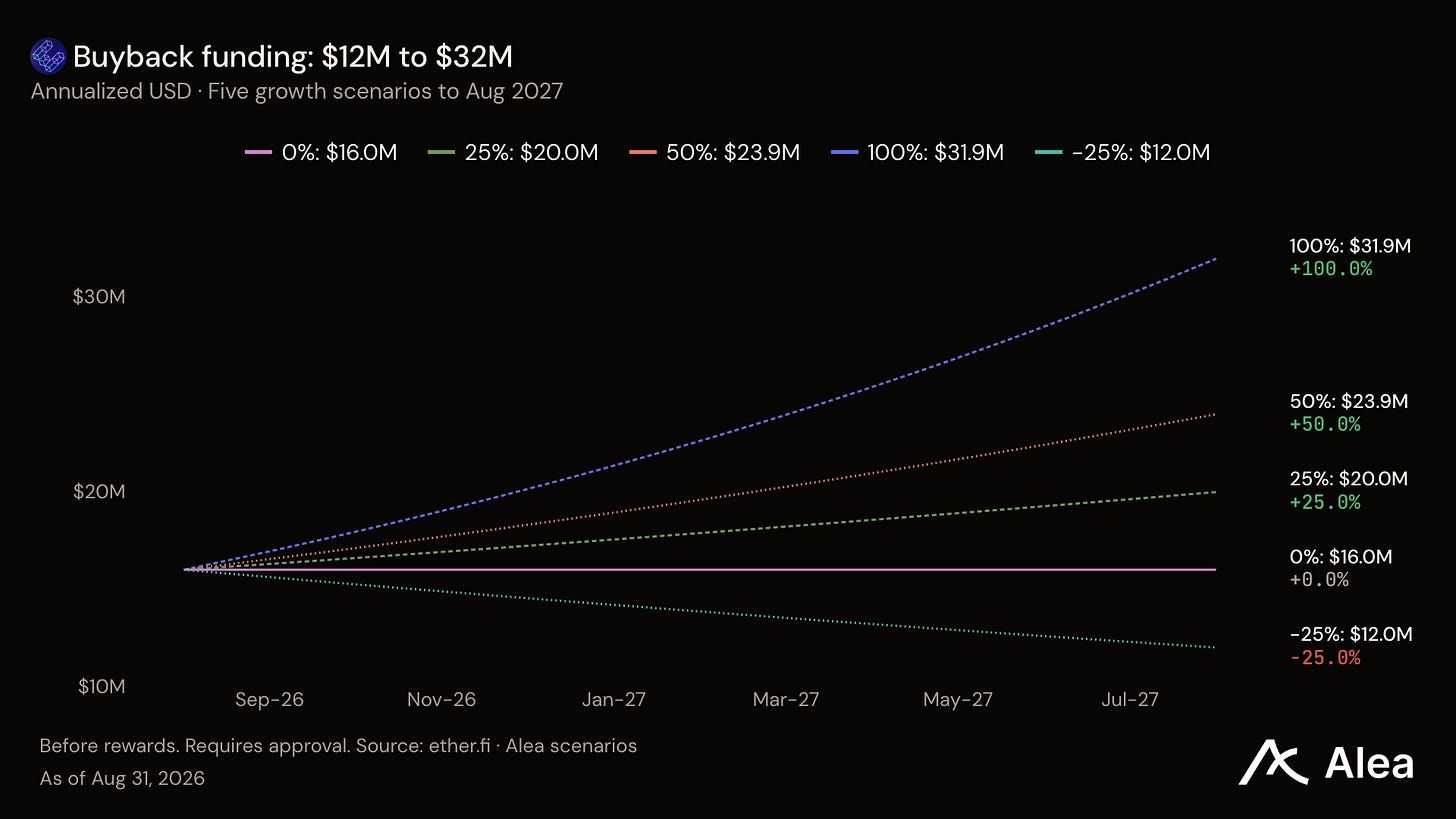
Contribution growth increases buying capacity before reward distributions.
A -25% contraction cuts the same annualized funding anchor to $12M; +50% growth lifts it to $24M. At a constant $0.55 token price, $16M buys about 29M ETHFI. Higher prices buy fewer tokens.
Cash grows; ETHFI lags YTD
Cash revenue and price have diverged this year. ETHFI recovered +45% from August 13 to August 30, reaching $0.55, leaving it -21% from January 1.
Price recently recovered above its 30-day and 90-day averages.
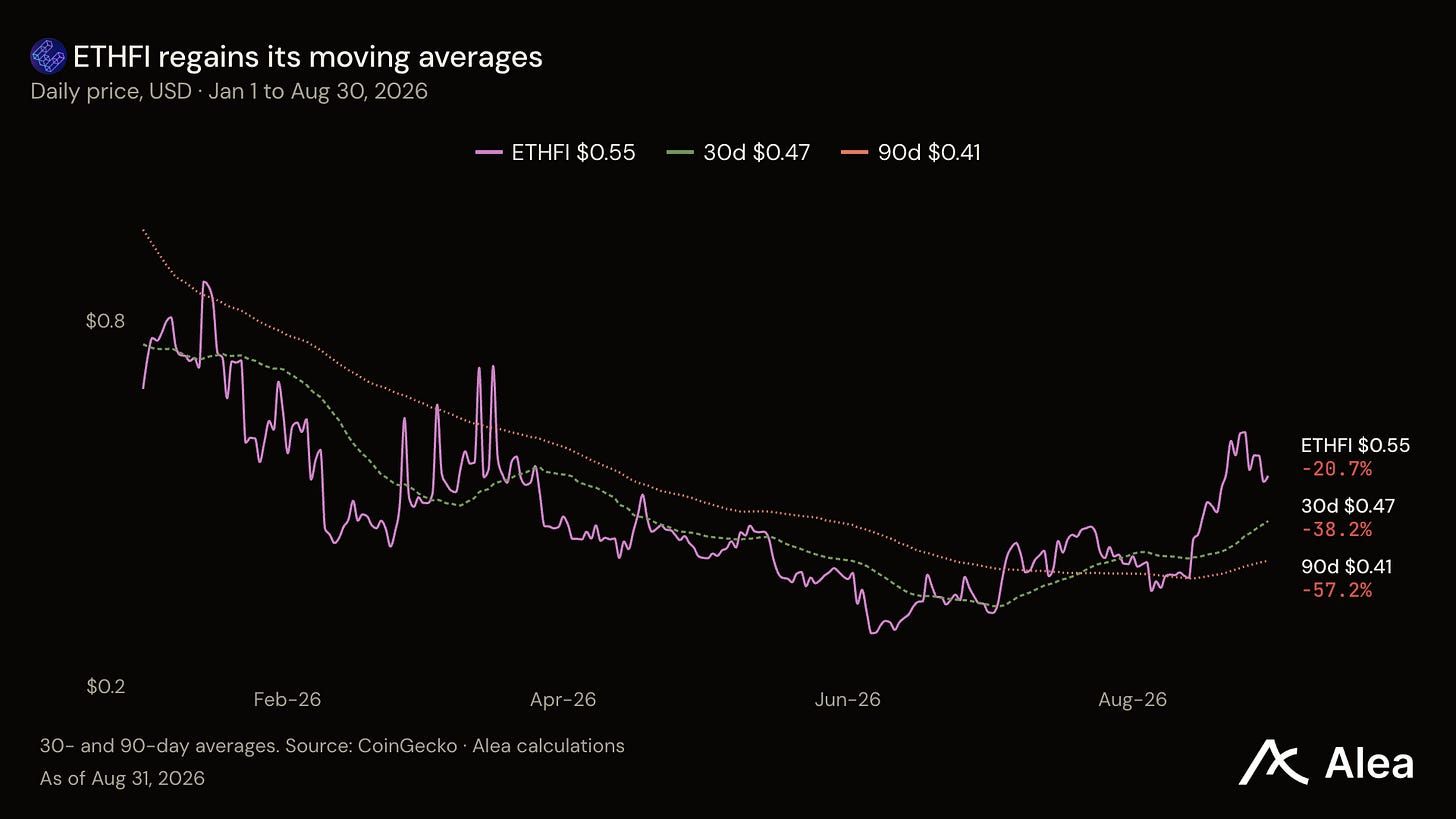
The August recovery still leaves ETHFI below its January starting point.
On the basis of 1B maximum supply, the price implies a $545M reference valuation, or 14.2x tracked annualized revenue and 3.6x gross fees. Gross fees include staking rewards and card cashback, which do not accrue to ETHFI holders.
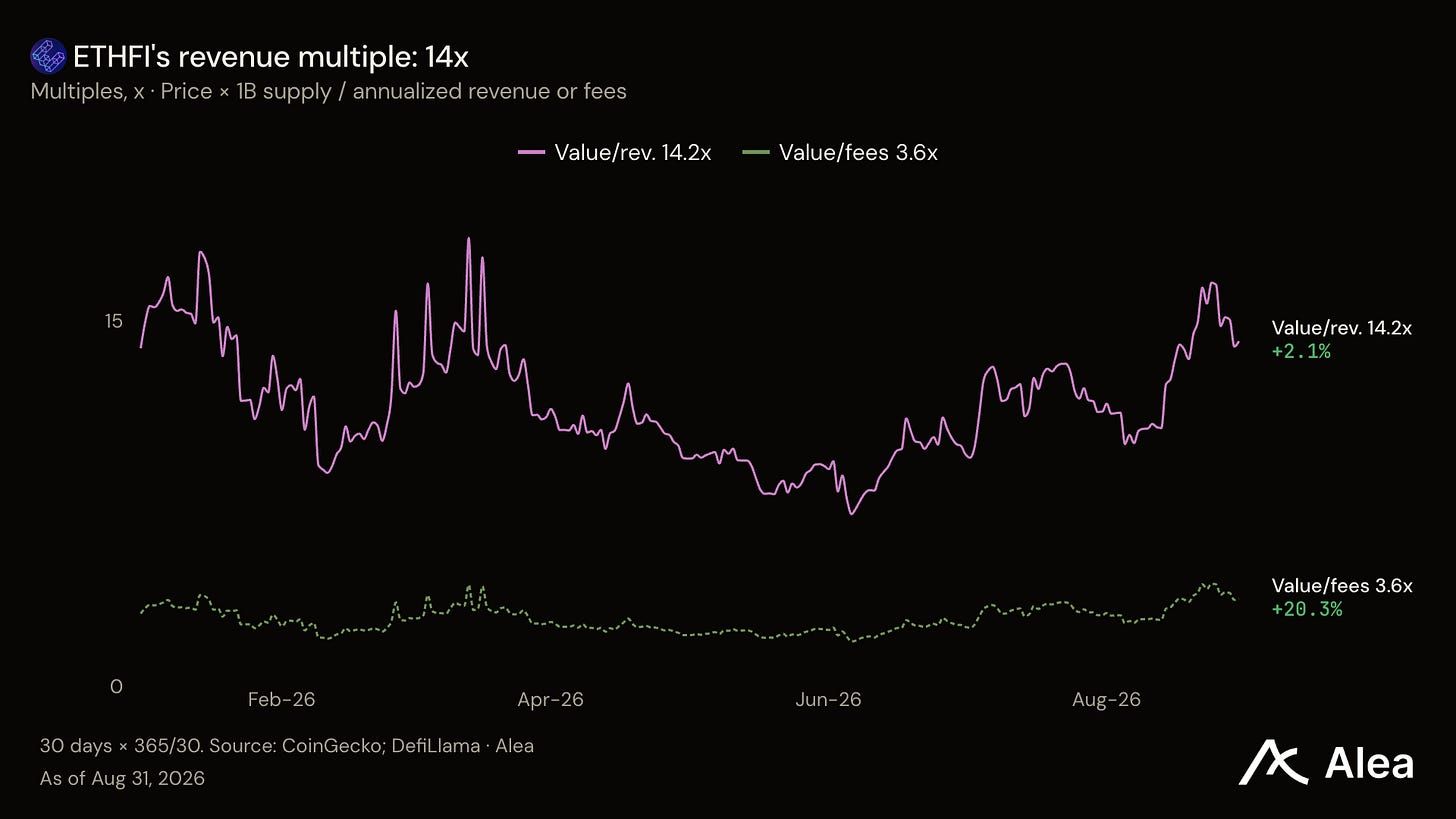
Gross fees give a much lower multiple than protocol revenue.
The proposed $16M annual funding anchor equals 2.9% of that reference value, before reward distributions. With +50% contribution growth, the ratio reaches 4.4% at an unchanged price.
These ratios measure gross funding capacity. ETHFI holders have no equity claim on Labs.
At a hypothetical 10x revenue multiple, sustaining $545M requires $54.5M in annual revenue, +42% above the current run rate.
September 3 and what follows
September 3: voting closes. On August 31, voting power stood near 245,800 ETHFI, just 25% of the 1M quorum.
Important Links
Nexo Card, KAST, and Gnosis Pay

Use Alea’s research and live protocol data to move from market signal to an investment decision. Paid plans start at $149 per month.
Explore the platform:
Reports. Read Deep Dives, Perspectives, Blueprints, Theses, Benchmarks, Memos, and Pulse.
Protocol Data Rooms. Review live protocol data, risk matrices, and governance activity in standardized diligence portals.
Podcast Digest and Summit Digest. Get the key points from the conversations shaping markets.
Governance Tracker. Follow live proposal feeds and voting activity across major protocols.
Newsletters. Browse Alea’s market analysis and newsletter archive.
For daily market intelligence between reports, join Alea Research on Telegram.