What the proposal would connect
Ethena is taking the lead in setting a standard to be followed by other protocols. As the industry matures and more sophisticated investors demand more transparency, the market is forcing protocols’ hands to connect their economics to their tokens (without promising token holders a dividend or redemption right).
The Ethena Foundation proposes using 95% of its net revenue for open-market ENA purchases once USDe’s trailing 14-day supply average clears $7.5B. Separately, Ethena announced an agreement in principle to place substantially all protocol intellectual property and residual economics with the Ethena Foundation. The agreement would remove residual protocol cash flow from Ethena Labs equity holders.
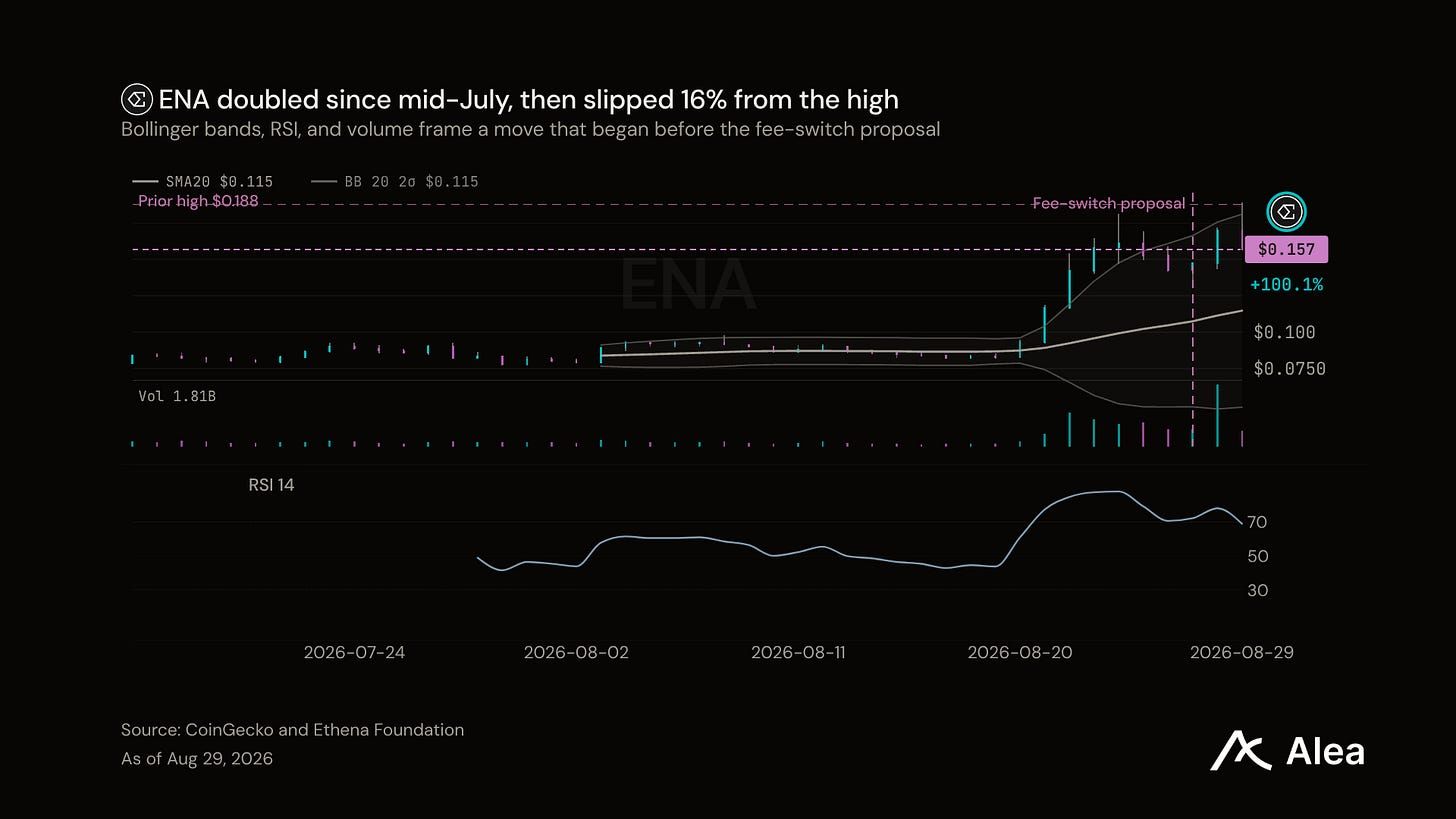
The implications go beyond Ethena. In a way, Hyperliquid set the standard, and now protocols can no longer ignore the fact that business model and token value flows are two sides of the same coin.
In crypto, protocols often split ownership from governance and token value capture: equity controls the operating company; a foundation or DAO governs the protocol; and the token trades on expected value capture.
Ethena’s framework would place material protocol intellectual property and residual economics with the Foundation first, then use buybacks to turn part of its net revenue into token demand.
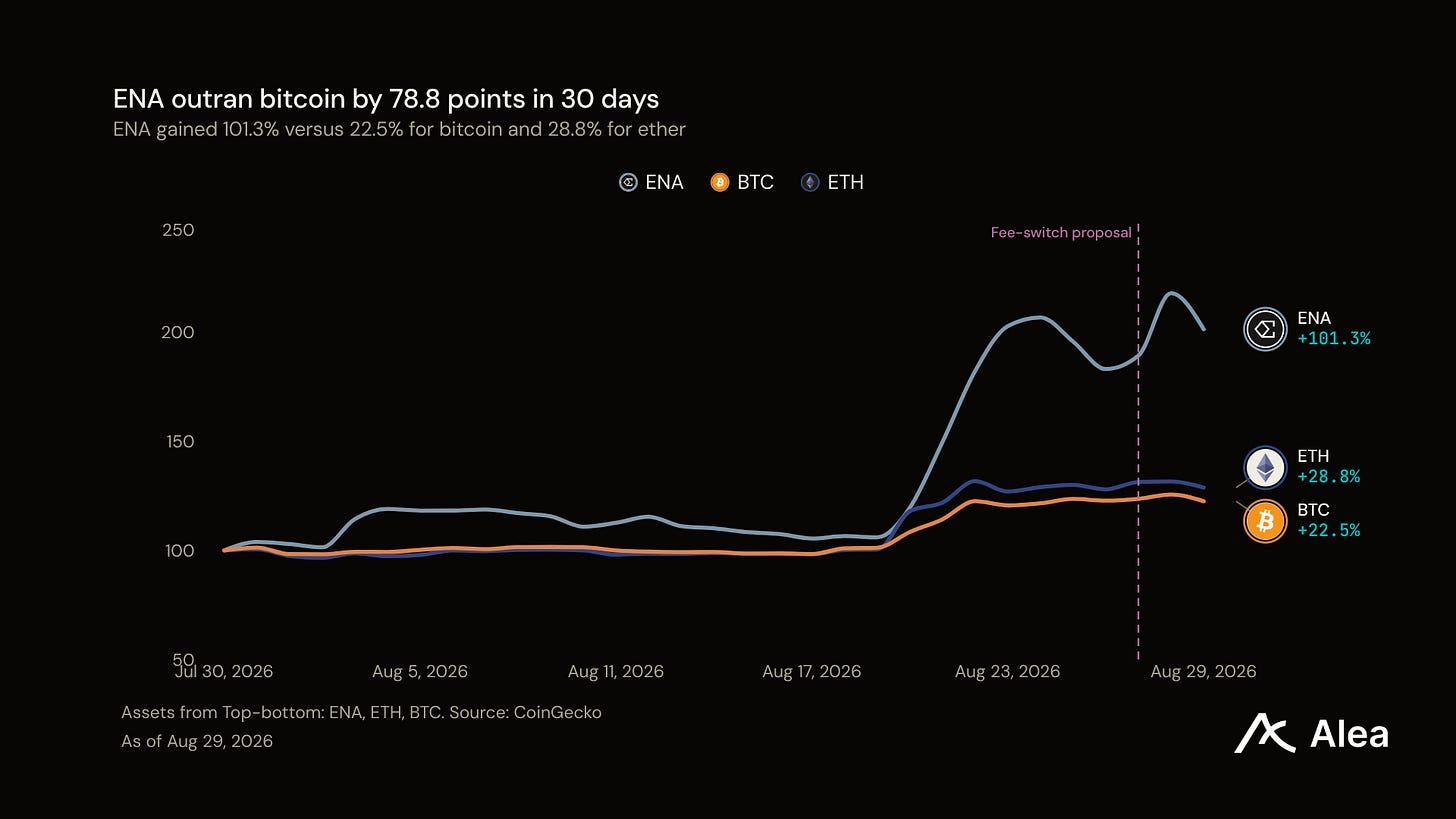
This way, Ethena has made ENA’s route to value clearer without enforcing a contractual holder entitlement. That’s the model we expect other protocols to follow, making tokens look more like equity, while still bypassing certain regulatory bottlenecks.
The legal transfer, for example, is a prerequisite. Labs would state any consideration for equity holders and the obligations to purchases.
For Ethena, after the transfer of intellectual property, the fee schedule would set the Foundation’s share of gross protocol revenue according to USDe’s trailing 14-day average supply:
$7.5B: 5%
$10B: 10%
$15B: 15%
$20B: 20%
The 95% instruction applies to net revenue that reaches the Foundation. ENA holders therefore sit behind product distributions and partners. Operating costs and reserves also come first, as do any other senior claims.
Scale came fast, then reversed
The governance vote remains open through September 2, with 17 million votes for and none against at the latest check. Approval would establish the schedule, but activation still requires the legal transfer and a $7.5B trailing average. USDe’s latest 14-day average is $4.054B, or 54.1% of the first tier. The $3.446B gap requires 85.0% growth from that base.
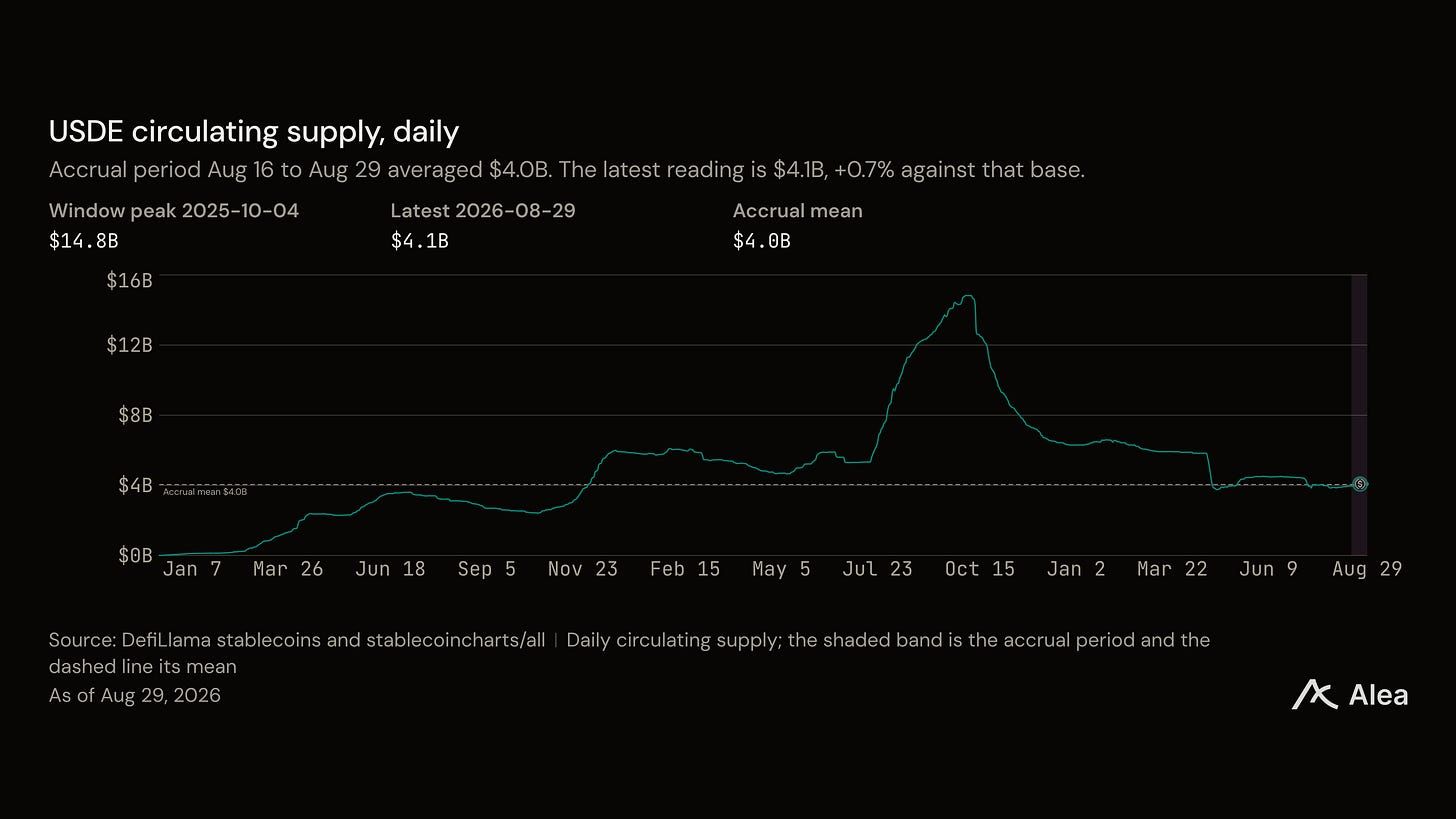
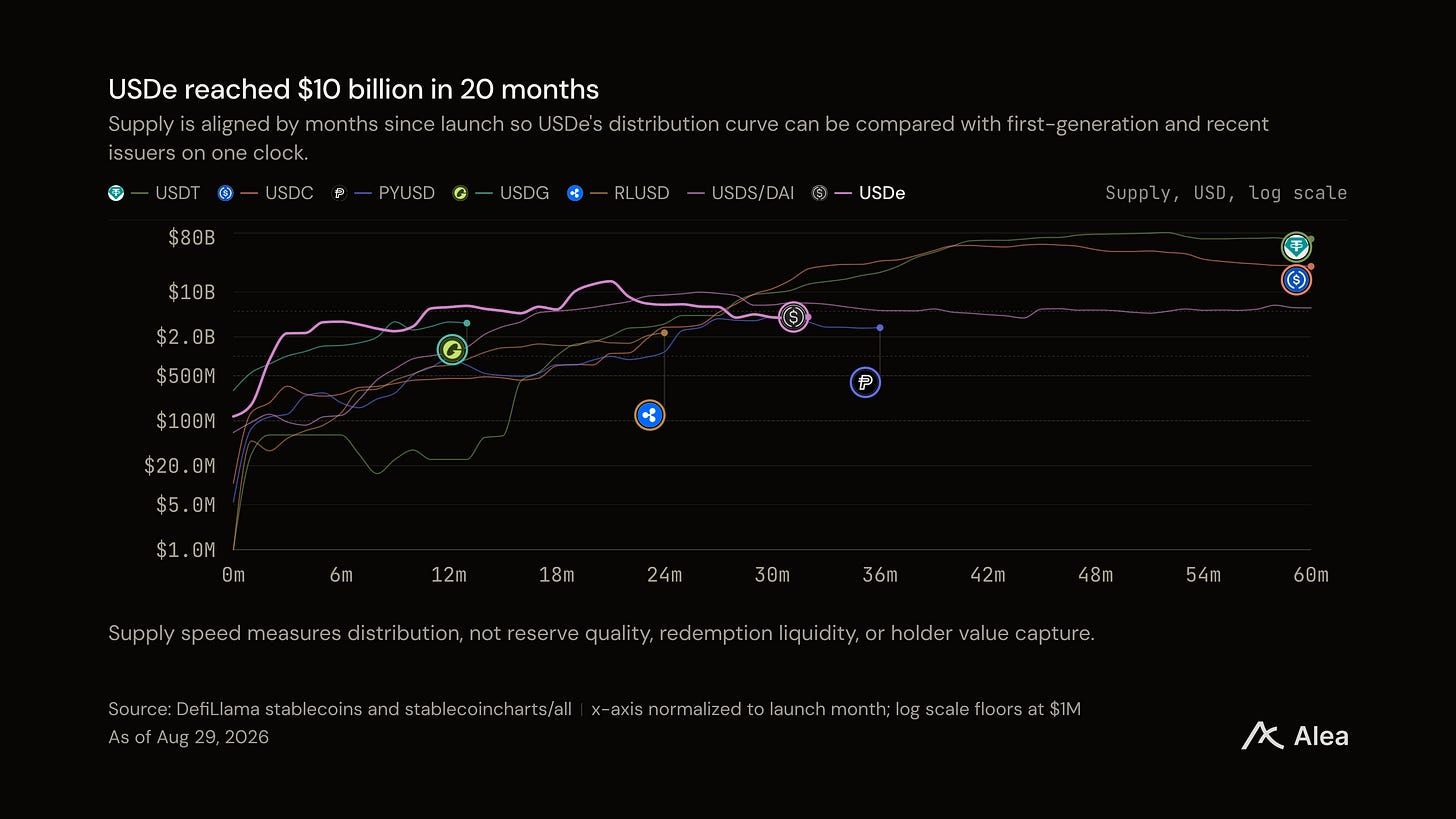
USDe still scaled at exceptional speed, crossing $5B in 12 months and $10B in 20 months. Time to threshold avoids a launch-to-date CAGR distorted by a near-zero base and a decisive endpoint.
The 14-day schedule would turn on above $7.5B and off below it. Buybacks are procyclical as a result, since they start only after supply has strengthened.
The engine must fund both product and token
Ethena’s analysis estimated a $175M annualized distribution over its prior 30-day window. About 34.3% went to sUSDe staking, 34.3% to partner payouts, and 31.4% to Aave liquid leverage. At a 10% protocol take, the analysis estimated a $6.0M annualized reduction in sUSDe distributions and $11.5M across the two incentive programs.
That trade-off is the mechanism. Higher USDe supply would raise the protocol take and, after costs, ENA purchases. The same take would reduce the yield or incentives supporting the next dollar of USDe demand. Thus, the fee switch creates value when the remaining product economics can sustain growth.
ENA’s market capitalization is approximately $1.54B. DefiLlama’s trailing 30-day gross-fee series annualizes to roughly $234M, producing a market-cap-to-fees ratio near 6.6 times. DefiLlama’s much smaller revenue series only covers mint fees and reserve allocations, while the proposal depends on net Foundation revenue across business lines.
Across 705 days, the trigger would have been active for 118 days and funded $17.04M of ENA purchases. That equals a 3.36% annualized buyback yield while active and 0.56% across the full period.
Going forward, valuation requires: gross protocol revenue, product distributions and operating costs, net Foundation revenue, completed ENA purchases, and purchases relative to effective float and unlocks.
Investment view
The proposal addresses a weakness in token capital structures. It would place protocol assets and residual economics with the Foundation, then connect net revenue to token purchases. The cost is explicit: ENA cannot capture more without taking cash from the product or finding new revenue.
As a result, ENA remains a contingent value-accrual instrument. So far, the $7.5B threshold is unmet, the legal transfer is unfinished, and net Foundation revenue lacks a reconciled public series.
The next decision points are concrete:
Ownership: definitive documents assign or license the promised intellectual property and residual economics on acceptable terms.
Activation: USDe’s 14-day average closes the $3.446B gap while the peg and sUSDe competitiveness hold.
Cash conversion: the Foundation reconciles gross revenue with costs and net revenue, then links that result to completed ENA purchases.
Market impact: purchases are measured against effective float and revised unlocks. Discretionary seller supply is tracked separately.
Clearing those tests would give other protocols a practical template for aligning tokens with operating economics. Failure would leave ENA with clearer governance language and no dependable cash-flow link.
Sources
Important Links

Read our latest Weekly Pulse, Alea’s flagship report covering macro, crypto, equities, and commodities. The August 29 edition examines whether fresh buyers can sustain the rally after the short squeeze.
Alea combines independent research with live protocol data to help you evaluate opportunities and understand their risks before committing capital.
Crypto teams can benchmark performance and give investors and partners a clearer view of their protocol’s economics.
Institutions can conduct due diligence with structured research and Protocol Data Rooms.
Traders can follow flows and catalysts across markets.
Investors can test an investment thesis against fundamentals and valuation.