Tokenized equities are finally graduating from early experiments to mainstream trading venues. Coinbase plans to introduce prediction markets and tokenized stocks to its platform on 17 December 2025, with tokenized shares providing 24/7 access and fractional investing.
Edel Finance is positioning itself as a permissionless money market for tokenized stocks, aiming to turn the opaque stock‑lending industry into an open yield engine.
Its native EDEL token allows holders to participate in governance and revenue sharing while capturing real‑world lending yield.
In this edition, we’ll look at Edel’s architecture, tokenomics, partnerships, Coinbase tailwinds, and details around its fair launch.
Stay informed in the markets ⬇️
What is Edel Finance
Edel calls itself “the global lending network for tokenized stocks.” The team includes finance veterans including co-founders James Sherbone (prev. IB at Berenberg, Saxon), Andres Soltermann (prev. DeFi Franc), and Giles Colwell (prev. Global Markets at JPM, UBS). Edel did not raise venture capital and instead launched with a community allocation structure.
Edel is built on Base and inspired by Aave V3, operating isolated pools for each tokenized equity like TSLA or AAPL minted by partners like Ondo Finance or xStocks and earn yield by lending them out. Each supported asset has its own lending pool with its own dynamic interest rate based on utilization and risk parameters.
To maintain composability with Aave, Edel issues aTokens as the interest-bearing receipt for positions.
Because the collateral is tokenized equities, pricing becomes the critical dependency. Edel uses index prices (benchmarks) rather than executable trading quotes. Their oracle stack also explicitly accounts for stock-specific realities like market hours, halts, and corporate actions (e.g. stock splits). They tap into 3 primary oracles:
Chainlink Price Feeds: Primary oracle for crypto and FX pairs.
xStock Data Streams: Primary oracle for real-world equity pricing onchain.
Ondo Oracle: for pricing Ondo tokenized stocks and global market tokens.
Tokenized Equities Need Lending Rails
Once users can hold tokenized equity, the natural next step is using them the way sophisticated investors already use portfolios: borrow against them for liquidity or create hedges without liquidating the underlying exposure.
Edel is targeting this $2.6T market where brokers earned $10.3B in fees in 2024, aiming to capture that spread onchain with transparent borrow rates.
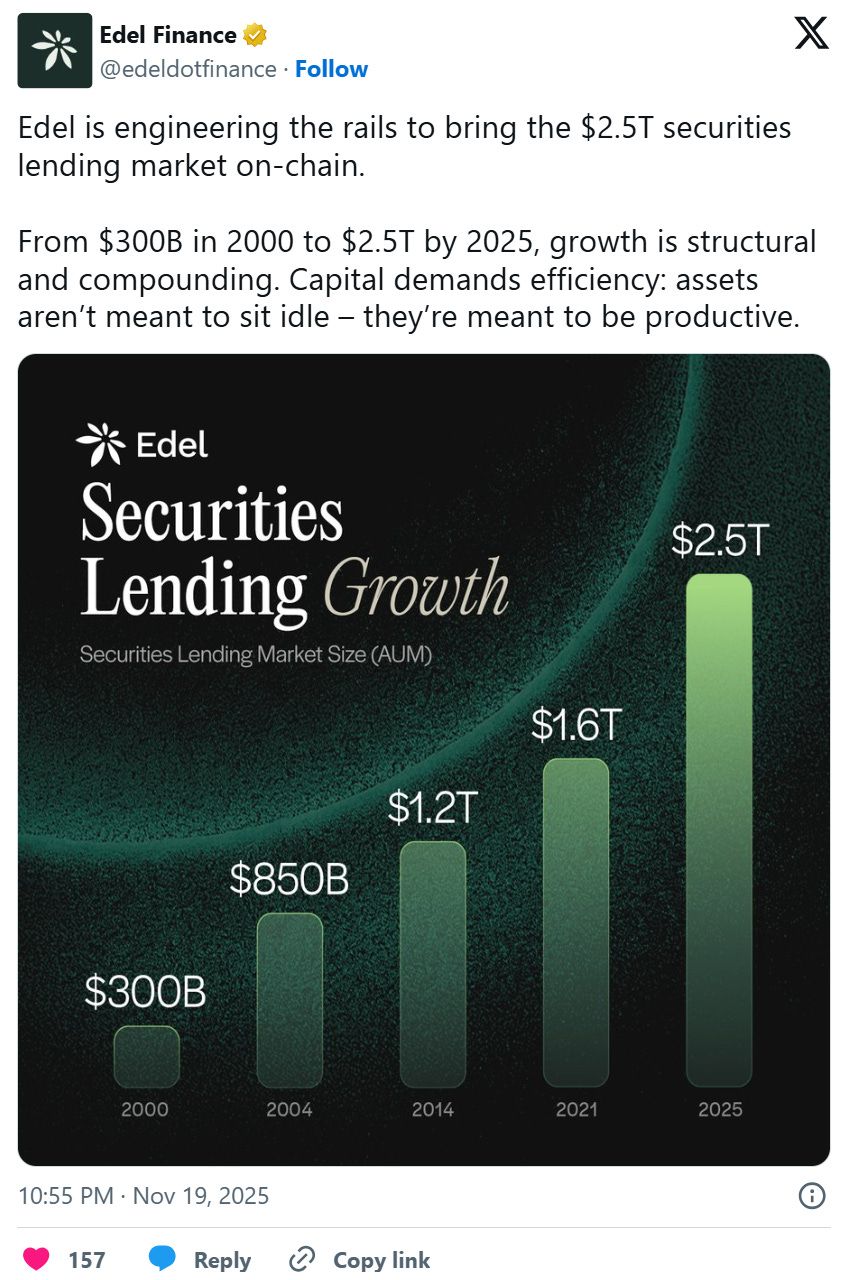
In TradFi, that stack is achievable through prime brokers and securities lenders. The onchain equivalent primitives are money markets, oracle systems, and liquidation engines that can handle complex real-world information on stocks (closed markets, halts, stock splits, etc.).
Coinbase’s push for tokenized stocks which launches on December 17 matters for adjacent protocols like Edel as it creates demand for secondary infrastructure (collateralization, borrow/lend, risk tooling), not just spot trading surfaces.
Whether that demand is met by incumbent DeFi lenders, exchange-native lending, or specialised venues like Edel will depend on the exact token standards, custody model, and regulatory constraints of each tokenized equity product.
$EDEL Token and Fair Launch
EDEL has a maximum supply of 1 billion tokens where only about 48% of the total supply is circulating (as of 16 Dec). The token distribution is as follows:
Community: 50%. Of which, 80% of this portion unlocked at token generation event (TGE); includes liquidity programs and future emissions.
Investors: 15.8% allocated to strategic partners and early supporters.
Reserves: 15% for protocol reserves and growth.
Team: 12.7% vested over 36 months with a 6month cliff.
Advisors: 2.7%
Airdrop: 3%
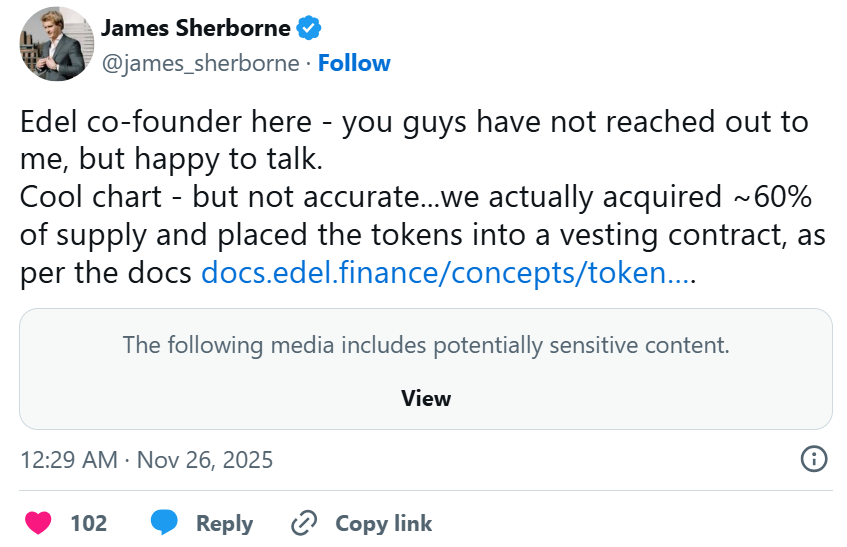
EDEL did a fair launch with only 12.7% allocated to the team. However, onchain analysts at Bubblemaps discovered that wallets linked to the project acquired over 30% of the total EDEL supply immediately after launch.
Co-founder James Sherborne responded that the team bought around 60% of tokens from the open market to place them into a vesting contract, claiming this was allowed under the tokenomics. The published allocation does not mention a 60% vesting plan though the vesting contract is presumably found here.
Despite this, EDEL continues to trade and now sits at a $40M FDV.
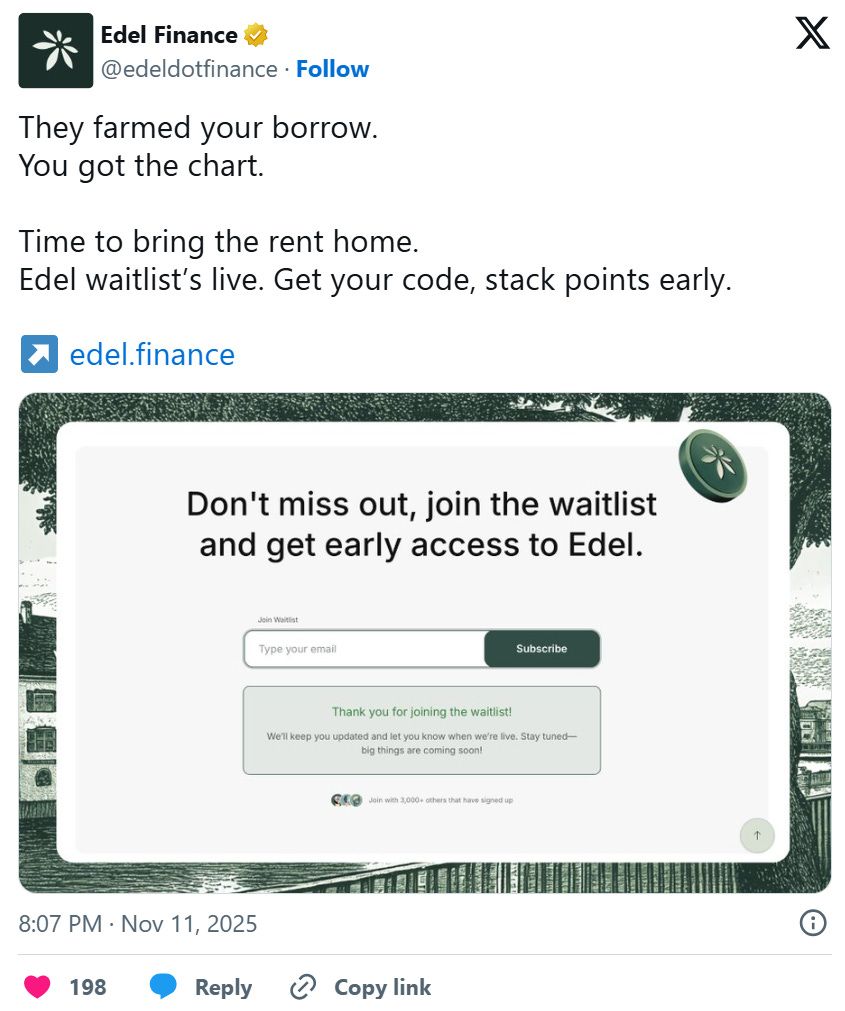
Edel also has a points program issuing 1M points every week which will contribute to the upcoming airdrop (date TBD) though they are still in its pre-launch phase with over 45K signups in their waitlist.
Closing Thoughts
Coinbase’s Dec 17 tokenized stocks launch and broader regulatory acceptance of tokenized securities could drive borrowing demand. Edel is an intriguing example of bringing TradFi cash flows onchain, and this could be reflected in its token performance despite the product still being in pre-launch.