Markets received a brutal reminder of how quickly leverage can unwind with BTC sliding over 40% in just a few days to a ytd low of $60K. Over $20B was also wiped out from DeFi markets. With liquidity drained and volatility spiking, thousands of onchain positions suddenly sat precariously close to liquidation.
During these kinds of flash crash events, reactive traders often panic-close loans or miss opportunities to rotate into safer collateral. DeFi Saver's automation engine and Shifter tools were designed for exactly this scenari. As we revisit how to survive volatility, DeFi Saver’s toolset offers a blueprint for staying proactive instead of reactive.
In this edition, we’ll look into how automated strategies behaved during recent drawdowns and how Loan Shifter, Collateral & Debt Switch and Position Flip enable one‑click repositioning across protocols and assets.

Quick Primer on How DeFi Saver Works
We covered DeFi Saver’s core mechanics in a previous newsletter and in a Perspective Report. In short, DeFi Saver inserts an automation layer between users and lending protocols, executing multi-step recipes (supply, borrow, swap, repay) in single atomic transactions.
Currently, DeFi Saver supports Aave, Morpho, Maker, Spark, Fluid, and other major lending markets across Ethereum, Arbitrum, Optimism, Linea, Plasma, and Base. New assets that have been integrated include Metamask’s mUSD, Syrup’s syrupUSDT, and Strata’s PT-srUSDe. The platform has automated 940 positions with over $283M in total value.
This piece focuses on what that infrastructure does when markets crash and how the Shifter features let users reposition without unwinding.
DeFi Saver Strategies for Volatile Markets
DeFi Saver’s automation doesn’t just exist as a feature list. It executes. Their February 2026 newsletter revealed that during the early Feb unwind of $5B in liquidations, the system triggered 1,227 automated transactions in a single day, protecting 467 unique positions liquidation as health factors plunged across lending markets.
Similar spikes occurred throughout last year with 908 automated transactions on October 10 during a $19B liquidation event, and 812 transactions on November 4 during another drawdown. These are all executed trades that fired when conditions were met, often faster than users could react manually.
The automation engine supports several strategies designed to minimize downside and lock in upside:
Leverage Management repays part of a position when the health ratio falls below a user-defined threshold and re-boosts when it rises above another. This keeps leverage within a safe band which is the most common use case for liquidation protection.
Price-Based Triggers execute partial boost (increasing exposure) or repay (decreasing exposure) when collateral or debt assets hit specific prices. Users can deploy these to add leverage after crashes or trim exposure into strength.
Stop-loss and Take-profits define price points where positions are closed entirely, repaying debt from collateral. This offers classic risk management for limiting losses or realizing gains. Trailing stops can also be used.
Collateral Switch Automation (currently only on Aave) sets price thresholds at which collateral automatically swaps into a different asset (often a stable) and switches back when price recovers. Users can ladder multiple instances to gradually de-risk. This is useful when rotating from volatile collateral into stables during a crash, or refinancing into a debt asset with lower borrow rates.
Protocol fees apply accordingly, but since automation bundles swaps and repayments into single atomic transactions, users often save on gas versus manual multi-step adjustments especially during high volatility periods when gas spikes.
Shifter: Repositioning Without Unwinding
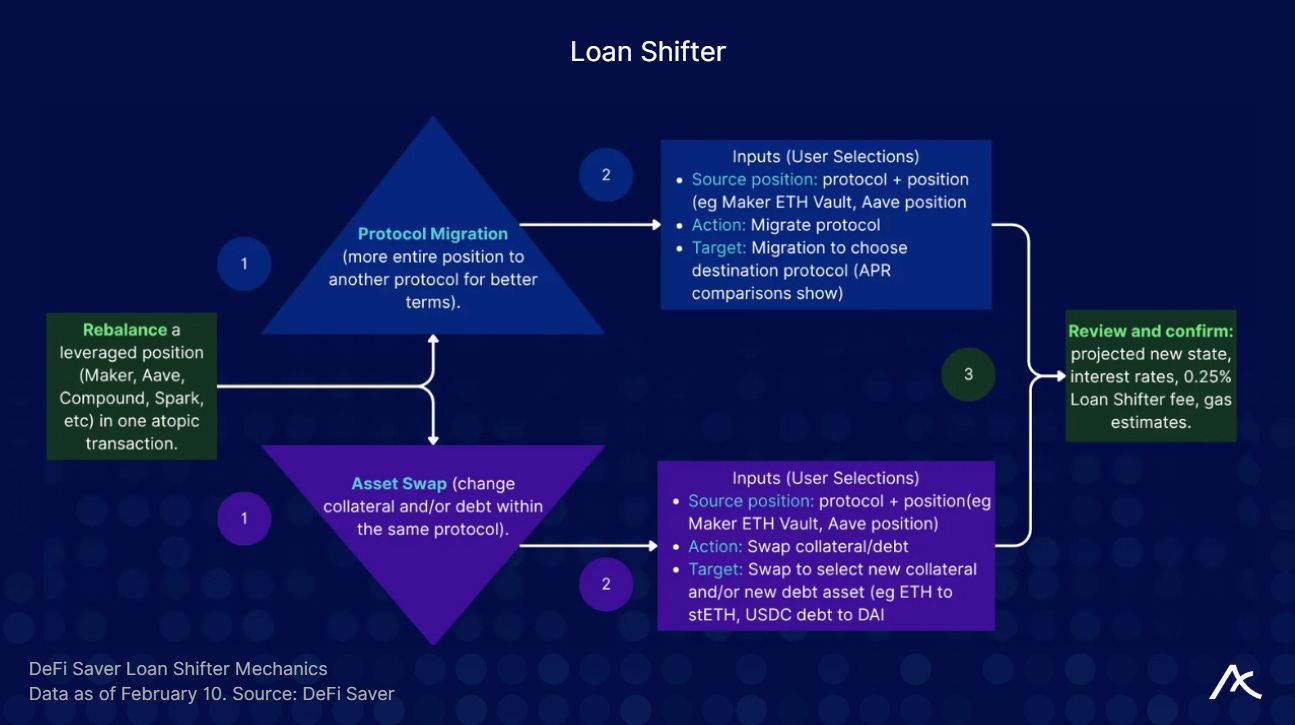
Automation handles reactive protection but Loan Shifter product suite handles proactive repositioning through migrating loans, switching collateral or debt assets, and flipping directional exposure, all in single transactions. They have handled over 4.4K shifts executed to date with $250M in automated value.
Loan Shifter lets users transfer collateral and debt between protocols (Aave, Compound, Maker, Spark, Morpho) instantly via flash loans. The primary use cases include capturing better rates across protocols, reducing borrowing costs as spreads change, or accessing features unique to another venue. If any part fails, nothing executes.
When market sentiment flips quickly, Position Flip lets users swap the collateral and debt in their position, effectively converting a long position into a short or vice versa For example, if you hold ETH collateral with USDC debt, flipping borrows ETH, repays the USDC debt, and borrows USDC against ETH, essentially creating short ETH exposure. This preserves the same collateral and debt value (minus fees), and its currently available on Aave V3 and Spark across all supported chains.
The value proposition is clearest during volatility. When markets drop 40% in a week, manually unwinding a position across multiple transactions (having to manually withdraw, swap, repay, repeat) exposes users to slippage, elevated gas fees, and MEV. The game during crashes is to prioritize survival. DeFi Saver’s automation suite fires off protective measures faster than users can react manually. The Shifter then handles repositioning by compressing multi-step unwinds into atomic execution.
Conclusion
Over 1K in automated transactions on a single crash day is the proof point. These are all positions that didn’t get liquidated because the automation worked while their owners were asleep, at dinner, or just not watching charts.
Whether it is worth the fee overhead depends on your position size and how much you trust yourself to be awake and attentive when markets dump 15% at 3am.
For most people running meaningful leverage, the answer is probably yes.
For the ones who think they’ll always be there to click manually—good luck. Liquidations don’t care about your sleep schedule.