The first wave of crypto ETFs provided access to Bitcoin through standard brokerage rails. These BTC ETFs attracted >$50B in net inflows to-date across names like IBIT, FBTC, BITB, and more.
ETH, SOL, and HYPE each followed their own regulatory pathway, clearing custody, surveillance, and classification requirements separately. Once enough individual assets have cleared their own regulatory pathways, a basket becomes possible. Baskets are an entirely different kind of product because it takes the asset selection and weighting decisions off the advisor's plate entirely.
In this edition, we look at what each phase solved and why index adoption is fundamentally changing the market's underlying plumbing.

What the ETF Wrapper Actually Solves
An ETF converts an asset into a listed security that is brokerage-accessible, held in regulated custody, priced intraday, and reconcilable inside reporting systems built for equities. Before January 2024, BTC required a crypto exchange account, separate custody rails, and compliance frameworks not designed for digital assets. The wrapper removed all of that.
GBTC, Grayscale's BTC trust, charged 2% annually as a closed-end product. When IBIT launched at 0.25%, GBTC holders promptly rotated.
IBIT is BlackRock’s spot Bitcoin ETF designed to give investors BTC exposure through an exchange-traded product without wallets, direct custody, or exchange accounts. BlackRock’s ETHA follows the same structure for Ethereum.

The 2025 Altcoin ETF Wave
BTC came first because CME launched BTC futures in December 2017, creating the surveillance-sharing agreement the SEC required before approving a spot product, and the DC Circuit Court's August 2023 ruling forced that approval after the SEC rejected Grayscale's conversion application.
Under Gensler, the SEC had explicitly named SOL as a security in enforcement actions against Binance and Coinbase, making a SOL ETF impossible regardless of custody infrastructure or futures markets. What changed was SAB 121, the accounting rule requiring banks to hold customer crypto as a balance sheet liability, was repealed in January 2025. The FDIC also removed prior-approval requirements for bank crypto activities in March 2025. And the SEC adopted generic listing standards in September 2025 that let qualifying ETPs list without individual rule-change submissions to the SEC.
Baskets Delegate Asset Selection to the Index
Buying IBIT gives Bitcoin exposure, but it doesn’t answer the broader portfolio construction questions an advisor must resolve before adding it. Bitcoin has historically run ~40% annualized volatility. Sizing it properly requires knowing exactly how much risk budget the rest of the portfolio has left to give.
Adding ETH or SOL introduces a second layer of complexity as each asset represents a fundamentally different thesis about where value accrues in the crypto stack. Managing 3 separate single-asset ETFs forces an explicit, ongoing weighting decision that most traditional advisors are not positioned to make.
A basket like Hashdex’s Crypto Index ETF (NCIQ), Bitwise’s 10 Crypto Index Fund (BITW), or broad market-cap index funds launched by issuers like 21shares (such as their FTSE Crypto 10 index ETF) removes those second and third decisions.
Bitwise’s 10 Crypto Index Fund has operated since 2017 and today holds a market-cap-weighted basket of major crypto assets, providing one of the earliest examples of crypto exposure being packaged as an asset-class allocation rather than a single-token bet.
The index handles asset selection and market-cap weighting so the investment advisor only handles the sleeve size.
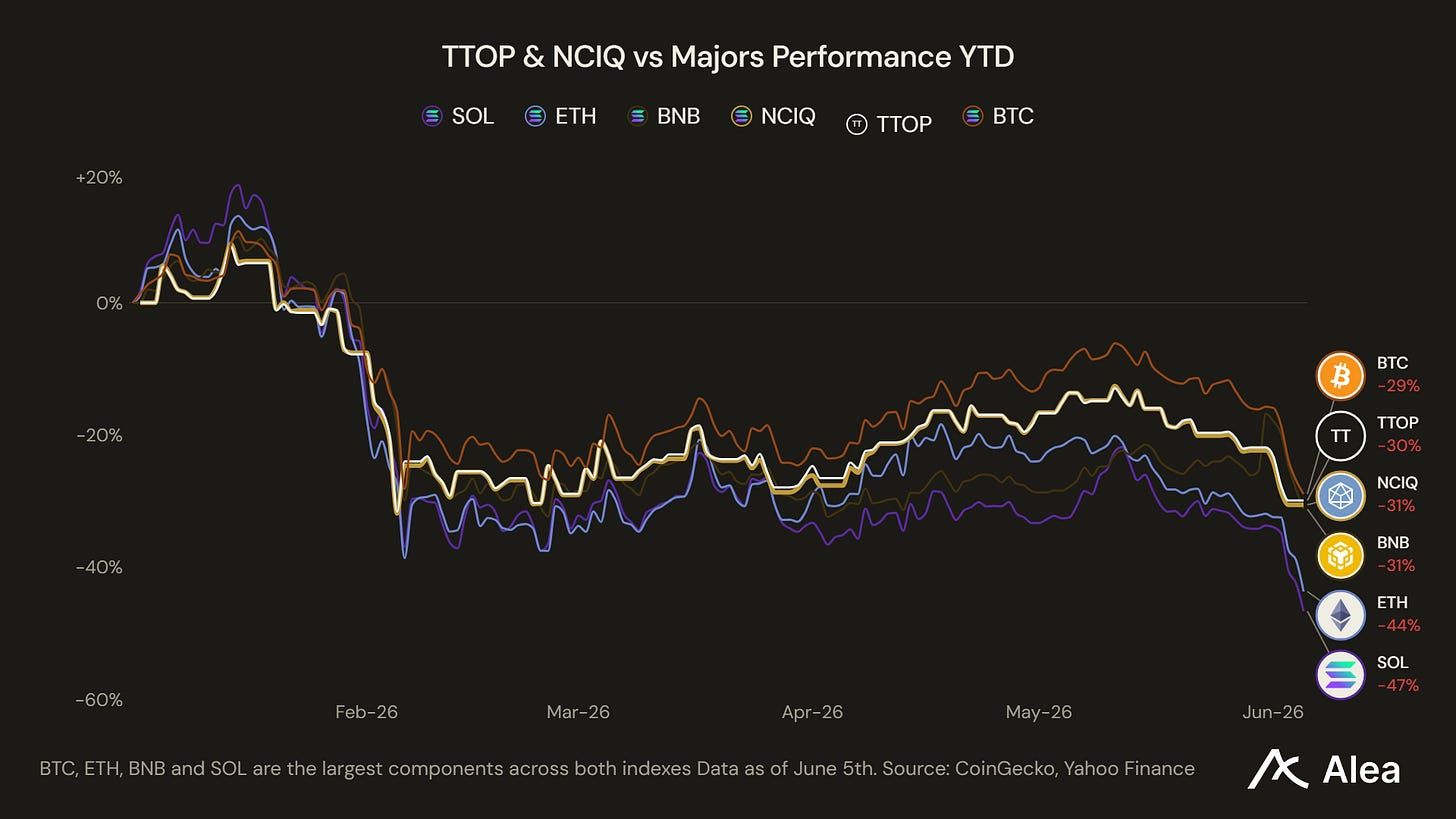
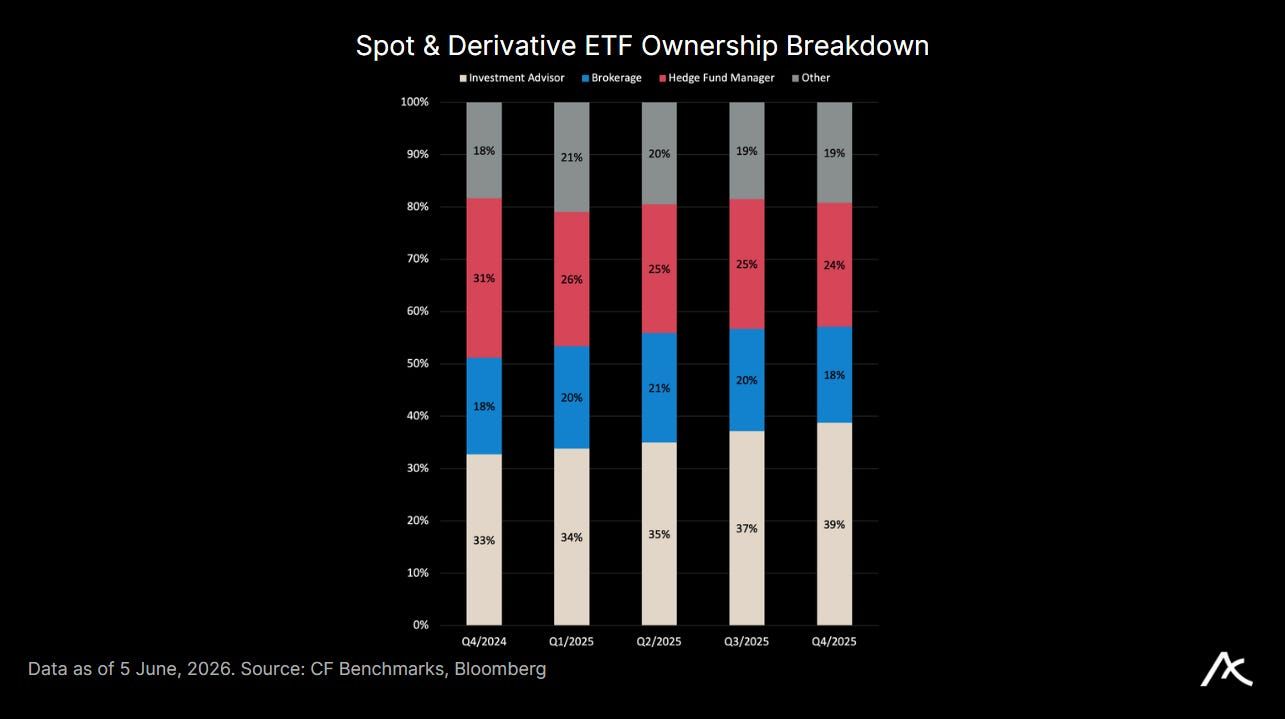
This shift from manual asset picking to index delegation directly dictates the underlying holder mix. Early single-asset ETF volume was highly concentrated among hedge funds that used BTC ETFs as basis-trade inventory, longing them against short CME futures to earn carry.
Registered Investment Advisors (RIAs), by contrast, added through volatility because the position had become part of an allocation framework, these become price-insensitive passive bids. CF Benchmarks found investment advisors grew their aggregate IBIT position 145% from Q4 2024 to Q4 2025 while hedge funds reduced exposure 28% over the same period.
Model Portfolios & Non-Discretionary Allocation
The sticky AUM argument depends on how advisors actually deploy allocations. Most advisors at wirehouses and larger RIAs run model portfolios which are standardized allocation templates where an investment committee sets the line items and percentages, not the individual advisor.
A committee can approve "2% in NCIQ" as a crypto sleeve but not "0.8% IBIT, 0.5% ETHA, 0.4% in a SOL ETF, and 0.3% in BHYP” because that is taking an explicit position on relative weights between BTC, ETH, SOL, and HYPE. Most investment committees won't do that level of intra-crypto analysis, and compliance won't sign off on four separate crypto line items without a systematic framework behind each one.
Once a basket ETF like NCIQ becomes a model portfolio line item, the buying becomes non-discretionary:
Automated Inflows: Every new client dollar funneled into that model automatically buys its pro-rata share of NCIQ.
Mechanical Rebalancing: Every rebalancing cycle where crypto underperforms its target weight triggers automatic buys, regardless of outlook on BTC.
Institutional Friction: Getting into and out of a model portfolio takes a lot of paperwork. This red tape makes it very hard for advisors to panic sell during market dips.
This is why multi-asset baskets represent a huge step-up. Basket ETFs embedded inside a model portfolio creates non-discretionary, recurring, rebalancing-driven demand.