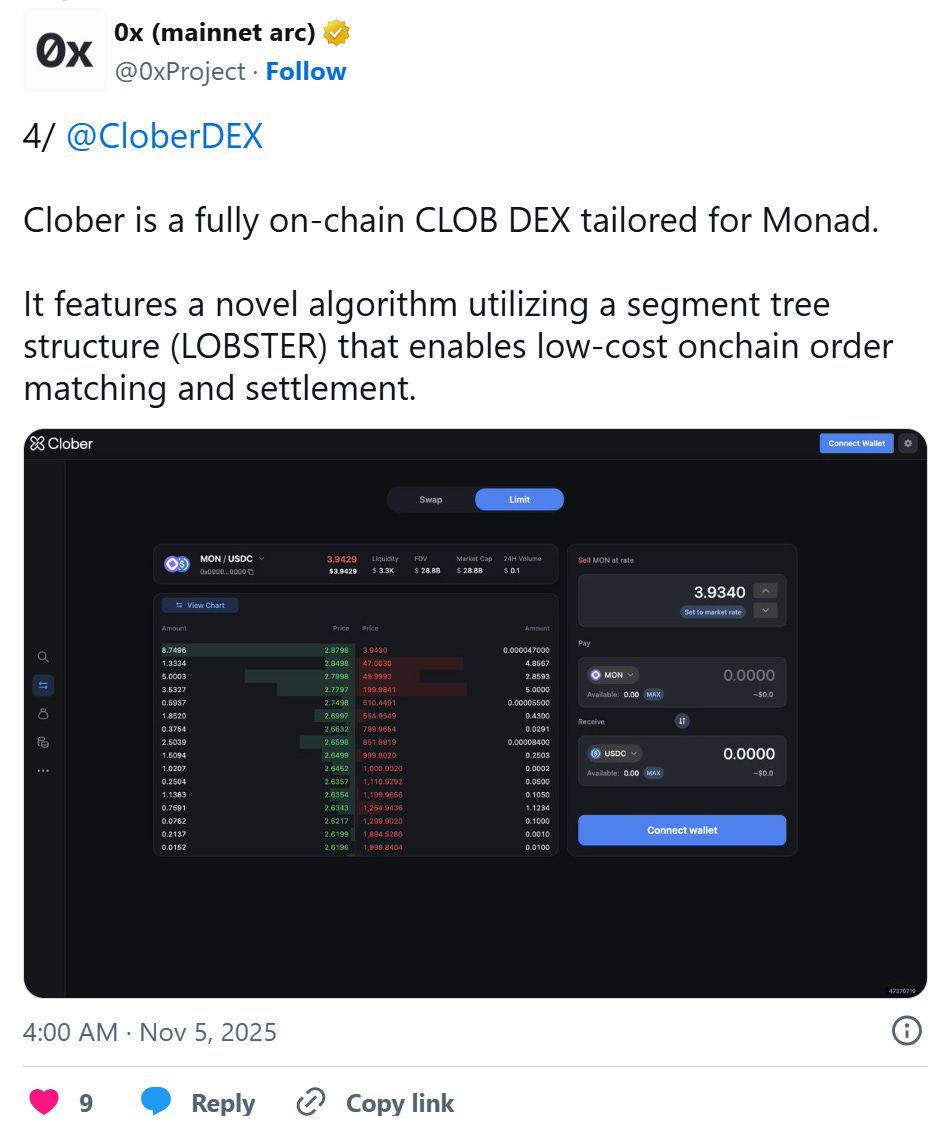
Clober is a fully on‑chain central‑limit order‑book (CLOB) exchange built for precision and performance on high‑throughput networks like Monad.
Ahead of Monad’s mainnet launch, Clober is preparing to deploy its LOBSTER matching engine on a high-throughput, parallel EVM and to reduce onboarding friction via bridgeless funding through Avail’s Unified Balances. The goal is to make it possible to trade with limit orders on Monad using assets held on other EVM chains, without manual bridging or complex setup.
In this edition, we’ll cover Clober’s architecture, why Monad is the perfect home for Clober, and what to expect from Clober’s mainnet debut.
Stay informed in the markets ⬇️
What is Clober?
Clober is an on-chain order book DEX that tries to make CLOBs viable within the EVM environment by optimizing how orders are represented and settled rather than pushing complexity off-chain.
On a normal on-chain order book, when someone sends a buy order, the contract has to:
Look at the cheapest sell order.
Fill as much as possible.
Move to the next price.
Repeat until the buy size is fully filled or the price limit is hit.
What Clober intends to fix is to match trades and keep track of who should get what without walking through every order within one transaction.
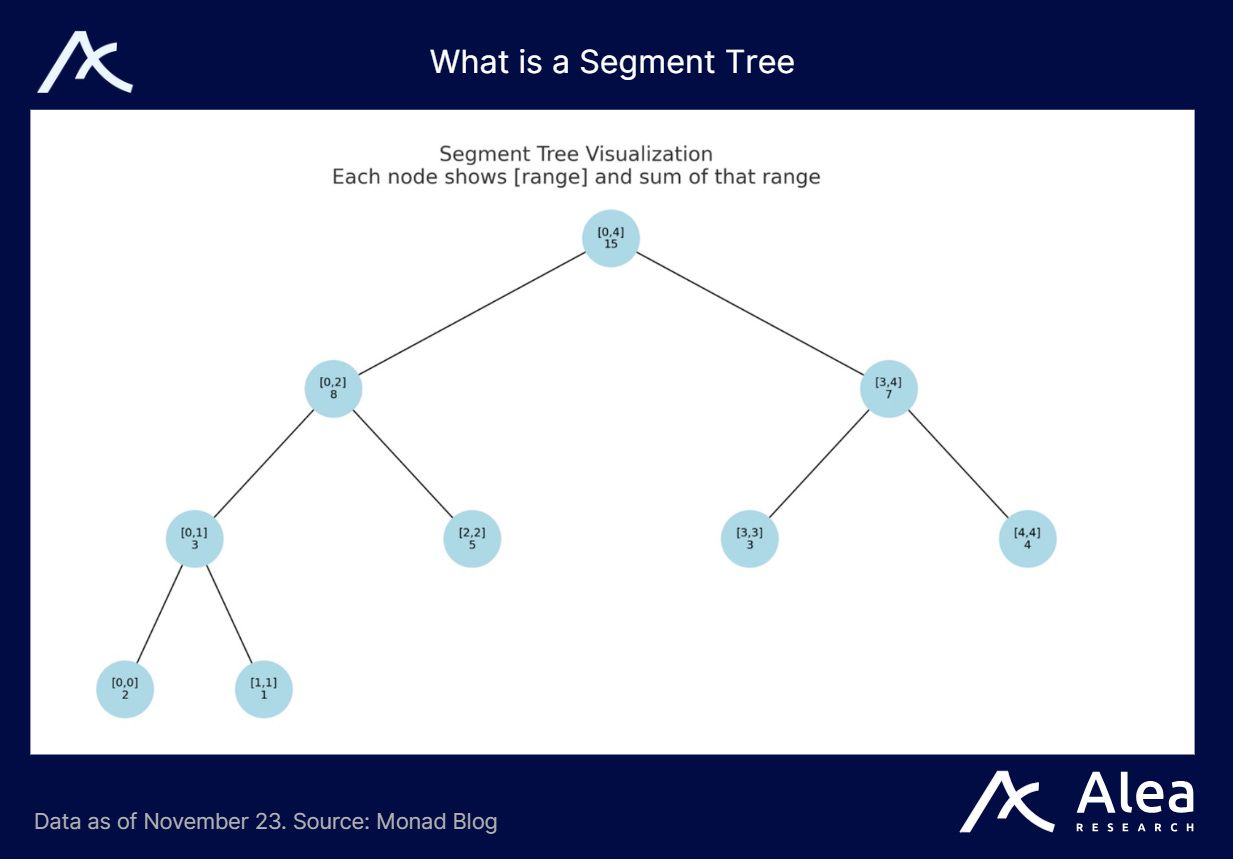
They have a proprietary engine called the LOBSTER engine, which stands for “Limit Order Book with Segment Tree for Efficient oRder-matching”.
The Segment Tree simply remembers the cumulative size over a range of prices so the contract can jump directly to where a large order finishes instead of makers going through each price range individually. (e.g. an asset’s orderbook 1.00 to 1.05 has $1,000 in liquidity, $1,005 sends me to 1.06)
Order Books on High-Performance EVMs
DeFi has largely been built on automated market makers because they are simple to integrate and provide continuous liquidity, but they introduce persistent slippage for larger trades and impermanent loss for LPs. Traditional orderbook models let traders specify exact prices, sizes, and allow professional market makers to compete directly for orderflow.
On first-generation EVMs, sequential execution models, high gas costs and slow transaction finality made on-chain CLOBs expensive and operationally unfeasible. Monad’s architecture introduces optimized BFT consensus, parallel execution and short finality.
This addresses many of the bottlenecks, making it more realistic to maintain thousands of on-chain orders, frequent cancel cycles, and fine tick sizes without gas or latency issues. Strategically, Clober is the order-book infrastructure for chains like Monad.
Clober’s Launch on Monad Mainnet
A recurring pain point for new L1/L2 ecosystems is the “cold start” problem: users must bridge funds in, acquire gas, and set up wallets before placing a single trade. Clober’s integration with Avail Nexus is designed to reduce this friction. Avail introduces Unified Balances.
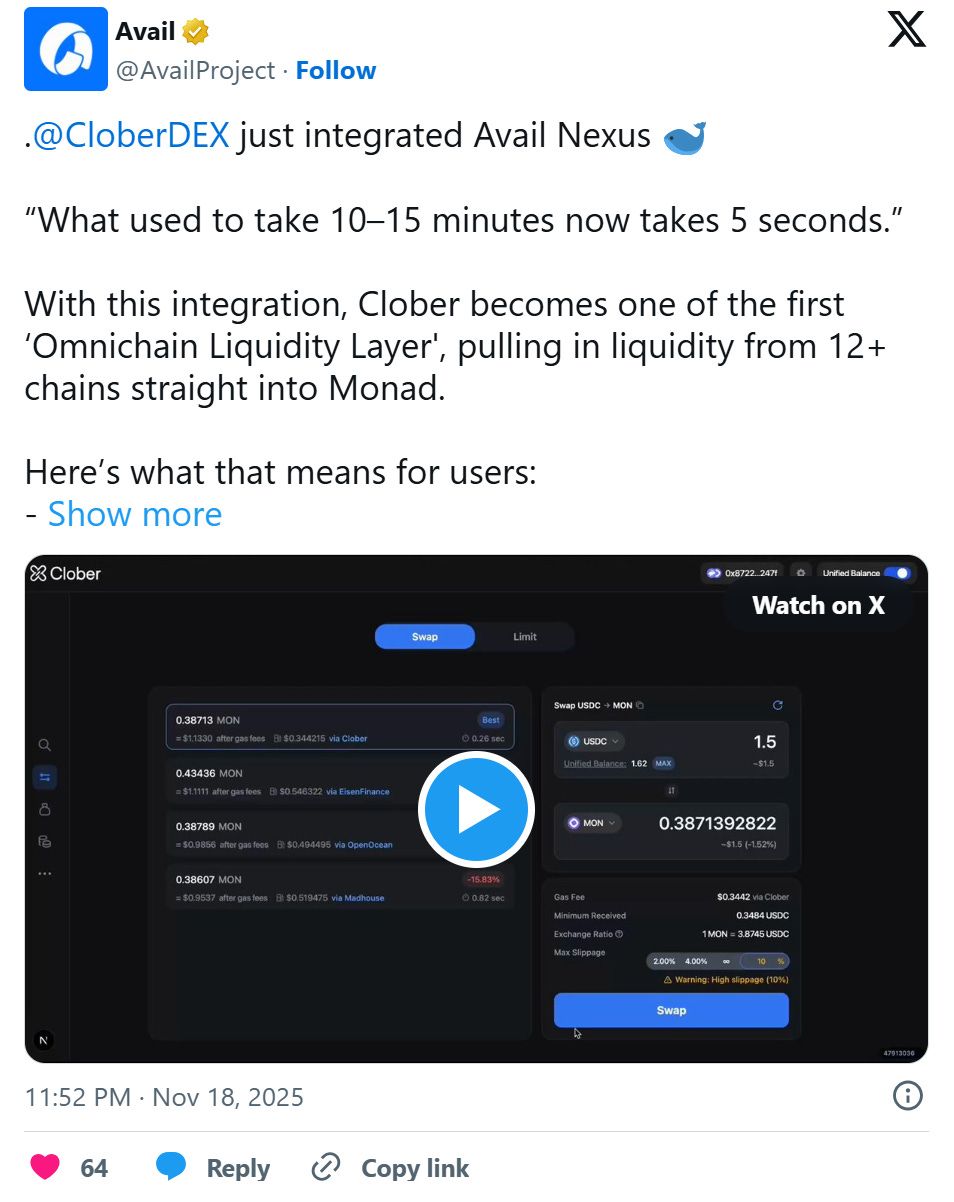
With Unified Balances, users can trade on Clober using stablecoins they hold on any of the 12+ EVM chains, while Avail manages the underlying cross-chain settlement. This means users get to enjoy:
No manual bridging step in the user flow.
No separate step to acquire MON gas as the system supplies gas behind the scenes.
Time-to-first-trade compressed from a 10-15 minute bridging workflow to roughly a 10s single transaction sequence.
This is important for Monad’s mainnet launch as most users’ capital will initially reside on other chains. For the Monad ecosystem, this positions Clober as one of the main order-book venues and a potential routing layer for spot liquidity at the point of network launch; for investors and allocators, the key questions become whether Clober attracts sufficient market-making activity to sustain deep books, how much flow it captures relative to other DEXs on Monad, and to what extent other protocols adopt its order-book layer as a core piece of their own product architecture.