Cap introduces cUSD, a fully collateralized digital dollar backed by a basket of blue‑chip stablecoins like USDC, USDT, pyUSD and more.
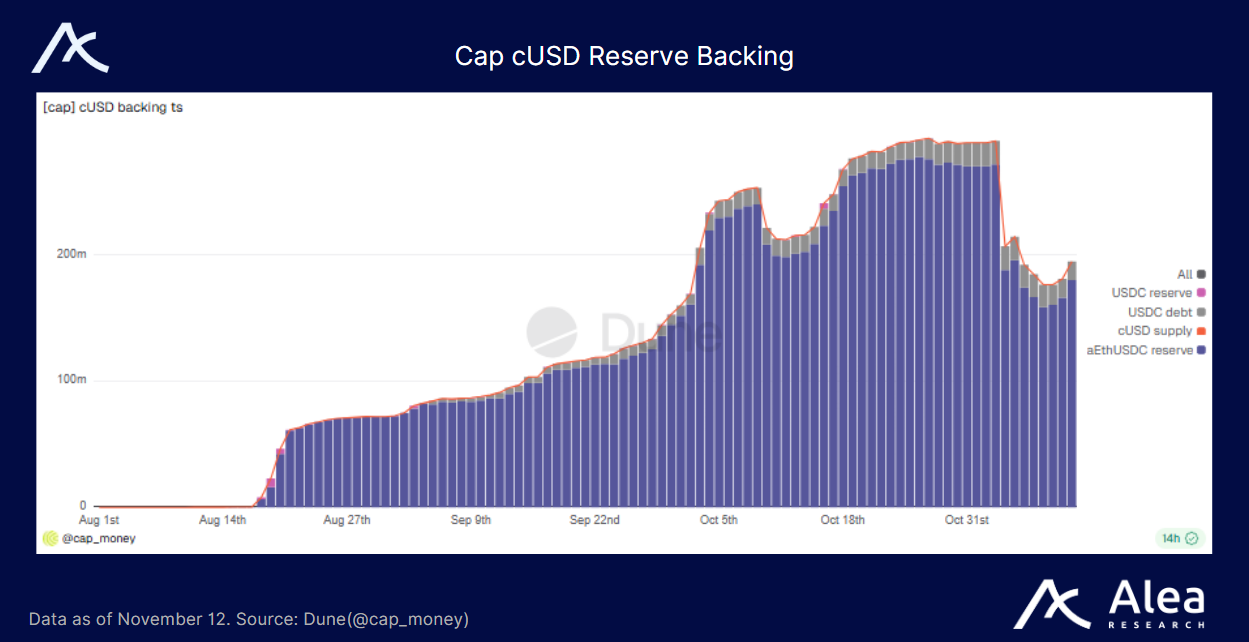
As they enter their third epoch of the Frontier program, designed to incentivize usage via points, Cap has attracted $250M in TVL over just 2 months.
At the same time Cap has become one of the first native applications on the MegaETH L2. Participants in MegaETH’s raise can earn extra yield by supplying liquidity to Cap’s cUSD, positioning the protocol as one of the first stablecoin project for the network.
In this edition we’ll look into Cap’s architecture, the Frontier program, and why it fits into the current rotation towards yield‑bearing stablecoins despite slowing net inflows.
Stay informed in the markets ⬇️

Introduction to Cap
Cap officially launched in August 2025 built by DeFi veterans from Beefy, Frax, and QiDAO. They were also part of the first cohort to graduate from the MegaMafia (MegaETH’s incubation program) in 2024. They raised $8M in April 2025 from investors like Franklin Templeton, Layerzero’s Bryan Pellegrino, Selini, and many more.
Cap is built on MegaETH rails, leveraging the chain’s speed and low latency for its vault strategies and offer users an efficient DeFi experience. Cap operates what they call a “three-sided marketplace” comprising cUSD holders, stakers, and a group of institutional operators.

Users first deposit an approved stablecoin reserve asset into a Peg Stability Module (PSM) and mint cUSD. The PSM enables mint, burn and redemption operations to ensure peg stability as the name suggests. To address depegs, redemption distributes a basket of underlying assets and socializes losses across all redeemers. Idle reserves are placed into money market funds or lending markets like Aave through a Fractional Reserve Vault to earn a base yield.
Staking cUSD produces stcUSD which accrues auto-compounded yields. Vetted high-level operators use the cUSD reserves to pursue yield strategies across market making, arbitrage, HFT, and more. The yields are then split between stcUSD holders (hurdle rate), restakers (risk premium) and operators (excess profit), providing perpetual competitive yield.
Frontier Program and Current Activities
Cap’s Frontier Program is its multi‑epoch launch incentive, rewarding users with caps points (convertible to future governance or rewards) for holding and deploying cUSD and stcUSD. Epoch 3 (Oct 13 2025 - Jan 28 2026) keeps the same rates as earlier phases but introduces a participation boost for early and consistent depositor. This has led to a significant boost in their TVL to over $250M within just 3 months.

On top of that, cUSD is also supported on Pendle, allowing users to purchase YTs and PTs or LP positions to earn points multipliers and leverage exposures. Pendle markets had grown to $150M, becoming Cap’s largest demand source.
Morpho and Euler lending markets also recently started supplying stcUSD, PT‑stcUSD and PT‑cUSD. Lending liquidity has exceeded $30M since the start of the Frontier program.

MegaETH Integration & TGE Boosts
Cap is also one of the first protocols incubated in MegaETH’s ecosystem.

During MegaETH’s public sale, a subset of 5,000 bidders were promised an additional on‑chain yield boost (~2.5%) for deploying capital on the network.

Cap’s cUSD is positioned as a primary liquidity vehicle for this program. While stablecoin inflows are slowing, Cap’s integration allows allocators to pair MegaETH exposure with a neutral, yield‑bearing dollar. cUSD adoption on Pendle and Morpho further reflects the “points & yield farming” meta as TVLs on secondary markets are over 50% of the cUSD TVL itself.