Quick note before we get into today’s edition - we receive positive feedback on the content we put out, but it’s important to stay in touch with our evolving audience, especially in crypto.
To help us optimize our content on this newsletter, X, our platform, and more, please take a couple of minutes to a quick survey we put together…
Last week, we covered the MegaETH ecosystem, even releasing a MegaETH Blueprint breaking down the chain’s architecture, bull and bear cases, and more. While the MegaETH NFT mint is ongoing, the token’s TGE won't happen for around a year, with testnet launch scheduled to happen soon ahead of mainnet.
The chain that did already launch and have its TGE within the past week is Berachain. Interest in new chains this cycle has mostly been concentrated around a few chains; MegaETH, Monad, and Berachain. During this current market slump, market participants have some time to play around with new chains, and gauge what works and what doesn’t.
In today’s edition, we’ll go over how what makes Berachain unique, how i’s launch went, and more…
Stay informed in the markets ⬇

Background on Berachain
Berachain is an EVM-equivalent L1 built on the Cosmos SDK and powered by Proof of Liquidity, a consensus mechanism variant. This allows users to turn liquidity into security for the network. The main thing to note with Berachain is it’s unique dual-token model. Berachain has two main tokens: BERA (the gas token) and BGT (the non-transferable governance and rewards token).
$BGT can only be earned by providing liquidity to the network, not purchased. Validators need $BGT delegated to them to produce block rewards. Users earn $BGT by providing liquidity to basic DeFi primitives like a DEX, a perps vault, and a stablecoin lending market. Validators direct block rewards/emissions towards different pools, creating an incentive structure for protocols and validators to collaborate.
Those familiar with the Solidly model present in protocols like Aerodrome can likely draw the parallels between these projects and Berachain, which uses incentive direction as a basis upon which to build an entire chain’s ecosystem.
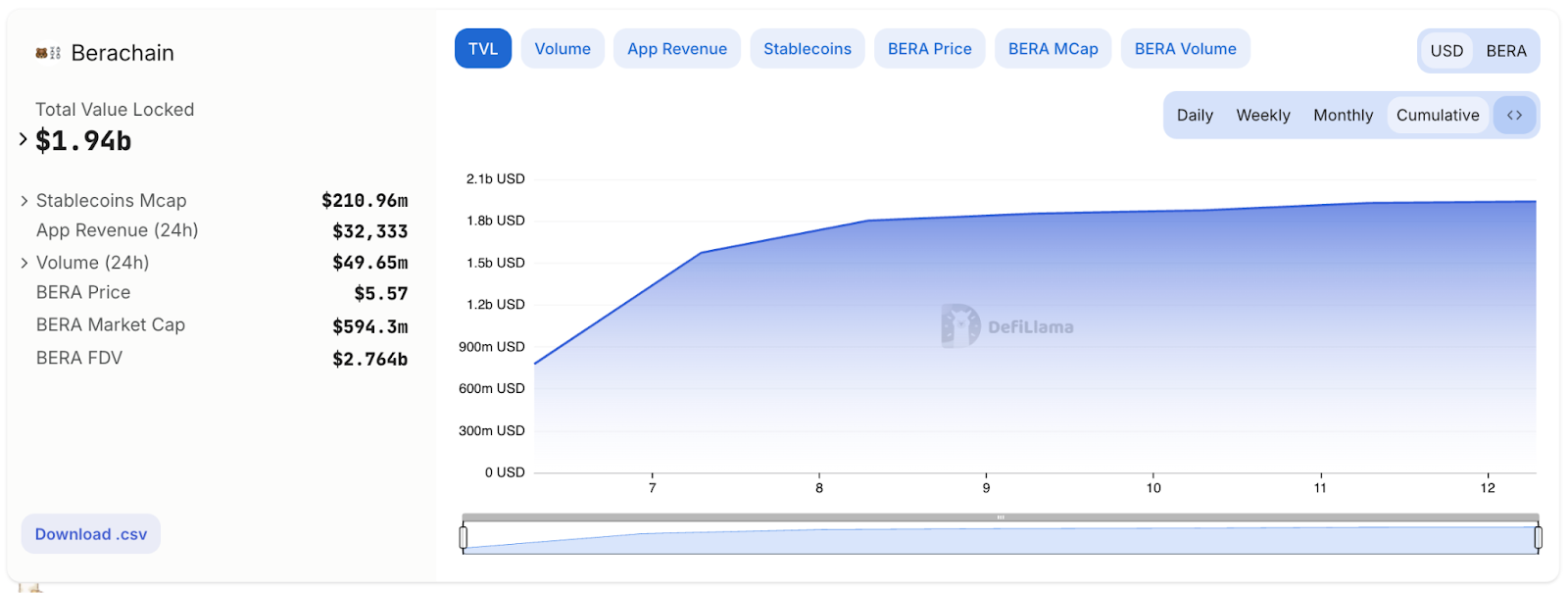
But beyond the inherent rewards mechanisms, the Berachain team has gone above and beyond in its quest to curate projects, relying on its BD and ecosystem team to develop arguably the most sophisticated ecosystem of any chain prior to launching. This is what Berachain is most known for, and this shows in the chain’s TVL. Berachain’s total TVL has continued to steadily tick up and to the right since launch, closing in on $2B. This makes it a top-ten chain by TVL, ahead of Sui, and behind Arbitrum and Base, a notable feat.

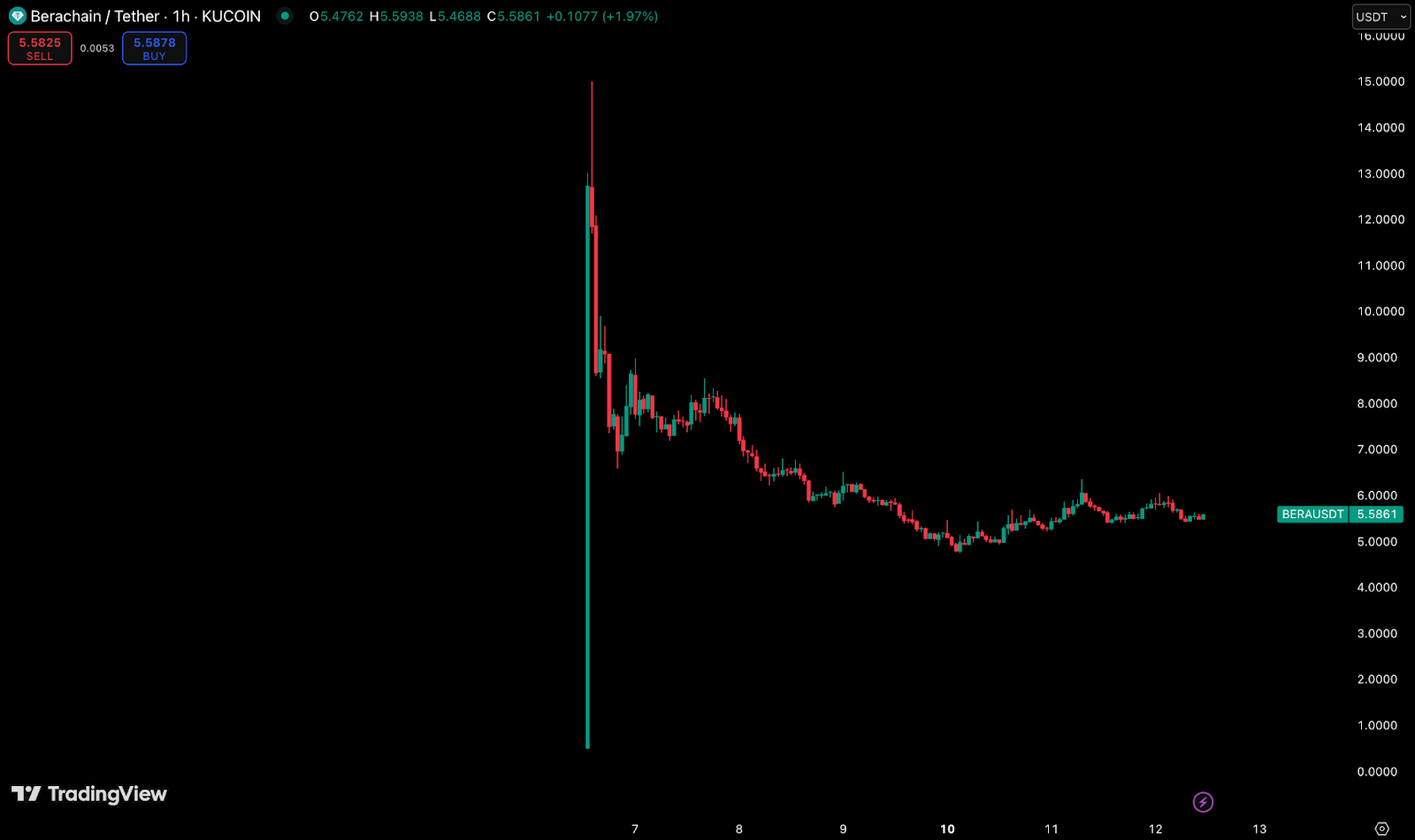
However, this increase in TVL has not exactly transferred to the $BERA token price. When analyzing $BERA’s price action since its TGE last week, the token is down roughly 60% from its highs reached immediately after launch.
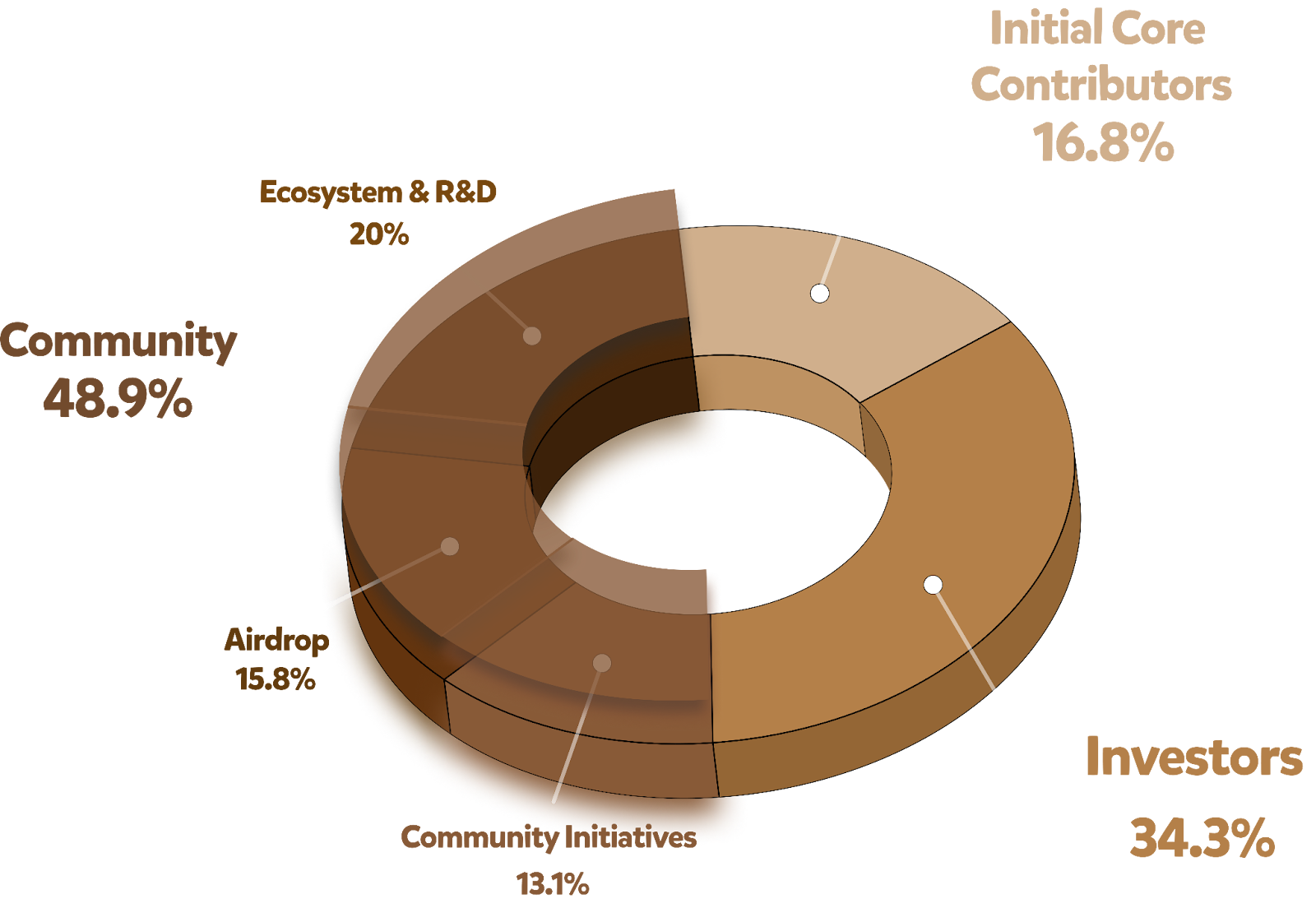
When it comes to tokenomics, roughly 20% of supply is circulating; ~100M out of 500M total tokens. Most of the token allocation will not begin vesting until around a year from now. In the meantime, the 10% annual token inflation will be the main driver of new tokens coming to market.
New Chain Launches in 2025
Crypto market participants have a habit of judging a project based on it’s token price, even if this isn’t always the best measure of success both on the way up or on the way down. On the surface, it doesn’t look like Berachain did anything particularly wrong in regards to their launch; they just launched at an inoptimal time.
Right now, the market is more bifurcated than ever, with a strong divide between $BTC and alts. In the 2021 cycle, alts could depend on downstream inflows from $ETH, primarily. Now, $ETH itself just isn’t going up, but there are also many new chains completely distinct from Ethereum, including Solana, Berachain, and others. Combine this with the fact that inflows into $BTC are now primarily happening via Michael Saylor’s Strategy, or ETFs, and you have a situation where there is much less of a wealth effect for new alts and chain launches.
Considering that people had been waiting for the chain to launch for a considerable amount of time, delaying just to wait for better market conditions probably wouldn’t have been a good idea either. Some chains, like MOVE, have opted to prioritize political alignment as a means of bypassing the existing headwinds for chains in this environment.
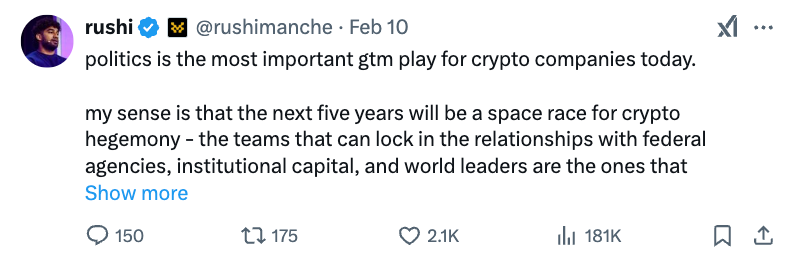
Projects based in the US that are aligned with the Trump administration or World Liberty Fi could indeed see a boost that others might not be able to. Right now, this is made apparent by the fact that $MOVE is trading at about 2x both the marketcap and FDV of $BERA, despite seemingly having less of an established community.
To put it bluntly, a lot of struggles that new chains might face might not be the fault of the team or their approach, but are simply due to the fact that there isn’t enough new money entering crypto excluding $BTC to go around. It remains to be seen when this might change, but in the meantime, teams can continue prioritizing ecosystem building in key areas such as AI and implementing what works on other chains.