O trading de memecoin continua sendo o pêndulo mais acentuado do cripto. Endereços ativos dispararam >2x e os volumes aumentaram em ~40% em Jan 2026, enquanto BAGS brevemente roubou os holofotes quando poucos memes subiram 1,000% em uma semana. Durante essa janela, o launchpad Bags capturou cerca de 42.6% do volume diário de launchpads de memecoin (~85 million), brevemente no mesmo nível que Pump.fun (43.7%)
This volume however was fleeting. By 19 Jan, most BAGS‑launched tokens, including leaders like RALPH and GAS, were down 33% and 90% from their highs. Onchain dashboards show BAGS’s 24‑hour volume at its peak on 16 Jan (~$26.4 million) pales next to Pump.fun’s $80.2 million, and BAGS accounts for only a fraction of daily revenue (~$103k vs. Pump.fun’s ~$749k). In other words, BAGS managed to momentarily rival Pump.fun but is now back to single‑digit market share.
In this edition, we’ll look into how BAGS’s launchpad model works, why the coins were shortlived, and what metrics signal whether meme liquidity is returning or merely rotating.

Introduction to BAGS
BAGS is built around dynamic bonding curves (via Meteora’s liquidity framework). Instead of using Pump.fun’s Pumpswap AMM model, BAGS lets anyone launch a token backed by an onchain liquidity pool. Fees shares are defined at launch:
- Every BAGS token generates a 1% fee on trading volume.
- Creators retain a minimum of 10% of fees by default.
- A designated recipient identified by a social account (Twitter, TikTok, Kick, or GitHub). The fee claimer can receive up to 90% of generated fees. They don’t need to be involved in the launch or even be aware of it.
The mechanic enables permissionless tokenization. Anyone can launch a token for someone else's project, route fees to their social account, and let them claim later. The goal is to entice retail to speculate on early-stage builders who'd never launch tokens themselves.
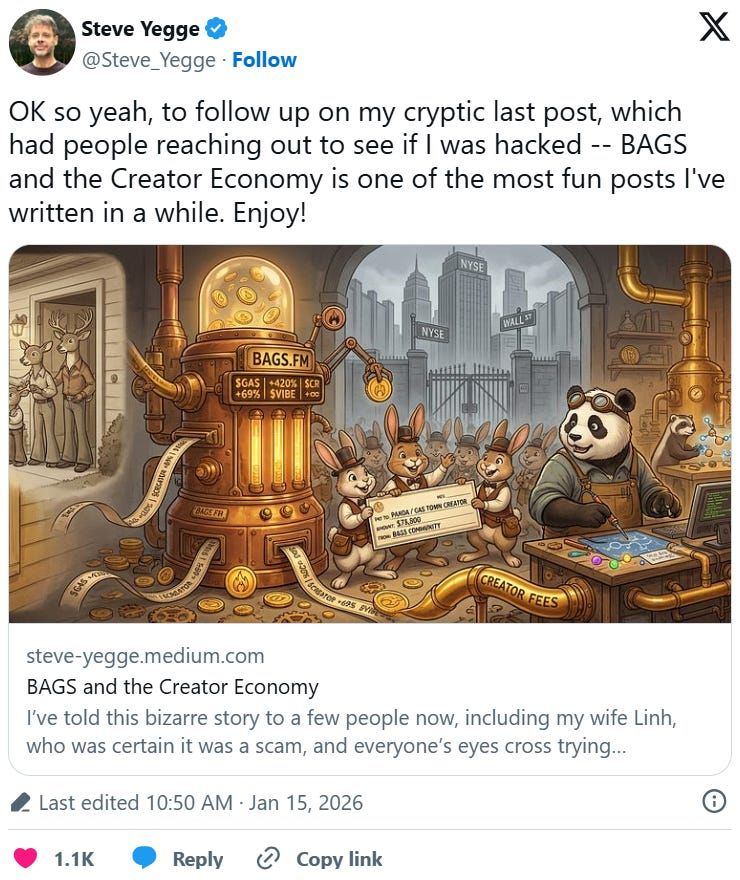
Gas Town’s success underscored the appeal for BAGS. Steve Yegge, a former senior engineer at Google and Amazon, released Gas Town on January 1, which is an open-source multi-agent workspace manager for orchestrating AI coding agents. An anonymous community member tokenized it on BAGS without Yegge’s involvement, routing trading fees to his verified account.
The token sat quietly for two weeks until Yegge discovered he’d accrued $49k in fees (later $75k+), wrote a Medium post about it, which was later picked up by Ansem.
Launchpad Wars
BAGS isn’t the first platform to challenge Pump.fun. The Solana launchpad wars have produced a consistent pattern where a new challenger captures narrative, volume surges, CT declares Pump.fun dead, activity proceeds to fall of a cliff within weeks. The mechanism that generated initial hype fails to produce sticky users.
This has played out 3 times in the past eight months.
- Believe (May 2025) - Ben Pasternak’s tweet-to-launch platform. At peak, Believe hit $14.7M in revenue and nearly matched Pump.fun in volume. By August, 0.4% market share.
- Letsbonk (July 2025) - The most credible challenge to date. BONK community, Raydium infrastructure, 60% revenue share, fee burns to holders. In late July they achieved 78% market share, 200-300 tokens graduating daily, Pump.fun down to single digits and CT declared Pump.fun done. By late August, 3% market share.
- Heavendex (Aug 2025) - Introduced the “God Flywheel” with 100% of protocol revenue committed to buying back and burning $LIGHT. By the first week, $1.4M was spent on buybacks, 2% of supply was burned, and they captured ~28% market. By September, less than 1% market share.
Pump.fun’s moat isn’t technical superiority but rather reflexive network effects. The platform where tokens are most likely to get traded is the platform where creators want to launch, which makes it the platform where tokens are most likely to get traded. This loop is difficult to break without sustained narrative momentum and a mechanism that produces genuinely stickier behavior.
The Current State of BAGS
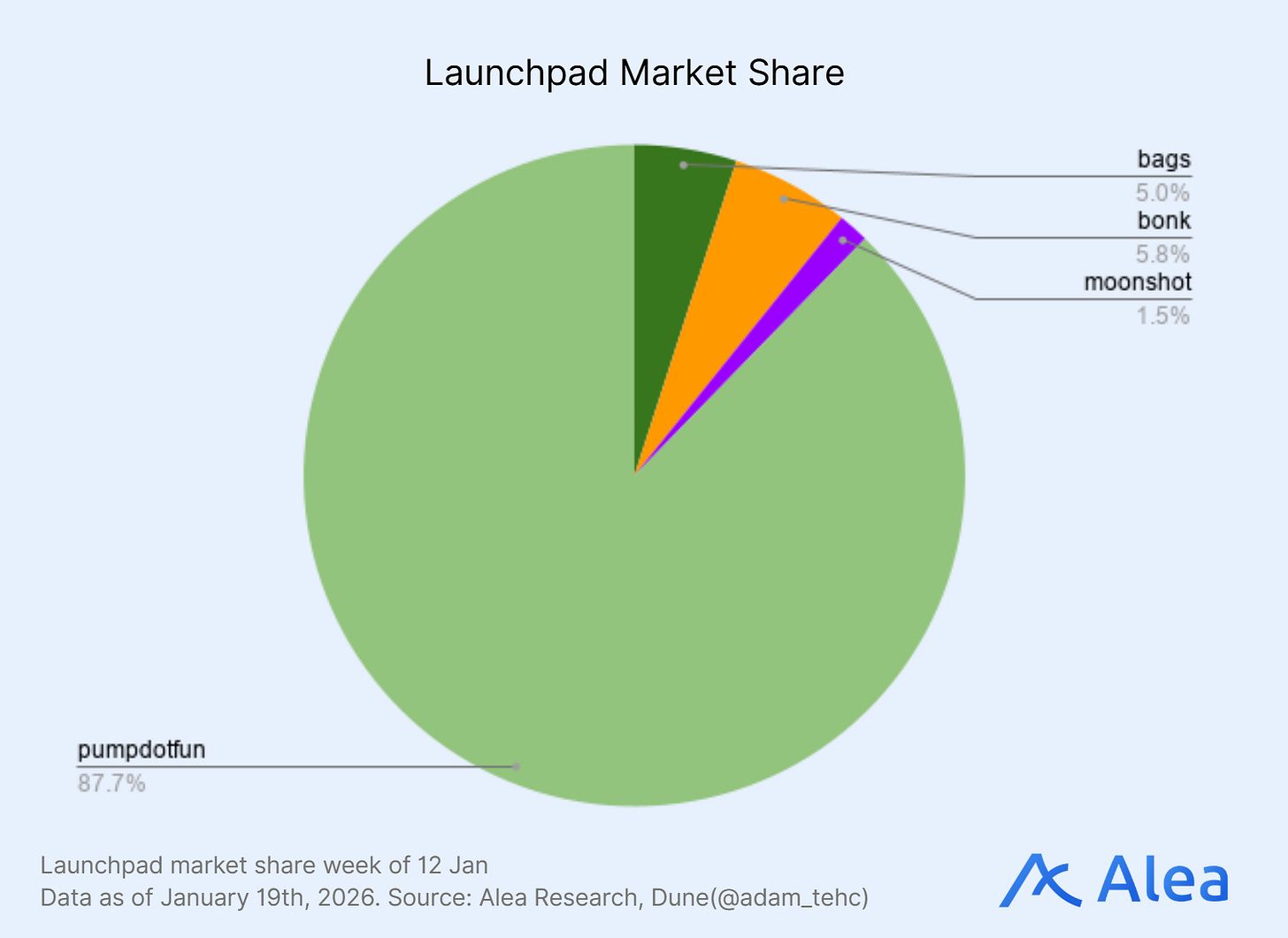
After Gas Town’s rug, BAGS’s share of launchpad volume collapsed to ~17%.
The market rotated back to the incumbent. Classic pattern.
Yegge even posted a new article titled “birthday blog” and stepped back from the $GAS community after claiming ~$300k in fees:
I must reiterate my sincere regrets to the CT/BAGS crowd, who so generously funded me to the tune of just shy of $300k last week on bags.fm. That money was hard to duck, and the funds are deeply appreciated. They will help Gas Town be a big success this year. But Gas Town itself needs my full attention... So I had to step back from the community.
Claim bag. Thank community. Disappear. The BAGS model working exactly as designed — and exactly why it doesn’t produce sustained migration. Compared to Geoffrey Huntley ($RALPH), who uses fees to buy back the token and actively engages holders.
Closing Thoughts: BAGS’s Drawdown and What to Monitor
BAGS represents another iteration of the creator-friendly launchpad or ICM thesis. The Gas Town episode surfaced a genuine use case as infrastructure for retail speculation on early-stage tech. Yegge built something real, the community tokenized it, fees funded his work, and for a brief window it looked like a flywheel.
The historical pattern however still looms: Believe, LetsBonk, HeavenDex, and now BAGS have all briefly challenged Pump.fun, and all faded to single-digit share within days or weeks. BAGS might be different. The perpetual royalty model does create different incentive alignment for long-term creators, and the “speculation on early-stage tech” framing gives it a narrative hook beyond pure memecoin degeneracy. If AI builder tokens keep emerging, and if BAGS can keep capturing them, there is a potential path to stickier users than its predecessors.
But “might be different” is also a bold statement. Pump.fun still holds ~70% share. LetsBonk holds ~15%. BAGS is in single digits. No challenger has maintained elevated share for more than 6-8 weeks. The Gas Town surge already faded.
(And regardless of which casino wins, 98.6% of tokens on these platforms are scams or pump and dumps. The infrastructure debate is about who handles the action, not whether the action is good)