LayerZero announced ATLAS on August 25, 2026, in a bid to become the exchange engine beneath many trading venues.
ATLAS, short for Aggregated Trading Liquidity and Settlement, is a headless exchange built on Zero. It has no consumer application. Trading venues keep their users and distribution through the interface.
Market creators define what trades.
Market makers supply liquidity.
ATLAS handles matching, clearing, settlement, and risk, while Zero records final ownership and verifies execution.
This shifts the adoption problem from traders to market operators. Exchanges, brokers, wallets, and market operators must trust LayerZero’s backend over infrastructure controlled by a direct competitor.
ATLAS can address a market far beyond crypto perps, and large institutional demand shuold translate into ZRO economics. Launch is scheduled for later in 2026.
Why now: tokenized assets have outgrown their market infrastructure
LayerZero’s original thesis was that assets and ledgers would become multi-chain. ATLAS extends that thesis from asset movement to price discovery and settlement.
The timing reflects a real infrastructure gap. Stablecoins, tokenized equities, prediction markets, perpetual contracts, and private-market claims now trade around the clock. However, the systems that match buyers and sellers often separate risk management from clearing and final settlement. Each handoff, as a result, adds reconciliation costs and a balance-sheet dependency.
Live crypto markets already separate distribution from exchange infrastructure. Orderly reported on July 24, 2026, that more than 400 branded perp DEXs use its shared orderbook. Hyperliquid published HIP-3, which lets builders deploy independent perp markets after staking 500,000 HYPE. Injective launched a module that manages the orderbook from execution through settlement.
Those systems prove that distribution and exchange infrastructure can be separated. ATLAS pushes the model across a broader trade lifecycle and into institution-configured markets.
The commercial premise is that a distributor will build on neutral infrastructure, keeping the customer and enough of the economics. That bargain will determine adoption; throughput sets only the technical threshold.
Mechanism: the venue becomes the exchange’s native route
The trading venue owns the user experience and order flow:
A market creator chooses the asset and oracle, then sets the market rules.
Liquidity providers quote markets and bear inventory risk.
ATLAS supplies the shared exchange engine.
Zero separates execution by block producers from proof verification by settlement-layer validators.
This architecture produces two configurations:
Open ATLAS serves permissionless products, including crypto-native applications and prediction markets.
Institutional ATLAS uses the same engine while allowing an institution to enforce access and define product and market rules.
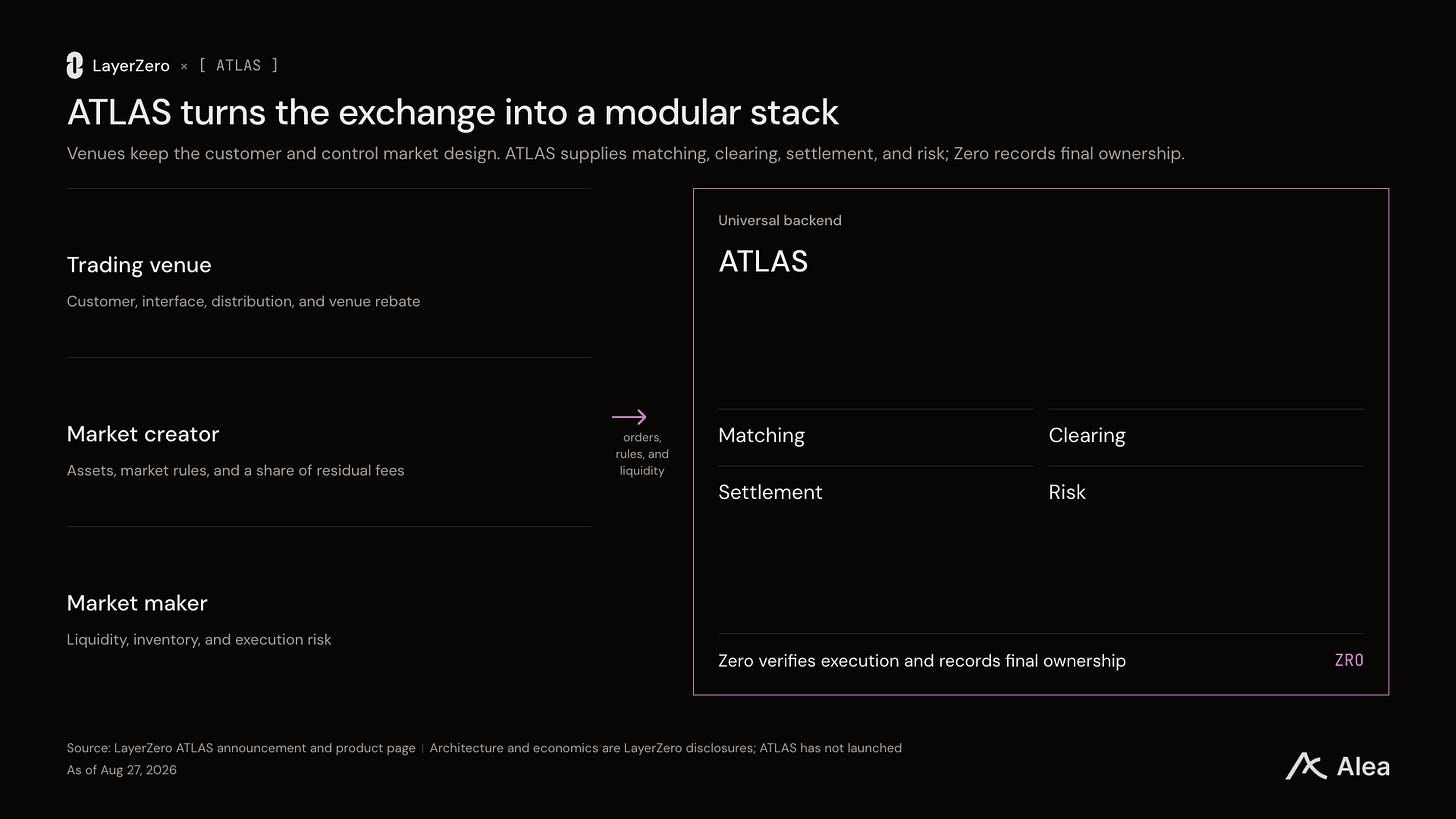
The headless choice removes a conflict that weakens many exchange-builder programs. A frontend built on an exchange often adds a fee above the exchange’s own fee, then competes with the exchange’s native application for the same sophisticated user. ATLAS has no native application. The venue is the native route.
LayerZero reported 965 microseconds of median perps latency. Its announcement reports 1.418 milliseconds at p95 and 2.641 milliseconds at p99 in an environment designed to mirror public deployment. ATLAS will be provisioned for 200,000 transactions per second at launch.
Every trade is verified onchain through a zero-knowledge proof. More details can be found on the Zero paper released on February 10, 2026., which said Jolt Pro implemented succinct proofs and placed zero-knowledge proofs on the immediate roadmap.
Operating economics: 75% becomes 26.25% to 60% of gross fees
ATLAS charges one all-in trading fee. Open ATLAS venues receive a 20% to 65% rebate based on a combination of ZRO stake and aggregate volume. The highest tier can require up to 1% of ZRO supply. The remaining fee is split 25% to the market creator and 75% to buying and burning ZRO.
With 100 gross fee units and a 20% venue rebate, the venue gets 20. The creator gets 20, leaving 60 for ZRO buy-and-burn.
At a 65% rebate, the venue gets 65. The creator gets 8.75, leaving 26.25 for ZRO.
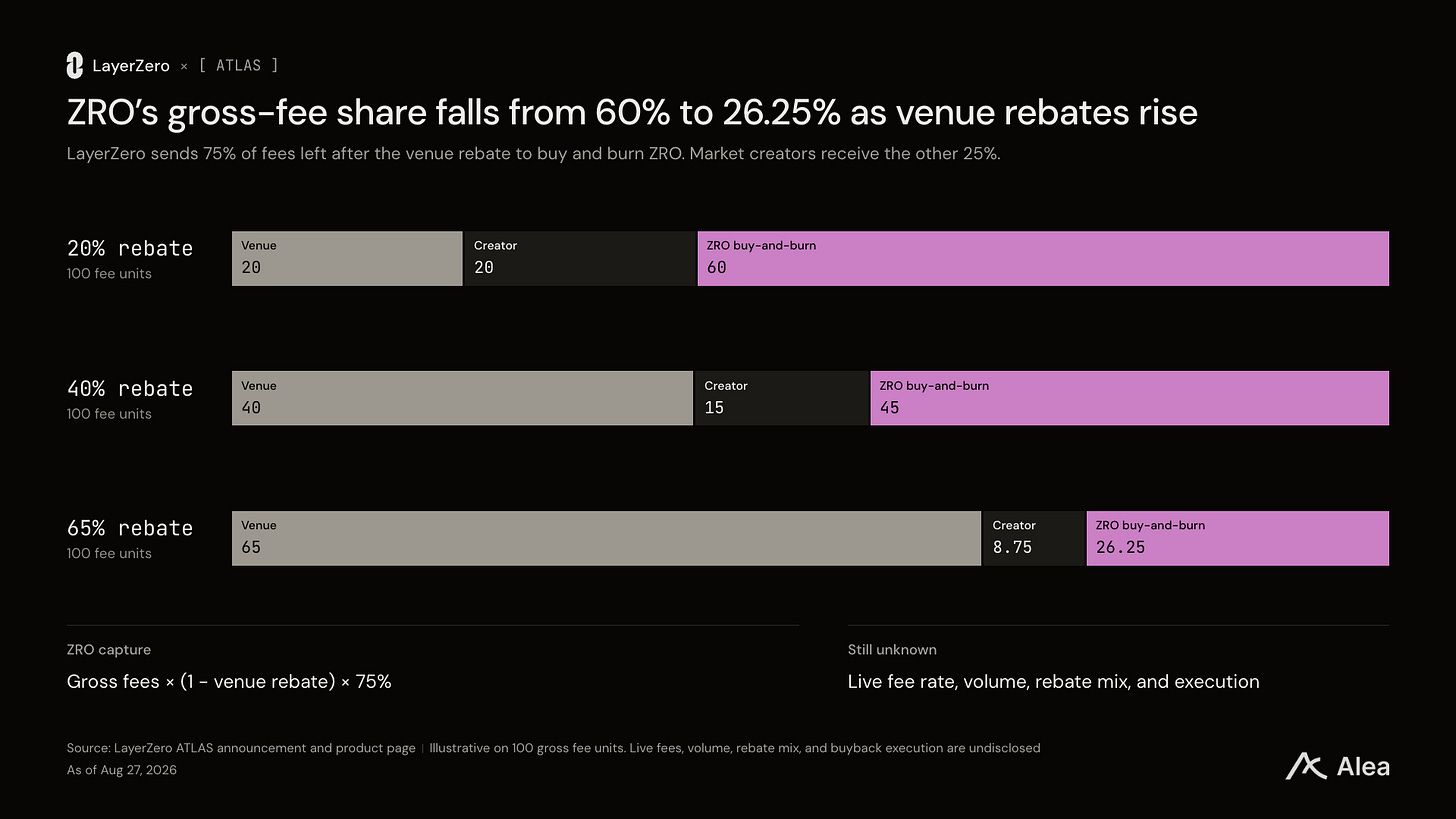
The 75% allocation applies only after the venue rebate. ZRO therefore captures 26.25% to 60% of gross fee units across the disclosed rebate range. Actual capture then depends on four undisclosed variables: the live fee rate, trading volume, the distribution of venues across rebate tiers, and execution of the buy-and-burn.
The model aligns revenue with each role. Venues monetize distribution, creators monetize market expertise, and buy-and-burn ties ZRO demand to shared infrastructure. Larger venue rebates can improve distribution and liquidity while reducing the share of each gross fee available to ZRO.
ATLAS gives ZRO direct roles. The token secures Zero through delegated proof of stake, pays gas, governs upgrades and zones, qualifies venues for rebates, and receives buy-and-burn demand from residual trading fees. That creates a clear value-capture path, conditional on activity and execution.
In the constructive case, ZRO stake earns venues better economics. Better economics attract distribution, then market makers and creators. More volume increases buy-and-burn demand and the value of access to higher tiers.
The adverse path runs through the same mechanism. Large venues demand the highest rebates. Liquidity concentrates and smaller venues cannot match the dominant book; residual token capture falls. The system gains activity while ZRO captures less than the headline implies.
What consensus is missing: LayerZero’s edge is neutrality
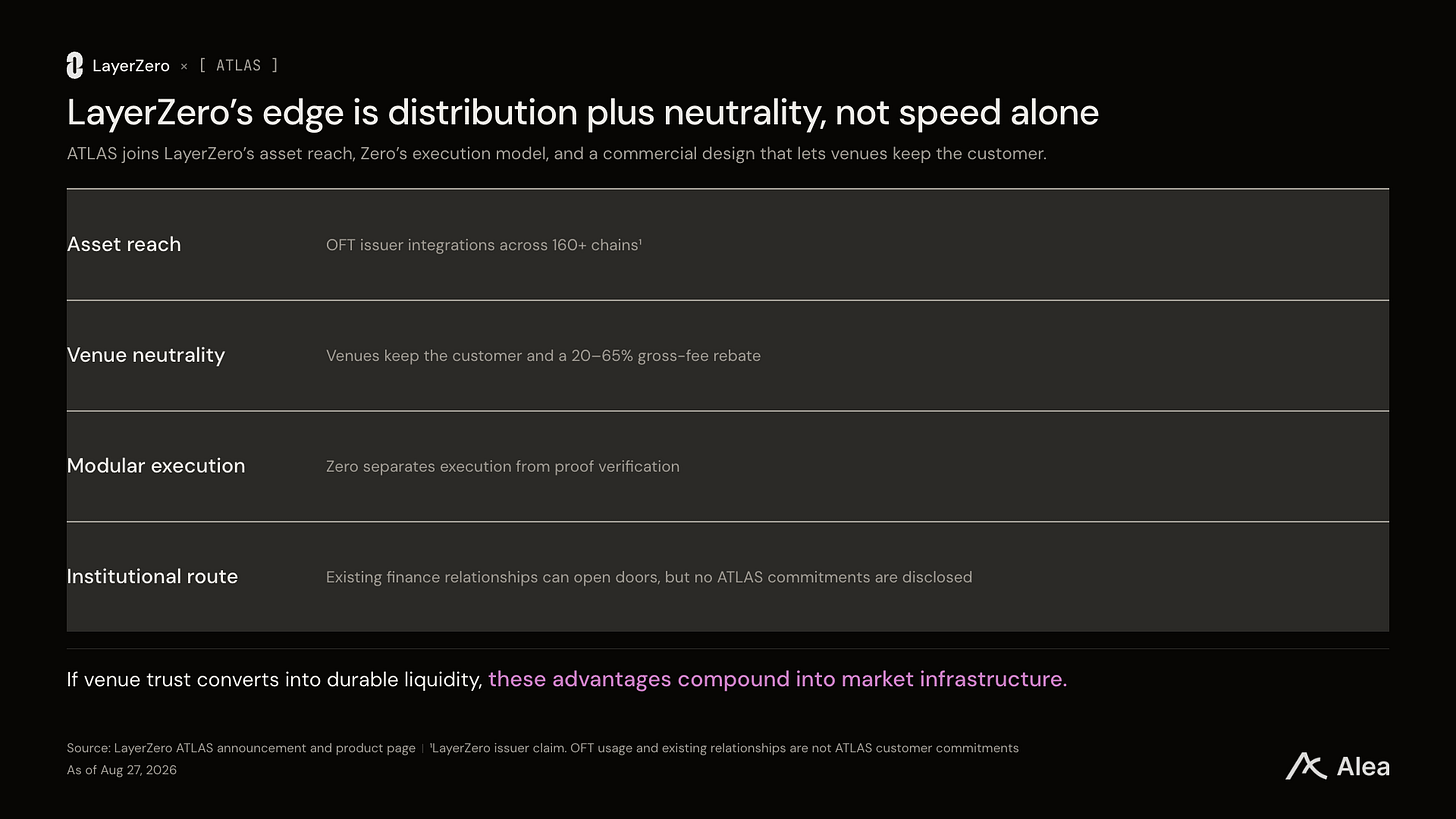
Performance sets the entry threshold. LayerZero’s strategic advantage comes from neutrality plus distribution.
LayerZero already lives beneath applications rather than in front of their users. It has integrated assets across chains, built relationships with issuers and financial institutions, and designed its commercial identity around infrastructure.
A headless exchange extends that posture. GTE, Bullish, defined.fi, and TrueNorth give Open ATLAS an initial venue slate. LayerZero says institutional partners will follow.
The company gives venues 20% to 65% of per-trade economics. That choice recognizes a lesson exchanges often resist: the party that earns customer trust and owns the relationship needs a durable business model.
What matters next
ATLAS is due later in 2026. LayerZero has not disclosed an exact launch date.
Collapsing the trade lifecycle removes handoffs. It also concentrates responsibility. A failure in matching, risk, proof generation, data availability, governance, or settlement can affect every venue using the shared backend.
A separate risk layer comes from market creators. New assets need reliable oracles and margin rules, plus a clear path from liquidation to final settlement. Open access also increases product breadth and raises the cost of weak controls.
Institutional ATLAS faces a separate constraint. Institutions need configurable rules, but counterparties and regulators need clarity about who operates the market, who bears losses, where assets sit, and which authority can reverse or upgrade the system. Technical verifiability does not answer those legal questions.
Overall, ATLAS tests whether trust in LayerZero’s messaging layer transfers to exchange operations. Success would move LayerZero from carrying messages and assets between markets to operating the machinery inside them.
Important Links
LayerZero announced ATLAS.
LayerZero published the ATLAS product page.
LayerZero published the Zero technical positioning paper.

Read our latest Weekly Pulse, Alea’s flagship report covering macro, crypto, equities, and commodities. The August 29 edition examines whether fresh buyers can sustain the rally after the short squeeze.
Alea combines independent research with live protocol data to help you evaluate opportunities and understand their risks before committing capital.
Crypto teams can benchmark performance and give investors and partners a clearer view of their protocol’s economics.
Institutions can conduct due diligence with structured research and Protocol Data Rooms.
Traders can follow flows and catalysts across markets.
Investors can test an investment thesis against fundamentals and valuation.